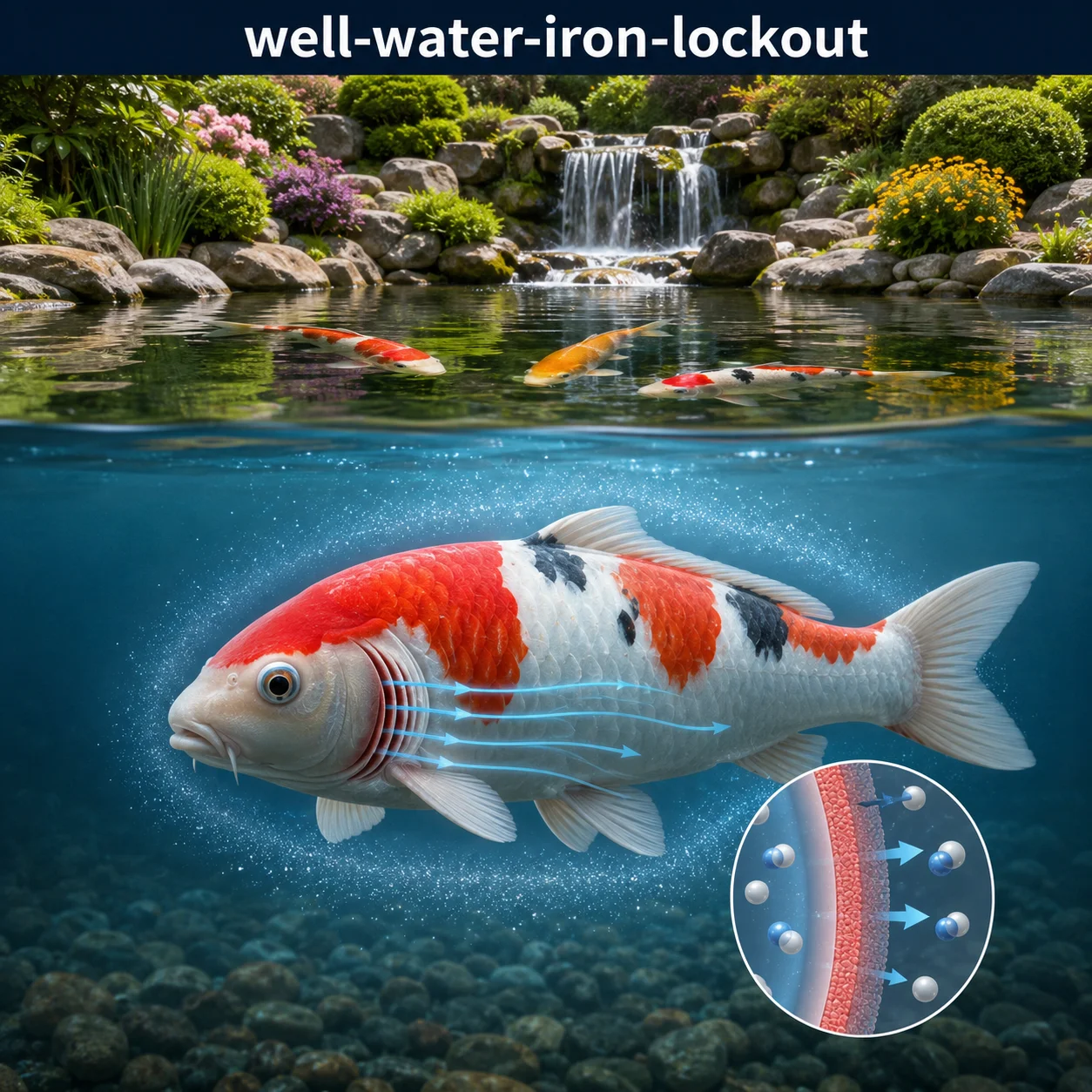
Well-Water Iron Lockout
Iron lockout describes the intentional precipitation of dissolved ferrous iron (Fe²⁺) from well water before it enters a pond or filtration system. When oxygenated or exposed to oxidizing agents, soluble ferrous iron converts to insoluble ferric iron (Fe³⁺), which forms orange-brown particulates that can be filtered out mechanically. If left unchecked, that same oxidation happens inside the pond or filter media, staining surfaces, clogging biological media, and fueling iron-loving bacteria that degrade water quality.
This page covers the practical chemistry and engineering behind iron lockout: how to measure iron concentration, select an oxidizing agent or aeration strategy, design a detention or settling basin, size a chemical feed pump, and troubleshoot common failure modes. None of this is a universal prescription — well-water chemistry varies by region, iron concentration, pH, and competing ions — so every system requires a site-specific water test and a tailored treatment approach.
Test Your Iron Lockout Knowledge
Work through ten scenario-based questions covering iron chemistry, oxidation methods, detention time, pH effects, and troubleshooting. Each answer includes the reasoning behind it.
Well-Water Iron Lockout — Quick Facts
Most Asked Questions About Well-Water Iron Lockout
On a well-fed koi pond in central Texas, the owner reported persistent rusty staining on the waterfall rocks and a gradual decline in filter flow. A water test showed 2.8 mg/L dissolved iron at the well head, with pH at 6.4. The existing system had a sediment filter and a UV clarifier but no iron-specific treatment. Adding a 200-gallon detention tank with aeration stones, followed by a 30-micron bag filter, reduced dissolved iron to 0.2 mg/L and eliminated the staining entirely — but only after extending the detention time from 15 minutes to 40 minutes and raising pH to 7.2 with a small soda ash feed.
The lesson was that iron lockout is not just about adding oxygen or oxidant; it’s about matching contact time and chemistry to the specific well water. The same system would have failed on a different well with 5+ mg/L iron or a lower pH, underscoring the need for site-specific design rather than a one-size-fits-all approach.
Iron Chemistry: Ferrous To Ferric Oxidation
The core reaction in iron lockout is the oxidation of ferrous iron (Fe²⁺) to ferric iron (Fe³⁺), followed by the precipitation of ferric hydroxide [Fe(OH)₃]. In the presence of dissolved oxygen, the reaction proceeds as: 4Fe²⁺ + O₂ + 10H₂O → 4Fe(OH)₃ + 8H⁺. This is a simplified representation, but it captures the essential stoichiometry: each milligram of ferrous iron consumes about 0.14 mg of dissolved oxygen and produces acid, which can lower pH in poorly buffered water.
- Ferrous iron (Fe²⁺): soluble, colorless, and stable in anoxic conditions such as deep well water. It does not stain or cloud until it oxidizes.
- Ferric iron (Fe³⁺): insoluble at typical pond pH, precipitates as rust-colored ferric hydroxide particles that are filterable.
- Oxidation kinetics: the rate depends on pH, temperature, and the presence of catalysts or oxidants; it can be accelerated by aeration, chemical oxidants, or biological activity.
For pond intake systems, the goal is to complete this oxidation and precipitation before the water reaches the pond or the biological filter. If oxidation happens inside the filter, iron hydroxide coats the media, reducing biological activity and increasing head loss. If it happens in the pond, it stains surfaces and can harm fish gills if concentrations are high enough. Lockout is a preventive measure, not a corrective one.
Behind The Chemistry: PH, Alkalinity, And Buffering
The oxidation of ferrous iron produces protons (H⁺), which can lower the pH of water that has low alkalinity. Lower pH, in turn, slows the oxidation reaction, creating a feedback loop that can stall iron precipitation in acidic well water. This is why many iron lockout systems include a pH adjustment step — typically adding soda ash (sodium carbonate) or caustic soda to maintain pH above 7.0 and to provide alkalinity to buffer the acid generated. Without this buffering, a system that works well for the first few hundred gallons may gradually acidify the water and lose effectiveness as pH drops.
A well producing 5 GPM with 4 mg/L iron was treated with a simple aeration tank and no pH adjustment. After two weeks, the pH had dropped from 6.8 to 6.0, and iron oxidation effectively stopped — the water leaving the tank still tested at 3.8 mg/L dissolved iron. Adding a metering pump for soda ash and adjusting the detention time from 20 to 40 minutes restored performance, but the initial oversight cost the owner a month of stained pond surfaces and a filter media replacement.
Oxidant Selection And Dosing Strategies
Choosing an oxidant involves balancing effectiveness, cost, handling safety, and downstream impact. Aeration is the simplest and most chemical-free option, but it is slow and requires sufficient detention time and turbulence to dissolve enough oxygen. Chlorine is effective and affordable but requires a dechlorination step before the water reaches the pond. Potassium permanganate is a strong oxidant that also oxidizes manganese and organic compounds, but it imparts a pink tint if overdosed and requires careful metering. Ozone and peroxide are powerful and fast but require more capital and maintenance.
Dosing is typically based on the stoichiometric oxidant demand plus a safety margin. A jar test — dosing a sample of well water with various oxidant levels and observing the time to clear precipitation — is the most reliable way to determine the actual dose for a specific well. The dose should be high enough to achieve complete oxidation within the available detention time, but low enough to avoid wasting oxidant or creating harmful residuals.
A pond builder installed a potassium permanganate feed system based on a standard dose table without running a jar test. The well water had high organic content that consumed permanganate unpredictably, leaving both iron and manganese incompletely oxidized. After switching to chlorine with a dechlorination step and extending detention time by 15 minutes, the water cleared reliably — but the change came after three months of frustrating trial-and-error adjustments.
Monitoring the lockout system is essential to maintaining performance over time. A simple field test for dissolved iron at the well head and again at the basin outlet provides direct feedback on oxidation completeness. An ORP meter can indicate whether the water is sufficiently oxidizing to drive the reaction forward. Visual inspection of the basin — checking for clear water above the sludge layer and measuring sludge accumulation — helps schedule cleaning and avoid carryover of precipitated iron into the pond.
When troubleshooting a failing lockout system, the first step is to test dissolved iron at every stage: well head, basin inlet, basin outlet, and pond intake. This identifies whether the failure is in oxidation (iron remains soluble) or in removal (iron is oxidized but not settled or filtered). Oxidation failures point to insufficient oxidant dose, too short detention time, or low pH. Removal failures point to inadequate settling, excessive flow velocity, or clogged filtration. Addressing the wrong cause — for example, adding more oxidant when the real issue is poor settling — wastes time and money without solving the problem.
Well-Water Iron Lockout — Full Question Library
Review indexed engineering questions below.
Q1:
What is the oxidation state of dissolved iron in anoxic well water before lockout treatment?
Correct Answer: Option B
In anoxic well water, iron is typically present as soluble ferrous iron (Fe²⁺), which is colorless and stable until exposed to oxygen or another oxidant.
Q2:
What is the chemical formula for the iron precipitate formed during lockout oxidation?
Correct Answer: Option A
Ferric iron precipitates as ferric hydroxide [Fe(OH)₃], which appears as an orange-brown floc that can be settled or filtered.
Q3:
Which of the following is a characteristic of ferric iron in water?
Correct Answer: Option B
Ferric iron is insoluble in typical pond water pH and appears as the characteristic rust-colored precipitate associated with iron staining.
Q4:
What is the primary driver for converting ferrous iron to ferric iron in a lockout system?
Correct Answer: Option A
Oxidation is the chemical process that changes the oxidation state of iron from Fe²⁺ to Fe³⁺, which then precipitates as ferric hydroxide.
Q5:
Which acid is produced as a byproduct of ferrous iron oxidation by dissolved oxygen?
Correct Answer: Option C
The oxidation reaction 4Fe²⁺ + O₂ + 10H₂O → 4Fe(OH)₃ + 8H⁺ produces hydrogen ions, which can lower pH in poorly buffered water.
Q6:
What is the typical color of water with high ferrous iron content?
Correct Answer: Option A
Ferrous iron is soluble and colorless — the rusty color appears only after oxidation to ferric iron and precipitation.
Q7:
At what pH range does ferric iron precipitation become most effective?
Correct Answer: Option B
Ferric hydroxide precipitates most effectively in the pH range of 6.5 to 8.5, typical of most pond water. Below pH 6.0, ferric iron remains more soluble.
Q8:
What is the oxidation state of iron in rust (iron oxide)?
Correct Answer: Option B
Rust is primarily ferric oxide (Fe₂O₃) or ferric hydroxide, containing iron in the +3 oxidation state.
Q9:
Which of the following is a reducing agent that would keep iron in the ferrous state?
Correct Answer: Option A
Low dissolved oxygen maintains the reducing conditions that keep iron in the soluble ferrous state. Oxidants like chlorine, ozone, and permanganate oxidize iron to ferric.
Q10:
What is the solubility product (Ksp) of ferric hydroxide approximately?
Correct Answer: Option B
The very low solubility product of ferric hydroxide (approximately 1 × 10⁻³⁹) means that at typical pond pH, iron concentrations above about 0.1 mg/L will precipitate.
Q11:
Which iron species is responsible for staining concrete and pond surfaces?
Correct Answer: Option B
The orange-brown staining is caused by ferric hydroxide [Fe(OH)₃] and ferric oxide (rust) depositing on surfaces.
Q12:
What is the stoichiometric oxygen demand to oxidize 1 mg/L of ferrous iron?
Correct Answer: Option A
From the stoichiometry 4Fe²⁺ + O₂ → 4Fe³⁺, approximately 0.14 mg of oxygen is required per mg of ferrous iron oxidized.
Q13:
Which of the following is a common interfering ion that can affect iron lockout chemistry?
Correct Answer: Option C
Manganese behaves similarly to iron in oxidation and precipitation and often co-occurs in well water, requiring simultaneous treatment.
Q14:
What happens to alkalinity during the precipitation of ferric hydroxide?
Correct Answer: Option A
The precipitation reaction consumes alkalinity (bicarbonate) to neutralize the acid produced, which can lower pH and reduce buffering capacity.
Q15:
Which of the following is a characteristic of colloidal ferric hydroxide particles?
Correct Answer: Option B
Freshly precipitated ferric hydroxide particles are often colloidal and may require coagulation or flocculation to aggregate into settleable flocs.
Q16:
What is the relationship between temperature and iron oxidation rate?
Correct Answer: Option A
Chemical reaction rates generally increase with temperature; iron oxidation is faster in warmer water, which can reduce required detention time.
Q17:
What is the primary source of dissolved oxygen for iron oxidation in a simple aeration system?
Correct Answer: Option B
In aeration-based lockout, oxygen is transferred from air into the water through bubble diffusion, splashing, or surface mixing.
Q18:
What is the practical detection limit for soluble iron in a well-water test?
Correct Answer: Option A
Laboratory analytical methods can detect iron down to 0.01 mg/L or lower. Field test kits typically have a practical detection limit of about 0.05–0.1 mg/L.
Q19:
Which of the following is a strong oxidant commonly used for iron lockout?
Correct Answer: Option B
Potassium permanganate is a powerful oxidant used for iron and manganese removal, oxidizing Fe²⁺ to Fe³⁺ rapidly.
Q20:
What is the effect of high dissolved organic matter on iron lockout?
Correct Answer: Option A
Organic matter can form complexes with ferrous iron, making it more resistant to oxidation and interfering with effective lockout.
Q21:
What is the approximate half-life of ferrous iron oxidation by dissolved oxygen at pH 7.0 and 25°C?
Correct Answer: Option B
At pH 7.0 and 25°C, the half-life of ferrous iron oxidation by dissolved oxygen is approximately 15–30 minutes, depending on oxygen concentration and mixing.
Q22:
How does a decrease in pH from 7.5 to 6.0 affect the oxidation rate of ferrous iron?
Correct Answer: Option A
The oxidation rate of ferrous iron by dissolved oxygen is highly pH-dependent, dropping by orders of magnitude at pH values below 6.5.
Q23:
Which of the following oxidants provides the fastest oxidation of ferrous iron in well water?
Correct Answer: Option D
Ozone is one of the fastest oxidants for ferrous iron, oxidizing Fe²⁺ to Fe³⁺ within seconds. However, it is more expensive and requires more equipment than other options.
Q24:
What is the role of pH in the oxidation of ferrous iron by dissolved oxygen?
Correct Answer: Option A
Hydroxide ions (OH⁻) are involved in the oxidation mechanism; higher pH increases the concentration of OH⁻, which accelerates the reaction.
Q25:
At pH 8.0, approximately how much faster is ferrous iron oxidation compared to pH 6.5?
Correct Answer: Option C
Q26:
What is the effect of temperature on the rate of iron oxidation?
Correct Answer: Option B
The oxidation rate increases with temperature following the Arrhenius relationship, approximately doubling for every 10°C increase in the range of typical pond temperatures.
Q27:
What is the approximate order of the ferrous iron oxidation reaction with respect to hydroxide ion concentration?
Correct Answer: Option B
The oxidation of ferrous iron by dissolved oxygen is first order with respect to hydroxide ion concentration in the pH range of 6–8.
Q28:
Which of the following increases the oxygen transfer rate in an aeration basin?
Correct Answer: Option A
Fine bubble diffusers create small bubbles with high surface-area-to-volume ratio, improving oxygen transfer efficiency and oxidation rate.
Q29:
What is the primary mechanism of oxidation when chlorine is used for iron lockout?
Correct Answer: Option B
Chlorine oxidizes ferrous iron by accepting electrons from Fe²⁺, converting it to Fe³⁺ while being reduced to chloride.
Q30:
What is the stoichiometric chlorine demand to oxidize 1 mg/L of ferrous iron?
Correct Answer: Option B
From the reaction 2Fe²⁺ + Cl₂ → 2Fe³⁺ + 2Cl⁻, approximately 0.64 mg of chlorine is required per mg of ferrous iron oxidized.
Q31:
Which factor most significantly affects the oxidation rate in a well-water iron lockout system?
Correct Answer: Option A
pH has the most dramatic effect on ferrous iron oxidation rate, with changes of 1 pH unit changing the rate by approximately two orders of magnitude.
Q32:
What is the effect of alkalinity on the oxidation rate of ferrous iron?
Correct Answer: Option B
Alkalinity buffers the pH drop caused by acid generation during oxidation, helping maintain the high pH that is favorable for rapid oxidation.
Q33:
Which of the following oxidants is most effective at low pH (pH < 6.0)?
Correct Answer: Option C
Ozone is effective across a wide pH range and can oxidize ferrous iron even at low pH where dissolved oxygen oxidation is very slow.
Q34:
What is the role of mixing intensity in iron lockout basin design?
Correct Answer: Option B
Proper mixing ensures uniform distribution of the oxidant and maintains contact between iron molecules and the oxidant, which is essential for complete oxidation within the detention time.
Q35:
What is the approximate energy requirement for aeration-based iron oxidation in a detention basin?
Correct Answer: Option A
Aeration systems typically require approximately 0.5–2.0 kW per 1000 gallons of basin volume, depending on diffuser type and oxygen demand.
Q36:
What is the effect of bicarbonate concentration on iron oxidation?
Correct Answer: Option B
Bicarbonate provides alkalinity that neutralizes the acid produced during oxidation, helping maintain optimal pH for the reaction.
Q37:
Which of the following is a disadvantage of using chlorine for iron lockout?
Correct Answer: Option A
Chlorine residual is toxic to pond life and must be removed by dechlorination (e.g., with sodium thiosulfate or activated carbon) before water reaches the pond.
Q38:
What is the effect of high sulfide content on iron lockout with chlorine?
Correct Answer: Option A
Hydrogen sulfide reacts with chlorine, creating additional oxidant demand and potentially interfering with the iron lockout process if not accounted for.
Q39:
What is the ideal dissolved oxygen level for rapid iron oxidation in an aeration basin?
Correct Answer: Option A
Maintaining a dissolved oxygen concentration of 2–4 mg/L in the basin provides sufficient oxygen for iron oxidation while keeping aeration energy costs reasonable.
Q40:
What is the primary advantage of using potassium permanganate over aeration for iron lockout?
Correct Answer: Option B
Potassium permanganate oxidizes ferrous iron rapidly and is effective even at pH values where oxygen-driven oxidation is unacceptably slow.
Q41:
What is the minimum recommended detention time for aeration-based iron lockout at pH > 7.0?
Correct Answer: Option A
At pH above 7.0, a minimum detention time of 20–30 minutes is typically sufficient for aeration-based oxidation, though longer times may be needed for higher iron concentrations or colder water.
Q42:
How should detention time be adjusted for well water with pH 6.2?
Correct Answer: Option B
At pH below 6.5, oxidation rates are much slower. Detention time may need to be increased by a factor of 10–100, or pH adjustment and/or chemical oxidants should be considered.
Q43:
What is the formula for calculating detention basin volume?
Correct Answer: Option A
Basin volume is calculated by multiplying the flow rate (e.g., gallons per minute) by the desired detention time (e.g., minutes) to get total volume (e.g., gallons).
Q44:
For a 10 GPM well with a target detention time of 30 minutes, what basin volume is required?
Correct Answer: Option A
Using Volume = Flow Rate × Detention Time: 10 GPM × 30 minutes = 300 gallons.
Q45:
What is the effect of short-circuiting on detention time in a basin?
Correct Answer: Option B
Short-circuiting occurs when water flows directly from inlet to outlet, bypassing the full volume of the basin and reducing the time available for oxidation and settling.
Q46:
Which basin design feature helps prevent short-circuiting?
Correct Answer: Option B
Baffles create a longer, more convoluted flow path that reduces short-circuiting and ensures more uniform detention time distribution.
Q47:
What is the typical horizontal velocity limit in a settling basin to avoid resuspension of precipitated iron?
Correct Answer: Option A
To prevent resuspension of ferric hydroxide flocs, horizontal flow velocities should be kept below about 0.3–1.0 ft/min, depending on floc characteristics.
Q48:
How does basin depth affect settling efficiency for iron flocs?
Correct Answer: Option A
Deeper basins provide more vertical distance for particles to settle and reduce horizontal flow velocity, improving settling efficiency.
Q49:
What is the approximate settling velocity of a 50-micron ferric hydroxide particle?
Correct Answer: Option B
Ferric hydroxide flocs have a relatively low density and settle at approximately 0.3–1.0 ft/min, which is why low horizontal flow velocities are essential for effective settling.
Q50:
What is the effect of coagulant addition on the required detention time?
Correct Answer: Option B
Coagulants (e.g., alum, ferric chloride) can aggregate colloidal ferric hydroxide particles into larger, denser flocs that settle faster, potentially reducing required detention time.
Q51:
What is the recommended sludge storage capacity for an iron lockout basin treating 5 mg/L iron?
Correct Answer: Option A
Sludge accumulation rates depend on iron concentration, but typical rates are 1–3% of basin volume per month for 5 mg/L iron, requiring periodic cleaning.
Q52:
What is the effect of temperature on required detention time?
Correct Answer: Option B
Higher temperatures increase oxidation rates and decrease water viscosity, both of which reduce the detention time needed for complete iron lockout.
Q53:
Which of the following is a sign that detention time is insufficient?
Correct Answer: Option A
Orange-brown staining in the pond or on filter media is a strong indicator that soluble iron is passing through the lockout system without being fully oxidized and removed.
Q54:
What is the purpose of a sludge removal system in an iron lockout basin?
Correct Answer: Option B
Accumulated ferric hydroxide sludge must be periodically removed to prevent it from reducing basin volume and potentially being resuspended into the water.
Q55:
What is the effect of increasing flow rate on required detention time?
Correct Answer: Option B
Detention time is based on chemical kinetics and does not change with flow rate. To maintain the same detention time at higher flow, the basin volume must be increased proportionally.
Q56:
What is the recommended aspect ratio (length:width) for a rectangular settling basin to minimize short-circuiting?
Correct Answer: Option A
A length-to-width ratio of 3:1 to 10:1 provides a long, narrow flow path that reduces short-circuiting and improves settling efficiency.
Q57:
What is the typical sludge volume produced from treating 1 mg/L of iron?
Correct Answer: Option A
Ferric hydroxide sludge volume is relatively small, approximately 1–2 mL per 1000 gallons per mg/L of iron removed, but this can vary with floc density and water chemistry.
Q58:
What is the effect of using a tube or lamella settler in an iron lockout system?
Correct Answer: Option B
Tube or lamella settlers provide a large effective settling area in a compact footprint, improving solids removal and reducing basin size requirements.
Q59:
What is the minimum freeboard recommended for an open iron lockout basin?
Correct Answer: Option A
A freeboard of 6–12 inches above the maximum water level provides a safety margin against overflow and helps contain splashing or wave action.
Q60:
How often should sludge be removed from an iron lockout basin treating moderate iron levels (2–5 mg/L)?
Correct Answer: Option B
For moderate iron concentrations, sludge removal is typically needed on a monthly to quarterly basis, depending on flow rate, iron concentration, and basin size.
Q61:
What is the effect of iron oxidation on pH?
Correct Answer: Option B
The oxidation reaction produces hydrogen ions (H⁺), which lower pH. This acid generation can be significant in poorly buffered water.
Q62:
What is the recommended alkalinity level for stable iron lockout performance?
Correct Answer: Option B
An alkalinity of 80–200 mg/L as CaCO₃ provides sufficient buffering to neutralize the acid produced during oxidation and maintain pH in the optimal range.
Q63:
Which chemical is commonly used to raise pH in an iron lockout system?
Correct Answer: Option B
Soda ash (sodium carbonate) is commonly used to raise pH and provide alkalinity, neutralizing the acid produced during iron oxidation.
Q64:
What is the effect of low alkalinity (< 50 mg/L) on iron lockout?
Correct Answer: Option A
Low alkalinity allows pH to drop as acid is produced during oxidation, which can slow the oxidation rate and potentially stop it entirely.
Q65:
What is the stoichiometric alkalinity consumption per mg/L of iron oxidized?
Correct Answer: Option A
Each mg/L of ferrous iron oxidized consumes approximately 2.7 mg/L of alkalinity (as CaCO₃) to neutralize the acid produced.
Q66:
At what pH does ferric hydroxide solubility become minimal?
Correct Answer: Option A
Ferric hydroxide has minimum solubility (and thus maximum precipitation) in the pH range of 6.5–8.5, which is typical for pond water.
Q67:
What is the effect of pH on the color of ferric hydroxide precipitate?
Correct Answer: Option B
At lower pH, ferric hydroxide tends to form more orange-colored precipitates, while at higher pH the precipitate becomes darker brown as hydroxide content increases.
Q68:
How does pH affect the oxidation rate of ferrous iron by chlorine?
Correct Answer: Option B
The oxidation of ferrous iron by chlorine is pH-dependent and faster at higher pH, though chlorine remains effective over a wider pH range than oxygen alone.
Q69:
What is the recommended pH adjustment strategy for well water with pH 5.5?
Correct Answer: Option A
Q70:
What is the effect of high pH (> 9.0) on iron lockout?
Correct Answer: Option A
At very high pH (> 9.0), ferric hydroxide can become amphoteric and redissolve, potentially causing iron to pass through the system.
Q71:
Which of the following is a side effect of using soda ash for pH adjustment in well water?
Correct Answer: Option A
Soda ash can increase hardness and may cause calcium carbonate precipitation in hard water, which can be managed with proper dosing and mixing.
Q72:
What is the relationship between alkalinity and buffering capacity in iron lockout?
Correct Answer: Option B
Alkalinity is the primary measure of buffering capacity. Higher alkalinity means more resistance to pH changes from the acid generated during oxidation.
Q73:
What is the effect of temperature on pH in an iron lockout system?
Correct Answer: Option A
As temperature increases, the pH of water typically decreases slightly due to changes in equilibrium constants and reduced solubility of CO₂.
Q74:
What is the recommended pH for rapid ferrous iron oxidation by dissolved oxygen?
Correct Answer: Option B
The oxidation of ferrous iron by dissolved oxygen is most rapid in the pH range of 7.0–8.0, where hydroxide ion concentration is sufficient to catalyze the reaction.
Q75:
What is the effect of iron oxidation on total alkalinity over time?
Correct Answer: Option A
As iron oxidizes and precipitates, alkalinity is consumed to neutralize the acid produced, gradually reducing the water’s buffering capacity over time.
Q76:
Which pH test is most appropriate for monitoring an iron lockout system?
Correct Answer: Option A
A digital pH meter provides accurate, repeatable readings essential for precise pH control and troubleshooting in an iron lockout system.
Q77:
What is the effect of adding CO₂ to water on iron lockout chemistry?
Correct Answer: Option B
Carbon dioxide dissolved in water forms carbonic acid, lowering pH and making iron oxidation by dissolved oxygen slower and less complete.
Q78:
What is the recommended maximum pH rise per day when adjusting pH in a lockout system?
Correct Answer: Option B
A gradual pH adjustment of 0.5–1.0 units per day is recommended to allow the water to equilibrate and to avoid shocking the biological system.
Q79:
What is the effect of high calcium hardness on iron lockout at elevated pH?
Correct Answer: Option A
High calcium hardness combined with elevated pH from soda ash addition can lead to calcium carbonate precipitation, which may scale pipes and equipment.
Q80:
What is the effect of pH on ferric hydroxide floc size and settling?
Correct Answer: Option B
At higher pH (within the 7–8.5 range), ferric hydroxide flocs tend to be larger and denser, which improves settling characteristics.
Q81:
What is the primary advantage of using potassium permanganate for iron lockout?
Correct Answer: Option A
Potassium permanganate oxidizes ferrous iron rapidly and is effective even at pH values where dissolved oxygen oxidation would be unacceptably slow.
Q82:
What is the stoichiometric demand of potassium permanganate for iron oxidation?
Correct Answer: Option B
From the reaction 3Fe²⁺ + MnO₄⁻ + 8H⁺ → 3Fe³⁺ + Mn²⁺ + 4H₂O, approximately 0.94 mg of KMnO₄ is required per mg of ferrous iron oxidized.
Q83:
What is the primary disadvantage of using chlorine for iron lockout?
Correct Answer: Option B
Chlorine residual is toxic to aquatic life and must be neutralized (dechlorinated) before the treated water can be discharged to a koi pond.
Q84:
What is the recommended method for determining the correct oxidant dose for a specific well water?
Correct Answer: Option A
Jar testing — dosing a sample of the actual well water with increasing amounts of oxidant and observing the results — is the most reliable way to determine the correct dose for a specific water source.
Q85:
What is the primary advantage of using aeration as the sole oxidant for iron lockout?
Correct Answer: Option A
Aeration is the simplest and most chemical-free option, with no oxidant cost and no residual toxicity concerns for pond life.
Q86:
What is the effect of organic matter on oxidant demand in iron lockout?
Correct Answer: Option B
Organic matter consumes oxidants (chlorine, permanganate, ozone) through competing reactions, increasing the total oxidant demand beyond the stoichiometric iron demand.
Q87:
What is the primary advantage of using ozone for iron lockout?
Correct Answer: Option A
Ozone oxidizes ferrous iron within seconds and rapidly decomposes to oxygen, leaving no persistent residual that requires neutralization.
Q88:
What is the recommended oxidant dose safety margin above stoichiometric demand?
Correct Answer: Option A
A safety margin of 10–20% above the theoretical stoichiometric demand is typically used to account for mixing inefficiencies and minor interferences.
Q89:
Which oxidant is most susceptible to interference from reducing substances like sulfides?
Correct Answer: Option B
Chlorine reacts readily with reducing substances like hydrogen sulfide and organic matter, which can significantly increase the chlorine demand beyond that required for iron oxidation.
Q90:
What is the primary advantage of using hydrogen peroxide for iron lockout?
Correct Answer: Option A
Hydrogen peroxide oxidizes ferrous iron and decomposes to water and oxygen, leaving no harmful residual. However, it is more expensive and requires careful handling.
Q91:
What is the effect of using an excessive oxidant dose in an iron lockout system?
Correct Answer: Option B
Overdosing with chlorine, permanganate, or other oxidants can create toxic residuals that must be neutralized before the water reaches the pond.
Q92:
What is the recommended oxidant injection point in relation to the detention basin?
Correct Answer: Option B
Oxidant should be injected at the basin inlet with thorough mixing to maximize contact time and ensure complete oxidation before the water leaves the basin.
Q93:
What is the effect of high turbidity on chlorine demand for iron lockout?
Correct Answer: Option A
Suspended solids in turbid water can react with chlorine and create additional oxidant demand, requiring higher doses for effective iron oxidation.
Q94:
What is the maximum recommended chlorine residual for water entering a koi pond after dechlorination?
Correct Answer: Option A
Chlorine is toxic to koi at very low concentrations. The residual should be undetectable (0.0 mg/L) before water enters the pond.
Q95:
What is the primary advantage of using a combination of aeration and chemical oxidation?
Correct Answer: Option B
Combining aeration with a low dose of chemical oxidant can reduce chemical costs while ensuring complete oxidation even during periods of high iron concentration or low pH.
Q96:
What is the recommended frequency for recalibrating chemical feed pumps in an iron lockout system?
Correct Answer: Option A
Chemical feed pumps should be calibrated weekly to monthly to ensure accurate dosing, as changes in pump wear, chemical viscosity, or pressure can affect delivery rates.
Q97:
What is the effect of pH on the effectiveness of potassium permanganate for iron oxidation?
Correct Answer: Option A
Potassium permanganate is effective for iron oxidation across a wide pH range, making it suitable for water with low or variable pH.
Q98:
What is the recommended oxidant storage practice for chlorine in an iron lockout system?
Correct Answer: Option B
Chlorine and chlorinating compounds should be stored in a cool, dry, well-ventilated area away from direct sunlight and incompatible materials to prevent degradation and safety hazards.
Q99:
What is the effect of using sodium bisulfite for dechlorination after chlorine-based iron lockout?
Correct Answer: Option B
Sodium bisulfite reacts with chlorine and also consumes dissolved oxygen, which can temporarily reduce oxygen levels in water entering the pond.
Q100:
What is the primary factor in selecting between chlorine and potassium permanganate for iron lockout?
Correct Answer: Option A
The choice between chlorine and permanganate depends on water chemistry (pH, alkalinity, organic content, and presence of other reducing substances) and the need for dechlorination.
Q101:
What is the primary mechanism for removing precipitated iron from water?
Correct Answer: Option B
Once iron is oxidized to ferric hydroxide, it must be removed by settling (sedimentation) or mechanical filtration before the water enters the pond.
Q102:
What is the recommended filter type for removing ferric hydroxide particles after settling?
Correct Answer: Option A
A sand filter or a 5–50 micron cartridge filter is typically sufficient to remove ferric hydroxide flocs after they have been allowed to settle in a detention basin.
Q103:
What is the effect of ferric hydroxide on filter performance over time?
Correct Answer: Option B
Ferric hydroxide accumulates in filter media, increasing head loss and requiring more frequent backwashing or cartridge replacement.
Q104:
What is the recommended backwash frequency for a sand filter treating iron-laden water?
Correct Answer: Option A
Sand filters should be backwashed when the pressure differential increases by 5–10 psi from the clean filter pressure, or as recommended by the manufacturer.
Q105:
What is the effect of flocculant addition on the removal of ferric hydroxide?
Correct Answer: Option B
Flocculants (polymer-based coagulants) can aggregate colloidal ferric hydroxide particles into larger flocs that settle more rapidly and filter more effectively.
Q106:
What is the recommended sludge disposal method for iron lockout basin sludge?
Correct Answer: Option A
Iron hydroxide sludge is generally considered non-hazardous and can be disposed of in a landfill or, in some cases, land-applied, but always in accordance with local regulations.
Q107:
What is the effect of ferric hydroxide on biological filter media?
Correct Answer: Option A
Ferric hydroxide can coat biological filter media, reducing the available surface area for bacterial colonization and impairing biological filtration.
Q108:
What is the recommended way to handle filter backwash water from a sand filter treating iron-laden water?
Correct Answer: Option B
Backwash water contains concentrated ferric hydroxide and should be collected and allowed to settle. The supernatant can often be returned to the system, while the sludge is disposed of properly.
Q109:
What is the effect of ferric hydroxide on pump impellers and piping?
Correct Answer: Option A
Ferric hydroxide particles can be abrasive and can accumulate in pipes and pumps, reducing flow rates and increasing maintenance requirements.
Q110:
What is the recommended filter media size for removing ferric hydroxide flocs?
Correct Answer: Option B
Standard sand filter media (0.5–1.0 mm effective size) or 5–50 micron cartridge filters are typically effective for ferric hydroxide removal after proper flocculation.
Q111:
What is the effect of ferric hydroxide on water clarity after it has been properly settled?
Correct Answer: Option A
Properly settled ferric hydroxide is removed from the water column, resulting in clear water with low dissolved iron content.
Q112:
What is the recommended approach for cleaning iron deposits from sand filter media?
Correct Answer: Option B
Regular backwashing removes accumulated iron from sand filters. Chemical cleaning (e.g., with acid or oxidizing agents) may be needed periodically for severe iron fouling.
Q113:
What is the effect of ferric hydroxide on pond bottom aesthetics?
Correct Answer: Option A
Ferric hydroxide that enters the pond precipitates on surfaces, creating the characteristic orange-brown staining that is unsightly and difficult to remove.
Q114:
What is the recommended cartridge filter micron rating for final polishing after iron lockout?
Correct Answer: Option A
A 10–50 micron final filter provides good protection for the pond while maintaining reasonable filter life and flow rates.
Q115:
What is the effect of ferric hydroxide on UV clarifier performance?
Correct Answer: Option B
Ferric hydroxide can coat the quartz sleeve of UV clarifiers, reducing UV light transmission and impairing the clarifier’s effectiveness.
Q116:
What is the recommended sludge depth limit in a detention basin before removal is needed?
Correct Answer: Option B
Sludge should typically be removed when it reaches 6–12 inches in depth to prevent carryover and maintain effective basin volume.
Q117:
What is the effect of ferric hydroxide on water hardness?
Correct Answer: Option A
Ferric hydroxide precipitation consumes alkalinity but does not directly affect calcium or magnesium hardness.
Q118:
What is the recommended filter flow rate for a sand filter treating iron-laden water?
Correct Answer: Option A
Typical sand filter flow rates are 5–15 GPM per square foot of filter area. Higher rates can reduce filtration efficiency and increase head loss.
Q119:
What is the effect of ferric hydroxide on pond aeration equipment?
Correct Answer: Option A
Ferric hydroxide can clog the pores of air stones and diffusers, reducing aeration efficiency and requiring more frequent cleaning.
Q120:
What is the recommended testing frequency for iron levels at the basin outlet?
Correct Answer: Option A
Daily testing during startup and commissioning, then weekly testing for ongoing monitoring, is recommended to ensure the lockout system is performing effectively.
Q121:
What is the most common cause of orange-brown staining in a pond with a lockout system?
Correct Answer: Option B
Staining indicates that soluble ferrous iron is reaching the pond and oxidizing there, which means the lockout system is not completing the oxidation and removal before discharge.
Q122:
What is the first step in troubleshooting a failing iron lockout system?
Correct Answer: Option A
Systematic testing of dissolved iron at each stage identifies where the failure is occurring — oxidation or removal — and directs the troubleshooting effort.
Q123:
What is a sign that detention time is insufficient?
Correct Answer: Option B
If dissolved iron is still high at the basin outlet, the detention time may be too short for complete oxidation, or the oxidant dose may be insufficient.
Q124:
What is the effect of pH drop on iron lockout performance?
Correct Answer: Option A
A pH drop slows the oxidation rate, which can result in incomplete oxidation and allow soluble iron to pass through the system.
Q125:
What is the recommended ORP range for effective iron oxidation in a lockout system?
Correct Answer: Option B
An ORP (oxidation-reduction potential) of 500–700 mV indicates a sufficiently oxidizing environment for rapid ferrous iron oxidation.
Q126:
What is a sign of overdosing chemical oxidant in an iron lockout system?
Correct Answer: Option A
A pink or purple color indicates residual potassium permanganate. Chlorine residual can be detected with a DPD test. Both indicate overdosing.
Q127:
What is the effect of high flow rate on iron lockout performance?
Correct Answer: Option B
Higher flow rates reduce the detention time available for oxidation, which can lead to incomplete iron oxidation if the system was designed for a lower flow rate.
Q128:
What is the recommended frequency for checking oxidant pump calibration?
Correct Answer: Option A
Regular calibration checks (weekly to monthly) are essential to ensure accurate dosing, as pump wear and chemical viscosity changes can affect delivery rates.
Q129:
What is a sign that iron bacteria are interfering with the lockout system?
Correct Answer: Option B
Iron bacteria produce a gelatinous slime that can foul pipes, interfere with settling, and reduce the effectiveness of the lockout system.
Q130:
What is the recommended way to test for dissolved iron in the field?
Correct Answer: Option A
Colorimetric test kits using reagents like ferrozine or 1,10-phenanthroline provide accurate field measurements of dissolved iron down to 0.05–0.1 mg/L.
Q131:
What is the effect of iron staining on pond liner materials?
Correct Answer: Option B
Iron staining on pond liners, especially EPDM and PVC, can be difficult or impossible to remove completely, and may require liner replacement in severe cases.
Q132:
What is the effect of manganese on iron lockout troubleshooting?
Correct Answer: Option A
Manganese behaves similarly to iron in well water and will consume oxidant, potentially reducing the effective dose available for iron oxidation.
Q133:
What is the recommended maintenance schedule for a detention basin used for iron lockout?
Correct Answer: Option A
Regular inspections and sludge removal (monthly to quarterly, depending on iron concentration and flow) are essential for reliable lockout performance.
Q134:
What is a sign that the aeration system in a detention basin is underperforming?
Correct Answer: Option A
Dissolved oxygen below 2 mg/L indicates inadequate aeration, which will slow iron oxidation and reduce lockout effectiveness.
Q135:
What is the effect of ferric hydroxide on fish gills?
Correct Answer: Option B
High concentrations of precipitated iron can coat fish gills, impairing oxygen transfer and causing respiratory stress in koi and other pond fish.
Q136:
What is the recommended dissolved iron level for water entering a koi pond?
Correct Answer: Option A
Dissolved iron should be below 0.3 mg/L to prevent staining and biological issues in a koi pond. Lower is better.
Q137:
What is the effect of high alkalinity on iron lockout system monitoring?
Correct Answer: Option B
High alkalinity buffers pH changes, making the system more stable and the monitoring data more reliable, as pH remains relatively constant.
Q138:
What is the recommended action if iron levels increase suddenly in a well-water system?
Correct Answer: Option A
Sudden increases in iron concentration require corresponding increases in oxidant dose or retention time to maintain effective lockout.
Q139:
What is the effect of water temperature on monitoring frequency for iron lockout?
Correct Answer: Option B
In colder water, oxidation is slower, so the system is closer to the edge of adequate performance. More frequent monitoring is prudent during cold weather.
Q140:
What is a sign that filter media needs to be replaced after iron lockout?
Correct Answer: Option A
Persistent high head loss after backwashing indicates that the filter media is fouled with iron deposits and may need to be replaced.
Q141:
Why does iron concentration in a well often vary seasonally?
Correct Answer: Option B
Seasonal variations in groundwater levels and flow paths can change the contact time with iron-bearing minerals, leading to variable iron concentrations.
Q142:
What is the relationship between well water pH and iron solubility?
Correct Answer: Option B
Q143:
What is the effect of groundwater pumping rate on iron concentration?
Correct Answer: Option B
Increased pumping can change the flow path of groundwater, potentially accessing iron-bearing zones that contribute higher iron concentrations.
Q144:
What is a typical iron concentration range for groundwater in sedimentary regions?
Correct Answer: Option A
Groundwater in sedimentary regions commonly contains 0.5–10 mg/L of dissolved iron, though concentrations can vary widely by local geology.
Q145:
What is the effect of well casing condition on iron water quality?
Correct Answer: Option A
Corrosion of steel well casing can add ferrous iron to the water, sometimes significantly increasing total iron concentration above the natural groundwater level.
Q146:
What is the effect of well age on iron concentration?
Correct Answer: Option B
As wells age, casing corrosion can become a significant source of iron, increasing the iron concentration of the water over time.
Q147:
What is the relationship between dissolved oxygen and iron in groundwater?
Correct Answer: Option A
In anoxic groundwater (low DO), iron remains in the reduced ferrous state. When oxygen enters the system, it triggers oxidation and precipitation.
Q148:
What is the effect of high sulfate content on iron lockout?
Correct Answer: Option A
Sulfate-reducing bacteria in the well or system can produce hydrogen sulfide, which consumes oxidants and can interfere with iron lockout.
Q149:
What is the typical alkalinity range of groundwater in limestone regions?
Correct Answer: Option A
Groundwater in limestone (carbonate) regions is typically well-buffered with alkalinity of 100–300 mg/L as CaCO₃, which is favorable for iron lockout.
Q150:
What is the effect of seasonal rainfall on well water iron concentration?
Correct Answer: Option A
Recharge from rainfall can change groundwater flow paths and chemistry, potentially altering iron concentration and pH in the well.
Q151:
What is the effect of deep well depth on iron concentration?
Correct Answer: Option B
Deeper aquifers may contain water with higher dissolved mineral content, including iron, due to longer residence times and different geochemical conditions.
Q152:
What is the relationship between water temperature and iron solubility?
Correct Answer: Option A
The solubility of ferric hydroxide decreases with increasing temperature, which can improve precipitation in warmer water.
Q153:
What is the effect of water softeners on iron in well water?
Correct Answer: Option A
Ion-exchange water softeners can remove some dissolved iron, but are typically not recommended for high iron concentrations as iron can foul the resin.
Q154:
What is the recommended frequency for comprehensive well water testing?
Correct Answer: Option B
Annual comprehensive water testing is recommended to track changes in iron concentration, pH, alkalinity, and other parameters that affect lockout design.
Q155:
What is the effect of well drawdown on iron concentration?
Correct Answer: Option B
As a well is pumped, the water level drops (drawdown), which can draw water from different geological zones with different iron concentrations.
Q156:
What is the relationship between iron and manganese in groundwater?
Correct Answer: Option A
Iron and manganese are both common in reducing groundwater environments and often occur together, requiring treatment for both.
Q157:
What is the effect of well flushing on iron concentration?
Correct Answer: Option A
Flushing a well can remove stagnant, iron-rich water from the casing and improve water quality, though the effect may be temporary.
Q158:
What is the typical pH range of groundwater in granitic regions?
Correct Answer: Option B
Groundwater in granitic (silicate) regions is often slightly acidic to neutral (pH 5.5–7.0) due to low buffering capacity, which can affect iron lockout.
Q159:
What is the effect of agricultural runoff on well water chemistry?
Correct Answer: Option A
Agricultural runoff can introduce nitrates, organic matter, and other substances that increase oxidant demand and interfere with iron lockout.
Q160:
What is the recommended approach for managing variable well water quality?
Correct Answer: Option A
Designing the system with conservative safety margins and implementing regular monitoring allows the system to handle natural variability in well water quality.
Q161:
What is the recommended placement of the iron lockout system relative to the pond?
Correct Answer: Option B
The lockout system must be placed between the well and the pond (or filtration system) to prevent iron from entering the pond or clogging filters.
Q162:
What is the recommended piping material for an iron lockout system?
Correct Answer: Option A
Corrosion-resistant materials like PVC or stainless steel are recommended to prevent additional iron introduction and ensure long system life.
Q163:
What is the effect of integrating an iron lockout system with an existing pond filtration system?
Correct Answer: Option B
A properly designed lockout system removes iron before it reaches the biological and mechanical filters, reducing their loading and extending their life.
Q164:
What is the recommended backup system for critical iron lockout applications?
Correct Answer: Option A
For critical applications (e.g., commercial koi ponds), dual oxidant feed pumps and regular monitoring provide redundancy and reliability.
Q165:
What is the recommended basin shape for optimal iron settling?
Correct Answer: Option A
A rectangular basin with a length-to-width ratio of at least 3:1 provides a long, uniform flow path that promotes settling and minimizes short-circuiting.
Q166:
What is the effect of pump selection on iron lockout system performance?
Correct Answer: Option A
The well pump’s flow rate determines the detention time in the basin and the oxidant dose required. Proper pump selection is essential for system design.
Q167:
What is the recommended control system for an iron lockout system?
Correct Answer: Option A
Q168:
What is the effect of automation on iron lockout system reliability?
Correct Answer: Option A
Automated controls with alarms and feedback loops can improve reliability by maintaining consistent dosing and alerting operators to problems.
Q169:
What is the recommended integration of iron lockout with existing water softeners?
Correct Answer: Option B
Installing the iron lockout system before the water softener protects the softener resin from iron fouling, extending its life and effectiveness.
Q170:
What is the recommended system redundancy for critical well-fed pond systems?
Correct Answer: Option B
For critical systems (commercial ponds, high-value fish), redundant oxidant feed pumps and power backup provide a safety margin against equipment failure.
Q171:
What is the effect of bypass piping on an iron lockout system?
Correct Answer: Option A
A bypass around the lockout system allows for maintenance and repairs while maintaining water supply, though a temporary bypass may allow untreated water into the pond.
Q172:
What is the recommended method for adding chemical oxidants to well water?
Correct Answer: Option A
A metering pump with an injection quill and static mixer at the basin inlet ensures uniform oxidant distribution and efficient oxidation.
Q173:
What is the effect of system commissioning on long-term iron lockout performance?
Correct Answer: Option A
Thorough commissioning with jar testing, calibration, and performance verification sets the baseline for reliable long-term operation.
Q174:
What is the recommended drain valve location in a detention basin?
Correct Answer: Option B
A drain valve at the lowest point allows complete drainage and sludge removal during maintenance.
Q175:
What is the effect of system size on iron lockout economics?
Correct Answer: Option A
Larger systems benefit from economies of scale in equipment and construction, though operating costs scale with flow and iron concentration.
Q176:
What is the recommended level of automation for a residential iron lockout system?
Correct Answer: Option A
Automatic chemical feed with alarms (for low chemical level, pump failure, or high/low pH) provides reliable operation with minimal operator attention.
Q177:
What is the effect of system integration on overall pond management?
Correct Answer: Option B
A properly designed and integrated lockout system prevents iron staining and filter fouling, significantly reducing pond maintenance requirements.
Q178:
What is the recommended documentation for an iron lockout system?
Correct Answer: Option A
Comprehensive documentation including an operating manual, maintenance log, and water test records ensures consistent operation and troubleshooting.
Q179:
What is the effect of system age on iron lockout performance?
Correct Answer: Option A
Equipment wear, chemical fouling, and changing well water quality can degrade performance over time, making regular maintenance essential.
Q180:
What is the recommended service life for key components of an iron lockout system?
Correct Answer: Option A
With proper maintenance, chemical feed pumps typically last 5–10 years, while well-designed basin and piping systems can last 20 years or more.
Q181:
What is the primary safety concern when handling potassium permanganate?
Correct Answer: Option B
Potassium permanganate is a strong oxidizer that can cause burns and is toxic if ingested. It requires careful handling and storage.
Q182:
What is the OSHA permissible exposure limit for chlorine?
Correct Answer: Option B
The OSHA permissible exposure limit for chlorine is 1 ppm (0.5 ppm for indoor operations) as an 8-hour time-weighted average.
Q183:
What is the recommended storage practice for chemical oxidants used in iron lockout?
Correct Answer: Option A
Chemical oxidants should be stored in their original containers in a cool, dry, well-ventilated area away from heat, sunlight, and incompatible materials.
Q184:
What is the recommended personal protective equipment (PPE) for handling chemical oxidants?
Correct Answer: Option A
Chemical-resistant gloves, safety goggles, and appropriate protective clothing are essential when handling oxidants like chlorine, permanganate, and peroxide.
Q185:
What is the regulatory status of ferric hydroxide sludge?
Correct Answer: Option A
Ferric hydroxide sludge is generally not considered hazardous, but disposal must comply with local regulations and may require testing for other contaminants.
Q186:
What is the recommended action in case of a chlorine spill?
Correct Answer: Option B
Chlorine spills require immediate evacuation of the area and contacting emergency services, as chlorine gas is highly toxic and can be rapidly fatal at high concentrations.
Q187:
What is the environmental concern associated with potassium permanganate discharge?
Correct Answer: Option A
Potassium permanganate is toxic to fish and aquatic life at concentrations typically above 2 mg/L, so residual must be minimized before discharge.
Q188:
What is the recommended labeling for chemical storage containers in an iron lockout system?
Correct Answer: Option B
All chemical containers should be clearly labeled with the chemical name, hazard warnings, and date of receipt to ensure safe handling and use.
Q189:
What is the regulatory consideration for iron lockout systems in areas with water use restrictions?
Correct Answer: Option A
Discharge of treated water to surface water or groundwater may require permits or monitoring to ensure compliance with water quality standards.
Q190:
What is the recommended emergency equipment for an iron lockout chemical storage area?
Correct Answer: Option A
An eyewash station, safety shower, and appropriate spill kit are essential emergency equipment for chemical storage and handling areas.
Q191:
What is the effect of chemical oxidants on pond microbial communities?
Correct Answer: Option B
Residual oxidants (chlorine, ozone, permanganate) can be toxic to beneficial bacteria in pond biofilters. Complete neutralization is essential.
Q192:
What is the recommended training for personnel operating an iron lockout system?
Correct Answer: Option A
Personnel should be trained on chemical safety, proper system operation, and emergency procedures to ensure safe and effective operation.
Q193:
What is the regulatory requirement for well water testing in many jurisdictions?
Correct Answer: Option A
Many jurisdictions require water quality testing for wells used for human consumption or agricultural purposes, and may have standards for iron and other contaminants.
Q194:
What is the recommended disposal method for expired chemical oxidants?
Correct Answer: Option A
Expired chemicals should be disposed of according to the manufacturer’s recommendations and local regulations, typically through a licensed hazardous waste handler.
Q195:
What is the effect of iron lockout systems on private well water rights?
Correct Answer: Option A
Iron lockout systems treat water quality and do not affect water extraction rights, but may be subject to installation permits in some jurisdictions.
Q196:
What is the recommended action if an oxidant is accidentally ingested?
Correct Answer: Option B
If a chemical oxidant is ingested, contact poison control or a physician immediately and follow their instructions. Do not induce vomiting unless instructed.
Q197:
What is the requirement for material safety data sheets (MSDS/SDS) in an iron lockout system?
Correct Answer: Option A
Safety Data Sheets (SDS) for all chemicals used in the system must be kept on-site and accessible to all personnel in case of emergency.
Q198:
What is the effect of iron lockout systems on drinking water regulations?
Correct Answer: Option A
Pond water treatment systems are typically not subject to drinking water regulations, unless the water is also used for human consumption.
Q199:
What is the recommended insurance consideration for chemical oxidant storage?
Correct Answer: Option A
Liability and spill coverage may be prudent for commercial pond facilities that store significant quantities of chemical oxidants.
Q200:
What is the recommended record-keeping requirement for an iron lockout system?
Correct Answer: Option A
Maintaining detailed records of oxidant usage, water test results, and maintenance activities is essential for troubleshooting and regulatory compliance.