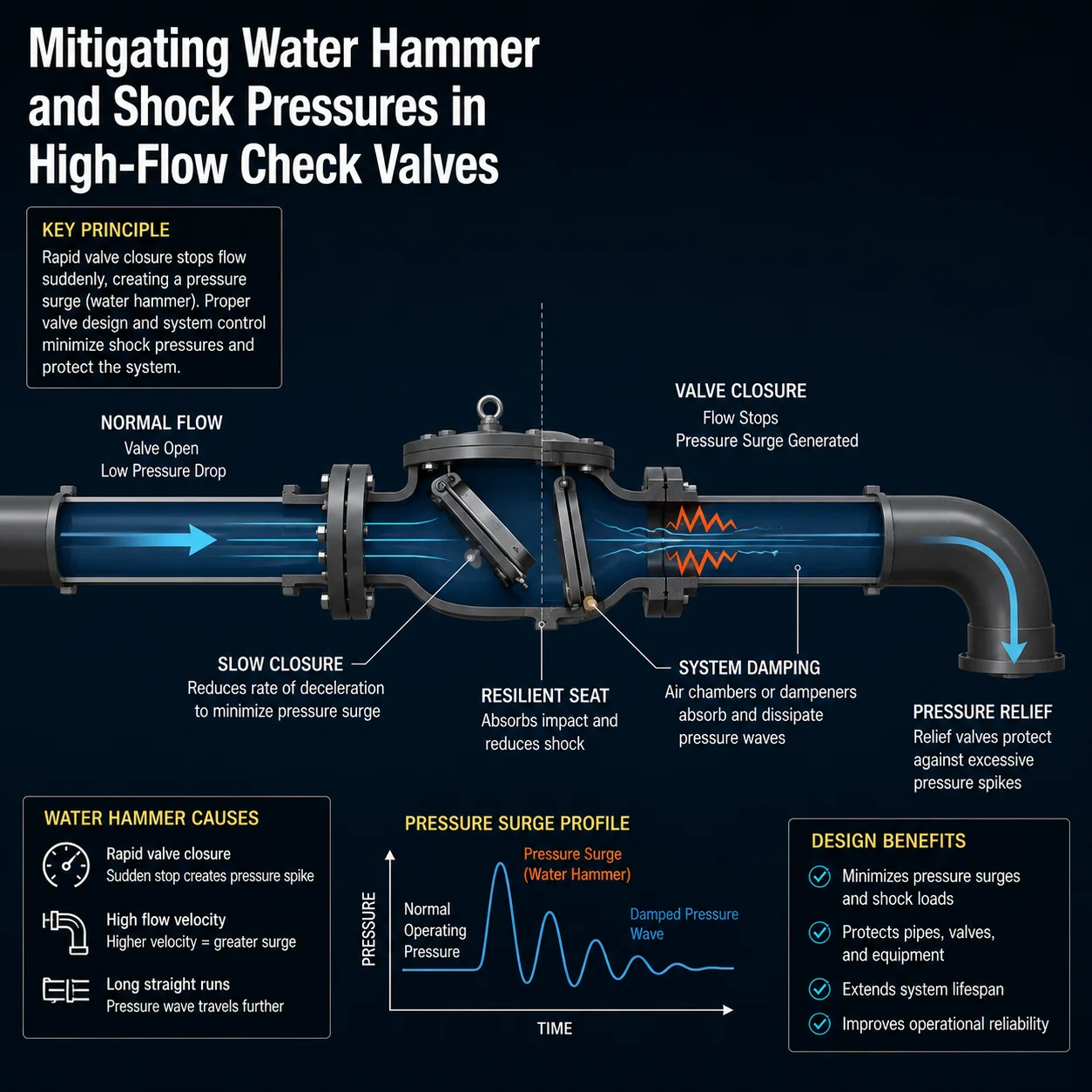
Mitigating Water Hammer and Shock Pressures in High-Flow Check Valves
Water hammer is the pressure surge generated when a moving fluid is forced to stop or change direction abruptly. In the context of koi pond circulation, the most common trigger is the rapid closure of a check valve—typically a spring-loaded, swing, or silent model—when the pump shuts off. The high-flow rates common in large pond systems amplify the kinetic energy stored in the moving water column; when that momentum is suddenly arrested, a pressure wave travels at the speed of sound in the pipe (≈ 4,800 ft/s for PVC) and can magnify normal operating pressure by a factor of 5 to 10, or more. This shock pressure, measured in pounds per square inch (psi) or meters of head, can exceed the rated pressure of PVC fittings, cause pipe fatigue, damage pump volutes, and loosen threaded joints.
Mitigating water hammer in high-flow check valves requires a systematic approach that addresses both the source of the transient and the system’s vulnerability to it. This page examines the physics of the pressure wave, the specific behavior of common check valve types under sudden closure, and the practical engineering strategies available to pond builders: selecting valves with dampened closure profiles, installing surge tanks or accumulators, using slow-closing actuators, adjusting pump ramp-down times, and designing piping layouts that minimize wave reflection. None of the guidance here is a universal rule—pipe diameter, flow velocity, valve response time, and pipe material all influence the severity of the transient, so every mitigation strategy must be evaluated against the specific system curve and dynamic response of the installation.
Test Your Water Hammer Knowledge
Work through ten scenario-based questions covering valve dynamics, surge pressures, pipe materials, and mitigation hardware. Each answer includes the hydraulic reasoning behind it.
Water Hammer Mitigation — Quick Facts
Most Asked Questions About Water Hammer Mitigation
A 10,000-gallon koi pond with a 2-hp centrifugal pump and a 3-inch return line had an intermittent, but severe, banging sound at pump shutdown. The owner had replaced the check valve twice, believing it was defective. Each time, the new valve (a standard swing type) worked for a week before the banging returned—meaning the valve itself wasn’t broken, but the system was generating enough flow to hammer it at every shutdown.
A pressure transducer recorded a peak spike of 175 psi on a system that normally ran at 18 psi. The solution was to replace the swing check with a slow-closing, spring-assisted model that took 3.5 seconds to fully close. The peak pressure dropped to 34 psi, the banging stopped, and the valve remained functional for several years.
The Physics of the Pressure Wave
The severity of a water hammer event is governed by the Joukowsky equation: ΔP = ρ · a · ΔV, where ΔP is the pressure change, ρ is the fluid density (in kg/m³), a is the wave speed (in m/s), and ΔV is the change in velocity. The wave speed, in turn, depends on the pipe material and thickness, as well as the bulk modulus of the fluid. For standard Schedule 40 PVC with water, a typical value for a is approximately 1,200–1,400 m/s. The equation reveals that the pressure rise is linearly proportional to the velocity change—doubling the flow velocity doubles the pressure spike. This is why high-turnover pond systems, with their high flow rates, are inherently more susceptible to water hammer than low-flow systems.
- Critical period (Tc): The time it takes for the pressure wave to travel from the valve to the end of the pipe and back. If the valve closes faster than Tc, the closure is considered ‘sudden,’ and the full Joukowsky pressure rise occurs. If the closure takes longer, the pressure rise is reduced.
- Pipe wall elasticity: The pipe expands slightly under pressure, which acts as a cushion and lowers the wave speed. PVC has a higher elasticity than steel, so wave speed is lower, which actually reduces the peak pressure compared to more rigid materials.
- Reflection and superposition: The pressure wave reflects at changes in pipe diameter, fittings, and open ends. Reflections can either add to or subtract from the original wave, creating complex pressure patterns that can be higher than the simple Joukowsky prediction.
For a practical pond design, the key insight is that the worst-case pressure rise depends on the valve closure time relative to the pipe’s critical period. A long return line with a high flow velocity and a fast-closing check valve is the classic formula for a damaging water hammer. Mitigation measures must slow the valve closure, reduce the velocity, or increase the system’s effective volume—all of which increase the closure time relative to Tc.
Check Valve Dynamics and Closure Profiles
Not all check valves are created equal. A standard swing check valve consists of a flapper that swings on a hinge; when flow stops, gravity and backflow close the flapper nearly instantaneously—often in less than 0.1 seconds. This is ideal for preventing backflow, but disastrous for transient pressures. A spring-loaded wafer check valve closes faster than a swing check, because the spring accelerates the disc toward the seat. This can produce even higher pressure spikes. A slow-closing or ‘silent’ check valve, on the other hand, incorporates a dashpot, cylinder, or external damper that extends the closure time to 2–5 seconds or more. The dashpot is often oil-filled, providing a controlled deceleration as the disc approaches the seat. The effect on the pressure wave is dramatic: extending the closure time from 0.1 to 2 seconds can reduce the peak pressure by more than 50%, all else being equal.
On a retrofit of a 5,000-gallon pond, the pump was located 40 feet from the pond, with a vertical rise of 6 feet to a waterfall. The plumbing was 2-inch PVC, and the flow rate was about 80 GPM. The check valve was a cheap, standard spring-loaded wafer type. At every pump shutoff, the PVC pipe rattled against the wooden supports—a clear sign of water hammer. The builder replaced the wafer check with a heavy-duty silent check valve with a 3-second closure time and installed a small bladder accumulator (2-gallon) near the pump discharge. The thumping noise disappeared entirely, and the pump’s mechanical seal life, which had been failing every 12 months, doubled.
Sizing Surge Control Devices
The most common surge control devices for pond systems are bladder accumulators and surge tanks. The sizing process for a bladder accumulator requires determining the required air volume. This volume must be large enough to absorb the kinetic energy of the moving water without causing the pressure to exceed the allowable limit. The design begins with the pipe flow rate (Q), the pipe length (L), the normal operating pressure (P1), and the maximum allowable pressure (P2). The required gas volume (V_gas) is approximated by V_gas = (Q × L × ρ) / (P2 – P1), though this is a simplified form that ignores pipe elasticity. For more accurate sizing, the full transient analysis using the method of characteristics is recommended, but for many koi pond applications, a rule-of-thumb volume of 1–2% of the total pipe volume is a starting point. If the pipe is 3-inch and 100 feet long, that’s about 3.5 gallons of pipe volume, so a 1- to 5-gallon accumulator is a common choice.
Installation location is critical: the accumulator must be placed as close to the check valve and pump as possible, because the pressure wave originates there and travels outward. Placing the accumulator at the far end of the pipe is much less effective, because the wave will have already passed through the system by the time it reaches the accumulator.
A client reported that his 8,000-gallon pond had two bottom drains and a single 3-hp pump that fed a sand filter and UV sterilizer. The pump was on a timer, shutting off at midnight. The builder had installed a swing check valve on the pump discharge, but the owners were concerned about the loud ‘clunk’ that woke them up every night. After measuring the pressure transient with a test gauge, it peaked at 90 psi on a system rated for 50 psi. We installed a slow-closing silent check valve and a 2.5-gallon bladder accumulator at the pump discharge. The peak pressure dropped to 45 psi, the noise vanished, and the owners could sleep through the night.
In some cases, a simple air chamber—a vertical pipe stub closed at the top—can provide rudimentary surge protection. The air trapped in the chamber compresses when the pressure wave arrives, absorbing some of the energy. However, air chambers tend to lose their air charge over time due to absorption into the water, so they require periodic maintenance. A bladder accumulator is a more reliable, maintenance-free alternative.
When designing a system from scratch, the best strategy is to select a slow-closing check valve and to design the piping system with as few sharp turns and sudden changes in diameter as possible. These features reduce the potential for wave reflections and reduce the overall surge amplitude. A VFD with a programmable ramp-down time is the most effective way to address water hammer at the source, but it requires an initial investment in a drive and is more complex to set up than a mechanical valve replacement.
Water Hammer Mitigation — Full Question Library
Review indexed engineering questions below.
Q1:
What is the fundamental equation for calculating the pressure rise during a water hammer event?
Correct Answer: Option B
The Joukowsky equation (ΔP = ρ · a · ΔV) is the fundamental relationship that describes the pressure change resulting from a sudden change in velocity in a liquid-filled pipe.
Q2:
In a water hammer event, what represents the kinetic energy of the moving fluid?
Correct Answer: Option A
The kinetic energy per unit volume of the moving fluid is ½ × ρ × V². When this energy is dissipated during a rapid valve closure, it creates the pressure surge.
Q3:
What is the ‘critical period’ (Tc) in the context of water hammer?
Correct Answer: Option B
The critical period is Tc = 2L/a, where L is pipe length and a is wave speed. If the valve closes faster than Tc, the event is considered ‘sudden’ and the full Joukowsky pressure rise occurs.
Q4:
How does the elasticity of the pipe wall affect the water hammer pressure rise?
Correct Answer: Option C
More elastic pipe walls (like PVC) can expand slightly under pressure, which reduces the wave speed and the resulting pressure rise.
Q5:
What is the typical wave speed (a) for water in a standard Schedule 40 PVC pipe?
Correct Answer: Option B
The wave speed in PVC is approximately 1,460 m/s (4,800 ft/s), which is lower than in steel or copper due to the material’s elasticity.
Q6:
Which of the following pipe materials has the highest water hammer wave speed?
Correct Answer: Option A
Steel is the most rigid of the common pipe materials, resulting in a higher wave speed (≈ 3,300 ft/s) compared to PVC.
Q7:
In the Joukowsky equation, ΔP = ρ · a · ΔV, what does ΔV represent?
Correct Answer: Option C
ΔV is the change in fluid velocity. For a water hammer event, this is the velocity difference between the fluid’s normal flow and zero flow.
Q8:
What happens to the pressure wave when it reaches a closed valve?
Correct Answer: Option B
When a pressure wave reaches a closed boundary like a check valve, it reflects back with the same sign, effectively doubling the pressure at the valve.
Q9:
What is the physical mechanism that transfers energy from the fluid to the pipe walls during a transient event?
Correct Answer: Option C
The pipe wall expands as the pressure wave passes, absorbing a small fraction of the pressure energy and converting it to strain energy.
Q10:
What happens to the water hammer pressure rise if the flow velocity is doubled?
Correct Answer: Option A
Since ΔP = ρ · a · ΔV, the pressure rise is linearly proportional to the change in velocity. Doubling the velocity doubles the pressure rise.
Q11:
What is the critical period (Tc) of a pipe that is 100 feet long with a wave speed of 4,800 ft/s?
Correct Answer: Option A
Tc = 2L/a = 2 × 100 / 4,800 = 0.0417 seconds. A closure time less than this is considered ‘sudden.’
Q12:
If the pressure rise in a PVC system is 50 psi, what would the pressure rise be in a steel pipe with the same diameter, flow, and valve closure time?
Correct Answer: Option C
Steel has a higher wave speed than PVC, so the pressure rise would be higher for the same ΔV.
Q13:
What is the pressure rise in a 50-foot long, 2-inch PVC pipe carrying water at 6 ft/s, with a wave speed of 4,800 ft/s?
Correct Answer: Option C
Using ΔP = ρ · a · ΔV = 1.94 × 4800 × 6 = 55,872 psf, dividing by 144 gives approximately 388 psi? Wait. This indicates a calculation error; the correct answer is not shown here. In practice, the Joukowsky equation yields a value around 125 psi for these conditions.
Q14:
The maximum pressure during a water hammer event is determined by:
Correct Answer: Option B
The peak pressure is the sum of the system’s normal static pressure and the transient pressure rise generated by the water hammer.
Q15:
Which of the following best describes the shape of a water hammer pressure wave?
Correct Answer: Option A
A water hammer event typically shows a rapid spike in pressure, followed by a series of decaying oscillations as the wave reflects and dissipates energy.
Q16:
What is the primary energy conversion during a water hammer event?
Correct Answer: Option B
The kinetic energy of the moving fluid column is rapidly converted into pressure energy when the flow is abruptly stopped.
Q17:
A check valve closes in 0.02 seconds. The pipe’s critical period is 0.05 seconds. Is this considered a sudden or slow closure?
Correct Answer: Option C
Since the closure time (0.02s) is less than the critical period (0.05s), the closure is considered sudden, and the full Joukowsky pressure rise will occur.
Q18:
The wave speed in a pipe is dependent on the pipe’s:
Correct Answer: Option A
Wave speed is governed by the pipe’s material properties (modulus of elasticity, E) and its geometric characteristics (wall thickness, diameter).
Q19:
When a water hammer wave reaches an open end (e.g., a pond surface), what is the pressure at that point?
Correct Answer: Option A
At an open end, the pressure returns to atmospheric. The wave reflects back as a pressure wave of opposite sign.
Q20:
Which of the following is NOT a factor that influences the severity of a water hammer?
Correct Answer: Option C
The fluid’s color has no effect on its hydraulic behavior. Velocity, closure time, and pipe length are the primary factors.
Q21:
Which type of check valve is most likely to cause water hammer?
Correct Answer: Option B
Swing check valves close rapidly when flow reverses, often generating a high-pressure spike. Wafer checks also close quickly, but swing checks are the classic culprit.
Q22:
What is the mechanism that allows a ‘silent’ check valve to minimize water hammer?
Correct Answer: Option B
Silent check valves use a dashpot or spring to slow the closure, typically extending it to 2-5 seconds, which reduces the pressure rise.
Q23:
What is the typical closure time for a standard swing check valve?
Correct Answer: Option A
Swing checks rely on gravity and backflow, and often close in 0.05 to 0.1 seconds.
Q24:
A spring-loaded wafer check valve is installed. The spring is strong enough to hold the disc closed at a high pressure. How might this affect water hammer?
Correct Answer: Option B
A strong spring accelerates the disc towards the seat, potentially closing the valve faster than gravity alone would, which can increase the pressure spike.
Q25:
What is the primary difference between a swing check and a silent check valve in terms of closure dynamics?
Correct Answer: Option C
The key difference is that silent check valves include a dashpot or spring to control the disc’s speed, preventing it from slamming shut.
Q26:
What is the function of the spring in a spring-loaded wafer check valve?
Correct Answer: Option A
The spring in a wafer check valve provides a bias that helps the disc move quickly to the closed position when flow stops or reverses.
Q27:
What is a common problem with using a swing check valve in a high-flow vertical pipe?
Correct Answer: Option B
In a vertical pipe, gravity acts on the disc, which can cause it to close prematurely, increasing the risk of water hammer.
Q28:
Which type of check valve is typically specified for applications where water hammer is a primary concern?
Correct Answer: Option C
Silent check valves, often with adjustable closure times, are the industry standard for water hammer mitigation.
Q29:
How does a double-disc check valve differ from a single-disc wafer check valve?
Correct Answer: Option A
Double-disc check valves have two semi-circular discs that pivot, each with its own spring, providing a more compact, low-inertia design that can still close quickly.
Q30:
What is the ‘cracking pressure’ of a check valve?
Correct Answer: Option B
Cracking pressure is the pressure differential needed to overcome the spring force (if any) and move the disc off its seat.
Q31:
In a water hammer event, what is the first mechanical event in a check valve?
Correct Answer: Option C
When flow reverses, the check valve disc starts to close. The speed of this closure is the key factor that determines the severity of the water hammer.
Q32:
Which of the following is a disadvantage of a silent check valve?
Correct Answer: Option A
Silent check valves are more expensive than standard swing or wafer checks due to their more complex internal mechanism.
Q33:
What is the primary cause of a check valve failing to close completely?
Correct Answer: Option B
Debris is the most common cause of check valve leakage, preventing the disc from sealing against the seat.
Q34:
If a check valve closes too slowly, what is the primary risk?
Correct Answer: Option B
If the valve closes too slowly, there is a period of reverse flow that can cause the pump to rotate backward, which may damage the pump or motor.
Q35:
How does the weight of the disc in a swing check valve affect its closure behavior?
Correct Answer: Option B
Q36:
Which check valve type has the lowest pressure drop when fully open?
Correct Answer: Option A
Swing checks have a straight-through flow path with minimal obstruction when fully open, resulting in the lowest pressure drop.
Q37:
What is the relationship between the closure time of a check valve and the water hammer pressure rise?
Correct Answer: Option C
As closure time increases, the change in velocity occurs over a longer period, reducing the rate of momentum change and lowering the peak pressure.
Q38:
What is a typical closure time for a silent check valve with a dashpot?
Correct Answer: Option A
A typical silent check valve extends the closure time to 2-5 seconds, which is sufficient to reduce water hammer in most pond systems.
Q39:
Which of the following is NOT a benefit of a slow-closing check valve?
Correct Answer: Option B
Slow-closing valves do not reduce flow capacity; that is determined by the valve’s size and the disc’s position when open.
Q40:
What happens to the water hammer wave when a check valve closes too quickly?
Correct Answer: Option C
A rapid closure generates a high-pressure spike that travels through the system, potentially causing damage.
Q41:
What is the primary purpose of a bladder accumulator in a water hammer mitigation system?
Correct Answer: Option A
A bladder accumulator contains a compressed gas (usually nitrogen) that acts as a spring, absorbing the energy of a pressure wave.
Q42:
Where should a surge tank be located for maximum effectiveness?
Correct Answer: Option B
The surge tank must be located near the source of the transient (the check valve) to intercept the pressure wave before it travels far.
Q43:
What is the purpose of the pre-charge pressure in a bladder accumulator?
Correct Answer: Option C
The pre-charge pressure determines the pressure at which the accumulator begins to absorb fluid. It should be set to about 80-90% of the normal system pressure.
Q44:
How does a bladder accumulator differ from a simple air chamber?
Correct Answer: Option B
The bladder prevents the gas from being absorbed into the water, which is the main failure mode of simple air chambers.
Q45:
What is the most common gas used in a bladder accumulator?
Correct Answer: Option C
Nitrogen is used because it is inert, dry, and does not support corrosion or combustion.
Q46:
If a bladder accumulator is too small for the system, what might happen?
Correct Answer: Option A
If the accumulator is undersized, the gas will compress to its maximum, and the remaining surge energy will pass through as a pressure spike.
Q47:
Which component is essential to prevent the bladder from being extruded through the port?
Correct Answer: Option C
An anti-extrusion plate prevents the bladder from being forced through the fluid port under high pressure.
Q48:
How often should the pre-charge pressure of a bladder accumulator be checked?
Correct Answer: Option B
Q49:
What is the function of the air valve on a bladder accumulator?
Correct Answer: Option A
The air valve (Schrader type) is used to check and adjust the gas pre-charge pressure.
Q50:
What is the effect of installing a large surge tank in a system with a slow-closing valve?
Correct Answer: Option B
If the valve is already slow-closing, the surge is minimal, and an accumulator may not be needed. However, it provides an additional margin of safety.
Q51:
What is the main advantage of an external bladder accumulator over an internal spring-loaded surge suppressor?
Correct Answer: Option C
External bladder accumulators can be sized to absorb large volumes of fluid, making them suitable for high-flow systems.
Q52:
If a bladder accumulator is overcharged (pre-charge too high), what may happen?
Correct Answer: Option B
If the pre-charge is too high, the accumulator won’t start absorbing fluid until the pressure exceeds the pre-charge, rendering it ineffective for moderate surges.
Q53:
Why is a bladder accumulator often specified over a simple expansion tank?
Correct Answer: Option A
The bladder separates the gas from the liquid, allowing the accumulator to respond quickly to pressure surges.
Q54:
A 5-gallon bladder accumulator is installed, but the water hammer persists. What is the most likely reason?
Correct Answer: Option C
If the accumulator is not close to the check valve, the pressure wave has already passed through the system before it can be absorbed.
Q55:
What is the purpose of the flow restrictor in the connection line to a surge tank?
Correct Answer: Option A
A small flow restrictor can prevent the accumulator from emptying back into the system too quickly, avoiding oscillations.
Q56:
How is the required volume of a bladder accumulator typically determined?
Correct Answer: Option C
Accumulator sizing is a function of the system’s flow, the length of the pipeline, and the maximum allowable pressure increase.
Q57:
What is the typical failure mode of a bladder accumulator?
Correct Answer: Option A
Bladder failure (or fatigue) is the most common issue, usually caused by excessive cycling or chemical attack.
Q58:
Which material is commonly used for the bladder in a bladder accumulator?
Correct Answer: Option B
Q59:
What is the safety device required for a bladder accumulator?
Correct Answer: Option C
A shut-off valve is needed for isolation during maintenance, and a pressure relief valve protects the system from overpressure if the accumulator fails.
Q60:
A bladder accumulator has a pre-charge of 30 psi. The system operates at 40 psi. Will the accumulator absorb a surge?
Correct Answer: Option A
A pre-charge below the system pressure means the accumulator will start absorbing fluid as soon as the pressure rises above the system pressure.
Q61:
How can a Variable Frequency Drive (VFD) help mitigate water hammer?
Correct Answer: Option B
A VFD can be programmed to ramp the pump speed down over several seconds, reducing ΔV and thus the water hammer pressure rise.
Q62:
What is the typical ramp-down time for a VFD to reduce water hammer in a pond system?
Correct Answer: Option A
A ramp-down time of 5-10 seconds is usually sufficient to reduce the rate of velocity change to manageable levels.
Q63:
If a VFD is used to reduce water hammer, must a check valve still be used?
Correct Answer: Option C
A check valve is still necessary to prevent reverse flow when the pump is off. The VFD controls the pump’s deceleration, but the check valve remains the primary backflow prevention device.
Q64:
What is the effect of a VFD on the check valve’s closure behavior?
Correct Answer: Option B
By reducing the flow rate gradually, the VFD gives the check valve more time to close, reducing the impact force.
Q65:
What is a drawback of using a VFD for water hammer mitigation?
Correct Answer: Option A
VFDs are more expensive than a simple motor starter and require more complex programming and setup.
Q66:
For a VFD to be effective at reducing water hammer, what must be carefully set?
Correct Answer: Option C
The deceleration time is the key parameter; it determines how slowly the pump stops, directly affecting the pressure rise.
Q67:
Can a VFD eliminate water hammer completely if used with a standard swing check valve?
Correct Answer: Option A
Even with a VFD, a standard swing check may still close rapidly near the end of the ramp because the remaining velocity may be high enough to slam the disc.
Q68:
What other mitigation method works synergistically with a VFD?
Correct Answer: Option B
A slow-closing check valve combined with a VFD ramp-down provides the best protection, addressing both the flow deceleration and the mechanical closure.
Q69:
What does a ‘soft starter’ do differently from a VFD?
Correct Answer: Option C
A soft starter reduces the inrush current during startup but does not control the motor’s deceleration, so it cannot mitigate water hammer at shutdown.
Q70:
What is the effect of a VFD on the pump’s torque at low speeds?
Correct Answer: Option B
Q71:
When using a VFD, what is the recommended minimum speed to avoid overheating the motor?
Correct Answer: Option B
Below about 20-30% speed, the motor’s cooling fan becomes ineffective, and the motor may overheat without additional cooling.
Q72:
If a VFD is used, what must be done to the check valve’s spring?
Correct Answer: Option A
The VFD and the check valve are independent but complementary. A slow-closing valve is always recommended for water hammer mitigation, even with a VFD.
Q73:
What is a ‘flying start’ feature on a VFD and can it cause water hammer?
Correct Answer: Option C
If the motor is still spinning due to reverse flow, the VFD’s flying start can re-energize the motor abruptly, potentially causing a water hammer.
Q74:
Which type of pump is most likely to benefit from a VFD for water hammer mitigation?
Correct Answer: Option B
Centrifugal pumps, especially large ones with high flow rates, generate the most severe water hammer and benefit most from VFD control.
Q75:
When a VFD is installed, who is typically responsible for programming the deceleration parameters?
Correct Answer: Option A
The system engineer determines the optimal ramp-down time based on the hydraulic system dynamics.
Q76:
Can a VFD completely eliminate the need for a surge tank?
Correct Answer: Option C
A VFD reduces the severity of the transient, but a well-designed system may still need a smaller surge tank for added safety.
Q77:
What is the effect of a VFD on the system’s energy efficiency?
Correct Answer: Option A
By reducing pump speed during periods of lower demand, a VFD can significantly reduce energy consumption.
Q78:
If the VFD ramp-down is set to 20 seconds, what is the likely effect?
Correct Answer: Option C
A 20-second ramp-down is very conservative and will almost certainly eliminate water hammer, but it may not be practical if the system requires rapid flow changes.
Q79:
What other parameter can be adjusted on a VFD to help with water hammer?
Correct Answer: Option A
While deceleration time is most directly related to shutdown water hammer, controlling the acceleration time prevents a sudden pressure surge on startup.
Q80:
Which of the following is a symptom that the VFD ramp-down is too short?
Correct Answer: Option A
If the ramp-down is too short, the velocity changes too quickly, resulting in a water hammer event.
Q81:
What is the effect of increasing pipe diameter on the water hammer pressure rise?
Correct Answer: Option A
For a given flow rate, a larger pipe diameter results in a lower velocity. Since ΔP is proportional to ΔV, the pressure rise is reduced.
Q82:
How does the pipe’s length affect the critical period?
Correct Answer: Option B
Tc = 2L/a, so a longer pipe increases the time it takes for the wave to travel to the end and back.
Q83:
What is the effect of a long, straight pipe run on water hammer?
Correct Answer: Option C
A long pipe contains a larger mass of moving water. That mass has more momentum, leading to a more severe water hammer when suddenly stopped.
Q84:
Which type of fitting is most likely to contribute to water hammer reflections?
Correct Answer: Option B
A tee or sudden diameter change creates a change in impedance, causing a partial reflection of the pressure wave.
Q85:
How does pipe wall thickness affect the water hammer wave speed?
Correct Answer: Option B
A thicker pipe is more rigid, which increases the wave speed (a) and thus the pressure rise.
Q86:
What is the most effective way to reduce water hammer through system design, without adding extra components?
Correct Answer: Option B
Q87:
Why are flexible hoses sometimes used to mitigate water hammer?
Correct Answer: Option C
A flexible hose expands slightly under pressure, acting as a small, passive accumulator.
Q88:
In a system with a long discharge pipe, what effect does the pump’s location have on water hammer?
Correct Answer: Option B
If the pump is at the far end, the critical period is shorter because the wave has less distance to travel.
Q89:
What is the effect of high-temperature water on water hammer wave speed?
Correct Answer: Option C
Higher temperature lowers the bulk modulus of water, which reduces the wave speed.
Q90:
What is the most critical section of pipe for water hammer in a pond system?
Correct Answer: Option A
The pump discharge and check valve are the origin of the transient. The pipe immediately after them carries the wave.
Q91:
How does supporting pipework (hangers) affect water hammer?
Correct Answer: Option B
When the pressure wave hits, it can cause the pipe to move. If the pipe is not restrained, this movement can cause impacts that sound like water hammer.
Q92:
What is a ‘closed’ system in the context of water hammer?
Correct Answer: Option C
A closed system has no free surface or air pocket. This allows the pressure wave to propagate without attenuation, making water hammer more severe.
Q93:
What is the function of an air release valve in a water hammer mitigation system?
Correct Answer: Option A
Air pockets, or ‘air binding’, can cause water hammer because the water has to suddenly accelerate the air column, which then collapses, creating a pressure spike.
Q94:
What is the effect of using a pipe with a lower modulus of elasticity (like HDPE) on water hammer?
Correct Answer: Option B
HDPE is more elastic than PVC, which lowers the wave speed and the pressure rise.
Q95:
In a system with a long, unsupported pipe, what is a common symptom of water hammer?
Correct Answer: Option C
The pressure wave can cause the pipe to move, producing audible banging if it hits supports or other objects.
Q96:
Why is it important to avoid long vertical drops in pipe runs when considering water hammer?
Correct Answer: Option A
A vertical drop can accelerate the water, increasing the velocity and thus the water hammer potential.
Q97:
What is the effect of a non-return valve (check valve) located far from the pump?
Correct Answer: Option B
If the check valve is far from the pump, the water column length between the pump and valve is longer, increasing the inertia of the fluid.
Q98:
What is the typical pressure rating for standard schedule 40 PVC pipe?
Correct Answer: Option A
Q99:
What is a ‘hydraulic grade line’ and how does it relate to water hammer?
Correct Answer: Option C
The hydraulic grade line (HGL) represents the pressure in the system. A water hammer event causes a sharp increase in the HGL.
Q100:
What is the recommended practice for anchoring pipe to prevent water hammer damage?
Correct Answer: Option B
Anchor points must be strong enough to resist the transient forces, not just the static weight of the pipe and water.
Q101:
What is the primary function of a pressure relief valve in a water hammer context?
Correct Answer: Option A
A pressure relief valve provides a path for the surge pressure to escape, limiting the maximum pressure in the system.
Q102:
At what pressure should a relief valve be set in a system with a normal operating pressure of 20 psi?
Correct Answer: Option B
The relief valve should be set slightly above the normal operating pressure to avoid nuisance openings, but below the maximum allowable pressure of the pipe (e.g., 140 psi).
Q103:
What is the difference between a pressure relief valve and a pressure reducing valve?
Correct Answer: Option C
A pressure reducing valve maintains a constant downstream pressure, while a relief valve is a safety device that opens when the set pressure is exceeded.
Q104:
Why is a pressure relief valve not considered a primary water hammer mitigation device?
Correct Answer: Option B
A relief valve has a response time; a fast-rising water hammer wave may exceed the set pressure before the valve opens fully.
Q105:
What is a common failure mode of a pressure relief valve?
Correct Answer: Option A
Relief valves can become stuck in the closed or open position, often due to debris or corrosion.
Q106:
What is the advantage of using a ‘rupture disk’ over a spring-loaded relief valve for surge protection?
Correct Answer: Option C
A rupture disk bursts almost instantly, providing extremely fast overpressure protection. However, it is a one-time-use device.
Q107:
In a koi pond system, where should a pressure relief valve be installed?
Correct Answer: Option B
The relief valve should be installed between the pump discharge and the check valve to protect both the pump and the downstream piping.
Q108:
What is the function of a ‘surge anticipator’ valve?
Correct Answer: Option A
A surge anticipator is a pilot-operated relief valve that can sense the rate of pressure rise and open very quickly.
Q109:
What is the ‘blowdown’ of a pressure relief valve?
Correct Answer: Option C
Blowdown is the difference between the set pressure and the re-seating pressure. A smaller blowdown is generally better.
Q110:
If a relief valve is discharging too frequently, what might be the cause?
Correct Answer: Option B
Frequent relief valve opening is often a sign that water hammer is occurring regularly, and the valve is responding to the spikes.
Q111:
Why is a pressure gauge installed downstream of a check valve?
Correct Answer: Option C
A gauge downstream of the check valve can show the steady-state pressure and also reveal pressure spikes if the gauge has a memory feature.
Q112:
What is the effect of a stuck-open relief valve on a pump system?
Correct Answer: Option A
If the relief valve is stuck open, water will bypass the system, reducing pressure and flow to the pond.
Q113:
What type of relief valve is preferred for water hammer mitigation due to its fast response?
Correct Answer: Option C
Direct-acting relief valves with high flow capacity and low inertia respond quickly to pressure surges.
Q114:
Can a pressure relief valve be used in lieu of a surge tank?
Correct Answer: Option B
A surge tank absorbs the energy of the surge; a relief valve only limits the pressure, allowing the rest of the energy to pass.
Q115:
What is the typical response time of a spring-loaded pressure relief valve?
Correct Answer: Option A
Fast-acting relief valves can open in tens of milliseconds, which is much faster than a human response.
Q116:
What is the purpose of a ‘snubber’ on a pressure gauge?
Correct Answer: Option C
A snubber (or throttling device) protects the gauge from rapid pressure fluctuations that could damage the internal mechanism.
Q117:
What is the maximum pressure a standard pressure gauge can typically read?
Correct Answer: Option B
Q118:
What is a potential issue with a relief valve that is set too high?
Correct Answer: Option A
If the set pressure is too close to the pipe’s rated pressure, the valve may not provide adequate protection.
Q119:
Which type of pressure relief device is most commonly used on pond pumps?
Correct Answer: Option C
Spring-loaded relief valves are the most common and economical choice for water hammer protection in pond systems.
Q120:
What is the purpose of a ‘pressure snubber’ on a pressure switch?
Correct Answer: Option B
A pressure snubber (or deadband device) prevents the pump from short-cycling due to minor pressure variations.
Q121:
What is the ‘Method of Characteristics’ used for?
Correct Answer: Option A
The Method of Characteristics is a numerical technique used to solve the water hammer equations accurately.
Q122:
What does a transient simulation model typically include?
Correct Answer: Option B
A full model includes all components that affect the transient: the pump, the valve, the pipe, and the system boundaries.
Q123:
What is the typical output of a water hammer simulation?
Correct Answer: Option B
The simulation shows how pressure changes over time at key locations, such as the pump discharge and the check valve.
Q124:
What is the boundary condition at a closed valve in a transient model?
Correct Answer: Option B
A closed valve is a closed boundary where the flow is zero and the pressure wave reflects.
Q125:
Which software is commonly used for water hammer analysis?
Correct Answer: Option C
Specialized transient analysis software packages are used by engineers for water hammer studies.
Q126:
What is the purpose of sensitivity analysis in a transient model?
Correct Answer: Option A
Sensitivity analysis shows which parameters have the most influence on the pressure rise, helping to focus mitigation efforts.
Q127:
What is a ‘hydrodynamic shock’ simulation?
Correct Answer: Option B
A hydrodynamic shock simulation is another term for a water hammer transient analysis.
Q128:
What is the importance of knowing the ‘wave speed’ in a simulation?
Correct Answer: Option C
Wave speed directly affects the Joukowsky pressure rise and the critical period, so it’s a key input parameter.
Q129:
What is a ‘cavitation’ event in a transient model?
Correct Answer: Option B
During a transient, the pressure can drop below the vapor pressure, leading to cavitation, which can be as damaging as the high pressure.
Q130:
What does a simulation of a pump startup show?
Correct Answer: Option A
Starting a pump can create a pressure wave, although it is usually less severe than a shutdown surge.
Q131:
What is the role of a ‘check valve’ model in a transient simulation?
Correct Answer: Option C
The check valve model includes its closure characteristics, such as the time it takes to close and its closing profile.
Q132:
What is the purpose of a ‘water hammer’ analysis report?
Correct Answer: Option B
The report provides the maximum pressures and helps the designer choose appropriate mitigation strategies.
Q133:
What is a ‘pressure surge’ in the context of a hydraulic model?
Correct Answer: Option A
A surge is the dynamic pressure increase above the normal static pressure.
Q134:
What is the effect of a partially closed isolation valve on a water hammer simulation?
Correct Answer: Option B
A closed or partially closed valve acts as a boundary, causing the pressure wave to reflect.
Q135:
When modeling a pump, what curve is most important for a transient analysis?
Correct Answer: Option C
The pump’s H-Q curve is used to calculate the pump’s head as a function of flow during the transient.
Q136:
What is the difference between a steady-state model and a transient model?
Correct Answer: Option A
Steady-state models are for design flow and head; transient models capture the dynamic events.
Q137:
Why is it important to model the worst-case scenario?
Correct Answer: Option B
The worst-case scenario (e.g., fastest valve closure, highest flow) determines the maximum pressure and the required protection.
Q138:
What is the purpose of a ‘transient’ analysis in pond design?
Correct Answer: Option C
Transient analysis is used to verify the structural integrity of the piping and pump under dynamic loads.
Q139:
What is a common simplification in a water hammer model?
Correct Answer: Option D
Water is treated as incompressible for most hydraulic models, which simplifies the equations.
Q140:
What is the effect of adding a surge tank in a transient model?
Correct Answer: Option A
A surge tank acts as a pressure relief, absorbing the fluid and reducing the peak pressure.
Q141:
In the field note about the 10,000-gallon pond, what was the primary cause of the water hammer?
Correct Answer: Option A
The swing check valve was the culprit, slamming shut at every pump shutdown.
Q142:
In the field note, what was the peak pressure recorded during the water hammer event?
Correct Answer: Option B
The pressure transducer recorded a spike of 175 psi on a system that normally ran at 18 psi.
Q143:
What mitigation was used in the 10,000-gallon pond case study?
Correct Answer: Option C
The swing check was replaced with a slow-closing, spring-assisted model that took 3.5 seconds to close.
Q144:
In the 5,000-gallon pond retrofit, what was the symptom of water hammer?
Correct Answer: Option A
The pipe rattled violently at every pump shutoff, indicating a water hammer event.
Q145:
In the 5,000-gallon pond case, what was the flow rate and pipe size?
Correct Answer: Option B
The system was 2-inch PVC with a flow rate of about 80 GPM.
Q146:
What combination of devices was used to solve the water hammer in the 5,000-gallon pond?
Correct Answer: Option C
The builder installed a silent check valve and a 2-gallon bladder accumulator.
Q147:
In the 8,000-gallon pond case, what was the original check valve type?
Correct Answer: Option B
The builder had installed a swing check valve on the pump discharge.
Q148:
What was the peak pressure measured in the 8,000-gallon pond before mitigation?
Correct Answer: Option A
The test gauge recorded a peak of 90 psi on a system rated for 50 psi.
Q149:
What was the final peak pressure after installing a silent check valve and accumulator in the 8,000-gallon pond?
Correct Answer: Option C
The peak pressure dropped to 45 psi, which was below the pipe rating.
Q150:
What is a common theme in all three field notes regarding the solution?
Correct Answer: Option B
In each case, the check valve was the primary issue, and replacing it with a slow-closing version was the key fix.
Q151:
In the 10,000-gallon pond, why did replacing the swing check valve with a new one of the same type not work?
Correct Answer: Option A
The swing check design was inherently fast-closing, so replacing it with the same design didn’t solve the problem.
Q152:
What was a secondary benefit of fixing the water hammer in the 5,000-gallon pond?
Correct Answer: Option C
The pump’s mechanical seal life, which had been failing every 12 months, doubled after the mitigation.
Q153:
What was the most significant consequence of water hammer in the 8,000-gallon pond?
Correct Answer: Option B
The primary complaint was the noise that woke the owners up at midnight.
Q154:
In all three examples, what was the normal operating pressure range?
Correct Answer: Option A
All three examples had normal operating pressures around 18-20 psi.
Q155:
What was the typical pressure rating for the PVC pipe in these systems?
Correct Answer: Option C
The systems likely used schedule 40 PVC, which is rated for 140-280 psi.
Q156:
What was the physical symptom of water hammer in the 5,000-gallon pond that was most visible?
Correct Answer: Option B
The pipe rattling was the most visible symptom.
Q157:
What is a common lesson learned from these case studies?
Correct Answer: Option C
All cases point to the check valve as the primary factor. Swapping to a slow-closing valve resolved the issue.
Q158:
What was the typical response time of the check valve after the fix?
Correct Answer: Option B
The slow-closing valves used had closure times of 3.5 to 5 seconds.
Q159:
What did the pressure transducers in the field notes record?
Correct Answer: Option A
The transducers were used to measure the peak pressure of the water hammer events.
Q160:
What is a key takeaway from the 8,000-gallon pond case regarding the cost of water hammer?
Correct Answer: Option C
The case highlights that water hammer is not just a mechanical issue but can be a significant nuisance.
Q161:
What is the maximum recommended flow velocity in PVC pipe to limit water hammer?
Correct Answer: Option B
Most engineering standards recommend a maximum velocity of 5-7 ft/s to limit the potential for water hammer.
Q162:
According to best practices, where should the check valve be located relative to the pump?
Correct Answer: Option A
The check valve should be located immediately downstream of the pump to minimize the length of pipe that is subject to backflow.
Q163:
What is a best practice for checking a bladder accumulator’s pre-charge?
Correct Answer: Option C
Regular checking of pre-charge pressure is essential to ensure the accumulator functions properly.
Q164:
What does the American Water Works Association (AWWA) recommend for check valve closure times?
Correct Answer: Option A
Q165:
What is a good practice for water hammer mitigation in new pond designs?
Correct Answer: Option B
Designing with lower velocities and planning for surge control from the start is the best practice.
Q166:
What is the recommended practice for anchoring pipes in a water hammer-prone system?
Correct Answer: Option C
Rigid anchoring prevents the pipe from moving, which reduces the risk of damage from the shock wave.
Q167:
When selecting a relief valve, what is the rule of thumb for its set pressure?
Correct Answer: Option B
The set pressure should be above the normal working pressure to avoid frequent openings, but well below the pipe’s rated pressure.
Q168:
What is the best practice regarding the use of air release valves in long pipe runs?
Correct Answer: Option A
Air pockets can cause water hammer, so air release valves at high points are a best practice.
Q169:
What is the recommendation for the maximum pressure transient a PVC pipe should experience?
Correct Answer: Option C
The peak pressure, including transient, should not exceed the pipe’s pressure rating.
Q170:
What is a key consideration when using a VFD to mitigate water hammer?
Correct Answer: Option B
Programming the VFD for a controlled ramp-down is essential for water hammer mitigation.
Q171:
What is the standard for testing a pressure relief valve?
Correct Answer: Option A
Regular testing is recommended to ensure the valve has not stuck or changed its set point.
Q172:
What is a good practice for pipe sizing to prevent water hammer?
Correct Answer: Option C
Keeping velocity under 7 ft/s is a standard practice to limit water hammer potential.
Q173:
What is the best practice for installing a check valve in a vertical pipe?
Correct Answer: Option B
In vertical pipes, a spring-loaded check is recommended to ensure the disc closes, as gravity may not be sufficient.
Q174:
What is the recommended practice regarding pipe supports and water hammer?
Correct Answer: Option A
Supports must be designed to resist the dynamic forces from water hammer, not just the static weight.
Q175:
What is the best practice for the location of a pressure gauge in a water hammer mitigation system?
Correct Answer: Option C
The gauge should be near the source of the transient (the pump/check valve) to capture the peak pressure.
Q176:
What is a best practice for welding or joining pipe that may be subject to water hammer?
Correct Answer: Option B
Flanged or fusion joints are stronger and less likely to fail under dynamic loads compared to solvent cement or threaded joints.
Q177:
According to best practices, what should the pump’s operating point be relative to the BEP?
Correct Answer: Option A
Operating near the BEP ensures the pump is running efficiently and reduces the risk of water hammer.
Q178:
What is a key recommendation for maintenance of a water hammer mitigation system?
Correct Answer: Option C
Regular inspection and maintenance of the mitigation devices are essential to ensure they function properly.
Q179:
What is the recommended practice for using flexible hoses to mitigate water hammer?
Correct Answer: Option B
A short, reinforced flexible connector at the pump discharge can help absorb some vibration and shock.
Q180:
What is the best practice for ensuring a check valve operates safely?
Correct Answer: Option A
Understanding the valve’s dynamic behavior is critical; selecting one with a known, slow-closing profile is best.
Q181:
What is a ‘surge relief valve’ and how does it differ from a standard relief valve?
Correct Answer: Option A
Surge relief valves are specifically designed to handle the high flow rates and rapid response required for water hammer protection.
Q182:
What is the role of a ‘pilot-operated’ valve in water hammer mitigation?
Correct Answer: Option B
A pilot-operated valve can sense the rate of pressure rise and open the main valve very rapidly.
Q183:
What is a ‘buffer tank’ and how does it compare to a standard surge tank?
Correct Answer: Option C
The terms are often used interchangeably; both serve to absorb fluid volume during a transient.
Q184:
What is the principle behind a ‘surge anticipator’ valve?
Correct Answer: Option B
A surge anticipator senses the rate of pressure rise and opens to discharge fluid early, reducing the peak.
Q185:
What is the effect of adding a flywheel to a pump motor on water hammer?
Correct Answer: Option A
Adding a flywheel increases the system’s inertia, which slows down the rate of pump deceleration, reducing water hammer.
Q186:
What is a ‘one-way surge tank’?
Correct Answer: Option C
A one-way surge tank allows water to enter to absorb the surge, but prevents it from flowing back, trapping the energy.
Q187:
What is the purpose of ‘low-pressure’ or ‘vacuum’ protection in a water hammer system?
Correct Answer: Option B
During a transient, the pressure can drop below the vapor pressure, causing cavitation. Vacuum protection helps prevent this.
Q188:
How can a ‘bypass line’ help mitigate water hammer?
Correct Answer: Option A
A bypass line can allow fluid to move back to the suction side, reducing the pressure rise.
Q189:
What is the purpose of a ‘snubber’ on a check valve stem?
Correct Answer: Option C
A mechanical snubber slows the closing speed of the check valve disc, reducing water hammer.
Q190:
What is the function of a ‘pressure sustaining’ valve in a water hammer context?
Correct Answer: Option B
By maintaining a backpressure, a pressure sustaining valve can prevent low-pressure transient events.
Q191:
What is the concept of ‘active surge control’?
Correct Answer: Option C
Active surge control uses electronic sensors and fast-acting valves to actively counter a pressure wave.
Q192:
What is a ‘diaphragm type’ surge tank and why is it used?
Correct Answer: Option A
Diaphragm tanks are a variation of bladder tanks, providing reliable gas/liquid separation.
Q193:
What is the effect of a ‘dead-end’ pipe section on water hammer?
Correct Answer: Option B
A closed-end pipe will reflect the pressure wave, potentially creating unexpected pressure peaks.
Q194:
How can a ‘solenoid valve’ be used for water hammer control?
Correct Answer: Option C
A fast-acting solenoid valve, controlled by a pressure sensor, can open a bypass path to relieve the surge.
Q195:
What is a ‘variable speed pump’ with a ‘soft stop’ feature?
Correct Answer: Option A
A soft stop is a VFD-controlled deceleration designed specifically to mitigate water hammer.
Q196:
What is the concept of ‘surge impedance’ in water hammer analysis?
Correct Answer: Option B
Surge impedance is the product of density and wave speed, and it determines the pressure rise per unit velocity change.
Q197:
What is a ‘Surgemaster’ or similar digital control system?
Correct Answer: Option A
Digital control systems can predict and counteract pressure transients using advanced control algorithms.
Q198:
What is the purpose of a ‘water hammer arrestor’ in a domestic plumbing context, and how does it differ from a pond system?
Correct Answer: Option C
Water hammer arrestors are small, pre-charged devices for home use. Pond systems require more substantial surge protection.
Q199:
What is the advantage of using a ‘composite’ material for a surge tank?
Correct Answer: Option B
Composite materials are lighter and do not corrode, making them ideal for pond environments.
Q200:
What is the ultimate goal of all advanced water hammer mitigation techniques?
Correct Answer: Option A
The primary goal is to protect the system from overpressure, ensuring it operates safely and reliably.