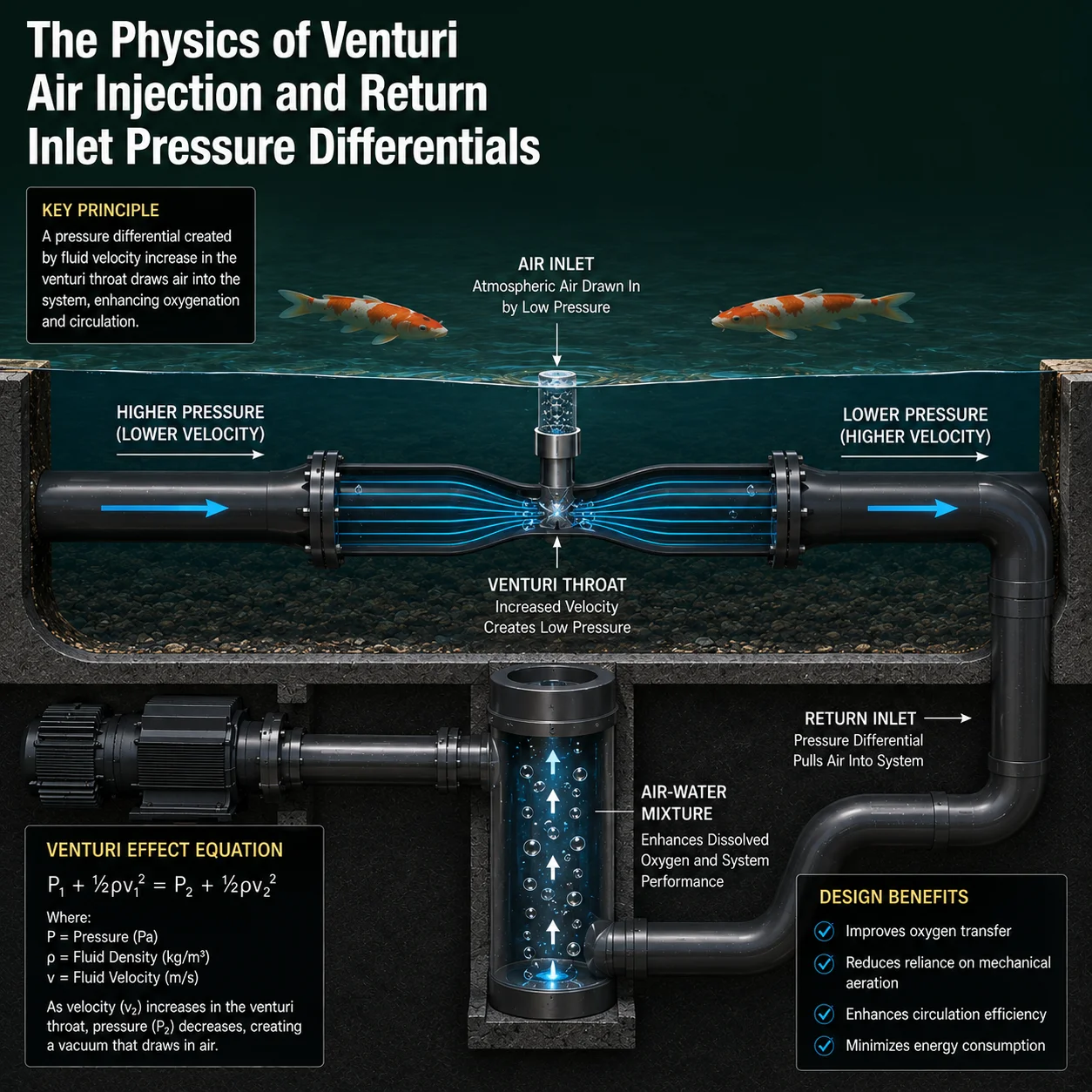
The Physics of Venturi Air Injection
The Venturi effect is one of the most elegant and misunderstood principles in pond hydraulics. At its core, it is a straightforward consequence of Bernoulli’s equation: as water accelerates through a constriction, its pressure drops, and if that pressure falls below atmospheric, air is drawn in through a small inlet port[reference:0][reference:1]. In a koi pond return line, this creates a stream of fine bubbles that can enhance oxygen transfer and add visual appeal — but only if the system is designed with the pressure relationships in mind.
This page works through the practical physics behind Venturi injection: how the pressure-velocity trade‑off actually behaves in a pipe, what minimum pressure differential is required to overcome backpressure and submergence depth[reference:2][reference:3], how throat diameter and inlet port size affect air entrainment[reference:4], and why a venturi is not a replacement for a dedicated air pump despite what some marketing materials suggest[reference:5][reference:6]. None of the guidance here is a universal prescription — pipe diameter, pump curve, submergence depth, and outlet backpressure all shift the operating point, so every venturi installation needs to be checked against the specific system rather than a rule of thumb.
Test Your Venturi Injection Knowledge
Work through ten scenario‑based questions covering Bernoulli’s principle, pressure differentials, air entrainment, backpressure, and installation pitfalls. Each answer includes the reasoning behind it.
Venturi Injection Physics — Quick Facts
Most Asked Questions About Venturi Injection Physics
A client installed a venturi on their 4,000‑gallon pond, following an online guide that showed a simple DIY design. The venturi was placed on the return line about 18 inches below the water surface. When they turned the system on, they saw no bubbles — just a steady stream of water. They assumed the venturi was faulty and replaced it twice, with no improvement.
The problem was submergence depth. At 18 inches below the surface, the hydrostatic backpressure was nearly 0.65 psi — enough to overcome the modest vacuum their pump could generate. Moving the venturi to just above the water surface, with only the discharge pipe submerged, restored full air entrainment immediately. The venturi wasn’t broken; the physics simply didn’t allow it to work at that depth.
Bernoulli’s Principle And The Pressure‑Velocity Trade‑Off
Bernoulli’s equation is the foundation of venturi physics. For a horizontal pipe with no change in elevation, it states that the sum of pressure energy and kinetic energy is constant along a streamline[reference:31][reference:32]. In practical terms, this means that when water speeds up — as it must when passing through a constriction to maintain the same mass flow rate — its pressure drops. The relationship is quantified by the equation:
- Continuity: A₁v₁ = A₂v₂ — the mass flow rate is constant, so a smaller area (the throat) means higher velocity.
- Bernoulli: P₁ + ½ρv₁² = P₂ + ½ρv₂² — as velocity increases, pressure decreases[reference:33].
- Pressure differential: ΔP = ½ρ(v₂² − v₁²) — the pressure drop is proportional to the square of the velocity increase[reference:34][reference:35].
In a koi pond return line, the venturi is typically a short section of pipe with a reduced diameter — often a reducer bushing or a specially machined insert. The water accelerates through this throat, and the pressure drops. If the pressure at the throat falls below atmospheric, a small hole drilled at the throat will draw in air[reference:36]. The amount of air drawn depends on the pressure differential, which in turn depends on the flow velocity and the geometry of the venturi.
Behind The Physics: Pressure Differential And The Vacuum Threshold
The pressure differential (ΔP) across a venturi is the engine that drives air entrainment. To draw air, the pressure at the throat must be lower than atmospheric pressure by at least the amount required to overcome the resistance of the air inlet and any backpressure from the water column. In practice, a minimum differential of about 2.2 psi (150 mbar) is often cited as the threshold for effective operation[reference:37]. Below this, the vacuum is too weak to pull air through the inlet, and the venturi will simply act as a flow restriction.
The available pressure differential is determined by the pump’s performance curve and the system resistance. If the pump is already operating near its maximum head, there may be little excess pressure to sacrifice to a venturi. This is why venturis are most effective in systems with oversize pumps or where the return line is short and has minimal friction losses. Adding a venturi to a system that is already marginal can reduce flow significantly and may even cause the pump to cavitate.
On a retrofit job, the owner wanted to add a venturi to a system that was already struggling with low flow due to a long, undersized return line. The pump was running at 80% of its rated flow, and the pressure gauge showed only 5 psi at the filter outlet. We calculated that the venturi would need at least 2.2 psi differential to work, but the system only had about 1.5 psi of excess pressure available. Installing the venturi would have dropped the flow below acceptable levels. The owner opted for a separate air pump instead — a decision that saved the system from performance degradation.
Submergence, Backpressure, And Installation Depth
The single most common installation error with venturis is placing them too deep below the water surface. Every foot of water depth adds approximately 0.43 psi of hydrostatic pressure at the venturi outlet. This backpressure must be overcome by the vacuum created at the throat[reference:38]. If the venturi is submerged too deep — generally more than 4–6 inches — the water pressure pushing back against the air inlet can prevent air from being drawn in at all[reference:39].
Backpressure can also come from downstream restrictions such as long pipe runs, elbows, or fittings[reference:40]. If the water exiting the venturi has to travel uphill or through a long horizontal run before discharging, the pressure at the outlet is higher than atmospheric, which reduces the effective pressure differential across the venturi. The ideal installation places the venturi as close to the discharge point as possible, with the outlet at or just below the water surface.
A pond owner installed a venturi on a return line that ran 20 feet horizontally before discharging into the pond. The venturi was placed at the pump end of the run, thinking that the high pressure there would ensure good air entrainment. In practice, the long pipe run created enough friction loss that the pressure at the venturi outlet was nearly equal to the pressure at the throat — the differential was almost zero.
Moving the venturi to the end of the run, just before the discharge point, restored the pressure differential and air entrainment. The lesson: a venturi must see the pressure drop across its own constriction, not the total system pressure. Placing it too far upstream defeats the purpose.
Measuring the pressure differential across a venturi is straightforward with a simple manometer or a pair of pressure gauges. One gauge is placed just upstream of the venturi, and another just downstream (or at the throat, if accessible). The difference between the two readings is the available ΔP. If this is less than about 2 psi, the venturi is unlikely to entrain air effectively. Adjusting the pump speed, reducing downstream restrictions, or moving the venturi closer to the discharge can increase the differential.
When troubleshooting a venturi that isn’t drawing air, the checklist is short but specific: check the pressure differential, check the submergence depth, check for air inlet blockages, and verify that the pump is delivering enough flow. If all these are correct and the venturi still doesn’t work, the geometry of the venturi itself may be the issue — the throat may be too large, the air inlet too small, or the taper too gradual to create a sufficient vacuum.
Venturi Injection Physics — Full Question Library
Review indexed engineering questions below.
Q1:
What is the Venturi effect?
Correct Answer: Option A
The Venturi effect is the reduction in fluid pressure that results when a moving fluid speeds up as it is funneled from one section of a pipe to another, smaller section[reference:41].
Q2:
Bernoulli’s equation states that for a horizontal pipe, the sum of pressure energy and kinetic energy is constant. What happens when water velocity increases?
Correct Answer: Option B
According to Bernoulli’s principle, an increase in fluid velocity is accompanied by a decrease in pressure[reference:42].
Q3:
Which equation describes the pressure differential in a venturi?
Correct Answer: Option C
The pressure differential in a venturi is given by ΔP = ½ρ(v₂² − v₁²), where v₂ is the velocity at the throat and v₁ is the velocity at the inlet[reference:43].
Q4:
What is the continuity equation, and why does it matter for venturi design?
Correct Answer: Option A
The continuity equation (A₁v₁ = A₂v₂) states that for an incompressible fluid, the mass flow rate is constant. This means that when the pipe area decreases (at the throat), the velocity must increase.
Q5:
In a venturi, where is the lowest pressure located?
Correct Answer: Option B
The lowest pressure in a venturi occurs at the throat, where the velocity is highest and the cross‑sectional area is smallest[reference:44].
Q6:
What condition is required for a venturi to draw air through an inlet port?
Correct Answer: Option C
Air is drawn into the venturi only when the pressure at the throat drops below atmospheric pressure, creating a vacuum[reference:45].
Q7:
According to Bernoulli’s equation, what happens to the total energy of a fluid flowing through a venturi?
Correct Answer: Option A
Bernoulli’s equation states that the total energy (pressure + kinetic + potential) remains constant along a streamline in the absence of friction[reference:46].
Q8:
What is the relationship between throat diameter and velocity in a venturi?
Correct Answer: Option B
According to the continuity equation, reducing the cross‑sectional area (smaller throat) increases the velocity to maintain the same mass flow rate.
Q9:
Which of the following is NOT a practical application of the Venturi effect?
Correct Answer: Option C
Positive displacement pumps operate on a different principle (trapping and moving a fixed volume of fluid), not the Venturi effect.
Q10:
In a venturi, the pressure at the throat is typically measured relative to what reference?
Correct Answer: Option A
The vacuum created at the throat is measured relative to atmospheric pressure; air is drawn in when the throat pressure falls below atmospheric.
Q11:
What happens to the pressure at the throat if the flow rate through a venturi is increased?
Correct Answer: Option B
Higher flow rate means higher velocity at the throat, which, according to Bernoulli, results in a lower pressure (stronger vacuum).
Q12:
What is the primary limitation of Bernoulli’s equation when applied to real venturi systems?
Correct Answer: Option C
Bernoulli’s equation assumes ideal, frictionless flow. In real venturis, friction and turbulence cause energy losses that reduce the actual pressure differential.
Q13:
In the context of a venturi, what does the term “throat” refer to?
Correct Answer: Option A
The throat is the constricted section of the venturi where the velocity is highest and the pressure is lowest[reference:47].
Q14:
What is the effect of increasing the inlet pipe diameter on the pressure differential for a fixed throat diameter?
Correct Answer: Option B
A larger inlet diameter means lower inlet velocity for the same flow rate, so the velocity increase at the throat is greater, producing a larger pressure differential.
Q15:
Which dimensionless number is most relevant to predicting the onset of turbulence in a venturi?
Correct Answer: Option C
The Reynolds number predicts whether flow is laminar or turbulent. High Reynolds numbers in the throat indicate turbulent flow, which affects the pressure recovery.
Q16:
What is the relationship between the area ratio (inlet area / throat area) and the pressure differential?
Correct Answer: Option A
A larger area ratio means a greater velocity increase at the throat, which produces a larger pressure differential according to Bernoulli.
Q17:
In a venturi, what is the purpose of the diverging section downstream of the throat?
Correct Answer: Option B
The diverging section allows the fluid to slow down gradually, recovering some of the pressure that was lost at the throat (pressure recovery).
Q18:
What happens to the velocity of water as it passes through a venturi throat?
Correct Answer: Option C
To maintain mass flow through a smaller area, the velocity must increase at the throat (continuity equation).
Q19:
Which of the following best describes the energy conversion in a venturi?
Correct Answer: Option A
At the throat, pressure energy is converted to kinetic energy as the fluid speeds up. Some of this kinetic energy is then converted back to pressure in the diverging section.
Q20:
What is the typical discharge coefficient (Cd) for a well‑designed venturi?
Correct Answer: Option B
Well‑designed venturis have discharge coefficients in the range of 0.95 to 0.98, meaning they recover most of the pressure[reference:48].
Q21:
What is the minimum pressure differential typically required for effective air entrainment in a venturi?
Correct Answer: Option B
A minimum pressure differential of about 2.2 psi (150 mbar) is typically required for effective air entrainment[reference:49].
Q22:
What is the relationship between pressure differential and air entrainment rate in a venturi?
Correct Answer: Option A
A larger pressure differential creates a stronger vacuum, which draws more air through the inlet port[reference:50].
Q23:
What happens to venturi performance if the outlet pressure increases (backpressure)?
Correct Answer: Option C
Increasing backpressure reduces the pressure differential across the venturi, which decreases the vacuum and reduces air entrainment[reference:51].
Q24:
How does submergence depth affect the pressure differential in a venturi?
Correct Answer: Option B
Each foot of water depth adds approximately 0.43 psi of backpressure, which reduces the effective pressure differential available for air entrainment[reference:52].
Q25:
What is the maximum recommended submergence depth for a typical pond venturi?
Correct Answer: Option C
Most venturis should be installed no deeper than 4–6 inches below the water surface to avoid excessive backpressure[reference:53].
Q26:
What is the hydrostatic pressure at a depth of 1 foot of water?
Correct Answer: Option A
One foot of water depth exerts approximately 0.43 psi of hydrostatic pressure.
Q27:
If a venturi is installed 18 inches below the water surface, what is the approximate backpressure it must overcome?
Correct Answer: Option B
18 inches = 1.5 feet. 1.5 × 0.43 = 0.645 psi backpressure.
Q28:
What is the effect of a partially blocked air inlet on venturi performance?
Correct Answer: Option C
A blocked or partially blocked air inlet prevents air from being drawn in, even if the pressure differential is adequate.
Q29:
How can a pond owner measure the pressure differential across a venturi?
Correct Answer: Option A
A manometer or a pair of pressure gauges placed upstream and downstream of the venturi can measure the pressure differential.
Q30:
If the pressure differential across a venturi is less than 2 psi, what is the most likely outcome?
Correct Answer: Option B
Below about 2 psi, the vacuum is typically too weak to draw air through the inlet port[reference:54].
Q31:
What is the relationship between backpressure and air entrainment in a venturi?
Correct Answer: Option C
Backpressure reduces the pressure differential, which decreases the vacuum and reduces air entrainment[reference:55].
Q32:
What is the typical pressure range for a venturi to operate effectively?
Correct Answer: Option A
Venturis can operate effectively over a wide range of pressures, from 1 to 250 psi[reference:56].
Q33:
If the outlet of a venturi is raised above the water surface, what happens to the backpressure?
Correct Answer: Option B
Raising the outlet above the water surface reduces or eliminates hydrostatic backpressure, improving the pressure differential.
Q34:
What is the effect of a clogged air inlet filter on a venturi?
Correct Answer: Option C
A clogged filter restricts the air inlet, reducing the amount of air that can be drawn in even if the pressure differential is adequate.
Q35:
How does a venturi create a vacuum?
Correct Answer: Option A
The venturi creates a vacuum by accelerating water through a constriction, which lowers the pressure below atmospheric[reference:57].
Q36:
What is the relationship between water flow rate and the vacuum generated by a venturi?
Correct Answer: Option B
Higher flow rate means higher velocity at the throat, which creates a stronger vacuum according to Bernoulli’s equation.
Q37:
What happens to the pressure differential if the throat diameter is increased while the inlet diameter remains the same?
Correct Answer: Option C
A larger throat means less velocity increase and a smaller pressure differential for the same flow rate.
Q38:
What is the minimum flow rate typically required for a venturi to entrain air?
Correct Answer: Option A
Below about 4 m³/hour, many venturis stop entraining air altogether[reference:58].
Q39:
Why does a venturi installed too deep fail to draw air?
Correct Answer: Option B
At sufficient depth, the hydrostatic pressure at the outlet pushes back against the air inlet, preventing air from being drawn in[reference:59].
Q40:
What is the most common cause of venturi failure in koi ponds?
Correct Answer: Option C
The most common failure is installing the venturi too deep or with excessive downstream backpressure, which prevents air entrainment[reference:60].
Q41:
What is the primary mechanism by which a venturi entrains air?
Correct Answer: Option A
The venturi uses the pressure drop at the throat to create a vacuum that draws atmospheric air into the water stream[reference:61].
Q42:
What is the typical size of bubbles produced by a pond venturi?
Correct Answer: Option B
Pond venturis typically produce fine to medium bubbles that are visible as a milky or cloudy stream in the water.
Q43:
Does a venturi significantly increase dissolved oxygen in a koi pond?
Correct Answer: Option C
Venturis can supplement aeration, but the bubbles are typically large and rise too quickly for significant oxygen transfer. A dedicated air pump is more effective[reference:62][reference:63].
Q44:
What is the primary benefit of a venturi in a koi pond system?
Correct Answer: Option A
Venturis provide surface agitation, add visual appeal with bubble streams, and offer moderate aeration without requiring an additional pump[reference:64].
Q45:
How does air bubble size affect oxygen transfer efficiency?
Correct Answer: Option B
Smaller bubbles have a larger surface area relative to their volume, which allows more efficient oxygen transfer to the water.
Q46:
What happens to the air bubbles as they travel through the return pipe after the venturi?
Correct Answer: Option C
As bubbles travel through the pipe, they tend to coalesce into larger bubbles and may rise to the top of the pipe, reducing the effective aeration at the discharge.
Q47:
What is the relationship between air entrainment and water flow rate?
Correct Answer: Option A
Air entrainment generally increases with water flow rate, but there is a threshold below which no air is entrained[reference:65].
Q48:
What is the effect of surface tension on bubble formation in a venturi?
Correct Answer: Option B
Higher surface tension requires more energy to create new bubble surfaces, making it harder to produce small bubbles.
Q49:
In a venturi, where does the air enter the water stream?
Correct Answer: Option C
Air is drawn in through a small hole drilled at the throat of the venturi, where the pressure is lowest[reference:66].
Q50:
What is the typical air‑to‑water ratio for a pond venturi?
Correct Answer: Option A
The air‑to‑water ratio depends on the venturi geometry, pressure differential, and flow rate, and varies widely between designs.
Q51:
How does water temperature affect bubble size in a venturi?
Correct Answer: Option B
Warmer water has lower surface tension, which can make it easier to form smaller bubbles, though the effect is modest.
Q52:
What is the primary factor that limits oxygen transfer from venturi bubbles?
Correct Answer: Option C
Venturi bubbles rise quickly and have a short contact time with the water, limiting the amount of oxygen that can dissolve[reference:67].
Q53:
What is the effect of adding a venturi on the overall system flow rate?
Correct Answer: Option A
The venturi adds backpressure to the system, which typically reduces the pump’s effective flow rate[reference:68].
Q54:
Why are venturis often described as “free aeration”?
Correct Answer: Option B
Venturis use the existing pump flow to draw in air, so they don’t require a separate air pump or compressor[reference:69].
Q55:
What is the relationship between the air inlet diameter and air entrainment rate?
Correct Answer: Option C
There is an optimal air inlet diameter that maximises air entrainment; too small restricts flow, too large may allow water leakage[reference:70].
Q56:
How does the angle of the diverging section affect venturi performance?
Correct Answer: Option A
A gradual divergence allows the fluid to slow down smoothly, recovering more pressure and improving overall efficiency[reference:71].
Q57:
What happens to the air bubbles when they exit the venturi into the pond?
Correct Answer: Option B
The bubbles rise to the surface and burst, creating surface agitation that can help with gas exchange[reference:72].
Q58:
What is the primary advantage of a venturi over a submerged air stone?
Correct Answer: Option C
A venturi uses the existing pump flow and does not require a separate air pump or compressor, unlike an air stone[reference:73].
Q59:
Why does the air entrainment rate in a venturi eventually plateau as water flow increases?
Correct Answer: Option A
Beyond a certain flow rate, the pressure drop becomes large enough that the flow may choke, or the air inlet cannot draw any more air.
Q60:
What is the most common visual indicator that a venturi is working correctly?
Correct Answer: Option B
A working venturi produces a visible stream of fine bubbles in the return water, often described as a “milky” or “cloudy” appearance.
Q61:
What is backpressure in the context of a venturi?
Correct Answer: Option A
Backpressure is the pressure at the venturi outlet that opposes the flow and reduces the effective pressure differential across the venturi[reference:74].
Q62:
How does backpressure affect the vacuum created by a venturi?
Correct Answer: Option B
Higher backpressure reduces the pressure differential across the venturi, which decreases the vacuum and reduces air entrainment[reference:75].
Q63:
What is the primary source of backpressure in a pond return line?
Correct Answer: Option B
Backpressure comes from friction losses in the pipe and fittings, as well as hydrostatic pressure from the depth of submergence[reference:76].
Q64:
If a venturi is installed 2 feet below the water surface, what is the approximate backpressure from submergence?
Correct Answer: Option A
2 feet × 0.43 psi/ft = 0.86 psi of hydrostatic backpressure.
Q65:
What is the relationship between the length of the discharge pipe and backpressure?
Correct Answer: Option B
Longer pipes have higher friction losses, which increase the backpressure at the venturi outlet.
Q66:
What is the effect of using a larger diameter pipe downstream of a venturi?
Correct Answer: Option C
A larger diameter pipe has lower friction losses, which reduces backpressure at the venturi outlet.
Q67:
How can a pond owner reduce backpressure on a venturi?
Correct Answer: Option A
Reducing submergence depth and using larger, shorter pipe runs reduce backpressure and improve venturi performance.
Q68:
What is the maximum depth at which a typical venturi will still entrain air?
Correct Answer: Option B
Most venturis work best when installed no deeper than 4–6 inches below the water surface[reference:77].
Q69:
What happens if the venturi outlet is completely submerged but the inlet is above water?
Correct Answer: Option C
If the outlet is submerged, the hydrostatic backpressure must be overcome. The venturi may still work if the pressure differential is sufficient, but performance is reduced.
Q70:
What is the relationship between the venturi inlet pressure and the ability to overcome backpressure?
Correct Answer: Option A
Higher inlet pressure means a larger pressure differential is available, which helps overcome backpressure and maintain air entrainment[reference:78].
Q71:
How does a check valve affect backpressure in a venturi system?
Correct Answer: Option B
Check valves, like any fitting, add resistance to the flow and increase backpressure.
Q72:
What is the effect of a partially closed valve downstream of a venturi?
Correct Answer: Option C
A partially closed valve adds resistance and increases backpressure, which reduces the pressure differential and air entrainment.
Q73:
Why is it recommended to install a venturi as close to the discharge point as possible?
Correct Answer: Option A
Installing the venturi close to the discharge minimises the length of pipe downstream, which reduces friction losses and backpressure.
Q74:
What is the total backpressure on a venturi that is submerged 1.5 feet and has 10 feet of 2‑inch pipe downstream (assume 0.1 psi per foot of pipe)?
Correct Answer: Option B
Hydrostatic: 1.5 × 0.43 = 0.645 psi. Friction: 10 × 0.1 = 1.0 psi. Total = 1.645 psi.
Q75:
What is the effect of backpressure on the air‑to‑water ratio of a venturi?
Correct Answer: Option C
Higher backpressure reduces the vacuum, which decreases the amount of air entrained, lowering the air‑to‑water ratio.
Q76:
How does the pump’s performance curve relate to the venturi’s ability to overcome backpressure?
Correct Answer: Option A
A pump that can maintain pressure at reduced flow is better able to provide the pressure differential needed for a venturi.
Q77:
What is the most common symptom of excessive backpressure on a venturi?
Correct Answer: Option B
Excessive backpressure reduces the vacuum, resulting in weak or no air entrainment, which is visible as a lack of bubbles.
Q78:
What happens to the backpressure if the venturi is installed in a vertical pipe section?
Correct Answer: Option C
In a vertical pipe, the height of the water column above the venturi adds hydrostatic backpressure proportional to the height.
Q79:
What is the recommended orientation for a venturi to minimise backpressure?
Correct Answer: Option A
A horizontal installation with the outlet near the water surface minimises hydrostatic backpressure.
Q80:
How does the number of elbows in the discharge pipe affect venturi performance?
Correct Answer: Option B
Each elbow adds friction loss, which increases backpressure and reduces the pressure differential available for air entrainment.
Q81:
What is the most critical geometric parameter in a venturi design?
Correct Answer: Option A
The throat diameter determines the velocity increase and the resulting pressure differential, making it the most critical design parameter.
Q82:
What is the typical taper angle for the converging section of a venturi?
Correct Answer: Option B
The converging section typically has a taper angle of 15–20 degrees to accelerate the flow smoothly without excessive turbulence.
Q83:
What is the typical taper angle for the diverging section of a venturi?
Correct Answer: Option A
The diverging section uses a much smaller angle (5–7 degrees) to allow gradual pressure recovery and minimise energy losses[reference:79].
Q84:
How does the throat length affect venturi performance?
Correct Answer: Option A
A longer throat increases the surface area for friction, which can increase losses. The throat is typically kept as short as practical.
Q85:
What is the purpose of the air inlet hole in a venturi?
Correct Answer: Option B
The air inlet hole is drilled at the throat to allow atmospheric air to be drawn in by the vacuum created there[reference:80].
Q86:
What is the recommended size for the air inlet hole in a DIY venturi?
Correct Answer: Option B
A hole size of 1/8 to 1/4 inch is typical for DIY venturis, though the optimal size depends on the flow rate and throat diameter[reference:81].
Q87:
What is the effect of making the air inlet hole too large?
Correct Answer: Option A
If the hole is too large, water can leak out when the pump is off, and the vacuum may not be strong enough to draw air through the larger opening.
Q88:
What is the effect of making the air inlet hole too small?
Correct Answer: Option B
A hole that is too small restricts the air flow, limiting the amount of air that can be drawn in even if the vacuum is adequate.
Q89:
What is the relationship between the inlet diameter and the throat diameter in a venturi?
Correct Answer: Option C
The throat is always smaller than the inlet to create the constriction that accelerates the flow and reduces the pressure.
Q90:
What is the typical area ratio (inlet area / throat area) for a pond venturi?
Correct Answer: Option A
Area ratios of 2:1 to 4:1 are common for pond venturis, providing enough velocity increase for a good vacuum without excessive losses.
Q91:
How does the material of the venturi affect its performance?
Correct Answer: Option B
The material mainly affects durability and surface roughness (friction). PVC is commonly used because it is smooth, durable, and easy to work with.
Q92:
What is the recommended pipe size for a venturi on a typical koi pond return?
Correct Answer: Option C
Most koi pond returns use 1.5 to 2 inch pipe, and venturis are sized to match these common pipe diameters[reference:82].
Q93:
What happens if a venturi is installed in a pipe that is too large for the flow rate?
Correct Answer: Option A
If the pipe is too large, the velocity at the throat may not be high enough to create the pressure drop needed for air entrainment.
Q94:
What is the effect of a sharp-edged inlet on venturi performance?
Correct Answer: Option B
A sharp inlet creates turbulence and eddies, which increase energy losses and reduce the efficiency of the venturi.
Q95:
What is the purpose of a rounded inlet in a venturi design?
Correct Answer: Option C
A rounded inlet allows the fluid to enter the venturi smoothly, reducing turbulence and friction losses.
Q96:
What is the relationship between the venturi geometry and the pressure recovery?
Correct Answer: Option A
The diverging section is designed to gradually reduce velocity and recover pressure. A well‑designed venturi can recover 90–95% of the pressure[reference:83].
Q97:
How does the length of the straight section before the venturi affect performance?
Correct Answer: Option B
A straight section upstream helps ensure the flow is uniform and fully developed before entering the venturi, which improves accuracy and performance.
Q98:
What is the effect of a venturi on the pump’s operating point?
Correct Answer: Option C
The added backpressure from the venturi moves the pump’s operating point to a higher head and lower flow on the pump curve.
Q99:
What is the recommended approach for sizing a venturi for a specific pond system?
Correct Answer: Option A
The venturi should be sized to match the pipe diameter and expected flow rate, with the pressure differential verified using gauges.
Q100:
What is the most common material used for DIY pond venturis?
Correct Answer: Option B
PVC is the most common material for DIY venturis because it is inexpensive, easy to work with, and corrosion‑resistant[reference:84].
Q101:
What is the primary mechanism of oxygen transfer from a venturi?
Correct Answer: Option A
Oxygen transfer occurs both from the bubbles themselves (though limited) and from the surface agitation created when the bubbles burst.
Q102:
What is the typical dissolved oxygen concentration target for a koi pond?
Correct Answer: Option B
The Merck Veterinary Manual lists dissolved oxygen above 5 mg/L as a key freshwater target; levels below 5 mg/L are dangerous[reference:85].
Q103:
How does water temperature affect dissolved oxygen levels?
Correct Answer: Option B
Warm water holds less dissolved oxygen. At 30 °C, saturation drops to roughly 7.5 mg/L compared to 10 mg/L at 15 °C[reference:86].
Q104:
Why is a dedicated air pump more effective for oxygenation than a venturi?
Correct Answer: Option A
Dedicated air pumps with fine diffusers produce very small bubbles that rise slowly, allowing much more oxygen to dissolve[reference:87].
Q105:
What is the relationship between bubble size and rise velocity?
Correct Answer: Option B
Smaller bubbles have a lower rise velocity, which means they spend more time in the water and have more opportunity for oxygen transfer.
Q106:
How does a venturi compare to a waterfall for aeration?
Correct Answer: Option C
Waterfalls and venturis can supplement aeration, but neither should be relied upon as the primary oxygen source[reference:88].
Q107:
What is the typical oxygen transfer efficiency of a venturi compared to a fine‑bubble diffuser?
Correct Answer: Option A
Fine‑bubble diffusers typically have much higher oxygen transfer efficiency because the smaller bubbles have a much larger surface area and longer contact time.
Q108:
What happens to dissolved oxygen levels in a pond at night?
Correct Answer: Option B
At night, plants and algae consume oxygen through respiration, and photosynthesis stops, which can cause dissolved oxygen levels to drop.
Q109:
What is the primary benefit of surface agitation from a venturi?
Correct Answer: Option C
Surface agitation increases the surface area for gas exchange, allowing more oxygen to enter and more carbon dioxide to leave.
Q110:
Why do venturi bubbles appear white or milky?
Correct Answer: Option A
The milky appearance is caused by the scattering of light by the large number of fine bubbles in the water stream.
Q111:
What is the effect of a venturi on the biological filtration in a pond?
Correct Answer: Option B
Higher oxygen levels support the aerobic bacteria that break down ammonia and nitrite in the biological filter[reference:89].
Q112:
What is the relationship between dissolved oxygen and fish health?
Correct Answer: Option C
Fish require adequate dissolved oxygen for respiration. Low oxygen levels cause stress and can be fatal[reference:90].
Q113:
How does a venturi help remove dissolved gases like carbon dioxide?
Correct Answer: Option A
The surface agitation created by bursting bubbles increases gas exchange, which allows excess carbon dioxide to escape from the water[reference:91].
Q114:
What is the relationship between aeration and algae growth?
Correct Answer: Option B
Stable oxygen levels and a healthy bacterial population can help compete with algae for nutrients, potentially reducing algae blooms.
Q115:
What is the typical recommended aeration method for a heavily stocked koi pond?
Correct Answer: Option C
Heavily stocked ponds require dedicated aeration with fine‑bubble diffusers for efficient oxygen transfer[reference:92].
Q116:
How does a venturi’s bubble size compare to that of a wooden air stone?
Correct Answer: Option A
Wooden air stones and ceramic diffusers produce very fine bubbles (microbubbles) that are significantly smaller than those from a venturi.
Q117:
What is the effect of a venturi on water clarity?
Correct Answer: Option B
The fine bubbles created by a venturi can make the water appear cloudy or milky while the venturi is operating, but this is temporary.
Q118:
What is the relationship between dissolved oxygen and water temperature?
Correct Answer: Option C
As water temperature increases, the solubility of oxygen decreases, so dissolved oxygen levels drop[reference:93].
Q119:
Can a venturi alone maintain adequate dissolved oxygen in a koi pond?
Correct Answer: Option A
In most koi ponds, a venturi alone is not sufficient to maintain adequate dissolved oxygen levels, particularly during warm weather or with heavy stocking[reference:94].
Q120:
What is the most effective way to monitor dissolved oxygen levels in a pond?
Correct Answer: Option B
A dissolved oxygen meter provides a direct, accurate measurement of oxygen levels in the water.
Q121:
Where is the best location to install a venturi on a pond return line?
Correct Answer: Option A
Installing the venturi close to the discharge minimises backpressure from downstream pipe and fittings, maximising performance.
Q122:
What is the most common mistake when installing a venturi?
Correct Answer: Option B
Installing the venturi too deep is the most common mistake; the backpressure prevents air from being drawn in[reference:95].
Q123:
What should you check first if a venturi is not producing bubbles?
Correct Answer: Option C
The first thing to check is the submergence depth and backpressure, as these are the most common causes of failure.
Q124:
How can you test if a venturi is drawing air?
Correct Answer: Option A
A hissing sound at the air inlet and visible bubbles at the discharge confirm that the venturi is drawing air.
Q125:
What is the effect of a leaking air inlet on a venturi?
Correct Answer: Option B
If the air inlet is not sealed properly, water may leak out when the pump is off, and the vacuum may be reduced.
Q126:
How can you increase the pressure differential across a venturi?
Correct Answer: Option C
Increasing pump speed (flow) or reducing the throat diameter increases the velocity at the throat, which increases the pressure differential.
Q127:
What is the minimum recommended distance between the venturi and the pond water surface?
Correct Answer: Option A
The venturi should be installed as close to the water surface as possible, ideally above it, to minimise backpressure[reference:96].
Q128:
What should you do if a venturi is installed correctly but still not drawing air?
Correct Answer: Option B
If the venturi is installed correctly but not drawing air, measure the pressure differential. If it is below about 2 psi, the venturi may not work[reference:97].
Q129:
Can a venturi be installed on a pressurized filter outlet?
Correct Answer: Option C
Venturis can be installed on pressurised systems as long as there is adequate pressure differential at the installation point.
Q130:
What is the recommended pipe material for a venturi installation?
Correct Answer: Option A
PVC is the most common material because it is smooth, corrosion‑resistant, and easy to work with[reference:98].
Q131:
How does the orientation of the venturi affect its performance?
Correct Answer: Option B
Installing the venturi horizontally with the air inlet on top helps prevent water from leaking out through the air inlet when the pump is off.
Q132:
What is the effect of a clogged venturi throat on performance?
Correct Answer: Option C
A clogged throat restricts flow, reduces velocity, and may prevent the venturi from creating a vacuum.
Q133:
How often should a venturi be inspected for maintenance?
Correct Answer: Option A
Venturis should be inspected periodically for debris, clogging, and air inlet blockages, especially if performance declines.
Q134:
What is the effect of installing a venturi before the filter?
Correct Answer: Option B
Air bubbles can accumulate in the filter, causing air locking and reducing filtration efficiency. Venturis are typically installed after the filter.
Q135:
What is the recommended way to connect a venturi to the return pipe?
Correct Answer: Option C
Using threaded fittings or unions allows the venturi to be easily removed for inspection, cleaning, or replacement.
Q136:
What is the effect of a venturi on the pump’s noise level?
Correct Answer: Option A
The air being drawn in through the inlet creates a hissing sound, which is normal for a working venturi.
Q137:
Can a venturi be used with a submersible pump?
Correct Answer: Option B
Venturis can be used with submersible pumps as long as the pump provides enough pressure and the venturi is installed properly.
Q138:
What is the first sign that a venturi is not working properly?
Correct Answer: Option C
The most obvious sign of a non‑functioning venturi is the absence of bubbles at the discharge point.
Q139:
How does a venturi affect the overall energy consumption of a pond system?
Correct Answer: Option A
The added backpressure from the venturi may cause the pump to work harder, increasing energy consumption.
Q140:
What is the recommended way to winterise a venturi?
Correct Answer: Option B
In freezing climates, the air inlet should be capped or the tube removed to prevent water from entering and freezing, which could crack the fitting.
Q141:
How does a venturi compare to a dedicated air pump for oxygenation?
Correct Answer: Option A
Dedicated air pumps with fine diffusers are much more efficient for oxygen transfer than venturis[reference:99].
Q142:
What is the primary advantage of a venturi over an air pump?
Correct Answer: Option B
A venturi uses the existing pump flow and does not require a separate air pump or electrical connection[reference:100].
Q143:
How does a venturi compare to a waterfall for aeration?
Correct Answer: Option C
Both provide aeration through surface agitation. A waterfall with a significant drop can provide more gas exchange, but neither should be the sole source of oxygen.
Q144:
What is the primary disadvantage of a venturi compared to a diffused air system?
Correct Answer: Option A
Venturis have lower oxygen transfer efficiency and add backpressure to the system, which can reduce pump flow.
Q145:
In what situation is a venturi most appropriate for a pond?
Correct Answer: Option B
Venturis are best used as a supplementary aeration method and visual feature, not as the primary oxygen source.
Q146:
How does a venturi compare to a surface aerator (paddle wheel)?
Correct Answer: Option C
Surface aerators create intense surface agitation and are very effective for oxygen transfer, but they are separate powered devices.
Q147:
What is the cost advantage of a venturi?
Correct Answer: Option A
A venturi has no additional energy cost because it uses the existing pump flow, though it may slightly increase pump energy consumption due to backpressure.
Q148:
How does a venturi compare to an air stone in terms of bubble size?
Correct Answer: Option B
Air stones and ceramic diffusers produce very fine microbubbles that are much smaller than venturi bubbles, providing more efficient oxygen transfer.
Q149:
What is the primary reason pond keepers choose venturis despite their lower efficiency?
Correct Answer: Option C
Venturis are popular because they are simple to install, require no separate equipment, and add visual appeal with bubble streams[reference:101].
Q150:
How does a venturi compare to a T‑pipe air injector?
Correct Answer: Option A
A venturi uses the vacuum created by flow through a constriction to draw air, while a T‑pipe injector usually requires a separate air pump or pressurized air supply.
Q151:
What is the oxygen transfer efficiency of a typical venturi compared to a fine‑bubble diffuser?
Correct Answer: Option B
Fine‑bubble diffusers are significantly more efficient for oxygen transfer, often by a factor of 5 or more.
Q152:
Can a venturi be used with an ozone generator?
Correct Answer: Option C
Venturis are commonly used to inject ozone into water, though the materials must be ozone‑compatible (e.g., certain plastics or stainless steel).
Q153:
How does a venturi compare to a Venturi‑type protein skimmer?
Correct Answer: Option A
Both use the Venturi principle, but protein skimmers are designed to create foam that removes dissolved organics, not just to aerate.
Q154:
What is the primary maintenance difference between a venturi and an air pump?
Correct Answer: Option B
Venturis have no moving parts and require minimal maintenance (just occasional cleaning), while air pumps have diaphragms and bearings that wear out.
Q155:
How does a venturi compare to a Venturi‑type eductor?
Correct Answer: Option C
Both use the Venturi effect, but eductors are typically designed to entrain liquids or slurries, while venturis are often used for air or gas entrainment.
Q156:
What is the relationship between a venturi and a carburettor?
Correct Answer: Option A
A carburettor uses the Venturi effect to create a vacuum that draws fuel into the air stream, just as a venturi draws air into a water stream.
Q157:
How does a venturi compare to a mechanical surface skimmer for gas exchange?
Correct Answer: Option B
A surface skimmer removes surface films and promotes gas exchange at the surface, while a venturi injects air into the water stream.
Q158:
What is the primary limitation of a venturi compared to a diffused air system in deep ponds?
Correct Answer: Option C
Venturis are limited by hydrostatic backpressure in deep water, while diffused air systems can operate effectively at any depth.
Q159:
What is the noise level of a venturi compared to an air pump?
Correct Answer: Option A
Venturis typically produce only a gentle hissing sound, while diaphragm air pumps can be quite noisy.
Q160:
In a well‑designed pond system, how should a venturi be used relative to other aeration methods?
Correct Answer: Option B
A venturi is best used as a supplement to a dedicated air pump, providing additional surface agitation and visual appeal.
Q161:
What is Bernoulli’s equation for a horizontal venturi?
Correct Answer: Option A
For a horizontal pipe, Bernoulli’s equation simplifies to P₁ + ½ρv₁² = P₂ + ½ρv₂², where P is pressure, ρ is density, and v is velocity[reference:102][reference:103].
Q162:
What is the continuity equation for a venturi?
Correct Answer: Option B
The continuity equation (A₁v₁ = A₂v₂) states that the mass flow rate is constant, so a smaller area means higher velocity.
Q163:
What is the formula for the pressure differential in a venturi?
Correct Answer: Option C
The pressure differential is ΔP = ½ρ(v₂² − v₁²), where v₂ is the velocity at the throat and v₁ is the velocity at the inlet[reference:104].
Q164:
How is the velocity at the throat (v₂) related to the inlet velocity (v₁) and the area ratio?
Correct Answer: Option A
From the continuity equation, v₂ = v₁ × (A₁ / A₂). Since A₁ > A₂, v₂ > v₁.
Q165:
What is the hydrostatic pressure at a depth of h feet of water?
Correct Answer: Option B
Hydrostatic pressure is approximately 0.433 psi per foot of water depth.
Q166:
If a venturi has an inlet diameter of 2 inches and a throat diameter of 1 inch, what is the area ratio (A₁/A₂)?
Correct Answer: Option C
Area is proportional to diameter squared. (2/1)² = 4:1 area ratio.
Q167:
What is the relationship between flow rate (Q) and pressure differential in a venturi?
Correct Answer: Option A
The flow rate through a venturi is proportional to the square root of the pressure differential[reference:105].
Q168:
What is the typical discharge coefficient (Cd) for a well‑designed venturi?
Correct Answer: Option B
Well‑designed venturis have discharge coefficients of 0.95 to 0.98, meaning they recover most of the pressure[reference:106].
Q169:
What is the relationship between the venturi throat diameter and the air entrainment rate?
Correct Answer: Option C
There is an optimal throat diameter that balances velocity increase against friction losses for maximum air entrainment.
Q170:
How does the Reynolds number affect venturi performance?
Correct Answer: Option A
Turbulent flow in the throat creates more mixing and can improve air entrainment, while laminar flow may not create sufficient pressure drop.
Q171:
What is the formula for the air entrainment rate in a venturi?
Correct Answer: Option B
Air entrainment rate depends on multiple factors including pressure differential, throat geometry, and inlet hole size, and is typically determined empirically[reference:107].
Q172:
What is the relationship between the pressure differential and the vacuum created in a venturi?
Correct Answer: Option C
A larger pressure differential creates a stronger vacuum, which draws more air through the inlet[reference:108].
Q173:
How is the total backpressure on a venturi calculated?
Correct Answer: Option A
Total backpressure is the sum of hydrostatic pressure from submergence and friction losses from the downstream pipe and fittings.
Q174:
What is the effect of pipe roughness on venturi performance?
Correct Answer: Option B
Rougher pipe surfaces create more friction, which increases pressure losses and can reduce the pressure differential available for the venturi.
Q175:
What is the relationship between the venturi inlet pressure and the maximum submergence depth?
Correct Answer: Option A
Higher inlet pressure provides more capacity to overcome hydrostatic backpressure, allowing the venturi to operate at greater depths.
Q176:
What is the typical pressure loss through a venturi as a percentage of the total system pressure?
Correct Answer: Option A
The pressure loss through a venturi depends on the design and operating conditions, typically ranging from 5–20% of the system head.
Q177:
How does the specific gravity of water affect venturi calculations?
Correct Answer: Option B
The density of water (ρ) appears in Bernoulli’s equation and the pressure differential formula, so specific gravity matters for accurate calculations.
Q178:
What is the relationship between the venturi throat velocity and the air entrainment rate?
Correct Answer: Option C
Higher throat velocity creates a stronger vacuum, which generally increases air entrainment up to the point where the air inlet becomes choked or flow separates.
Q179:
How is the air‑to‑water ratio (AWR) typically expressed for a venturi?
Correct Answer: Option A
The air‑to‑water ratio is typically expressed as the volume of air entrained per volume of water passing through the venturi.
Q180:
What is the typical air‑to‑water ratio for a pond venturi?
Correct Answer: Option B
Typical air‑to‑water ratios for pond venturis range from 0.1 to 0.5, meaning 10–50% air by volume, depending on the design and operating conditions.
Q181:
What is a multi‑stage venturi?
Correct Answer: Option A
Multi‑stage venturis use two or more venturi sections in series to increase air entrainment or improve pressure recovery.
Q182:
What is a Venturi‑type flow meter?
Correct Answer: Option B
A Venturi flow meter uses the pressure differential between the inlet and throat to measure the flow rate of the fluid[reference:109].
Q183:
How can a venturi be used to inject chemicals into a pond system?
Correct Answer: Option C
The vacuum at the throat can be used to draw liquid chemicals through a separate tube, allowing precise injection into the water stream.
Q184:
What is a variable‑geometry venturi?
Correct Answer: Option A
A variable‑geometry venturi allows the throat diameter to be adjusted, optimising performance for different flow rates or operating conditions.
Q185:
What is the effect of air temperature on venturi performance?
Correct Answer: Option B
Colder air is denser, so for the same volumetric flow, the mass flow rate of oxygen is slightly higher in cold air.
Q186:
How does a venturi compare to an ejector pump?
Correct Answer: Option C
Both use the Venturi effect, but ejector pumps are designed to entrain and pump liquids or slurries, while venturis are typically for air or gas entrainment.
Q187:
What is the effect of altitude on venturi performance?
Correct Answer: Option A
At higher altitudes, atmospheric pressure is lower, so the venturi must create a vacuum below a lower ambient pressure, which can reduce performance.
Q188:
What is a Venturi scrubber?
Correct Answer: Option B
A Venturi scrubber uses the Venturi effect to create a high‑velocity gas stream that entrains liquid droplets, which capture particulates from the gas.
Q189:
How can a venturi be used in a foam fractionation (protein skimming) system?
Correct Answer: Option A
In foam fractionation, a venturi injects air into the water, creating foam that carries dissolved organics to the surface for removal.
Q190:
What is the effect of surface tension on the minimum pressure required for a venturi to work?
Correct Answer: Option A
Higher surface tension makes it harder to create new bubble surfaces, so a higher pressure differential is needed to initiate bubble formation.
Q191:
What is a supersonic venturi?
Correct Answer: Option B
A supersonic venturi is designed so that the flow reaches sonic velocity at the throat, creating a very strong vacuum, used in specialised applications.
Q192:
How does a venturi compare to a nozzle for flow measurement?
Correct Answer: Option C
A venturi has a lower permanent pressure loss than a flow nozzle or orifice plate because of the gradual pressure recovery in the diverging section.
Q193:
What is the effect of the air inlet being located too close to the throat?
Correct Answer: Option A
If the air inlet is too close to the throat, the incoming air can disrupt the flow and create turbulence, reducing efficiency.
Q194:
What is a Venturi‑type eductor used for in pond systems?
Correct Answer: Option B
An eductor uses the Venturi effect to create a vacuum that can draw chemicals or water from a secondary source into the main flow.
Q195:
How does a venturi compare to a centrifugal pump for air entrainment?
Correct Answer: Option C
Centrifugal pumps are designed to move liquids, not entrain air. Venturis are specifically designed to entrain air or gases using the flow of a liquid.
Q196:
What is the effect of the air inlet being located too far downstream of the throat?
Correct Answer: Option A
If the air inlet is too far downstream, the pressure may have partially recovered, reducing the vacuum and air entrainment.
Q197:
How can CFD (Computational Fluid Dynamics) be used in venturi design?
Correct Answer: Option B
CFD is widely used to model the complex flow patterns in venturis, helping engineers optimise geometry for maximum air entrainment and efficiency[reference:110].
Q198:
What is the effect of adding a venturi on the pump’s NPSH (Net Positive Suction Head) requirement?
Correct Answer: Option C
The added backpressure from a venturi can increase the system head, which may require a higher NPSH to avoid cavitation in the pump.
Q199:
What is a Venturi‑type aspirator?
Correct Answer: Option A
An aspirator uses the Venturi effect to create a vacuum, typically used for suction or to draw fluids into a stream.
Q200:
What is the most important factor in determining whether a venturi will work in a specific pond system?
Correct Answer: Option B
The most important factor is whether the available pressure differential is sufficient to overcome backpressure and submergence depth to create a vacuum[reference:111].