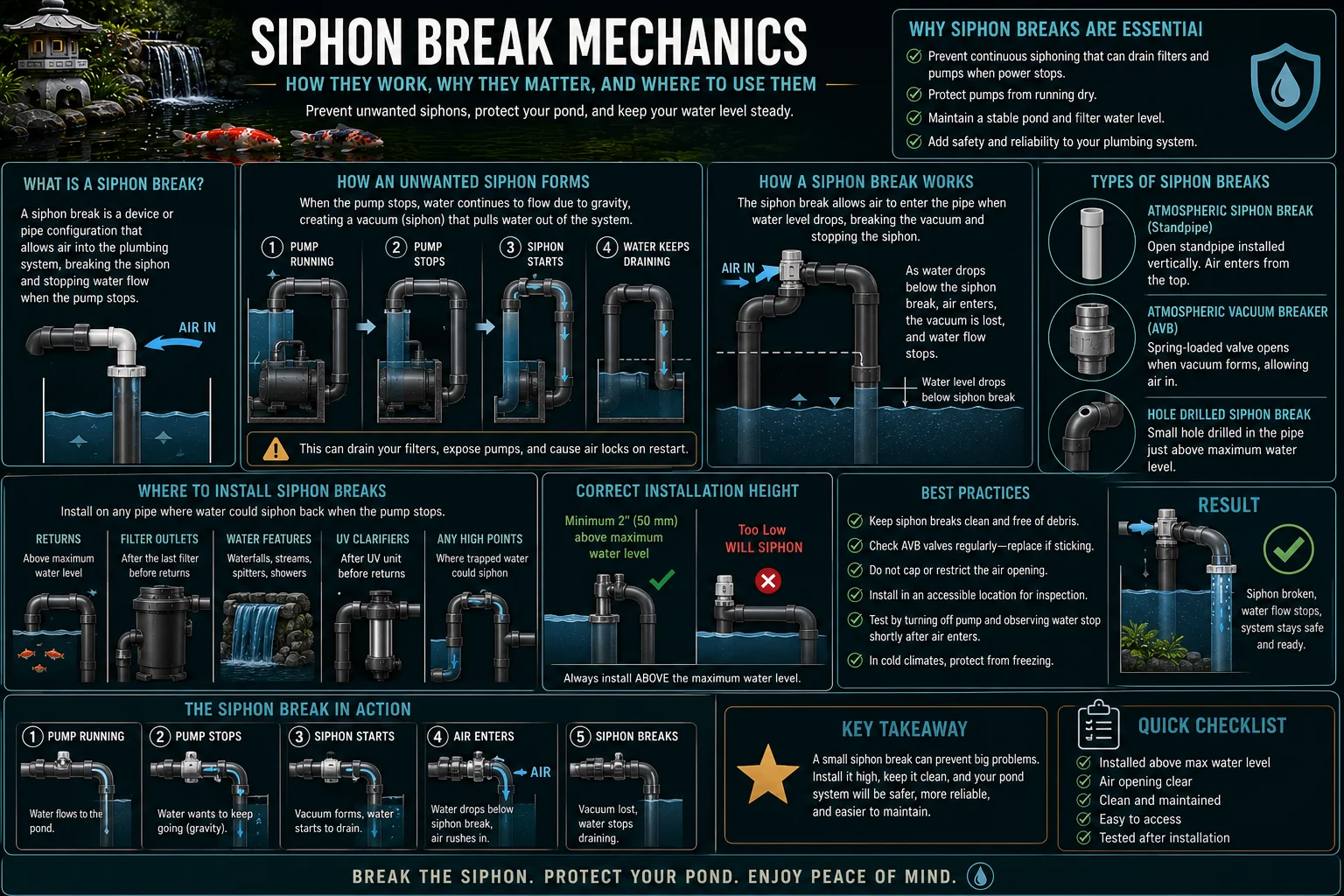
Siphon-Break Mechanics & Anti-Siphoning Weir Height Calibration
A siphon is a remarkable hydraulic phenomenon — it allows water to flow uphill over an obstacle and then downward, driven entirely by atmospheric pressure and gravity. In a koi pond system, siphons are essential for overflow drains, filter bypasses, and water level control. But an uncontrolled siphon can drain a pond to below the intake level, flood a filter pit, or create a vacuum that damages equipment. The solution is a siphon break — a simple hole, valve, or weir calibration that allows air to enter the pipe at the right moment and stop the siphoning action before it becomes destructive.
This page works through the practical physics behind siphon breaks: how atmospheric pressure creates the siphon effect, what determines the maximum siphon height and flow rate, how a properly located break hole or breather tube interrupts the vacuum, and how weir height calibration establishes the precise water level at which the siphon stops. None of the guidance here is a universal prescription — pipe diameter, elevation differences, flow rate, and weir geometry all shift the numbers, so every siphon-break design needs to be checked against the specific system rather than a rule of thumb.
Test Your Siphon-Break Knowledge
Work through ten scenario‑based questions covering siphon physics, break hole sizing, weir height calibration, and installation best practices. Each answer includes the reasoning behind it.
Siphon-Break Mechanics — Quick Facts
Most Asked Questions About Siphon-Break Mechanics
A pond owner installed an overflow siphon to manage heavy rainfall, but every time it rained, the siphon continued to drain the pond well below the intended level. The owner had drilled a 1/4″ break hole in the pipe, but it was positioned too high — above the normal water level — so it never drew air. The siphon continued to run until the water level dropped below the intake.
Relocating the break hole to just below the normal water line, and verifying that it was positioned correctly relative to the weir crest, solved the problem. The siphon now stops at the intended level, and the pond maintains its desired water depth after every rain event.
Siphon Physics And The Role Of Atmospheric Pressure
A siphon works because of atmospheric pressure and gravity. The pipe is filled with water, creating a continuous liquid column. Atmospheric pressure pushes down on the water surface at the intake, forcing water up the intake leg. Gravity pulls water down the longer discharge leg, creating a pressure difference that maintains the flow. The siphon will continue as long as the pipe remains full and the discharge end is lower than the intake.
- Atmospheric pressure: At sea level, atmospheric pressure is approximately 14.7 psi, which can support a column of water about 33 feet (10.3 m) high.
- Gravity: The weight of the water in the discharge leg creates a pressure differential that draws water up the intake side.
- Priming: The siphon must be primed — the pipe must be completely filled with water — before the siphon effect can start.
- Breaking: Introducing air into the pipe at the highest point breaks the vacuum and stops the siphon.
The maximum theoretical siphon height is limited by atmospheric pressure. At sea level, water can be lifted about 33 feet. In practice, the effective height is less because of friction losses in the pipe, air bubbles that accumulate at the high point, and the vapour pressure of water. At higher altitudes, atmospheric pressure is lower, so the maximum siphon height decreases[reference:1].
Behind The Physics: Weir Height Calibration And Flow Rate
The weir height is the elevation of the weir crest relative to the normal water surface. When the water level rises above the weir crest, water flows over the weir and into the siphon pipe, priming the siphon. When the water level drops below the weir crest, the siphon is de‑primed, and the siphon break admits air to stop the flow.
The flow rate over a weir is given by the weir equation: Q = C_w × L × H^(3/2), where C_w is the weir coefficient (typically 3.33 for a sharp-crested weir in imperial units), L is the length of the weir crest, and H is the head (the height of water above the weir crest). This relationship is used to size the weir for the expected flow rate and to determine the water level at which the siphon will prime[reference:2].
A system with an overflow siphon was consistently failing to prime during heavy rain. The weir crest was set too high, so the water level had to rise significantly before the siphon would start. By lowering the weir crest by 2 inches, the siphon primed more easily and started flowing at a lower water level. The weir height calibration was critical to the system’s reliability.
Siphon Break Design: Holes, Tubes, And Valves
There are several methods to create a siphon break:
- Break hole: A small hole drilled in the pipe at the highest point of the siphon, positioned just below the water line. When the water level drops, air is drawn in, breaking the siphon[reference:3].
- Breather tube: A vertical pipe connected to the top of the siphon, with the open end positioned at the desired stop level. More reliable than a simple hole[reference:4][reference:5].
- Check valve: A one-way valve that allows air to enter but prevents water from escaping.
- Float valve: A valve that opens to admit air when the water level drops to a certain point[reference:6].
The break hole or breather tube must be positioned correctly relative to the weir crest. If the break is too low (below the water line during normal operation), it will continuously draw air and disrupt the siphon. If it is too high (above the weir crest), the siphon may not break when the water level drops[reference:7].
A pond system used a simple break hole, but the hole kept clogging with debris. The owner replaced it with a breather tube that extended above the water level, which was much less prone to clogging. The breather tube also allowed easy adjustment of the stop level by sliding the tube up or down.
When sizing a break hole, a larger hole admits more air and breaks the siphon more quickly, but it can also allow water to spray out during normal operation. A hole that is too small may not admit enough air to break the siphon reliably. A 1/8″ to 1/4″ hole is a good starting point for small pond systems[reference:8][reference:9].
The position of the break hole is critical. It should be located on the discharge side of the siphon, at the highest point of the pipe, and just below the normal water level. Some designers recommend positioning the hole at the same height as the bottom of the weir comb[reference:10]. If the hole is positioned too low, it may not break the siphon when needed; if it is too high, it may cause the siphon to lose prime prematurely[reference:11].
Siphon-Break Mechanics — Full Question Library
Review indexed engineering questions below.
Q1:
What is a siphon?
Correct Answer: Option A
A siphon uses atmospheric pressure and gravity to move water from a higher elevation to a lower elevation over an intermediate high point, without requiring a pump.
Q2:
What force primarily drives a siphon?
Correct Answer: Option B
A siphon is driven by atmospheric pressure pushing water up the intake leg and gravity pulling it down the discharge leg.
Q3:
What is the maximum theoretical height a siphon can lift water at sea level?
Correct Answer: Option C
At sea level, atmospheric pressure (14.7 psi) can support a column of water about 33 feet (10.3 metres) high. This is the theoretical maximum siphon lift.[reference:12]
Q4:
What is required for a siphon to start (prime)?
Correct Answer: Option A
A siphon must be primed — the pipe must be completely filled with water — before the siphon effect can begin.
Q5:
What happens when air enters the highest point of a siphon pipe?
Correct Answer: Option B
Introducing air into the highest point of a siphon pipe breaks the vacuum, which stops the siphon flow.
Q6:
What is the effect of altitude on siphon performance?
Correct Answer: Option C
At higher altitudes, atmospheric pressure is lower, so the maximum siphon height decreases.[reference:13]
Q7:
What is the relationship between the intake and discharge elevations in a siphon?
Correct Answer: Option A
For a siphon to work, the discharge end must be lower than the intake end, creating a pressure difference that drives the flow.
Q8:
What is the typical minimum fall required for a siphon system to work reliably?
Correct Answer: Option B
A minimum of 4 feet of fall (inlet to outlet) is typically recommended for a siphon system to work correctly.[reference:14]
Q9:
What is the role of atmospheric pressure in a siphon?
Correct Answer: Option C
Atmospheric pressure pushes down on the water surface at the intake, forcing water up the intake leg of the siphon.
Q10:
What happens to a siphon if the pipe is not completely filled with water?
Correct Answer: Option A
If the pipe contains air bubbles, the siphon may not start or may lose prime, stopping the flow.
Q11:
What is the effect of pipe diameter on siphon flow rate?
Correct Answer: Option B
A larger diameter pipe has a larger cross‑sectional area, which allows a higher flow rate for the same head.
Q12:
What is the relationship between siphon height and flow rate?
Correct Answer: Option C
A higher siphon lift means more friction loss and a lower effective head, which reduces the flow rate.
Q13:
What is the primary cause of siphon failure in pond systems?
Correct Answer: Option A
The most common cause of siphon failure is loss of prime, which occurs when air enters the pipe and breaks the vacuum.
Q14:
What is the purpose of a siphon in a pond system?
Correct Answer: Option B
Siphons are used in pond systems for overflow drainage and water level control, moving water from the pond to a lower elevation.[reference:15]
Q15:
What is the effect of water temperature on siphon performance?
Correct Answer: Option C
Warmer water has a higher vapour pressure, which reduces the effective lift height of a siphon slightly.
Q16:
What is the difference between a siphon and a pump?
Correct Answer: Option A
A siphon uses atmospheric pressure and gravity to move water, while a pump uses mechanical energy.
Q17:
What is the effect of pipe roughness on siphon flow?
Correct Answer: Option B
Rough pipes create more friction, which reduces the flow rate for a given head.
Q18:
What is the minimum depth of water required to prime a siphon?
Correct Answer: Option C
The intake opening must be submerged below the water surface to allow the siphon to prime.
Q19:
What is the relationship between siphon flow and the height difference between intake and discharge?
Correct Answer: Option A
A larger height difference creates a larger pressure differential, which drives a higher flow rate.
Q20:
What is the most common application of a siphon in a koi pond?
Correct Answer: Option B
Siphons are commonly used in koi ponds for overflow drainage and to prevent the pond from overflowing during heavy rain.[reference:16]
Q21:
What is a siphon break?
Correct Answer: Option A
A siphon break introduces air into the pipe, breaking the vacuum and stopping the siphon[reference:17].
Q22:
What is the most common type of siphon break in a pond system?
Correct Answer: Option B
The most common siphon break is a small hole drilled in the pipe at the highest point of the siphon[reference:18].
Q23:
Where should a siphon break hole be positioned?
Correct Answer: Option C
The break hole should be positioned at the highest point of the siphon, just below the water line, so it draws air when the water level drops.[reference:19]
Q24:
What is the typical size of a siphon break hole in a small pond system?
Correct Answer: Option A
A 1/8″ to 1/4″ hole is typical for small pond systems[reference:20][reference:21].
Q25:
What happens if the siphon break hole is too large?
Correct Answer: Option B
A hole that is too large can allow water to spray out and may admit too much air, causing the siphon to lose prime.
Q26:
What happens if the siphon break hole is too small?
Correct Answer: Option C
If the hole is too small, it may not admit enough air to break the siphon, allowing the siphon to continue draining the pond.
Q27:
What is a breather tube?
Correct Answer: Option A
A breather tube is a vertical pipe connected to the highest point of the siphon, with the open end positioned at the desired stop level[reference:22].
Q28:
How does a breather tube differ from a simple break hole?
Correct Answer: Option B
A breather tube is less prone to clogging and allows the stop level to be adjusted by moving the tube up or down.
Q29:
What is the purpose of positioning the breather tube opening at the weir crest level?
Correct Answer: Option C
When the water level drops below the weir crest, the breather tube opening is exposed to air, breaking the siphon[reference:23].
Q30:
What is the recommended minimum diameter for a breather tube?
Correct Answer: Option A
A breather tube with a diameter of at least 4 mm is recommended to ensure reliable air intake[reference:24].
Q31:
What is the effect of a siphon break on the water level in the pond?
Correct Answer: Option B
The siphon break stops the siphon when the water level drops to the desired minimum level.
Q32:
Why is a siphon break necessary in an overflow siphon?
Correct Answer: Option C
Without a siphon break, an overflow siphon can continue to drain the pond below the intake level[reference:25].
Q33:
What is a siphon-break valve?
Correct Answer: Option A
A siphon-break valve is a mechanical valve that opens to admit air when the water level drops to a set point[reference:26].
Q34:
How does a float valve work as a siphon break?
Correct Answer: Option B
A float valve uses a float to sense the water level and opens to admit air when the level drops[reference:27].
Q35:
What is the advantage of a breather tube over a simple break hole?
Correct Answer: Option C
A breather tube is less prone to clogging because it extends above the water level, and its height can be adjusted[reference:28].
Q36:
What is the effect of a siphon break on the flow rate?
Correct Answer: Option A
A properly sized and positioned siphon break should not significantly affect the normal flow rate.
Q37:
What happens if the siphon break hole is positioned below the water line?
Correct Answer: Option B
If the break hole is below the water line, it is always submerged and cannot admit air to break the siphon.
Q38:
What is the recommended way to prevent a break hole from clogging?
Correct Answer: Option C
A breather tube is less prone to clogging than a simple hole because it extends above the water level.
Q39:
What is the effect of multiple siphon break holes?
Correct Answer: Option A
Using two or more break holes at opposite sides of the pipe provides redundancy[reference:29].
Q40:
What is the most reliable siphon break method?
Correct Answer: Option B
A breather tube or siphon-break valve with an air gap is the most reliable method[reference:30].
Q41:
What is a weir in the context of a pond system?
Correct Answer: Option A
A weir is an overflow structure that controls the water level in a pond or tank.
Q42:
What is the weir crest?
Correct Answer: Option B
The weir crest is the top edge of the weir structure. When the water level exceeds the crest, water flows over the weir.
Q43:
What is weir height?
Correct Answer: Option C
Weir height is the distance from the normal water surface to the top of the weir crest.
Q44:
How does weir height affect siphon operation?
Correct Answer: Option A
The weir height sets the water level at which the siphon starts (priming) and stops (de‑priming).
Q45:
What is the relationship between weir height and the siphon stop level?
Correct Answer: Option B
When the water level drops below the weir crest, the siphon is de‑primed and the siphon break admits air.
Q46:
What is the formula for flow over a rectangular weir?
Correct Answer: Option C
The weir equation is Q = C × L × H^(3/2), where C is the weir coefficient, L is the crest length, and H is the head.[reference:31]
Q47:
What is the typical weir coefficient (C) for a sharp-crested rectangular weir?
Correct Answer: Option A
For a sharp-crested rectangular weir in imperial units, the weir coefficient is approximately 3.33.
Q48:
What is the effect of increasing the weir crest length on flow rate?
Correct Answer: Option B
Flow over a weir is directly proportional to the crest length, so a longer crest allows more flow.
Q49:
What is the effect of increasing the head (H) on weir flow?
Correct Answer: Option C
Flow over a weir increases with the head raised to the power of 3/2, so a small increase in head significantly increases flow.
Q50:
What is a contracted weir?
Correct Answer: Option A
In a contracted weir, the crest is shorter than the channel, and the flow contracts at the ends.
Q51:
What is a suppressed weir?
Correct Answer: Option B
A suppressed weir extends across the full width of the channel, with no end contractions.
Q52:
What is the effect of a weir comb on flow measurement?
Correct Answer: Option C
A weir comb with multiple notches can provide more accurate flow measurement by creating a more stable flow pattern.
Q53:
How does weir height calibration affect the reliability of a siphon break?
Correct Answer: Option A
The weir height must be calibrated so that the siphon break is exposed to air at the correct water level.
Q54:
What is the recommended weir height for a typical pond overflow siphon?
Correct Answer: Option B
The weir height must be set based on the desired maximum water level and the required flow capacity.
Q55:
What is the effect of a weir that is set too low?
Correct Answer: Option C
If the weir is set too low, the siphon will de‑prime at a lower water level, keeping the pond level below the desired point.
Q56:
What is the effect of a weir that is set too high?
Correct Answer: Option A
If the weir is set too high, the water level must rise significantly before the siphon primes, which may not happen during normal rain events.
Q57:
What is the relationship between weir height and the breather tube position?
Correct Answer: Option B
The breather tube opening should be positioned at or just above the weir crest so it is exposed to air when the water level drops[reference:32].
Q58:
What is the effect of a weir comb on the weir coefficient?
Correct Answer: Option C
The teeth of a weir comb create a more complex flow pattern, which can alter the effective weir coefficient.
Q59:
How can you adjust the weir height in an existing pond?
Correct Answer: Option A
Adjustable weir plates or moving the weir structure can change the weir height.
Q60:
What is the most important consideration when calibrating weir height?
Correct Answer: Option B
The weir height must be calibrated to maintain the desired water level in the pond.
Q61:
How do you calculate the required siphon break hole size?
Correct Answer: Option A
Siphon break hole sizing is typically done empirically, starting with a 1/8″ to 1/4″ hole.[reference:33]
Q62:
What is the relationship between siphon break hole size and the flow rate?
Correct Answer: Option B
A properly sized siphon break hole should not significantly affect the normal flow rate.
Q63:
How does the position of the siphon break hole affect its effectiveness?
Correct Answer: Option C
The break hole must be at the highest point of the siphon so that air is drawn in when the water level drops[reference:34].
Q64:
What is the recommended distance between the siphon break hole and the water surface?
Correct Answer: Option A
The break hole should be positioned just below the water surface so it draws air when the level drops[reference:35].
Q65:
What is the effect of the break hole being positioned too far below the water surface?
Correct Answer: Option B
If the hole is too far below the water surface, it will remain submerged when the water level drops, preventing the siphon from breaking.
Q66:
What is the relationship between the break hole position and the weir crest?
Correct Answer: Option C
Positioning the break hole at the same height as the bottom of the weir comb ensures the siphon breaks at the correct level[reference:36].
Q67:
How do you calculate the flow rate of a siphon?
Correct Answer: Option A
Siphon flow can be calculated using the orifice equation: Q = C × A × √(2gh), where h is the head[reference:37].
Q68:
What is the effect of friction loss on siphon flow rate?
Correct Answer: Option B
Friction loss in the pipe reduces the effective head, which reduces the flow rate.
Q69:
What is the maximum flow rate of a siphon determined by?
Correct Answer: Option C
The maximum flow rate is determined by the pipe diameter, the height difference, and the friction losses in the pipe.
Q70:
What is the minimum diameter for a breather tube to be effective?
Correct Answer: Option A
A breather tube diameter of at least 4 mm is recommended for reliable air intake[reference:38].
Q71:
What is the effect of a siphon break on the total system head?
Correct Answer: Option B
A properly designed siphon break adds very little head loss to the system.
Q72:
What is the relationship between the breather tube height and the stop level?
Correct Answer: Option C
The position of the breather tube opening sets the water level at which air enters the siphon, breaking the flow[reference:39].
Q73:
What is the effect of air bubbles in the siphon pipe on the flow rate?
Correct Answer: Option A
Air bubbles in the siphon pipe reduce the effective cross‑sectional area and can cause the siphon to lose prime.
Q74:
How can you calculate the volume of water that will drain before the siphon breaks?
Correct Answer: Option B
The volume of water that drains before the siphon breaks equals the pond surface area multiplied by the drop in water level.
Q75:
What is the relationship between the break hole diameter and the air flow rate?
Correct Answer: Option C
Air flow rate through the break hole is proportional to the cross‑sectional area of the hole.
Q76:
What is the recommended way to size a breather tube?
Correct Answer: Option A
A breather tube with a diameter of at least 4 mm, positioned at the desired stop level, is recommended[reference:40].
Q77:
What is the effect of a siphon break on the pump’s operating point?
Correct Answer: Option B
A siphon break is typically on the overflow or drain side of the system and does not affect the pump’s operating point.
Q78:
What is the relationship between the siphon break hole and the water level drop?
Correct Answer: Option C
The position of the break hole relative to the water surface determines the water level at which the siphon breaks.
Q79:
How can you test if a siphon break is working correctly?
Correct Answer: Option A
The simplest test is to observe whether the siphon stops when the water level drops to the weir crest.
Q80:
What is the most important factor in siphon break design?
Correct Answer: Option B
The most important factor is positioning the break hole or breather tube correctly relative to the weir crest[reference:41].
Q81:
What is the most common cause of siphon break failure?
Correct Answer: Option A
The most common failure is incorrect positioning of the break hole, which prevents it from admitting air when needed[reference:42].
Q82:
What should you check first if a siphon is not breaking?
Correct Answer: Option B
The first thing to check is whether the break hole is positioned correctly and not clogged.
Q83:
What is the effect of a clogged siphon break hole?
Correct Answer: Option C
A clogged break hole cannot admit air, so the siphon continues to run and may drain the pond too low.
Q84:
How can you prevent a siphon break hole from clogging?
Correct Answer: Option A
A breather tube is less prone to clogging because it extends above the water level.
Q85:
What is the effect of a siphon that does not break?
Correct Answer: Option B
If the siphon does not break, it will continue to drain the pond, potentially emptying it completely[reference:43].
Q86:
What is the effect of a siphon that breaks too early?
Correct Answer: Option C
If the break occurs too early, the siphon may not remove enough water, and the pond level may remain too high.
Q87:
What is the most common sign of a failing siphon break?
Correct Answer: Option A
The most obvious sign is that the water level drops below the intended level, indicating the siphon is not breaking.
Q88:
How can you test a breather tube siphon break?
Correct Answer: Option B
Lower the water level to the weir crest and observe whether the breather tube draws air and stops the siphon.
Q89:
What is the effect of debris blocking the breather tube?
Correct Answer: Option C
If the breather tube is blocked, air cannot enter the pipe, and the siphon will not break.
Q90:
How do you clean a clogged siphon break hole?
Correct Answer: Option A
A small drill bit or wire can be used to clear debris from a clogged break hole.
Q91:
What is the effect of a siphon break that is positioned too high?
Correct Answer: Option B
If the break hole is too high, it may not be submerged during normal operation and may never draw air to break the siphon.
Q92:
What is the recommended way to prevent debris from entering a breather tube?
Correct Answer: Option C
A screen or perforated cap can prevent debris from entering the breather tube while allowing air to flow.
Q93:
What is the effect of a siphon that does not prime?
Correct Answer: Option A
If the siphon does not prime, it will not remove overflow water, and the pond may overflow.
Q94:
What is the most common cause of a siphon failing to prime?
Correct Answer: Option B
Air in the pipe prevents the siphon from priming, and a weir set too high prevents the water from reaching the siphon intake.
Q95:
How can you remove air from a siphon pipe to help it prime?
Correct Answer: Option C
Air can be bled from the highest point of the siphon pipe through a vent or valve.
Q96:
What is the effect of a siphon break that is positioned too low?
Correct Answer: Option A
If the break hole is too low, the siphon will continue to drain the pond until the water level drops below the hole.
Q97:
What is the recommended way to adjust the stop level of a breather tube?
Correct Answer: Option B
The breather tube can be slid up or down to change the height of the opening and adjust the stop level.
Q98:
What is the effect of a siphon that breaks too early?
Correct Answer: Option C
If the siphon breaks too early, it may not remove enough overflow water, and the pond level may remain too high.
Q99:
What is the most reliable way to ensure a siphon break works in all conditions?
Correct Answer: Option A
A combination of a breather tube and a properly calibrated weir is the most reliable siphon break method.
Q100:
What is the most important step in troubleshooting a siphon break?
Correct Answer: Option B
The most important troubleshooting step is to verify that the break hole or breather tube is positioned correctly[reference:44].
Q101:
What is a syphon (siphon) used for in pond management?
Correct Answer: Option A
Siphons are used to drain ponds, control water levels, and move water without the need for a pump.[reference:45]
Q102:
What is the maximum theoretical height a siphon can lift water at sea level?
Correct Answer: Option B
At sea level, atmospheric pressure can support a column of water about 33 feet (10.3 metres) high.[reference:46]
Q103:
What is a siphon breaker used for?
Correct Answer: Option C
A siphon breaker admits air into the pipe to stop the siphoning action.[reference:47]
Q104:
How does a siphon breaker work?
Correct Answer: Option A
A siphon breaker introduces air into the pipe, breaking the vacuum and stopping the siphon.[reference:48]
Q105:
What is the purpose of a weir in a siphon system?
Correct Answer: Option B
The weir controls the water level and de‑primes the siphon when the water level drops.[reference:49]
Q106:
What is a siphon break hole used for?
Correct Answer: Option C
A siphon break hole admits air into the pipe to stop the siphon.[reference:50]
Q107:
What is the relationship between a weir and a siphon break?
Correct Answer: Option A
The weir height sets the water level at which the siphon break is exposed to air[reference:51].
Q108:
What is the recommended hole size for an anti‑siphon hole?
Correct Answer: Option B
A hole size of 1/8″ to 1/4″ (3–6 mm) is typically recommended for anti‑siphon applications.[reference:52][reference:53]
Q109:
Where should an anti‑siphon hole be drilled?
Correct Answer: Option C
The anti‑siphon hole should be drilled at the highest point of the siphon, just below the water line.[reference:54]
Q110:
What is the primary purpose of a siphon break in a pond overflow system?
Correct Answer: Option A
The siphon break prevents the pond from draining below the desired level[reference:55].
Q111:
What is the effect of a siphon that is not properly vented?
Correct Answer: Option B
An unvented siphon can create a vacuum that may damage equipment or cause flow to stop and start erratically.
Q112:
How does a siphon breaker valve work?
Correct Answer: Option C
A siphon breaker valve opens to admit air when the pressure drops, breaking the siphon[reference:56].
Q113:
What is the primary advantage of using a siphon for pond drainage?
Correct Answer: Option A
A siphon does not require a pump, making it a simple and energy‑free way to move water.
Q114:
What is the typical minimum pipe diameter for a siphon used in pond drainage?
Correct Answer: Option B
A 1–2 inch pipe is typically used for siphon drainage in pond systems.
Q115:
What is the effect of a siphon on the pond’s ecosystem?
Correct Answer: Option C
By maintaining stable water levels, a siphon can help improve water quality in the pond.
Q116:
What is the relationship between siphon flow and the outlet elevation?
Correct Answer: Option A
A lower outlet elevation increases the height difference, which increases the flow rate.
Q117:
What is the recommended slope for a siphon pipe?
Correct Answer: Option B
The siphon pipe should slope downward from the intake to the discharge to ensure proper flow.
Q118:
What is the effect of a siphon on the pump’s energy consumption?
Correct Answer: Option C
A siphon can reduce energy consumption by moving water without a pump.
Q119:
What is the most important consideration when designing a siphon system?
Correct Answer: Option A
The most important consideration is ensuring the siphon breaks at the correct water level to prevent over‑draining.
Q120:
What is the relationship between siphon height and the risk of losing prime?
Correct Answer: Option B
A higher siphon height increases the risk of losing prime because the pressure at the top of the siphon is lower.
Q121:
What was the primary cause of the siphon failure in the field note example?
Correct Answer: Option A
The break hole was positioned too high, so it never drew air to break the siphon.
Q122:
What was the solution to the field note problem?
Correct Answer: Option B
Relocating the break hole to just below the water line solved the problem.
Q123:
What was the consequence of the siphon failure in the field note?
Correct Answer: Option B
The siphon continued to drain the pond well below the intended level because it never broke.
Q124:
What was the primary cause of the weir calibration issue in the second field note?
Correct Answer: Option A
The weir crest was set too high, so the water level had to rise significantly before the siphon would start.
Q125:
What was the solution to the weir calibration problem?
Correct Answer: Option B
Lowering the weir crest by 2 inches allowed the siphon to prime more easily.
Q126:
What was the effect of lowering the weir crest in the second field note?
Correct Answer: Option C
Lowering the weir crest allowed the siphon to prime more easily and start at a lower water level.
Q127:
What was the primary cause of the breather tube issue in the third field note?
Correct Answer: Option A
The simple break hole kept clogging, so the owner replaced it with a breather tube.
Q128:
What was the solution to the clogged break hole problem?
Correct Answer: Option B
The owner replaced the clogged break hole with a breather tube that extended above the water level.
Q129:
What was the advantage of the breather tube in the third field note?
Correct Answer: Option C
The breather tube was less prone to clogging and allowed easy adjustment of the stop level by sliding the tube up or down.
Q130:
What was the key lesson from the first field note?
Correct Answer: Option A
The position of the break hole relative to the water line is critical for the siphon to break correctly.
Q131:
What was the key lesson from the second field note?
Correct Answer: Option A
Proper weir height calibration is essential for the siphon to prime at the correct water level.
Q132:
What was the key lesson from the third field note?
Correct Answer: Option B
A breather tube is more reliable and less prone to clogging than a simple break hole.
Q133:
What was the common theme across all three field notes?
Correct Answer: Option A
In all three cases, the problems were caused by incorrect positioning or calibration of the siphon break components.
Q134:
What was the effect of the break hole being positioned too high in the first field note?
Correct Answer: Option B
Because the break hole was above the water line, it never drew air, and the siphon continued to drain the pond.
Q135:
What was the effect of the weir being set too high in the second field note?
Correct Answer: Option C
The weir was set too high, so the siphon did not prime until the water level rose significantly.
Q136:
What was the most significant benefit of the breather tube in the third field note?
Correct Answer: Option A
The breather tube could be slid up or down to adjust the stop level.
Q137:
What was the primary lesson about weir height from the second field note?
Correct Answer: Option B
The weir height must be calibrated to ensure the siphon primes at the correct water level.
Q138:
What was the effect of the clogged break hole in the third field note?
Correct Answer: Option C
The clogged break hole could not admit air, so the siphon did not break.
Q139:
What was the most important takeaway from all three field notes?
Correct Answer: Option A
The consistent theme across all three field notes is that correct positioning and calibration are essential for reliable siphon break operation.
Q140:
What was the recommended solution for the first field note problem?
Correct Answer: Option B
Relocating the break hole to just below the water line solved the problem.
Q141:
What is the most important safety consideration when using a siphon?
Correct Answer: Option A
The most important safety consideration is preventing the siphon from over‑draining the pond.
Q142:
What is the recommended way to prevent backsiphonage in a pond system?
Correct Answer: Option B
A siphon break or air gap is the recommended way to prevent backsiphonage[reference:57].
Q143:
What is the relationship between a siphon break and backflow prevention?
Correct Answer: Option A
A siphon break allows air into the pipe, which prevents backflow[reference:58].
Q144:
What is the recommended air gap for an anti‑siphon device?
Correct Answer: Option A
An air gap of at least twice the pipe diameter is recommended for reliable anti‑siphon protection[reference:59].
Q145:
What is the effect of a siphon on the pump’s suction line?
Correct Answer: Option B
A siphon can create a vacuum in the suction line, which can affect the pump’s operation.
Q146:
What is the recommended way to test an anti‑siphon device?
Correct Answer: Option C
The most reliable test is to simulate a power failure or pump stop and observe whether the siphon breaks.
Q147:
What is the relationship between a siphon break and water hammer?
Correct Answer: Option A
By allowing air into the pipe, a siphon break can reduce the risk of water hammer.
Q148:
What is the recommended material for a siphon break hole?
Correct Answer: Option B
PVC is corrosion‑resistant and commonly used for siphon break holes.
Q149:
What is the effect of a siphon on the pond’s water level?
Correct Answer: Option C
A siphon lowers the water level until the siphon break stops the flow.
Q150:
What is the recommended way to prevent a siphon from starting accidentally?
Correct Answer: Option A
A siphon cannot start if the pipe is not completely filled with water.
Q151:
What is the relationship between a siphon break and the pond’s overflow level?
Correct Answer: Option B
The siphon break determines the minimum water level (where the siphon stops).
Q152:
What is the most important factor in siphon break reliability?
Correct Answer: Option C
Correct positioning and regular maintenance are the most important factors for reliability.
Q153:
What is the recommended inspection frequency for a siphon break?
Correct Answer: Option A
Monthly inspection for debris and proper operation is recommended.
Q154:
What is the effect of a siphon on the pond’s oxygen levels?
Correct Answer: Option B
The movement of water through a siphon can help aerate the pond.
Q155:
What is the relationship between a siphon break and the pond’s filter?
Correct Answer: Option C
A siphon break prevents the pond from draining too low, which can protect the filter from running dry.
Q156:
What is the recommended way to mark the correct weir height?
Correct Answer: Option A
The correct weir height can be marked by observing the water level during normal operation.
Q157:
What is the effect of a siphon on the pond’s pump?
Correct Answer: Option B
A siphon can help prime the pump by maintaining water in the suction line.
Q158:
What is the relationship between a siphon break and the pond’s overflow pipe?
Correct Answer: Option C
The siphon break is typically part of the overflow pipe system[reference:60].
Q159:
What is the most important thing to remember about siphon breaks?
Correct Answer: Option A
Correct positioning is the most important factor in siphon break reliability.
Q160:
What is the recommended way to prevent debris from entering the siphon intake?
Correct Answer: Option B
A screen or strainer on the intake prevents debris from entering the siphon pipe.
Q161:
What is the formula for flow through a siphon?
Correct Answer: Option A
Siphon flow can be calculated using the orifice equation: Q = C × A × √(2gh).[reference:61]
Q162:
What is the formula for flow over a rectangular weir?
Correct Answer: Option B
The weir equation is Q = C × L × H^(3/2).[reference:62]
Q163:
What is the typical discharge coefficient (C) for a sharp‑crested weir?
Correct Answer: Option C
For a sharp‑crested rectangular weir in imperial units, the discharge coefficient is approximately 3.33.
Q164:
What is the formula for the velocity of water in a siphon?
Correct Answer: Option A
The velocity of water in a siphon is given by v = √(2gh) for an ideal siphon.
Q165:
What is the maximum theoretical height of a siphon at sea level?
Correct Answer: Option B
At sea level, atmospheric pressure can support a column of water about 10.3 metres (33 feet) high.[reference:63]
Q166:
What is the relationship between the siphon height and the flow rate?
Correct Answer: Option C
A higher siphon height means more friction loss and a lower effective head, which reduces the flow rate.
Q167:
What is the formula for the head loss in a siphon pipe?
Correct Answer: Option A
The Darcy‑Weisbach equation is used to calculate head loss: h_f = f × (L/D) × (v²/2g).
Q168:
What is the relationship between the break hole diameter and the air flow rate?
Correct Answer: Option B
Air flow rate through a break hole is proportional to the cross‑sectional area of the hole.
Q169:
What is the relationship between the weir crest length and the flow rate?
Correct Answer: Option C
Flow over a weir is directly proportional to the crest length.
Q170:
What is the formula for the volume of water that drains before the siphon breaks?
Correct Answer: Option A
The volume of water that drains before the siphon breaks equals the pond surface area multiplied by the drop in water level.
Q171:
What is the relationship between the breather tube height and the stop level?
Correct Answer: Option B
The height of the breather tube opening determines the water level at which the siphon breaks[reference:64].
Q172:
What is the relationship between the weir height and the water level in the pond?
Correct Answer: Option B
The weir height determines the maximum water level; when water rises above the weir crest, it flows over.[reference:65]
Q173:
What is the formula for the pressure at the top of a siphon?
Correct Answer: Option A
The pressure at the top of a siphon is P = ρ × g × h, where h is the height of the water column.
Q174:
What is the relationship between the siphon pipe diameter and the flow rate?
Correct Answer: Option B
Flow rate is proportional to the cross‑sectional area of the pipe.
Q175:
What is the relationship between the siphon height and the risk of losing prime?
Correct Answer: Option C
A higher siphon height means lower pressure at the top of the siphon, which increases the risk of losing prime.
Q176:
What is the formula for the volume of water in a pipe?
Correct Answer: Option A
The volume of water in a pipe is the cross‑sectional area times the length: V = π × (D/2)² × L.
Q177:
What is the relationship between the break hole and the water level drop?
Correct Answer: Option B
The position of the break hole determines how much the water level drops before the siphon breaks.
Q178:
What is the relationship between the weir crest and the breather tube position?
Correct Answer: Option C
The breather tube opening should be at or just above the weir crest[reference:66].
Q179:
What is the formula for the volume of a pond that will drain before the siphon breaks?
Correct Answer: Option A
The volume that drains is the pond surface area multiplied by the drop in water level.
Q180:
What is the most important calculation in siphon break design?
Correct Answer: Option B
The most important calculation is determining the correct position of the break hole or breather tube relative to the weir crest.
Q181:
What is a siphon-break valve?
Correct Answer: Option A
A siphon-break valve is a mechanical valve that opens to admit air when the water level drops.[reference:67]
Q182:
What is a float‑controlled siphon break?
Correct Answer: Option B
A float‑controlled siphon break uses a float to sense the water level and open a vent when the level drops[reference:68].
Q183:
What is a vacuum breaker?
Correct Answer: Option C
A vacuum breaker admits air to prevent a vacuum from forming in the pipe.
Q184:
What is the relationship between a vacuum breaker and a siphon break?
Correct Answer: Option A
A vacuum breaker is a type of siphon break that admits air to prevent vacuum formation.
Q185:
What is an anti‑siphon valve?
Correct Answer: Option B
An anti‑siphon valve prevents backflow by allowing air into the pipe[reference:69].
Q186:
What is the purpose of a check valve in a siphon system?
Correct Answer: Option C
A check valve prevents backflow and protects the pump from reverse rotation.
Q187:
What is the relationship between a siphon break and a check valve?
Correct Answer: Option A
A siphon break admits air to prevent backflow, while a check valve uses a mechanical disc.
Q188:
What is the advantage of a mechanical siphon break over a simple hole?
Correct Answer: Option B
A mechanical siphon break is more reliable and less prone to clogging than a simple hole.
Q189:
What is the purpose of a breather pipe in a siphon system?
Correct Answer: Option C
A breather pipe admits air to break the siphon when the water level drops[reference:70].
Q190:
What is the relationship between a breather pipe and a weir?
Correct Answer: Option A
The breather pipe opening is positioned at the weir crest level so it is exposed to air when the water level drops[reference:71].
Q191:
What is the most reliable type of siphon break?
Correct Answer: Option B
A combination of a breather tube and a properly calibrated weir is the most reliable siphon break.[reference:72]
Q192:
What is the purpose of a siphon in a pond filtration system?
Correct Answer: Option C
A siphon can be used to move water from the pond to a filter or drain without a pump.
Q193:
What is the relationship between a siphon and a pump in a pond system?
Correct Answer: Option A
A siphon can be used in conjunction with a pump to move water without additional energy input.
Q194:
What is the advantage of a siphon over a pump for pond drainage?
Correct Answer: Option B
A siphon does not require electricity or mechanical parts, making it a simple and energy‑free solution.
Q195:
What is the most important maintenance task for a siphon break?
Correct Answer: Option C
Regular inspection and cleaning of the break hole or breather tube is the most important maintenance task.
Q196:
What is the relationship between a siphon break and the pond’s water quality?
Correct Answer: Option A
By preventing over‑draining and maintaining stable water levels, a siphon break can help improve water quality.
Q197:
What is the recommended way to install a breather tube?
Correct Answer: Option B
A breather tube should be installed with an adjustable fitting so the height can be changed to calibrate the stop level.
Q198:
What is the effect of a breather tube that is too long?
Correct Answer: Option C
If the breather tube is too long, the opening may be above the water level during normal operation, preventing the siphon from priming.
Q199:
What is the effect of a breather tube that is too short?
Correct Answer: Option A
If the breather tube is too short, the opening may be below the desired stop level, causing the siphon to drain too low.
Q200:
What is the most important factor in choosing a siphon break method?
Correct Answer: Option B
Reliability and the ability to maintain the correct stop level are the most important factors in choosing a siphon break method.