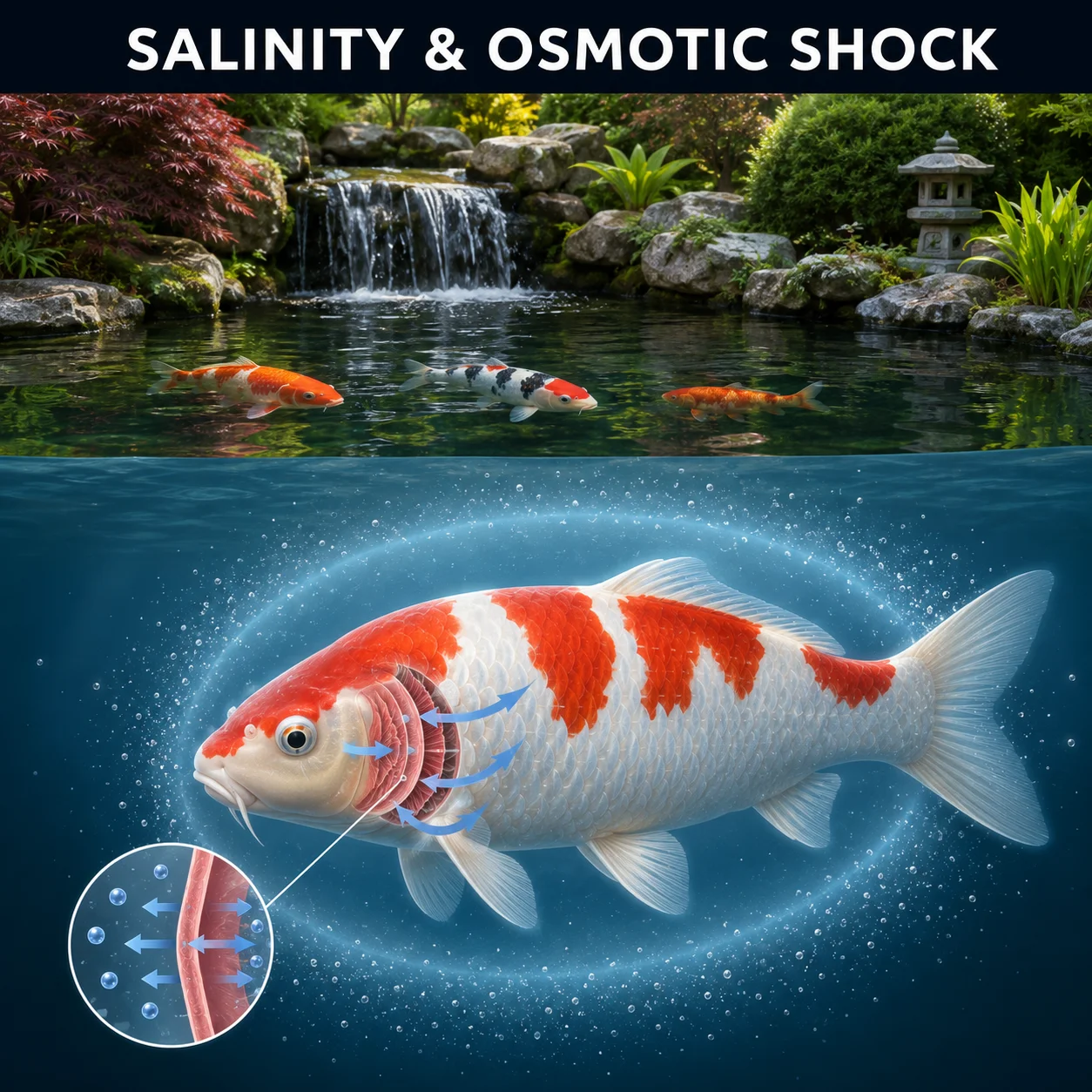
Therapeutic Sodium Chloride — Salinity Curves & Osmotic Shock Physics
Salt (sodium chloride) has been used in koi husbandry for decades, but its mode of action is often misunderstood. At therapeutic concentrations (0.3%–0.6% by weight), NaCl alters the osmotic gradient between the fish’s internal fluids and the surrounding water. This gradient can be leveraged to manage parasitic infections—particularly Costia, Chilodonella, and Trichodina—by creating an environment that is physiologically stressful to the parasite while remaining within the koi’s tolerance window. However, the margin between therapeutic efficacy and acute osmotic shock is narrow, and the salinity curve is nonlinear: as salt concentration rises, the osmotic differential increases exponentially, and the fish must expend increasing energy on osmoregulation.
This page examines the physics behind salinity-driven osmotic shock: how sodium chloride dissociates in water, how it affects the membrane potential of parasites, and how to read a salinity response curve. We also cover practical protocols for salt baths, long-term low-level salting, and the critical importance of accurate measurement (refractometer vs. hydrometer). All guidance must be tailored to the specific pond volume, fish load, and species tolerance; there is no universal salt recipe.
Test Your Salinity & Osmotic Shock Knowledge
Work through ten scenario-based questions covering osmotic principles, salinity curves, parasite physiology, measurement, and safe salt application. Each answer includes the reasoning behind it.
Salinity & Osmotic Shock — Quick Facts
Most Asked Questions About Salinity & Osmotic Shock
During a spring outbreak of Costia in a 5,000-gallon koi pond, the owner added salt at a rate of 1 lb per 100 gallons, aiming for 0.3%. However, they used a hydrometer that was never calibrated, and the actual salinity reached 0.8% after 48 hours. Several koi showed severe distress—clamped fins, gasping, and one fish lost equilibrium. Emergency dilution with fresh water over 6 hours brought the salinity back to 0.3%, and the fish recovered, but the incident underscores the importance of accurate measurement and gradual acclimation.
After the event, the pond was maintained at 0.4% for 10 days, and the Costia infestation cleared without further losses. The lesson: slow increments, precise measurement, and close observation are non-negotiable when using salt therapeutically.
Osmotic Pressure & Salinity Curves
The osmotic pressure exerted by a sodium chloride solution is governed by the van ‘t Hoff equation: π = iMRT, where i is the van ‘t Hoff factor (2 for NaCl, because it dissociates into Na⁺ and Cl⁻), M is the molar concentration, R is the ideal gas constant, and T is absolute temperature. For koi pond applications, this translates into a roughly linear relationship between salinity (g/L) and osmotic pressure, but the biological response is nonlinear: small changes in salinity near 0.5% can double the osmotic gradient experienced by the fish’s gill epithelium.
- Isosmotic point: The salinity at which the fish’s internal osmotic pressure equals that of the water (~0.9% NaCl). Koi are hyperosmotic regulators; they maintain internal osmolarity around 300–350 mOsm/L, equivalent to ~0.9% salt.
- Sub-therapeutic range: 0.1–0.2% — minimal effect on parasites; may reduce stress in some cases.
- Therapeutic range: 0.3–0.6% — creates a favorable osmotic gradient that dehydrates many external parasites.
- Shock threshold: >0.7% — risk of acute osmotic shock increases, especially in warm water or compromised fish.
The salinity curve is not a simple line; the biological response depends on the rate of change, water temperature, and the fish’s health status. A sudden increase from 0.2% to 0.5% over 2 hours is far more dangerous than a gradual increase over 48 hours, even though the final concentration is the same.
Parasite Vulnerability & Membrane Dynamics
External parasites such as Ichthyophthirius (free-swimming theronts) and Chilodonella have semipermeable membranes that are more permeable to water than the koi’s gill epithelium. When placed in a hypertonic environment (higher salt concentration outside), water flows out of the parasite cells, causing them to shrink and die. The process is purely osmotic—there is no chemical toxicity. This is why salt is effective against many protozoan parasites but has no effect on bacterial infections or flukes, which have thicker cuticles.
A common mistake is using salt as a “tonic” at low levels (0.1%) continuously, believing it prevents disease. While low-level salt can reduce stress in some cases, it does not provide therapeutic benefits against parasites and can actually promote the growth of salt-tolerant organisms over time. Moreover, chronic salt exposure has been linked to renal hypertrophy in koi, potentially shortening lifespan. Salt should be used as a targeted treatment, not a permanent additive.
Practical Salt Application Protocols
For a pond treatment, the target salinity is typically 0.3–0.5%. Calculate the total salt needed as: (pond volume in gallons × 0.003) = pounds of salt for 0.3%. For example, a 1,000-gallon pond requires 3 pounds of salt to reach 0.3%. Always dissolve salt in a bucket of pond water before distributing it around the pond, preferably near the return flow to aid mixing. Monitor salinity with a refractometer every 6 hours during the ramp-up phase.
For a dip/bath treatment, prepare a separate container with pond water and salt at 1.5–2.0%. Place the fish in the bath for 30–60 seconds (for 2.0%) up to 5 minutes (for 1.5%). Watch for signs of distress—rolling over, gasping, or color changes—and return the fish to fresh water immediately if observed. Bath treatments are stressful and should only be used when pond-wide treatment is impractical.
In a 3,000-gallon pond with a persistent Trichodina infestation, the owner raised salinity to 0.5% over 72 hours. After 7 days, the parasite load was significantly reduced, but the koi showed signs of mild stress—reduced appetite and increased breathing rate. A partial water change (20%) over the next 48 hours gradually lowered salinity to 0.2%, and the fish returned to normal behavior. The key takeaway: 0.5% is effective but not without cost; the fish’s energy budget is diverted to osmoregulation, so they may not grow or breed as well during treatment.
Salinity & Osmotic Shock — Full Question Library
Review indexed engineering questions below.
Q1:
What is the van ‘t Hoff factor (i) for sodium chloride in dilute aqueous solution?
Correct Answer: Option A
NaCl dissociates into two ions: Na⁺ and Cl⁻, so i = 2.
Q2:
Osmotic pressure is directly proportional to:
Correct Answer: Option B
π = iMRT; osmotic pressure is proportional to molarity (M).
Q3:
A 0.5% NaCl solution corresponds to approximately how many ppt (parts per thousand)?
Correct Answer: Option C
0.5% = 5 ppt (0.5 × 10).
Q4:
What is the approximate osmolarity of koi blood plasma?
Correct Answer: Option B
Freshwater fish like koi maintain internal osmolarity around 300–350 mOsm/L.
Q5:
When a koi is placed in a hypertonic solution, water moves:
Correct Answer: Option A
Water moves from lower solute concentration (fish) to higher (water), i.e., out of the fish.
Q6:
The term “isosmotic” refers to a solution that has the same _____ as the fish’s internal fluids.
Correct Answer: Option C
Isosmotic means equal osmolarity, causing no net water movement.
Q7:
Which of the following units is most commonly used to express salinity in koi pond practice?
Correct Answer: Option B
Salinity is typically expressed in ppt or %; 1 ppt = 0.1%.
Q8:
The osmotic pressure of a 0.5% NaCl solution at 25°C is approximately:
Correct Answer: Option A
Using π = iMRT, M ≈ 0.086 M, π ≈ 2 × 0.086 × 0.082 × 298 ≈ 4.2 atm.
Q9:
What happens to the osmotic gradient as water temperature increases?
Correct Answer: Option B
Osmotic pressure is directly proportional to absolute temperature (π = iMRT), so it increases with temperature.
Q10:
In a hypotonic solution, a koi will tend to:
Correct Answer: Option C
In hypotonic water (low salt), water enters the fish, and the fish must actively excrete it.
Q11:
The primary organ responsible for osmoregulation in koi is the:
Correct Answer: Option A
The gills are the primary site of ion exchange and water movement in freshwater fish.
Q12:
Which ion is actively transported out of the koi’s gills in freshwater?
Correct Answer: Option B
Koi actively excrete Na⁺ and Cl⁻ via gill chloride cells to maintain osmotic balance.
Q13:
At 0.9% NaCl, the solution is considered _____ to koi blood.
Correct Answer: Option A
0.9% NaCl is approximately isosmotic to koi plasma (300–350 mOsm/L).
Q14:
What is the effect of salt on the surface mucus of koi?
Correct Answer: Option B
Salt can thin the mucus layer, which may reduce the fish’s natural protection but also dislodge parasites.
Q15:
In the van ‘t Hoff equation, R is the:
Correct Answer: Option C
R = 0.0821 L·atm/mol·K in the van ‘t Hoff equation.
Q16:
Water hardness (Ca²⁺, Mg²⁺) affects osmotic shock by:
Correct Answer: Option A
Hard water cations stabilize gill membranes, reducing water influx and osmotic stress.
Q17:
A 1% NaCl solution is equal to:
Correct Answer: Option B
1% = 10 ppt = 10,000 ppm.
Q18:
The rate of osmotic water movement is governed by:
Correct Answer: Option A
Fick’s law describes the diffusion of water across a membrane due to a concentration gradient.
Q19:
Which of the following is NOT a factor in osmotic shock?
Correct Answer: Option C
pH is not directly related to osmotic stress; salinity, temperature, and health are the primary factors.
Q20:
What is the molecular weight of sodium chloride (NaCl)?
Correct Answer: Option B
Na (22.99) + Cl (35.45) = 58.44 g/mol.
Q21:
Which instrument is most accurate for measuring salinity in a koi pond?
Correct Answer: Option A
A refractometer measures the refractive index, which is highly correlated with salinity and is temperature-compensated.
Q22:
At 25°C, a 0.3% NaCl solution has a specific gravity of approximately:
Correct Answer: Option B
0.3% salt adds roughly 0.002 to specific gravity.
Q23:
The relationship between salinity (ppt) and refractive index is:
Correct Answer: Option C
Over the range 0–10 ppt, the relationship is nearly linear.
Q24:
A digital conductivity meter measures salinity by:
Correct Answer: Option A
Conductivity meters measure the ability of ions (Na⁺, Cl⁻) to carry electrical current.
Q25:
Which of the following is a source of error when using a hydrometer?
Correct Answer: Option B
Air bubbles cause the hydrometer to float higher, giving a falsely low salinity reading.
Q26:
What is the recommended salinity ramp rate to avoid osmotic shock?
Correct Answer: Option C
Slow increments allow the fish to acclimatize; 0.1% per 12–24 hours is the standard safe rate.
Q27:
At 20°C, the refractive index of freshwater is 1.333. What does a reading of 1.338 indicate?
Correct Answer: Option A
A refractive index of 1.338 corresponds to roughly 5 ppt (0.5%) at 20°C.
Q28:
Why should salt be added in a dissolved form rather than directly as crystals?
Correct Answer: Option B
Undissolved salt can cause local hotspots that burn gills or cause shock.
Q29:
A 0.5% solution is equivalent to:
Correct Answer: Option A
0.5% = 5,000 ppm (0.5 × 10,000).
Q30:
The most common error in salinity measurement is:
Correct Answer: Option C
Temperature affects both refractometer readings and conductivity; compensation is critical.
Q31:
What is the salinity of seawater in ppt?
Correct Answer: Option B
Average seawater salinity is 35 ppt (3.5%).
Q32:
A refractometer should be calibrated with:
Correct Answer: Option A
Distilled water gives a baseline reading of 0 ppt.
Q33:
Which of the following affects the electrical conductivity of water?
Correct Answer: Option C
Conductivity is directly proportional to the total concentration of dissolved ions.
Q34:
In a 1,000-gallon pond, how much salt is needed to raise salinity from 0 to 0.3%?
Correct Answer: Option B
0.3% of 1,000 gallons = 3 gallons of salt equivalent; 1 lb salt per 100 gallons gives 0.1%.
Q35:
The most reliable method for measuring salinity in a pond is:
Correct Answer: Option A
Refractometers are accurate, easy to use, and temperature-compensated.
Q36:
What is the specific gravity of a 0.5% NaCl solution at 25°C?
Correct Answer: Option B
0.5% salt raises specific gravity by about 0.003.
Q37:
Why is a hydrometer less accurate in a pond with high organic load?
Correct Answer: Option C
Suspended solids and dissolved organic matter can change the density of water, skewing hydrometer readings.
Q38:
At what temperature is the refractometer typically calibrated?
Correct Answer: Option A
Most refractometers are calibrated at 20°C (ATC models adjust automatically).
Q39:
Which of the following is NOT a unit of salinity?
Correct Answer: Option B
ppb (parts per billion) is too small for pond salinity; ppt, %, and PSU are common.
Q40:
A rise from 0.2% to 0.5% salinity over 2 hours is considered:
Correct Answer: Option A
A 0.3% increase in 2 hours is likely to cause osmotic shock.
Q41:
Which stage of Ichthyophthirius is most susceptible to salt?
Correct Answer: Option A
The free-swimming theront has a thin membrane and is most affected by osmotic stress.
Q42:
Salt is ineffective against which type of parasite?
Correct Answer: Option B
Flukes have a thicker cuticle and are not killed by osmotic dehydration.
Q43:
Parasites lose water in a hypertonic environment due to:
Correct Answer: Option A
Osmosis drives water out of the parasite cells, causing dehydration.
Q44:
Which parasite is known to be particularly sensitive to salt?
Correct Answer: Option B
Costia is very susceptible to salt; 0.3–0.5% is often curative.
Q45:
The mechanism of salt action against parasites is:
Correct Answer: Option C
Salt works purely through osmotic dehydration, not chemical toxicity.
Q46:
What is the approximate salinity threshold for killing Chilodonella in 24 hours?
Correct Answer: Option A
Chilodonella is usually eliminated at 0.3–0.4% within 24–48 hours.
Q47:
Which of the following is NOT affected by salt?
Correct Answer: Option B
Salt has no direct effect on bacteria; it is an antiparasitic, not an antibiotic.
Q48:
In a hypertonic environment, the parasite’s cells:
Correct Answer: Option C
Water leaves the cells, causing them to shrink and undergo osmotic lysis.
Q49:
The effectiveness of salt against parasites is enhanced by:
Correct Answer: Option A
Higher temperature increases metabolic rate and osmotic stress.
Q50:
Salt treatments are most effective against parasites that:
Correct Answer: Option B
Thin-membraned parasites are more susceptible to osmotic shock.
Q51:
Which parasite is known to be salt-tolerant and may require higher concentrations?
Correct Answer: Option C
Trichodina can sometimes survive 0.3%; 0.5% may be needed.
Q52:
Salt’s osmotic effect on parasites is reversible if:
Correct Answer: Option A
If salinity is reduced, parasites can rehydrate and recover.
Q53:
Why is salt less effective against encysted parasites?
Correct Answer: Option B
The cyst wall provides a barrier to osmotic water movement.
Q54:
At 0.6% salt, which of the following is likely to occur?
Correct Answer: Option C
0.6% is near the upper limit; fish will show signs of osmotic stress.
Q55:
The primary target of salt therapy is the parasite’s:
Correct Answer: Option A
The semipermeable membrane is the site of osmotic water movement.
Q56:
Salt at 0.2% is considered:
Correct Answer: Option B
0.2% has minimal effect on most parasites.
Q57:
Which of the following parasites is most resistant to salt?
Correct Answer: Option C
The trophont stage is under the skin and protected from osmotic effects.
Q58:
Salt treatment is often combined with:
Correct Answer: Option A
Salt and formalin are often used together, but with reduced formalin dose.
Q59:
Why is salt not effective against fungal infections?
Correct Answer: Option B
Fungal cell walls (chitin) provide structural support and resist osmotic pressure.
Q60:
Salt at 0.4% will cause which parasite to die within 24 hours?
Correct Answer: Option C
Costia is highly sensitive to salt; 0.4% is typically lethal.
Q61:
What is the maximum safe salinity for a 30-minute dip?
Correct Answer: Option A
1.5% is the upper limit for short-term dips; higher concentrations are lethal.
Q62:
Salt should be added to a pond after:
Correct Answer: Option B
Always pre-dissolve salt to avoid localized high concentrations.
Q63:
How long should a koi be kept in a 0.5% salt bath?
Correct Answer: Option A
0.5% is a pond-level treatment maintained for days, not a dip.
Q64:
What is the recommended frequency of salinity checks during a treatment?
Correct Answer: Option B
Frequent checks ensure the target salinity is maintained, especially after water changes.
Q65:
When lowering salinity after treatment, the maximum safe drop per day is:
Correct Answer: Option C
Slow reduction prevents reverse osmotic shock.
Q66:
What is the first sign of osmotic shock in koi?
Correct Answer: Option A
These are early indicators of osmotic stress.
Q67:
Salt treatments are contraindicated in:
Correct Answer: Option B
Salt can irritate open wounds and delay healing.
Q68:
The “salt bath” method is best for:
Correct Answer: Option B
Dips are used for individual fish, not for whole-pond treatment.
Q69:
What is the ideal temperature for salt treatment?
Correct Answer: Option A
Moderate temperatures balance efficacy and fish tolerance.
Q70:
After a salt treatment, it is recommended to:
Correct Answer: Option B
Gradual reduction avoids osmotic shock when returning to freshwater.
Q71:
Koi should be observed for how long after a salt bath?
Correct Answer: Option A
Monitor for signs of stress before returning to the pond.
Q72:
What is the recommended salt concentration for quarantine tanks?
Correct Answer: Option C
0.2% is often used in quarantine to reduce stress without being therapeutic.
Q73:
Salt should be avoided if the pond contains:
Correct Answer: Option D
Snails are highly sensitive to salt; even low levels can kill them.
Q74:
What is the maximum salt concentration for a pond with plants?
Correct Answer: Option A
Most aquatic plants are damaged above 0.1% salt.
Q75:
A salt dip at 2.0% should last no longer than:
Correct Answer: Option B
2.0% is very stressful; short exposure is critical.
Q76:
How does water hardness affect salt tolerance?
Correct Answer: Option C
Hard water cations (Ca²⁺, Mg²⁺) stabilize gill membranes, increasing salt tolerance.
Q77:
What is the recommended action if a koi shows signs of shock during salt addition?
Correct Answer: Option A
Dilution is the emergency response to osmotic shock.
Q78:
Salt treatments should be avoided if the koi are:
Correct Answer: Option B
Stressed fish have reduced tolerance to salinity changes.
Q79:
Salt is often used in conjunction with which other therapy?
Correct Answer: Option A
Salt and formalin are a common combination for external parasites.
Q80:
What is the primary risk of salt in a pond with high organic load?
Correct Answer: Option C
Salt can increase the toxicity of ammonia (NH₃) by converting NH₄⁺ to NH₃.
Q81:
At what salinity does biological filtration typically begin to be inhibited?
Correct Answer: Option A
Above 0.6%, nitrifying bacteria start to show reduced activity.
Q82:
How does salt affect the nitrification cycle?
Correct Answer: Option B
Salt can stress the biofilm, causing a temporary drop in nitrification.
Q83:
Which group of bacteria is most sensitive to salt?
Correct Answer: Option C
Both ammonia-oxidizing and nitrite-oxidizing bacteria are similarly affected.
Q84:
Salt at 0.3% is generally considered safe for biological filters:
Correct Answer: Option A
Most filters can handle 0.3% with minimal impact.
Q85:
What is the effect of salt on nitrite toxicity?
Correct Answer: Option B
Chloride ions (Cl⁻) compete with nitrite at the gill uptake site, reducing nitrite toxicity.
Q86:
To reduce nitrite toxicity, the recommended salt addition is:
Correct Answer: Option C
A low level (0.05–0.1%) is sufficient to protect against nitrite poisoning.
Q87:
Salt at 0.5% can cause ammonia toxicity to increase because:
Correct Answer: Option A
Salt reduces the ionized fraction (NH₄⁺), increasing the toxic unionized NH₃.
Q88:
How long does it take for a biological filter to recover after a salt treatment?
Correct Answer: Option B
The biofilm can take 1–2 weeks to fully recover.
Q89:
Salt concentrations above 1.0% will:
Correct Answer: Option C
Above 1.0%, most nitrifying bacteria are severely inhibited.
Q90:
When using salt, it is advisable to:
Correct Answer: Option D
All these measures help mitigate salt’s effects on the filter.
Q91:
Salt is often added to help with:
Correct Answer: Option B
Salt competes with nitrite at the gill level, reducing toxicity.
Q92:
What is the chloride concentration at 0.3% salt?
Correct Answer: Option C
0.3% = 3,000 ppm chloride (roughly).
Q93:
Adding salt to a pond with high ammonia levels is:
Correct Answer: Option A
Salt increases the proportion of toxic NH₃, so it should be avoided when ammonia is elevated.
Q94:
Biological filters in saltwater aquariums are adapted to:
Correct Answer: Option B
Saltwater systems have bacteria that tolerate higher salinity.
Q95:
At 0.6% salt, the nitrification rate may drop by:
Correct Answer: Option C
Significant inhibition occurs at 0.6%.
Q96:
What is the best practice when using salt with a biological filter?
Correct Answer: Option A
Slow addition allows the biofilm to acclimatize.
Q97:
Salt at 0.2% is often used to:
Correct Answer: Option B
Low-level salt is commonly used as a stress reducer in transport.
Q98:
Which of the following will NOT be affected by salt in a pond?
Correct Answer: Option D
Salt affects all organisms to some degree.
Q99:
Salt can be used to treat nitrite toxicity at levels as low as:
Correct Answer: Option A
A small amount (0.05–0.1%) is sufficient to protect against nitrite.
Q100:
After a salt treatment, it is important to:
Correct Answer: Option B
Watch for ammonia/nitrite spikes as the filter recovers.
Q101:
Osmotic shock in koi is primarily caused by:
Correct Answer: Option A
Sudden salinity shifts cause cellular water imbalance.
Q102:
Which organ is most affected by osmotic shock?
Correct Answer: Option B
The kidney is responsible for osmoregulation and is stressed during shock.
Q103:
A koi suffering from osmotic shock may exhibit:
Correct Answer: Option C
Lethargy and respiratory distress are classic signs.
Q104:
The physiological stress of salt is measured by:
Correct Answer: Option A
Cortisol is the primary stress hormone in fish.
Q105:
What is the primary cellular effect of osmotic shock?
Correct Answer: Option B
In hypertonic conditions, cells lose water and shrink.
Q106:
Osmotic shock can lead to:
Correct Answer: Option C
Renal failure is a common consequence of severe osmotic stress.
Q107:
Which of the following can mitigate osmotic shock?
Correct Answer: Option A
Gradual acclimation is the best prevention.
Q108:
Koi can tolerate higher salinity if:
Correct Answer: Option B
Lower temperature reduces metabolic rate and osmotic stress.
Q109:
Osmotic shock is more severe in:
Correct Answer: Option B
Soft water lacks cations that stabilize gill membranes.
Q110:
The most rapid osmotic shock occurs when:
Correct Answer: Option A
Direct addition creates localized high concentrations.
Q111:
What is the recovery time for a koi after mild osmotic shock?
Correct Answer: Option B
Recovery depends on the severity; mild cases improve within 24–48 hours.
Q112:
Osmotic shock is less likely in:
Correct Answer: Option C
Hard water reduces gill permeability and shock risk.
Q113:
Which of the following is a sign of recovery from osmotic shock?
Correct Answer: Option A
Normal breathing indicates the fish is stabilizing.
Q114:
Salt at 0.8% is likely to cause:
Correct Answer: Option B
0.8% is above the safe threshold for most koi.
Q115:
Koi are classified as:
Correct Answer: Option B
Koi are euryhaline—they can tolerate a range of salinities.
Q116:
What is the recommended emergency treatment for osmotic shock?
Correct Answer: Option A
Freshwater dilution is the immediate response.
Q117:
The maximum safe salinity for koi at 28°C is:
Correct Answer: Option B
At high temperatures, tolerance is lower; 0.3% is safer.
Q118:
Osmotic shock can be prevented by:
Correct Answer: Option C
Slow acclimation is the most effective prevention.
Q119:
Which electrolyte is most critical for osmoregulation in koi?
Correct Answer: Option A
Sodium is the primary ion regulated by the gills.
Q120:
What is the most common cause of death from osmotic shock?
Correct Answer: Option B
Renal failure due to osmotic stress is the leading cause.
Q121:
Salt affects the pH of water by:
Correct Answer: Option A
NaCl does not directly alter pH.
Q122:
Salt can increase the toxicity of which substance?
Correct Answer: Option B
Salt shifts ammonia equilibrium toward toxic NH₃.
Q123:
Which of the following ions does salt provide in the water?
Correct Answer: Option C
Salt dissociates into sodium and chloride ions.
Q124:
Salt at 0.3% will increase the total dissolved solids (TDS) by approximately:
Correct Answer: Option A
0.3% = 3,000 ppm TDS.
Q125:
Salt can reduce the oxygen-carrying capacity of water by:
Correct Answer: Option B
Q126:
What is the effect of salt on the specific conductivity of water?
Correct Answer: Option C
Conductivity increases with ion concentration.
Q127:
Salt is often added to soft water to:
Correct Answer: Option D
Salt adds ions that contribute to total hardness (though Ca/Mg are better).
Q128:
The relationship between salinity and conductivity is:
Correct Answer: Option B
Conductivity is linearly proportional to salt concentration over a wide range.
Q129:
Salt can help reduce the toxicity of:
Correct Answer: Option C
Chloride competes with nitrite at the gill level.
Q130:
What is the effect of salt on alkalinity?
Correct Answer: Option A
Salt does not directly affect alkalinity.
Q131:
Salt can contribute to:
Correct Answer: Option B
TDS increases with salt addition.
Q132:
Salt at 0.5% will raise the freezing point of water:
Correct Answer: Option C
Salt lowers the freezing point (colligative property).
Q133:
What is the density of a 0.5% salt solution compared to freshwater?
Correct Answer: Option A
Q134:
Salt can affect the taste of water:
Correct Answer: Option A
At low concentrations, salt is not detectable by human taste.
Q135:
The presence of salt in water reduces the:
Correct Answer: Option C
Q136:
Which of the following is NOT a colligative property of salt?
Correct Answer: Option A
Color is not a colligative property.
Q137:
Salt can interact with heavy metals to:
Correct Answer: Option B
Chloride can form complexes with some heavy metals, reducing their toxicity.
Q138:
What is the effect of salt on the electrical conductivity of water?
Correct Answer: Option C
Ions increase electrical conductivity.
Q139:
Salt can be used to reduce the toxicity of:
Correct Answer: Option A
Chloride competes with nitrite at the gill.
Q140:
What is the approximate conversion factor between % salinity and ppt?
Correct Answer: Option B
1% = 10 ppt.
Q141:
As temperature increases, the safe salinity level for koi:
Correct Answer: Option A
Higher temperature increases metabolic stress, lowering salt tolerance.
Q142:
At 30°C, the maximum recommended salt for a prolonged bath is:
Correct Answer: Option B
At high temperatures, salt should be kept below 0.3%.
Q143:
Temperature affects osmotic pressure because:
Correct Answer: Option C
Osmotic pressure increases with absolute temperature.
Q144:
In cold water (10°C), koi can tolerate salt up to:
Correct Answer: Option A
Lower temperatures reduce metabolic demand, allowing higher salt tolerance.
Q145:
Temperature also affects the solubility of:
Correct Answer: Option B
Oxygen solubility decreases with increasing temperature.
Q146:
When treating with salt, it is advisable to:
Correct Answer: Option C
Stable temperature reduces additional stress.
Q147:
At higher temperatures, the parasite’s metabolism:
Correct Answer: Option A
Q148:
The combined effect of high temperature and high salinity can be:
Correct Answer: Option A
Both stress the fish, making the effect more severe.
Q149:
Salt at 0.3% in 15°C water is equivalent in stress to what level at 25°C?
Correct Answer: Option A
As temperature rises, the stress increases; 0.3% at 15°C ≈ 0.2% at 25°C.
Q150:
What is the effect of temperature on the refractometer reading?
Correct Answer: Option A
ATC (Automatic Temperature Compensation) models adjust for temperature.
Q151:
In winter, salt treatments are often:
Correct Answer: Option B
Lower temperatures reduce metabolic stress.
Q152:
The density of water changes with temperature, affecting:
Correct Answer: Option D
Temperature affects density and thus all measurements.
Q153:
Salt at 0.4% in 20°C water is considered:
Correct Answer: Option A
0.4% is within the therapeutic range at moderate temperatures.
Q154:
What happens to salt’s effectiveness as temperature drops?
Correct Answer: Option B
Lower temperature slows metabolism, reducing osmotic stress on parasites.
Q155:
At 30°C, a 0.5% salt bath should last no longer than:
Correct Answer: Option C
High temperature shortens safe exposure time.
Q156:
Temperature affects the vapor pressure of water, which in turn affects:
Correct Answer: Option A
Q157:
Which is more stressful: 0.3% salt at 28°C or 0.5% salt at 18°C?
Correct Answer: Option A
High temperature amplifies the stress of salt.
Q158:
Salt at 0.2% in 25°C is comparable to what % at 15°C?
Correct Answer: Option C
Higher temperature increases the stress equivalent.
Q159:
Why is salt less effective in cold water against parasites?
Correct Answer: Option A
Q160:
In summer, the recommended salt level for a pond is:
Correct Answer: Option B
Lower levels are safer in warm weather.
Q161:
Chronic salt exposure can lead to:
Correct Answer: Option A
The kidneys enlarge due to the workload of osmoregulation.
Q162:
Long-term salt at 0.1% is considered:
Correct Answer: Option B
0.1% is not effective against parasites but may cause chronic stress.
Q163:
Salt can accumulate in the pond over time because:
Correct Answer: Option C
Salt remains in the water; only water changes remove it.
Q164:
What is the effect of long-term salt on koi growth?
Correct Answer: Option A
Energy diverted to osmoregulation can reduce growth.
Q165:
Salt can affect the endocrine system of koi by:
Correct Answer: Option B
Chronic stress alters cortisol and other hormone levels.
Q166:
What is the primary concern with long-term salt use in ponds?
Correct Answer: Option C
Chronic salt can impair the biological filter.
Q167:
Koi kept in 0.2% salt for months may develop:
Correct Answer: Option A
Constant osmoregulation can exhaust the fish’s systems.
Q168:
Salt can cause the depletion of which essential ion?
Correct Answer: Option B
High sodium can compete with potassium uptake.
Q169:
What is the recommended maximum duration for a salt treatment?
Correct Answer: Option C
Extended salt exposure should be avoided; 10–14 days is typical.
Q170:
Salt can affect the pond’s ecosystem by:
Correct Answer: Option A
Salt can reduce the diversity of pond life.
Q171:
What is the effect of salt on the skin of koi over time?
Correct Answer: Option B
Salt can reduce the protective mucus layer.
Q172:
Long-term salt is not recommended because:
Correct Answer: Option C
Chronic stress is the primary concern.
Q173:
Salt can interact with other medications to:
Correct Answer: Option A
Q174:
What is the best way to remove salt from a pond?
Correct Answer: Option B
Dilution through water changes is the only effective method.
Q175:
Salt can cause the accumulation of which substance in the pond?
Correct Answer: Option C
Q176:
What is the effect of salt on the pond’s bacteria?
Correct Answer: Option A
Q177:
Salt can contribute to the development of:
Correct Answer: Option B
Q178:
After a salt treatment, it is important to:
Correct Answer: Option C
Q179:
Salt can affect the reproductive health of koi by:
Correct Answer: Option A
Q180:
What is the long-term effect of salt on the pond’s substrate?
Correct Answer: Option B
Q181:
If a koi shows signs of osmotic shock, the first action is:
Correct Answer: Option A
Q182:
What is the antidote for salt poisoning?
Correct Answer: Option B
Q183:
If a koi is gasping at the surface after salt addition, you should:
Correct Answer: Option C
Q184:
What is the recommended first aid for a koi with severe osmotic shock?
Correct Answer: Option A
Q185:
If salt is added accidentally at a high concentration, what should you do?
Correct Answer: Option B
Q186:
What is the first sign of salt stress in koi?
Correct Answer: Option C
Q187:
In an emergency, you can reduce salinity by:
Correct Answer: Option A
Q188:
What is the maximum safe salinity for a koi in distress?
Correct Answer: Option B
Q189:
If a salt dip goes wrong, the fish should be:
Correct Answer: Option C
Immediate return to fresh water is critical.
Q190:
What is the recommended action if salinity exceeds 0.7%?
Correct Answer: Option A
Q191:
Koi with osmotic shock may also show:
Correct Answer: Option B
Q192:
What is the best way to prevent salt emergencies?
Correct Answer: Option C
Q193:
If you suspect salt poisoning, the first step is to:
Correct Answer: Option A
Q194:
What is the recommended salinity for a hospital tank?
Correct Answer: Option B
Q195:
Salt toxicity is increased by:
Correct Answer: Option C
Q196:
What is the first thing to do if a koi stops breathing during a salt dip?
Correct Answer: Option A
Q197:
Salt at 1.0% is considered:
Correct Answer: Option B
Q198:
What is the most important factor in salt first aid?
Correct Answer: Option C
Q199:
If a fish is rolling over in a salt bath, you should:
Correct Answer: Option A
Q200:
What is the best way to avoid salt emergencies?
Correct Answer: Option B
{"@context":"https://schema.org","@type":"FAQPage","@id":"https://koipondengineering.com/salinity-osmotic-shock/#faq","mainEntity":[]}