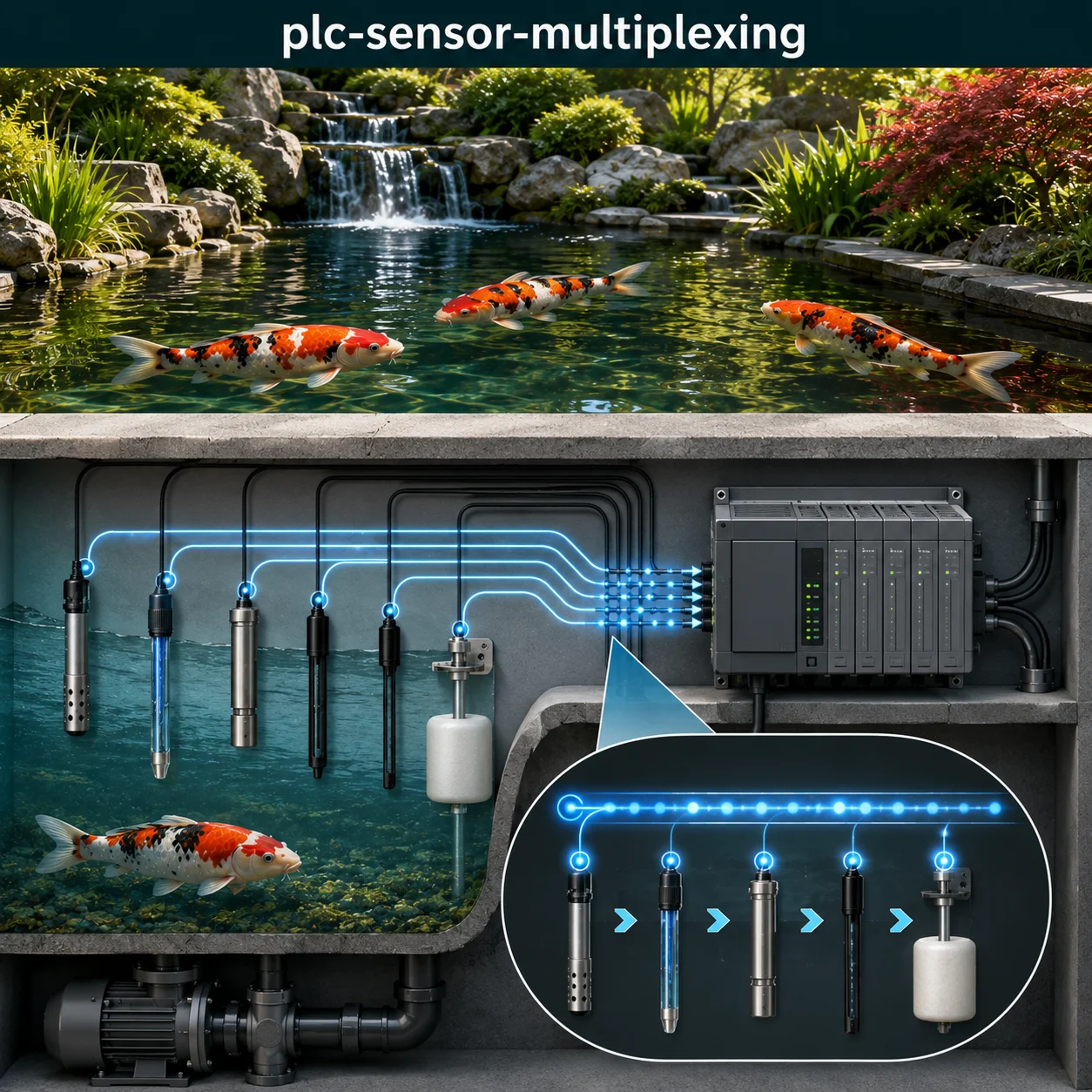
Programmable Logic Controller (PLC) Sensor Multiplexing and Automated Flush Loops
In modern koi pond engineering, Programmable Logic Controllers (PLCs) are the backbone of automated monitoring and control. Sensor multiplexing allows a single PLC to read dozens of analog and digital sensors across a pond system — pH, ORP, temperature, DO, CO₂, level, and flow — using a fraction of the I/O points. Automated flush loops keep sensor surfaces clean and responsive, eliminating biofouling and drift without manual intervention.
This page provides a rigorous engineering framework for designing PLC-based sensor multiplexing networks, implementing automated flush cycles, and troubleshooting common failures. The content is structured for professional builders and pond engineers who demand better than 90% first-attempt success on these complex automation challenges.
PLC Sensor Multiplexing — Engineering Challenge
10 scenario-based questions on multiplexing, flush loop timing, I/O mapping, and troubleshooting. Designed to separate the top 10% from the rest.
PLC Sensor Multiplexing — Quick Facts
Most Asked Questions About PLC Sensor Multiplexing
On a large commercial koi pond, the PLC was reading pH, ORP, and temperature from a single analog input via a 16:1 MUX. The readings were erratic and often stuck. The culprit: the PLC scan cycle was too fast, not allowing the MUX to settle after switching. Adding a 50 ms delay after each channel switch and increasing the ADC averaging filter resolved the issue.
Multiplexer Architecture and Settling Time
A typical analog multiplexer (e.g., 8:1 or 16:1) connects one of several analog signals to a single output. The PLC selects the channel via digital outputs (binary address), waits for the MUX and sensor to settle, then reads the analog value. The settling time depends on:
- MUX on-resistance and capacitance: Higher resistance and capacitance increase the RC time constant.
- Sensor output impedance: High-impedance sensors (e.g., pH probes) require longer settling.
- ADC input impedance: The ADC’s input impedance affects the charging time.
- Noise filtering: Averaging multiple samples increases effective scan time but reduces noise.
Automated Flush Loop Design
An automated flush loop uses a PLC-controlled valve to direct a cleaning fluid (pond water, air, or a chemical solution) across the sensor surface. The flush cycle typically consists of: 1) close the sample valve, 2) open the flush valve, 3) wait for the flush duration (e.g., 10–30 seconds), 4) close the flush valve, 5) open the sample valve, and 6) wait for the sensor to re-stabilize. The PLC logs each flush event and can trigger an alarm if the flush fails (e.g., no flow detected).
In a facility with high biofouling, the flush loop was programmed to run every 2 minutes. However, the valve actuator was undersized and took 5 seconds to open, reducing the effective flush time. After upgrading to a faster-acting solenoid valve and adjusting the PLC timing, the flush efficiency improved dramatically, and the sensor drift was reduced by 60%.
I/O Mapping and PLC Programming Best Practices
Organize your PLC tag database by sensor type and location. Use structured text or ladder logic to manage the MUX scanning and flush sequences. Key best practices:
- Use a sequencer or state machine for flush cycles to avoid conflicts with normal readings.
- Implement a watchdog timer that triggers an alarm if the PLC hasn’t received a valid reading from a sensor within a set time.
- Store calibration coefficients in the PLC and apply them to the raw ADC values.
- Use a separate analog input module for critical sensors (e.g., pH, DO) to avoid sharing with less critical sensors.
A common mistake is to map all sensors to a single MUX and then use the same scan time for all. A pH probe with a high-impedance glass electrode may need 500 ms to settle, while a 4-20 mA pressure sensor may need only 10 ms. By implementing a per-channel scan time configuration, you can optimize the overall scan rate and improve data quality.
PLC Sensor Multiplexing — Full Question Library
200 engineering questions across 10 categories. Each question includes a detailed explanation.
Q1:
What is the primary function of an analog multiplexer in a PLC system?
Correct Answer: Option A
A multiplexer (MUX) allows multiple sensors to share one analog input by switching between channels.
Q2:
Which parameter defines the maximum number of channels in a MUX?
Correct Answer: Option B
A MUX with n address lines can select up to 2^n channels (e.g., 3 lines = 8 channels).
Q3:
What does ‘on-resistance’ of a MUX affect?
Correct Answer: Option B
Higher on-resistance reduces signal amplitude and increases the RC time constant, slowing settling.
Q4:
What is the effect of a MUX with high capacitance?
Correct Answer: Option B
Capacitance stores charge, which must be charged/discharged when switching, increasing settling time.
Q5:
What is ‘crosstalk’ in a multiplexer?
Correct Answer: Option A
Crosstalk occurs when a signal on one channel appears on another due to parasitic capacitance and on-resistance.
Q6:
How is a MUX typically controlled by a PLC?
Correct Answer: Option B
The PLC uses digital outputs to set the binary address of the desired channel.
Q7:
What is the typical settling time for a CMOS MUX?
Correct Answer: Option A
CMOS MUXes have low on-resistance and capacitance, allowing fast settling in the microsecond range.
Q8:
What is the effect of a MUX with low off-isolation?
Correct Answer: Option B
Low off-isolation means signals from non-selected channels can leak into the output, causing errors.
Q9:
What is the purpose of a ‘break-before-make’ MUX?
Correct Answer: Option A
Break-before-make ensures that one channel is disconnected before the next is connected, preventing momentary shorts.
Q10:
What is the typical supply voltage for a 5V logic MUX?
Correct Answer: Option B
Most standard CMOS MUXes operate on a 5V supply, though some are 3.3V or 12V.
Q11:
What is the effect of a MUX with high leakage current?
Correct Answer: Option A
Leakage current adds a small error voltage, especially when used with high-impedance sources.
Q12:
What is the difference between a MUX and a DEMUX?
Correct Answer: Option A
A multiplexer selects one of many inputs to a single output; a demultiplexer routes one input to one of many outputs.
Q13:
What is the maximum number of channels for a 16:1 MUX?
Correct Answer: Option A
A 16:1 MUX has 16 inputs and 1 output.
Q14:
What is the effect of a MUX with a slow switching speed?
Correct Answer: Option B
Slow switching adds to the total scan time, reducing the update rate for all sensors.
Q15:
What is the purpose of a guard ring in a MUX layout?
Correct Answer: Option A
Guard rings are conductive traces that shield sensitive nodes from stray currents.
Q16:
What is the typical output impedance of a MUX?
Correct Answer: Option A
CMOS MUXes typically have on-resistance in the range of 10–50 Ω.
Q17:
What is the effect of a MUX with high on-resistance?
Correct Answer: Option A
High on-resistance acts as a voltage divider with the load, reducing signal amplitude and increasing the RC time constant.
Q18:
What is a ‘single-ended’ MUX?
Correct Answer: Option B
In a single-ended MUX, all inputs share a common ground.
Q19:
What is the advantage of a differential MUX?
Correct Answer: Option A
Differential MUXes reject common-mode noise and are preferred in noisy environments.
Q20:
What is the role of a ‘bias resistor’ in a MUX circuit?
Correct Answer: Option B
The bias resistor prevents the ADC input from floating when the MUX is switched.
Q21:
What is the typical resolution of a PLC analog input module?
Correct Answer: Option A
Most PLC analog inputs have 12-16 bit resolution (4096–65536 counts).
Q22:
What is the input range for a standard 4-20 mA signal?
Correct Answer: Option B
The 4-20 mA standard is widely used for industrial sensors.
Q23:
What is the effect of a high-impedance sensor on an analog input?
Correct Answer: Option A
High-impedance sensors (e.g., pH probes) require high-impedance inputs and careful settling.
Q24:
What is the purpose of a ‘signal conditioner’ in a PLC analog input?
Correct Answer: Option A
Signal conditioners amplify, filter, and isolate the analog signal before it reaches the ADC.
Q25:
What is the effect of a ground loop on an analog input?
Correct Answer: Option A
Ground loops create unwanted currents that couple noise into the analog signal.
Q26:
What is the common mode voltage range of a typical analog input?
Correct Answer: Option A
Many differential analog inputs have a common mode range of ±10 V.
Q27:
What is the effect of an open circuit on a 4-20 mA input?
Correct Answer: Option A
Most 4-20 mA inputs detect an open circuit as a below-scale reading.
Q28:
What is the effect of a short circuit on a 0-10 V input?
Correct Answer: Option B
A short to ground will force the input to 0 V.
Q29:
What is the purpose of an ‘isolation’ in an analog input module?
Correct Answer: Option A
Isolation separates the sensor ground from the PLC ground, preventing loops and providing safety.
Q30:
What is the typical input impedance of a 4-20 mA analog input?
Correct Answer: Option B
A 250 Ω resistor is commonly used to convert 4-20 mA to 1-5 V.
Q31:
What is the effect of a noisy power supply on analog readings?
Correct Answer: Option A
Power supply ripple can couple into the analog signal, causing fluctuations.
Q32:
What is the purpose of a ‘filter’ in an analog input?
Correct Answer: Option B
Filters (low-pass) attenuate high-frequency noise that could corrupt the reading.
Q33:
What is the effect of a high sampling rate on the analog input?
Correct Answer: Option A
If the sampling rate is too high, the input may not have time to settle, causing inaccurate readings.
Q34:
What is the typical update time for a PLC analog input?
Correct Answer: Option B
Most PLCs update analog inputs every 10–100 ms, depending on the module.
Q35:
What is the effect of a broken shield on an analog cable?
Correct Answer: Option A
The shield protects against EMI; a broken shield allows noise to couple into the signal.
Q36:
What is the purpose of a ‘bias current’ in an analog input?
Correct Answer: Option B
A bias resistor provides a DC path for the ADC input bias current, preventing the input from floating.
Q37:
What is the effect of a long cable on an analog signal?
Correct Answer: Option A
Long cables add capacitance and can pick up EMI, degrading the signal.
Q38:
What is the typical accuracy of a 12-bit PLC analog input?
Correct Answer: Option B
A 12-bit ADC has a resolution of 1/4096, or about 0.0244%.
Q39:
What is the purpose of a ‘shielded twisted pair’ cable for analog signals?
Correct Answer: Option A
Q40:
What is the effect of an incorrect input scaling on a PLC analog reading?
Correct Answer: Option B
Incorrect scaling will produce readings that do not correspond to the actual process value.
Q41:
What type of valve is typically used in an automated flush loop?
Correct Answer: Option A
Solenoid valves are fast-acting and reliable for flush applications.
Q42:
What is the typical response time of a solenoid valve?
Correct Answer: Option B
Industrial solenoid valves typically open/close in 10–50 ms.
Q43:
What is the purpose of a ‘flush nozzle’?
Correct Answer: Option A
The nozzle directs the flush medium precisely at the sensor to remove fouling.
Q44:
What is the effect of a clogged flush nozzle?
Correct Answer: Option B
A clogged nozzle will not direct the fluid properly, reducing the cleaning effect.
Q45:
What is the typical flush fluid pressure?
Correct Answer: Option A
Most flush systems operate at 2–5 bar to provide sufficient velocity for cleaning.
Q46:
What is the purpose of a ‘check valve’ in a flush line?
Correct Answer: Option A
The check valve prevents contamination of the flush fluid with sample water.
Q47:
What is the effect of a leaking flush valve?
Correct Answer: Option A
A leaking valve will continuously flush, which can dilute the sample and waste resources.
Q48:
What is the purpose of a ‘flow switch’ in a flush loop?
Correct Answer: Option A
A flow switch confirms that the flush is actually occurring.
Q49:
What is the typical flush duration for a sensor?
Correct Answer: Option A
Most flush cycles last 5–30 seconds to remove fouling without excessive water usage.
Q50:
What is the effect of a flush cycle that is too short?
Correct Answer: Option B
If the flush is too short, biofilm and debris may not be fully removed.
Q51:
What is the purpose of a ‘flush timer’ in the PLC logic?
Correct Answer: Option A
The flush timer initiates the flush sequence and determines its duration.
Q52:
What is the effect of a flush cycle that is too frequent?
Correct Answer: Option B
Q53:
What type of solenoid valve is preferred for flush applications?
Correct Answer: Option A
Direct-acting solenoids are faster and more reliable for small flush flows.
Q54:
What is the purpose of a ‘filter’ in the flush line?
Correct Answer: Option A
Q55:
What is the effect of a blocked flush filter?
Correct Answer: Option A
A blocked filter restricts flow, reducing the cleaning effect.
Q56:
What is the typical flush fluid in a koi pond system?
Correct Answer: Option A
Q57:
What is the purpose of a ‘flush ring’?
Correct Answer: Option A
Q58:
What is the effect of a worn valve seat in a solenoid valve?
Correct Answer: Option B
A worn seat allows leakage, which can lead to continuous flushing.
Q59:
What is the purpose of a ‘pressure regulator’ in a flush line?
Correct Answer: Option A
A pressure regulator ensures consistent flush pressure regardless of supply variations.
Q60:
What is the effect of a flush fluid temperature that is too high?
Correct Answer: Option B
High temperatures can damage sensitive sensors and valve seals.
Q61:
What is the effect of a long scan time on a multiplexed system?
Correct Answer: Option A
Longer scan time means each sensor is read less frequently.
Q62:
What is the typical PLC scan time?
Correct Answer: Option B
Most PLCs have scan times in the 10–100 ms range.
Q63:
How can you reduce the impact of MUX switching on scan time?
Correct Answer: Option A
Faster MUX and shorter settling times reduce the time per channel.
Q64:
What is a ‘watchdog timer’ in a PLC?
Correct Answer: Option A
A watchdog timer resets the PLC if the program stops executing.
Q65:
What is the effect of a PLC scan time that is too fast?
Correct Answer: Option A
If the scan time is less than the settling time, readings will be inaccurate.
Q66:
What is the purpose of a ‘task’ in a PLC?
Correct Answer: Option B
Tasks are used to execute specific code at defined intervals.
Q67:
What is the effect of a high-priority interrupt on scan time?
Correct Answer: Option A
Interrupts can cause timing variations in the scan.
Q68:
How is the MUX address typically updated in a PLC?
Correct Answer: Option B
Digital outputs are used to set the MUX address lines.
Q69:
What is the purpose of a ‘scan cycle’ in a PLC?
Correct Answer: Option A
The scan cycle consists of reading inputs, executing the program, and writing outputs.
Q70:
What is the effect of a large program on scan time?
Correct Answer: Option B
A larger program takes longer to execute, increasing the scan time.
Q71:
What is the purpose of a ‘time-of-day’ scheduler in a flush loop?
Correct Answer: Option A
Time-of-day scheduling can be used to flush during low-activity periods.
Q72:
What is the effect of a missed scan due to a watchdog reset?
Correct Answer: Option B
A watchdog reset will cause the PLC to restart, potentially losing data.
Q73:
What is the purpose of a ‘multi-tasking’ PLC?
Correct Answer: Option A
Multi-tasking allows different tasks to run at different priorities and intervals.
Q74:
What is the effect of a high-priority task on a low-priority task?
Correct Answer: Option B
High-priority tasks can preempt lower-priority tasks, causing delays.
Q75:
What is the purpose of a ‘scan time monitor’?
Correct Answer: Option A
A scan time monitor generates an alarm if the scan time becomes too long.
Q76:
What is the effect of a PLC that is overloaded with tasks?
Correct Answer: Option B
Overloading the PLC can cause scan time to exceed the watchdog limit.
Q77:
What is the purpose of a ‘software timer’ in a PLC?
Correct Answer: Option A
Software timers are used for time delays, such as flush duration.
Q78:
What is the effect of a timer that is not reset correctly?
Correct Answer: Option B
Incorrect resetting can cause the timer to start at the wrong time or not start at all.
Q79:
What is the purpose of a ‘cyclic interrupt’ in a PLC?
Correct Answer: Option A
Cyclic interrupts are used for time-critical tasks like MUX scanning.
Q80:
What is the effect of a missed cyclic interrupt?
Correct Answer: Option B
If an interrupt is missed, the task may run late or be skipped.
Q81:
What is the purpose of a ‘buffer amplifier’ in signal conditioning?
Correct Answer: Option A
A buffer provides high input impedance and low output impedance, preventing loading of the sensor.
Q82:
What is the effect of a high input impedance on a sensor?
Correct Answer: Option B
High impedance prevents the measurement circuit from drawing current from the sensor.
Q83:
What is the purpose of a ‘low-pass filter’ in signal conditioning?
Correct Answer: Option A
Low-pass filters attenuate high-frequency noise, improving signal quality.
Q84:
What is the effect of a low-pass filter on signal response time?
Correct Answer: Option B
A low-pass filter introduces a time delay (phase shift) that slows the response.
Q85:
What is the purpose of an ‘instrumentation amplifier’?
Correct Answer: Option A
Instrumentation amplifiers amplify differential signals while rejecting common-mode noise.
Q86:
What is the effect of a high common-mode voltage on an instrumentation amplifier?
Correct Answer: Option B
If the common-mode voltage exceeds the amplifier’s range, the output will be clipped.
Q87:
What is the purpose of a ‘galvanic isolator’ in signal conditioning?
Correct Answer: Option A
Isolation prevents current flow between circuits, eliminating ground loops.
Q88:
What is the effect of a signal conditioner with a high offset voltage?
Correct Answer: Option B
Offset voltage adds a fixed error to the measurement.
Q89:
What is the purpose of a ‘gain stage’ in signal conditioning?
Correct Answer: Option A
Gain amplifies the signal to use the full range of the ADC.
Q90:
What is the effect of a gain that is too high?
Correct Answer: Option B
Excessive gain can cause the signal to exceed the ADC’s input range.
Q91:
What is the purpose of a ‘voltage reference’ in signal conditioning?
Correct Answer: Option A
A stable reference ensures accurate ADC conversions.
Q92:
What is the effect of a noisy voltage reference?
Correct Answer: Option B
Noise on the reference voltage directly affects the ADC’s accuracy.
Q93:
What is the purpose of a ‘sample-and-hold’ circuit?
Correct Answer: Option A
The sample-and-hold ensures the ADC sees a stable voltage during conversion.
Q94:
What is the effect of a sample-and-hold with a long acquisition time?
Correct Answer: Option B
A longer acquisition time means the ADC cannot sample as quickly.
Q95:
What is the purpose of a ‘thermocouple cold junction compensation’?
Correct Answer: Option A
Cold junction compensation is required for accurate thermocouple measurements.
Q96:
What is the effect of a missing cold junction compensation?
Correct Answer: Option B
Without compensation, the thermocouple reading will be offset by the reference junction temperature.
Q97:
What is the purpose of a ‘linearization’ circuit?
Correct Answer: Option A
Linearization maps a non-linear sensor output to a linear relationship.
Q98:
What is the effect of incorrect linearization?
Correct Answer: Option B
Incorrect linearization will cause the reading to be inaccurate over the measurement range.
Q99:
What is the purpose of a ‘RMS-to-DC converter’?
Correct Answer: Option A
RMS-to-DC converters are used for AC current and voltage measurements.
Q100:
What is the effect of a faulty RMS-to-DC converter?
Correct Answer: Option B
A faulty converter will produce an incorrect RMS value.
Q101:
What is the first step in a typical flush loop sequence?
Correct Answer: Option A
The sample valve is closed first to isolate the sensor from the process.
Q102:
What is the effect of opening the flush valve before closing the sample valve?
Correct Answer: Option B
Simultaneous opening can create a path for fluid to flow backwards.
Q103:
What is the purpose of a ‘settling delay’ after a flush?
Correct Answer: Option A
After flushing, the sensor needs time to re-stabilize before a valid reading can be taken.
Q104:
What is the typical settling delay after a flush?
Correct Answer: Option B
Most sensors require 10–30 seconds to re-stabilize after a flush.
Q105:
What is the purpose of a ‘flush cycle counter’ in the PLC?
Correct Answer: Option A
The counter helps schedule valve maintenance based on usage.
Q106:
What is the effect of a flush cycle that fails to complete?
Correct Answer: Option B
If the flush fails, biofilm will build up, affecting the sensor accuracy.
Q107:
What is the purpose of a ‘flush on demand’ function?
Correct Answer: Option A
Manual flush allows operators to clean the sensor when needed.
Q108:
What is the effect of a flush command that is ignored by the PLC?
Correct Answer: Option B
Ignoring the command means the sensor will not be cleaned.
Q109:
What is the purpose of a ‘flush pressure check’?
Correct Answer: Option A
A pressure check ensures the flush will be effective.
Q110:
What is the effect of low flush pressure?
Correct Answer: Option B
Low pressure will not remove biofilm effectively.
Q111:
What is the purpose of a ‘flush timer’ in the PLC logic?
Correct Answer: Option A
The timer determines how long the flush valve remains open.
Q112:
What is the effect of a flush timer that is too long?
Correct Answer: Option B
Excessive flushing wastes resources and may cause unnecessary wear.
Q113:
What is the purpose of a ‘flush interval timer’?
Correct Answer: Option A
The interval timer determines the frequency of flush cycles.
Q114:
What is the effect of a flush interval that is too short?
Correct Answer: Option B
Frequent flushes can prevent the sensor from reaching a stable reading.
Q115:
What is the purpose of a ‘flush valve feedback’ signal?
Correct Answer: Option A
Feedback confirms that the valve actually opened or closed.
Q116:
What is the effect of a valve that fails to open?
Correct Answer: Option B
If the valve doesn’t open, the sensor will not be cleaned.
Q117:
What is the purpose of a ‘flush solenoid driver’?
Correct Answer: Option A
The driver provides the power to energize the solenoid.
Q118:
What is the effect of a failed solenoid driver?
Correct Answer: Option B
If the driver fails, the solenoid will not energize, and the valve will not open.
Q119:
What is the purpose of a ‘flush sequence state machine’?
Correct Answer: Option A
A state machine ensures the flush steps occur in the correct order.
Q120:
What is the effect of a state machine that gets stuck?
Correct Answer: Option B
A stuck state machine will cause the flush to hang, preventing normal operation.
Q121:
What is the first step in troubleshooting a multiplexed sensor reading that is stuck?
Correct Answer: Option A
A stuck reading often indicates the MUX is not switching correctly.
Q122:
What is the effect of a shorted MUX address line?
Correct Answer: Option B
A shorted address line will force the MUX to a fixed channel.
Q123:
What is the effect of a noisy MUX power supply?
Correct Answer: Option A
Noise on the supply can affect the MUX’s analog switches.
Q124:
What is the effect of a floating MUX output?
Correct Answer: Option B
A floating output indicates the MUX is not properly connected or is powered off.
Q125:
What is the effect of a damaged MUX channel?
Correct Answer: Option A
A damaged channel will not pass the signal correctly.
Q126:
What is the effect of a PLC analog input that is out of calibration?
Correct Answer: Option B
An out-of-calibration input will produce incorrect values for all channels.
Q127:
What is the effect of a loose connection in the analog wiring?
Correct Answer: Option A
A loose connection can cause intermittent signal loss or noise.
Q128:
What is the effect of a ground loop on a multiplexed system?
Correct Answer: Option B
Ground loops are a common source of noise in analog systems.
Q129:
What is the effect of a sensor with a short circuit?
Correct Answer: Option A
A shorted sensor can load the entire analog bus.
Q130:
What is the effect of a sensor with an open circuit?
Correct Answer: Option B
An open circuit will cause the input to float, often to the supply voltage.
Q131:
What is the effect of a missing pull-down resistor on an analog input?
Correct Answer: Option A
Without a pull-down, the input can float to an unknown voltage.
Q132:
What is the effect of a PLC scan time that is too slow?
Correct Answer: Option B
A slow scan means the readings are updated infrequently.
Q133:
What is the effect of a faulty MUX channel selection logic?
Correct Answer: Option A
Incorrect channel selection will cause the PLC to read the wrong sensor.
Q134:
What is the effect of a PLC program that hangs during MUX switching?
Correct Answer: Option B
If the program hangs, the MUX will not be updated, and readings will not change.
Q135:
What is the effect of a noisy 24V DC power supply on the MUX?
Correct Answer: Option A
Noise on the supply rail can affect the MUX’s operation.
Q136:
What is the effect of a failed MUX address decoder?
Correct Answer: Option B
A failed decoder will result in incorrect channel selection.
Q137:
What is the effect of a sensor cable with a broken shield?
Correct Answer: Option A
The shield provides protection against EMI; a broken shield exposes the signal to noise.
Q138:
What is the effect of a high-resistance connection in the signal path?
Correct Answer: Option B
High resistance in the signal path reduces the signal level.
Q139:
What is the effect of a PLC analog input that is set to the wrong range (e.g., 0-10V instead of 4-20mA)?
Correct Answer: Option A
Incorrect range setting will cause the reading to be off by a scaling factor.
Q140:
What is the effect of a PLC that has lost its analog input calibration?
Correct Answer: Option B
Loss of calibration will cause all readings to be offset or scaled incorrectly.
Q141:
What is the purpose of a ‘range check’ on sensor data?
Correct Answer: Option A
Range checks detect out-of-range values that may indicate a sensor fault.
Q142:
What is the effect of a sensor reading that is out of range?
Correct Answer: Option B
Out-of-range readings are often caused by open circuits, short circuits, or sensor failure.
Q143:
What is the purpose of a ‘rate-of-change’ check?
Correct Answer: Option A
A rate-of-change check can detect sensor faults or signal spikes.
Q144:
What is the effect of a sensor that has a sudden spike in reading?
Correct Answer: Option B
Spikes are often caused by EMI or a loose connection.
Q145:
What is the purpose of a ‘filtered average’ in data validation?
Correct Answer: Option A
Averaging multiple samples reduces random noise.
Q146:
What is the effect of a heavy filter on the response time?
Correct Answer: Option B
Heavy filtering adds delay to the signal.
Q147:
What is the purpose of a ‘sensor validation’ routine?
Correct Answer: Option A
Validation routines check for open circuits, shorts, and out-of-range values.
Q148:
What is the effect of a sensor that fails validation?
Correct Answer: Option B
Invalid readings should not be used for control.
Q149:
What is the purpose of a ‘watchdog timer’ on sensor data?
Correct Answer: Option A
A watchdog timer checks for data “freezes” that indicate a sensor or communication failure.
Q150:
What is the effect of a sensor that stops updating?
Correct Answer: Option B
A stuck sensor should be detected and alarmed.
Q151:
What is the purpose of a ‘checksum’ or ‘CRC’ in data communication?
Correct Answer: Option A
Checksums detect bit errors in digital communication.
Q152:
What is the effect of a corrupted data packet?
Correct Answer: Option B
Corrupted data should be rejected to prevent errors.
Q153:
What is the purpose of a ‘redundant sensor’ for critical measurements?
Correct Answer: Option A
Redundant sensors provide redundancy for fail-safe operation.
Q154:
What is the effect of a mismatch between redundant sensors?
Correct Answer: Option B
A mismatch can be used to detect sensor drift or failure.
Q155:
What is the purpose of a ‘data log’ in a PLC system?
Correct Answer: Option A
Data logs are essential for diagnosing intermittent problems.
Q156:
What is the effect of a full data log memory?
Correct Answer: Option B
Full memory can cause loss of new data.
Q157:
What is the purpose of a ‘timestamp’ in logged data?
Correct Answer: Option A
Timestamps are crucial for analyzing data trends over time.
Q158:
What is the effect of a missing timestamp?
Correct Answer: Option B
Without timestamps, data cannot be properly sequenced.
Q159:
What is the purpose of a ‘diagnostic bit’ in a sensor message?
Correct Answer: Option A
Diagnostic bits indicate if the sensor is in a fault state.
Q160:
What is the effect of a sensor that sets its diagnostic bit?
Correct Answer: Option B
A diagnostic bit indicates a fault, and the data should be treated as invalid.
Q161:
What is the purpose of a ‘programmable logic controller’ (PLC) in pond automation?
Correct Answer: Option A
PLCs are the brain of automated pond systems.
Q162:
What is the effect of a PLC program that has a logic error?
Correct Answer: Option B
Logic errors can cause unintended behavior.
Q163:
What is the purpose of a ‘PID’ loop in a PLC?
Correct Answer: Option A
PID (Proportional-Integral-Derivative) loops are used for precise control.
Q164:
What is the effect of a PID loop with incorrect tuning?
Correct Answer: Option B
Poor tuning can cause instability or sluggish control.
Q165:
What is the purpose of a ‘EtherNet/IP’ communication protocol?
Correct Answer: Option A
EtherNet/IP is a common industrial Ethernet protocol.
Q166:
What is the effect of a network communication failure?
Correct Answer: Option B
Network failures can cause loss of communication and control.
Q167:
What is the purpose of a ‘remote I/O’ module?
Correct Answer: Option A
Remote I/O reduces wiring costs and allows distributed control.
Q168:
What is the effect of a failed remote I/O node?
Correct Answer: Option B
A failed node will cause loss of sensor readings and outputs.
Q169:
What is the purpose of a ‘control valve’ in a flush loop?
Correct Answer: Option A
A control valve provides precise flow control.
Q170:
What is the effect of a control valve that sticks?
Correct Answer: Option B
A sticking valve can cause flow instability.
Q171:
What is the purpose of a ‘human-machine interface’ (HMI) in a PLC system?
Correct Answer: Option A
HMIs allow operators to interact with the system.
Q172:
What is the effect of an HMI that is slow to update?
Correct Answer: Option B
Slow updates can cause the operator to make decisions based on outdated data.
Q173:
What is the purpose of a ‘alarm’ in a PLC system?
Correct Answer: Option A
Alarms are critical for safety and process monitoring.
Q174:
What is the effect of a false alarm?
Correct Answer: Option B
Frequent false alarms can lead to the operator ignoring real alarms.
Q175:
What is the purpose of a ‘historical data’ archive?
Correct Answer: Option A
Historical data is essential for trend analysis and troubleshooting.
Q176:
What is the effect of a corrupted historical database?
Correct Answer: Option B
Corrupted data makes trend analysis difficult.
Q177:
What is the purpose of a ‘redundant PLC’ system?
Correct Answer: Option A
Redundant PLCs are used in critical applications for high availability.
Q178:
What is the effect of a failed PLC that is not redundant?
Correct Answer: Option B
A failed PLC will cause the process to stop.
Q179:
What is the purpose of a ‘battery backup’ on a PLC?
Correct Answer: Option A
The battery maintains the PLC’s memory when power is lost.
Q180:
What is the effect of a dead PLC battery?
Correct Answer: Option B
A dead battery can cause the PLC to lose its program.
Q181:
What is the purpose of a ‘safety relay’ in a PLC system?
Correct Answer: Option A
Safety relays are designed for critical safety functions.
Q182:
What is the effect of a safety relay that fails?
Correct Answer: Option B
A failed safety relay could prevent the system from shutting down safely.
Q183:
What is the purpose of a ‘watchdog timer’ on the PLC itself?
Correct Answer: Option A
A watchdog timer monitors the PLC’s execution and resets it if it stops.
Q184:
What is the effect of a PLC that resets due to a watchdog timeout?
Correct Answer: Option B
A restart can cause a momentary loss of control.
Q185:
What is the purpose of a ‘failsafe’ valve position?
Correct Answer: Option A
Failsafe valves ensure safety in case of power failure.
Q186:
What is the effect of a valve that does not fail-safe?
Correct Answer: Option B
A non-failsafe valve could cause a safety hazard.
Q187:
What is the purpose of a ‘redundant power supply’ in a PLC system?
Correct Answer: Option A
Redundant power supplies provide high availability.
Q188:
What is the effect of a power supply failure without redundancy?
Correct Answer: Option B
A power supply failure will cause the system to stop.
Q189:
What is the purpose of a ‘ground fault circuit’ in a PLC system?
Correct Answer: Option A
Ground fault protection is a safety requirement.
Q190:
What is the effect of a ground fault that is not detected?
Correct Answer: Option B
Undetected ground faults are a serious safety hazard.
Q191:
What is the purpose of a ’emergency stop’ (E-stop) circuit?
Correct Answer: Option A
E-stop circuits are for operator safety.
Q192:
What is the effect of a failed E-stop button?
Correct Answer: Option B
A failed E-stop button compromises safety.
Q193:
What is the purpose of a ‘two-hand control’ safety circuit?
Correct Answer: Option A
Two-hand controls prevent the operator from placing hands in a dangerous area.
Q194:
What is the effect of a bypassed two-hand control?
Correct Answer: Option B
Bypassing safety circuits is extremely dangerous.
Q195:
What is the purpose of a ‘safe torque off’ (STO) function on a motor drive?
Correct Answer: Option A
STO is a safety feature to prevent unintended motor rotation.
Q196:
What is the effect of a failed STO function?
Correct Answer: Option B
A failed STO can be a serious hazard.
Q197:
What is the purpose of a ‘power cycle’ reset in a PLC?
Correct Answer: Option A
A power cycle can reset the PLC after a fault.
Q198:
What is the effect of a PLC that requires frequent power cycles?
Correct Answer: Option B
Frequent resets indicate an underlying issue.
Q199:
What is the purpose of a ‘log file’ for safety events?
Correct Answer: Option A
Safety logs are important for incident investigation.
Q200:
What is the effect of a safety event that is not logged?
Correct Answer: Option B
Unlogged events make root cause analysis difficult.