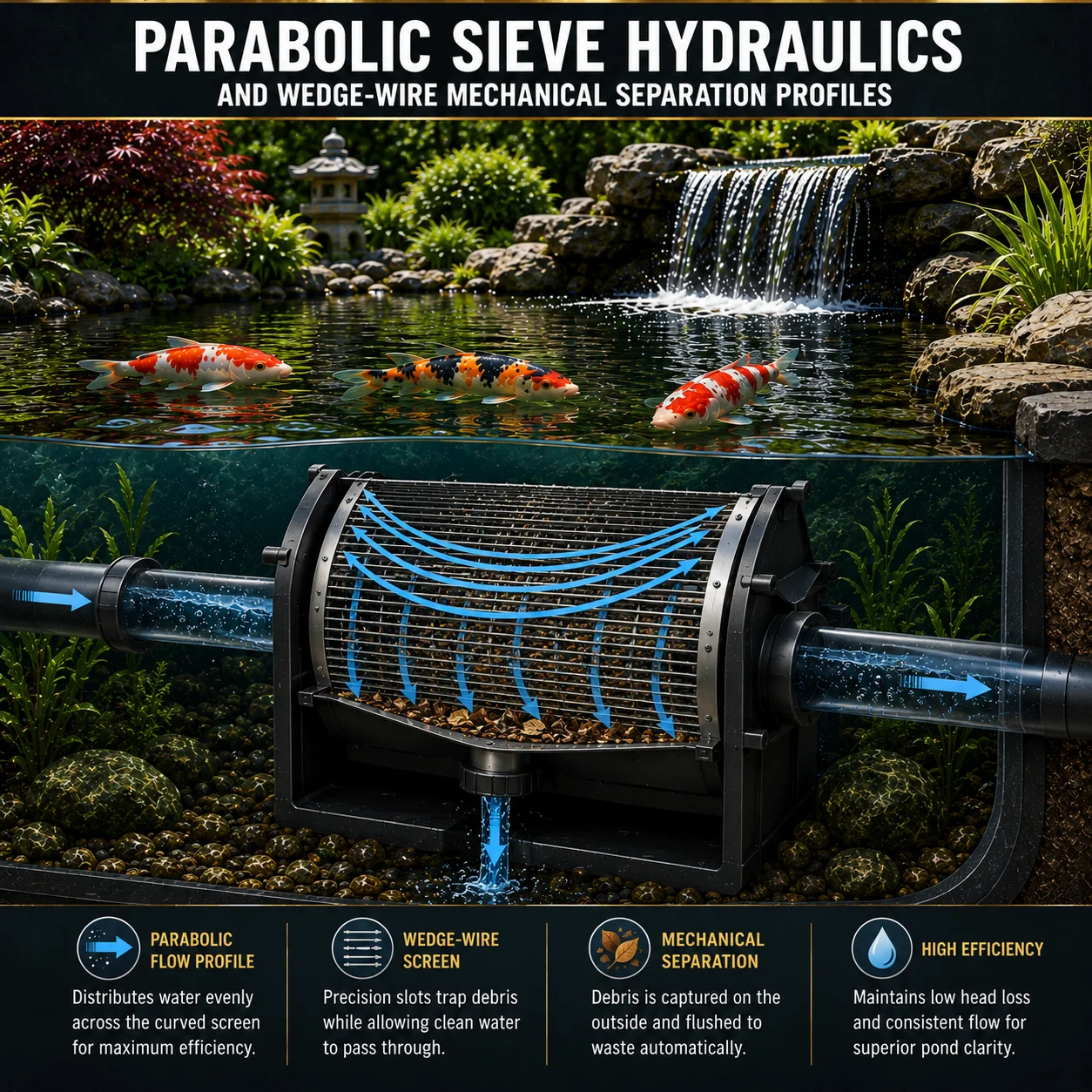
Parabolic Sieve Hydraulics and Wedge-Wire Mechanical Separation Profiles
A parabolic sieve separates solids from koi pond water by passing a thin sheet of flow over a curved bank of wedge-wire, using gravity and surface shear rather than a pump-driven pressure differential to force water through narrow slots. The curvature is not decorative — the changing angle between the water film and the wire surface is what keeps the slots from clogging as fast as a flat screen would, and it is the single design element that separates a self-cleaning mechanical separator from a static strainer basket.
This page works through the hydraulics that actually govern performance: how curvature and wedge-wire slot geometry interact with hydraulic loading, approach velocity, and upstream/downstream water levels to determine how much flow a given screen width can process, how much head it consumes, and how well it separates versus bypasses solids. It also draws a hard line between the nominal slot size printed on a spec sheet and the real particle-removal performance you get once solids shape, flow distribution, and fouling are factored in, so you can size, install, and troubleshoot a unit based on its actual operating conditions rather than a single published number.
Test Your Parabolic Sieve Hydraulics Knowledge
Work through ten engineering scenarios covering wedge-wire geometry, hydraulic loading, weir behavior, and mechanical separation troubleshooting.
Parabolic Sieve Quick Facts
Frequently Asked Questions
A koi keeper called about a parabolic sieve that worked perfectly at low flow but sheeted water over one side of the headbox whenever the return pump kicked up to its higher speed setting. The screen itself was clean and correctly rated for the flow. The problem was upstream: the inlet pipe entered the headbox at a single point near one corner instead of through a distribution weir or diffuser plate.
At low flow, the jet from the inlet pipe dissipated before reaching the far edge of the headbox, and the water leveled out enough to load the screen evenly. At high flow, the same jet carried straight across and piled water against the far wall faster than it could spread laterally, so that corner overtopped even though the average loading rate across the whole screen width was still within the rated range. The fix wasn’t a bigger screen — it was a simple baffle plate that broke up the inlet jet and forced even lateral spreading before the water ever reached the wedge-wire.
Screen Curvature and Wedge-Wire Slot Geometry
A parabolic sieve’s working surface is a curved bank of wedge-wire, individual wires with a triangular cross-section arranged parallel to each other and welded to supporting cross-ribs. The wide face of each wire sits on the upstream (wetted) side, and the wire tapers to a narrower face on the underside, so the physical gap between adjacent wires — the slot — is narrowest at the surface and widens as flow moves through it. This taper is the core anti-blinding feature of wedge-wire: a particle that is small enough to enter the slot at the surface has an increasingly larger opening to pass through as it travels deeper, rather than a constant-diameter hole that a particle can wedge into partway through, as happens with punched-plate or woven-mesh media.
- Wedge-wire profile: the triangular wire cross-section presents its wide face to the flow and its narrow face downstream, so the effective slot widens away from the surface and resists particles becoming lodged partway through.
- Percentage open area: the ratio of total slot width to total screen width at a given wire spacing sets the theoretical maximum specific flow capacity for the screen independent of slot width alone, and two screens with the same nominal slot rating can have different open areas and therefore different real capacities.
- Curvature radius and arc length: a tighter radius accelerates the water film faster and increases the self-cleaning shear at the surface, but it also shortens the time and distance available for water to pass through the slots before reaching the discharge edge, which shifts more of the flow budget toward the lower portion of the curve.
Installation angle matters as much as the manufactured curve. Wedge-wire panels are engineered around a specific mounting geometry relative to the incoming flow, and rotating or tilting the assembly from that design orientation changes the angle at which the water sheet meets the wire faces. A shallower-than-designed entry angle lets the film ride higher on the curve before beginning to thin and shear properly, effectively shortening the usable screening length; a steeper entry can accelerate the film so quickly that residence time on the upper slots drops and more unscreened flow is pushed toward the lower rows. Field installs that deviate from the specified mounting angle — often to fit an existing sump or stand — should be treated as a different hydraulic device from the one described in the manufacturer’s flow curve.
Behind the Physics: Film Flow and Self-Cleaning Action
As water flows over the convex parabolic surface, gravity accelerates the film along the curve while the wire surface exerts a normal reaction that has both a tangential component (which keeps the film moving along the curve) and a component perpendicular to the local surface (which drives a portion of the flow through the slots). Near the top of the curve, where the surface is closer to horizontal, more of the flow’s momentum is directed into the slots and less into forward motion; further down the curve, where the surface steepens, the balance shifts toward forward motion, and any flow that hasn’t already passed through a slot is increasingly likely to continue toward the discharge edge unscreened. This is why the upper portion of a properly loaded parabolic screen does the bulk of the filtering work, while the lower portion mainly serves to shear captured solids clean and convey the residual water and solids to the collection trough. Solids riding on top of the accelerating film experience a scouring shear force from the water moving beneath and around them, which is what lifts and carries debris across the wire faces rather than letting it settle into a slot.
One pond had a parabolic sieve that ran fine for weeks and then started leaking green filamentous algae fragments into the biofilter intake, even though the screen’s nominal slot rating was well below the visible fragment size. Pulling the screen showed the true cause: a thin mat of filamentous growth had colonized the underside taper of the wedge-wire, not the surface slot itself, effectively narrowing the widening portion of the gap that’s supposed to let captured material pass through freely. Water was still getting through, but larger fragments that would normally have been carried down and off the curve were catching on the mat and eventually breaking free in pieces small enough to pass. Cleaning restored performance immediately, and the owner moved to a shorter cleaning interval during the algae-growth season rather than waiting for a visible flow problem to appear.
Hydraulic Loading, Head Loss, and Gravity/Pump Matching
Hydraulic loading rate — flow delivered per unit width of screen — is the variable that ties headbox design, weir behavior, and screen performance together. Water enters the headbox and spills onto the screen crown across an effective weir length; for a rectangular weir this inflow follows the general form Q is proportional to the weir length times the head over the crest raised to a power greater than one, meaning small changes in upstream water level produce disproportionately larger changes in flow. If that inflow is not distributed evenly across the full width of the screen — through a properly sized headbox, distribution weir, or diffuser — some sections of wire will be overloaded relative to their slot capacity while others run underutilized, and the overloaded sections drive both bypass risk and localized blinding.
Head loss across a parabolic sieve is best understood as the elevation and pressure differential consumed in moving water from the headbox, across the curved wire, and into the collection sump beneath — part of it is the geometric drop built into the curve itself, and part of it is the resistance added by the wedge-wire slots and any accumulated fouling. In a gravity-fed installation, this consumption is fixed by the physical elevations in the build, so the available drop between the upstream drain or skimmer and the screen inlet has to be budgeted deliberately, leaving enough remaining head for downstream piping and any additional filtration stage. In a pump-fed installation, the pump supplies the energy directly, which relaxes the site elevation constraint but shifts the risk toward mismatch between pump output and headbox capacity — a downstream sump level that rises too close to the underside of the screen, for instance, will reduce the driving differential and slow drainage through the slots even when the pump is delivering the correct flow.
A build that piped a bottom drain through a lengthy run of undersized fittings before reaching a gravity-fed parabolic sieve ran into a problem that had nothing to do with the screen itself: by the time water reached the headbox, so much of the available elevation drop had been consumed by pipe and fitting losses that the remaining head over the weir crest was too shallow to distribute flow evenly across the screen’s full width. Only the center of the headbox, directly under the inlet, saw enough depth to spill onto the screen at a useful rate. The apparent fix — a bigger screen — would have done nothing, because the screen was never receiving adequate distributed flow to begin with. Reworking the plumbing to recover a few extra centimeters of head solved the distribution problem that a screen swap could not.
Measuring a parabolic sieve’s real-world performance means tracking a small set of numbers over time rather than relying on a single inspection. A staff gauge or simple level mark in the headbox, compared against a similar mark in the downstream sump, converts an invisible head-loss trend into a visible, loggable number; a widening gap over days or weeks flags progressive blinding well before flow visibly overtops the unit. Timing how quickly the solids discharge trough fills, and checking whether discharge is continuous versus intermittent and clumped, gives an early read on dewatering performance and slot fouling that’s independent of the water-level comparison. Visual inspection should specifically look for uneven wetting patterns across the screen’s width — dry streaks or dry patches indicate that section isn’t receiving its share of the loaded flow, usually a headbox distribution problem rather than a screen defect.
The core design tradeoff in parabolic sieve selection is that finer slot widths improve nominal particle capture but reduce the open area available for a given screen width, which lowers hydraulic capacity per unit width and raises the risk of blinding under the same solids loading — so a finer screen usually has to be wider, more steeply curved, or cleaned more frequently to deliver the same net throughput as a coarser one. Matching slot geometry to actual solids characteristics matters more than chasing the smallest available nominal rating: rigid granular solids are captured fairly predictably at a given slot width, while fibrous, gelatinous, or biological floc solids behave less predictably and often benefit more from higher approach shear and frequent cleaning than from an ever-finer slot. Practical sizing therefore starts from the manufacturer’s flow-versus-width curve for the specific slot and curvature in question, adjusted for the actual solids expected and the realistic cleaning interval the installation will support, rather than from the nominal micron number alone.
Parabolic Sieve & Wedge-Wire Question Library
Review indexed engineering questions below.
Q1:
What primary hydraulic principle allows a parabolic sieve to effectively separate suspended solids from pond water?
Correct Answer: Option B
The Coanda effect ensures that the water film remains attached to the curved surface of the sieve, allowing the slots to shear off solids while the water passes through.
Q2:
Which parameter most directly affects the ‘shearing’ efficiency of a parabolic sieve?
Correct Answer: Option B
Effective separation relies on the speed at which the water flows across the slots; too slow prevents shearing, while too fast may cause overflowing.
Q3:
What occurs when the flow rate into a parabolic sieve exceeds its design capacity?
Correct Answer: Option A
When the capacity is exceeded, the water level rises above the slots (overflowing), causing unfiltered water to bypass the separation process.
Q4:
How does the curvature of a parabolic sieve optimize hydraulic flow?
Correct Answer: Option C
The parabolic profile ensures that as water flows down the screen, the acceleration keeps the layer thin, maximizing the effectiveness of the slots.
Q5:
What role does surface tension play in the hydraulic performance of a parabolic sieve?
Correct Answer: Option D
Surface tension is critical; it keeps the liquid film pinned to the screen surface, ensuring water follows the curvature rather than splashing off.
Q6:
What is the consequence of high turbulent energy at the inlet of a parabolic sieve?
Correct Answer: Option A
Turbulence at the inlet causes the water to ‘jump’ or fail to adhere to the sieve, leading to overflow even at lower flow rates.
Q7:
In hydraulic terms, why is the ‘slot size’ of a sieve filter considered a resistance variable?
Correct Answer: Option A
The slot size dictates the aperture resistance; smaller slots increase resistance and can reduce flow capacity.
Q8:
What is the primary function of the inlet ‘stilling’ chamber in a sieve system?
Correct Answer: Option B
A stilling chamber reduces flow velocity and turbulence, ensuring a smooth, uniform distribution of water across the sieve surface.
Q9:
How does the viscosity of the water impact the hydraulic throughput of a sieve?
Correct Answer: Option D
Increased viscosity (often due to temperature drops) slows the movement of the film and increases resistance through the narrow slots.
Q10:
What is meant by the ‘hydraulic loading rate’ of a parabolic sieve?
Correct Answer: Option D
Hydraulic loading is a standard design metric representing flow per effective screening area.
Q11:
Which hydraulic phenomenon causes solids to ‘climb’ the sieve screen?
Correct Answer: Option A
The kinetic energy transfer from the flowing water pushes solids up the slope of the parabolic sieve.
Q12:
What effect does partial clogging of the screen have on hydraulic performance?
Correct Answer: Option B
Clogging reduces the effective flow area, which increases local head pressure and often results in water jumping over the clogged area.
Q13:
Why is laminar, non-turbulent flow essential for the ‘Coanda effect’ in sieves?
Correct Answer: Option B
Laminar flow is essential to maintain the thin film contact necessary for the Coanda effect to work effectively.
Q14:
Which design factor most impacts the hydraulic ‘dwell time’ of water on the sieve?
Correct Answer: Option C
The geometry of the parabola determines the acceleration and, consequently, the dwell time the water spends on the screen.
Q15:
How does the gravitational component assist the function of a parabolic sieve?
Correct Answer: Option B
Gravity ensures the water flows down the screen, maintaining the steady flow required for filtration.
Q16:
What is the ‘critical velocity’ of a parabolic sieve?
Correct Answer: Option B
If the water speed exceeds the critical velocity, the inertia of the water overcomes the Coanda effect and surface tension, leading to massive overflowing.
Q17:
Why does a wider intake manifold improve the hydraulic efficiency of a sieve?
Correct Answer: Option B
A wider manifold reduces the speed of the incoming water, which is crucial for achieving the laminar flow needed for the screen.
Q18:
How do wedge wires influence the hydraulic resistance of the sieve surface?
Correct Answer: Option C
The wedge-shaped profile of the wire is specifically designed to minimize drag and prevent the clogging of the slots.
Q19:
Which hydraulic characteristic makes parabolic sieves superior for koi ponds?
Correct Answer: Option B
Removing solids rapidly at the start of the filtration path is the key to maintaining low nutrient loads in high-bio-load koi ponds.
Q20:
What happens if a sieve screen is mounted perfectly vertical instead of parabolic?
Correct Answer: Option B
Without the curve to manage the acceleration and velocity, water would drop straight through too quickly, failing to separate particles correctly.
Q21:
Which material is the industry standard for parabolic sieve screens and why?
Correct Answer: Option D
316 Stainless Steel is essential for resisting oxidation and chemical degradation in pond water systems.
Q22:
What is a common indicator that a parabolic sieve’s screen requires cleaning?
Correct Answer: Option B
Overflow is the classic symptom of slot blockage, indicating that hydraulic capacity has been compromised by debris.
Q23:
What determines the effective ‘micron rating’ of a wedge wire screen?
Correct Answer: Option C
The gap width between the wires is the sole physical constraint that determines the size of the smallest particle able to pass through.
Q24:
Why must a parabolic sieve be installed perfectly level in both axes?
Correct Answer: Option C
If not level, water will gravitate toward the lowest side, causing uneven flow and local overloading of the screen.
Q25:
What is the primary benefit of the wedge-shaped wire profile over a flat wire?
Correct Answer: Option C
The diverging shape of the wedge wire means that if a particle fits in the top of the slot, it falls clear rather than becoming wedged.
Q26:
Which maintenance procedure is vital for long-term screen health?
Correct Answer: Option D
Biofilm and mineral scale buildup will slowly constrict the slots, necessitating regular, deep cleaning to maintain hydraulic capacity.
Q27:
What is the role of an ‘overflow safety’ feature in some sieve designs?
Correct Answer: Option B
Safety overflows prevent the system from flooding the surrounding area if the main filter area becomes blocked.
Q28:
Why is the placement of the influent pipe crucial relative to the screen start?
Correct Answer: Option C
The goal is to ensure the water enters as a sheet with low turbulence; the pipe orientation is key to this hydraulic distribution.
Q29:
What is a ‘pre-filter brush’ sometimes used in conjunction with a parabolic sieve?
Correct Answer: Option B
Coarse pre-filtration prevents the sieve from becoming overwhelmed by large organic matter like leaves or twigs.
Q30:
Which factor must be considered when sizing a pump for a parabolic sieve?
Correct Answer: Option A
Sieve systems have a ‘sweet spot’ for flow; too little and the water won’t travel properly; too much and it overflows.
Q31:
How does the orientation of the screen slots (horizontal vs. vertical) affect the sieve?
Correct Answer: Option A
Horizontal slots align with the shear plane of the water film, allowing the sieve to pull water through while debris is pushed across.
Q32:
What is the ‘waste tray’ in a sieve system?
Correct Answer: Option B
The waste tray acts as the endpoint where the solids, having been transported by the water flow, are finally deposited for easy manual removal.
Q33:
Why is the rigidity of the screen frame critical in high-flow systems?
Correct Answer: Option D
Vibrations from flowing water can cause non-rigid screens to flex, which can lead to slot misalignment and failure.
Q34:
Which property of 316L stainless steel makes it preferable to 304 in pond sieves?
Correct Answer: Option A
316L is ‘Low carbon’ 316, which is more resistant to the specific types of corrosion encountered in permanently wet, bio-active environments.
Q35:
What is the primary cause of a ‘dry-run’ risk in sieve-fed pump systems?
Correct Answer: Option B
When the screen blocks, it diverts water away from the pump, starving the pump of intake flow and risking damage.
Q36:
Why is it important to ensure the sieve screen is not ‘bowed’ during installation?
Correct Answer: Option A
The parabolic geometry must be precise to maintain the desired flow characteristics; any warping disrupts the film.
Q37:
What is the relationship between slot orientation and ‘clogging resistance’?
Correct Answer: Option A
When slots are oriented horizontally (across the flow), the water’s movement effectively shears the debris across the slots, preventing them from settling in.
Q38:
What purpose does the enclosure (housing) serve for a parabolic sieve?
Correct Answer: Option B
The housing serves as a splash guard and a collection vessel, often allowing a small amount of final settling before water enters the next stage.
Q39:
What should be checked if a sieve is overflowing despite a clean screen?
Correct Answer: Option A
If the screen is clean, the only logical reason for overflow is that the volume of incoming water exceeds the physical processing capacity of the sieve.
Q40:
Why is ‘bio-loading’ a key factor in selecting a sieve size?
Correct Answer: Option D
The higher the bio-load (number of fish), the faster the screen will trap debris; a larger surface area gives the user more time between cleanings.
Q41:
What primary physical principle allows a parabolic sieve to separate solids from water effectively?
Correct Answer: Option A
A parabolic sieve functions because the water hits the bars at a tangent, forcing water through the gaps while the solids continue along the screen surface.
Q42:
Which variable is most critical in determining the ‘coanda effect’ efficiency on a sieve surface?
Correct Answer: Option D
The Coanda effect is highly sensitive to the angle of incidence, ensuring the water adheres to the wedge-wire profile bars correctly.
Q43:
What is the primary function of the ‘stilling box’ in a parabolic sieve system?
Correct Answer: Option D
The stilling box (or weir) is essential for damping flow velocity to create an even, consistent curtain of water across the sieve width.
Q44:
How does the ‘wedge-wire’ profile design impact hydraulic capacity compared to flat mesh?
Correct Answer: Option B
The V-shape of wedge wire reduces friction and clogging, promoting efficient hydraulic separation.
Q45:
What is the hydraulic consequence of overloading a parabolic sieve beyond its GPH capacity?
Correct Answer: Option C
Exceeding capacity causes the water to overwhelm the sieve’s ability to pull fluid through, leading to ‘waterfall’ bypass where waste is carried over the screen.
Q46:
In parabolic sieve design, why is the curvature of the sieve profile mathematically significant?
Correct Answer: Option B
The parabolic curve is engineered to transition the flow energy such that water is sliced away while solid particles are decelerated.
Q47:
What is the ideal ‘screen angle’ relative to the flow direction for maximum particle separation?
Correct Answer: Option A
Acute, tangential contact ensures the fluid shears across the aperture without pinning the debris to the mesh.
Q48:
How does water viscosity affect the hydraulic throughput of a sieve?
Correct Answer: Option A
Increased water viscosity increases friction, reducing the hydraulic throughput through fine mesh apertures.
Q49:
What is the primary role of gravity in the parabolic sieve mechanism?
Correct Answer: Option B
Gravity works with the curve to move separated waste to the collection area while the water passes through into the sump.
Q50:
When configuring sieve hydraulics, what is ‘sheet flow’?
Correct Answer: Option C
Sheet flow is the desired flow state where the water enters the sieve as a wide, thin, steady curtain.
Q51:
What does ‘micron rating’ signify in the context of sieve hydraulic resistance?
Correct Answer: Option D
The micron rating is defined by the width of the aperture (slot size) which dictates both filtration precision and hydraulic resistance.
Q52:
Which hydraulic issue is caused by a rough or damaged wedge-wire screen?
Correct Answer: Option B
Damaged wire creates uneven surfaces that catch debris, increasing drag and reducing the hydraulic capacity of the sieve.
Q53:
Why is ‘laminar flow’ preferred over ‘turbulent flow’ entering a parabolic sieve?
Correct Answer: Option A
Laminar flow ensures the water hits the screen at the optimal angle for filtration; turbulence causes inconsistent entry angles, leading to bypass.
Q54:
How does the ‘weir level’ affect the hydraulic head in a sieve system?
Correct Answer: Option D
Adjusting the weir level modifies the hydraulic head, which in turn regulates the flow rate over the screen.
Q55:
What is the effect of ‘aperture clogging’ on the hydraulic gradient of a sieve?
Correct Answer: Option B
Clogging reduces the total open area, forcing the water level to rise (increasing the gradient) as it tries to find open apertures.
Q56:
Which hydraulic factor is responsible for ‘shearing’ liquid away from waste particles?
Correct Answer: Option C
The velocity differential created by the profile of the wire causes water to be diverted through the screen while solids are carried forward.
Q57:
How does gravity flow (as opposed to pressurized flow) affect sieve performance?
Correct Answer: Option C
Gravity-fed systems naturally provide a controlled, consistent flow rate that prevents the ‘blasting’ of particles through the screen.
Q58:
What is the primary function of the discharge lip on a parabolic sieve?
Correct Answer: Option A
The discharge lip ensures that separated debris is efficiently collected or channeled away from the clean water discharge.
Q59:
In hydraulic design, what defines the ‘total open area’ of a sieve?
Correct Answer: Option A
Total open area is a critical ratio determining hydraulic capacity; higher ratios allow for greater throughput.
Q60:
What happens to the hydraulics if the water temperature drops significantly?
Correct Answer: Option C
Cold water is more viscous, which increases flow resistance and can reduce the hydraulic capacity of the sieve apertures.
Q61:
What is the recommended method for clearing calcification from a wedge-wire screen to restore hydraulic performance?
Correct Answer: Option D
Acids break down calcification chemically without damaging the integrity of the wedge wires, which is crucial for maintaining flow.
Q62:
If a parabolic sieve overflows, which adjustment should be checked first?
Correct Answer: Option A
Overflow is usually caused by excessive input volume or a clogged screen; adjusting the weir or cleaning the screen corrects the head height.
Q63:
How does ‘algal biofilm’ buildup negatively affect sieve hydraulics?
Correct Answer: Option D
Biofilm creates a physical barrier that restricts water passage, causing the hydraulic load to move over the top of the sieve.
Q64:
When installing a sieve, why is leveling the unit horizontally critical for hydraulic distribution?
Correct Answer: Option A
An unleveled sieve causes water to favor one side, overloading one area while leaving others dry and reducing overall filtration efficiency.
Q65:
What is the impact of excessive ‘pump oscillation’ on a gravity-fed sieve system?
Correct Answer: Option A
Constant flow changes prevent the sieve from maintaining a steady sheet flow, leading to inconsistent separation efficiency.
Q66:
What is the primary indicator that a parabolic sieve is reaching its maximum hydraulic limit?
Correct Answer: Option B
When the volume of incoming water exceeds the screen’s throughput, it bypasses the filtration stage, creating a visible waterfall effect.
Q67:
Which material choice for the sieve frame offers the best long-term hydraulic performance in pond water?
Correct Answer: Option C
316 Stainless Steel is resistant to the corrosive environment of pond water, ensuring the apertures do not warp or clog due to rust.
Q68:
How does backflushing a sieve improve its hydraulic profile?
Correct Answer: Option D
Backflushing uses reverse flow to dislodge stubborn particles, immediately increasing the hydraulic capacity of the screen.
Q69:
What effect does a ‘variable speed pump’ have on a parabolic sieve system?
Correct Answer: Option C
VSP allows users to dial in the exact GPH needed to achieve perfect sheet flow without over-supplying the sieve.
Q70:
Why is it important to ensure no air bubbles are trapped at the sieve intake?
Correct Answer: Option B
Air bubbles disrupt the uniformity of the water flow hitting the screen, leading to erratic performance and potential splashing.
Q71:
What is the main hydraulic drawback of a sieve that is too small for the pump flow?
Correct Answer: Option D
A smaller screen has fewer apertures; if the pump flow is too high, the sieve cannot process the water fast enough, resulting in bypass.
Q72:
In the context of hydraulic maintenance, what does ‘de-greasing’ a screen achieve?
Correct Answer: Option C
Grease and oils increase surface tension, causing water to slide over the apertures instead of passing through; cleaning ensures good flow adhesion.
Q73:
Why should the inlet pipe to the sieve be designed for low velocity?
Correct Answer: Option D
Lower inlet velocity prevents chaotic, swirling water that ruins the thin sheet flow necessary for the sieve to operate correctly.
Q74:
What should the hydraulic relationship be between the sieve outflow and the pump intake?
Correct Answer: Option B
The sieve must deliver water to the pump intake as fast or faster than the pump demands, or the pump will cavitate.
Q75:
How often should sieve aperture condition be inspected for hydraulic health?
Correct Answer: Option B
Hydraulic capacity changes with waste accumulation, requiring periodic checks to maintain peak system performance.
Q76:
What is the primary benefit of a ‘stilling box’ baffle?
Correct Answer: Option A
Baffles break up high-velocity energy, ensuring the water enters the sieve as a controlled, slow-moving sheet.
Q77:
Which hydraulic failure occurs if the sieve screen is positioned too low?
Correct Answer: Option B
If the screen is too low, the water depth on the screen increases, which reduces the effective separation of debris.
Q78:
What is a common symptom of ‘air binding’ in a sieve’s hydraulic circuit?
Correct Answer: Option C
Air trapped in the hydraulic circuit displaces water, reducing the effective flow area and creating inconsistent pressure at the screen face.
Q79:
How do you optimize the ‘hydraulic head’ of a gravity-fed sieve?
Correct Answer: Option B
The head is the potential energy; adjusting the height of the entrance relative to the sieve is the primary way to regulate volume.
Q80:
What is the purpose of periodic ‘visual flow checks’ on a sieve?
Correct Answer: Option B
A non-uniform water curtain indicates a screen obstruction or incoming turbulence, both of which require corrective maintenance.
Q81:
What is the primary physical mechanism that allows a parabolic sieve to separate solids from water?
Correct Answer: Option C
The sieve operates on a gravity-fed principle where water shears off the mesh screen while the solids are transported down the parabolic slope.
Q82:
Why is the screen profile of a sieve filter parabolic rather than a simple straight incline?
Correct Answer: Option A
The parabolic curve is engineered to maintain optimal fluid shear angles, ensuring water passes through the screen rather than following the solids down the ramp.
Q83:
What is the industry-standard material for parabolic sieve screens due to its corrosion resistance and surface properties?
Correct Answer: Option B
316L stainless steel provides superior resistance to chloride-induced pitting and maintains the smooth finish required for efficient particle shedding.
Q84:
In sieve hydraulics, what does the ‘slot width’ refer to in relation to screen geometry?
Correct Answer: Option A
The slot width is the critical dimension between individual wedge wires, determining the maximum size of solid particles that pass through the filter.
Q85:
How does incoming flow velocity affect the filtration efficiency of a parabolic sieve?
Correct Answer: Option B
If water speed exceeds the design threshold, inertia prevents the water from turning through the slots, causing it to bounce off the surface and carry waste into the clean water chamber.
Q86:
Which hydraulic phenomenon allows water to effectively pass through a screen mounted at an angle?
Correct Answer: Option D
The Coanda effect helps draw water against the screen surface, while surface tension and gravity pull the liquid through the mesh as it travels down the curve.
Q87:
What is the consequence of ‘blinding’ in a parabolic sieve?
Correct Answer: Option D
Blinding occurs when debris accumulates and blocks the slots, effectively reducing the surface area available for flow, which leads to water spilling over the sieve edge.
Q88:
What is the standard function of the weir plate at the inlet of a parabolic sieve?
Correct Answer: Option A
The weir plate serves to level out incoming surges and ensure the water hits the sieve screen at an even, non-turbulent depth.
Q89:
When designing a pond system, what must be prioritized regarding sieve placement?
Correct Answer: Option D
Most parabolic sieves are gravity-fed; therefore, they must be positioned so that the inlet weir is slightly below the pond’s static water level.
Q90:
Why is wedge-wire screen geometry preferred over flat perforated plate?
Correct Answer: Option C
The v-shape (wedge-wire) design ensures that any particle passing through the opening at the narrowest point does not get wedged further, as the opening widens behind the screen.
Q91:
How does the ‘open area’ percentage of a sieve screen influence its performance?
Correct Answer: Option B
The open area is the ratio of slot space to solid material; a higher ratio allows more water to pass through, directly increasing the unit’s maximum GPH (gallons per hour) rating.
Q92:
What happens if a parabolic sieve is installed too high above the pond level?
Correct Answer: Option A
If the sieve is installed too high, the gravity-fed water from the pond drains will not reach the screen height, causing the system to run dry or fail to prime.
Q93:
What is the primary role of the sieve’s ‘clean water chamber’?
Correct Answer: Option A
The clean water chamber collects the water that has successfully passed through the sieve mesh, providing a clear path to the pump or bio-filter.
Q94:
Why is ‘surface wetting’ critical for sieve operation?
Correct Answer: Option B
Effective surface wetting keeps the water in contact with the screen mesh, utilizing surface tension to pull the water through the slots.
Q95:
What is the result of using a sieve with a mesh size smaller than the particle load demands?
Correct Answer: Option C
A smaller mesh captures more fine debris, resulting in clearer water, but it blinds more quickly, requiring more frequent manual cleaning.
Q96:
Which factor most limits the flow capacity of a parabolic sieve?
Correct Answer: Option C
The GPH capacity of a sieve is primarily limited by the width of the intake weir and the overall surface area of the screen available for liquid/solid separation.
Q97:
How do biofilm deposits on the sieve screen impact hydraulics?
Correct Answer: Option B
Biofilm builds up on the wedge wire, which reduces the effective slot width and hydraulic throughput, often requiring periodic cleaning.
Q98:
What describes a ‘true’ gravity-fed installation for a sieve?
Correct Answer: Option A
A true gravity-fed setup uses the pond level to push water into the sieve, meaning the sieve must be located at a specific elevation to prevent overflowing or running dry.
Q99:
Why is the discharge of the sieve usually located at the lowest point of the parabola?
Correct Answer: Option C
The parabolic geometry naturally concentrates solids toward the bottom exit, where they can be collected in a waste tray or flushed away.
Q100:
What is the primary benefit of the sieve being a ‘mechanical-only’ pre-filter?
Correct Answer: Option D
Removing solid waste before it decays significantly reduces the biological load and prevents the accumulation of toxic compounds like ammonia in the system.
Q101:
When calculating hydraulic head for a sieve installation, what is the ‘draw-down’ effect?
Correct Answer: Option A
Draw-down is the difference between the static pond level and the operational water level inside the sieve chamber, indicating resistance in the system.
Q102:
In computational fluid dynamics (CFD) modeling of a sieve, what does the ‘angle of attack’ determine?
Correct Answer: Option C
The angle at which water hits the sieve screen influences how effectively particles are ‘shed’ or transported down the ramp versus being forced through the screen.
Q103:
What is the impact of Reynolds number on the efficiency of sieve filtration?
Correct Answer: Option B
Higher Reynolds numbers suggest more turbulent flow, which makes it harder for water to pass through the slots efficiently, potentially causing overtopping.
Q104:
How does surface tension modify the flow characteristics over a parabolic sieve?
Correct Answer: Option A
Surface tension is essential for the thin-film hydraulic effect, pulling the water against the screen slots as it flows down the curve.
Q105:
When sizing a sieve, what is the ‘Specific Flow Rate’ unit of measure?
Correct Answer: Option A
Sieves are typically rated based on the flow capacity per linear inch of the intake weir, as this defines the maximum laminar load the screen can handle.
Q106:
What hydraulic phenomenon occurs when the sieve screen becomes fully saturated with fluid?
Correct Answer: Option A
Capillary bridging occurs when the fluid covers the entire screen, preventing air flow and often leading to a breakdown in the separation efficiency.
Q107:
Why is the ‘slot alignment’ relative to the flow direction critical in advanced designs?
Correct Answer: Option A
Aligning the wedge wire perpendicular to the flow ensures that the sharp edge of the wire acts to shear the particle from the water film effectively.
Q108:
What is the relationship between screen ‘open area’ and the ‘pressure drop’ across the sieve?
Correct Answer: Option D
More open area results in less resistance to flow, thereby reducing the pressure differential (head loss) required for water to pass through the screen.
Q109:
In a pond with high dissolved organic compounds, how does the surface energy of the stainless steel screen affect hydraulics?
Correct Answer: Option C
High organic loads accelerate biofilm formation, which alters the hydrophobicity of the steel, often causing water to ‘roll off’ the screen rather than pass through.
Q110:
How can ‘vortex formation’ at the inlet affect sieve hydraulics?
Correct Answer: Option D
Vortices at the inlet create surges and uneven distribution, preventing the steady-state flow required for optimal parabolic sieve performance.
Q111:
What effect does the Froude number have on flow over a parabolic profile?
Correct Answer: Option A
The Froude number is vital in open-channel hydraulics for understanding flow regime stability as water transitions over the parabolic curve.
Q112:
What is the disadvantage of excessive ‘mesh thickness’ in sieve engineering?
Correct Answer: Option C
Excessive mesh thickness creates deeper slots, which can lead to ‘shadowing’ or vertical trapping, where debris gets stuck in the thickness of the screen rather than being shed.
Q113:
Which design parameter dictates the ‘terminal velocity’ of a particle moving down a sieve?
Correct Answer: Option B
Particle movement is a balance of gravity and friction; a low-friction surface allows faster shedding of debris before it has a chance to pass through the screen.
Q114:
How does ‘weir crest thickness’ impact the fluid entry characteristics?
Correct Answer: Option A
A sharp, thin weir crest ensures that the water flows out in a predictable sheet, avoiding the ‘clinging’ or curling that happens with thicker, rounded edges.
Q115:
Why is structural deflection a concern for large-scale sieve installations?
Correct Answer: Option A
Even minor deflection in the sieve frame can cause the precision wedge-wire slots to deform, leading to uneven filtration or localized overloading.
Q116:
What is the hydraulic purpose of the ‘bottom radius’ in a parabolic sieve?
Correct Answer: Option B
The radius at the base of the curve ensures that water and solids are directed into the discharge path, preventing stagnant corners where waste can accumulate.
Q117:
How do dissolved gases (e.g., CO2) affect water surface tension in a sieve?
Correct Answer: Option A
Dissolved gasses and surfactants can alter water’s surface tension, which directly affects how the water film adheres to and passes through the sieve wires.
Q118:
What defines the ‘critical depth’ in the flow sheet passing over the screen?
Correct Answer: Option B
Critical depth is a fundamental hydraulic concept in open-channel flow, defining the transition point between subcritical and supercritical flow regimes.
Q119:
What is the primary trade-off when increasing the screen ‘incline angle’?
Correct Answer: Option A
Steeper angles increase the speed of debris transit (improving self-cleaning) but reduce the time water is in contact with the slots, potentially lowering total filtration efficiency.
Q120:
In high-end sieve design, what is ‘flow attenuation’?
Correct Answer: Option D
Flow attenuation is the management of surges in the inlet flow, ensuring that even under fluctuating pump rates, the screen surface receives a stable, manageable water layer.
Q121:
What is the primary physical phenomenon that drives the separation of solids from water in a parabolic sieve?
Correct Answer: Option C
Parabolic sieves operate by using the velocity of the water flowing tangentially across a curved screen, where the water’s surface tension and gravity pull it through the slots while solids are carried forward.
Q122:
How does the ‘Coanda effect’ influence the efficiency of a parabolic sieve?
Correct Answer: Option D
The Coanda effect describes the tendency of a fluid jet to stay attached to a convex surface, which helps pull water through the sieve slots effectively.
Q123:
Why is the wedge wire shape (triangular) critical for sieve performance?
Correct Answer: Option D
Triangular wedge wires have a wider opening on the bottom side of the slot, which prevents debris from wedging and blocking the screen.
Q124:
What happens if the inflow velocity onto a parabolic sieve is too low?
Correct Answer: Option D
Without sufficient velocity, the water does not maintain the tangential flow needed to stick to the screen via the Coanda effect, leading to bypass/overflow.
Q125:
In parabolic sieve hydraulics, what does the ‘slot size’ refer to?
Correct Answer: Option B
The slot size determines the micron rating of the filtration, measuring the physical gap between the stainless steel wires.
Q126:
Which hydraulic characteristic most directly limits the maximum flow rate of a sieve?
Correct Answer: Option B
Total open area is the ratio of slot space to solid material; higher open area allows more water throughput before reaching hydraulic saturation.
Q127:
What is the primary cause of ‘blinding’ on a parabolic sieve?
Correct Answer: Option C
Blinding occurs when fine particulate matter adheres to and bridges across the slots, preventing water from passing through.
Q128:
How does water viscosity affect sieve performance?
Correct Answer: Option B
Higher viscosity fluid experiences higher resistance when passing through fine slots, increasing head loss and reducing flow rate.
Q129:
What is the optimal angle of incidence for water hitting the sieve screen?
Correct Answer: Option C
A tangential approach is critical to ensuring the flow spreads across the curvature rather than splashing or causing turbulence.
Q130:
Why is the screen material typically 316-grade stainless steel?
Correct Answer: Option C
316-grade stainless steel is highly resistant to corrosion in aquatic environments, ensuring the longevity and integrity of the precise slots.
Q131:
How does flow turbulence at the inlet affect sieve performance?
Correct Answer: Option C
Turbulent, uneven flow breaks the Coanda effect, causing the water to splash or jump off the screen surface.
Q132:
What is the function of the inlet weir in a sieve housing?
Correct Answer: Option D
The inlet weir ensures the incoming water is distributed uniformly across the screen surface, preventing localized overloading.
Q133:
What is the typical result of high screen slope on particle retention?
Correct Answer: Option C
Increased slope increases fluid velocity, which can force smaller, less dense particles through the slots if the flow exceeds design capacity.
Q134:
Which of the following describes the ‘surface tension’ role in sieving?
Correct Answer: Option A
Surface tension is essential for the water to maintain contact with the screen as it is pulled through by gravity.
Q135:
What characterizes the ‘Clean Water’ side of a parabolic sieve?
Correct Answer: Option B
Once water passes through the screen, it enters a lower-pressure zone and is usually routed to the next stage of filtration via gravity.
Q136:
What is the primary benefit of the parabolic shape vs. a flat screen?
Correct Answer: Option A
The curvature allows for a gradual reduction in velocity, helping solids slide toward the discharge area while water drains through.
Q137:
What impact do high levels of filamentous algae have on sieve hydraulics?
Correct Answer: Option A
Filamentous algae bind together across the wedge wires, creating a mat that prevents water from passing through.
Q138:
What is a major hydraulic disadvantage of oversized slot sizes?
Correct Answer: Option A
Larger slots allow smaller debris particles to pass into the biological filter, reducing the overall efficacy of the mechanical stage.
Q139:
Why is it important to keep the sieve screen level horizontally?
Correct Answer: Option D
If a screen is tilted, water will flow to the lowest point, overwhelming that section while the other side remains dry.
Q140:
How does water temperature affect the hydraulic flow capacity of a sieve?
Correct Answer: Option C
Colder water is more viscous, which increases resistance when passing through fine slots, potentially lowering total flow capacity.
Q141:
When designing a pond, where is the optimal location for a parabolic sieve relative to the pump?
Correct Answer: Option C
Parabolic sieves are designed for gravity-fed, pre-pump application to remove solids before they are shredded by a pump impeller.
Q142:
What is the primary risk of installing a sieve in a pressure-fed line?
Correct Answer: Option A
Most parabolic sieves are gravity-fed and lack the structural integrity to withstand the positive pressure produced by a pump.
Q143:
What parameter is required to size a sieve for a specific pond flow rate?
Correct Answer: Option C
Sieves must be sized based on the actual flow rate they will receive; exceeding the design LPH causes the water to bypass the screen.
Q144:
How does ‘head loss’ affect the design of a gravity-fed sieve system?
Correct Answer: Option B
In gravity-fed systems, the water level in the sieve is determined by the drawdown in the pond; sufficient elevation drop is needed to maintain flow.
Q145:
What is the primary function of an overflow weir or safety bypass in a sieve?
Correct Answer: Option C
If the screen blocks, the water level rises; an overflow or bypass prevents the pump from running dry or causing a flood.
Q146:
Why should the suction pipe from the pond be large enough for the intended flow rate?
Correct Answer: Option D
In gravity-fed systems, undersized pipes increase friction, reducing the water level in the sieve and forcing the pump to run dry.
Q147:
How does the height of the sieve in relation to the pond water level impact the pump suction?
Correct Answer: Option D
The height differential (water level to sieve intake) creates the necessary pressure head to overcome frictional resistance in the lines.
Q148:
What is the recommended cleaning interval for a sieve in a standard Koi system?
Correct Answer: Option C
Maintenance intervals are entirely dependent on the organic load (fish waste and uneaten food) being processed by the system.
Q149:
What happens if the sieve is installed without a sediment trap upstream?
Correct Answer: Option A
Without a sediment trap (like a vortex or settlement chamber), the sieve will collect large leaves and heavy debris, causing it to block prematurely.
Q150:
Which of these is a best practice for piping into a sieve inlet?
Correct Answer: Option D
Long-radius elbows reduce friction and prevent the loss of momentum, ensuring the water arrives at the sieve with the necessary velocity.
Q151:
What is the purpose of the ‘clean water’ baffle inside the sieve?
Correct Answer: Option C
The baffle guides the water exiting the screen, reducing turbulence and noise while directing flow to the discharge port.
Q152:
How do you mitigate the risk of pump cavitation after a sieve?
Correct Answer: Option D
Cavitation occurs when the pump tries to pull more water than the sieve or intake line can provide. Oversized piping prevents this restriction.
Q153:
What is the benefit of a lid or cover on a sieve housing?
Correct Answer: Option D
Light penetration promotes algae and biofilm growth on the stainless steel, which significantly increases maintenance and decreases throughput.
Q154:
Why should the sieve housing be vented?
Correct Answer: Option C
Proper venting prevents air pockets from forming in the filter or pump intake, which is essential for stable hydraulic flow.
Q155:
What is the consequence of placing a sieve too far from the pump?
Correct Answer: Option A
Long distances introduce friction and potential air-leak points (at pipe joints), jeopardizing the vacuum required to pull water through a gravity-fed sieve.
Q156:
What is the primary indicator that a sieve has been incorrectly installed regarding pond levels?
Correct Answer: Option C
Incorrect elevation (too high) results in the pump pulling the water level below the screen entry, while too low causes the housing to overflow.
Q157:
Why is it important to provide easy access for sieve cleaning?
Correct Answer: Option A
If access is difficult, the user will delay cleaning, leading to screen blinding and degradation of the total system filtration performance.
Q158:
Which of these materials is standard for connecting the sieve to other filtration components?
Correct Answer: Option C
Flexible rubber couplings are standard in hydraulic engineering to absorb vibration and accommodate slight misalignments between components.
Q159:
When replacing a sieve screen, what must be verified?
Correct Answer: Option B
Any deviation in slot size or orientation directly changes the filtration performance and hydraulic resistance of the filter.
Q160:
What is the consequence of bypassing a sieve entirely in a recirculating system?
Correct Answer: Option B
If large solids bypass the mechanical stage, they break down in the biological filter, causing it to clog, deplete oxygen, and harbor anaerobic bacteria.
Q161:
What is the primary physical principle that allows a parabolic sieve to achieve solid-liquid separation?
Correct Answer: Option C
Parabolic sieves operate by utilizing gravity to pull water across a curved screen, where the wedge-wire profile creates a shearing action that slices the water away from the suspended solids.
Q162:
In a parabolic sieve, what is the role of the wedge-wire profile in terms of fluid dynamics?
Correct Answer: Option A
The triangular shape of the wedge-wire creates a sharp edge that shears the liquid layer away from the solid particles as they pass over the aperture.
Q163:
How does the angle of the parabolic curve affect the hydraulic capacity of the sieve?
Correct Answer: Option D
The gradient of the parabolic curve controls how quickly water is stripped from the solids; a shallower curve can increase the residence time of the water on the sieve.
Q164:
What happens if the inflow velocity to a parabolic sieve is too high?
Correct Answer: Option C
If velocity exceeds the capacity of the apertures to shear the liquid, the fluid carries the debris across the surface of the screen rather than through it.
Q165:
What is the ‘Coanda effect’ in the context of parabolic sieve hydraulics?
Correct Answer: Option C
The Coanda effect refers to the fluid’s tendency to adhere to a curved surface, which helps keep the flow in contact with the wedge-wire profile for efficient separation.
Q166:
What is the critical determinant of the ‘cut size’ in a parabolic sieve?
Correct Answer: Option C
The physical gap width (aperture) of the wedge-wire screen is the primary factor limiting the size of solids that can pass through into the filtrate.
Q167:
Which hydraulic parameter is most responsible for screen blinding in a parabolic sieve?
Correct Answer: Option D
Insufficient velocity leads to a lack of scouring, allowing organic matter to adhere to the wire rather than being carried off, leading to blinding.
Q168:
What is the function of the ‘stilling chamber’ often located before the screen surface?
Correct Answer: Option B
The stilling chamber reduces turbulence and ensures laminar flow across the screen, which is essential for consistent separation efficiency.
Q169:
Why is a parabolic shape preferred over a flat screen in gravity-fed pond systems?
Correct Answer: Option D
The changing slope of the parabolic curve allows the water to be stripped away gradually while the solids are transported efficiently off the end of the screen.
Q170:
How does water viscosity impact the hydraulic performance of a parabolic sieve?
Correct Answer: Option D
Higher viscosity liquids resist the shear forces at the screen boundary, making it harder for the water to pass through the wedge-wire apertures.
Q171:
What happens to hydraulic efficiency if the screen becomes partially fouled?
Correct Answer: Option D
Fouling reduces the active open area, causing the remaining water to bypass or overflow the screen, which often leads to poor separation performance.
Q172:
In terms of hydraulics, why is the ‘leading edge’ of the wedge-wire crucial?
Correct Answer: Option C
The geometry of the leading edge is designed specifically to initiate the shearing action as the water passes over it, separating the liquid from the debris.
Q173:
What is the result of using a screen with an aperture that is too small for the flow rate?
Correct Answer: Option A
If the aperture cannot pass the required volume due to flow resistance, the water will simply flow over the screen without being filtered.
Q174:
What effect does surface tension have on the hydraulics of a parabolic sieve?
Correct Answer: Option D
Surface tension creates a film that attempts to hold the liquid together, requiring the screen design to provide sufficient mechanical shear to break this bond.
Q175:
Which of these factors does not typically influence the hydraulic capacity of a sieve?
Correct Answer: Option D
The color of the materials is a cosmetic factor and has no bearing on the fluid mechanics or hydraulic capacity of the system.
Q176:
What is ‘laminar flow’ regarding the entry into a parabolic sieve?
Correct Answer: Option D
Laminar flow ensures that the water passes over the wedge-wire at an even depth and speed, maximizing the shearing surface area.
Q177:
What happens when a parabolic sieve reaches its ‘hydraulic limit’?
Correct Answer: Option D
When the volume of inflow surpasses the drainage capacity of the screen, the water rises and flows over the screen surface unfiltered.
Q178:
How does the ‘open area percentage’ impact sieve hydraulics?
Correct Answer: Option D
The open area is the path for the water; increasing this percentage directly correlates to the volume of liquid the sieve can process.
Q179:
Why is the screen incline angle critical in parabolic design?
Correct Answer: Option D
The incline must be steep enough to keep solids moving off the end, but shallow enough to give the liquid time to pass through the wires.
Q180:
What is the relationship between screen length and hydraulic dwell time?
Correct Answer: Option A
A longer screen increases the contact duration between the flow and the screen, allowing for more thorough liquid removal from the solids.
Q181:
When designing a pond system for a parabolic sieve, what is the importance of ‘head loss’?
Correct Answer: Option B
Since parabolic sieves are typically gravity-fed, any significant head loss upstream reduces the available energy to drive the flow across the screen, impacting performance.
Q182:
Which material choice is standard for parabolic sieve wedge-wire to ensure hydraulic durability?
Correct Answer: Option D
316 Stainless Steel is the industry standard for pond filtration to prevent oxidation and ensure the sharp edges of the wedge-wire remain precise over time.
Q183:
What is the primary maintenance requirement for ensuring consistent hydraulic flow through a sieve?
Correct Answer: Option C
Biofilm and detritus buildup on the screen will cause blinding; keeping the screen clear is the only way to maintain the design hydraulic capacity.
Q184:
How should an engineer calculate the required width of a parabolic sieve for a given flow rate?
Correct Answer: Option C
Sieve capacity is rated by flow per unit width (e.g., liters per minute per cm of screen width); exceeding this value causes overflow.
Q185:
What is the impact of a ‘non-uniform’ inflow on parabolic sieve performance?
Correct Answer: Option A
Inflow must be uniformly distributed to ensure that the entire surface area of the screen is utilized, preventing bypass on one side of the parabola.
Q186:
Which system component is essential to regulate flow into a parabolic sieve?
Correct Answer: Option B
Managing the inflow rate at the entry point is necessary to ensure the flow doesn’t exceed the design hydraulic load of the sieve.
Q187:
What is the typical outcome of a pump-fed system without proper energy dissipation before the sieve?
Correct Answer: Option C
High-velocity water exiting a pump will impact the curved screen with too much kinetic energy, causing it to overshoot the sieve or splash.
Q188:
Why is it important to prevent biofilm growth on the sieve?
Correct Answer: Option D
Biofilm thickens the edges of the wedge-wires, reducing the open area and creating a resistance layer that prevents water from passing through.
Q189:
What is the primary indicator that a parabolic sieve is properly sized for a koi pond system?
Correct Answer: Option D
Properly sized sieves handle the incoming flow effortlessly, with minimal buildup and no water skipping over the edge of the discharge.
Q190:
What is the ‘dwell time’ of a particle on a parabolic sieve?
Correct Answer: Option B
Dwell time is the transit duration of solids across the surface; if it is too short, liquid might remain in the solids; if too long, they may stick.
Q191:
Which design factor best mitigates the impact of fluctuating pump flows?
Correct Answer: Option B
A weir regulates the height and volume of water hitting the sieve, ensuring that even if the pump flow varies, the sieve sees a steady, controlled volume.
Q192:
Why is the rigidity of the screen mounting frame important?
Correct Answer: Option A
The geometry of the parabolic curve is mathematically calculated; any structural flexing changes that curve and disrupts the hydraulic separation process.
Q193:
In extreme cold environments, what hydraulic concern exists for parabolic sieves?
Correct Answer: Option C
Water freezing in the gaps of the wedge-wire can expand, damaging the tight tolerances of the screen and potentially causing structural failure.
Q194:
What is the function of the discharge lip at the end of a parabolic sieve?
Correct Answer: Option D
The discharge lip ensures that the separated solids are completely cleared from the sieve and do not re-contaminate the clean water collection chamber.
Q195:
When comparing wedge-wire to perforated sheet metal, why is wedge-wire preferred for sieves?
Correct Answer: Option C
The triangular cross-section of wedge-wire is hydraulically superior to the flat edges of perforated sheet, which tend to trap more debris and impede flow.
Q196:
How should an engineer verify the aperture size of an existing sieve screen?
Correct Answer: Option D
The aperture size is a physical gap measurement; precision tools like feeler gauges provide the accurate data required to ensure it meets design specs.
Q197:
What happens to the efficiency of a sieve if the flow rate is set below the ‘minimum transport velocity’?
Correct Answer: Option D
If the water doesn’t have enough velocity, it fails to sweep the solids off the screen, causing them to sit and decompose, which leads to rapid fouling.
Q198:
Why is the placement of the inlet pipe crucial in sieve housing design?
Correct Answer: Option A
Abrupt changes in flow direction right at the entrance of the screen will prevent the water from settling into the proper flow profile needed for the sieve.
Q199:
What material is best avoided for sieve construction in saline or high-mineral koi systems?
Correct Answer: Option B
Carbon steel will rust in a high-moisture, high-mineral pond environment, leading to structural degradation and contamination of the pond water.
Q200:
What is the primary benefit of a modular sieve design for maintenance?
Correct Answer: Option C
Modular design allows engineers to isolate sections for cleaning or replacement without needing to shut down or disassemble the entire filtration system.