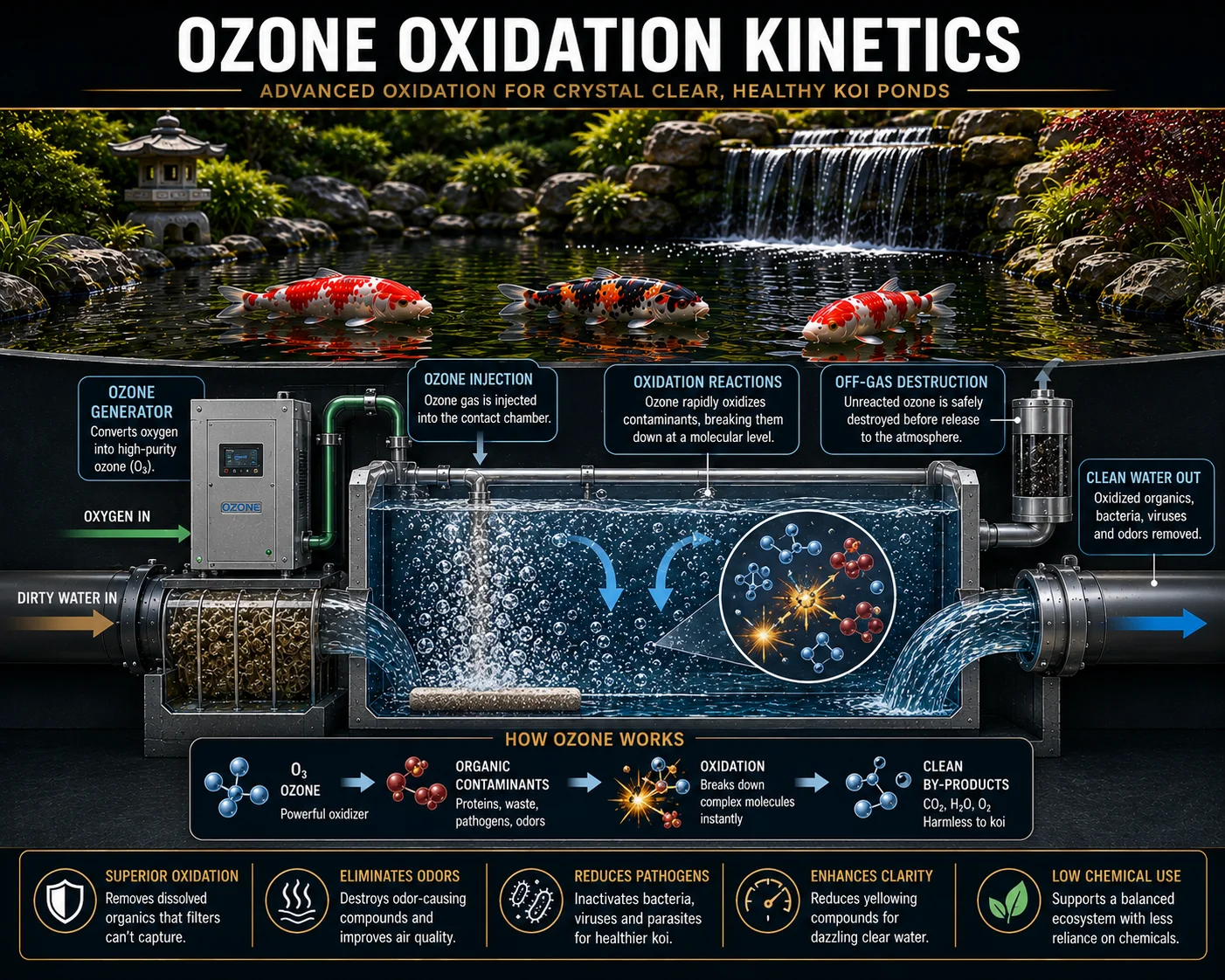
Ozone Oxidation Kinetics
Ozone (O₃) is one of the most powerful oxidants available for water treatment, with an oxidation potential of 2.07 V — second only to fluorine. In koi pond engineering, its primary application is the oxidative destruction of dissolved organic compounds responsible for yellow or tea-colored water, and the neutralization of chromophoric groups that absorb visible light. Unlike mechanical filtration, which removes particulates, ozone chemically alters the molecular structure of organics, breaking conjugated double bonds and aromatic rings that impart color.
The kinetics of ozone oxidation are governed by two distinct pathways: direct molecular ozone reactions, which are selective and relatively slow, and indirect radical-chain reactions involving the hydroxyl radical (•OH), which are non-selective and extremely fast (rate constants up to 10⁹ M⁻¹s⁻¹). The presence of pH, dissolved organic matter (DOM) concentration, and alkalinity heavily influence which pathway dominates. At lower pH (pH < 6), direct molecular ozone reactions are favored; at higher pH, hydroxide ions catalyze the decomposition of ozone into •OH radicals, accelerating oxidation but also reducing the residual ozone concentration.
For practical pond engineering, the critical parameter is the product of ozone concentration and contact time (CT value), which defines the exposure required to achieve a target level of color removal. The CT concept, adapted from disinfection kinetics, is equally applicable to oxidation of humic and fulvic acids that cause discoloration. Hydraulic design must account for mixing efficiency, off-gas handling, and the residual ozone decay rate, which follows pseudo-first-order kinetics in most pond applications. This page provides a practical guide to the chemical and hydraulic principles governing ozone oxidation in koi pond systems.
Test Your Ozone Oxidation Knowledge
Ten scenario-based questions covering reaction kinetics, CT values, pH effects, mass transfer, and system design.
Ozone Oxidation Kinetics — Quick Facts
Most Asked Questions About Ozone Oxidation Kinetics
A pond with persistent yellowing (25 Pt-Co units) despite regular water changes was retrofitted with an ozone system. Initial design assumed a CT of 2.0 mg·min/L, but batch testing revealed an ozone demand of 0.4 mg/L and a half-life of 2.5 minutes at the site pH of 7.8. The actual delivered CT at the designed flow was only 0.8 mg·min/L, resulting in 40% color removal — well below expectations. The solution was to increase the ozone generator output and add a static mixer to improve mass transfer, raising the delivered CT to 2.5 mg·min/L and achieving 85% color reduction.
The key lesson was that ozone demand must be measured on the actual water, not assumed from literature values, and that CT is a function of both generator output and hydraulic design.
Reaction Kinetics And Rate Constants
Ozone oxidation of dissolved organic matter is a complex, multi-step process that can be approximated by second-order kinetics when both ozone and organic substrate concentrations are considered. The rate law for direct reaction is -d[O₃]/dt = k₂ [O₃][DOM], where k₂ is the second-order rate constant. However, because ozone concentration is typically low (mg/L range) and DOM is in excess, the reaction often simplifies to pseudo-first-order: -d[O₃]/dt = k₁ [O₃], where k₁ = k₂ [DOM].
- Direct reaction rate constants: k₂ typically ranges 10¹–10³ M⁻¹s⁻¹ for phenol, 10³–10⁵ M⁻¹s⁻¹ for olefins, and 10⁵–10⁷ M⁻¹s⁻¹ for amines. The specific value depends on the electron density of the substrate.
- Radical reaction rate constants: •OH reacts with virtually all organic compounds at near diffusion-limited rates (10⁹–10¹⁰ M⁻¹s⁻¹), making the radical pathway much faster but less selective.
- Effect of temperature: Increasing temperature raises the rate constant, but also reduces ozone solubility. The net effect on CT is often minimal in the 15–25°C range typical of koi ponds.
For practical design, the pseudo-first-order assumption allows the use of a simple decay model: C(t) = C₀ · exp(-k·t), where k (min⁻¹) is the first-order decay rate constant. This constant can be measured experimentally by spiking ozone into a water sample and monitoring residual ozone over time. The CT value is then the integral of C(t) over the contact period, which for first-order decay reduces to CT = (C₀/k) · (1 – exp(-k·t)). This equation is the basis for sizing ozone contactors and predicting color removal.
Mass Transfer And Ozone Solubility
Ozone must be transferred from the gas phase into the liquid phase before any reaction can occur. The rate of mass transfer is governed by Henry’s Law and the two-film model. Ozone has a relatively low solubility in water; its Henry’s constant at 25°C is approximately 0.0011 atm·m³/mol, giving a maximum dissolved concentration of about 10–20 mg/L at typical feed gas concentrations (5–10% ozone by weight).
Mass transfer efficiency depends on the bubble size, contactor geometry, and mixing intensity. Venturi injectors produce fine bubbles (50–200 µm) that maximize the interfacial area, achieving transfer efficiencies of 80–95% in well-designed systems. Diffuser-based systems using porous stones or membranes produce larger bubbles and typically achieve 60–80% efficiency. The transfer efficiency must be accounted for when calculating the required ozone dose: applied dose = required dissolved ozone / transfer efficiency.
Temperature and salinity also affect solubility: lower temperatures increase solubility, while higher salt content decreases it. For koi ponds, these variations are minor, but they should be considered if the system experiences wide seasonal temperature swings.
An ozone system was installed on a 10,000-gallon pond with a 5 gpm return flow. The contact chamber was a 55-gallon drum with a 3-minute theoretical retention time. The ozone generator produced 2 g/hr, which was estimated to provide 0.5 mg/L at the applied flow. However, field testing showed the residual ozone in the chamber was only 0.05 mg/L — a 90% loss due to poor mixing and off-gassing at the water surface.
Adding a static mixer at the injection point and a submerged baffle to force the water to flow through the entire chamber increased the residual to 0.25 mg/L, a fivefold improvement. The corrected CT value was sufficient to achieve the required color removal, demonstrating that hydraulic design is as important as generator sizing.
Design Considerations For Ozone Systems
Designing a reliable ozone system requires integrating the generator, mass transfer device, contact chamber, off-gas destructor, and residual control into a cohesive hydraulic circuit. The generator output must be matched to the required dose, which is determined by batch testing or CT modeling. For color removal in koi ponds, a typical design dose is 0.5–1.0 mg/L applied to the full return flow, with a target CT of 2.0–4.0 mg·min/L.
Contact time is often the limiting factor in retrofit applications, where existing pipe lengths or vessels are used. In new installations, a dedicated contactor (such as a tank with internal baffles) should be sized for a minimum of 2 minutes at the design flow. Longer contact times allow lower ozone doses, reducing operating costs and improving safety.
Off-gas handling is mandatory in enclosed spaces: the ozone-laden gas exiting the contactor must be destructed by thermal or catalytic conversion to oxygen. Similarly, the water leaving the contactor must pass through activated carbon to remove any residual ozone and oxidative by-products before returning to the pond. This final polishing step ensures the water is safe for fish and does not carry ozone into the pond environment.
A high-end koi facility installed an ozone system but skipped the activated carbon polishing step, assuming the residual ozone would be low enough. Within 48 hours, the koi began showing signs of stress — gas bubble disease caused by supersaturated dissolved oxygen generated as a by-product of ozone decomposition. The system was quickly retrofitted with a 20-gallon activated carbon column, which removed the residual ozone and allowed dissolved oxygen to equilibrate to safe levels. This incident emphasized that ozone oxidation is not complete without post-treatment polishing.
Monitoring And Control Strategies
Effective ozone system control requires continuous or frequent monitoring of dissolved ozone concentration, oxidation-reduction potential (ORP), and color removal efficiency. An ORP probe installed in the contact chamber provides a real-time indication of oxidative activity; typically, an ORP of 600–800 mV indicates sufficient ozone exposure for effective color removal.
- Dissolved ozone monitoring: Use a amperometric or colorimetric sensor installed in the contactor outlet, with a sample pump to deliver a representative stream. The residual should be maintained at 0.1–0.3 mg/L at the contactor outlet to ensure sufficient CT.
- Color monitoring: A UV-Vis spectrophotometer at 254 nm (UV₂₅₄) provides a convenient measure of aromatic organic content, which correlates with color. A reduction in UV₂₅₄ by 50–80% is a practical target.
- ORP measurement: ORP is a logarithmic measure of oxidative capacity. A drop in ORP below 550 mV indicates insufficient ozone dosing or a sudden increase in organic load.
Automatic control systems can adjust the ozone generator output based on ORP or residual ozone readings, maintaining consistent performance across varying water quality conditions. However, care must be taken to avoid over-dosing, which can lead to elevated dissolved oxygen levels and the formation of bromate if bromide is present in the source water.
Ozone Oxidation Kinetics — Full Question Library
Review indexed engineering questions below. 10 categories · 200 questions total.
Q1:
What is the molecular formula of ozone?
Correct Answer: Option A
Ozone is a molecule composed of three oxygen atoms, with a bent structure.
Q2:
What is the oxidation potential of ozone?
Correct Answer: Option B
Ozone has an oxidation potential of 2.07 V, making it one of the strongest oxidants available.
Q3:
What are the two primary oxidation pathways for ozone?
Correct Answer: Option C
Ozone reacts via direct molecular reactions and indirect radical-chain reactions involving hydroxyl radicals.
Q4:
What is the typical half-life of ozone in pure water at neutral pH?
Correct Answer: Option A
In clean water, ozone can have a half-life of 20–30 minutes, but in pond water with DOM, it is much shorter.
Q5:
Which species is formed when ozone decomposes in water?
Correct Answer: Option B
Ozone decomposition produces hydroxyl radicals, superoxide, and other reactive oxygen species.
Q6:
What is the Henry’s constant for ozone at 25°C?
Correct Answer: Option C
The Henry’s constant reflects ozone’s low solubility, limiting the maximum dissolved concentration.
Q7:
At what pH range does direct molecular ozone reaction dominate?
Correct Answer: Option A
At low pH, ozone is more stable and direct reactions with organics dominate.
Q8:
Which factor increases the decomposition rate of ozone in water?
Correct Answer: Option B
Hydroxide ions catalyze ozone decomposition, increasing the rate at high pH.
Q9:
What is the major by-product of ozone decomposition in water?
Correct Answer: Option C
Ozone ultimately decomposes into oxygen gas, which can supersaturate water.
Q10:
What is the primary mechanism for color removal by ozone?
Correct Answer: Option A
Ozone oxidizes the conjugated double bonds and aromatic rings that absorb visible light, destroying color.
Q11:
Which type of organic compound is most reactive with ozone?
Correct Answer: Option B
Ozone reacts rapidly with electron-rich double bonds and aromatic rings.
Q12:
What is the effect of alkalinity on ozone oxidation?
Correct Answer: Option C
Bicarbonate and carbonate scavenge •OH radicals, reducing the indirect oxidation rate.
Q13:
What is the typical ozone dose for color removal in koi pond water?
Correct Answer: Option A
Typical applied doses range from 0.5 to 1.0 mg/L for effective color oxidation.
Q14:
What is the CT concept in ozone disinfection?
Correct Answer: Option B
CT is the integral of ozone concentration over time, representing the total oxidative exposure.
Q15:
Which parameter is used to measure the ozone concentration in water?
Correct Answer: Option C
The indigo method is the standard for dissolved ozone measurement.
Q16:
What is the role of a static mixer in an ozone system?
Correct Answer: Option A
Static mixers create turbulence and fine bubbles, enhancing ozone dissolution.
Q17:
What is the effect of temperature on ozone solubility?
Correct Answer: Option B
Gases like ozone are less soluble at higher temperatures.
Q18:
Which gas is used to generate ozone in commercial generators?
Correct Answer: Option C
Ozone is generated from dry, high-purity oxygen via corona discharge.
Q19:
What is the typical pressure for ozone generation?
Correct Answer: Option A
Ozone generators operate at moderate pressures, typically 10–30 psi.
Q20:
What is the maximum dissolved ozone concentration achievable in water at ambient conditions?
Correct Answer: Option B
Due to low solubility, the maximum dissolved ozone is around 10–20 mg/L.
Q21:
What is the order of the direct ozone reaction with DOM when ozone is in excess?
Correct Answer: Option A
When DOM is in excess, the reaction simplifies to pseudo-first-order with respect to ozone.
Q22:
What is the typical range of second-order rate constants for direct ozone reactions?
Correct Answer: Option B
Direct ozone reactions with organics typically have rate constants in the 10¹–10³ M⁻¹s⁻¹ range.
Q23:
What is the rate constant for hydroxyl radical reaction with most organic compounds?
Correct Answer: Option C
•OH reacts at near diffusion-limited rates, typically 10⁹–10¹⁰ M⁻¹s⁻¹.
Q24:
What is the Arrhenius equation used for in ozone kinetics?
Correct Answer: Option A
The Arrhenius equation relates rate constant to activation energy and temperature.
Q25:
What is the effect of increasing pH on the ozone decay rate?
Correct Answer: Option B
Higher pH promotes ozone decomposition, increasing the decay rate.
Q26:
What is the half-life of ozone in water with high DOM concentration?
Correct Answer: Option C
In water with high organic content, ozone half-life can be less than 2 minutes.
Q27:
What is the overall order of the ozone decomposition reaction in water?
Correct Answer: Option A
Ozone decomposition is second-order overall, involving both ozone and hydroxide ion.
Q28:
What is the rate-limiting step in ozone oxidation of organics?
Correct Answer: Option B
The chemical reaction step, not mass transfer, is often the rate-limiting step in well-mixed systems.
Q29:
What is the activation energy range for ozone oxidation of humic substances?
Correct Answer: Option C
Typical activation energies for ozone oxidation of humic substances are 20–40 kJ/mol.
Q30:
What is the significance of the rate constant in CT calculations?
Correct Answer: Option A
The first-order decay rate constant (k) is essential for calculating the actual CT value.
Q31:
What is the half-life of •OH radical in water?
Correct Answer: Option B
Hydroxyl radicals have a very short lifetime, typically less than 10⁻⁹ seconds.
Q32:
What is the effect of increasing ozone concentration on the reaction rate?
Correct Answer: Option C
Higher ozone concentration increases the reaction rate, following the rate law.
Q33:
Which parameter is most important for determining the required ozone dose?
Correct Answer: Option A
The ozone demand, measured by batch testing, determines the required dose.
Q34:
What is the relationship between ozone concentration and UV₂₅₄ in a reactor?
Correct Answer: Option C
UV₂₅₄ removal follows exponential decay with respect to ozone concentration.
Q35:
What is the typical pseudo-first-order rate constant for ozone decay in pond water?
Correct Answer: Option C
For pond water, the decay rate constant is typically in the range of 0.1–0.5 min⁻¹.
Q36:
What is the effect of DOM concentration on the ozone decay rate?
Correct Answer: Option A
Higher DOM concentration consumes ozone, increasing the observed decay rate.
Q37:
What is the role of the initiation step in the ozone decomposition mechanism?
Correct Answer: Option B
The initiation step generates •OH radicals, which drive the chain reaction.
Q38:
What is the termination step in the ozone chain reaction?
Correct Answer: Option C
Termination occurs when radical species recombine, consuming radicals.
Q39:
What is the effect of temperature on the rate constant of ozone oxidation?
Correct Answer: Option A
Higher temperature increases the rate constant, following the Arrhenius equation.
Q40:
Which parameter is used to express the efficiency of ozone utilization?
Correct Answer: Option B
The CT value is a measure of the oxidative exposure and utilization efficiency.
Q41:
What is the typical CT value for 80% color removal in pond water?
Correct Answer: Option A
Effective color removal in koi ponds typically requires CT values of 2.0–4.0 mg·min/L.
Q42:
What is the minimum contact time recommended for ozone in a pond system?
Correct Answer: Option B
A minimum contact time of 2 minutes is recommended to achieve sufficient CT.
Q43:
What is the typical ozone residual after the contact chamber in a properly designed system?
Correct Answer: Option C
A residual of 0.1–0.3 mg/L at the contactor outlet ensures adequate CT.
Q44:
How is the CT value calculated in a batch reactor?
Correct Answer: Option A
CT is the area under the ozone concentration vs. time curve.
Q45:
What is the effect of increasing flow rate on the CT value in a plug-flow reactor?
Correct Answer: Option B
Higher flow rate reduces contact time, thus decreasing CT.
Q46:
What is the typical design CT value for disinfection in addition to color removal?
Correct Answer: Option C
For disinfection, CT values of 5.0 mg·min/L or higher may be required.
Q47:
What is the role of an ozone contactor in the system?
Correct Answer: Option A
The contactor ensures adequate time for ozone to react with the water.
Q48:
What is the advantage of using a baffled contactor over an open tank?
Correct Answer: Option B
Baffles promote plug-flow, improving CT efficiency compared to a well-mixed tank.
Q49:
What is the typical ozone dose for a contactor with 80% transfer efficiency?
Correct Answer: Option C
If 0.8 mg/L is required, the applied dose must be 1.0 mg/L at 80% transfer.
Q50:
What is the effect of contactor volume on the CT value?
Correct Answer: Option A
Larger contactor volume increases retention time, thus increasing CT.
Q51:
What is the typical range of ozone transfer efficiency in a venturi injector system?
Correct Answer: Option B
Venturi injectors typically achieve 80–95% transfer efficiency.
Q52:
What is the purpose of an ozone destructor?
Correct Answer: Option C
An ozone destructor converts residual ozone in the off-gas to oxygen.
Q53:
What is the effect of ozone demand on the required ozone dose?
Correct Answer: Option A
Ozone demand must be satisfied before a residual can be maintained.
Q54:
What is the typical retention time in a static mixer contactor?
Correct Answer: Option B
Static mixers provide very short retention times, relying on high turbulence for mass transfer.
Q55:
What is the purpose of an activated carbon filter after ozone contact?
Correct Answer: Option C
Activated carbon removes residual ozone and oxidative by-products before water returns to the pond.
Q56:
What is the effect of pipe length on the CT value in a system?
Correct Answer: Option A
Longer pipe increases the retention time, thus increasing CT.
Q57:
What is the typical ozone residual after the activated carbon filter?
Correct Answer: Option B
Activated carbon removes ozone completely, resulting in zero residual.
Q58:
What is the purpose of a sample point in the contactor?
Correct Answer: Option C
A sample point allows for measurement of dissolved ozone concentration.
Q59:
What is the effect of temperature on the required CT for color removal?
Correct Answer: Option A
Higher temperature increases the reaction rate, thus reducing the required CT.
Q60:
What is the typical CT value for 90% color removal?
Correct Answer: Option B
Higher removal percentages require CT values of 3.0–5.0 mg·min/L.
Q61:
At what pH does the radical pathway dominate ozone oxidation?
Correct Answer: Option A
At high pH, hydroxide ions catalyze ozone decomposition, promoting the radical pathway.
Q62:
What is the effect of pH on the stability of ozone in water?
Correct Answer: Option B
Ozone is more stable at low pH, with a slower decomposition rate.
Q63:
What is the pKa of ozone?
Correct Answer: Option C
Ozone is a neutral molecule and does not have a pKa.
Q64:
What is the effect of pH on the oxidation potential of ozone?
Correct Answer: Option A
The oxidation potential of ozone increases slightly with pH due to radical formation.
Q65:
What is the typical pH range for koi pond water?
Correct Answer: Option B
Koi ponds are typically maintained at a pH of 7.0–8.5.
Q66:
What is the effect of pH on the color removal efficiency?
Correct Answer: Option C
Color removal efficiency is typically optimal in the neutral to slightly alkaline pH range.
Q67:
What is the effect of pH on ozone solubility?
Correct Answer: Option A
Ozone solubility decreases slightly with increasing pH.
Q68:
What is the role of hydroxide ions in ozone decomposition?
Correct Answer: Option B
Hydroxide ions initiate the chain reaction that decomposes ozone.
Q69:
What is the effect of pH on the half-life of ozone?
Correct Answer: Option C
Higher pH reduces the half-life of ozone due to faster decomposition.
Q70:
What is the effect of pH on the CT value required for a given removal?
Correct Answer: Option A
Higher pH increases the reaction rate, thus reducing the required CT.
Q71:
What is the typical pH adjustment method for ozone systems?
Correct Answer: Option B
pH can be adjusted with sodium hydroxide (increase) or carbon dioxide (decrease).
Q72:
What is the effect of pH on the oxidation of humic substances?
Correct Answer: Option C
The radical pathway at high pH is more effective for oxidizing humic substances.
Q73:
What is the effect of pH on the formation of bromate from bromide?
Correct Answer: Option A
Bromate formation is enhanced at high pH and in the presence of ozone.
Q74:
What is the typical pH of water entering an ozone contactor?
Correct Answer: Option B
Pond water typically enters the ozone contactor at pH 7.0–8.0.
Q75:
What is the effect of pH on the reaction rate of ozone with phenol?
Correct Answer: Option C
Phenol oxidation by ozone is faster at higher pH due to radical formation.
Q76:
What is the effect of pH on ozone’s ability to oxidize ammonia?
Correct Answer: Option A
At high pH, ammonia is in the more reactive NH₃ form, enhancing oxidation.
Q77:
What is the typical pH range for effective ozone oxidation of organics?
Correct Answer: Option B
Effective oxidation of organics by ozone typically occurs in the pH range of 6.0–8.5.
Q78:
What is the effect of pH on the ozone residual?
Correct Answer: Option C
Higher pH leads to faster ozone decomposition, reducing the residual.
Q79:
What is the role of bicarbonate in ozone systems?
Correct Answer: Option A
Bicarbonate is a scavenger of •OH radicals, reducing the indirect oxidation rate.
Q80:
What is the effect of pH on the overall efficiency of ozone oxidation?
Correct Answer: Option B
Overall oxidation efficiency is typically optimal in the neutral to slightly alkaline range.
Q81:
What is ozone demand?
Correct Answer: Option A
Ozone demand is the difference between the applied dose and the residual.
Q82:
How is ozone demand measured in a water sample?
Correct Answer: Option B
A batch test involves spiking ozone and measuring the residual over time.
Q83:
What is the effect of high DOM concentration on ozone demand?
Correct Answer: Option C
Higher DOM concentration increases the ozone demand.
Q84:
What is the typical ozone demand for clear pond water?
Correct Answer: Option A
Clear water with low DOM has a demand of 0.1–0.3 mg/L.
Q85:
What is the effect of DOM on the reaction pathway?
Correct Answer: Option B
DOM acts as a •OH scavenger, reducing the contribution of the indirect pathway.
Q86:
What is the relationship between DOM and ozone half-life?
Correct Answer: Option C
Higher DOM reduces the half-life of ozone due to increased consumption.
Q87:
What is the effect of ozone pre-oxidation on DOM?
Correct Answer: Option A
Ozone pre-oxidation breaks down large DOM molecules, improving biodegradability.
Q88:
What is the typical DOM concentration in a koi pond?
Correct Answer: Option B
Koi ponds typically have TOC concentrations of 5–20 mg/L.
Q89:
What is the effect of DOM on the required ozone dose?
Correct Answer: Option C
Higher DOM requires a higher ozone dose to overcome the demand.
Q90:
What is the role of ozone in reducing DOC (Dissolved Organic Carbon)?
Correct Answer: Option A
Complete oxidation of DOC to CO₂ and water is the ultimate goal.
Q91:
What is the effect of ozone on the UV₂₅₄ absorbance of water?
Correct Answer: Option B
Ozone oxidizes aromatic compounds, reducing UV₂₅₄ absorbance.
Q92:
What is the typical relationship between DOM and ozone demand?
Correct Answer: Option C
Ozone demand generally increases linearly with DOM concentration.
Q93:
What is the effect of ozone on biodegradable dissolved organic carbon (BDOC)?
Correct Answer: Option A
Ozone breaks down refractory organics, increasing their biodegradability.
Q94:
What is the role of ozone in removing color from water?
Correct Answer: Option B
Color removal occurs by oxidation of the chemical bonds responsible for light absorption.
Q95:
What is the effect of DOM on the ozone decay rate?
Correct Answer: Option C
Higher DOM leads to faster ozone decay due to increased consumption.
Q96:
What is the role of ozone in reducing trihalomethane (THM) precursors?
Correct Answer: Option A
Ozone oxidizes organic precursors, reducing THM formation potential.
Q97:
What is the effect of ozone on the molecular weight of DOM?
Correct Answer: Option B
Ozone breaks down large molecules, reducing the average molecular weight.
Q98:
What is the role of ozone in controlling taste and odor?
Correct Answer: Option C
Ozone oxidizes geosmin, MIB, and other compounds responsible for taste and odor.
Q99:
What is the effect of ozone on the coagulation of DOM?
Correct Answer: Option A
Pre-oxidation with ozone can enhance coagulation by reducing organic interference.
Q100:
What is the typical ozone dose for reducing DOM in a pond?
Correct Answer: Option B
Typical doses for DOM reduction in ponds are in the 0.5–1.0 mg/L range.
Q101:
What is the driving force for ozone mass transfer?
Correct Answer: Option A
Mass transfer is driven by the concentration gradient between the gas and liquid phases.
Q102:
What is the effect of bubble size on ozone mass transfer?
Correct Answer: Option B
Smaller bubbles provide more surface area per volume, enhancing mass transfer.
Q103:
What is the typical transfer efficiency of a fine-bubble diffuser?
Correct Answer: Option C
Fine-bubble diffusers typically achieve 60–80% transfer efficiency.
Q104:
What is the effect of mixing on ozone mass transfer?
Correct Answer: Option A
Mixing increases turbulence, renewing the liquid surface and enhancing transfer.
Q105:
What is the role of a venturi injector in an ozone system?
Correct Answer: Option B
A venturi injector creates a vacuum that draws ozone gas into the water flow.
Q106:
What is the effect of water temperature on ozone mass transfer?
Correct Answer: Option C
Higher temperatures reduce gas solubility, decreasing the mass transfer rate.
Q107:
What is the effect of pressure on ozone mass transfer?
Correct Answer: Option A
Higher pressure increases the solubility of ozone, enhancing mass transfer.
Q108:
What is the role of a sidestream injection system?
Correct Answer: Option B
A sidestream system creates a high-velocity flow for efficient ozone dissolution.
Q109:
What is the effect of surface tension on bubble size?
Correct Answer: Option C
Higher surface tension resists bubble formation, resulting in larger bubbles.
Q110:
What is the typical bubble size produced by a venturi injector?
Correct Answer: Option A
Venturi injectors produce fine bubbles in the range of 50–200 µm.
Q111:
What is the effect of water depth on ozone mass transfer?
Correct Answer: Option B
Greater depth increases hydrostatic pressure, enhancing ozone solubility.
Q112:
What is the role of a static mixer in mass transfer?
Correct Answer: Option C
Static mixers create turbulence, which improves contact between ozone and water.
Q113:
What is the effect of flow rate on mass transfer in a static mixer?
Correct Answer: Option A
Higher flow rate increases the Reynolds number, enhancing turbulence and mass transfer.
Q114:
What is the typical ozone gas concentration for a venturi system?
Correct Answer: Option B
Ozone generators typically produce gas with 5–10% ozone by weight.
Q115:
What is the effect of high salinity on ozone mass transfer?
Correct Answer: Option C
Higher salinity reduces gas solubility, decreasing the mass transfer rate.
Q116:
What is the role of the gas flow rate in a diffuser system?
Correct Answer: Option A
Higher gas flow increases mixing in the contactor, enhancing mass transfer.
Q117:
What is the effect of ozone concentration on the mass transfer driving force?
Correct Answer: Option B
Higher gas-phase ozone concentration increases the concentration gradient, enhancing transfer.
Q118:
What is the typical contact time in a sidestream injection system?
Correct Answer: Option C
Sidestream systems provide very short contact times, typically 2–10 seconds.
Q119:
What is the effect of liquid viscosity on mass transfer?
Correct Answer: Option A
Higher viscosity reduces the diffusion coefficient, decreasing the mass transfer rate.
Q120:
What is the role of the liquid flow rate in mass transfer?
Correct Answer: Option B
Higher flow rate increases mixing and turbulence, enhancing mass transfer.
Q121:
What is the principle of corona discharge ozone generation?
Correct Answer: Option A
Corona discharge uses high voltage to create a plasma that converts oxygen to ozone.
Q122:
What is the typical ozone concentration from a corona discharge generator?
Correct Answer: Option B
Corona discharge generators typically produce 5–10% ozone by weight.
Q123:
What is the principle of UV ozone generation?
Correct Answer: Option C
UV light at 185 nm splits oxygen molecules, producing ozone.
Q124:
What is the effect of air drying on ozone generation?
Correct Answer: Option A
Moisture interferes with the discharge, reducing ozone production.
Q125:
What is the typical energy efficiency of a corona discharge ozone generator?
Correct Answer: Option B
Corona discharge generators typically produce 10–20 g of ozone per kWh.
Q126:
What is the role of a dielectric in a corona discharge cell?
Correct Answer: Option C
The dielectric material ensures a uniform discharge across the gap.
Q127:
What is the effect of gas pressure on ozone generation efficiency?
Correct Answer: Option A
Higher gas pressure increases the density, improving the efficiency of ozone production.
Q128:
What is the role of a power supply in a corona discharge generator?
Correct Answer: Option B
The power supply provides the high voltage necessary for corona discharge.
Q129:
What is the typical feed gas for a large ozone generator?
Correct Answer: Option C
High-purity oxygen is typically used for large generators to maximize efficiency.
Q130:
What is the effect of temperature on ozone generation?
Correct Answer: Option A
Ozone production decreases at higher temperatures due to thermal decomposition.
Q131:
What is the role of a cooling system in an ozone generator?
Correct Answer: Option B
Cooling is essential to prevent thermal decomposition of ozone.
Q132:
What is the typical lifespan of a corona discharge cell?
Correct Answer: Option C
With proper maintenance, corona cells can last 10–15 years.
Q133:
What is the effect of nitrogen in the feed gas on ozone generation?
Correct Answer: Option A
Nitrogen in the feed gas forms nitrogen oxides, reducing ozone purity.
Q134:
What is the role of a moisture trap in an ozone generation system?
Correct Answer: Option B
Moisture reduces ozone generation efficiency and damages the cell.
Q135:
What is the typical ozone output of a small pond system generator?
Correct Answer: Option C
Small pond systems typically use generators with 2–10 g/hr output.
Q136:
What is the effect of electrode gap on ozone production?
Correct Answer: Option A
An optimal gap balances voltage and gas flow for maximum ozone production.
Q137:
What is the role of a check valve in an ozone injection system?
Correct Answer: Option B
A check valve prevents water from flowing back into the ozone generator.
Q138:
What is the typical operating frequency of a corona discharge generator?
Correct Answer: Option C
Modern generators operate at high frequencies (1–10 kHz) for improved efficiency.
Q139:
What is the effect of gas flow rate on ozone concentration?
Correct Answer: Option A
Higher gas flow dilutes the ozone, reducing its concentration.
Q140:
What is the purpose of an ozone destructor?
Correct Answer: Option B
An ozone destructor prevents ozone from being released into the atmosphere.
Q141:
What is the OSHA permissible exposure limit for ozone?
Correct Answer: Option A
The 8-hour time-weighted average exposure limit for ozone is 0.1 ppm.
Q142:
What is the odor threshold for ozone?
Correct Answer: Option B
Ozone has a sharp, pungent odor detectable at 0.02–0.05 ppm.
Q143:
What is the effect of ozone on respiratory tissue?
Correct Answer: Option C
Ozone is a respiratory irritant and can cause lung damage at high concentrations.
Q144:
What is the typical location for an ozone leak detector?
Correct Answer: Option A
Leak detectors should be placed where ozone is most likely to leak.
Q145:
What is the role of an ORP meter in ozone monitoring?
Correct Answer: Option B
ORP is an indirect indicator of ozone concentration and oxidative activity.
Q146:
What is the typical ORP value indicating sufficient ozone exposure?
Correct Answer: Option C
An ORP of 600–800 mV indicates effective oxidation.
Q147:
What is the effect of ozone on fish gills?
Correct Answer: Option A
Residual ozone can irritate and damage fish gills, requiring removal before return.
Q148:
What is the purpose of a flow meter in an ozone system?
Correct Answer: Option B
A flow meter measures water flow, which is used to calculate the ozone dose.
Q149:
What is the typical warning sign of an ozone leak?
Correct Answer: Option C
The characteristic sharp odor of ozone is the primary warning sign.
Q150:
What is the role of a contactor drain in an ozone system?
Correct Answer: Option A
A drain allows the contactor to be emptied for cleaning and maintenance.
Q151:
What is the effect of ozone on pond pH?
Correct Answer: Option B
Ozone oxidation does not significantly alter pH in most pond waters.
Q152:
What is the role of a sample valve in an ozone system?
Correct Answer: Option C
A sample valve allows for the collection of water for residual ozone measurement.
Q153:
What is the effect of ozone on biological filtration?
Correct Answer: Option A
Residual ozone must be removed before water returns to the biofilter to prevent damage.
Q154:
What is the purpose of an ozone destructor catalyst?
Correct Answer: Option B
A catalyst promotes the conversion of ozone to oxygen.
Q155:
What is the typical material used for ozone-resistant tubing?
Correct Answer: Option C
Ozone-resistant materials include stainless steel, Teflon, and some specialized plastics.
Q156:
What is the effect of ozone on UV sterilizers?
Correct Answer: Option A
Ozone is corrosive to the quartz sleeves of UV lamps.
Q157:
What is the role of an air dryer in a PSA oxygen generator?
Correct Answer: Option B
An air dryer is essential for producing high-purity oxygen.
Q158:
What is the typical lifespan of an ozone destructor catalyst?
Correct Answer: Option C
With proper care, catalysts can last 5–10 years.
Q159:
What is the effect of ozone on plastic pond fittings?
Correct Answer: Option A
Ozone can attack certain plastics, causing cracking and failure.
Q160:
What is the purpose of a pressure gauge in an ozone system?
Correct Answer: Option B
Pressure gauges monitor the pressure in the system.
Q161:
What is the most common cause of low ozone output?
Correct Answer: Option A
Contamination or wear of the corona cell reduces ozone production.
Q162:
What is the effect of a clogged venturi injector?
Correct Answer: Option B
A clogged venturi reduces the vacuum, limiting ozone injection.
Q163:
What is the most common cause of high ozone residual?
Correct Answer: Option C
Low water flow and low demand can both lead to a high residual.
Q164:
What is the first step in troubleshooting an ozone system?
Correct Answer: Option A
Ensure the feed gas is dry and at the correct pressure.
Q165:
What is the effect of a leak in the ozone line?
Correct Answer: Option B
Leaks reduce the amount of ozone reaching the water.
Q166:
What is the most common cause of fish stress in an ozone system?
Correct Answer: Option C
Residual ozone can cause gill damage and respiratory stress.
Q167:
What is the effect of a failed check valve in the ozone system?
Correct Answer: Option A
A failed check valve can allow water to damage the ozone generator.
Q168:
What is the role of a pressure relief valve in an ozone system?
Correct Answer: Option B
A relief valve protects the system from excessive pressure.
Q169:
What is the most common cause of high ozone demand?
Correct Answer: Option C
High DOM concentration is the primary driver of ozone demand.
Q170:
What is the effect of a dirty UV lamp in a UV ozone generator?
Correct Answer: Option A
Fouling of the UV lamp reduces the intensity of 185 nm light, reducing ozone generation.
Q171:
What is the effect of a power supply failure on an ozone generator?
Correct Answer: Option B
Without power, the generator cannot produce ozone.
Q172:
What is the most common issue with an activated carbon filter?
Correct Answer: Option C
Over time, carbon becomes saturated and channeling reduces contact.
Q173:
What is the effect of low pH on ozone oxidation?
Correct Answer: Option A
At low pH, the direct pathway dominates, which is slower.
Q174:
What is the role of a flow meter in troubleshooting?
Correct Answer: Option B
Flow meter readings confirm that the hydraulic design is correct.
Q175:
What is the most common cause of ozone odor in the filter room?
Correct Answer: Option C
An ozone leak is the primary cause of detectable ozone odor.
Q176:
What is the effect of a blocked diffuser stone?
Correct Answer: Option A
A blocked stone reduces the surface area available for mass transfer.
Q177:
What is the effect of high alkalinity on ozone oxidation?
Correct Answer: Option B
Alkalinity acts as a radical scavenger, reducing the indirect oxidation pathway.
Q178:
What is the most common cause of low ORP in an ozone system?
Correct Answer: Option C
Low ORP indicates that the ozone dose is insufficient to meet the demand.
Q179:
What is the role of a sample pump in ozone monitoring?
Correct Answer: Option A
A sample pump ensures a continuous flow to the ozone analyzer.
Q180:
What is the most common cause of failure in an ozone generator?
Correct Answer: Option B
Contamination of the dielectric by dust or moisture is a common cause of failure.
Q181:
What is the first step in designing an ozone system for a pond?
Correct Answer: Option A
Ozone demand testing is the foundation of proper system sizing.
Q182:
How is the required ozone dose calculated?
Correct Answer: Option B
The required dose is calculated from the target CT value, flow rate, and transfer efficiency.
Q183:
What is the recommended material for ozone contactor piping?
Correct Answer: Option C
Ozone-resistant materials like stainless steel or CPVC are required for contactor piping.
Q184:
What is the role of an off-gas destructor in system design?
Correct Answer: Option A
An off-gas destructor ensures that ozone is not released into the environment.
Q185:
What is the typical flow rate range for a venturi injector?
Correct Answer: Option B
Venturi injectors are available for flow rates from 5 to 100+ gpm.
Q186:
What is the recommended contact time for disinfection with ozone?
Correct Answer: Option C
Disinfection typically requires 4–10 minutes of contact time.
Q187:
What is the role of a flow totalizer in an ozone system?
Correct Answer: Option A
A flow totalizer records the cumulative water volume for dose tracking.
Q188:
What is the effect of system pressure on ozone solubility?
Correct Answer: Option B
Higher pressure increases the solubility of ozone, enhancing mass transfer.
Q189:
What is the recommended pipe size for a sidestream injection system?
Correct Answer: Option C
Sidestream systems typically use 1.5–3 inch piping.
Q190:
What is the role of a bypass line in an ozone system?
Correct Answer: Option A
A bypass line allows maintenance on the ozone system while water continues to flow.
Q191:
What is the typical lifespan of an activated carbon filter in a pond system?
Correct Answer: Option B
Activated carbon filters typically last 6–12 months before needing replacement.
Q192:
What is the effect of water temperature on the required ozone dose?
Correct Answer: Option C
Temperature affects both reaction rate and solubility, requiring careful dose adjustment.
Q193:
What is the purpose of a surge tank in an ozone system?
Correct Answer: Option A
A surge tank absorbs flow fluctuations, ensuring stable ozone dosing.
Q194:
What is the recommended type of valve for ozone systems?
Correct Answer: Option B
Ball valves with Teflon seats are recommended for ozone systems due to their resistance.
Q195:
What is the effect of ozone on the biodegradability of organic matter?
Correct Answer: Option C
Ozone breaks down refractory organics, increasing their biodegradability.
Q196:
What is the purpose of a pressure regulator in an ozone system?
Correct Answer: Option A
A pressure regulator ensures stable gas pressure for consistent ozone generation.
Q197:
What is the typical oxygen purity required for ozone generation?
Correct Answer: Option B
Oxygen purity of 90–95% is typically sufficient for ozone generation.
Q198:
What is the role of a flow switch in an ozone system?
Correct Answer: Option C
A flow switch prevents ozone generation when there is no water flow, protecting the system.
Q199:
What is the purpose of a data logger in an ozone system?
Correct Answer: Option A
Data loggers track performance metrics for system optimization and troubleshooting.
Q200:
What is the final step in commissioning an ozone system?
Correct Answer: Option B
The CT value must be validated with field testing to confirm the system meets design goals.