NDIR Carbon Dioxide Sensor Optical Drift and Damp Environment Calibration
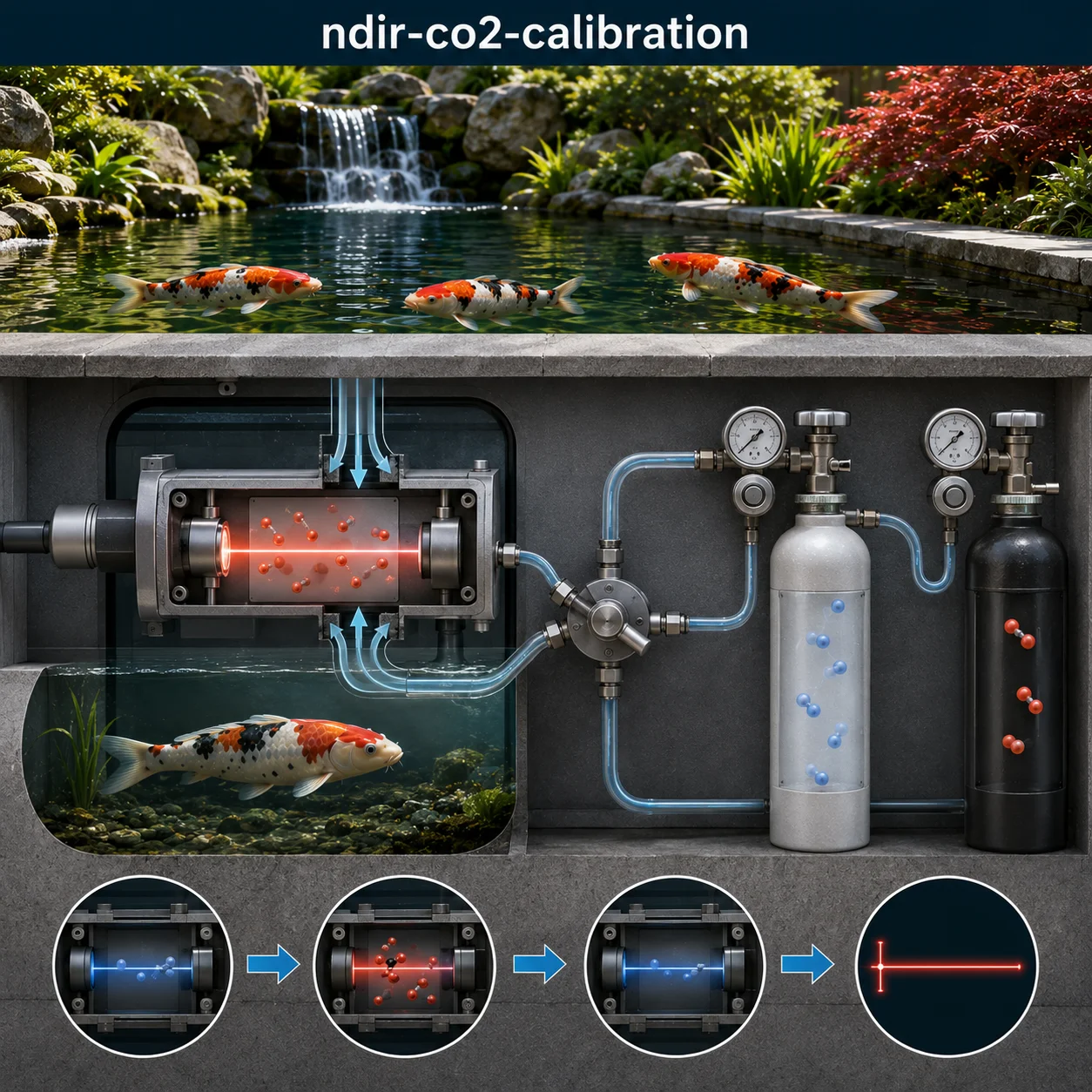
Non-dispersive infrared (NDIR) CO₂ sensors are the workhorse of modern pond water quality monitoring, but they are uniquely sensitive to optical drift and damp-environment interference. In koi pond applications, high humidity, biofilm accumulation, and temperature cycling can shift the baseline and span calibration, leading to erroneous CO₂ readings that undermine aeration control and pH stability.
This page provides a rigorous engineering framework for understanding NDIR optical drift, calibrating in high-humidity environments, and maintaining sensor accuracy over the long term. The content is structured for professional builders and pond engineers who demand better than 90% first-attempt success on these complex calibration challenges.
NDIR CO₂ Calibration — Engineering Challenge
10 scenario-based questions on optical drift, humidity compensation, span gas, and damp-environment troubleshooting. Designed to separate the top 10% from the rest.
NDIR CO₂ Calibration — Quick Facts
Most Asked Questions About NDIR CO₂ Calibration
On a large commercial koi pond, the CO₂ sensor was reading 1200 ppm consistently, triggering the aeration system to run at full power — but the pH was stable and fish showed no signs of distress. A field check with a calibrated handheld sensor showed the actual CO₂ was only 600 ppm. The culprit: the sensor had a thin film of condensation on the optical mirror due to a failed desiccant pack. After drying and recalibration, the reading returned to normal. Lesson: always inspect the optical path and maintain desiccant in the sensor housing.
Optical Drift Mechanisms
NDIR CO₂ sensors measure the absorption of infrared light at 4.26 µm. The ratio of absorbed to transmitted light is used to calculate CO₂ concentration via the Beer-Lambert law. However, any change in the optical path length, source intensity, or detector sensitivity will cause drift. In pond environments, the primary sources are:
- Condensation: Water droplets on the optical surfaces scatter and absorb IR light, reducing the effective path length and causing a false high reading.
- Biofilm: Bacterial and algal films absorb IR light and can permanently attenuate the signal.
- Source aging: The IR source (typically a micro-machined tungsten filament) degrades over time, reducing output intensity.
- Detector drift: Pyroelectric or thermopile detectors can shift gain with temperature and age.
Humidity Compensation and Correction
Water vapor has a broad IR absorption spectrum that overlaps with CO₂. At 100% RH, the interference can be as high as 15–20% of the CO₂ reading. Modern sensors incorporate a humidity sensor and a polynomial correction algorithm. However, these corrections are only as good as the sensor’s calibration; they cannot correct for optical surface contamination. In high-humidity environments, it’s often better to use a dew point sensor and a correction factor derived from a calibration curve at known humidity levels.
In a tropical indoor koi facility, the ambient RH consistently exceeded 90%. The NDIR sensor’s built-in humidity correction was insufficient, and the CO₂ readings were consistently 150–200 ppm high. By installing a small inline desiccant filter on the gas sampling line, we reduced the humidity to 60% RH, eliminating the interference and allowing the sensor to read accurately without recalibration.
Calibration Best Practices
Professional NDIR calibration requires: 1) a clean, dry optical path; 2) certified zero and span gases; 3) stable temperature (within ±2°C) and humidity; 4) sufficient warm-up time; 5) multiple-point calibration if possible (e.g., 0, 500, 1000, 2000 ppm). Always document the calibration data and compare with historical trends to detect early drift. For pond applications, consider using a secondary, less expensive sensor as a check or a portable reference for spot checks.
A common mistake is to calibrate the sensor in a dry, clean lab and then install it in the pond without re-checking. The humidity and temperature difference can shift the baseline by 50–100 ppm. Always perform a final zero and span check in the actual installation environment, and allow the sensor to equilibrate for at least an hour before finalizing calibration.
NDIR CO₂ Calibration — Full Question Library
200 engineering questions across 10 categories. Each question includes a detailed explanation.
Q1:
What is the fundamental measurement principle of NDIR CO₂ sensors?
Correct Answer: Option A
NDIR sensors rely on the Beer-Lambert law: the absorption of infrared light at the characteristic CO₂ wavelength is proportional to concentration.
Q2:
Which wavelength is most strongly absorbed by CO₂?
Correct Answer: Option B
CO₂ has a strong absorption band centered at 4.26 µm, which is used in NDIR sensors.
Q3:
What does the ‘N’ in NDIR stand for?
Correct Answer: Option C
Non-dispersive means the sensor uses a broad-band IR source and an optical filter to isolate the CO₂ absorption band.
Q4:
What is the role of the optical filter in an NDIR sensor?
Correct Answer: Option B
The optical filter allows only the CO₂ absorption band to reach the detector, reducing interference from other gases.
Q5:
Which law describes the relationship between absorbed IR and gas concentration?
Correct Answer: Option A
The Beer-Lambert law states that absorbance is proportional to the concentration and path length.
Q6:
What type of IR source is commonly used in NDIR sensors?
Correct Answer: Option B
Micro-machined tungsten filaments are low-power, long-life, and produce a broad IR spectrum.
Q7:
What is the typical path length in an NDIR sensor?
Correct Answer: Option A
Typical path lengths are 2–10 cm, depending on the sensor design and sensitivity requirements.
Q8:
What detector type is most common in NDIR sensors?
Correct Answer: Option B
Pyroelectric and thermopile detectors are sensitive to IR radiation and operate at room temperature.
Q9:
What is the effect of a shorter path length on NDIR sensitivity?
Correct Answer: Option A
Shorter path lengths reduce the number of absorbing molecules, thus decreasing sensitivity.
Q10:
What is the typical CO₂ absorption coefficient at 4.26 µm?
Correct Answer: Option A
The absorption coefficient is high, which makes NDIR a sensitive method for CO₂ measurement.
Q11:
What is the influence of pressure on NDIR CO₂ measurement?
Correct Answer: Option A
Pressure affects the number of molecules in the path; higher pressure increases the partial pressure and thus the absorption.
Q12:
What is the typical warm-up time for an NDIR sensor?
Correct Answer: Option B
The IR source and detector need thermal stabilization, typically 10–30 minutes.
Q13:
What is the effect of optical window contamination on NDIR readings?
Correct Answer: Option B
Contamination absorbs or scatters light, reducing the signal and leading to a low reading if not corrected.
Q14:
What is a ‘reference channel’ in some NDIR sensors?
Correct Answer: Option A
A reference channel at a wavelength not absorbed by CO₂ helps correct for source intensity variations and optical path changes.
Q15:
What is the effect of a failing IR source on NDIR readings?
Correct Answer: Option B
A failing IR source reduces the emitted intensity, which is interpreted as less absorption and results in a low reading.
Q16:
What is the typical measurement range for CO₂ in pond applications?
Correct Answer: Option A
Pond CO₂ levels typically range from 0 to 2000 ppm, with 400–1000 ppm being common.
Q17:
What is the role of a ‘chopper’ in some NDIR designs?
Correct Answer: Option A
A chopper modulates the IR beam, allowing the detector to operate in AC mode, which reduces drift and improves signal-to-noise.
Q18:
What is the effect of high humidity on the NDIR optical path?
Correct Answer: Option B
Water vapor has overlapping absorption, which can cause a positive interference and an overestimation of CO₂.
Q19:
What is the typical response time of an NDIR sensor?
Correct Answer: Option A
Response time depends on the gas exchange rate and the sensor design, but 10–60 seconds is typical.
Q20:
What is the effect of aging on the NDIR detector?
Correct Answer: Option B
Detectors can degrade over time, losing sensitivity and causing a drift that requires recalibration.
Q21:
How does water vapor interfere with NDIR CO₂ measurement?
Correct Answer: Option A
Water vapor has a broad IR absorption band that overlaps with the CO₂ absorption peak.
Q22:
At 100% RH, what is the typical magnitude of humidity interference?
Correct Answer: Option B
High humidity can cause a 10–20% overestimation of CO₂ if not corrected.
Q23:
What is the standard method to correct for humidity interference?
Correct Answer: Option A
Most sensors incorporate a humidity sensor and use a polynomial or lookup table to correct the CO₂ reading.
Q24:
What is the effect of condensing humidity on the optical surfaces?
Correct Answer: Option B
Condensation on the optical surfaces scatters and absorbs IR, causing a significant reduction in signal.
Q25:
What is the recommended method to prevent condensation on NDIR optics?
Correct Answer: Option A
A desiccant pack absorbs moisture, and a heated window prevents condensation.
Q26:
How does temperature affect humidity interference?
Correct Answer: Option A
Warm air can hold more water vapor, so the interference is higher at higher temperatures for the same RH.
Q27:
What is the typical dew point range in a koi pond environment?
Correct Answer: Option B
Pond environments are warm and humid, with dew points often in the 15–25°C range.
Q28:
What is the effect of a dirty humidity sensor on the correction algorithm?
Correct Answer: Option A
If the humidity sensor reads incorrectly, the correction factor will be wrong, causing a bias in the CO₂ reading.
Q29:
What is the recommended frequency for checking the desiccant in an NDIR sensor?
Correct Answer: Option B
Desiccant should be checked monthly in high-humidity environments and replaced if saturated.
Q30:
What is the effect of barometric pressure on humidity interference?
Correct Answer: Option A
At higher pressure, the water vapor partial pressure is higher, which can increase the IR absorption interference.
Q31:
What is the role of a ‘gas drying’ system in NDIR sampling?
Correct Answer: Option B
A drying system (e.g., Nafion tube or desiccant) removes water vapor before the gas reaches the sensor.
Q32:
What is the typical correction factor for 100% RH at 25°C?
Correct Answer: Option A
At 100% RH and 25°C, the interference can be 10–20%, so a correction factor of 0.8–0.9 is applied.
Q33:
What is the effect of salt-fog (marine) environments on NDIR sensors?
Correct Answer: Option A
Salt can cause corrosion on the optical surfaces and electronic connections, leading to drift and failure.
Q34:
What is the recommended housing IP rating for NDIR sensors in damp environments?
Correct Answer: Option B
IP65 provides protection against dust and water jets, which is suitable for most pond installations.
Q35:
What is the effect of a biofilm on the optical window?
Correct Answer: Option A
Biofilm absorbs and scatters IR light, reducing the signal and causing a low bias.
Q36:
What is the recommended cleaning agent for NDIR optical surfaces?
Correct Answer: Option B
Isopropyl alcohol is safe for most optical surfaces and evaporates quickly without leaving residue.
Q37:
What is the effect of a damaged optical mirror on NDIR performance?
Correct Answer: Option A
A damaged mirror scatters light and reduces the effective path length, leading to a low reading.
Q38:
What is the role of a ‘dew point’ sensor in an NDIR system?
Correct Answer: Option A
A dew point sensor can activate a heater to keep the optical surfaces above the dew point.
Q39:
What is the effect of a slow gas flow on humidity interference?
Correct Answer: Option B
Slow flow allows the gas to equilibrate with the ambient humidity, potentially increasing the water vapor content.
Q40:
What is the effect of a leak in the gas sampling line on NDIR readings?
Correct Answer: Option A
A leak can introduce ambient air, which may have a different humidity and CO₂ concentration, affecting the reading.
Q41:
What gas is typically used for zero calibration?
Correct Answer: Option A
Zero gas is a known CO₂-free gas to set the baseline offset.
Q42:
What is the typical concentration of span gas for a 0–2000 ppm sensor?
Correct Answer: Option B
Span gas is usually in the middle of the measurement range, e.g., 800–1000 ppm.
Q43:
What is the recommended flow rate for calibration gas?
Correct Answer: Option A
A flow rate of 0.5–2 L/min ensures the sensor chamber is flushed and the gas is at ambient pressure.
Q44:
How long should the calibration gas be applied before reading?
Correct Answer: Option B
Allow enough time for the gas to displace the existing atmosphere and for the sensor to stabilize.
Q45:
What is the effect of temperature difference between calibration gas and the sensor?
Correct Answer: Option A
Temperature differences affect the IR source and detector, causing a drift in the reading.
Q46:
What is the recommended frequency for zero and span calibration?
Correct Answer: Option A
In a stable environment, 3–6 months is typical; in harsh conditions, monthly is recommended.
Q47:
What is the effect of using expired calibration gas?
Correct Answer: Option B
Expired gas may have a different concentration due to leakage or chemical changes, leading to incorrect calibration.
Q48:
What is the role of a ‘zero drift’ check?
Correct Answer: Option A
A zero drift check ensures the baseline hasn’t shifted and is a quick diagnostic for contamination or drift.
Q49:
What is the effect of a dirty calibration gas regulator?
Correct Answer: Option B
A dirty regulator can introduce particles or oils into the gas stream, which can contaminate the sensor.
Q50:
What is the recommended pressure for calibration gas?
Correct Answer: Option A
Calibration should be done at the same pressure as the measurement to avoid pressure-dependent errors.
Q51:
What is the effect of a gas flow that is too high?
Correct Answer: Option B
High flow can create a pressure differential and cool the sensor, affecting the reading.
Q52:
What is the benefit of a two-point calibration over a single-point?
Correct Answer: Option A
Two-point calibration (zero and span) corrects for both offset and gain errors.
Q53:
What is the effect of a loose optical filter during calibration?
Correct Answer: Option A
A loose filter can shift the transmission peak, leading to incorrect CO₂ readings.
Q54:
What is the recommended humidity for calibration?
Correct Answer: Option B
Calibration should be performed at the same humidity as the measurement to avoid interference.
Q55:
What is the effect of a failing detector on calibration?
Correct Answer: Option A
A failing detector may not stabilize, making calibration impossible.
Q56:
What is the role of a ‘calibration adapter’?
Correct Answer: Option A
A calibration adapter creates a sealed chamber around the sensor for accurate gas delivery.
Q57:
What is the effect of a calibration gas that is too humid?
Correct Answer: Option B
Humid calibration gas can condense on the optical surfaces, causing errors.
Q58:
What is the recommended interval for replacing the calibration gas cylinder?
Correct Answer: Option A
Calibration gas has a limited shelf life; it should be replaced before the expiry date.
Q59:
What is the effect of a pressure regulator with a leak?
Correct Answer: Option B
A leak can introduce ambient air, changing the concentration of the calibration gas.
Q60:
What is the purpose of a ‘span check’ after calibration?
Correct Answer: Option A
A span check verifies that the sensor’s output matches the span gas concentration.
Q61:
How does temperature affect the NDIR IR source?
Correct Answer: Option A
The IR source output varies with temperature, which can cause a drift in the reading.
Q62:
What is the typical temperature compensation method?
Correct Answer: Option A
Most sensors have a built-in thermistor for temperature compensation.
Q63:
What is the effect of a temperature gradient across the sensor?
Correct Answer: Option A
A temperature gradient can cause thermal stresses and uneven expansion, affecting the optical path.
Q64:
What is the recommended temperature stability for calibration?
Correct Answer: Option B
A stable temperature (±2°C) is recommended to minimize drift during calibration.
Q65:
What is the effect of a cold start on NDIR readings?
Correct Answer: Option A
Before reaching thermal equilibrium, the IR source and detector are not stable, leading to low readings.
Q66:
What is the role of a thermal shield in an NDIR sensor?
Correct Answer: Option B
A thermal shield reduces the effect of external temperature changes on the sensor.
Q67:
What is the effect of ambient temperature on the CO₂ absorption coefficient?
Correct Answer: Option A
The absorption coefficient is temperature-dependent, so the reading can change with temperature.
Q68:
What is the typical temperature coefficient of an NDIR sensor?
Correct Answer: Option A
The temperature coefficient is typically 0.1–0.3% of reading per °C, requiring compensation.
Q69:
What is the effect of a temperature sensor failure on the compensation?
Correct Answer: Option B
If the thermistor fails, the compensation algorithm will use incorrect temperature data, causing errors.
Q70:
What is the recommended warm-up time for temperature stabilization?
Correct Answer: Option A
10–30 minutes is typical for the sensor to reach thermal equilibrium.
Q71:
What is the effect of a rapid temperature change on NDIR readings?
Correct Answer: Option B
Rapid temperature changes cause thermal shock and transient drift until the sensor stabilizes.
Q72:
What is the role of a ‘temperature-controlled’ housing?
Correct Answer: Option A
A temperature-controlled housing keeps the sensor at a constant temperature, minimizing drift.
Q73:
What is the effect of high ambient temperature on sensor life?
Correct Answer: Option B
High temperatures accelerate the degradation of electronic and optical components.
Q74:
What is the effect of a temperature offset in the compensation algorithm?
Correct Answer: Option A
If the temperature reading is offset, the compensation will be wrong, causing a bias.
Q75:
What is the recommended operating temperature range for most NDIR sensors?
Correct Answer: Option A
Most sensors are specified for 0–50°C, but some industrial sensors have wider ranges.
Q76:
What is the effect of a temperature-controlled calibration bath?
Correct Answer: Option A
A calibration bath maintains a constant temperature for both the sensor and the gas, eliminating temperature gradients.
Q77:
What is the effect of a faulty temperature sensor on the NDIR reading?
Correct Answer: Option B
If the temperature sensor fails, the compensation will not function, and the reading will drift with ambient temperature.
Q78:
What is the role of a ‘temperature look-up table’ in some sensors?
Correct Answer: Option A
A look-up table provides pre-calibrated correction factors for different temperatures.
Q79:
What is the effect of a temperature change on the optical filter?
Correct Answer: Option A
Optical filters can shift their transmission peak with temperature, affecting the wavelength selectivity.
Q80:
What is the recommended method to minimize temperature effects?
Correct Answer: Option B
Maintaining a stable temperature is the most effective way to minimize temperature-related errors.
Q81:
What is the typical lifespan of an NDIR IR source?
Correct Answer: Option A
Micro-machined tungsten sources can last 5–10 years, depending on the duty cycle.
Q82:
What is the effect of source aging on NDIR readings?
Correct Answer: Option A
As the source ages, its output decreases, which is interpreted as less CO₂ (negative drift).
Q83:
How does detector aging affect NDIR performance?
Correct Answer: Option B
Detector sensitivity decreases over time, leading to a negative drift in the reading.
Q84:
What is the effect of a dirty optical mirror on sensor aging?
Correct Answer: Option A
Dirt on the mirror reduces the reflected light, mimicking source aging and causing a negative drift.
Q85:
What is the recommended method to detect sensor aging?
Correct Answer: Option B
Regular calibration checks are the best way to detect and quantify drift due to aging.
Q86:
What is the effect of a failing IR source on the zero calibration?
Correct Answer: Option A
A failing source will cause the baseline to drift, requiring more frequent zero recalibration.
Q87:
What is the typical aging rate of an NDIR sensor?
Correct Answer: Option B
Typical drift is around 1–2% of reading per year, depending on the quality of the sensor.
Q88:
What is the effect of a voltage drop on the IR source?
Correct Answer: Option A
A lower voltage reduces the source temperature and IR output, mimicking aging.
Q89:
What is the effect of a power cycle on an aging sensor?
Correct Answer: Option B
Power cycling can sometimes reset the baseline, but it won’t correct for aging.
Q90:
What is the recommended replacement interval for NDIR sensors?
Correct Answer: Option D
Replace the sensor when the drift cannot be corrected by calibration (typically >5% of the reading).
Q91:
What is the effect of a broken optical window on sensor aging?
Correct Answer: Option B
A broken window exposes the internal optics to the environment, causing rapid degradation.
Q92:
What is the effect of a degraded optical filter on NDIR readings?
Correct Answer: Option A
A degraded filter may pass wavelengths that are not specific to CO₂, causing interference.
Q93:
What is the effect of a loose electrical connection on the sensor?
Correct Answer: Option A
Loose connections can cause noise and intermittent readings, which can be mistaken for drift.
Q94:
What is the effect of a moisture ingress on sensor electronics?
Correct Answer: Option B
Moisture can corrode electronic components and cause electrical failures.
Q95:
What is the recommended storage condition for NDIR sensors?
Correct Answer: Option A
Storage in a dry, clean, and temperature-controlled environment extends sensor life.
Q96:
What is the effect of a power surge on an NDIR sensor?
Correct Answer: Option B
A power surge can permanently damage the delicate IR source or the detector electronics.
Q97:
What is the effect of a long-term exposure to high CO₂ concentration?
Correct Answer: Option B
High CO₂ exposure can cause some adsorption on the optical surfaces, leading to a minor drift.
Q98:
What is the role of a ‘diagnostic self-test’ in NDIR sensors?
Correct Answer: Option B
A self-test checks the IR source, detector, and electronics for proper operation.
Q99:
What is the effect of a failing temperature compensation circuit?
Correct Answer: Option A
If the temperature compensation fails, the sensor will be susceptible to temperature-induced drift.
Q100:
What is the typical failure mode of an NDIR sensor?
Correct Answer: Option B
NDIR sensors typically fail by gradual drift and loss of sensitivity, which can be managed with regular calibration.
Q101:
What is the first step in troubleshooting a high CO₂ reading?
Correct Answer: Option A
Condensation is a common cause of high readings; inspect the optical surfaces first.
Q102:
What is the effect of a blocked gas inlet on NDIR readings?
Correct Answer: Option B
A blocked inlet prevents gas exchange, causing the reading to remain constant or respond very slowly.
Q103:
What is the effect of a low battery on an NDIR sensor?
Correct Answer: Option A
Low battery can cause the IR source to operate at lower power, leading to a negative drift.
Q104:
What is the effect of electromagnetic interference (EMI) on NDIR readings?
Correct Answer: Option B
EMI can couple into the analog or digital circuits, causing noise and erratic readings.
Q105:
What is the effect of a damaged cable on NDIR readings?
Correct Answer: Option A
Damaged cables can cause intermittent connections or short circuits, leading to loss of signal.
Q106:
What is the effect of a loose sensor connector?
Correct Answer: Option B
A loose connector can cause intermittent contact, leading to reading dropouts and errors.
Q107:
What is the effect of a dirty sample gas filter?
Correct Answer: Option A
A dirty filter restricts gas flow, increasing the response time and potentially causing a low reading.
Q108:
What is the effect of a kink in the gas sampling tube?
Correct Answer: Option B
A kink restricts the flow of gas to the sensor, increasing the response time.
Q109:
What is the effect of a water trap in the gas line?
Correct Answer: Option A
A water trap prevents liquid water from reaching the sensor, but if it overflows, water can enter the sensor.
Q110:
What is the effect of a high vibration environment on NDIR sensors?
Correct Answer: Option B
Vibration can affect the optical alignment and cause mechanical fatigue in the sensor components.
Q111:
What is the effect of a sudden pressure change on NDIR readings?
Correct Answer: Option A
A sudden pressure change can affect the partial pressure of CO₂ and cause a transient reading change.
Q112:
What is the effect of a contaminated calibration gas?
Correct Answer: Option B
Contaminated calibration gas (e.g., with other hydrocarbons) will cause incorrect calibration.
Q113:
What is the effect of a slow sampling pump?
Correct Answer: Option A
Slow sampling means it takes longer for the gas to reach the sensor, increasing the response time.
Q114:
What is the effect of a cracked sensor housing?
Correct Answer: Option B
A cracked housing can leak ambient air into the sensor chamber, diluting the sample.
Q115:
What is the effect of a clogged particulate filter?
Correct Answer: Option A
A clogged filter restricts the gas flow, increasing the response time and potentially causing a low reading.
Q116:
What is the effect of a faulty display on the NDIR reading?
Correct Answer: Option B
A faulty display may show incorrect digits or fail to show the reading, but the sensor output may still be correct.
Q117:
What is the effect of a loose optical element?
Correct Answer: Option A
A loose mirror or lens can change the optical path, causing drifts and instability.
Q118:
What is the effect of a wrong RS-485 address in a network?
Correct Answer: Option B
If the address is wrong, the sensor will not respond to polling requests on the network.
Q119:
What is the effect of a dry desiccant pack?
Correct Answer: Option A
A dry desiccant pack is fully saturated and cannot remove moisture, but it won’t directly affect the reading.
Q120:
What is the effect of a missing O-ring seal?
Correct Answer: Option B
A missing O-ring allows ambient air to leak into the gas path, diluting the sample and causing a low reading.
Q121:
What does a rising CO₂ trend in a pond indicate?
Correct Answer: Option A
Rising CO₂ often indicates increased respiration or reduced aeration, which can be a problem.
Q122:
What does a sudden drop in CO₂ indicate?
Correct Answer: Option B
A sudden drop often indicates a water change, increased aeration, or a sudden decrease in biological activity.
Q123:
How does pH correlate with CO₂ concentration?
Correct Answer: Option A
CO₂ dissolves to form carbonic acid, which lowers the pH.
Q124:
What is the typical CO₂ concentration in a well-aerated koi pond?
Correct Answer: Option B
Well-aerated ponds typically have CO₂ levels around 400–1000 ppm, depending on fish load.
Q125:
What is the effect of a high CO₂ reading on fish?
Correct Answer: Option A
High CO₂ (above 1000 ppm) can cause stress and reduce the fish’s ability to take up oxygen.
Q126:
What is the effect of low CO₂ on the pond ecosystem?
Correct Answer: Option B
Low CO₂ can limit the carbon available for photosynthetic plants and reduce the buffering capacity.
Q127:
How does temperature affect the solubility of CO₂ in water?
Correct Answer: Option A
CO₂ solubility decreases with increasing temperature, which can lead to higher free CO₂ levels in warm water.
Q128:
What is the effect of a diurnal cycle on CO₂ readings?
Correct Answer: Option A
During the night, photosynthesis stops, and respiration continues, causing CO₂ to build up.
Q129:
What is the effect of a large fish load on CO₂?
Correct Answer: Option B
More fish mean more respiration, which increases the CO₂ concentration in the water.
Q130:
What is the effect of aeration on CO₂ levels?
Correct Answer: Option A
Aeration increases the rate of gas exchange, allowing CO₂ to escape to the atmosphere.
Q131:
What is the effect of a dead zone in the pond on CO₂?
Correct Answer: Option B
Dead zones with poor circulation can have higher CO₂ due to localized respiration.
Q132:
What is the effect of rainfall on CO₂ readings?
Correct Answer: Option A
Rainwater is slightly acidic and can alter the carbonate equilibrium, potentially lowering the pH and CO₂ reading.
Q133:
What is the effect of an algal bloom on CO₂?
Correct Answer: Option B
During the day, algae photosynthesize and consume CO₂, causing a drop in the reading.
Q134:
What is the effect of a heavy fish feeding on CO₂?
Correct Answer: Option A
Feeding increases metabolic activity, leading to more CO₂ production.
Q135:
What is the effect of a water change on CO₂?
Correct Answer: Option B
Fresh water typically has lower CO₂, so a water change will dilute the existing CO₂.
Q136:
What is the effect of a malfunctioning pH probe on CO₂ interpretation?
Correct Answer: Option A
CO₂ is often calculated from pH and alkalinity; a faulty pH probe will give a wrong CO₂ value.
Q137:
What is the effect of a high alkalinity on CO₂ buffering?
Correct Answer: Option B
High alkalinity resists pH changes, so CO₂ changes have less of an effect on pH.
Q138:
What is the effect of a low alkalinity on CO₂?
Correct Answer: Option A
With low alkalinity, the pH will swing more with changes in CO₂.
Q139:
What is the effect of a software filter on CO₂ data?
Correct Answer: Option B
Software filters (e.g., moving average) can reduce noise and reveal the underlying trend.
Q140:
What is the effect of a data logger’s sample rate on CO₂ interpretation?
Correct Answer: Option A
A high sample rate (e.g., 1 minute) captures the diurnal cycle and sudden changes, providing better insight.
Q141:
What is the accuracy requirement for calibration gas?
Correct Answer: Option A
Calibration gas should have an accuracy of ±1% of the certified value for precise calibration.
Q142:
What is the NIST traceability of calibration gas?
Correct Answer: Option B
NIST traceability ensures the gas concentration is accurately known and traceable to a national standard.
Q143:
What is the effect of using a lower concentration span gas?
Correct Answer: Option A
A lower span gas concentration reduces the signal-to-noise ratio and the calibration accuracy.
Q144:
What is the recommended gas type for zero calibration?
Correct Answer: Option B
Zero gas must be free of CO₂ to set the baseline correctly.
Q145:
What is the effect of a humidity in the zero gas?
Correct Answer: Option A
Humidity in zero gas can be absorbed by the optical surfaces, causing a baseline shift.
Q146:
What is the purpose of a ‘span gas’ with 1000 ppm CO₂?
Correct Answer: Option B
Span gas sets the sensitivity (gain) of the sensor at a known concentration.
Q147:
What is the effect of a leaking valve on the calibration gas cylinder?
Correct Answer: Option A
A leak can allow air to enter or gas to escape, changing the concentration of the calibration gas.
Q148:
What is the recommended calibration frequency for a new sensor?
Correct Answer: Option B
A new sensor should be calibrated after 24 hours of operation to account for initial drift.
Q149:
What is the effect of a calibration gas that is too old?
Correct Answer: Option A
Over time, the gas concentration can change due to leakage or permeation.
Q150:
What is the role of a ‘calibration certificate’?
Correct Answer: Option B
A calibration certificate provides the certified concentration and traceability information.
Q151:
What is the effect of using a different balance gas (e.g., nitrogen vs. air) in calibration?
Correct Answer: Option A
If the sensor has a reference channel, the balance gas composition can affect the reading.
Q152:
What is the recommended flow rate for a calibration gas?
Correct Answer: Option B
A flow rate of 0.5–2 L/min ensures the gas reaches the sensor without over-pressurizing the chamber.
Q153:
What is the effect of a pressure regulator on the calibration gas?
Correct Answer: Option A
The regulator reduces the high pressure in the cylinder to the low pressure required for calibration.
Q154:
What is the effect of a dirty regulator on calibration?
Correct Answer: Option B
A dirty regulator can release particles into the gas stream, which can deposit on the optical surfaces.
Q155:
What is the role of a ‘gas blending system’?
Correct Answer: Option A
A gas blending system mixes pure CO₂ with a diluent to generate precise calibration concentrations.
Q156:
What is the effect of a ‘zero gas’ that contains 5 ppm CO₂?
Correct Answer: Option B
A zero gas with a small amount of CO₂ will set the baseline 5 ppm high.
Q157:
What is the recommended storage condition for calibration gas cylinders?
Correct Answer: Option A
Calibration cylinders should be stored in a cool, dry place, upright, to prevent contamination.
Q158:
What is the effect of using a calibration gas with a different humidity than the sample?
Correct Answer: Option B
If the humidity of the calibration gas differs from the sample, the humidity interference will not be correctly compensated.
Q159:
What is the role of a ‘mass flow controller’ in calibration?
Correct Answer: Option A
A mass flow controller ensures a steady and precise flow rate of the calibration gas.
Q160:
What is the effect of a calibration gas that has been exposed to sunlight?
Correct Answer: Option B
UV exposure can cause some gases to decompose or the cylinder material to degrade.
Q161:
What is the effect of a bad solder joint on the sensor board?
Correct Answer: Option A
A bad solder joint can cause intermittent connections, leading to erratic readings.
Q162:
What is the role of a ‘firmware update’ in NDIR sensors?
Correct Answer: Option B
Firmware updates can improve the sensor’s compensation algorithms and fix known issues.
Q163:
What is the effect of a broken trace on the PCB?
Correct Answer: Option A
A broken trace is an open circuit, which can cause a complete loss of signal or power.
Q164:
What is the effect of a short circuit on the NDIR sensor?
Correct Answer: Option B
A short circuit can cause excessive current to flow, potentially damaging the components.
Q165:
What is the role of a ‘watchdog timer’ in the sensor’s firmware?
Correct Answer: Option A
A watchdog timer resets the microprocessor if it stops responding, ensuring the sensor continues to operate.
Q166:
What is the effect of a corrupted EEPROM on the sensor?
Correct Answer: Option B
The EEPROM stores calibration coefficients; if corrupted, the sensor will not read correctly.
Q167:
What is the effect of a high-frequency noise on the detector signal?
Correct Answer: Option A
High-frequency noise can couple into the detector output, causing the reading to fluctuate.
Q168:
What is the role of a ‘band-pass filter’ in the detector circuit?
Correct Answer: Option B
A band-pass filter passes the frequency of the modulated IR signal while rejecting other noise.
Q169:
What is the effect of a faulty analog-to-digital converter (ADC)?
Correct Answer: Option A
A faulty ADC will produce incorrect digital values, leading to inaccurate readings.
Q170:
What is the effect of a power supply ripple on NDIR readings?
Correct Answer: Option B
AC ripple on the power supply can couple into the analog circuits, causing noise and instability.
Q171:
What is the role of a ‘shielded cable’ in NDIR installations?
Correct Answer: Option A
Shielded cables reduce EMI from external sources, preventing noise coupling.
Q172:
What is the effect of a ground loop on NDIR readings?
Correct Answer: Option B
A ground loop can inject power-line frequency noise into the sensor signal.
Q173:
What is the effect of a non-isolated power supply?
Correct Answer: Option A
A non-isolated power supply can create ground loops and inject noise into the sensor.
Q174:
What is the role of a ‘data logger’ in sensor diagnostics?
Correct Answer: Option B
A data logger records readings over time, which is useful for trend analysis and diagnostics.
Q175:
What is the effect of a slow data logger on detecting transient events?
Correct Answer: Option A
If the logging interval is too long, short-term spikes or drops may be missed.
Q176:
What is the effect of a corrupted data file on the analysis?
Correct Answer: Option B
Corrupted data can cause misleading trends or readings, leading to incorrect conclusions.
Q177:
What is the role of a ‘status LED’ in NDIR sensors?
Correct Answer: Option A
A status LED provides a quick visual indication of the sensor’s health and state.
Q178:
What is the effect of a failed status LED?
Correct Answer: Option A
While the LED failure doesn’t affect the reading, it removes a useful diagnostic tool.
Q179:
What is the effect of a ‘watchdog reset’ on logged data?
Correct Answer: Option A
A reset will stop logging, causing a gap until the sensor restarts.
Q180:
What is the role of a ‘diagnostic port’ on an NDIR sensor?
Correct Answer: Option B
A diagnostic port allows for communication with the sensor for troubleshooting and updates.
Q181:
What is the effect of a long gas sampling line on NDIR readings?
Correct Answer: Option A
A long sampling line increases the dead volume and the time for gas to reach the sensor.
Q182:
What is the effect of a sample pump on NDIR readings?
Correct Answer: Option B
A pump can create a pressure differential, which can affect the partial pressure of CO₂.
Q183:
What is the effect of a bubbler in the sampling line?
Correct Answer: Option A
A bubbler can cause gas exchange, altering the CO₂ concentration.
Q184:
What is the role of a ‘gas cooler’ in the sample conditioning?
Correct Answer: Option B
A gas cooler condenses water vapor before it reaches the sensor, reducing humidity interference.
Q185:
What is the effect of a ‘gas dryer’ (e.g., Nafion) on CO₂ readings?
Correct Answer: Option A
A dryer selectively removes water vapor without affecting CO₂ concentration.
Q186:
What is the effect of a ‘particulate filter’ on the gas sample?
Correct Answer: Option B
A filter protects the sensor from particulate contamination that could cause drift.
Q187:
What is the effect of a gas sampling probe with a small diameter?
Correct Answer: Option A
A smaller diameter tube increases the flow resistance and the response time.
Q188:
What is the effect of a leak in the sample line after the pump?
Correct Answer: Option B
A leak after the pump can pull in ambient air, diluting the sample.
Q189:
What is the effect of a sensor mounted near a CO₂ source (e.g., a breather)?
Correct Answer: Option A
The sensor will measure the local CO₂ concentration, which may not be representative of the bulk water.
Q190:
What is the effect of a sensor mounted too close to a water surface?
Correct Answer: Option B
Proximity to the water surface increases the risk of splashes and high humidity, causing interference.
Q191:
What is the role of a ‘modbus’ communication protocol?
Correct Answer: Option A
Modbus is a common protocol for transmitting sensor data to a PLC or data acquisition system.
Q192:
What is the effect of a wrong baud rate on RS-485 communication?
Correct Answer: Option B
If the baud rates don’t match, the devices cannot communicate with each other.
Q193:
What is the effect of a 4-20 mA current loop signal?
Correct Answer: Option A
A 4-20 mA signal is a current loop that is less susceptible to voltage drop over long distances.
Q194:
What is the effect of a wiring error on a 4-20 mA loop?
Correct Answer: Option B
A wiring error (e.g., reversed polarity) will cause the 4-20 mA signal to be incorrect or absent.
Q195:
What is the effect of a sensor with a 0–10 V output?
Correct Answer: Option A
A 0–10 V signal provides a voltage output that is proportional to the CO₂ concentration.
Q196:
What is the effect of a high impedance load on a 0–10 V output?
Correct Answer: Option B
If the load is too low (too much current draw), the voltage will drop.
Q197:
What is the role of a ‘relay output’ in a CO₂ controller?
Correct Answer: Option A
A relay output can control external equipment based on the CO₂ reading.
Q198:
What is the effect of a setpoint hysteresis in a CO₂ controller?
Correct Answer: Option B
Hysteresis prevents rapid on/off cycling of the relay when the reading is near the setpoint.
Q199:
What is the effect of a failed relay on the system?
Correct Answer: Option A
If the relay fails, it will not be able to switch the connected device.
Q200:
What is the role of a ‘data acquisition system’ (DAQ) in the context of NDIR sensors?
Correct Answer: Option B
A DAQ system collects data from sensors and may store it for analysis or send it to a control system.