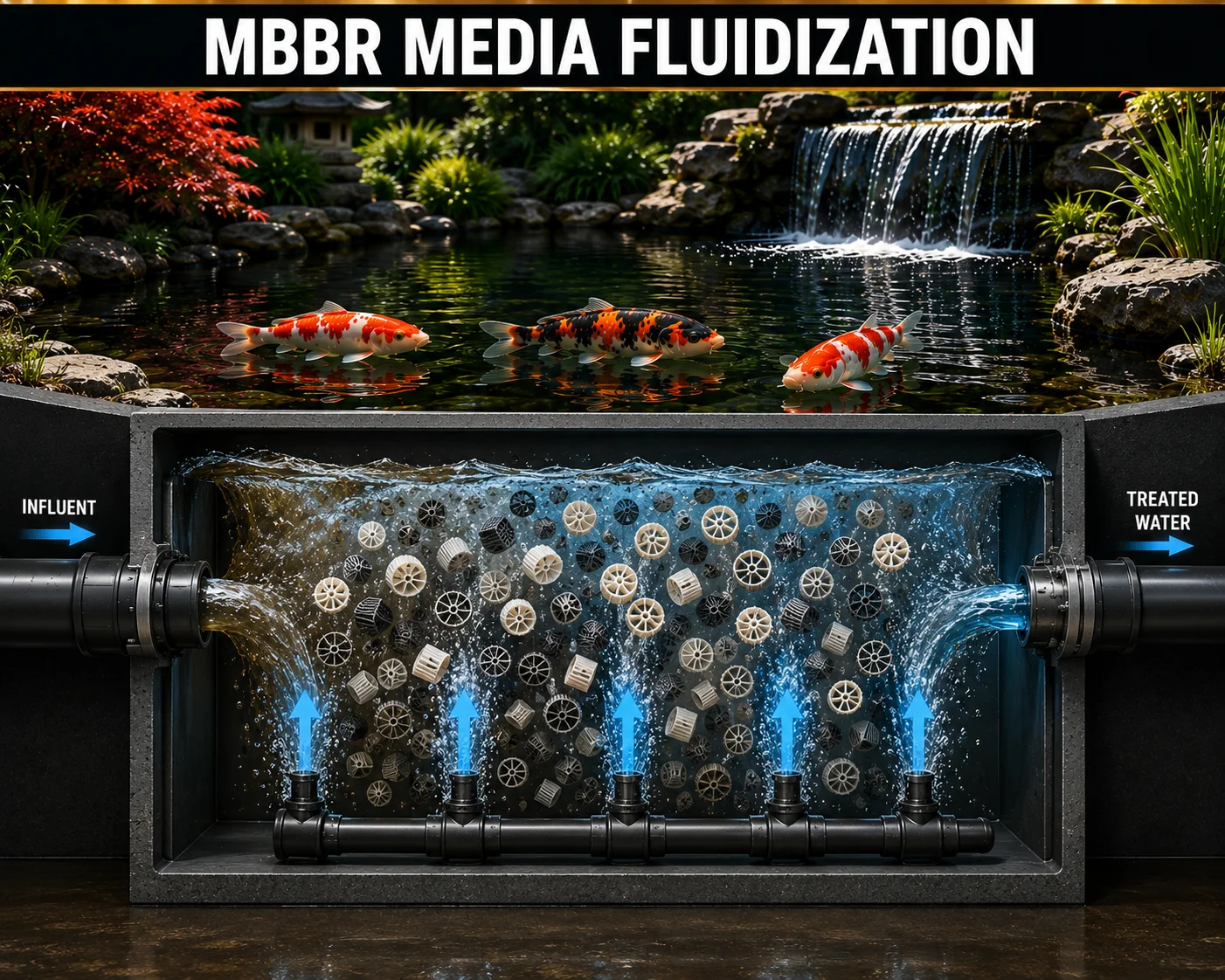
MBBR Media Fluidization and Biomass Ratios
Moving Bed Bio-Reactor (MBBR) technology relies on the controlled fluidization of plastic biofilm carriers within a reactor vessel. The fundamental engineering challenge is balancing the upward drag force from the aeration system and the pump-induced flow with the effective weight of the media. Proper fluidization ensures that the entire surface area of the carriers is exposed to the wastewater, maximizing the active biomass for nitrification and denitrification. The ratio of media volume to reactor volume, typically between 30% and 70%, directly influences the available surface area for biofilm growth and, consequently, the system’s overall treatment capacity. This relationship is governed by the specific surface area of the media (usually around 500-800 m²/m³), the target organic loading rate, and the hydraulic retention time.
This page delves into the practical hydraulics and biological engineering behind MBBR media fluidization. We will explore how to calculate the required aeration rate for optimal mixing, how to determine the appropriate biomass concentration for your system, and how to diagnose common operational issues like media clustering, uneven fluidization, and biofilm sloughing. The guidance provided here is based on first principles and field experience, but every installation is unique. Always verify calculations against your specific system parameters, including the shape of your reactor, the type of media, and the characteristics of your wastewater.
Test Your MBBR Fluidization Knowledge
Work through ten scenario-based questions covering media sizing, aeration requirements, biomass ratios, and troubleshooting. Each answer includes the reasoning behind it.
MBBR Fluidization & Biomass — Quick Facts
Most Asked Questions About MBBR Fluidization & Biomass
On a recent system upgrade, a client’s MBBR was struggling to achieve nitrification despite a high fill ratio. The aeration system was producing a lot of air, but the media was not circulating properly. A dye test revealed that the aeration grid was poorly designed, creating a central updraft that left the corners of the rectangular reactor dead. The media in the corners was not fluidized, effectively reducing the active surface area by over 30%.
We redesigned the aeration grid to a full-floor layout with evenly spaced fine-bubble diffusers. This created a uniform fluidization pattern, eliminating the dead zones. Within two weeks, ammonia levels dropped to near-zero, and the system was able to handle a higher fish load. The cost of the new grid was minimal compared to the improvement in performance.
Media Selection And Surface Area Calculations
Choosing the right MBBR media is the first critical step in system design. The key parameters are the specific surface area (SA), the density, and the shape. A higher SA provides more space for biofilm, but it also means the media is more prone to clogging and requires more energy to fluidize. The density of the media relative to water is crucial; the media should have a density slightly greater than water (usually 0.95-1.0 g/cm³) so that it can be easily suspended by aeration.
- Specific Surface Area (SA): Typically ranges from 500 to 800 m²/m³. Media like K1 (SA ~500 m²/m³) are standard for many applications. K3 (SA ~800 m²/m³) offers more surface area but requires more aeration.
- Media Fill Ratio: The volume of media as a percentage of the reactor volume. A 40% fill ratio is a common starting point, providing a good balance of biomass and fluidization energy.
- Effective Surface Area: The total surface area available for biofilm is calculated as Reactor Volume × Fill Ratio × SA. For example, a 1,000 L reactor with a 40% fill ratio and K1 media (500 m²/m³) has an effective surface area of 200 m².
- Biomass Capacity: Assuming a biofilm thickness of 100 µm, the biomass concentration can be estimated. For the example above, the biomass would be approximately 200 m² × 0.1 mm × 1.0 kg/m³ (approximate biofilm density) = 0.02 kg/m³, but this is a simplification; actual biomass can be significantly higher.
One of the most common mistakes in MBBR design is underestimating the impact of reactor geometry. A client once installed a large MBBR tank that was too tall and narrow, with the aeration diffusers at the bottom. The media at the top of the tank was not fluidizing properly, and the DO concentration at the top was near zero. The solution was to install multiple aeration manifolds along the height of the tank to provide staged fluidization, ensuring that all the media remained active. This underscores the importance of considering the reactor’s aspect ratio (height to width) when designing the aeration system.
Aeration Requirements And Oxygen Transfer
Aeration serves two primary purposes in an MBBR: it provides the oxygen required for aerobic biological processes (primarily nitrification), and it provides the mixing energy to fluidize the media. The oxygen demand is dictated by the organic loading rate (OLR) and the ammonia loading rate. The aeration system must be designed to meet both the oxygen demand and the fluidization requirement. The fluidization requirement typically sets the minimum aeration rate. Standard aeration rates are often given in terms of air flow per unit reactor volume or media volume.
Fine-bubble diffusers are generally more efficient for oxygen transfer, but coarse-bubble diffusers provide more aggressive mixing, which can be better for fluidizing high-density media. A common compromise is to use a combination of both: fine bubbles for oxygen transfer and coarse bubbles for mixing. The placement of the diffusers is critical; they must be distributed evenly across the tank floor to ensure uniform fluidization and prevent dead zones. The aeration rate should be adjustable to account for changes in loading and temperature.
A client with a heavily stocked koi pond was experiencing chronic high ammonia levels despite having a large MBBR. We found that the aeration system was undersized for the actual fish load. The system was designed based on a generic recommendation, not on the actual ammonia production rate. By installing a larger blower and a more efficient diffuser system, we increased the aeration capacity by 50% and were able to keep the media properly fluidized and the DO levels at 5-6 mg/L. The ammonia problem was resolved, and the koi thrived.
Troubleshooting an MBBR typically starts with a visual inspection of the media fluidization. If the media is clumped or not moving, the aeration is likely insufficient or the diffusers are clogged. If the media is moving too violently, the biofilm may be shearing off. Routine maintenance involves cleaning the diffusers, checking the blower output, and periodically removing and rinsing a sample of media to check for biofilm thickness and any signs of clogging. A simple DO meter is an indispensable tool for monitoring the health of the reactor.
MBBR Fluidization & Biomass — Full Question Library
Review indexed engineering questions below.
Q1:
What is the primary force that opposes the downward force of gravity on MBBR media?
Correct Answer: Option A
In a fluidized bed, the upward drag force from the water and the buoyant force counteract the weight of the media, causing it to become suspended.
Q2:
The minimum velocity required to initiate fluidization of a particle bed is known as:
Correct Answer: Option B
The minimum fluidization velocity is the superficial velocity of the fluid at which the bed just begins to expand and the particles are suspended.
Q3:
Which of the following media properties has the greatest effect on the minimum fluidization velocity?
Correct Answer: Option C
The density difference between the particle and the fluid is the dominant factor in determining the minimum fluidization velocity.
Q4:
What is the typical range of minimum fluidization velocity for common plastic MBBR media (e.g., K1, K3)?
Correct Answer: Option B
Plastic MBBR media are designed to have a low density, resulting in a minimum fluidization velocity on the order of a few centimeters per second.
Q5:
What is the effect of increasing the viscosity of the fluid on the minimum fluidization velocity?
Correct Answer: Option B
Higher viscosity increases the drag force required to lift the particles, thus increasing the minimum fluidization velocity.
Q6:
In a fluidized bed, the pressure drop across the bed at the minimum fluidization point is approximately equal to:
Correct Answer: Option C
At minimum fluidization, the pressure drop across the bed balances the weight of the particles, ignoring wall friction.
Q7:
What type of fluidization pattern is characterized by bubbles and channels forming within the bed?
Correct Answer: Option B
Aggregative fluidization, often seen in liquid-solid systems, involves the formation of bubbles and channeling, which can reduce efficiency.
Q8:
What is the primary driver of media movement in an aerated MBBR?
Correct Answer: Option A
The rising air bubbles entrain water, creating a flow field that lifts and mixes the media.
Q9:
In the context of an MBBR, what is meant by the term “dead zone”?
Correct Answer: Option B
Dead zones are regions within the reactor where the media is static, reducing the effective surface area and treatment capacity.
Q10:
Which parameter is most commonly used to describe the intensity of media mixing in an MBBR?
Correct Answer: Option A
The aeration rate is the primary control parameter for mixing and fluidization intensity in an aerated MBBR.
Q11:
What is the effect of a high fill ratio on the fluidization behavior?
Correct Answer: Option B
A higher fill ratio means more particles to support, increasing the pressure drop and the energy required for fluidization.
Q12:
How does the shape of MBBR media affect its fluidization characteristics?
Correct Answer: Option B
Media with irregular shapes and fins (like K1, K3) create more turbulence and have a higher drag coefficient, promoting easier fluidization.
Q13:
The “expanded bed height” in a fluidized bed is:
Correct Answer: Option A
During fluidization, the bed expands as the particles separate, increasing the overall bed height.
Q14:
Which of the following is NOT a typical method for achieving media fluidization in an MBBR?
Correct Answer: Option D
Aeration is the most common method, but mechanical stirring or pumped recirculation can also be used.
Q15:
In a well-fluidized MBBR, the media particles should appear:
Correct Answer: Option C
Proper fluidization results in a uniform, homogenous suspension of media with no visible dead zones.
Q16:
The “voidage” of a fluidized bed refers to:
Correct Answer: Option A
Voidage (ε) is the volume fraction of the bed that is not occupied by solids.
Q17:
What is the primary cause of media “carryover” from an MBBR?
Correct Answer: Option A
If the fluidization velocity is too high, media can be carried out of the reactor with the effluent.
Q18:
How can you prevent media carryover in an MBBR?
Correct Answer: Option A
A retention screen or sieve is essential to keep the media inside the reactor while allowing water to pass.
Q19:
What is the relationship between the minimum fluidization velocity and the media particle size?
Correct Answer: Option B
Larger particles have a higher terminal settling velocity, requiring a higher fluid velocity to suspend them.
Q20:
Which of the following is NOT a common type of MBBR media?
Correct Answer: Option B
Bio-Balls are a different type of biological filter media, not typically used in MBBR systems.
Q21:
What is the primary component of the biofilm in an MBBR?
Correct Answer: Option B
Biofilm is a complex matrix of microorganisms and their extracellular polymeric substances (EPS).
Q22:
The process of converting ammonia to nitrate is called:
Correct Answer: Option B
Nitrification is a two-step aerobic process performed by ammonia-oxidizing and nitrite-oxidizing bacteria.
Q23:
What is the typical thickness of a healthy MBBR biofilm?
Correct Answer: Option A
A biofilm thickness of 100-200 µm provides a good balance between biomass concentration and substrate diffusion.
Q24:
What is the “sloughing” of biofilm?
Correct Answer: Option A
Sloughing is a normal process where portions of the biofilm detach, making room for new growth.
Q25:
Excessive biofilm sloughing is typically caused by:
Correct Answer: Option B
High shear forces from excessive aeration can strip the biofilm from the media.
Q26:
The ideal dissolved oxygen (DO) concentration for nitrification in an MBBR is:
Correct Answer: Option A
A DO of 4-6 mg/L ensures that oxygen is not a limiting factor for the nitrifying bacteria.
Q27:
Which environmental factor has the greatest impact on the nitrification rate?
Correct Answer: Option C
Q28:
What is the primary carbon source for heterotrophic bacteria in a denitrifying MBBR?
Correct Answer: Option A
Denitrifying bacteria require a source of organic carbon for energy and cell synthesis.
Q29:
How does the biomass concentration affect the oxygen demand of the system?
Correct Answer: Option A
More biomass means a higher rate of biological activity, which consumes more oxygen.
Q30:
The “biomass yield” refers to:
Correct Answer: Option B
Biomass yield (Y) is a key parameter in biological kinetics, indicating the efficiency of converting substrate into biomass.
Q31:
Which type of bacteria is responsible for converting nitrite (NO2-) to nitrate (NO3-) in nitrification?
Correct Answer: Option C
NOB (e.g., Nitrospira) are the bacteria that oxidize nitrite to nitrate.
Q32:
What is the role of alkalinity in nitrification?
Correct Answer: Option A
Nitrification produces acid (H+), and alkalinity neutralizes this acid, maintaining a stable pH.
Q33:
What is a common sign that an MBBR is experiencing a biomass “crash”?
Correct Answer: Option B
A crash in the bacterial population results in the loss of nitrification, leading to the accumulation of toxic ammonia and nitrite.
Q34:
The process of reducing nitrate (NO3-) to nitrogen gas (N2) is called:
Correct Answer: Option A
Denitrification is an anoxic process where nitrate is used as an electron acceptor, producing nitrogen gas.
Q35:
What is the effect of a high organic loading rate (OLR) on an MBBR?
Correct Answer: Option B
Heterotrophic bacteria grow faster and can outcompete the slower-growing nitrifiers when organic carbon is abundant.
Q36:
What is the primary function of the extracellular polymeric substance (EPS) in biofilm?
Correct Answer: Option C
EPS is a gel-like matrix that provides structural stability and a protective environment for the biofilm community.
Q37:
How does an increase in salinity affect the biological activity in an MBBR?
Correct Answer: Option A
High salinity can be toxic to many freshwater bacteria and can also affect the osmotic balance of the cells.
Q38:
Which of these is NOT a typical nutrient required for bacterial growth in an MBBR?
Correct Answer: Option B
Oxygen is an electron acceptor, not a nutrient in the traditional sense. Nutrients include carbon, nitrogen, phosphorus, and trace elements.
Q39:
What is the “retention time” of the biomass in an MBBR?
Correct Answer: Option B
In an MBBR, the solids retention time (SRT) is decoupled from the hydraulic retention time (HRT) because the bacteria are attached to the media.
Q40:
What is the typical ratio of biofilm mass to media mass in a mature MBBR?
Correct Answer: Option A
A mature biofilm can add a significant amount of weight to the media, often doubling its effective mass.
Q41:
What is the purpose of aeration in an MBBR?
Correct Answer: Option B
Aeration serves the dual purpose of oxygen supply and media fluidization.
Q42:
What type of diffuser is generally more efficient for oxygen transfer?
Correct Answer: Option B
Fine bubbles have a higher surface area to volume ratio, resulting in more efficient oxygen transfer.
Q43:
What is the standard oxygen transfer rate (SOTR) typically measured in?
Correct Answer: Option A
SOTR is the mass of oxygen transferred per unit time under standard conditions.
Q44:
The amount of oxygen available for biological processes is limited by:
Correct Answer: Option B
The aeration system’s efficiency dictates how much oxygen is actually transferred to the water.
Q45:
What is the effect of increasing the depth of the diffuser on oxygen transfer?
Correct Answer: Option B
The increased pressure at greater depths enhances the solubility of oxygen and increases the contact time of the bubbles.
Q46:
Which of the following is NOT a method for increasing oxygen transfer in an MBBR?
Correct Answer: Option A
Q47:
The oxygen uptake rate (OUR) is a measure of:
Correct Answer: Option B
OUR is a direct indicator of biological activity and the oxygen demand of the system.
Q48:
Which gas is the primary product of denitrification?
Correct Answer: Option A
Denitrification converts nitrate to harmless nitrogen gas, which is released to the atmosphere.
Q49:
What is the “alpha” factor (α) in oxygen transfer calculations?
Correct Answer: Option B
The alpha factor accounts for the reduced oxygen transfer efficiency in wastewater due to surfactants and other contaminants.
Q50:
What is the typical aeration rate for a nitrifying MBBR?
Correct Answer: Option A
Aeration rates of 0.5-2.0 m³/m³/h are common, with higher rates for high-density media or high fill ratios.
Q51:
What is the effect of biofilm on oxygen transfer in an MBBR?
Correct Answer: Option B
The oxygen is consumed by the outer layers of the biofilm, creating a concentration gradient that limits diffusion to the inner layers.
Q52:
Which type of aeration is generally preferred for denitrifying MBBRs?
Correct Answer: Option C
Denitrification requires anoxic conditions, so aeration is kept low or intermittent to avoid high DO levels.
Q53:
The standard oxygen transfer efficiency (SOTE) of a fine-bubble diffuser is typically:
Correct Answer: Option B
Fine-bubble diffusers generally have a SOTE of 15-30% in clean water, with lower values in wastewater.
Q54:
What is a common problem associated with over-aeration in an MBBR?
Correct Answer: Option A
High shear forces from over-aeration can strip the biofilm from the media, reducing treatment capacity.
Q55:
What is the oxygen demand of nitrifying bacteria (AOB and NOB) per gram of ammonia oxidized?
Correct Answer: Option A
This is a well-established stoichiometric ratio for complete nitrification of ammonia to nitrate.
Q56:
What is the effect of high TDS (Total Dissolved Solids) on oxygen transfer?
Correct Answer: Option B
High salinity reduces the solubility of oxygen, making it harder to maintain adequate DO levels.
Q57:
What is the purpose of a “mixer” in an MBBR that uses pumped recirculation for fluidization?
Correct Answer: Option B
Good mixing is essential for uniform fluidization and substrate distribution.
Q58:
How does the oxygen transfer rate change with water temperature?
Correct Answer: Option B
Q59:
Which type of air pump is commonly used in small to medium-scale MBBR systems?
Correct Answer: Option A
Linear air pumps are energy-efficient, quiet, and commonly used in pond applications.
Q60:
What is the oxygen concentration of air?
Correct Answer: Option A
Air is composed of approximately 21% oxygen and 78% nitrogen.
Q61:
What is the typical specific surface area of K1 MBBR media?
Correct Answer: Option A
K1 media is widely used and has a specific surface area of approximately 500 m²/m³.
Q62:
What material is MBBR media typically made of?
Correct Answer: Option C
Polypropylene is the most common material due to its durability, chemical resistance, and density.
Q63:
Which K-series media has the highest specific surface area?
Correct Answer: Option C
K3 media has a higher specific surface area (around 800 m²/m³) than K1.
Q64:
The density of most MBBR media is designed to be slightly greater than water to:
Correct Answer: Option B
A density of 0.95-1.0 g/cm³ ensures that the media can be easily fluidized with moderate aeration.
Q65:
Which media characteristic is most important for protecting the biofilm from shear stress?
Correct Answer: Option B
A rough or porous surface provides better biofilm adhesion and protects it from being washed off.
Q66:
What is the advantage of the “wheel” or “cylinder” shape of media like K1 and K3?
Correct Answer: Option A
The shape creates turbulence and enhances the distribution of water and substrate.
Q67:
What is a typical size (diameter) for K1 MBBR media?
Correct Answer: Option A
K1 media is approximately 10 mm in diameter and 7 mm in length.
Q68:
How does the specific surface area of media affect the required aeration rate?
Correct Answer: Option B
Media with higher surface area typically have a more complex shape, increasing the drag force and energy required for fluidization.
Q69:
Which media type is generally considered “high-rate” due to its specific surface area?
Correct Answer: Option B
K3’s higher surface area allows for a higher biomass concentration and, therefore, a higher treatment rate.
Q70:
What is the purpose of the ribs on the inside of K1 and K3 media?
Correct Answer: Option B
The internal ribs provide protected surfaces where biofilm can grow without being exposed to high shear forces.
Q71:
Which of these is NOT a characteristic of MBBR media?
Correct Answer: Option A
MBBR media is designed to be durable and non-biodegradable to ensure a long lifespan.
Q72:
What is the typical lifespan of high-quality MBBR media?
Correct Answer: Option C
High-quality polypropylene media can last for 15-20 years or more.
Q73:
What is the primary disadvantage of using media with an extremely high specific surface area (>800 m²/m³)?
Correct Answer: Option B
Media with very high surface area have smaller pores or channels that can become clogged with biofilm or debris.
Q74:
What is the effect of “media attrition” over time?
Correct Answer: Option A
Over many years, the media can abrade, losing mass and surface area.
Q75:
Which of the following is NOT a common MBBR media brand?
Correct Answer: Option C
Biomax is a type of ceramic biological filter media, not a plastic MBBR media.
Q76:
How does the media’s surface roughness affect biofilm attachment?
Correct Answer: Option B
A rough surface provides more sites for bacterial adhesion and protects the biofilm from shear.
Q77:
What is the primary factor that determines the number of media needed for a system?
Correct Answer: Option A
The media volume is calculated based on the reactor volume and the target fill ratio.
Q78:
What is the effect of using media with a lower density?
Correct Answer: Option A
Lighter media are easier to suspend and require less aeration.
Q79:
Which type of media is generally better for denitrification?
Correct Answer: Option B
Denitrification requires anoxic zones within the biofilm, which are better created by media with protected internal surfaces.
Q80:
What is the recommended way to clean MBBR media?
Correct Answer: Option B
Harsh cleaning can damage the biofilm; it’s generally better to only remove excess debris gently.
Q81:
What is the typical hydraulic retention time (HRT) for a nitrifying MBBR in a recirculating aquaculture system (RAS)?
Correct Answer: Option A
In RAS, a short HRT of 1-2 hours is typical to minimize the reactor volume.
Q82:
The organic loading rate (OLR) is a measure of the:
Correct Answer: Option B
OLR is a critical design parameter, typically expressed as g COD/m²/d.
Q83:
What is the typical fill ratio for a nitrifying MBBR in a koi pond?
Correct Answer: Option C
A fill ratio of 30-60% is standard, with 40% being a common starting point.
Q84:
How do you calculate the total media volume required for a system?
Correct Answer: Option A
The media volume is a simple product of the reactor volume and the target fill ratio.
Q85:
Which of the following is a common method for designing an MBBR?
Correct Answer: Option A
Proper design uses established criteria like OLR, HRT, and fill ratio.
Q86:
What is the effect of increasing the fill ratio on the required aeration rate?
Correct Answer: Option B
More media requires more energy to fluidize, so the aeration rate must be increased.
Q87:
What is the typical reactor configuration for an MBBR in a pond system?
Correct Answer: Option A
MBBRs are typically installed in a separate, dedicated reactor vessel.
Q88:
The ammonia loading rate is calculated based on:
Correct Answer: Option B
Ammonia production is directly related to the amount of feed consumed and the fish biomass.
Q89:
What is the purpose of a “retention screen” in an MBBR?
Correct Answer: Option B
Retention screens keep the media inside the reactor while allowing the treated water to flow out.
Q90:
Which of these factors does NOT need to be considered when sizing an MBBR?
Correct Answer: Option A
Q91:
What is the “turnover rate” in the context of an MBBR?
Correct Answer: Option B
Turnover rate is the number of times the pond water passes through the MBBR per day.
Q92:
What is the advantage of using multiple MBBR reactors in series?
Correct Answer: Option A
Aerobic (nitrifying) and anoxic (denitrifying) stages can be separated for optimal nutrient removal.
Q93:
What is the typical approach for scaling up an MBBR system?
Correct Answer: Option B
Scale-up is based on maintaining the key design parameters (OLR, HRT) as the system grows.
Q94:
What is the effect of high TSS (Total Suspended Solids) on MBBR performance?
Correct Answer: Option B
High TSS can accumulate on the media and block the pores, reducing the effective surface area for biofilm.
Q95:
Which of the following is a typical design criterion for a denitrifying MBBR?
Correct Answer: Option A
Denitrification requires anoxic conditions, so the DO must be kept very low.
Q96:
What is the importance of “even flow distribution” in an MBBR?
Correct Answer: Option B
Even flow distribution prevents dead zones and ensures uniform fluidization and substrate contact.
Q97:
How does the system’s daily ammonia production relate to the MBBR sizing?
Correct Answer: Option A
The media surface area must be sufficient to support a biofilm that can oxidize the daily ammonia load.
Q98:
What is the typical “specific nitrification rate” (SNR) for an MBBR?
Correct Answer: Option B
The SNR is a key design parameter, and values of 0.5-1.5 g N/m²/d are common.
Q99:
Which of these is a common mistake in MBBR design?
Correct Answer: Option B
Underestimating the oxygen demand is a frequent error that leads to low DO and treatment failure.
Q100:
What is the recommended media fill ratio for a denitrifying MBBR?
Correct Answer: Option B
Denitrifying MBBRs often use a lower fill ratio to ensure adequate mixing with lower aeration.
Q101:
What is the most common cause of poor fluidization in an MBBR?
Correct Answer: Option B
Inadequate aeration is the most common cause of media settling and dead zones.
Q102:
What is a typical sign that the aeration rate is too low?
Correct Answer: Option A
If the aeration is too low, the media will not be suspended and will settle at the bottom.
Q103:
What is the effect of a sudden drop in water temperature on an MBBR?
Correct Answer: Option B
Q104:
What does a sudden increase in effluent turbidity from an MBBR indicate?
Correct Answer: Option C
A sudden increase in turbidity is often a sign that a large amount of biofilm has detached.
Q105:
How often should the diffusers in an MBBR be cleaned?
Correct Answer: Option A
Q106:
What is the best way to measure the DO concentration in an MBBR?
Correct Answer: Option B
DO can vary significantly within the reactor, so multiple readings are needed to detect dead zones.
Q107:
What should be done if the MBBR media is observed to be floating on the surface instead of being suspended?
Correct Answer: Option C
Floating media usually indicates that the aeration is insufficient or the media is overloaded.
Q108:
What is a common cause of high nitrite levels in an MBBR?
Correct Answer: Option B
Nitrite accumulation is a sign that the NOB are not converting nitrite to nitrate fast enough.
Q109:
How does pH affect the performance of a nitrifying MBBR?
Correct Answer: Option A
Nitrification is sensitive to pH, and the optimal range is slightly alkaline.
Q110:
What is the effect of high organic loading on a nitrifying MBBR?
Correct Answer: Option B
A high organic carbon load favors faster-growing heterotrophs, which can limit the nitrifying population.
Q111:
What should you check if you hear a “gurgling” sound from your MBBR?
Correct Answer: Option C
Gurgling often indicates that the aeration system is not functioning properly.
Q112:
What is a common sign of a clogged retention screen?
Correct Answer: Option B
A clogged screen restricts the flow of water out of the reactor, causing the water level to rise.
Q113:
How can you determine if the media is “overloaded” with biofilm?
Correct Answer: Option B
When biofilm becomes too thick, it can cause the media to stick together and form clumps.
Q114:
What is the first step in troubleshooting a high ammonia level in a pond with an MBBR?
Correct Answer: Option A
The first step is to ensure the system has adequate oxygen and that the media is properly fluidized.
Q115:
Why is it important to gradually increase the load on a new MBBR?
Correct Answer: Option B
A gradual loading strategy is essential to establish a stable and robust biofilm.
Q116:
What is the effect of using an oversized blower on an MBBR?
Correct Answer: Option C
Too much aeration can be as harmful as too little, causing the biofilm to be physically stripped off.
Q117:
What is the typical lifespan of a fine-bubble diffuser in an MBBR?
Correct Answer: Option B
Q118:
What is a sign that the MBBR is performing well?
Correct Answer: Option A
Low ammonia and nitrite are the primary indicators of a healthy, functioning biological filter.
Q119:
How often should the media be checked for biofilm thickness?
Correct Answer: Option B
Regular visual inspections can help detect problems like overloading or clogging early.
Q120:
What should you do if you notice a sudden drop in water level in the MBBR reactor?
Correct Answer: Option A
A drop in water level is a sign of a physical problem with the reactor or plumbing.
Q121:
What is the Monod equation used for in biological wastewater treatment?
Correct Answer: Option B
The Monod equation is the fundamental kinetic model for microbial growth.
Q122:
In the Monod equation, Ks represents:
Correct Answer: Option B
Ks is the substrate concentration at which the growth rate is half of the maximum.
Q123:
Nitrifying bacteria are classified as:
Correct Answer: Option A
Nitrifying bacteria are autotrophs, meaning they obtain energy from oxidizing inorganic compounds (ammonia/nitrite).
Q124:
What is the typical biomass yield (Y) for nitrifying bacteria?
Correct Answer: Option B
Nitrifying bacteria have a low yield compared to heterotrophs.
Q125:
The growth rate of nitrifying bacteria is known to be:
Correct Answer: Option B
Nitrifying bacteria are notoriously slow-growing, which is why they are sensitive to disturbances.
Q126:
What is the temperature coefficient (theta, θ) for nitrification?
Correct Answer: Option C
The temperature coefficient for nitrification is higher than for BOD oxidation, making it very temperature-sensitive.
Q127:
The first step in nitrification is performed by:
Correct Answer: Option B
AOB (e.g., Nitrosomonas) oxidize ammonia (NH3) to nitrite (NO2-).
Q128:
Denitrification is an electron acceptor process. What is the terminal electron acceptor in denitrification?
Correct Answer: Option B
In denitrification, nitrate (NO3-) is used as the final electron acceptor, reducing it to nitrogen gas.
Q129:
What is the ideal pH range for denitrification?
Correct Answer: Option B
Denitrification is less sensitive to pH than nitrification, but the optimal range is still slightly alkaline.
Q130:
What is the role of an external carbon source in a denitrifying MBBR?
Correct Answer: Option B
Denitrifying bacteria need a source of organic carbon to reduce nitrate.
Q131:
Which of the following is a common external carbon source used in MBBR denitrification?
Correct Answer: Option A
Methanol, ethanol, acetate, and glycerol are common carbon sources for denitrification.
Q132:
What is the stoichiometric oxygen demand for nitrification?
Correct Answer: Option C
This is the theoretical oxygen demand for the complete oxidation of ammonia to nitrate.
Q133:
The “endogenous decay” of biomass refers to:
Correct Answer: Option B
Endogenous decay is a first-order loss of biomass as bacteria undergo maintenance metabolism and cell death.
Q134:
What is the effect of high alkalinity on nitrification?
Correct Answer: Option A
Alkalinity is consumed during nitrification, and its depletion can lead to a pH crash.
Q135:
What is the alkalinity requirement for nitrifying 1 g of NH4-N?
Correct Answer: Option B
Nitrification consumes 7.14 mg of alkalinity (as CaCO3) per mg of NH4-N nitrified.
Q136:
What is the effect of a low F/M ratio (Food to Microorganism ratio) on an MBBR?
Correct Answer: Option B
A low F/M ratio favors the slower-growing nitrifying bacteria.
Q137:
Which of these inhibitors can affect nitrification?
Correct Answer: Option C
Many chemicals, including heavy metals, chlorine, and antibiotics, can inhibit nitrifying bacteria.
Q138:
What is the benefit of using a “biofilm” over “suspended growth” for nitrification?
Correct Answer: Option A
The attached growth nature of an MBBR provides a high SRT, which is essential for nitrification.
Q139:
What is the oxidation state of nitrogen in ammonia (NH3)?
Correct Answer: Option A
Ammonia has nitrogen in its most reduced state (-3). Nitrification is an oxidation process.
Q140:
What is the oxidation state of nitrogen in nitrate (NO3-)?
Correct Answer: Option B
Nitrate has nitrogen in its most oxidized state (+5).
Q141:
What is the EPS (Extracellular Polymeric Substance) matrix in a biofilm primarily composed of?
Correct Answer: Option B
EPS is a complex mixture of biopolymers that provide structural integrity to the biofilm.
Q142:
What is the primary benefit of biofilm for bacteria?
Correct Answer: Option B
Biofilm provides a protective environment, allowing bacteria to survive in harsh conditions.
Q143:
Which of the following is NOT a stage in biofilm formation?
Correct Answer: Option A
Emulsification is a process of mixing liquids, not a stage of biofilm development.
Q144:
What is “quorum sensing” in the context of biofilm?
Correct Answer: Option B
Quorum sensing allows bacteria to detect their population density and regulate gene expression accordingly.
Q145:
The depth to which oxygen can penetrate a biofilm is limited by:
Correct Answer: Option B
Oxygen is consumed by the outer layers of the biofilm, creating an anoxic zone in the deeper layers.
Q146:
What is the term for the process where bacteria actively detach from a biofilm?
Correct Answer: Option A
Dispersal is a regulated process where bacteria leave the biofilm to colonize new surfaces.
Q147:
The surface of MBBR media is often designed to be rough to:
Correct Answer: Option B
A rough surface provides more surface area and better “hiding” spots for bacteria to attach.
Q148:
What is the role of water channels within a biofilm?
Correct Answer: Option C
Water channels are pores within the biofilm that allow for the convective flow of nutrients and removal of waste.
Q149:
What is the effect of high shear stress on a biofilm?
Correct Answer: Option B
High shear forces physically strip the biofilm from the media surface.
Q150:
Which type of bacteria typically resides in the deeper layers of a thick biofilm?
Correct Answer: Option B
Oxygen is depleted in the deeper layers, creating an anoxic environment suitable for denitrification.
Q151:
What is the primary function of the EPS matrix in protecting the biofilm?
Correct Answer: Option B
The EPS matrix can bind or slow the diffusion of harmful substances.
Q152:
Why is a biofilm considered a “microbial ecosystem”?
Correct Answer: Option B
Biofilms are diverse communities with complex food webs and interactions.
Q153:
What is the term for the initial, reversible attachment of bacteria to a surface?
Correct Answer: Option A
Initial attachment is often reversible and mediated by weak forces like van der Waals forces.
Q154:
What is the effect of nutrient limitation on biofilm structure?
Correct Answer: Option B
Under nutrient stress, bacteria produce more EPS, resulting in a denser biofilm.
Q155:
Which of these is a common method for studying biofilm structure?
Correct Answer: Option C
Microscopy is essential for visualizing the 3D structure of biofilms.
Q156:
What is the role of protozoa in a biofilm?
Correct Answer: Option B
Protozoa are predators of bacteria and contribute to the dynamics of the biofilm ecosystem.
Q157:
What is the advantage of using “protected” internal surfaces in MBBR media?
Correct Answer: Option B
Protected surfaces are a key advantage of media like K1 and K3.
Q158:
What is the term for the process by which bacteria in a biofilm coordinate their behavior based on population density?
Correct Answer: Option B
Quorum sensing is a critical regulatory mechanism in biofilm formation and function.
Q159:
How does a biofilm increase the resilience of a biological system?
Correct Answer: Option A
Biofilms are more stable and resilient than suspended cultures.
Q160:
What is a potential disadvantage of a very thick biofilm?
Correct Answer: Option B
If the biofilm becomes too thick, nutrients and oxygen cannot penetrate to the deeper layers.
Q161:
What is the primary energy cost in operating an MBBR?
Correct Answer: Option B
Aeration is by far the largest energy consumer in an MBBR system.
Q162:
What is the standard oxygen transfer efficiency (SOTE) of a typical fine-bubble diffuser?
Correct Answer: Option B
Fine-bubble diffusers have a SOTE of 15-30%, meaning only 15-30% of the oxygen in the air is transferred to the water.
Q163:
How can you reduce the energy consumption of aeration in an MBBR?
Correct Answer: Option B
Using efficient diffusers and only supplying the required amount of air are the best ways to save energy.
Q164:
What is the effect of reducing the media fill ratio on energy consumption?
Correct Answer: Option B
Less media requires less aeration to fluidize, reducing energy consumption.
Q165:
Which of the following is NOT a strategy for improving energy efficiency in an MBBR?
Correct Answer: Option B
Oversizing pumps or blowers is inefficient and increases energy costs.
Q166:
What is the specific energy consumption of an MBBR typically measured in?
Correct Answer: Option D
Energy consumption can be expressed in several ways, depending on the performance metric of interest.
Q167:
What is a “VFD” (Variable Frequency Drive) used for in an MBBR?
Correct Answer: Option B
VFDs allow you to match the energy input to the actual demand, saving significant energy.
Q168:
What is the effect of clogged diffusers on energy efficiency?
Correct Answer: Option B
Clogged diffusers require more energy to push the same amount of air, wasting electricity.
Q169:
Which of the following is the most energy-efficient way to supply oxygen to an MBBR?
Correct Answer: Option A
Fine-bubble aeration is the most energy-efficient method for oxygen transfer, although pure oxygen can be more efficient in specific applications.
Q170:
What is the typical energy consumption of a small to medium-scale MBBR for a koi pond?
Correct Answer: Option B
Energy consumption can vary, but 20-40 W per cubic meter of reactor volume is a common range.
Q171:
How does the oxygen transfer efficiency change with water temperature?
Correct Answer: Option A
Q172:
What is the purpose of an “air flow meter” in an MBBR?
Correct Answer: Option B
Air flow meters are essential for monitoring and optimizing the aeration rate.
Q173:
What is the “alpha factor” (α) in oxygen transfer calculations?
Correct Answer: Option C
The alpha factor accounts for the reduced oxygen transfer efficiency in wastewater due to surfactants and other contaminants.
Q174:
Which of the following is a sign of an energy-inefficient MBBR operation?
Correct Answer: Option B
Excessive DO indicates that more air is being supplied than needed, wasting energy.
Q175:
What is the effect of a dirty or clogged air filter on the blower’s energy efficiency?
Correct Answer: Option B
A clogged air filter restricts airflow, making the blower work harder and consume more energy.
Q176:
Which of the following can help reduce the energy cost of operating an MBBR?
Correct Answer: Option A
Cycling the aeration or using a VFD are effective ways to save energy, especially during periods of low load.
Q177:
What is the typical pressure drop across a fine-bubble diffuser?
Correct Answer: Option A
Q178:
What is the effect of high altitude on the efficiency of an air blower?
Correct Answer: Option B
At higher altitudes, the air is thinner, meaning the blower must move more air to deliver the same mass of oxygen.
Q179:
How does the use of a “pre-filter” for the air intake affect energy consumption?
Correct Answer: Option B
While a filter adds a small pressure drop, it prevents dust from clogging the diffusers, which would be a much larger inefficiency.
Q180:
What is the single most cost-effective way to improve the energy efficiency of an existing MBBR?
Correct Answer: Option A
Replacing old diffusers is often the most cost-effective upgrade for improving oxygen transfer efficiency.
Q181:
What is the primary difference between an MBBR and a traditional trickling filter?
Correct Answer: Option A
The key difference is the mobility of the media, which allows for better mixing and self-cleaning in an MBBR.
Q182:
Compared to a traditional bead filter, what is the primary advantage of an MBBR?
Correct Answer: Option B
Bead filters can have significant head loss, whereas MBBRs are open-channel systems with very low head loss.
Q183:
What is the main disadvantage of an MBBR compared to a submerged fixed-film reactor (e.g., sand filter)?
Correct Answer: Option C
The energy required for aeration is the primary operational cost of an MBBR.
Q184:
In a recirculating aquaculture system (RAS), where is an MBBR typically placed in relation to other filters?
Correct Answer: Option A
An MBBR should be placed after a mechanical filter to prevent solids from clogging the media.
Q185:
Compared to a bead filter, an MBBR typically has a ____ footprint for the same flow rate.
Correct Answer: Option B
MBBR reactors are often larger than bead filters for the same flow rate, as they rely on hydraulic retention time.
Q186:
Which system is generally better at handling high organic shock loads?
Correct Answer: Option C
MBBRs are known for their resilience and ability to handle shock loads due to the large, protected biomass.
Q187:
What is the primary reason an MBBR is preferred over a sand filter for biological filtration in a RAS?
Correct Answer: Option B
Q188:
What is a key operational difference between an MBBR and a fluidized sand filter?
Correct Answer: Option C
This is the fundamental difference in their purpose: one is for biological treatment, the other for physical filtration.
Q189:
Which of the following is a disadvantage of a bead filter compared to an MBBR?
Correct Answer: Option A
Bead filters are pressure vessels with high head loss, whereas MBBRs operate at near-atmospheric pressure.
Q190:
In a pond setting, an MBBR is often used as a _____ filter.
Correct Answer: Option B
MBBRs are primarily biological filters designed for nitrification.
Q191:
What is the primary advantage of using an MBBR in a recirculating system compared to a “wet-dry” trickle filter?
Correct Answer: Option C
An MBBR is a more compact, self-contained solution compared to a trickle filter system.
Q192:
How does the cost of MBBR media compare to that of traditional ceramic rings or lava rock?
Correct Answer: Option B
While more expensive upfront, the high surface area and durability of plastic media offer long-term value.
Q193:
What is a common misconception about MBBRs?
Correct Answer: Option C
MBBRs require routine maintenance, including diffuser cleaning and media inspection.
Q194:
Which system typically has a higher sludge production rate?
Correct Answer: Option A
Bead filters are designed to trap solids and produce a concentrated waste stream.
Q195:
What is the key difference in the media used between an MBBR and a submerged fixed-bed reactor (like a bio-tower)?
Correct Answer: Option C
The fluidized nature of the media is the defining characteristic of an MBBR.
Q196:
Which of the following is a strength of an MBBR over a traditional activated sludge system?
Correct Answer: Option C
The biofilm in an MBBR is retained naturally, eliminating the need for a sludge return system and making it more robust.
Q197:
Why is an MBBR often considered a “low-maintenance” biological filter?
Correct Answer: Option B
The constant movement of the media prevents clogging and eliminates the need for backwashing.
Q198:
Which system is more energy-efficient for moving large volumes of water for biological treatment?
Correct Answer: Option B
MBBRs have a very low head loss, making them energy-efficient for water circulation.
Q199:
For a heavily stocked koi pond, which system is generally considered the best for high-rate nitrification?
Correct Answer: Option B
MBBRs are often the preferred choice for high-rate nitrification in RAS.
Q200:
What is the primary reason an MBBR can handle a high organic load compared to a static submerged filter?
Correct Answer: Option B
The constant mixing ensures that the entire media surface is exposed to the wastewater, maximizing treatment capacity.