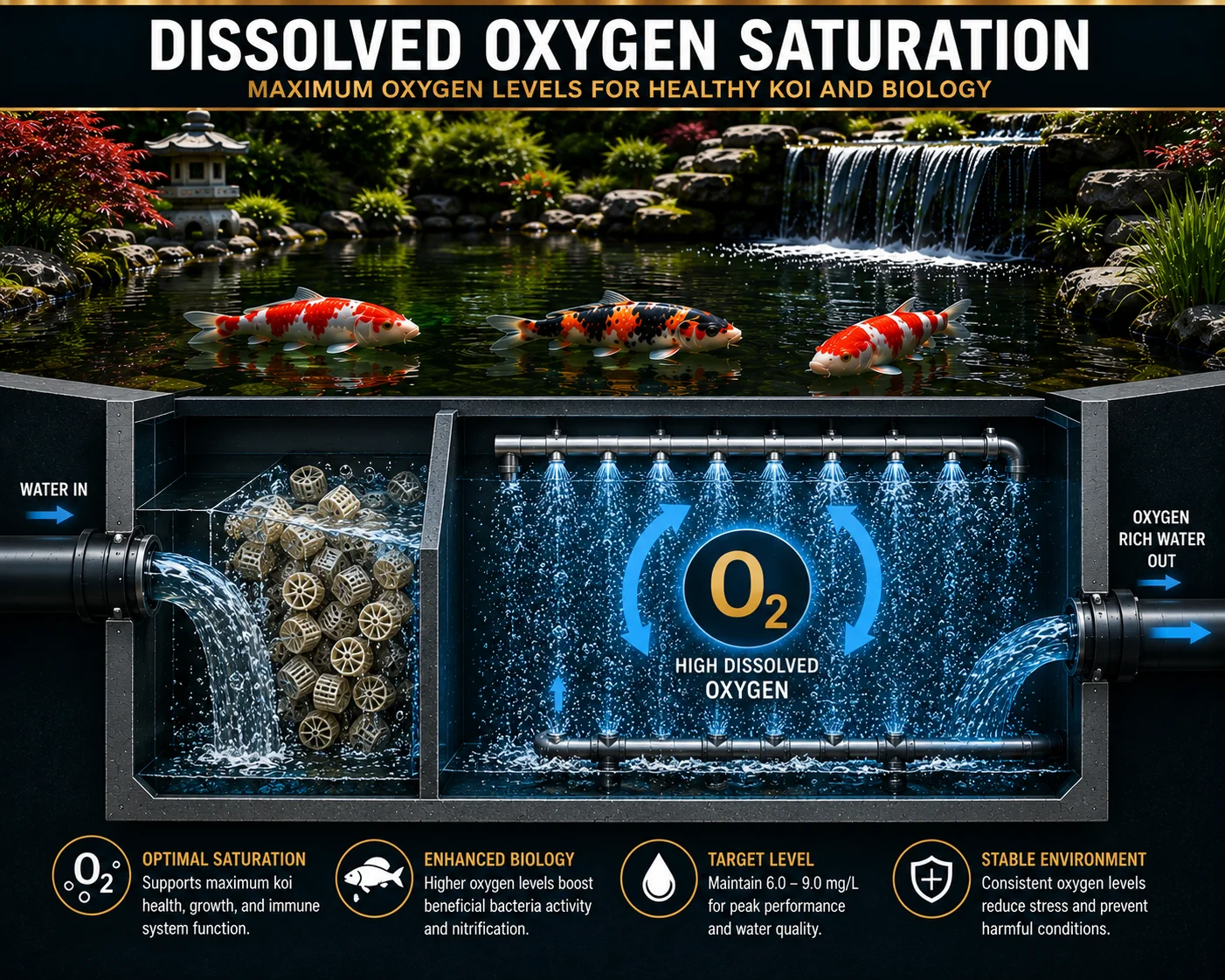
Dissolved Oxygen Saturation
Dissolved oxygen (DO) is the lifeblood of any koi pond, but its behavior is governed by a fundamental thermodynamic relationship: Henry’s Law. This law states that, at equilibrium, the concentration of a gas in a liquid is directly proportional to its partial pressure above the liquid. For oxygen in a pond, this means the maximum concentration of DO — the saturation point — is primarily a function of water temperature, barometric pressure, and salinity. The colder the water, the higher the saturation concentration, a relationship with profound implications for pond management across seasons.
This page dissects the engineering and biological significance of Henry’s Law, the temperature curves that define oxygen solubility, and the practical constraints of aerating a pond. We will explore how atmospheric pressure and altitude affect performance, how aeration equipment transfers oxygen into the water column, and why a pond at 25°C cannot hold as much oxygen as one at 10°C — a fact that directly influences stocking density and emergency aeration protocols. This is not a guide to basic aeration; it is a rigorous examination of the physical chemistry and hydraulic processes that dictate oxygen saturation, geared towards engineers, advanced hobbyists, and aquatic professionals.
Test Your DO Saturation Knowledge
Ten questions covering Henry’s Law, temperature curves, altitude effects, and aeration efficiency. Each answer includes a technical breakdown.
DO Saturation — Quick Facts
Most Asked Questions About DO Saturation
During the summer of 2023, a pond in Phoenix, Arizona, experienced a heatwave with water temperatures exceeding 32°C. The manager noticed koi gasping at the surface during the afternoon hours. The DO meter read 5.2 mg/L, which seemed dangerously low for koi. However, at 32°C, the saturation concentration is only about 7.6 mg/L. The water was at 68% saturation, which is within the stress zone for high-temperature conditions.
The solution involved installing a subsurface fine-bubble diffuser and adding a shade structure over the pond to reduce solar radiation heating. Additionally, the manager increased the aeration schedule to run continuously during the day. The DO concentration rose to 6.8 mg/L (89% saturation), resolving the surface gasping and restoring normal feeding behavior.
Henry’s Law and the Temperature Curve
The temperature-dissolved oxygen curve is one of the most predictable and important relationships in aquatic chemistry. It is a consequence of the thermodynamic equilibrium described by Henry’s Law and the Clausius-Clapeyron relation. As water temperature rises, the Henry’s Law constant increases, meaning the gas molecules escape more readily from the liquid phase, reducing the saturation concentration. The relationship is close to linear between 0°C and 30°C, decreasing by about 0.3 mg/L per degree Celsius.
- 0°C (32°F): Saturation is ~14.6 mg/L.
- 10°C (50°F): Saturation is ~11.3 mg/L. This is typical for spring and fall ponds.
- 20°C (68°F): Saturation is ~9.1 mg/L.
- 25°C (77°F): Saturation drops to ~8.3 mg/L. This is a critical inflection point for high-density koi ponds.
- 30°C (86°F): Saturation is ~7.6 mg/L. At this point, fish are under significant thermal stress, and aeration is paramount.
For engineers, these values are not just trivia; they are boundary conditions. When designing a system, one must calculate the worst-case scenario — usually the peak summer temperature — to ensure the aeration system can deliver enough oxygen to meet the biological demand at the lowest saturation point. This is known as the “oxygen deficit” calculation: Deficit = Saturation DO (mg/L) – Target DO (mg/L).
A commercial koi farm in Colorado, located at an elevation of 1,600m (5,250ft), was struggling to maintain acceptable DO levels despite running two aeration pumps. Standard saturation tables for sea level suggested the pond should be at 8.0 mg/L at 15°C. However, actual readings were consistently around 6.8 mg/L. The discrepancy was a misunderstanding of altitude corrections.
At 1,600m, the atmospheric pressure is about 84 kPa, compared to 101 kPa at sea level. This represents an 18% reduction in oxygen partial pressure, translating to an 18% reduction in DO saturation. Accounting for altitude, the true saturation was ~9.4 mg/L, and the system was achieving ~72% saturation. The farm upgraded to a high-efficiency diffuser with a greater Standard Oxygen Transfer Rate (SOTR) to meet the demand.
Aeration Equipment and Oxygen Transfer Efficiency
Oxygen Transfer Efficiency (OTE) is the percentage of oxygen injected into the water that successfully dissolves. The efficiency is heavily influenced by bubble size (smaller bubbles have a higher surface-to-volume ratio and rise slower, allowing more time for dissolution), depth (greater depth increases the pressure and partial pressure of oxygen), and turbulence (mixing enhances the transfer rate).
Fine-bubble diffusers, often made of ceramic or membrane discs, are capable of achieving OTE values between 20% and 40% at depths of 4-8 meters. Coarse bubble diffusers are less efficient (5-15%) but are more resistant to fouling. For most koi ponds, which are relatively shallow (1.5-2.5m), fine-bubble diffusers are the preferred choice for maximizing aeration efficiency while managing power consumption.
When sizing an aeration system, the Standard Oxygen Transfer Rate (SOTR) of the equipment must be matched to the pond’s maximum oxygen demand. This involves calculating the Biological Oxygen Demand (BOD) from fish stocking rates and water temperature. The engineering calculation often uses the equation: Required Oxygen Supply (g/h) = BOD (g/h) / OTE.
A high-density recirculating aquaculture system (RAS) for koi broodstock in Japan faced a critical failure when a power outage disabled the oxygen injection system. The backup generator kicked in, but the aeration pumps were undersized for the emergency oxygen demand. The DO dropped below 4 mg/L within 20 minutes.
The system was redesigned with a dual-redundant aeration system, incorporating a liquid oxygen (LOX) backup injection system capable of raising the DO from 2 to 8 mg/L in under 5 minutes. This highlights that emergency oxygen capacity must be factored into the design, not just the baseline equilibrium requirement.
Monitoring is essential. An optical DO sensor provides real-time data, allowing the controller to modulate the oxygen supply based on the actual deficit. This closed-loop control is standard practice in professional aquaculture and is increasingly adopted in high-end koi ponds.
When troubleshooting low DO, engineers should consider: (1) Is the aeration system properly sized and placed? (2) Are there any blockages or biofouling reducing OTE? (3) Is the pond overloaded with organic matter, increasing BOD? (4) Is the water temperature high, reducing the saturation point? (5) Is the altitude factored into the saturation calculations? Misdiagnosing a temperature issue for a mechanical failure is a common error.
DO Saturation — Full Question Library
Review indexed engineering questions below.
Q1:
What does Henry’s Law state regarding gas solubility in liquids?
Correct Answer: Option A
Henry’s Law states that at equilibrium, the concentration of a gas in a liquid is directly proportional to the partial pressure of that gas in contact with the liquid.
Q2:
Which factor primarily dictates the maximum dissolved oxygen concentration in water?
Correct Answer: Option B
While pressure and salinity also affect DO, temperature is the primary and most variable factor dictating the saturation concentration of oxygen in water.
Q3:
At constant temperature and pressure, what happens to DO saturation as salinity increases?
Correct Answer: Option C
The “salting out” effect reduces the solubility of gases as ionic strength increases, causing DO saturation to decrease.
Q4:
How is the partial pressure of oxygen in the atmosphere calculated?
Correct Answer: Option B
Oxygen makes up approximately 21% of dry air, so pO2 = P_atm * 0.21.
Q5:
What unit is commonly used for DO concentration in pond management?
Correct Answer: Option A
mg/L and ppm are the most practical and widely used units for dissolved oxygen in aqueous environments.
Q6:
What does the Henry’s Law constant (k_H) represent?
Correct Answer: Option B
k_H is temperature-dependent and represents the equilibrium constant for gas dissolution; it increases with temperature for oxygen.
Q7:
Under what condition would a pond become supersaturated with oxygen?
Correct Answer: Option A
If water cools rapidly, the saturation concentration increases, potentially resulting in a DO concentration that exceeds the new saturation level (supersaturation).
Q8:
Which gas has the highest solubility in water under standard conditions?
Correct Answer: Option C
CO2 is significantly more soluble in water than oxygen or nitrogen due to its reactivity and higher Henry’s Law constant.
Q9:
How does barometric pressure influence DO saturation at constant temperature?
Correct Answer: Option A
Increased barometric pressure increases the partial pressure of oxygen, which drives more gas into the liquid phase.
Q10:
What is the standard sea-level atmospheric pressure in kPa?
Correct Answer: Option B
101.3 kPa is the standard atmospheric pressure at sea level.
Q11:
At 20°C, what is the approximate DO saturation at sea level?
Correct Answer: Option C
At 20°C, the saturation is roughly 9.1 mg/L at 1 atm.
Q12:
If water temperature drops from 25°C to 15°C, what effect does this have on the oxygen saturation value?
Correct Answer: Option B
As temperature decreases, water holds more dissolved oxygen, increasing by approximately 0.3 mg/L per °C.
Q13:
What is the partial pressure of oxygen at sea level?
Correct Answer: Option A
101.3 kPa × 0.21 = 21.2 kPa.
Q14:
Which law describes the relationship between gas dissolution and pressure?
Correct Answer: Option A
Henry’s Law specifically addresses the concentration of a gas in a liquid as a function of its partial pressure.
Q15:
Why is DO often measured as a percentage of saturation rather than just mg/L?
Correct Answer: Option C
Saturation percentage indicates the reserve capacity of the water and accounts for temperature and pressure variations.
Q16:
What happens to the Henry’s Law constant for oxygen as water temperature increases?
Correct Answer: Option A
As temperature increases, the Henry’s Law constant increases, meaning the gas is less soluble.
Q17:
What effect does high altitude have on the Henry’s Law equation?
Correct Answer: Option B
Lower atmospheric pressure at altitude reduces the partial pressure of oxygen, directly reducing DO saturation.
Q18:
In addition to oxygen, which other gases are governed by Henry’s Law in pond water?
Correct Answer: Option C
Henry’s Law applies to all gases, including oxygen, nitrogen, carbon dioxide, and argon.
Q19:
What is the expected DO saturation at 10°C at sea level?
Correct Answer: Option A
At 10°C, the saturation is approximately 11.3 mg/L at sea level.
Q20:
If a pond is at 80% DO saturation, what does this mean?
Correct Answer: Option A
80% saturation indicates the water has 80% of the oxygen it could theoretically hold at its current temperature and pressure.
Q21:
How does increasing water temperature affect the saturation concentration of oxygen?
Correct Answer: Option B
The solubility of gases decreases as temperature increases.
Q22:
At what temperature does the oxygen saturation drop to around 8.3 mg/L?
Correct Answer: Option C
At 25°C, the saturation is approximately 8.3 mg/L.
Q23:
What is the approximate slope of the DO saturation curve per degree Celsius between 0°C and 30°C?
Correct Answer: Option A
The relationship is roughly linear at -0.3 mg/L per °C.
Q24:
Why is cold water able to hold more dissolved oxygen than warm water?
Correct Answer: Option B
Lower temperatures reduce the kinetic energy of gas molecules, making them more likely to stay dissolved.
Q25:
In a koi pond at 30°C, what is a typical danger zone for DO levels?
Correct Answer: Option A
At 30°C, the saturation is only ~7.6 mg/L. A drop to 6.0 mg/L is critically low for koi.
Q26:
Which equation is used to calculate the theoretical DO saturation at a given temperature?
Correct Answer: Option B
The Weiss (or Benson-Krause) equation is the standard formula for calculating DO saturation based on temperature and salinity.
Q27:
What is the DO saturation at 0°C (32°F) at sea level?
Correct Answer: Option A
At freezing point, water can hold its maximum oxygen concentration of ~14.6 mg/L.
Q28:
What is the primary risk of water temperature fluctuations on DO in a pond?
Correct Answer: Option B
Rapid temperature changes alter the saturation point, potentially leading to hypoxia or supersaturation.
Q29:
How does a pond’s surface area affect its resistance to daily temperature shifts?
Correct Answer: Option C
A large surface area increases heat exchange with the atmosphere, making the pond more susceptible to temperature shifts.
Q30:
At which temperature does the DO saturation drop below 10 mg/L?
Correct Answer: Option B
At 15°C, saturation is around 10.2 mg/L; above 15°C, it drops below 10 mg/L.
Q31:
What effect does summer stratification have on DO distribution?
Correct Answer: Option A
Warm water at the top becomes less dense, creating a barrier to mixing, which can lead to oxygen depletion at depth.
Q32:
How does a higher water temperature influence the rate of oxygen consumption by koi?
Correct Answer: Option B
The metabolic rate of ectotherms like koi doubles or triples for every 10°C increase, dramatically increasing oxygen demand.
Q33:
What is the approximate DO saturation at 20°C in a freshwater pond?
Correct Answer: Option A
At 20°C, the saturation is roughly 9.1 mg/L at 1 atm.
Q34:
What is the maximum DO concentration in freshwater at standard pressure?
Correct Answer: Option B
The maximum is at 0°C, approximately 14.6 mg/L.
Q35:
Why is DO monitoring more critical in summer than in winter?
Correct Answer: Option A
The combination of lower solubility and higher biological demand makes summer the most critical period.
Q36:
What is the consequence of low DO at high temperature for koi?
Correct Answer: Option C
Q37:
How does a temperature increase from 20°C to 25°C affect the saturation deficit if DO is constant at 7 mg/L?
Correct Answer: Option B
At 20°C, deficit = 9.1 – 7 = 2.1. At 25°C, deficit = 8.3 – 7 = 1.3. The change is 0.8 mg/L; however, the overall saturation pressure decreases, making it harder to achieve the same concentration.
Q38:
What is the DO saturation of water at 5°C?
Correct Answer: Option A
At 5°C, saturation is approximately 12.8 mg/L.
Q39:
For each degree Celsius increase in temperature, how much does the saturation of oxygen decrease?
Correct Answer: Option B
The standard rule of thumb is a decrease of 0.3 mg/L per degree Celsius.
Q40:
What is the risk of a sudden cold front causing the water temperature to drop quickly?
Correct Answer: Option A
Rapid cooling increases the saturation capacity, which can lead to gas bubble disease if the water is already saturated with oxygen.
Q41:
How does altitude affect the atmospheric pressure?
Correct Answer: Option B
Atmospheric pressure decreases exponentially with altitude.
Q42:
What is the effect of lower atmospheric pressure on DO saturation at a given temperature?
Correct Answer: Option A
Lower pressure means lower partial pressure of oxygen, leading to lower DO saturation.
Q43:
For every 100 meters of elevation gain, how much does DO saturation drop?
Correct Answer: Option C
A common rule of thumb is a 1% reduction in DO saturation for every 100 meters of altitude.
Q44:
At an altitude of 1,500 meters, what is the approximate atmospheric pressure?
Correct Answer: Option A
At 1,500m, atmospheric pressure is typically around 84-85 kPa.
Q45:
If a pond’s DO meter reads 8.0 mg/L at sea level, what would the same concentration represent at 2,000 meters?
Correct Answer: Option B
Since the saturation is lower at altitude, the same absolute DO concentration represents a higher percentage saturation at higher altitude.
Q46:
What is the theoretical DO saturation at 2,000m altitude and 20°C?
Correct Answer: Option A
At 2,000m, pressure is ~80 kPa, reducing sea-level saturation (9.1 mg/L) by roughly 20% to ~7.3 mg/L.
Q47:
Why do high-altitude ponds generally need more aggressive aeration than sea-level ponds?
Correct Answer: Option A
The lower atmospheric pressure reduces the driving force for oxygen dissolution, requiring more equipment to achieve the same DO level.
Q48:
How does altitude affect the Henry’s Law constant?
Correct Answer: Option B
The Henry’s Law constant is a function of temperature, not pressure.
Q49:
What is the partial pressure of oxygen at 1,500m altitude?
Correct Answer: Option C
At 1,500m, P_atm is ~85 kPa, so pO2 = 85 * 0.21 = 17.8 kPa.
Q50:
What is the primary gas exchange driver at high altitude?
Correct Answer: Option B
The lower partial pressure is the main constraint on gas exchange at altitude.
Q51:
If a pond is at 80% saturation at sea level, what is the approximate concentration?
Correct Answer: Option A
At 20°C, saturation is 9.1 mg/L; 80% of that is 7.3 mg/L.
Q52:
How can a pond manager compensate for altitude effects on DO?
Correct Answer: Option B
Increased aeration capacity is the only reliable way to overcome the low saturation ceiling.
Q53:
What is the relationship between altitude and the total gas pressure (TGP) in water?
Correct Answer: Option A
The total gas pressure in the water is in equilibrium with the atmospheric pressure, which is lower at altitude.
Q54:
At 2,500m altitude, what is the approximate barometric pressure?
Correct Answer: Option B
At 2,500m, pressure is roughly 75 kPa.
Q55:
Which type of aeration is most effective at high altitude?
Correct Answer: Option C
Fine bubble diffusers maximize the surface area for gas exchange, which is critical when the driving force (pressure) is lower.
Q56:
How does altitude affect the solubility of other gases like nitrogen?
Correct Answer: Option A
Q57:
If a pond is at 85% saturation at 1,500m, what is the concentration if the temperature is 15°C?
Correct Answer: Option B
At 15°C, sea-level saturation is 10.2 mg/L. At 1,500m, pressure is ~85%, so saturation = 10.2 * 0.85 = 8.7 mg/L. 85% of that is 7.4 mg/L.
Q58:
What is the dominant factor driving aeration at high altitude?
Correct Answer: Option A
The difference between the actual pO2 and the equilibrium pO2 is the primary driving force for gas transfer.
Q59:
How often should DO be monitored in a high-altitude pond?
Correct Answer: Option B
Given the lower buffer capacity, high-altitude ponds require more frequent monitoring to catch deficits early.
Q60:
What is the safety margin for DO in a high-altitude pond compared to sea level?
Correct Answer: Option C
With a lower saturation point, the margin between the target DO (e.g., 6 mg/L) and the saturation is smaller, leaving less room for error.
Q61:
What is the effect of salinity on DO saturation?
Correct Answer: Option A
The “salting out” effect reduces the water’s capacity to hold dissolved gases.
Q62:
Why does salt reduce oxygen solubility?
Correct Answer: Option B
Ions (Na+, Cl-) hydrate water molecules, making it harder for oxygen to dissolve.
Q63:
For every 1,000 mg/L of salinity, how much does DO saturation decrease?
Correct Answer: Option C
The decrease is roughly 1-2% per 1,000 ppm (1 ppt) of salinity.
Q64:
At 25°C and 0 salinity, saturation is 8.3 mg/L. What is it at 5 ppt salinity?
Correct Answer: Option A
5 ppt (5,000 ppm) results in roughly a 5-10% reduction, dropping saturation to approximately 8.0 mg/L.
Q65:
How does salinity affect the Henry’s Law constant?
Correct Answer: Option B
The effective Henry’s Law constant increases with salinity, meaning less gas dissolves for a given pressure.
Q66:
Should aeration requirements be adjusted when adding salt to a koi pond?
Correct Answer: Option B
Q67:
What is the salinity concentration (ppt) at which the oxygen solubility is reduced by ~10%?
Correct Answer: Option A
At 10 ppt, the reduction is roughly 10-20%, depending on temperature.
Q68:
What is the primary concern when adding salt to a pond regarding oxygen?
Correct Answer: Option B
The reduced capacity is the main chemical effect of salt on DO.
Q69:
Compared to freshwater, how does DO in saltwater behave with temperature changes?
Correct Answer: Option C
The temperature dependence remains, but the entire curve is shifted down.
Q70:
What is the standard salinity unit used for referencing saltwater DO tables?
Correct Answer: Option D
PSU and PPT are often used interchangeably in the context of DO solubility.
Q71:
At what salinity does the “salting out” effect become most pronounced?
Correct Answer: Option A
The effect is non-linear and becomes more pronounced at higher salinity concentrations.
Q72:
What is the primary reason brackish water ponds have lower DO capacity?
Correct Answer: Option C
The ionic strength of the solution is the direct cause of the solubility reduction.
Q73:
Does salinity affect the diffusion coefficient of oxygen in water?
Correct Answer: Option B
Increased viscosity and ionic interactions can reduce the diffusion rate of oxygen.
Q74:
If a koi pond is treated with 0.3% salt (3 ppt), what is the approximate saturation reduction?
Correct Answer: Option A
3 ppt results in a reduction of roughly 3-6%, a minor but measurable factor.
Q75:
Which is more soluble in saltwater: oxygen or nitrogen?
Correct Answer: Option C
Both gases experience the salting out effect to a similar degree.
Q76:
How does the addition of salt affect the vapor pressure of water?
Correct Answer: Option B
Q77:
Why is the “salting out” effect important for marine aquaculture?
Correct Answer: Option A
Marine systems start with a lower baseline saturation, requiring careful oxygen management.
Q78:
What is the DO saturation of seawater (35 ppt) at 20°C?
Correct Answer: Option B
Freshwater at 20°C is 9.1 mg/L; seawater is roughly 15% lower, around 7.8 mg/L.
Q79:
Does salinity affect the measurement of DO by optical sensors?
Correct Answer: Option A
Optical DO sensors measure mg/L (concentration) and are generally unaffected by salinity.
Q80:
At what salinity does the saturated DO level drop below 7 mg/L at 25°C?
Correct Answer: Option B
At 25°C, freshwater saturation is 8.3 mg/L. To reach 7 mg/L, a reduction of ~16% is needed, which corresponds to roughly 15-20 ppt.
Q81:
What is supersaturation in the context of dissolved oxygen?
Correct Answer: Option B
Supersaturation is a metastable state where the water holds more gas than it can theoretically hold at equilibrium.
Q82:
What is a common cause of DO supersaturation in ponds?
Correct Answer: Option A
If water cools, its saturation point increases, potentially causing the existing DO to be above the new saturation level.
Q83:
What is gas bubble disease (GBD) in fish?
Correct Answer: Option B
GBD occurs when gas bubbles form in the tissues and blood of fish due to high supersaturation.
Q84:
Which gas is most responsible for gas bubble disease in freshwater ponds?
Correct Answer: Option A
While oxygen can cause GBD, nitrogen is often the primary culprit because it is less metabolically active and more persistent in a supersaturated state.
Q85:
What are the symptoms of gas bubble disease in koi?
Correct Answer: Option D
All are symptoms of GBD, ranging from sublethal to acute mortality.
Q86:
How can a pond manager prevent supersaturation?
Correct Answer: Option B
Degassing towers help strip out excess gases before the water returns to the pond.
Q87:
What is the typical threshold of total gas pressure (TGP) that leads to GBD?
Correct Answer: Option A
Total Gas Pressure (TGP) above 105-110% is considered a risk for GBD in fish.
Q88:
Does water temperature influence the severity of supersaturation?
Correct Answer: Option B
Cold water holds more gas, so a rapid cooling event creates a larger supersaturation potential.
Q89:
Which equipment is used to mitigate supersaturation?
Correct Answer: Option A
Packed columns are designed specifically to strip gases from water.
Q90:
What is the ideal way to treat a pond with mild GBD?
Correct Answer: Option C
Removing the source of supersaturation (e.g., stopping aeration) and allowing the water to degas naturally is the first step.
Q91:
Why does a sudden rainstorm sometimes cause fish to die?
Correct Answer: Option C
A sudden cold rain can cool the surface water rapidly, creating a local supersaturation zone and triggering GBD.
Q92:
What is the definition of Total Gas Pressure (TGP)?
Correct Answer: Option A
TGP is the total gas pressure exerted by dissolved gases in the water.
Q93:
Can DO supersaturation be measured with a standard DO meter?
Correct Answer: Option B
If the meter reads a DO value higher than the saturation value for that temperature and altitude, the water is supersaturated.
Q94:
Why is nitrogen supersaturation more dangerous than oxygen supersaturation?
Correct Answer: Option C
Fish can metabolize excess oxygen, but excess nitrogen is not consumed, so it remains in the blood, forming bubbles.
Q95:
How can you degas a pond safely?
Correct Answer: Option A
Agitation breaks the surface tension and allows gases to escape to the atmosphere.
Q96:
What depth in a pond is generally safe from supersaturation effects?
Correct Answer: Option B
At greater depth, the water pressure increases, raising the TGP and making it harder for bubbles to form.
Q97:
What is a common sign of a supersaturation event in a pond?
Correct Answer: Option A
Fish gasping at the surface is common for both low DO and high TGP.
Q98:
What is the recommended maximum TGP for koi ponds?
Correct Answer: Option B
A TGP below 102% is generally considered safe for fish, though lower is always better.
Q99:
Which factor is the most important to monitor to prevent GBD?
Correct Answer: Option C
Monitoring TGP is the definitive way to assess the risk of GBD, as it accounts for all gases.
Q100:
If a pond has a DO reading of 12 mg/L at 15°C, what is the probable condition?
Correct Answer: Option A
12 mg/L exceeds the saturation value of 10.2 mg/L, indicating supersaturation.
Q101:
What does Oxygen Transfer Efficiency (OTE) measure?
Correct Answer: Option B
OTE is a key performance metric for aeration systems, usually expressed as a percentage.
Q102:
Which aeration method typically has the highest OTE?
Correct Answer: Option A
Fine bubbles have a very high surface area to volume ratio, maximizing gas transfer.
Q103:
What is the effect of water depth on OTE for a diffuser?
Correct Answer: Option B
Increased hydrostatic pressure at depth increases the partial pressure of oxygen, enhancing dissolution.
Q104:
What is a typical OTE for a fine-bubble diffuser in a koi pond (2-3m deep)?
Correct Answer: Option C
Fine bubble diffusers typically achieve 20-40% OTE at the depths found in most ponds.
Q105:
How does a diffuser’s pore size affect its performance?
Correct Answer: Option A
The smaller the bubble, the higher the surface area to volume ratio, leading to better mass transfer.
Q106:
Why is a surface aerator less efficient than a diffuser at transferring oxygen?
Correct Answer: Option B
Surface splashing relies on creating droplets and turbulence, but the contact time is much shorter than with bubble diffusion.
Q107:
What does SOTR stand for in aeration engineering?
Correct Answer: Option B
SOTR is the standard measure of a diffuser’s oxygen transfer capacity under standard conditions (20°C, 0 mg/L DO).
Q108:
How do you calculate the actual oxygen transfer rate (AOTR) in a pond?
Correct Answer: Option A
AOTR = SOTR × (C_sat – C_actual) / C_sat × (β × θ^(T-20)), where θ is the temperature correction factor (~1.024).
Q109:
What is the primary advantage of using a Venturi injector for aeration?
Correct Answer: Option B
Venturi injectors use the water flow to draw in air, creating a fine mist of bubbles, often achieving high OTE.
Q110:
What is the biggest operational challenge with fine-bubble diffusers?
Correct Answer: Option C
Q111:
Which aeration system is best suited for emergency oxygenation?
Correct Answer: Option A
LOX injection can rapidly raise DO levels in a matter of minutes, independent of electricity.
Q112:
How does an aerator’s placement affect its performance?
Correct Answer: Option B
Strategic placement ensures that oxygenated water is distributed throughout the pond.
Q113:
What is the “α” factor in aeration design?
Correct Answer: Option C
The α factor accounts for the reduced OTE in wastewater/pond water due to surfactants and solids.
Q114:
What is the typical Standard Oxygen Transfer Rate (SOTR) for a high-efficiency fine bubble disc?
Correct Answer: Option B
A standard 9-inch fine bubble disc at 2-3m depth can transfer 2-5 kg O2/h under standard conditions.
Q115:
Why might a koi pond benefit from a slow-speed, high-torque aerator?
Correct Answer: Option A
Low-speed aerators reduce fish stress and often have better energy efficiency for large volumes.
Q116:
What is the function of an air manifold in a diffuser system?
Correct Answer: Option B
Manifolds ensure each diffuser receives the same airflow for uniform aeration.
Q117:
What is the major advantage of a membrane disc diffuser over a ceramic disc diffuser?
Correct Answer: Option C
Membrane diffusers can be flexed to break off biofilm, reducing clogging.
Q118:
How does an air pump’s flow rate (LPM) relate to OTE?
Correct Answer: Option A
There is an optimal air flow rate for a given diffuser; exceeding it causes coalescence of bubbles and reduces OTE.
Q119:
What is the role of water current in aeration?
Correct Answer: Option B
Mixing is crucial; otherwise, oxygenated water stays near the diffuser.
Q120:
What is the recommended air-to-water flow ratio for a pond aerator?
Correct Answer: Option A
The required air flow is dictated by the oxygen demand, not a fixed ratio.
Q121:
What does BOD stand for in pond water quality?
Correct Answer: Option B
BOD is the amount of dissolved oxygen consumed by microorganisms during the decomposition of organic matter.
Q122:
What is the primary source of BOD in a koi pond?
Correct Answer: Option A
Organic input is the main driver of oxygen demand.
Q123:
How does temperature affect the rate of BOD?
Correct Answer: Option B
The rate of biological reactions doubles or triples with a 10°C increase, raising the oxygen demand.
Q124:
What is the average oxygen consumption rate for koi (mg O2/kg fish/hour) at 20°C?
Correct Answer: Option C
This is a standard metabolic rate for koi, but it increases with temperature and activity.
Q125:
How does fish stocking density influence oxygen demand?
Correct Answer: Option A
Total oxygen demand is the sum of the oxygen consumption of all fish.
Q126:
What is the difference between BOD and COD?
Correct Answer: Option B
BOD measures oxygen used by microorganisms; COD measures oxygen consumed by chemical oxidation.
Q127:
How can you reduce the BOD load in a pond?
Correct Answer: Option A
Physical removal of organic waste is the most effective way to reduce BOD.
Q128:
What is the critical DO level below which koi show severe stress?
Correct Answer: Option B
At 5 mg/L, koi start showing signs of stress; below 3 mg/L is lethal.
Q129:
What is the relationship between water temperature and the BOD rate constant (k)?
Correct Answer: Option C
k(T) = k(20°C) × θ^(T-20), where θ is typically 1.047.
Q130:
Why is BOD an important design parameter for aeration systems?
Correct Answer: Option A
The aeration system’s oxygen transfer capacity must exceed the peak BOD to prevent hypoxia.
Q131:
What is the typical BOD value for a heavily stocked koi pond?
Correct Answer: Option B
Heavily stocked systems can have BOD values of 5-15 mg/L, placing significant demand on the aeration system.
Q132:
How does the oxygen demand of a pond change at night?
Correct Answer: Option A
Without photosynthesis, the pond relies solely on aeration, creating a nighttime oxygen deficit.
Q133:
What is the “sag curve” in relation to BOD and DO?
Correct Answer: Option B
The sag curve is a classic environmental engineering model.
Q134:
What is the effect of heavy rain on pond BOD?
Correct Answer: Option C
Runoff introduces organic debris, increasing the oxygen demand.
Q135:
Why is it important to remove fish waste and uneaten food quickly?
Correct Answer: Option A
Organic waste breaks down rapidly, consuming large amounts of oxygen.
Q136:
What is the relationship between BOD and nitrification?
Correct Answer: Option B
The oxidation of ammonia to nitrate is a significant oxygen-consuming process.
Q137:
What is the rule of thumb for oxygen demand based on fish feeding rate?
Correct Answer: Option A
A standard figure used in aquaculture engineering is 250-300g O2 for every kg of feed.
Q138:
How can you measure the BOD of a pond?
Correct Answer: Option C
This is the standard BOD5 test.
Q139:
What is the impact of dissolved oxygen on the rate of BOD degradation?
Correct Answer: Option A
Aerobic bacteria require oxygen to break down organic matter; low DO will slow the process and favor anaerobic bacteria.
Q140:
What is the long-term consequence of chronic high BOD in a pond?
Correct Answer: Option B
Excess nutrients and low DO create a feedback loop that degrades water quality.
Q141:
Which type of DO sensor is most commonly used in professional pond management?
Correct Answer: Option B
Optical sensors are durable, accurate, and require minimal maintenance compared to electrochemical sensors.
Q142:
What is the advantage of an optical DO sensor over a polarographic sensor?
Correct Answer: Option A
Optical sensors measure luminescence lifetimes, which is not oxygen-dependent, making them more robust.
Q143:
How often should a DO sensor be calibrated?
Correct Answer: Option B
Regular calibration is essential for accurate data, with frequency depending on the sensor type and usage.
Q144:
What is the standard calibration method for a DO meter?
Correct Answer: Option C
Air-saturated water is the standard reference point for DO calibration.
Q145:
What is the effect of temperature on DO meter readings?
Correct Answer: Option B
Most modern DO meters have automatic temperature compensation (ATC).
Q146:
What is the ideal location to take a DO sample in a pond?
Correct Answer: Option A
DO can vary significantly vertically and horizontally, requiring a comprehensive sampling strategy.
Q147:
How does salinity affect the DO reading on a meter that is not salinity-compensated?
Correct Answer: Option B
If the meter is calibrated for freshwater but used in saltwater, it will read lower than the true concentration.
Q148:
What is a “DO sag” in a diurnal monitoring curve?
Correct Answer: Option C
The DO sag is the lowest point in the daily cycle, occurring after a night of respiration.
Q149:
What is the minimum recommended DO for koi?
Correct Answer: Option A
Maintaining 6-7 mg/L is the standard recommendation for optimal koi health.
Q150:
What is the typical response time of a modern optical DO sensor?
Correct Answer: Option B
Optical sensors have fast response times, allowing for real-time monitoring.
Q151:
What is the effect of light on a DO sensor?
Correct Answer: Option C
Many optical sensors are sensitive to light and should be used with a light-blocking cap.
Q152:
What is the purpose of a DO monitoring data logger?
Correct Answer: Option A
Data loggers provide valuable data for analyzing pond health and aeration performance.
Q153:
What is the effect of wind on surface DO levels?
Correct Answer: Option B
Wind-induced mixing is a natural form of aeration.
Q154:
What is the most common cause of inaccurate DO readings?
Correct Answer: Option C
Biofilm growth on the sensing element is a common issue that can be resolved with cleaning.
Q155:
What is the primary advantage of a portable DO meter over a test kit?
Correct Answer: Option A
Portable meters provide instant, accurate digital readings, while test kits are more subjective and manual.
Q156:
What does “mg/L” stand for in terms of DO?
Correct Answer: Option B
mg/L is the standard unit for dissolved oxygen concentration.
Q157:
How often should you clean the sensor cap of an optical DO meter?
Correct Answer: Option A
Cleaning frequency depends on the biofouling rate of the pond water.
Q158:
What is the relationship between DO and barometric pressure in monitoring?
Correct Answer: Option B
Q159:
What is the purpose of a stirring rod when using a polarographic sensor?
Correct Answer: Option A
Stirring ensures the sample is homogenous and avoids stratification in the sample container.
Q160:
What is the primary limitation of using a DO test kit (titration)?
Correct Answer: Option B
Test kits are useful for spot checks but lack the precision of electronic meters.
Q161:
What is the ideal pond turnover rate for koi?
Correct Answer: Option B
Turnover rate is the time it takes for the entire pond volume to pass through the filter; 1.5-2 times per hour is standard.
Q162:
Why is pond depth a critical factor in DO management?
Correct Answer: Option A
Stratification can trap oxygen-depleted water at the bottom, creating a dead zone.
Q163:
What is the benefit of a bottom drain in relation to DO?
Correct Answer: Option B
Removing settled waste prevents it from decomposing and consuming oxygen.
Q164:
How does algae affect the DO cycle in a pond?
Correct Answer: Option B
This diurnal cycle can lead to DO swings, with peaks during the day and sags at night.
Q165:
What is the ideal stocking density for a koi pond regarding oxygen management?
Correct Answer: Option A
Stocking density must be matched to the system’s carrying capacity, which is determined by oxygen supply and waste removal.
Q166:
Why is aeration typically placed in the deepest part of the pond?
Correct Answer: Option B
Air bubbles rising from the bottom lift water and create circulation, breaking up stratification.
Q167:
What is the “dead zone” in a pond?
Correct Answer: Option C
Dead zones are regions where water stagnates, leading to oxygen depletion and waste accumulation.
Q168:
How can waterfalls be used to improve DO?
Correct Answer: Option A
The splashing action entrained air into the water, raising DO.
Q169:
What is the most common management mistake leading to low DO?
Correct Answer: Option B
Excess organic input from overfeeding and high stocking density overwhelms the oxygen supply.
Q170:
How does the presence of a biofilter affect oxygen demand?
Correct Answer: Option C
The beneficial bacteria in the biofilter require oxygen to oxidize ammonia, adding to the system’s load.
Q171:
What is the benefit of a dedicated aeration loop in a pond?
Correct Answer: Option A
A separate aeration system ensures oxygen supply even if the main circulation pump fails.
Q172:
What is the effect of a heavy fish load on the DO sag curve?
Correct Answer: Option B
Higher fish density means more respiration at night, leading to a steeper drop in DO.
Q173:
What is the role of a UV sterilizer in relation to DO?
Correct Answer: Option C
By reducing algae populations, UV sterilizers can minimize the dramatic daily DO swings.
Q174:
How does the pond’s shape affect water circulation and DO distribution?
Correct Answer: Option A
Bays and corners can restrict flow, requiring careful placement of returns and aerators.
Q175:
What is the ideal slope for a pond bottom to promote waste removal?
Correct Answer: Option B
A gentle slope towards the drain helps sweep waste to the bottom drain, reducing BOD.
Q176:
What is the risk of using a pond with a black liner?
Correct Answer: Option C
Dark liners absorb more solar radiation, which can increase the water temperature.
Q177:
How can you reduce the temperature of a pond in summer?
Correct Answer: Option A
Shading reduces heat input, while evaporative cooling from aeration helps lower temperature.
Q178:
Why is winter aeration still important in colder climates?
Correct Answer: Option B
Even in winter, oxygen is needed, and aeration helps maintain a hole in the ice for gas exchange.
Q179:
What is the benefit of using a “diffuser” vs. a “waterfall” for aeration?
Correct Answer: Option C
Diffusers inject oxygen directly into the water column, while waterfalls only aerate the surface.
Q180:
What is the primary goal of a pond management plan regarding DO?
Correct Answer: Option A
The goal is to maintain a safe and consistent DO level that supports fish health.
Q181:
What is the first step when a pond shows low DO?
Correct Answer: Option B
Always confirm the DO reading and check equipment functionality before taking drastic action.
Q182:
What are the signs of low DO in koi?
Correct Answer: Option A
These are classic behavioral signs of hypoxia.
Q183:
If the DO meter reads low, what is the next logical step?
Correct Answer: Option B
Checking the aeration equipment is the most immediate and effective intervention.
Q184:
What is a common cause of sudden DO drops in a pond?
Correct Answer: Option B
When an algae bloom dies, the decomposition process consumes massive amounts of oxygen.
Q185:
What is the best emergency treatment for low DO?
Correct Answer: Option A
Rapidly increasing aeration is the only way to quickly raise DO.
Q186:
Why should you not overreact to a low DO reading by adding hydrogen peroxide (H2O2)?
Correct Answer: Option B
H2O2 can add oxygen, but it is a powerful oxidizer and must be used with extreme caution.
Q187:
How can you determine if a DO meter is reading correctly?
Correct Answer: Option A
Calibration is the only way to ensure accuracy.
Q188:
What is the solution for a pond that has chronic low DO despite adequate aeration?
Correct Answer: Option B
If equipment is working, the problem is likely an excessive oxygen demand that needs to be addressed at the source.
Q189:
How does a power outage affect DO in a pond?
Correct Answer: Option C
Backup power and emergency aeration are essential for high-density ponds.
Q190:
What is the purpose of a “degassing tower” in a koi pond system?
Correct Answer: Option A
Degassing towers are used to strip gases like CO2 or nitrogen from the water.
Q191:
How can you tell if your DO meter is affected by salinity?
Correct Answer: Option B
If salinity compensation is not enabled, the reading will be inaccurate.
Q192:
What is the typical lifespan of a DO sensor cap?
Correct Answer: Option B
Most optical sensor caps have a lifespan of 2-3 years before needing replacement.
Q193:
What is the effect of a “turnover” event on DO?
Correct Answer: Option A
Pond turnover can be catastrophic, rapidly depleting oxygen throughout the water column.
Q194:
What is the primary cause of “off-flavor” in fish related to DO?
Correct Answer: Option B
Poor water quality and low DO promote algae and bacteria that produce off-flavors.
Q195:
How should you treat a pond after a chemical spill (e.g., pesticide) that lowers DO?
Correct Answer: Option C
Aeration helps volatilize some compounds, and activated carbon adsorbs toxins.
Q196:
If a diffuser is not creating bubbles, what is the most likely problem?
Correct Answer: Option A
These are the common physical failures in a diffuser system.
Q197:
What is the benefit of using an air pump with a backup battery?
Correct Answer: Option B
Backup aeration is essential for high-density ponds.
Q198:
When troubleshooting low DO, what should you check first with the meter?
Correct Answer: Option A
An uncalibrated or dirty sensor is a common source of inaccurate readings.
Q199:
How does a sudden increase in water temperature affect DO troubleshooting?
Correct Answer: Option A
Warm water is a “double whammy” as described earlier in this guide.
Q200:
What is the most effective long-term strategy for preventing low DO?
Correct Answer: Option C
Prevention is about system design and management, not just reactive fixes.