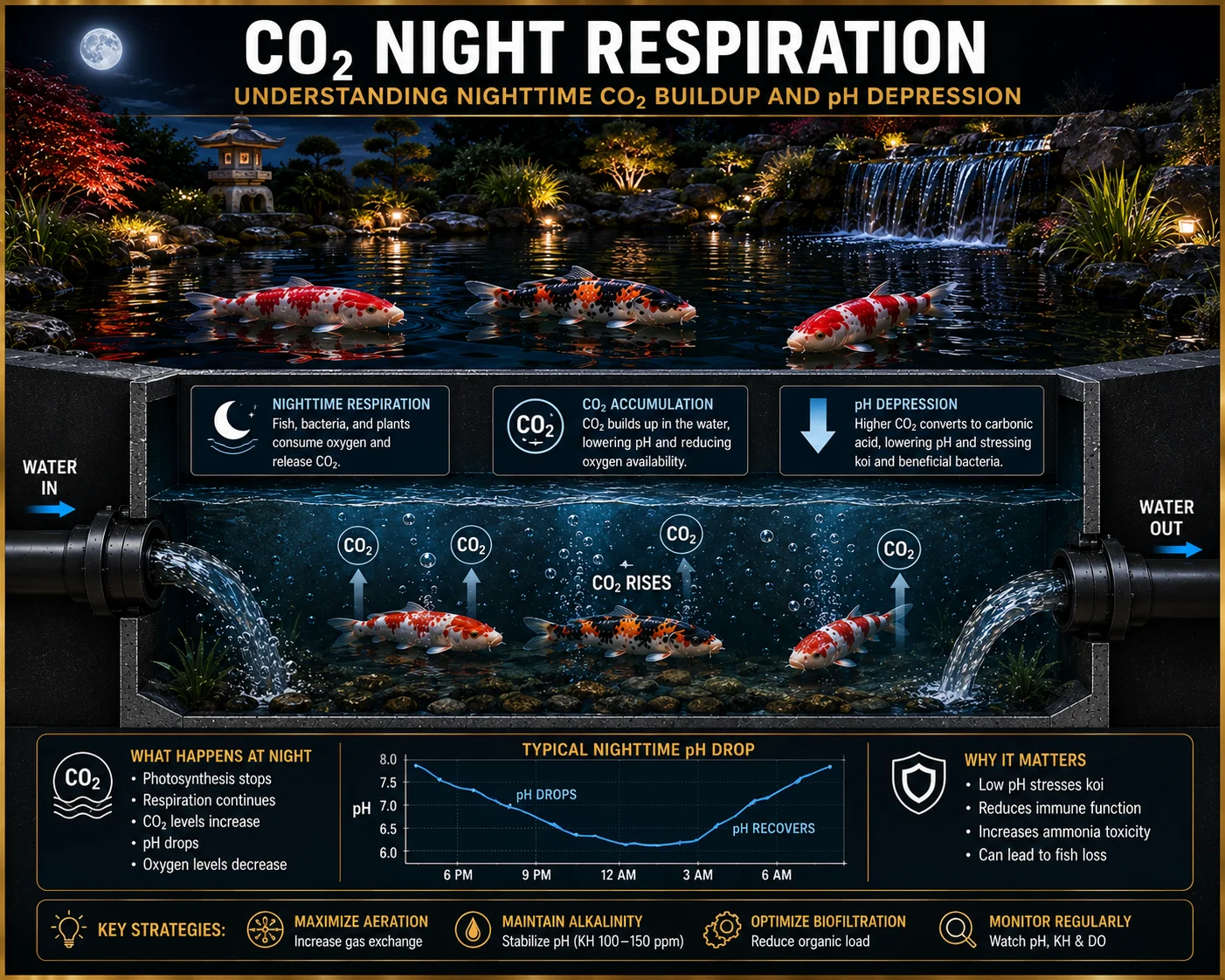
Carbon Dioxide (CO₂) Night Respiration Off-Gassing and Nocturnal pH Stabilization
In a well-stocked koi pond, the daily cycle of photosynthesis and respiration produces a measurable and predictable oscillation in dissolved CO₂ concentration and pH. During daylight hours, aquatic plants and algae consume CO₂ for photosynthesis, gradually depleting it from the water column. This drives the carbonate equilibrium toward bicarbonate and carbonate ions, typically raising the pH. At night, photosynthesis halts while all respiring organisms—fish, bacteria, and plants—continue to release CO₂ into the water, lowering the pH.
This swing is a natural feature of any biologically active pond, but when it becomes pronounced, it can impose stress on the koi by altering their blood pH and increasing the toxicity of ammonia. Proper pond engineering accounts for this cycle, not by attempting to eliminate it—which is impossible—but by managing the magnitude of the shift. Effective aeration and off-gassing play the largest role, not chemical buffers. This page covers the underlying aqueous chemistry and practical strategies for stabilizing the nocturnal pH swing, including the role of air pumps, surface agitation, and, in some cases, lime dosing.
Test Your Understanding of CO₂ Dynamics
Work through ten scenario-based questions on CO₂ respiration, pH swings, off-gassing, and biological oxygen demand.
CO₂ Night Respiration — Quick Facts
Most Asked Questions About CO₂ Night Respiration
A medium-sized pond with a high fish load was experiencing a dawn pH drop of over 0.8 units, causing visible signs of stress in the koi—flashing and clamped fins. The owner had been relying exclusively on the waterfall for aeration, but the waterfall only ran for a short period each day as part of a cycling schedule.
An additional air pump and two large air stones were installed in the deep end of the pond, running continuously through the night. Within three days, the dawn pH swing dropped to 0.3 units, and the koi’s behavior returned to normal. This confirmed that insufficient nocturnal aeration, rather than an alkalinity deficiency, was the root cause.
Understanding the Carbonate Equilibrium
The pH of pond water is governed by the dynamic equilibrium of the carbon dioxide–bicarbonate–carbonate system. Atmospheric CO₂ dissolves in water to form carbonic acid (H₂CO₃). This weak acid can dissociate into bicarbonate (HCO₃⁻) and hydrogen ions (H⁺), or further into carbonate (CO₃²⁻) and additional hydrogen ions.
- CO₂ + H₂O ⇌ H₂CO₃: The initial dissolution of CO₂ into water.
- H₂CO₃ ⇌ HCO₃⁻ + H⁺: The first dissociation that releases hydrogen ions and lowers pH.
- HCO₃⁻ ⇌ CO₃²⁻ + H⁺: A second dissociation at higher pH levels.
At night, respiration pushes the equilibrium to the left, increasing the concentration of CO₂ and H₂CO₃. This is the primary driver of the pH drop. The system’s alkalinity, measured as the buffering capacity, is directly tied to the concentrations of HCO₃⁻ and CO₃²⁻. When hydrogen ions are produced, they are neutralized by these alkaline ions, reducing the pH change. The effectiveness of this buffer system is finite, and when it is exhausted, the pH will drop rapidly.
Nocturnal pH Stabilization: Aeration and Off-Gassing
The most effective way to manage pH swings is to remove the excess CO₂. This is achieved through aeration, which increases the rate of gas exchange at the air-water interface. The concentration of CO₂ in the atmosphere is relatively low (around 0.04%). When you create turbulence or fine bubbles, you increase the surface area available for transfer, allowing the dissolved CO₂ to off-gas into the air until equilibrium is reached.
A commercial koi hatchery was experiencing severe fish stress and mortality due to a daily pH swing of over 1.0 units. The source of the problem was a high stocking density and an undersized biological filter that was also contributing a large CO₂ load.
The engineering solution was to install a grid of perforated air pipes across the bottom of the main rearing tanks. This system was designed to create a “curtain” of fine bubbles that maximized gas transfer without creating currents that were too strong for the juvenile koi. By using a variable-speed blower and a timer that increased airflow at sunset, they reduced the pH swing to under 0.2 units, and the mortality rate dropped to near zero.
Engineering Design for Minimal pH Swings
An effective system for pH stabilization integrates several design principles. First, ensure the pond’s alkalinity is maintained in an optimal range (100–150 ppm as CaCO₃). Second, size the aeration system appropriately for the peak biological load. This often means designing for the night-time respiration rate, which can be estimated by measuring the oxygen consumption or by using bio-load calculators. Third, consider using variable frequency drives to reduce energy usage during off-peak hours.
Aeration type matters: coarse bubble diffusers are excellent for mixing but less efficient for gas transfer than fine bubble diffusers. For off-gassing CO₂, fine bubbles are generally preferred because they provide a higher surface-area-to-volume ratio. Positioning these diffusers in areas of the pond with good water circulation, such as near bottom drains or return jets, ensures that the entire water volume is exposed to the aeration.
A pond with a dense population of string algae was experiencing a sharp pH drop at night. The algae were absorbing CO₂ during the day to drive photosynthesis, causing the pH to reach as high as 9.0 in the afternoon. The resulting nighttime respiration was equally dramatic, with the pH falling to 7.2 by dawn—a full 1.8 unit swing.
The solution involved mechanical removal of the algae to reduce the total biological load and the installation of a shading structure to reduce the intensity of the daily photosynthesis cycle. The engineering adjustment focused on balancing the ecosystem by reducing the extreme oversaturation of CO₂ and oxygen that was driving the chemical instability.
CO₂ Night Respiration — Full Question Library
Review indexed engineering questions below.
Q1:
What is the chemical formula for carbonic acid?
Correct Answer: Option A
Carbon dioxide (CO₂) dissolves in water to form carbonic acid (H₂CO₃).
Q2:
Which ion is responsible for the buffering capacity of water against pH changes?
Correct Answer: Option B
Bicarbonate is a weak base and acts as a buffer to neutralize hydrogen ions.
Q3:
What is the primary source of CO₂ in a pond at night?
Correct Answer: Option C
Respiration is the dominant source of CO₂, as photosynthesis has stopped.
Q4:
What is the primary cause of the pH drop at night in a pond?
Correct Answer: Option B
Accumulation of CO₂ from respiration creates carbonic acid, which lowers pH.
Q5:
What is the relationship between pH and the concentration of hydrogen ions (H⁺)?
Correct Answer: Option D
The pH is defined as the negative logarithm of the hydrogen ion concentration.
Q6:
What is the effect of high CO₂ levels on a fish’s blood?
Correct Answer: Option C
Excess CO₂ in the water diffuses into the fish’s blood, causing acidosis and reducing oxygen uptake.
Q7:
What is the relationship between CO₂ concentration and water temperature?
Correct Answer: Option B
Gases are less soluble in warmer water, meaning they off-gas more readily.
Q8:
What is the typical safe limit for a pH swing in a koi pond?
Correct Answer: Option B
A swing of more than 0.5 units is generally considered stressful for koi.
Q9:
What is the role of calcium carbonate (CaCO₃) in a pond?
Correct Answer: Option A
CaCO₃ dissolves slowly, releasing bicarbonate ions that buffer the water against pH changes.
Q10:
What is the chemical equation for the dissociation of carbonic acid?
Correct Answer: Option B
This is the first dissociation step that releases a hydrogen ion.
Q11:
What is the result of a pond with very low alkalinity?
Correct Answer: Option A
Low alkalinity means little buffering capacity, so any acid added will cause a rapid pH change.
Q12:
Which component of the carbonate system is the primary contributor to alkalinity?
Correct Answer: Option A
Bicarbonate is the most abundant buffering species in typical pond water.
Q13:
What process consumes CO₂ in a pond during the day?
Correct Answer: Option B
Plants and algae consume CO₂ in photosynthesis to produce biomass and oxygen.
Q14:
What is the formula for the Equilibrium Constant (K) of the carbonic acid system?
Correct Answer: Option B
This is the expression for the first dissociation constant of carbonic acid.
Q15:
What is the effect of adding sodium bicarbonate (NaHCO₃) to a pond?
Correct Answer: Option A
Bicarbonate is a buffer; adding it raises the alkalinity and stabilizes the pH.
Q16:
In the context of CO₂ equilibrium, what does ‘off-gassing’ mean?
Correct Answer: Option C
Off-gassing is the physical process that reduces dissolved CO₂.
Q17:
What is the ideal pH range for a koi pond?
Correct Answer: Option B
This is the generally accepted optimal range for koi health and biological filtration.
Q18:
What is the chemical formula for bicarbonate?
Correct Answer: Option C
Bicarbonate is a polyatomic anion with the formula HCO₃⁻.
Q19:
What factor primarily determines the amount of CO₂ that can dissolve in water?
Correct Answer: Option B
Henry’s Law governs gas solubility, which is directly proportional to the partial pressure of that gas.
Q20:
What is the primary source of CO₂ in the atmosphere?
Correct Answer: Option C
While there are natural sources, the largest contributor to the current atmospheric CO₂ levels is human activity, though for a pond, it’s the local biological process that matters most.
Q21:
What is the relationship between fish stocking density and nighttime pH drop?
Correct Answer: Option B
More fish mean more respiration and more CO₂ production, leading to a larger pH swing.
Q22:
What is the main source of CO₂ in a biological filter?
Correct Answer: Option A
The bacteria that break down ammonia are respiring, which produces CO₂.
Q23:
What process produces CO₂ at night in a pond?
Correct Answer: Option B
All respiring organisms produce CO₂ as a metabolic byproduct.
Q24:
How does plant life (algae) affect the diurnal pH swing?
Correct Answer: Option B
Algae and plants are a major driver of the CO₂ cycle, causing pH to rise during the day and drop at night.
Q25:
Which organisms in a pond contribute to the CO₂ load?
Correct Answer: Option A
All living organisms in the pond respire, adding CO₂ to the water.
Q26:
How does a high algae population affect the night-time CO₂ concentration?
Correct Answer: Option B
Dense algae consume CO₂ during the day but can produce a very large respiration load at night, leading to a significant pH drop.
Q27:
What is the primary driver of the biological oxygen demand (BOD) that relates to CO₂ production?
Correct Answer: Option C
Decomposing organic matter is consumed by bacteria, which respire and produce CO₂, contributing to the biological load.
Q28:
How does the metabolic rate of fish change with temperature, and how does this impact CO₂ production?
Correct Answer: Option B
Fish are ectothermic; as water warms, their metabolic rate increases, and they produce more CO₂.
Q29:
What is the relationship between CO₂ concentration and fish stress?
Correct Answer: Option B
High CO₂ lowers blood pH and interferes with oxygen uptake, which is a major physiological stress.
Q30:
How does the feeding rate affect the nocturnal pH swing?
Correct Answer: Option C
More food means more waste and higher biological activity, leading to higher CO₂ production.
Q31:
What is the typical CO₂ production rate of a healthy koi pond?
Correct Answer: Option C
The rate is highly site-specific and must be measured or estimated for each system.
Q32:
What is the primary source of CO₂ in a pond during the night?
Correct Answer: Option A
Photosynthesis ceases at night, so respiration is the only source.
Q33:
How does the decomposition of organic matter affect the CO₂ levels in a pond?
Correct Answer: Option B
Decomposition is a respiratory process carried out by bacteria, which produces CO₂.
Q34:
What is the relationship between the number of fish and the dawn pH reading?
Correct Answer: Option B
More fish produce more CO₂, which lowers the dawn pH.
Q35:
What is the effect of a high plant (or algae) biomass on the daily pH range?
Correct Answer: Option A
High biomass means more photosynthesis during the day and more respiration at night, causing a larger swing.
Q36:
Which organism’s activity is primarily responsible for the increase in CO₂ at night?
Correct Answer: Option A
All organisms in the pond respire, so they all contribute.
Q37:
What is the primary biological process that removes CO₂ from pond water during the day?
Correct Answer: Option A
Photosynthesis actively consumes CO₂.
Q38:
What is the role of nitrifying bacteria in the CO₂ cycle of a pond?
Correct Answer: Option B
Nitrifying bacteria are aerobes that respire and produce CO₂.
Q39:
What is the relationship between the respiration rate of fish and the concentration of dissolved CO₂ in the water?
Correct Answer: Option C
The concentration is the balance between the production rate and the removal rate (off-gassing).
Q40:
What is the primary effect of high CO₂ levels on fish health?
Correct Answer: Option A
Excess CO₂ acidifies the fish’s blood, making it difficult to carry oxygen.
Q41:
What is the primary mechanism by which aeration reduces the pH swing?
Correct Answer: Option A
By increasing gas exchange, aeration removes the excess CO₂ that causes the pH to drop.
Q42:
What type of aeration is most effective for CO₂ off-gassing?
Correct Answer: Option B
Fine bubbles provide a very large surface area for gas exchange, making them highly efficient.
Q43:
How does increasing surface agitation help stabilize pH?
Correct Answer: Option B
Agitation increases the gas exchange rate, which allows excess CO₂ to escape into the atmosphere.
Q44:
What is the effect of aeration on dissolved CO₂ concentration?
Correct Answer: Option A
Aeration drives CO₂ out of solution.
Q45:
What is the ideal placement of air stones for effective CO₂ removal?
Correct Answer: Option B
Placing aeration at the bottom creates a full water column circulation that maximizes gas exchange.
Q46:
What is the relationship between bubble size and gas transfer efficiency?
Correct Answer: Option B
Smaller bubbles have a larger surface area to volume ratio, increasing the rate of gas transfer.
Q47:
How does a Venturi valve contribute to CO₂ off-gassing?
Correct Answer: Option C
Venturi valves entrain air into the water flow, creating fine bubbles that enhance gas exchange.
Q48:
What is the primary advantage of a counter-current aeration system?
Correct Answer: Option B
By having water and air flow in opposite directions, the driving force for gas exchange is maximized.
Q49:
How does water temperature affect the efficiency of aeration?
Correct Answer: Option C
Warm water holds less gas, so CO₂ comes out of solution more readily.
Q50:
What is a common mistake when designing an aeration system for pH control?
Correct Answer: Option B
Aeration is needed when CO₂ is being produced, which is primarily at night. Daytime aeration is less critical.
Q51:
What is the primary function of a Venturi injector in a pond circulation system?
Correct Answer: Option B
Venturi injectors are an efficient way to add fine air bubbles to the water.
Q52:
How does the flow rate of water through a Venturi affect CO₂ removal?
Correct Answer: Option B
More water flow through a Venturi creates a larger pressure drop, pulling in more air.
Q53:
What is the ‘residence time’ of a bubble in water, and why is it important?
Correct Answer: Option A
Longer contact time allows more CO₂ to diffuse into the bubble.
Q54:
How does a diffuser with a smaller pore size affect aeration efficiency?
Correct Answer: Option A
Smaller pores produce smaller bubbles, which have a higher surface area for gas exchange.
Q55:
What is the relationship between atmospheric pressure and CO₂ off-gassing?
Correct Answer: Option B
Lower pressure means the dissolved gas is more readily able to escape from the water.
Q56:
What is the ideal oxygen-to-CO₂ ratio in a healthy koi pond?
Correct Answer: Option B
This is the goal for optimal fish health.
Q57:
What is the role of a droplet or splash aeration system in CO₂ removal?
Correct Answer: Option A
Waterfalls and splashes break water into droplets, greatly increasing the surface area for gas exchange.
Q58:
How can a timer be used effectively for aeration in a pond?
Correct Answer: Option B
This focuses the aeration effort on the period when it is most needed.
Q59:
What is the effect of high altitude on CO₂ off-gassing?
Correct Answer: Option A
Lower atmospheric pressure reduces the partial pressure of CO₂, making it easier for the gas to escape.
Q60:
What is the primary benefit of combining aeration with good water circulation?
Correct Answer: Option A
Circulation ensures that all water is brought to the surface to release CO₂.
Q61:
What is the recommended alkalinity range for a stable koi pond?
Correct Answer: Option A
This range provides good buffering capacity without being excessively high.
Q62:
How does alkalinity buffer against a pH drop?
Correct Answer: Option B
Bicarbonate and carbonate ions neutralize H⁺ ions, preventing a rapid pH drop.
Q63:
What is the effect of adding baking soda (sodium bicarbonate) to a pond?
Correct Answer: Option A
Baking soda is a common way to safely raise alkalinity.
Q64:
How often should you test alkalinity in a heavily stocked pond?
Correct Answer: Option B
Frequent testing is needed because alkalinity can be depleted by biological activity and pH swings.
Q65:
What is the relationship between pH and the toxicity of ammonia?
Correct Answer: Option A
As pH increases, a greater proportion of the total ammonia is the toxic form (NH₃).
Q66:
What is the term for the measure of the water’s ability to neutralize acid?
Correct Answer: Option A
Alkalinity is the buffering capacity against acidification.
Q67:
What is a potential risk of adding too much sodium bicarbonate to a pond?
Correct Answer: Option B
While rare, adding large amounts can significantly raise the pH, stressing the fish.
Q68:
How do you calculate the amount of sodium bicarbonate needed to raise alkalinity?
Correct Answer: Option B
A general rule is 1 gram of sodium bicarbonate per 10 US gallons raises alkalinity by about 10 ppm.
Q69:
What is the relationship between calcium hardness and pH stability?
Correct Answer: Option A
Dissolved calcium can help buffer the water, especially when it is in the form of calcium carbonate.
Q70:
What is the effect of a sudden change in pH on koi?
Correct Answer: Option A
Fish are sensitive to rapid pH changes, which can cause osmoregulatory stress and death.
Q71:
How does pH affect the efficiency of biological filtration?
Correct Answer: Option B
Nitrifying bacteria require a pH of 7.0 or above to function efficiently.
Q72:
What is a potential cause of a sudden alkalinity drop?
Correct Answer: Option B
Bacteria consume alkalinity as part of the nitrification process.
Q73:
How does the pH of the source water affect the pond’s pH stability?
Correct Answer: Option C
The source water provides the base chemistry that the pond’s biological processes will alter.
Q74:
What is the relationship between CO₂ and pH?
Correct Answer: Option A
CO₂ dissolves to form carbonic acid, which lowers the pH.
Q75:
How does aeration affect pH?
Correct Answer: Option B
Off-gassing CO₂ removes the acid, allowing the pH to rise.
Q76:
What is the ideal pH range for nitrifying bacteria?
Correct Answer: Option A
This is the optimal pH range for the biological filter to process ammonia.
Q77:
What is a common cause of a pH spike in a pond?
Correct Answer: Option B
Photosynthesis consumes CO₂, which can cause the pH to rise significantly.
Q78:
How does heavy rainfall affect a pond’s pH and alkalinity?
Correct Answer: Option A
Rainwater is typically acidic and low in minerals, so it can dilute the buffering capacity of the pond.
Q79:
What is the ‘equilibrium pH’ of a pond and how is it determined?
Correct Answer: Option B
This is the steady-state condition for the water chemistry.
Q80:
What is the primary difference between pH and alkalinity?
Correct Answer: Option A
pH is the current acid/base state, and alkalinity is the resistance to change.
Q81:
How does a heavily loaded biological filter contribute to the nighttime pH drop?
Correct Answer: Option B
Bacteria in the filter are constantly respiring and producing CO₂.
Q82:
What is the role of a ‘settling tank’ in managing the CO₂ load?
Correct Answer: Option B
Removing solids prevents them from being broken down and producing CO₂.
Q83:
How does the efficiency of a biofilter affect the overall CO₂ production?
Correct Answer: Option C
Regardless of efficiency, nitrification is a respiratory process that produces CO₂.
Q84:
What is the relationship between pond clarity and the diurnal pH swing?
Correct Answer: Option B
In clear water, light penetrates deeper, leading to more photosynthesis and a more pronounced daily cycle.
Q85:
How does the type of feed (protein content) affect CO₂ production?
Correct Answer: Option A
Protein metabolism produces nitrogenous waste and CO₂.
Q86:
What is the role of a protein skimmer in a koi pond?
Correct Answer: Option A
By removing dissolved organics, it reduces the biological oxygen demand and subsequent CO₂ production.
Q87:
How does the frequency of pond cleaning affect the CO₂ load?
Correct Answer: Option B
Decomposing organic matter is a major source of CO₂ and oxygen demand.
Q88:
What is the primary source of CO₂ in a filter system?
Correct Answer: Option B
Bacteria in the filter consume oxygen and produce CO₂.
Q89:
How does the flow rate through a biofilter affect CO₂ production?
Correct Answer: Option A
Good flow in a filter helps with gas exchange, allowing CO₂ to escape.
Q90:
What is the relationship between the number of fish and the alkalinity consumption rate?
Correct Answer: Option B
Alkalinity is consumed by nitrification and acidification from CO₂.
Q91:
What is a ‘load’ in the context of pond engineering?
Correct Answer: Option B
The biological load determines the aeration and filtration requirements.
Q92:
How does the addition of new fish affect the CO₂ dynamics?
Correct Answer: Option A
More fish mean more respiration and more waste for the filter.
Q93:
What is the relationship between the water volume and the magnitude of the pH swing?
Correct Answer: Option B
More water provides a larger buffer against chemical changes.
Q94:
What is the primary role of a biological filter in managing pH?
Correct Answer: Option B
The filter is essential for water quality, but its biological activity impacts pH chemistry.
Q95:
What is the effect of overfeeding on the night-time CO₂ level?
Correct Answer: Option B
Excess food becomes waste, fueling bacterial respiration and CO₂ production.
Q96:
How does a high organic load from dead algae affect the pH swing?
Correct Answer: Option B
Decomposition is a respiratory process that produces CO₂.
Q97:
What is the relationship between the efficiency of the bottom drain and the CO₂ load?
Correct Answer: Option A
Removing solid waste prevents it from breaking down and contributing to the biological load.
Q98:
What is the role of a ‘bio-load’ calculation in pond design?
Correct Answer: Option A
The bio-load is a key design parameter for ensuring water quality.
Q99:
How does water temperature affect the biological oxygen demand (BOD) and CO₂ production?
Correct Answer: Option A
Bacterial and fish metabolism are temperature-dependent, increasing with warmth.
Q100:
What is the primary difference between a low-load and a high-load pond in terms of pH management?
Correct Answer: Option B
The higher the load, the more CO₂ is produced, and the more management is required.
Q101:
Why is the pH swing generally larger in summer than in winter?
Correct Answer: Option B
Metabolism increases with temperature, leading to more CO₂ production and a larger swing.
Q102:
How does the seasonal change in daylight hours affect the CO₂ cycle?
Correct Answer: Option B
More daylight hours give more time for photosynthesis to deplete CO₂.
Q103:
How does the water temperature affect the solubility of CO₂?
Correct Answer: Option B
Gases are less soluble in warmer liquids, so they off-gas more easily.
Q104:
What is the impact of a spring or autumn turnover on the CO₂ concentration?
Correct Answer: Option C
The mixing of stratified water layers can bring CO₂-rich water to the surface.
Q105:
How does aeration demand change from summer to winter?
Correct Answer: Option B
Fish are less active and bacteria are slower in cold water, so CO₂ production drops.
Q106:
How does ice cover affect the CO₂ concentration in a pond?
Correct Answer: Option B
An ice cover traps gases in the water, including CO₂.
Q107:
What is the effect of autumn leaf litter on the CO₂ load?
Correct Answer: Option B
Decomposition of organic matter is a significant source of CO₂.
Q108:
How do seasonal feeding habits of koi affect the pH swing?
Correct Answer: Option A
Feeding rates are higher in summer, which increases the biological load.
Q109:
What is the impact of a summer algae bloom on the night-time pH?
Correct Answer: Option B
Algae consume CO₂ during the day and produce it at night.
Q110:
What is the relationship between seasonal rainfall and pond pH?
Correct Answer: Option C
Rainwater is usually low in minerals and can be acidic, so it can dilute the pond’s buffers.
Q111:
How does the length of the winter dormancy affect the CO₂ balance?
Correct Answer: Option B
Fish and bacteria are much less active in cold water, reducing CO₂ production.
Q112:
Why is it important to adjust aeration in the spring?
Correct Answer: Option B
Biological activity increases in spring, so the aeration system should be ramped up to match.
Q113:
How does the seasonal evaporation rate affect the pH and alkalinity?
Correct Answer: Option A
As water evaporates, the dissolved solids become more concentrated.
Q114:
What is the effect of a warm, cloudy day on the subsequent night-time pH?
Correct Answer: Option B
If photosynthesis is reduced, the starting pH is lower, and the night-time drop can be more significant.
Q115:
How does a sudden cold front affect the CO₂ balance?
Correct Answer: Option B
Q116:
What is the relationship between seasonal algal die-off and CO₂ levels?
Correct Answer: Option C
Dead algae are decomposed by bacteria, which respire and produce CO₂.
Q117:
How does the change in barometric pressure affect CO₂ off-gassing?
Correct Answer: Option B
Lower atmospheric pressure reduces the partial pressure of CO₂ in the air, making it easier for the gas to escape the water.
Q118:
What is the primary reason for a larger pH swing in shallow ponds compared to deep ponds?
Correct Answer: Option B
The smaller water volume in shallow ponds is more susceptible to temperature changes and biological activity.
Q119:
What is the effect of a high wind event on the CO₂ concentration?
Correct Answer: Option C
Wind greatly increases gas exchange at the water’s surface.
Q120:
What is the ‘turnover’ period and why is it a concern for CO₂ management?
Correct Answer: Option A
Turnover can cause a sudden drop in oxygen and a rise in CO₂ as the layers mix.
Q121:
What is the most important water quality parameter to monitor to prevent a pH crash?
Correct Answer: Option B
Alkalinity is the buffer; if it drops, a pH crash is imminent.
Q122:
How often should you test the pH during a 24-hour period to assess the swing?
Correct Answer: Option A
These are the two extremes of the daily pH cycle.
Q123:
What is the standard unit for measuring alkalinity?
Correct Answer: Option A
Alkalinity is typically expressed as ppm CaCO₃ equivalent.
Q124:
What is the purpose of a pH probe in a pond automation system?
Correct Answer: Option A
Probes are the foundation of automated water quality management.
Q125:
How do you test for dissolved CO₂ directly?
Correct Answer: Option B
There are specific test kits and probes available for measuring dissolved CO₂.
Q126:
What is the relationship between pH and the CO₂ concentration in a water sample?
Correct Answer: Option B
CO₂ is an acid, so it lowers the pH.
Q127:
What is the most reliable way to measure the daily pH swing?
Correct Answer: Option B
A digital meter provides the most accurate and repeatable readings.
Q128:
How does water temperature affect the pH reading?
Correct Answer: Option B
Many pH meters have automatic temperature compensation (ATC) to correct for this.
Q129:
What is the significance of measuring pH at the same time every day?
Correct Answer: Option C
Regular, consistent measurements are key to detecting problems early.
Q130:
What is the primary source of error when using a pH test strip?
Correct Answer: Option C
Color matching is subjective and can lead to inaccuracies.
Q131:
What is the relationship between dissolved oxygen (DO) and CO₂ levels?
Correct Answer: Option A
Both are gases involved in respiration and photosynthesis.
Q132:
What is the ‘Langelier Saturation Index’ and how does it relate to CO₂?
Correct Answer: Option A
This index is used to predict calcium carbonate precipitation or dissolution.
Q133:
What is a ‘pH crash’ and what are its warning signs?
Correct Answer: Option C
A pH crash is dangerous and must be corrected immediately.
Q134:
What is the importance of measuring Total Dissolved Solids (TDS) in relation to pH?
Correct Answer: Option B
High TDS often means more ions to buffer pH changes.
Q135:
What is the effect of a faulty pH probe on water quality management?
Correct Answer: Option A
Probes need regular calibration and maintenance to be accurate.
Q136:
How does the sampling method affect the accuracy of pH and CO₂ readings?
Correct Answer: Option B
Exposing the sample to the air can change the CO₂ concentration.
Q137:
What is the role of a data logger in pH management?
Correct Answer: Option A
Data loggers provide valuable long-term data for system analysis.
Q138:
What is the relationship between the pH and the carbon dioxide equilibrium?
Correct Answer: Option B
The carbonate equilibrium dictates the pH.
Q139:
What is the primary reason for calibrating a pH meter?
Correct Answer: Option A
Calibration is essential for reliable measurements.
Q140:
How does the presence of other ions in the water affect pH readings?
Correct Answer: Option A
High ionic strength can influence the activity of hydrogen ions.
Q141:
What is the first step in diagnosing a large nighttime pH drop?
Correct Answer: Option B
Always test alkalinity first to assess the buffer capacity.
Q142:
What is a common symptom of high CO₂ levels in koi?
Correct Answer: Option A
These are classic signs of respiratory distress or irritation.
Q143:
What is the most effective emergency measure for a pH crash?
Correct Answer: Option B
This is the standard emergency protocol to stabilize the pH.
Q144:
What is the likely cause if the dawn pH is consistently below 7.0?
Correct Answer: Option A
This is a sign that the system is not coping with the CO₂ production.
Q145:
How does a clogged air stone affect the pH swing?
Correct Answer: Option B
A dirty air stone produces fewer bubbles and reduces off-gassing efficiency.
Q146:
What is a common mistake in treating a low pH condition?
Correct Answer: Option B
Always make pH changes gradually to avoid shocking the fish.
Q147:
What is the most reliable indicator that a pond is experiencing CO₂ issues?
Correct Answer: Option A
This is a direct measure of the CO₂-induced pH swing.
Q148:
What is the first step in troubleshooting a pH crash?
Correct Answer: Option A
Reducing the biological load is a key step in recovery.
Q149:
How can you determine if the pH drop is due to CO₂ or another acid?
Correct Answer: Option B
If alkalinity is low, the problem is a lack of buffer; if alkalinity is adequate, it’s likely a CO₂ overload.
Q150:
What is a typical mistake made when using aeration to control pH?
Correct Answer: Option C
Daytime aeration is less critical, but it’s not a mistake. However, relying on aeration without addressing the root cause (e.g., bio-load) is a common oversight.
Q151:
What is the role of a water change in managing CO₂ levels?
Correct Answer: Option B
Water changes are a temporary but effective way to reduce CO₂ and replenish buffers.
Q152:
What is the primary cause of a sudden alkalinity crash?
Correct Answer: Option C
Nitrification consumes alkalinity.
Q153:
How can you tell if your aeration system is undersized?
Correct Answer: Option B
If alkalinity is normal but the pH still drops significantly, the aeration is not keeping up with the CO₂ load.
Q154:
What is a case study of aeration preventing a pH crash?
Correct Answer: Option B
This is a classic scenario where engineering intervention solves a water quality issue.
Q155:
What is the effect of a power outage on the CO₂ balance?
Correct Answer: Option C
Without aeration, CO₂ accumulates quickly.
Q156:
What is a common cause of high CO₂ in a pond that has adequate aeration?
Correct Answer: Option B
The aeration system is simply overwhelmed by the production rate.
Q157:
What is the first thing to check when a pond’s pH is unusually low at dawn?
Correct Answer: Option A
Alkalinity determines the buffer capacity and is the starting point for diagnosis.
Q158:
How does a poorly designed pond shape contribute to CO₂ buildup?
Correct Answer: Option B
Water circulation is key to bringing water to the surface for off-gassing.
Q159:
What is the ‘respiration coefficient’ in a pond and why does it matter?
Correct Answer: Option B
This coefficient helps in the design of aeration systems.
Q160:
What is the relationship between a dirty filter and the pH swing?
Correct Answer: Option A
Organic matter in a dirty filter is decomposed, producing CO₂.
Q161:
What is the role of a ‘degassing tower’ in a koi pond system?
Correct Answer: Option B
Degassing towers are specialized units for gas exchange.
Q162:
What is the advantage of using a variable speed pump for pH control?
Correct Answer: Option A
Variable speed drives are key for energy-efficient, dynamic water quality management.
Q163:
How does the size of a biofilter affect the CO₂ dynamics?
Correct Answer: Option B
Filter sizing is a balance between treatment capacity and oxygen/CO₂ management.
Q164:
What is the ideal placement for a pH probe in a pond system?
Correct Answer: Option B
This gives a representative reading of the overall pond water.
Q165:
What is the purpose of an aeration manifold?
Correct Answer: Option B
A manifold ensures uniform air flow across the system.
Q166:
How does the design of the return line affect CO₂ off-gassing?
Correct Answer: Option A
Surface agitation is a key component of gas exchange.
Q167:
What is the advantage of using a solar-powered air pump?
Correct Answer: Option A
This is a backup option to prevent a catastrophic pH crash during power outages.
Q168:
What is the role of an automated controller in pH management?
Correct Answer: Option B
Automation allows for rapid, precise responses to changing conditions.
Q169:
How does the pipe diameter affect the efficiency of a degassing system?
Correct Answer: Option A
This is similar to how a trickle filter works.
Q170:
What is the primary reason for using a venturi injector over a traditional air stone?
Correct Answer: Option B
Venturi systems use the energy of the water flow itself.
Q171:
How does the surface area of the pond affect the natural off-gassing rate?
Correct Answer: Option B
This is a fundamental factor in the pond’s design.
Q172:
What is the importance of a backup aeration system?
Correct Answer: Option A
Redundancy is a core principle of reliable pond engineering.
Q173:
How does the design of a bottom drain impact CO₂ levels?
Correct Answer: Option B
Efficient waste removal is a key part of managing the biological load.
Q174:
What is the role of a spray bar in a pond return?
Correct Answer: Option A
Spray bars are an effective aeration method.
Q175:
What is the ideal flow rate through a degassing tower?
Correct Answer: Option B
Thin films maximize the surface area for gas exchange.
Q176:
How does the use of UV sterilizers affect CO₂ levels?
Correct Answer: Option B
Algae is a major driver of the CO₂ cycle, so controlling it with UV will have an indirect effect.
Q177:
What is the benefit of installing a pH controller with a dosing pump?
Correct Answer: Option B
This is a high-end solution for automated pH control.
Q178:
How does the position of the air pump (above or below water) affect its efficiency?
Correct Answer: Option B
This is a standard installation practice to protect the pump.
Q179:
What is the primary advantage of a ‘membrane’ diffuser over a ‘ceramic’ diffuser?
Correct Answer: Option A
The bubble size is critical for gas transfer efficiency.
Q180:
What is the role of a system curve in designing an aeration system?
Correct Answer: Option B
This ensures the system is properly sized.
Q181:
What is the recommended maximum pH swing per day for koi health?
Correct Answer: Option B
This is a widely accepted best practice limit.
Q182:
What is the best practice for adding sodium bicarbonate to a pond?
Correct Answer: Option B
This prevents a rapid pH shock.
Q183:
What is the importance of keeping a water quality log?
Correct Answer: Option B
Data logging is essential for troubleshooting and system optimization.
Q184:
What is the best practice for monitoring a pond’s pH during a heatwave?
Correct Answer: Option A
Heatwaves stress the system and demand closer attention.
Q185:
What is the ‘dilution’ approach to managing pH swings?
Correct Answer: Option B
This is a temporary but effective management tool.
Q186:
What is the industry-standard unit for measuring alkalinity?
Correct Answer: Option B
This is the standard for water quality analysis.
Q187:
What is the recommended action if the dawn pH is below 7.0?
Correct Answer: Option A
This is the standard corrective action.
Q188:
What is the best practice for feeding koi to minimize CO₂ production?
Correct Answer: Option A
This reduces waste and the biological load.
Q189:
What is the relationship between the stocking density and the required aeration rate?
Correct Answer: Option B
This is a fundamental rule of pond engineering.
Q190:
What is the best practice for recording pH data?
Correct Answer: Option B
Context is essential for interpreting the data.
Q191:
What is the ‘double-check’ method for pH testing?
Correct Answer: Option B
This is a good quality control practice.
Q192:
What is the recommended alkalinity level for a koi pond to buffer CO₂?
Correct Answer: Option A
This is the optimal buffering range.
Q193:
What is the best practice for installing an air diffuser?
Correct Answer: Option A
This maximizes circulation and gas exchange.
Q194:
What is the most important factor in preventing a pH crash?
Correct Answer: Option A
Alkalinity is the primary defense against a pH crash.
Q195:
What is the best practice for managing a pond with a heavy fish load?
Correct Answer: Option B
A multi-faceted approach is required for high-load systems.
Q196:
What is the ‘acid test’ for determining if a pH drop is due to CO₂?
Correct Answer: Option A
If aeration raises the pH, the drop is due to excess CO₂.
Q197:
What is the recommended action if you suspect a pH crash is imminent?
Correct Answer: Option B
Being prepared with a buffer is the best preventative measure.
Q198:
What is the role of a ‘pH alarm’ in a koi pond system?
Correct Answer: Option B
This allows for a rapid human response to a crisis.
Q199:
What is the best practice for introducing new fish to an established pond with regard to pH?
Correct Answer: Option A
A sudden pH change is a major stressor for fish.
Q200:
What is the long-term solution to a persistent large pH swing?
Correct Answer: Option A
Engineering solutions are more sustainable than chemical treatments.