Calculating Bottom Drain Sweeping Velocity and Sediment Transport Kinetics
Every pond disaster that starts with “the water looked fine” ends the same way: a thick mat of settled solids sitting dead center over a bottom drain that’s doing absolutely nothing. Not because the drain failed. Because nobody ever calculated whether the water crossing that floor was moving fast enough to carry anything to it in the first place.
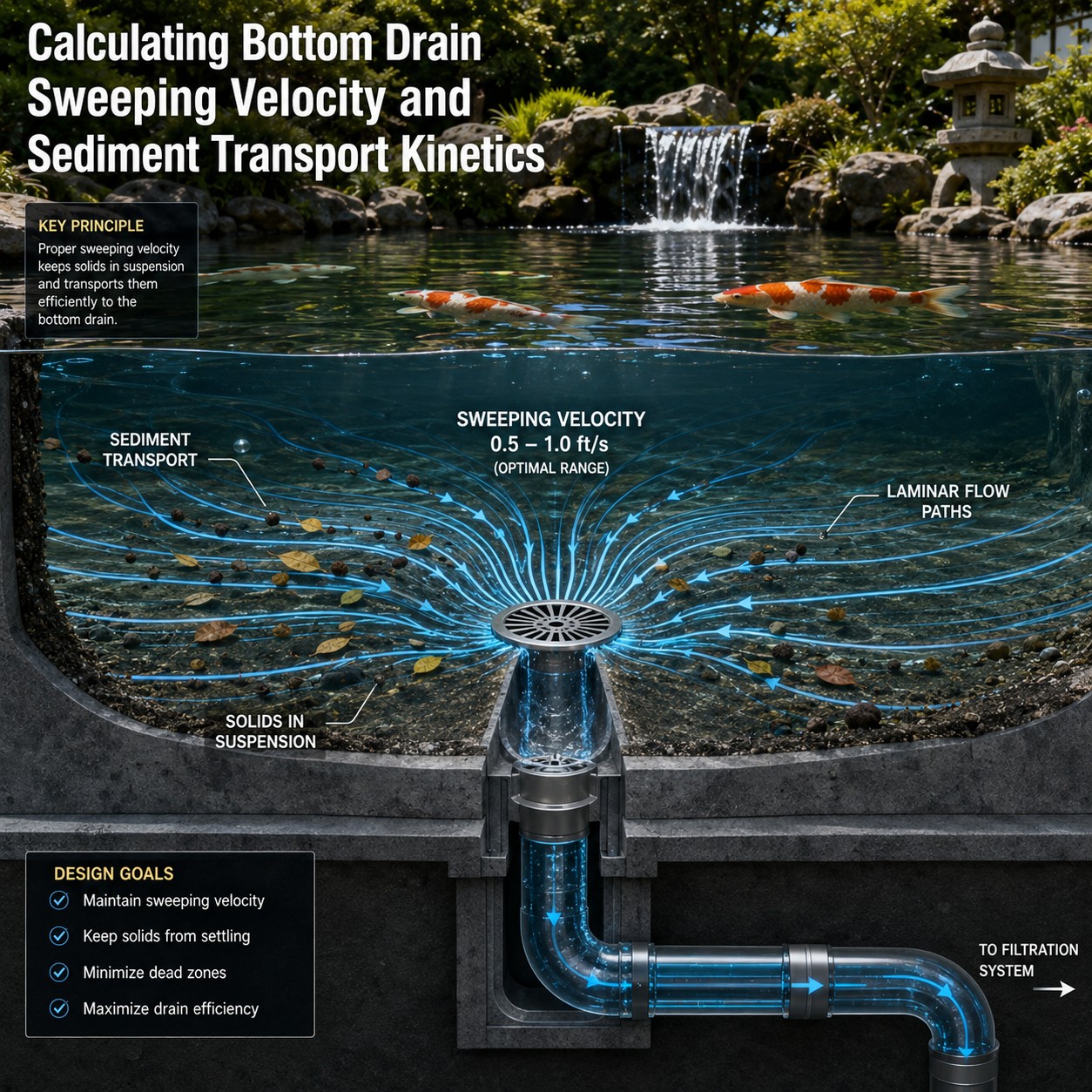
Sweeping velocity is the number nobody asks about at the point of sale and everybody should be asking about before concrete gets poured. It’s the speed water has to travel across the pond bottom to keep solid waste in motion toward the drain rather than settling out along the way.
Not a trivia quiz — this is what actually separates a functioning bottom drain system from an expensive dead zone.
First thing I do, always: ask for a coffee, or a glass of water, or anything really — it doesn’t much matter what. What matters is the ten minutes it buys before I actually look at anything. Because in that gap between arriving and getting to work, the customer will tell you exactly what they think is wrong, with total conviction, and if you’re not careful that story gets into your head before you’ve seen a single thing for yourself. Somebody decided early on the pump was “obviously” fine, or the drain was “obviously” in the right spot, and repeated it enough times that it stopped being a guess and became a fact nobody thought to check again.
So here’s what I actually check, in order, before anyone touches a pump or prices concrete. These are the problems I run into again and again, and none of them require breaking anything open.
Where is the sludge actually sitting, not where does everyone think it’s sitting. A mat dead center over the drain tells a different story than one lining a back wall or piling up behind a plant pot. Center usually means the intake gap or total flow rate needs attention. Along a wall or behind an obstacle almost always means the current is dying before it reaches the drain at all — and no pump upgrade fixes a dead zone caused by something sitting in the water blocking the sweep.
Run a dye test before you run anything else. A small amount of heavy, aquarium-safe dye released near the floor, not the surface — surface behavior tells you about the skimmer, not the drain. Watch it for a few minutes. Steady drift toward the drain means that zone is doing its job. Dye that just sits there, going nowhere, means you’ve found your dead zone for the price of a bottle of dye instead of a callout.
Ask whether this is new or old. A pond that swept clean for two years and only recently started sludging almost always has a mechanical cause, not a design flaw — a fouled pipe, a partially clogged impeller, a valve someone bumped without mentioning it. That’s a five-minute check, not a reason to start pricing a redesign.
If all three come back clean and one spot has simply always been dead since the concrete was poured, the fix is rarely a bigger pump. It’s usually a return jet nudged a few degrees, or accepting that corner as a designated settlement zone you vacuum out twice a year. Nine times out of ten, the fix is smaller than the panic. The tenth time is genuinely rare enough that I remember it.
Bottom Drain Sweeping Velocity Master Reference Index
Review indexed engineering questions below.
Q1:
In gravity-fed bottom drain hydraulics, how does horizontal boundary layer velocity determine whether heavy fish waste remains in motion or settles?
Correct Answer: Option A
Boundary layer shear stress must exceed the static friction and gravitational resistance of settled waste particles to prevent static sludge mats.
Q2:
How does the fluid velocity profile near the pond floor generate the shear stress required to transport solid waste?
Correct Answer: Option B
Shear stress is generated by the velocity gradient, the change in flow speed with respect to depth, within the boundary layer just above the floor.
Q21:
When applying the Shields parameter, which property of heavy waste mandates a higher sweeping velocity compared to fine mulm?
Correct Answer: Option B
The Shields criterion dictates that incipient motion depends on particle size and relative density. Dense fecal casts require significantly greater shear stress.
Q41:
What occurs when two adjacent drain suction fields meet without sufficient return momentum?
Correct Answer: Option C
Competing suction fields without directional return jets create stagnant zero-velocity boundaries where solids settle.
Q61:
When expanding main drain pipe diameter at constant flow rate, what compromise occurs?
Correct Answer: Option C
Under Q = A * v, expanding area (A) at constant flow (Q) lowers velocity (v) below self-cleansing thresholds.
Q81:
Why does a pre-filter settlement tank require an expansive internal cross-section?
Correct Answer: Option C
Expanding area drops fluid velocity below particle settling speed (Stokes’ Law).
Q101:
What does the exact physical location of a sludge mat reveal?
Correct Answer: Option C
Sludge marks where localized velocity drops below critical bed shear thresholds.
Q121:
How does an aerated dome bubble plume reinforce floor sweeping?
Correct Answer: Option C
Rising air creates a toroidal circulation cell that pulls near-floor water inward.
Q141:
Why do non-penetrating retrofit bottom drain plates require higher suction velocity?
Correct Answer: Option C
Without a sunken bowl to catch solids, rim suction velocity must be maintained.
Q161:
How does Total Dynamic Head (TDH) determine delivered flow rate?
Correct Answer: Option C
Operating point is set by the intersection of system TDH resistance and the pump curve.
Q181:
How does critical shear stress vary with particle grain size under Shields curve?
Correct Answer: Option C
Coarser particles possess greater submerged mass, requiring higher bed shear stress.