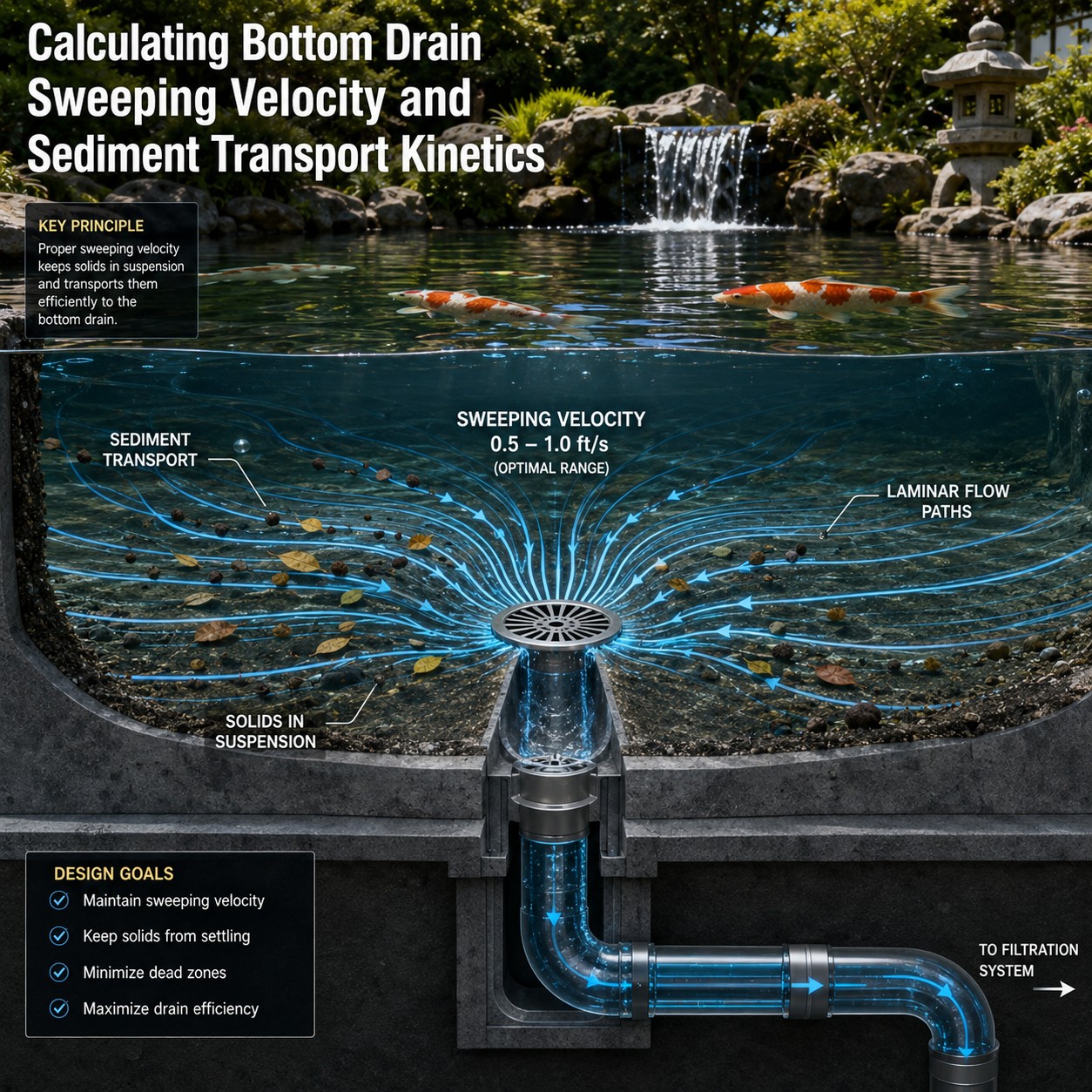
Calculating Bottom Drain Sweeping Velocity and Sediment Transport Kinetics
Sweeping velocity is the hydraulic parameter that determines whether suspended solids in a koi pond are effectively transported toward the bottom drain or allowed to settle into dead zones. This is not a fixed number but a design variable that depends on the pond’s geometry, the specific gravity and size of the solids, the friction characteristics of the floor surface, and the flow rate delivered through the return jet. The widely cited target range of 0.5 to 1.0 ft/s (0.15 to 0.3 m/s) represents a practical design envelope, but the actual required velocity must be calculated based on the shear stress imparted to the pond floor and the settling velocity of the worst-case debris.
This page works through the engineering principles behind sweeping velocity: the relationship between flow rate, jet momentum, and floor shear stress; the Shields parameter and its role in initiating sediment motion; the difference between suspended load and bedload transport; and the practical constraints that pipe size, pump curve, and return fitting geometry place on what a system can actually deliver. While rules of thumb have their place, reliable drain performance comes from understanding the transport mechanics rather than memorizing a single target number. Every design decision should be checked against the specific solids loading and pond configuration rather than a generic value.
Test Your Sweeping Velocity Knowledge
Work through ten scenario-based questions covering sediment transport, shear stress, the Shields parameter, jet momentum, return placement, and troubleshooting. Each answer includes the reasoning behind it.
Bottom Drain Sweeping Velocity — Quick Facts
Most Asked Questions About Sweeping Velocity
A 15′ diameter circular pond with a single 4″ bottom drain and a 3″ return was exhibiting a persistent debris ring at the 7-foot radius, despite a pump delivering 4500 GPH. The return jet was placed at the surface, angled horizontally along the wall. A dye test showed that the jet traveled along the wall for about 3 feet before diffusing into the water column, never reaching the pond floor.
Rerouting the return to discharge at a 35-degree downward angle through a 3″ eyeball fitting increased the floor velocity from a negligible 0.1 ft/s to an average of 0.6 ft/s across the floor. The debris ring was eliminated within three days. The pump and flow rate remained unchanged; only the return geometry was revised.
Sediment Transport Mechanics: Bedload and Suspended Load
Solids in a koi pond move in one of two modes: bedload, where particles roll or slide along the floor, and suspended load, where particles are carried in the water column. Sweeping velocity is primarily a bedload parameter—it creates the shear stress needed to overcome the friction and weight holding particles on the floor. Once a particle is lifted into suspension, the velocity required to keep it moving is lower than the velocity needed to lift it in the first place. This is why a return jet can often keep a clean pond clean but fails to clean a pond with established sediment—the initial lift requires more energy than the subsequent transport.
- Bedload: Rolling, sliding, or saltation of particles along the floor, governed by the Shields parameter and critical shear stress.
- Suspended load: Particles held in the water column by turbulence, governed by the settling velocity and the intensity of mixing.
- Wash load: Very fine particles that are always in suspension and do not settle, making them irrelevant to sweeping velocity design.
For pond design, the focus is on the bedload mode, because this is where the risk of accumulation is highest. Once particles are lifted into suspension, the return flow’s primary role is to keep them suspended until they reach the drain, not to lift them again. A successful design therefore needs to deliver enough shear stress to lift the particles and enough turbulent mixing to keep them suspended over the entire path to the drain.
The Shields Parameter and Critical Shear Stress
The Shields parameter (τ*) is defined as τ₀ / ((ρ_s – ρ) g d), where τ₀ is the bed shear stress, ρ_s is the density of the sediment, ρ is the density of water, g is gravitational acceleration, and d is the particle diameter. The critical Shields number (τ*_c) for incipient motion is approximately 0.03–0.06 for most natural sediments. To design a sweeping velocity, you can work backward from this parameter: the required bed shear stress is τ*_c (ρ_s – ρ) g d, and the required velocity is found from the shear stress-velocity relationship for the specific floor roughness. For a smooth liner, τ₀ ≈ ρ f/8 V², where f is the Darcy-Weisbach friction factor. This calculation lets you set a velocity target based on the worst-case solids you expect in the pond.
A rectangular 10′ x 20′ pond with two bottom drains was failing to clear a buildup of heavy, sand-like koi waste in the corners. The pump was oversized, delivering 6000 GPH through two returns, but the returns were placed near the surface, producing a gentle surface swirl with almost no floor flow. A velocity profile showed floor velocities below 0.2 ft/s in the corners.
By lowering the returns to near the floor and installing 45-degree jet nozzles aimed across the pond floor, the floor velocity increased to 0.8 ft/s in all areas. The sand-like waste, which had required manual removal every week, was now continuously swept to the drains. The cleaning cycle was eliminated.
Jet Momentum, Dissipation, and Effective Sweeping Range
A return jet’s momentum is Q × V, where Q is the flow rate and V is the velocity at the nozzle. This momentum is progressively dissipated as the jet entrains surrounding water, slows down, and spreads. The effective sweeping range of a jet is roughly 10 to 15 nozzle diameters in still water, but this range is reduced by pond geometry, floor friction, and interference from other jets. A well-designed return system accounts for this dissipation by either using a single high-velocity jet to sweep a large area or multiple smaller jets placed to cover the floor evenly without excessive overlap. The flow rate required is therefore a balance between the energy needed to reach all areas of the floor and the energy that will be dissipated before it can do useful work.
The design process starts with a velocity target based on the solids to be moved, then works backward to find a flow rate and nozzle size that produce that velocity at the target points. A common mistake is to set the velocity target at the nozzle and assume it carries to the drain. In reality, the velocity at the nozzle is typically much higher than what reaches the floor, and the floor velocity is what actually matters for transport. A reliable design should be verified with a velocity profile or dye test at the drain location, not just at the return fitting.
A kidney-shaped pond with a single bottom drain and a 2″ return was built with a 45-degree downward angled jet at the deep end. The pump delivered 2500 GPM, and the nozzle velocity was calculated at 1.5 ft/s. The owner reported that the drain area remained clean, but a strip along the far wall was always covered in debris. A dye test showed that the jet curved along the floor and then rose to the surface before reaching the far wall.
Replacing the standard return fitting with a water knife nozzle—a flat, wide jet—spread the flow across a broader swath of the floor, ensuring that the far wall was covered. The nozzle velocity dropped slightly, but the coverage area increased, and the far-wall debris was eliminated. The lesson: jet pattern and spread are as important as jet velocity and flow rate.
Troubleshooting a poorly sweeping drain often comes down to one of three issues: insufficient flow rate at the return, poor jet placement that does not direct momentum to the floor, or excessive momentum dissipation due to pond geometry or floor roughness. Each issue requires a different solution: resizing the pump or plumbing for the first, adjusting the return fitting or nozzle for the second, and either increasing flow rate or adding additional returns for the third. The simplest diagnostic is a dye test—it reveals not just whether water is moving, but where it is moving and how much energy it still has when it reaches the floor.
In practice, achieving a uniform sweeping velocity across the entire pond floor is rarely possible. The goal is to ensure that the velocity in all areas is above the critical threshold for the worst-case solids. This may require compromises: a higher flow rate than the pump curve would prefer, or a return placement that creates some eddies but ensures all areas are covered. The professional’s approach is to calculate the required threshold, design the system to exceed it comfortably, and then verify the design with field tests after installation.
Bottom Drain Sweeping Velocity — Full Question Library
Review indexed engineering questions below.
Q1:
What is the primary mechanism by which sweeping velocity transports solids?
Correct Answer: Option A
Sweeping velocity produces a shear stress on the pond floor that overcomes the friction and submerged weight of particles, initiating bedload transport.
Q2:
Which mode of transport is most relevant to typical koi pond solids (fish waste, uneaten food)?
Correct Answer: Option B
Most koi pond solids are too heavy to be permanently suspended and must be transported as bedload. The sweeping velocity must therefore be sufficient for bedload transport.
Q3:
What is the difference between bedload and suspended load?
Correct Answer: Option C
Bedload consists of particles that roll, slide, or bounce along the floor, while suspended load is carried by turbulent currents in the water column.
Q4:
Why is bedload transport the primary concern for drain sweeping?
Correct Answer: Option B
Solids that have already settled must be transported along the floor as bedload. A drain cannot suction solids from a distance; the sweeping flow must move them to the drain.
Q5:
What is the role of turbulent mixing in sweeping velocity design?
Correct Answer: Option C
Once particles are lifted by shear stress, turbulent mixing in the water column keeps them suspended, reducing the chance of resettling before reaching the drain.
Q6:
What is wash load in the context of pond solids?
Correct Answer: Option B
Wash load consists of fine particles that are effectively permanent in suspension. They do not require sweeping velocity because they never settle.
Q7:
How does particle size affect the required sweeping velocity?
Correct Answer: Option C
The critical shear stress for bedload transport increases with particle size and density, so larger, heavier solids require higher sweeping velocities.
Q8:
What is the relationship between bed shear stress and sweeping velocity?
Correct Answer: Option A
For turbulent flow, bed shear stress is proportional to the square of the velocity (τ₀ ∝ V²). A small increase in velocity can significantly increase the shear stress.
Q9:
Which of the following is NOT a mode of bedload transport?
Correct Answer: Option B
Suspension is a separate transport mode where particles are carried in the water column, not along the floor.
Q10:
What is the primary force resisting the motion of a settled particle?
Correct Answer: Option C
The frictional force between the particle and the pond floor, along with the particle’s submerged weight, resists rolling or sliding motion.
Q11:
How does the specific gravity of a particle affect its transport?
Correct Answer: Option B
Higher specific gravity particles have a greater submerged weight and therefore require higher shear stress to initiate motion.
Q12:
What is the difference between cohesive and non-cohesive sediment in pond transport?
Correct Answer: Option A
Organic waste tends to be cohesive, forming aggregates that are heavier and require more shear stress to break apart and move.
Q13:
Why do dead zones typically accumulate the heaviest debris?
Correct Answer: Option B
Dead zones have low velocities and low shear stress, so heavy particles settle and remain there because the sweeping flow cannot move them.
Q14:
What is saltation in the context of sediment transport?
Correct Answer: Option C
Saltation is a bedload transport mode where particles move in a series of hops or bounces along the floor, driven by turbulent eddies.
Q15:
What is the relationship between floor roughness and required sweeping velocity?
Correct Answer: Option A
Rough floors create more turbulence and friction, dissipating momentum and reducing the shear stress for a given velocity, so higher velocities are needed.
Q16:
How does water temperature affect sediment transport?
Correct Answer: Option B
Water viscosity decreases with temperature, which can slightly affect turbulence intensity and the settling velocity of particles.
Q17:
What is the primary way that bedload particles interact with each other during transport?
Correct Answer: Option C
Particles moving as bedload collide with each other, and the momentum transfer from moving particles can help initiate motion of stationary particles.
Q18:
Which transport mode requires the highest local velocity?
Correct Answer: Option A
Initiating bedload motion of heavy particles requires higher shear stress and velocity than maintaining particles in suspension.
Q19:
What is the relationship between the pond’s slope and sweeping velocity requirements?
Correct Answer: Option B
A slope toward the drain provides a gravitational component to the force balance, reducing the shear stress needed to move particles downhill.
Q20:
Why does a high sweeping velocity sometimes cause particles to resuspend and not reach the drain?
Correct Answer: Option C
Excessive velocity can resuspend particles into the water column, where they may be carried by eddies and currents away from the drain, creating a recycling loop.
Q21:
What does the Shields parameter represent in sediment transport?
Correct Answer: Option B
The Shields parameter (τ*) is a dimensionless ratio of the bed shear stress to the submerged weight of the particle, used to predict incipient motion.
Q22:
What is the typical critical Shields number (τ*_c) for incipient motion of natural sediments?
Correct Answer: Option C
The critical Shields number for most natural sediments is approximately 0.03–0.06, meaning motion begins when the bed shear stress is 3–6% of the particle’s submerged weight.
Q23:
How does the Shields parameter vary with particle size?
Correct Answer: Option B
The Shields curve shows that the critical Shields number is higher for intermediate sizes and lower for very fine and very coarse particles due to the influence of viscous and form drag.
Q24:
What is the relationship between the Shields parameter and the initiation of motion?
Correct Answer: Option A
Incipient motion occurs when the bed shear stress is sufficient to overcome the particle’s resistance to motion, which is quantified by the critical Shields number.
Q25:
What is the significance of the Shields parameter in pond drain design?
Correct Answer: Option C
By selecting a critical Shields number and knowing particle size and density, you can calculate the required bed shear stress and, from that, the necessary sweeping velocity.
Q26:
How does the Shields parameter change with the specific gravity of the sediment?
Correct Answer: Option A
The Shields parameter is shear stress divided by submerged weight. For a given shear stress, higher specific gravity means higher submerged weight, so the Shields parameter is lower.
Q27:
What is the impact of using a smooth liner vs. a rough concrete floor on the Shields parameter?
Correct Answer: Option B
Floor roughness influences the boundary layer and the local shear stress, which can affect the critical Shields number for a given particle.
Q28:
Why is the critical Shields number not a single fixed value?
Correct Answer: Option C
The critical Shields number is a function of the particle Reynolds number, which depends on particle size, shape, and the flow conditions.
Q29:
How can the Shields parameter be used to compare different pond designs?
Correct Answer: Option B
The Shields parameter normalizes the shear stress by the particle properties, allowing comparison of transport capacity across different pond sizes and configurations.
Q30:
What is the relationship between the Shields parameter and the velocity profile in a pond?
Correct Answer: Option C
The velocity profile near the floor determines the bed shear stress, which is the numerator of the Shields parameter.
Q31:
Why is the critical Shields number for organic waste (like koi waste) often different from that for mineral sediment?
Correct Answer: Option B
Organic waste tends to be less dense, more cohesive, and irregularly shaped, which can change its critical Shields number compared to mineral particles.
Q32:
What is the effect of particle shape on the critical Shields number?
Correct Answer: Option A
Angular particles interlock and have higher friction coefficients, requiring more shear stress to initiate motion than rounded particles.
Q33:
How can the Shields parameter help in troubleshooting a pond with poor drain performance?
Correct Answer: Option C
By estimating the Shields parameter for the observed solids and the actual flow conditions, you can determine if the shear stress is sufficient for transport.
Q34:
What is the role of the submerged weight of a particle in the Shields parameter?
Correct Answer: Option B
The Shields parameter is the ratio of the driving force (bed shear stress) to the resisting force (submerged weight). The submerged weight is the weight of the particle minus the buoyant force of water.
Q35:
How does the Shields parameter change with the angle of the pond floor?
Correct Answer: Option A
On a slope toward the drain, gravity helps move particles, so the required bed shear stress is lower. This is captured by a modified Shields parameter.
Q36:
What is the relationship between the Shields parameter and the critical velocity for a given particle?
Correct Answer: Option C
The critical Shields number gives the required bed shear stress. The velocity that produces that shear stress is then found from the velocity-shear stress relationship for the floor.
Q37:
Why might a design based on the Shields parameter still fail in practice?
Correct Answer: Option B
The Shields parameter provides a threshold shear stress, but actual systems have spatial variations in velocity. A design that meets the threshold in one area may fail in another due to jet dissipation.
Q38:
What is the significance of the boundary layer in calculating the Shields parameter for pond floors?
Correct Answer: Option A
The bed shear stress is determined by the velocity gradient at the floor, which is the key parameter in the Shields parameter.
Q39:
How does the presence of biofilm on the pond floor affect the Shields parameter?
Correct Answer: Option C
Biofilm can adhere to particles and the floor, increasing the force required to initiate motion and effectively raising the critical Shields number.
Q40:
What is the primary limitation of applying the Shields parameter to koi pond design?
Correct Answer: Option B
The Shields parameter was developed for uniform open-channel flow. Pond flows are often unsteady and dominated by jets and eddies, which can violate its assumptions.
Q41:
What is the primary goal of return jet placement in a pond?
Correct Answer: Option B
The primary hydraulic function of a return jet is to deliver momentum to the floor to generate the shear stress needed for sediment transport.
Q42:
What happens to a return jet’s momentum as it travels through the pond?
Correct Answer: Option C
A jet entrains surrounding water, slows down, and spreads. Its momentum is dissipated by turbulence and friction over distance.
Q43:
Why is it important to place the return jet near the water surface?
Correct Answer: Option B
A surface jet has a longer path to the floor, allowing it to spread and create a more uniform flow field that covers more area, though with lower velocity.
Q44:
What is the effect of aiming a return jet directly downward at the floor?
Correct Answer: Option C
A downward jet impinges on the floor, creating a high-velocity, high-shear zone but with rapid dissipation and little horizontal transport.
Q45:
What is the typical effective range of a return jet in still water?
Correct Answer: Option A
In still water, a jet’s core velocity is maintained for about 10–15 nozzle diameters, after which it decays significantly.
Q46:
How does the nozzle diameter affect the jet’s momentum dissipation?
Correct Answer: Option B
Larger nozzles produce a larger-diameter jet that entrains water more slowly, potentially reaching further, but with a lower initial velocity for the same flow rate.
Q47:
Why is a single return jet often insufficient for large, irregular ponds?
Correct Answer: Option C
A single jet cannot cover a large or irregular floor area. Multiple returns or a different jet design are needed to avoid dead zones.
Q48:
What is the role of a ‘water knife’ nozzle in sweeping velocity design?
Correct Answer: Option B
A water knife nozzle produces a flat, wide jet that is effective for covering a broad swath of the floor with moderate velocity.
Q49:
What is the relationship between the return jet angle and the floor velocity distribution?
Correct Answer: Option A
A horizontal jet (or slightly downward) travels along the floor, providing a uniform sweep. A steep downward jet impinges and creates a localized high-velocity zone.
Q50:
How can the placement of the return jet be optimized for a circular pond with a single central drain?
Correct Answer: Option C
A tangential return creates a rotating flow that sweeps the entire floor, while a radial inward component ensures the sweep moves toward the center drain.
Q51:
What is the effect of placing the return jet too close to the pond floor?
Correct Answer: Option B
A jet placed very close to the floor creates a concentrated, high-velocity flow that can erode liners and cause excessive localized scour.
Q52:
Why might a pond with multiple returns have better sweeping performance than one with a single return?
Correct Answer: Option A
Multiple returns allow the flow to be distributed to cover dead zones and create a more uniform floor velocity distribution.
Q53:
What is the significance of the jet’s ‘length scale’ in pond design?
Correct Answer: Option C
The length scale is a measure of how far the jet’s momentum persists. It is a key parameter in determining if the jet can reach the drain with sufficient velocity.
Q54:
How does the return jet’s flow rate affect its momentum dissipation?
Correct Answer: Option B
Higher flow rate means more momentum, but the jet still dissipates over a length scale proportional to its diameter and velocity.
Q55:
What is the role of the pond’s geometry in return jet placement?
Correct Answer: Option A
The pond’s shape, corners, and depth influence how the jet spreads and where low-velocity areas are likely to form.
Q56:
Why is a jet with a large included angle often preferred for sweeping?
Correct Answer: Option C
A wide-angle jet spreads the flow, covering more area and creating a more uniform floor velocity, reducing the risk of dead zones.
Q57:
How can a return jet be designed to avoid disturbing koi while still providing good sweeping velocity?
Correct Answer: Option B
A large-volume, low-velocity jet (or multiple jets) spreads the flow, providing sweeping velocity without creating strong, localized currents that stress fish.
Q58:
What is the effect of surface obstacles (like rocks or plants) on the return jet’s sweeping efficiency?
Correct Answer: Option A
Obstacles on the floor or in the flow path disrupt the velocity field, creating areas of low or zero velocity where debris can accumulate.
Q59:
Why might a pond owner need to adjust the return jet angle after installation?
Correct Answer: Option C
Field observations of debris accumulation often reveal that the jet is not optimally aimed for the specific pond geometry, requiring adjustment.
Q60:
What is the primary limitation of using a single, fixed-position return jet?
Correct Answer: Option B
A single jet creates a specific flow pattern. If the pond is irregular, has obstacles, or if debris patterns change, the jet may not cover all required areas effectively.
Q61:
What is the formula for average velocity in a pipe?
Correct Answer: Option B
Average velocity is the flow rate divided by the cross-sectional area. This is the basis for calculating the velocity at the return nozzle.
Q62:
How does the pipe diameter affect the velocity for a fixed flow rate?
Correct Answer: Option C
Since velocity = Q/A, and area is proportional to the square of diameter, increasing the diameter reduces the velocity for the same flow rate.
Q63:
Why is the velocity at the return nozzle typically higher than the sweeping velocity at the floor?
Correct Answer: Option A
The jet entrains ambient water and slows down, so the velocity at the floor is always lower than the nozzle velocity.
Q64:
What is the relationship between flow rate and sweeping velocity for a given pond size?
Correct Answer: Option B
Increasing flow rate increases the jet momentum, which can increase floor velocity, but the relationship is influenced by the nozzle design and pond geometry.
Q65:
How do you calculate the required flow rate to achieve a target sweeping velocity?
Correct Answer: Option C
There is no simple direct calculation. The required flow rate is found by modeling the jet’s behavior and ensuring the floor velocity meets the target.
Q66:
What is the significance of the ‘turnover rate’ in relation to sweeping velocity?
Correct Answer: Option B
Turnover rate is a filtration metric; sweeping velocity is a hydraulic transport metric. A high turnover rate does not ensure that the floor is swept.
Q67:
How does the pump’s performance curve affect the achievable sweeping velocity?
Correct Answer: Option C
The pump curve shows the flow rate available at a given system head. This flow rate, combined with the return design, sets the upper limit for sweeping velocity.
Q68:
What is the effect of a larger return pipe on the potential sweeping velocity?
Correct Answer: Option A
A larger pipe has less friction loss, so the pump can deliver more flow, which can increase the velocity at the nozzle if the nozzle is sized appropriately.
Q69:
How do you calculate the velocity at the return nozzle from the flow rate?
Correct Answer: Option B
The nozzle velocity is calculated using the continuity equation: V = Q / A_nozzle, where A_nozzle is the area of the return opening.
Q70:
Why is a flow meter useful in sweeping velocity design?
Correct Answer: Option C
A flow meter gives the actual flow rate, allowing you to calculate the velocity at the nozzle and confirm it matches the design assumptions.
Q71:
What is the relationship between the velocity at the return and the velocity at the drain in a well-designed system?
Correct Answer: Option B
The velocity at the drain is lower than at the return, but the design target is to ensure it is still sufficient for bedload transport at all points.
Q72:
How does the system’s total dynamic head (TDH) affect the available flow rate and sweeping velocity?
Correct Answer: Option A
The pump’s operating point is determined by the system curve. Higher TDH means the pump delivers less flow, which reduces the jet’s momentum.
Q73:
What is the difference between theoretical velocity and actual sweeping velocity?
Correct Answer: Option C
Calculations give the velocity at the nozzle. The actual velocity at the floor is always lower because of jet dissipation and friction.
Q74:
Why is it important to measure the actual velocity at the drain, not just at the return?
Correct Answer: Option B
The return velocity is a starting point. The velocity that actually moves solids is the velocity at the floor, which must be measured or estimated near the drain.
Q75:
How does the number of return jets affect the velocity distribution in the pond?
Correct Answer: Option A
Multiple returns allow the flow to be distributed, covering a larger area and creating a more uniform floor velocity field.
Q76:
What is the effect of a constriction in the return line on the sweeping velocity?
Correct Answer: Option A
A constriction (like a small nozzle) increases velocity but increases head loss, reducing the flow rate and the total momentum available.
Q77:
How can you estimate the sweeping velocity from a dye test?
Correct Answer: Option A
The dye cloud’s movement visually indicates the velocity. By timing it over a measured distance, you can get an approximate velocity.
Q78:
Why is the concept of ‘average velocity’ often misleading in sweeping velocity design?
Correct Answer: Option C
The average velocity across the pond volume is not the same as the velocity near the floor. The floor velocity is the critical parameter for sediment transport.
Q79:
What is the relationship between the flow rate and the pond’s turnover time?
Correct Answer: Option B
Turnover time = Pond Volume / Flow Rate. It describes how long it takes to filter the entire pond volume once, but does not directly indicate sweeping velocity.
Q80:
Why is it important to consider the pump’s actual operating flow rate when calculating sweeping velocity, rather than its maximum rated flow?
Correct Answer: Option B
The actual flow rate at the system’s operating point is always lower than the pump’s maximum rating. Using the maximum rating would result in an overestimation of the sweeping velocity.
Q81:
What is the boundary layer in the context of pond flow?
Correct Answer: Option C
The boundary layer is the region near the floor where the velocity changes from zero at the floor to the free-stream velocity.
Q82:
How does floor roughness affect the boundary layer and shear stress?
Correct Answer: Option B
A rougher floor creates a thicker, more turbulent boundary layer, which increases the velocity gradient and the bed shear stress.
Q83:
Why is a smooth liner sometimes less effective for sweeping than a rough concrete floor?
Correct Answer: Option A
Smooth liners have less friction, so the shear stress at the floor is lower for the same velocity. This can make it harder to initiate sediment motion.
Q84:
What is the role of turbulence in the boundary layer for sediment transport?
Correct Answer: Option C
Turbulence in the boundary layer lifts particles from the floor and keeps them suspended, aiding in transport once the initial lift is achieved.
Q85:
How does the velocity gradient in the boundary layer relate to the bed shear stress?
Correct Answer: Option B
Bed shear stress is defined as τ₀ = μ * (du/dy) at the floor, where du/dy is the velocity gradient. A steeper gradient means higher shear stress.
Q86:
What is the effect of biofilm on the roughness of a pond floor?
Correct Answer: Option A
Biofilm is a biological coating that can be rough and sticky, increasing hydraulic roughness and the potential for particle adhesion.
Q87:
Why is the concept of ‘equivalent roughness’ used in hydraulic engineering?
Correct Answer: Option C
Equivalent roughness (k_s) is a parameter that represents the roughness of a surface in a way that can be used in hydraulic calculations, like the Darcy-Weisbach equation.
Q88:
How does the depth of water affect the boundary layer and floor velocity?
Correct Answer: Option B
The same total flow distributed over a larger depth results in lower velocities near the floor, reducing the shear stress.
Q89:
What is the effect of a boundary layer trip (like a small ridge) on the pond floor?
Correct Answer: Option A
A boundary layer trip is a deliberate roughness element that triggers transition to turbulence, which can help to keep particles in suspension locally.
Q90:
How does the presence of a slope on the pond floor affect the boundary layer?
Correct Answer: Option C
On a downward slope, gravity helps to accelerate the flow, increasing the velocity and the shear stress near the floor.
Q91:
Why might a pond with a concrete floor require a higher flow rate for sweeping than one with a smooth liner?
Correct Answer: Option B
Rough concrete dissipates the jet’s momentum faster than a smooth liner, so a higher flow rate is needed to maintain the same floor velocity.
Q92:
What is the relationship between the turbulent boundary layer and the Shields parameter?
Correct Answer: Option A
Turbulence creates fluctuations in shear stress. The peak shear stress in a turbulent flow can be significantly higher than the mean, which can help to lift particles.
Q93:
How does the floor roughness affect the velocity profile in the pond?
Correct Answer: Option C
Roughness increases the friction near the floor, slowing the water there more than in the upper layers, resulting in a steeper velocity gradient near the floor.
Q94:
Why is the boundary layer thickness important for sediment transport?
Correct Answer: Option B
Particles located within the boundary layer experience the highest shear stress. The thickness of this layer defines the region where bedload transport occurs.
Q95:
How does the presence of sediment on the floor affect the roughness and, consequently, the sweeping velocity requirement?
Correct Answer: Option A
A layer of settled sediment creates a rough, uneven surface that is more difficult to clean and can increase the critical shear stress for transport.
Q96:
What is the significance of the law of the wall in boundary layer analysis?
Correct Answer: Option C
The law of the wall relates the velocity at a given height above the floor to the shear velocity. It is a standard tool for calculating bed shear stress.
Q97:
How does the return jet placement relative to the boundary layer affect sweeping efficiency?
Correct Answer: Option B
The placement of the jet determines how its momentum interacts with the floor’s boundary layer, influencing the distribution and magnitude of the bed shear stress.
Q98:
What is the effect of a sudden change in floor roughness on sediment transport?
Correct Answer: Option C
Changes in roughness cause changes in the boundary layer, leading to local variations in shear stress that can cause erosion or deposition.
Q99:
How can the boundary layer be manipulated to improve sweeping performance?
Correct Answer: Option B
Deliberate roughness elements (like ridges or grooves) can be used to engineer the boundary layer to promote turbulence and enhance sediment transport in specific areas.
Q100:
What is the relationship between the boundary layer and the concept of ‘dead zones’ in a pond?
Correct Answer: Option A
Dead zones are characterized by low velocities and thick boundary layers, meaning the bed shear stress is insufficient to transport sediment, leading to accumulation.
Q101:
What is the settling velocity of a particle?
Correct Answer: Option B
Settling velocity is the constant speed a particle reaches when falling through a fluid, where the weight is balanced by the drag force.
Q102:
How does particle size affect the settling velocity?
Correct Answer: Option A
Larger particles have a greater weight-to-drag ratio, causing them to fall faster and have a higher settling velocity.
Q103:
What is the relationship between settling velocity and the ability to keep particles in suspension?
Correct Answer: Option C
A particle will settle if the downward settling velocity exceeds the upward turbulent velocity. To keep it suspended, the turbulence must be stronger.
Q104:
How does water temperature affect the settling velocity of particles?
Correct Answer: Option B
For small particles, settling velocity is influenced by viscosity. As water warms, viscosity decreases, allowing small particles to settle slightly faster.
Q105:
What is the significance of the particle Reynolds number in calculating settling velocity?
Correct Answer: Option C
The drag coefficient depends on the particle Reynolds number. Different flow regimes (Stokes, transitional, Newtonian) use different drag coefficients.
Q106:
Why do fine organic particles often form aggregates in a pond?
Correct Answer: Option A
Organic particles are often cohesive and form flocs. This increases the effective particle size and settling velocity, making them easier to remove.
Q107:
How does the specific gravity of a particle affect its settling velocity?
Correct Answer: Option C
The submerged weight of a particle is proportional to (ρ_s – ρ). Higher specific gravity means heavier particles that fall faster.
Q108:
What is the relationship between settling velocity and the required sweeping velocity?
Correct Answer: Option B
If a particle’s settling velocity is high, it will tend to settle. The sweeping flow must provide enough shear stress and turbulence to lift it and keep it in transport.
Q109:
How can the settling velocity of pond waste be estimated in the field?
Correct Answer: Option A
A settling test in a jar or cylinder allows you to observe the settling rate of the actual waste, giving a direct measurement of its settling velocity.
Q110:
Why is the settling velocity of fish waste typically higher than that of clay particles?
Correct Answer: Option C
Q111:
What is the role of the hindered settling effect in a pond?
Correct Answer: Option B
In dense suspensions, particles are closely spaced, and the upward flow of displaced water hinders the settling of individual particles, reducing the overall settling rate.
Q112:
How does the particle shape affect the settling velocity?
Correct Answer: Option A
Irregular shapes have more surface area and drag, causing them to fall more slowly than smooth spheres.
Q113:
What is the relationship between the critical shear stress and the settling velocity of a particle?
Correct Answer: Option C
Large, dense particles have high settling velocities and also require high shear stress to initiate bedload motion.
Q114:
How does the presence of dissolved organic matter affect particle settling?
Correct Answer: Option B
Q115:
What is the Stokes’ Law used for in the context of pond solids?
Correct Answer: Option C
Stokes’ Law provides a formula for the settling velocity of small spherical particles at low Reynolds numbers, where viscous forces dominate.
Q116:
Why is it important to consider the settling velocity of the slowest-settling particles in sweeping velocity design?
Correct Answer: Option A
The slowest-settling particles are the hardest to remove by settling. If the flow is strong enough to keep them in suspension, it will also keep faster-settling particles suspended.
Q117:
How does the settling velocity of a particle change if it is already in motion?
Correct Answer: Option C
Bedload particles are not suspended; they are in contact with the floor. Their ‘settling’ is more complex, governed by the balance of forces at the bed.
Q118:
What is the relationship between particle concentration and the efficiency of a bottom drain?
Correct Answer: Option B
In dense slurries, particle-particle interactions can hinder settling and transport, affecting the rate at which solids reach the drain.
Q119:
How can the settling velocity of pond waste be used to predict the frequency of cleaning?
Correct Answer: Option A
Understanding the settling behavior helps in modeling the accumulation of solids, which aids in predicting maintenance needs.
Q120:
Why might a pond with a very high flow rate still have poor sweeping performance due to settling?
Correct Answer: Option C
Total flow rate is not a guarantee of sweeping performance. The velocity distribution is critical; high flow in one area can leave others with insufficient velocity.
Q121:
What is a dead zone in a pond?
Correct Answer: Option B
Dead zones are regions in the pond where the water movement is too weak to transport sediment, allowing solids to settle and accumulate.
Q122:
What is the primary cause of dead zones in a pond?
Correct Answer: Option C
Dead zones result from the flow pattern failing to cover the entire floor. This is typically due to jet placement, pond geometry, or insufficient momentum.
Q123:
Why do dead zones often form in the corners of rectangular ponds?
Correct Answer: Option B
Corners are natural low-velocity zones. The main flow tends to go straight or follow the walls, leaving the corners with little circulation.
Q124:
How can the presence of obstacles on the pond floor create dead zones?
Correct Answer: Option A
Any obstruction to the flow, like rocks, planters, or uneven liner, creates a wake region of low velocity and turbulence, which is a prime location for sediment deposition.
Q125:
What is the effect of a pond’s length-to-width ratio on dead zone formation?
Correct Answer: Option C
The shape of the pond influences the flow path. A long, narrow pond allows a single jet to sweep a large area, but the far end may become a dead zone.
Q126:
How can multiple return jets reduce dead zones?
Correct Answer: Option B
Strategic placement of multiple returns can distribute the flow to cover the entire floor, reducing or eliminating low-velocity dead zones.
Q127:
What is the role of a ‘sweeping jet’ in preventing dead zones?
Correct Answer: Option A
A wide, sweeping jet distributes momentum over a larger floor area, reducing the likelihood of dead zones.
Q128:
Why do dead zones often correspond to areas where the floor is not sloped toward the drain?
Correct Answer: Option C
A slope toward the drain assists sediment transport. In flat areas, the sweeping flow must do all the work, making them more vulnerable to dead zones.
Q129:
How can the location of the bottom drain influence the formation of dead zones?
Correct Answer: Option B
The drain’s location should be considered with the return design to create a coherent flow pattern that sweeps the entire floor.
Q130:
What is the effect of the pond’s water level on dead zones?
Correct Answer: Option A
Changing the water level changes the flow depth and the boundary layer dynamics, which can affect the velocity distribution and dead zones.
Q131:
How can the use of diffusers or flow straighteners help to reduce dead zones?
Correct Answer: Option C
Diffusers and flow straighteners can spread the discharge over a larger cross-section, creating a more uniform velocity field.
Q132:
Why is it important to test the flow pattern in a pond after installation?
Correct Answer: Option B
Field testing (e.g., dye tests) is essential to verify the actual flow pattern and identify any hidden dead zones that were not predicted in the design.
Q133:
What is the relationship between the pond’s depth and the risk of dead zones?
Correct Answer: Option A
In deep ponds, the return jet has to travel a longer distance to the floor, and its momentum may dissipate, leading to lower velocities near the floor.
Q134:
How can the use of a boundary layer trip help to reduce dead zones?
Correct Answer: Option C
A boundary layer trip is a deliberate roughness element that can be used to increase local shear stress and prevent sedimentation.
Q135:
What is the effect of a strong return jet on the overall flow distribution in a circular pond?
Correct Answer: Option B
In a circular pond, a tangential jet is the classic method to create a uniform rotating flow that sweeps the entire floor.
Q136:
Why might a pond with a central drain and a single return have a dead zone directly opposite the return?
Correct Answer: Option A
If the pond is too large or the jet too weak, the flow may not reach the far side, creating a dead zone opposite the return.
Q137:
How does the placement of filters and other equipment affect dead zones?
Correct Answer: Option C
Pumps, filters, and other structures in the pond disrupt the flow and can create local dead zones in their lee.
Q138:
What is the role of a ‘sweeping velocity field’ in dead zone prevention?
Correct Answer: Option B
A well-designed sweeping velocity field ensures that the entire floor receives enough shear stress to prevent sedimentation.
Q139:
How can a pond with a complex shape (e.g., kidney-shaped) be designed to minimize dead zones?
Correct Answer: Option C
Complex geometries require a more sophisticated approach with multiple returns to ensure all areas are covered by the sweeping flow.
Q140:
What is the primary indicator that a dead zone is present in a pond?
Correct Answer: Option A
The most obvious sign of a dead zone is the persistent accumulation of solids in a specific location while other areas remain clean.
Q141:
What is the first step in troubleshooting poor sweeping performance?
Correct Answer: Option B
The first step is to diagnose the problem by observing the flow. A dye test is the simplest and most effective way to see what the water is doing.
Q142:
If a dye test shows that the return jet is traveling in a straight line to the opposite wall and not spreading, what is the likely solution?
Correct Answer: Option C
A narrow, focused jet creates a concentrated flow but leaves the rest of the floor unswept. A wider angle or diffuser will spread the flow.
Q143:
What is a common cause of a return jet’s momentum dissipating too quickly?
Correct Answer: Option A
A jet that hits an obstacle or the floor directly loses its momentum rapidly through impingement and turbulent mixing.
Q144:
If a pond has a dead zone in a corner, what is the most effective solution?
Correct Answer: Option C
A targeted secondary return is often the most effective solution. A flow diverter can also redirect some of the main flow to cover the corner.
Q145:
What is the effect of a clogged pre-filter on sweeping velocity?
Correct Answer: Option B
A clogged pre-filter increases system head loss, reducing the flow rate and the momentum available for sweeping.
Q146:
How can you determine if a pump is underperforming and affecting sweeping velocity?
Correct Answer: Option A
The only reliable way to check pump performance is to measure the flow rate and pressure and compare them to the manufacturer’s pump curve.
Q147:
What is the role of a Variable Frequency Drive (VFD) in optimizing sweeping velocity?
Correct Answer: Option C
A VFD provides the ability to adjust the flow rate to find the optimal point where sweeping is effective without wasting energy.
Q148:
If a pond has poor sweeping in the center but good sweeping near the walls, what is the likely cause?
Correct Answer: Option B
A jet that follows the wall (a wall jet) does not penetrate to the center. The jet should be aimed to create a flow that covers the entire floor.
Q149:
What is the most effective way to optimize a return jet’s angle?
Correct Answer: Option A
There is no single universal angle. The optimal angle depends on the pond’s specific geometry and must be found by trial and observation.
Q150:
Why is it important to clean the return jet nozzle regularly?
Correct Answer: Option C
Buildup on the nozzle can constrict the flow and change the jet’s direction, reducing its effectiveness.
Q151:
How can the addition of a flow diverter or deflector improve sweeping?
Correct Answer: Option B
A deflector is a simple passive device that can be used to shape the flow and send it to areas that need it.
Q152:
What is the effect of turning the pump off for extended periods on sweeping velocity?
Correct Answer: Option A
When the pump is off, particles settle and compact. Restarting the flow may not be able to lift heavily compacted sediment, leading to permanent buildup.
Q153:
How can you tell if a change in return placement has improved the sweeping?
Correct Answer: Option C
The ultimate measure of success is improved cleanliness. If debris stops accumulating, the change was effective.
Q154:
What is the best way to verify the sweeping velocity in a pond without equipment?
Correct Answer: Option B
A dye test is a simple and effective method for visualizing and estimating flow velocity. A few drops of food coloring can reveal the flow pattern.
Q155:
If a pond has an irregular shape and multiple dead zones, what is the most comprehensive solution?
Correct Answer: Option C
Irregular ponds need a more distributed approach to flow management. Multiple returns are the most reliable way to cover all areas.
Q156:
How does the age of the pond liner affect sweeping performance?
Correct Answer: Option A
Q157:
What is the role of the pond’s bottom slope in troubleshooting sweeping issues?
Correct Answer: Option B
In flat-bottomed ponds, the sweeping flow must do all the work. Adding a slope can be a major improvement, but it is often not feasible to change.
Q158:
If a dye test shows that the flow is moving in the wrong direction (away from the drain), what is the most likely cause?
Correct Answer: Option C
The jet’s angle and direction are the primary control over the flow pattern. If it’s aimed incorrectly, it will create an adverse circulation pattern.
Q159:
What is the benefit of using a flow meter in a pond system?
Correct Answer: Option B
A flow meter gives you data. If the flow rate drops, you know something is wrong (e.g., a clogged filter) before it affects pond cleanliness.
Q160:
What is the final step in optimizing a pond’s sweeping velocity?
Correct Answer: Option A
Pond conditions change over time. The sweeping system should be considered a living part of the ecosystem and be checked and adjusted periodically.
Q161:
What is the relationship between flow rate and energy consumption for a typical pond pump?
Correct Answer: Option B
Pump power is proportional to flow rate and head. For a centrifugal pump, power is approximately proportional to the cube of the speed, and flow is proportional to speed.
Q162:
Why is it important to optimize sweeping velocity, not just maximize it?
Correct Answer: Option A
The goal is to achieve sufficient sweeping velocity, not the maximum possible. Over-design wastes energy and can have negative effects.
Q163:
How does the system head affect the energy efficiency of the pump and sweeping?
Correct Answer: Option C
Reducing friction in the plumbing (using larger pipes, fewer fittings) reduces the system head, so the pump can deliver the same flow with less energy.
Q164:
What is the role of a VFD (Variable Frequency Drive) in energy-efficient sweeping?
Correct Answer: Option B
A VFD is the most effective way to optimize energy use in a pond system, as you can match the flow rate to the actual cleaning requirement.
Q165:
How can the choice of pipe material affect the energy efficiency of the sweeping system?
Correct Answer: Option A
Smoother pipes reduce friction, allowing for a higher flow rate or a smaller, more efficient pump for the same performance.
Q166:
What is the relationship between pump speed and flow rate?
Correct Answer: Option C
According to the Affinity Laws, flow rate is directly proportional to speed (Q ∝ N).
Q167:
How does the use of a correctly sized return nozzle affect energy efficiency?
Correct Answer: Option B
The nozzle should be sized to create the desired velocity with the available flow rate. An undersized nozzle wastes energy; an oversized one may not create enough velocity.
Q168:
What is the most energy-efficient way to cover a large, irregular pond floor?
Correct Answer: Option A
Multiple low-flow returns can be more energy efficient than one high-flow jet, as they can cover the same area with less total energy dissipation.
Q169:
How can the cost of energy influence the design of a sweeping system?
Correct Answer: Option C
In high-cost energy regions, the financial analysis of the system strongly favors designs that achieve the required sweeping with the lowest possible energy input.
Q170:
What is the effect of a clogged impeller or pump on energy consumption?
Correct Answer: Option B
A clogged pump or impeller reduces the pump’s efficiency, requiring more energy to move the same amount of water.
Q171:
How can the use of timers or automation save energy in a sweeping system?
Correct Answer: Option A
Smart control of the pump can significantly reduce energy use by avoiding unnecessary operation.
Q172:
What is the relationship between pipe diameter and energy consumption for a given flow rate?
Correct Answer: Option C
Larger pipes have lower friction losses. This can significantly reduce the energy required to pump the water, especially over long distances.
Q173:
How does the use of high-efficiency pumps affect the overall energy use of a pond?
Correct Answer: Option B
Q174:
What is the effect of a leaking return pipe on the energy efficiency and sweeping performance?
Correct Answer: Option A
Any leak in the pressure side of the system wastes pump energy and reduces the flow available for sweeping.
Q175:
How can a pond owner optimize the sweeping system to balance cleaning and energy costs?
Correct Answer: Option C
The best balance is found by empirical testing with a VFD. Run at a certain speed, observe cleanliness, and adjust until the minimum effective speed is found.
Q176:
What is the effect of a dirty filter on the pump’s energy consumption?
Correct Answer: Option B
As the filter clogs, the pump must operate against higher head, which increases energy use and reduces flow.
Q177:
How can the physical layout of the plumbing affect energy efficiency?
Correct Answer: Option A
A well-designed plumbing system should be as short and straight as possible to minimize friction losses.
Q178:
What is the role of a flow meter in an energy-efficient system?
Correct Answer: Option C
A flow meter, combined with a VFD, gives you the feedback loop needed to precisely control the flow and minimize energy use.
Q179:
Why might it be more energy-efficient to use multiple smaller pumps rather than one large pump?
Correct Answer: Option A
A single large pump running at low speed can be inefficient. Multiple smaller pumps allow for a more modular, controlled system.
Q180:
What is the most cost-effective way to reduce the energy consumption of an existing pond sweeping system?
Correct Answer: Option C
Installing a VFD is often the single most cost-effective energy-saving measure for a pond with a constant-speed pump.
Q181:
A 12′ diameter circular pond has a return jet aimed tangentially. What is the expected flow pattern?
Correct Answer: Option B
In a circular pond, a tangential jet is the classic design for creating a uniform rotational sweeping flow.
Q182:
A rectangular pond has a dead zone in one corner. What is the most likely design flaw?
Correct Answer: Option A
Dead zones typically indicate that the flow pattern does not cover the entire floor. This is a placement or sizing issue.
Q183:
In a large pond, what is a good design strategy to avoid dead zones?
Correct Answer: Option C
Multiple returns are the most reliable way to ensure full floor coverage in large or complex ponds.
Q184:
A system with a single return is not keeping the far end of a 20′ long rectangular pond clean. What is the best design solution?
Correct Answer: Option B
If a single jet cannot cover the distance, the solution is either a more powerful/effective jet or an additional return.
Q185:
What is the effect of placing the return jet very close to the bottom drain?
Correct Answer: Option A
If the return is too close to the drain, it creates a localized flow that does not sweep the rest of the pond, leading to dead zones elsewhere.
Q186:
In a multi-level pond with different depth zones, what is the design challenge?
Correct Answer: Option C
Depth changes require careful planning. A jet that sweeps a shallow area may not reach the floor in a deeper zone, requiring a separate return.
Q187:
A pond is kidney-shaped. What is the most effective way to design the sweeping system?
Correct Answer: Option B
Kidney-shaped ponds have distinct lobes that are hard for a single jet to cover. Multiple returns are essential.
Q188:
What is the role of a ‘pump-fed’ system vs. a ‘gravity-fed’ system in sweeping design?
Correct Answer: Option A
The return jet is the source of sweeping momentum, regardless of whether the water is pumped or gravity-fed.
Q189:
A pond design shows a sweeping velocity of 0.4 ft/s at the return, but 0.2 ft/s at the drain. Is this acceptable?
Correct Answer: Option C
The design target is the velocity at the floor, not at the return. The minimum velocity must be sufficient for the actual solids.
Q190:
What is the benefit of using a ‘wide-angle’ return jet in a long, narrow pond?
Correct Answer: Option B
In a narrow pond, a wide-angle jet ensures the sweep covers the full width, preventing side dead zones.
Q191:
How would you design a sweeping system for a pond with a beach-style entry (shallow, sloped side)?
Correct Answer: Option C
Shallow areas are prone to dead zones. They need a gentle, low-velocity flow to prevent erosion while still sweeping debris.
Q192:
In a pond with a central bottom drain, what is the ideal return jet placement?
Correct Answer: Option A
The goal is to create a flow pattern that sweeps the entire floor and converges at the central drain.
Q193:
What is the design approach for a pond with a high fish load and heavy waste?
Correct Answer: Option B
High fish loads produce more waste, which tends to be heavy and cohesive. A more robust sweeping system is needed.
Q194:
When designing a new pond, what is the best practice for ensuring effective sweeping?
Correct Answer: Option C
Best practice is to use engineering principles for the design and validate it with field testing.
Q195:
In a cost-sensitive design, what is the most important component to get right for sweeping?
Correct Answer: Option B
A well-designed return can be effective even with a modest pump. A poor return design cannot be fixed by a larger pump.
Q196:
What is the design approach for a pond built on a steep slope?
Correct Answer: Option A
A slope can assist sweeping. Designing the flow to travel downhill with gravity is energy-efficient.
Q197:
How would you modify a sweeping system for a pond used for breeding (where fry need gentle conditions)?
Correct Answer: Option C
Protecting fry requires a gentle flow. Sweeping can still be achieved with diffused, low-velocity returns.
Q198:
In a pond with a high degree of automation, how can sweeping be controlled?
Correct Answer: Option B
Automation can use feedback to optimize the pump speed, saving energy and ensuring the pond is always clean.
Q199:
What is the most common design mistake made by new pond builders regarding sweeping velocity?
Correct Answer: Option A
The most common mistake is neglecting the design of the return system, which is the key to effective sweeping.
Q200:
What is the final test of a well-designed sweeping system?
Correct Answer: Option C
The ultimate measure of success is consistent cleanliness, demonstrating that the sweeping system is robust and effective.