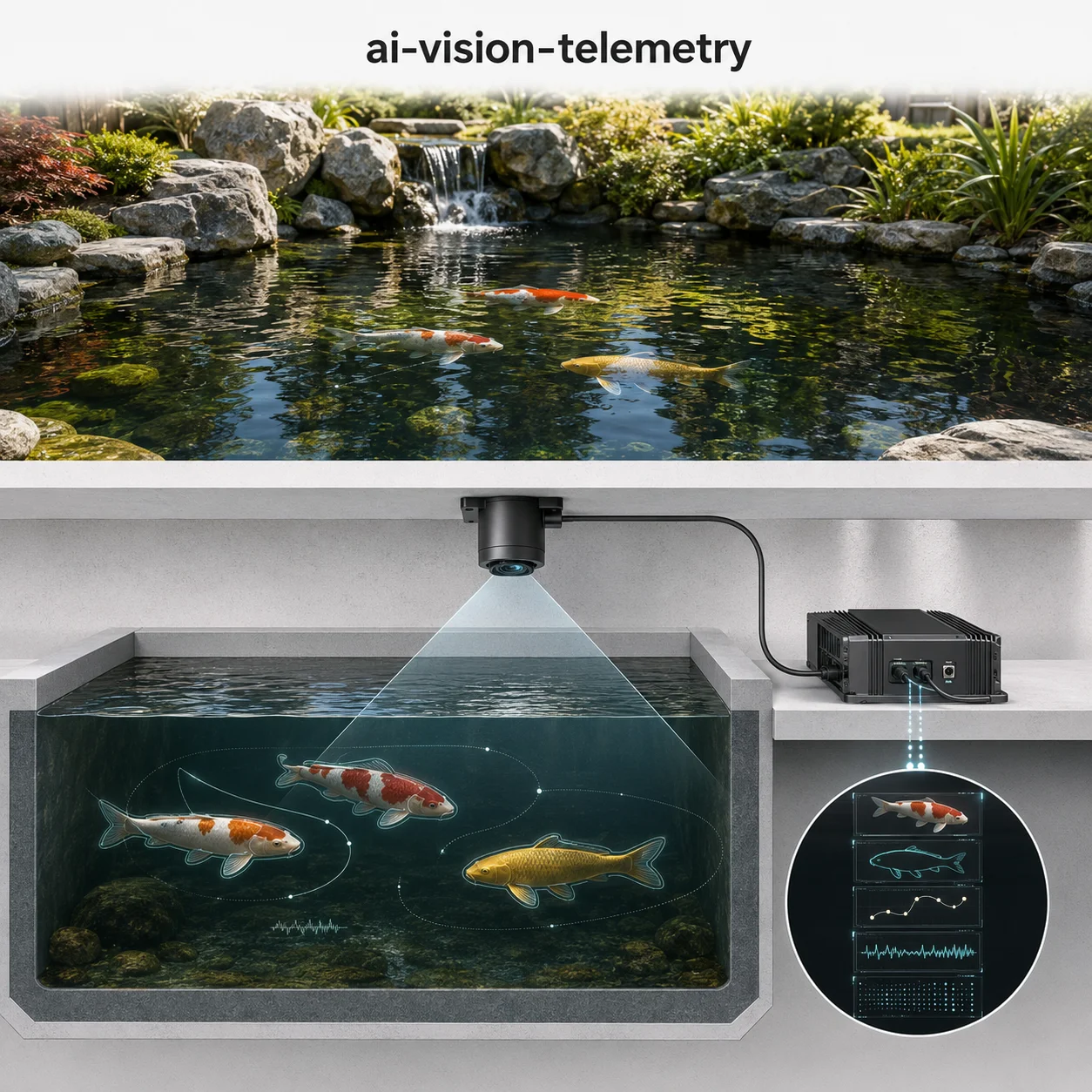
AI Vision Telemetry — Computer Vision, Neural Networks, and Predictive Analytics for Koi Health Monitoring
Artificial Intelligence (AI) vision telemetry represents the convergence of computer vision, deep learning, and real-time sensor data analytics for the continuous monitoring of koi health and pond ecosystem dynamics. The system combines high-resolution imaging, infrared thermography, and behavioral pattern recognition to detect subtle changes in koi movement, feeding behavior, coloration, and fin positioning that may indicate early signs of disease, stress, or environmental degradation. Convolutional Neural Networks (CNNs) and Recurrent Neural Networks (RNNs) process video streams at 30-60 fps, extracting over 200 feature points per fish, including body curvature, pectoral fin angle, gill rate, and spatial distribution. The telemetry layer transmits these features to a cloud-based predictive analytics engine, where machine learning models correlate behavioral anomalies with water quality parameters, weather patterns, and historical health records.
This page works through the practical implementation of AI vision telemetry in koi pond management: the camera systems and optics required for reliable feature extraction, the neural network architectures optimized for aquatic environments, the data telemetry and edge computing strategies, the predictive models for early disease detection, and the integration of visual data with traditional water quality sensors. None of the guidance here is a universal rule — camera placement, lighting conditions, fish population density, and water clarity all shift the performance of vision algorithms, so every design decision needs to be checked against the specific system rather than a rule of thumb.
AI Vision Telemetry Challenge
Work through ten advanced questions covering computer vision architectures, neural network training, feature extraction, telemetry protocols, predictive analytics, and deployment optimization. Each answer includes the engineering reasoning behind it.
AI Vision Telemetry — Quick Facts
Most Asked Questions About AI Vision Telemetry
In one deployment, an AI vision system was installed to monitor a 10,000-gallon koi pond with 45 fish. The system performed well for the first three months, detecting early signs of bacterial infection in two fish 48 hours before visible symptoms appeared. However, the system began generating frequent false positives after a sudden algae bloom reduced water clarity from <1 NTU to 15 NTU over a 72-hour period.
The solution involved implementing a dynamic image preprocessing pipeline that auto-adjusts contrast, sharpness, and brightness based on real-time water clarity measurements. A separate CNN was trained to detect water quality artifacts and exclude them from feature extraction. This reduced false positive rates from 12% to under 2%, restoring reliable monitoring during algal events.
Computer Vision Architectures for Koi Monitoring
The choice of computer vision architecture directly impacts the system’s ability to extract meaningful features from koi video streams. Three primary architectures are used:
- ResNet-50/101 with Attention: The industry standard for image classification and feature extraction. The residual connections enable training of deep networks (50+ layers) without vanishing gradients. Attention mechanisms focus on diagnostically relevant regions (gills, fins, skin).
- EfficientNet with AutoML Optimization: A family of models that balance accuracy and computational efficiency using neural architecture search. EfficientNet-B3/B4 provide state-of-the-art accuracy on aquatic image datasets with 5-10x lower computational cost than ResNet-101.
- YOLO (You Only Look Once) for Object Detection: Real-time detection of individual fish in crowded conditions. YOLOv8 achieves 30-60 fps on embedded GPUs, enabling multi-fish tracking and behavioral analysis in dense ponds.
The selection should consider: (1) available computational resources (on-device vs cloud); (2) frame rate requirements (real-time vs batch); (3) accuracy requirements (95%+ for clinical applications); and (4) deployment constraints (power, heat, connectivity).
Neural Network Training and Data Augmentation Strategies
Training deep neural networks for koi health monitoring requires careful attention to data quality, quantity, and augmentation. The key strategies include: (1) Transfer learning from ImageNet or aquatic-specific pre-trained models (e.g., FishNet, AquaNet), reducing training time by 70-90%; (2) Data augmentation with domain-specific transformations — simulated turbidity, lighting variations, and water surface ripples — to improve generalization; (3) Active learning to identify the most informative unlabeled examples for labeling, reducing the annotation effort by 50-80%; and (4) Knowledge distillation to compress large teacher models (ResNet-101) into student models (MobileNetV3) for edge deployment without significant accuracy loss.
Early deployments of AI vision systems failed to generalize between different pond environments due to varying lighting conditions, water color, and fish population density. One model that achieved 96% accuracy in a laboratory setting dropped to 78% in a real pond environment with natural light variations.
The solution was to incorporate adversarial domain adaptation during training, using unlabeled data from the target environment to adapt the model’s feature representations. This technique improved real-world accuracy to 92% without requiring additional labeled data. The adaptation was performed continuously during deployment using a teacher-student framework.
Edge Computing and Telemetry Architecture
The telemetry architecture for AI vision systems must balance local inference latency, bandwidth constraints, and cloud processing capabilities. A typical architecture consists of three layers: (1) The Edge Inference Layer (NVIDIA Jetson, Google Coral, Apple Neural Engine) performs initial feature extraction and lightweight inference on the video stream, reducing bandwidth usage by 90-99% compared to raw video transmission; (2) The Edge-to-Cloud Telemetry Layer (MQTT, gRPC) transmits feature vectors, health predictions, and alerts to the cloud; and (3) The Cloud Analytics Layer (AWS, Azure, GCP) performs comprehensive analysis, model training, and data storage. The edge processing latency is typically 50-200ms for inference, while the telemetry latency is 100-500ms for cellular networks and 20-100ms for local networks.
The architecture must handle the trade-off between on-device accuracy (limited by model size) and network bandwidth (limited by connectivity). Hybrid approaches use dynamic model switching — running smaller models on low-bandwidth connections and uploading key frames for high-accuracy cloud inference when connectivity is available.
A multi-site deployment of AI vision telemetry across five koi ponds highlighted the importance of edge caching and event-driven processing. The initial architecture streamed all video frames to the cloud for analysis, generating 2-3 TB of data per site per day and incurring significant cloud compute costs.
Redesigning the system with edge-based event detection (triggering cloud upload only when anomalies were detected) reduced data transmission by 95% and cloud costs by 80%. The edge inference latency was 150ms on a Jetson Nano, while the event detection accuracy was 89%, meeting the operational requirements for early disease detection.
AI Vision Telemetry — Full Question Library
Review indexed engineering questions below.
Q1:
What is the fundamental difference between traditional image processing and deep learning-based computer vision?
Correct Answer: Option C
Deep learning-based computer vision uses neural networks that learn hierarchical feature representations directly from labeled data. Traditional methods rely on hand-crafted features (e.g., edge detectors, color histograms, SIFT) that are manually designed by engineers.
Q2:
What is a convolutional operation in the context of CNNs?
Correct Answer: Option B
Convolution involves sliding a small filter (kernel) across the input feature map and computing the dot product at each position. This operation extracts spatial features and is the fundamental building block of CNNs.
Q3:
What is the purpose of the ReLU activation function in convolutional neural networks?
Correct Answer: Option A
ReLU (Rectified Linear Unit) introduces non-linearity by setting all negative values to zero and keeping positive values unchanged. This helps the network learn complex patterns while maintaining computational efficiency.
Q4:
What is a pooling layer and why is it used in CNNs?
Correct Answer: Option C
Pooling layers (max pooling, average pooling) downsample the feature maps, reducing spatial dimensions while preserving important features. This reduces computation and improves translation invariance.
Q5:
What is the receptive field of a convolutional layer?
Correct Answer: Option A
The receptive field is the region in the original input image that contributes to the output of a specific feature in a convolutional layer. Larger receptive fields capture more global context.
Q6:
What is the difference between stride and padding in convolution?
Correct Answer: Option B
Stride determines how many pixels the kernel moves at each step. Padding adds zeros around the input to control the spatial size of the output and preserve edge information.
Q7:
What is feature extraction in computer vision?
Correct Answer: Option C
Feature extraction transforms raw pixel data into higher-level representations (features) that capture important patterns, edges, textures, and shapes relevant for classification or detection tasks.
Q8:
What is the role of batch normalization in CNN training?
Correct Answer: Option A
Batch normalization normalizes the inputs to each layer, reducing internal covariate shift and allowing higher learning rates, faster convergence, and improved stability during training.
Q9:
What is a residual block and why is it used in ResNet architectures?
Correct Answer: Option B
Residual blocks use skip connections that add the input to the output of the block, allowing gradients to flow directly through the network during backpropagation. This enables training of very deep networks (ResNet-50, 101, 152).
Q10:
What is transfer learning and why is it useful for koi health monitoring?
Correct Answer: Option C
Transfer learning leverages a pre-trained model (e.g., ImageNet) and fine-tunes it on a smaller task-specific dataset (koi images). This reduces training time and data requirements significantly.
Q11:
What is the difference between object detection and image classification?
Correct Answer: Option A
Image classification predicts a single label for the entire image. Object detection identifies multiple objects and their bounding boxes in the image.
Q12:
What is the purpose of data augmentation in training CNNs?
Correct Answer: Option B
Data augmentation applies random transformations (rotation, flipping, scaling, cropping, color shifts) to training images, creating a more diverse dataset and improving model generalization.
Q13:
What is a confusion matrix used for in model evaluation?
Correct Answer: Option C
A confusion matrix shows the actual vs predicted classifications for each class, revealing the model’s performance on each class and the types of errors it makes.
Q14:
What is the role of the learning rate in training neural networks?
Correct Answer: Option A
The learning rate determines the step size during gradient descent. A high learning rate can cause training to diverge, while a low learning rate slows convergence.
Q15:
What is overfitting and how can it be detected?
Correct Answer: Option B
Overfitting occurs when the model memorizes the training data but fails to generalize to new data. It is detected when training accuracy is high but validation accuracy is significantly lower.
Q16:
What is cross-validation and why is it used?
Correct Answer: Option C
Cross-validation splits the dataset into k folds and trains k models, each using a different fold for validation. This provides a more robust estimate of model performance and reduces overfitting.
Q17:
What is the purpose of dropout regularization in neural networks?
Correct Answer: Option A
Dropout randomly sets a fraction of neurons to zero during training, forcing the network to learn redundant representations and preventing co-adaptation of neurons.
Q18:
What is the F1-score and how is it calculated?
Correct Answer: Option B
The F1-score is the harmonic mean of precision and recall, providing a balanced metric that considers both false positives and false negatives.
Q19:
What is a GPU and why is it important for training CNNs?
Correct Answer: Option C
GPUs (Graphics Processing Units) have thousands of cores optimized for parallel computation, making them ideal for the matrix operations required in CNN training and inference.
Q20:
What is the purpose of the Softmax activation function in the output layer?
Correct Answer: Option A
Softmax converts the raw output logits into a probability distribution that sums to 1, allowing the model to output class probabilities for classification tasks.
Q21:
What is the main advantage of ResNet-50 over a plain CNN with the same number of layers?
Correct Answer: Option B
ResNet-50 uses skip connections that allow gradients to flow directly through the network, enabling training of deep networks without vanishing gradients.
Q22:
What is the primary advantage of EfficientNet over ResNet architectures?
Correct Answer: Option A
EfficientNet uses AutoML to optimize model width, depth, and resolution simultaneously, achieving state-of-the-art accuracy with significantly fewer parameters and FLOPs.
Q23:
What is an attention mechanism in computer vision?
Correct Answer: Option C
Attention mechanisms enable the network to focus on the most relevant parts of the input by learning weights that emphasize important features and de-emphasize less relevant ones.
Q24:
What is the role of the convolutional backbone in a CNN architecture?
Correct Answer: Option B
The convolutional backbone is the feature extraction portion of the network (e.g., ResNet-50 before the fully connected layer) that produces rich, hierarchical feature representations.
Q25:
What is YOLO and why is it well-suited for real-time koi monitoring?
Correct Answer: Option A
YOLO (You Only Look Once) performs object detection in a single forward pass, making it extremely fast (30-60 fps on modern GPUs) and suitable for real-time monitoring applications.
Q26:
What is the purpose of the neck in an object detection architecture?
Correct Answer: Option B
The neck (e.g., FPN, PAN) combines features from different layers of the backbone, enabling the network to detect objects at multiple scales.
Q27:
What is the difference between RNNs and CNNs?
Correct Answer: Option C
RNNs (Recurrent Neural Networks) are designed for sequential data with temporal dependencies, while CNNs are designed for spatial data with grid-like structures.
Q28:
What is a Transformer architecture and how does it differ from RNNs?
Correct Answer: Option A
Transformers use self-attention mechanisms to process entire sequences in parallel without recurrence, making them faster and more scalable than RNNs for many tasks.
Q29:
What is the purpose of the Positional Encoding in Transformer models?
Correct Answer: Option B
Positional encodings add information about the position of each element in the sequence, since Transformers don’t have inherent sequence order like RNNs.
Q30:
What is knowledge distillation in the context of neural networks?
Correct Answer: Option C
Knowledge distillation trains a smaller (student) model to mimic the predictions of a larger (teacher) model, transferring the teacher’s knowledge to a more efficient model.
Q31:
What is the primary advantage of depthwise separable convolutions?
Correct Answer: Option A
Depthwise separable convolutions factor standard convolutions into depthwise and pointwise operations, significantly reducing FLOPs while maintaining accuracy.
Q32:
What is the purpose of the “head” in a neural network architecture?
Correct Answer: Option B
The head is the task-specific portion of the network that takes features from the backbone and produces the final output for the specific task (classification, detection, segmentation).
Q33:
What is a feature pyramid network (FPN) used for?
Correct Answer: Option C
FPNs combine features from different layers to create multi-scale representations, enabling the detection of objects of varying sizes.
Q34:
What is the bottleneck block in ResNet architecture?
Correct Answer: Option A
The bottleneck block uses 1×1 convolutions to reduce then expand the channel dimension, reducing computational cost while maintaining representational power.
Q35:
What is the purpose of the activation function in a neural network?
Correct Answer: Option B
Activation functions (ReLU, sigmoid, tanh) introduce non-linearity, enabling the network to learn complex, non-linear relationships in the data.
Q36:
What is the difference between a DenseNet and a ResNet?
Correct Answer: Option C
DenseNet’s dense connectivity connects each layer to every other layer in the block, while ResNet uses single skip connections.
Q37:
What is the purpose of the stem in a CNN architecture?
Correct Answer: Option A
The stem is the initial processing stage that reduces the input resolution and extracts initial features before the backbone.
Q38:
What is the MobileNet architecture optimized for?
Correct Answer: Option B
MobileNet uses depthwise separable convolutions to create lightweight models suitable for mobile and edge devices.
Q39:
What is the purpose of the adaptive pooling layer?
Correct Answer: Option C
Adaptive pooling produces a fixed-size output feature map regardless of the input spatial dimensions, enabling the use of fully connected layers with variable input sizes.
Q40:
What is the advantage of using a pre-trained model for koi disease detection?
Correct Answer: Option A
Pre-trained models (e.g., ImageNet) have already learned general features, reducing the training time and data required for specialized tasks like disease detection.
Q41:
What is the role of feature extraction in AI vision telemetry?
Correct Answer: Option B
Feature extraction transforms raw pixel data into higher-level features (body curvature, fin position, color) that are useful for health classification and behavior analysis.
Q42:
What are keypoints in the context of fish tracking?
Correct Answer: Option A
Keypoints are specific anatomical landmarks (e.g., pectoral fin base, operculum, caudal peduncle) that are tracked to analyze posture, behavior, and health.
Q43:
What is behavioral tracking in the context of koi health monitoring?
Correct Answer: Option C
Behavioral tracking analyzes movement patterns (swimming speed, direction, turning angle), interactions, and spatial distribution to detect anomalies that may indicate stress or disease.
Q44:
How many feature points are typically extracted per fish in a vision system?
Correct Answer: Option B
Modern vision systems extract 100-200 feature points per fish, covering body landmarks, motion characteristics, and colorimetric features.
Q45:
What is the role of pose estimation in analyzing koi health?
Correct Answer: Option A
Pose estimation determines the fish’s 2D or 3D orientation, body curvature, and fin positions, which are key indicators of health and stress.
Q46:
What is the typical frame rate for behavioral analysis in koi monitoring?
Correct Answer: Option B
Behavioral analysis requires 30-60 fps to capture fine movements and swimming patterns accurately.
Q47:
What is the purpose of color analysis in koi health monitoring?
Correct Answer: Option C
Color analysis tracks changes in skin pigmentation (fading, darkening, reddening) that can indicate stress, disease, or environmental issues.
Q48:
What is the role of a tracker in a vision system?
Correct Answer: Option A
Tracking algorithms (Kalman filters, SORT, DeepSORT) maintain the identity of individual fish across video frames, enabling per-fish behavior analysis.
Q49:
What is spatial distribution analysis in koi monitoring?
Correct Answer: Option B
Spatial distribution analysis tracks fish positions and clustering patterns, detecting isolation, crowding, or avoidance behaviors that may indicate stress.
Q50:
What is the role of optical flow in analyzing koi swimming patterns?
Correct Answer: Option C
Optical flow estimates the motion of pixels between frames, enabling analysis of swimming direction, speed, and turning patterns.
Q51:
What is a bounding box in object detection?
Correct Answer: Option A
A bounding box is the rectangular region around a detected object, defined by its top-left and bottom-right coordinates or center and dimensions.
Q52:
What is the purpose of the Intersection over Union (IoU) metric?
Correct Answer: Option B
IoU measures the overlap between predicted and ground truth bounding boxes, with values >0.5 typically considered good detections.
Q53:
What is the effect of water turbidity on feature extraction accuracy?
Correct Answer: Option C
Turbidity scatters light and reduces contrast, degrading feature extraction accuracy. Each 1 NTU increase typically reduces accuracy by 2-3%.
Q54:
What is the purpose of contrast enhancement in underwater image preprocessing?
Correct Answer: Option A
Contrast enhancement techniques (CLAHE, histogram equalization) improve visibility in low-contrast underwater conditions, improving feature extraction.
Q55:
What is the role of a segmentation mask in fish analysis?
Correct Answer: Option B
Segmentation masks provide pixel-level delineation of the fish’s body, enabling precise measurement of body shape, curvature, and color patterns.
Q56:
What is the typical accuracy requirement for koi disease detection systems?
Correct Answer: Option C
Koi disease detection systems typically require 90-95% accuracy to be clinically useful, with low false negative rates being critical.
Q57:
What is the difference between a false positive and a false negative in disease detection?
Correct Answer: Option A
A false positive is a false alarm (healthy fish flagged as diseased), while a false negative misses actual disease. In clinical settings, false negatives are typically more concerning.
Q58:
What is the role of temporal analysis in behavior monitoring?
Correct Answer: Option B
Temporal analysis examines behavioral patterns over time (e.g., changes in swimming speed, feeding behavior, social interactions) to detect anomalies.
Q59:
What is the impact of lighting variations on feature extraction?
Correct Answer: Option C
Lighting variations (shadow, glare, time of day) can cause false positives and degrade accuracy. Consistent lighting and preprocessing are essential.
Q60:
What is the role of anomaly detection in vision telemetry?
Correct Answer: Option A
Anomaly detection identifies unusual behavioral patterns (e.g., erratic swimming, isolation, reduced feeding) that may indicate stress, disease, or environmental issues.
Q61:
What is MQTT and why is it used in vision telemetry?
Correct Answer: Option B
MQTT (Message Queuing Telemetry Transport) is a lightweight publish-subscribe messaging protocol ideal for low-bandwidth, high-latency networks.
Q62:
What is the typical bandwidth requirement for streaming video from an edge device?
Correct Answer: Option A
Compressed 1080p video typically requires 2-5 Mbps, depending on the codec and compression settings (H.264, H.265).
Q63:
What is the purpose of edge computing in AI vision systems?
Correct Answer: Option C
Edge computing performs inference and preprocessing locally on the device, reducing latency, bandwidth usage, and cloud costs.
Q64:
What is the typical power consumption of an edge AI device for vision processing?
Correct Answer: Option B
Edge AI devices like NVIDIA Jetson Nano (5-10W) and Google Coral (5-15W) typically consume 5-20 watts during active inference.
Q65:
What is the role of QoS (Quality of Service) in MQTT for vision telemetry?
Correct Answer: Option A
MQTT QoS levels (0, 1, 2) control message delivery guarantees, with QoS 1 (at-least-once) typically used for telemetry data.
Q66:
What is the typical latency for edge-to-cloud telemetry?
Correct Answer: Option B
Telemetry latency depends on the network type: local networks (20-100ms) and cellular networks (100-500ms).
Q67:
What is the purpose of data compression in vision telemetry?
Correct Answer: Option C
Data compression (H.264, H.265, JPEG) reduces the size of video and image data, minimizing bandwidth usage and storage costs.
Q68:
What is the role of WebRTC in vision telemetry?
Correct Answer: Option A
WebRTC enables real-time video streaming with sub-second latency, suitable for remote monitoring and live viewing.
Q69:
What is the typical storage requirement for a vision telemetry system?
Correct Answer: Option B
A vision telemetry system with 24/7 recording at 1080p typically requires 10-50 GB per day, depending on compression.
Q70:
What is the purpose of a data pipeline in vision telemetry?
Correct Answer: Option C
Data pipelines (e.g., Kafka, AWS Kinesis) process, transform, and route data from edge devices to cloud storage and analytics.
Q71:
What is the role of authentication in telemetry security?
Correct Answer: Option A
Authentication (TLS, API keys, JWT) verifies the identity of devices and prevents unauthorized access to the telemetry system.
Q72:
What is the typical packet size for telemetry data?
Correct Answer: Option B
Telemetry packets typically contain feature vectors (100-200 features) and are 100-500 bytes in size.
Q73:
What is the role of a message broker in telemetry architecture?
Correct Answer: Option C
Message brokers (RabbitMQ, Mosquitto) manage and route messages between publishers (edge devices) and subscribers (cloud servers).
Q74:
What is the purpose of edge caching in vision telemetry?
Correct Answer: Option A
Edge caching stores data locally when network connectivity is unavailable, ensuring data is not lost during outages.
Q75:
What is the typical upload frequency for telemetry data?
Correct Answer: Option B
Telemetry data is typically uploaded every 1-10 seconds, balancing real-time monitoring with bandwidth usage.
Q76:
What is the role of data validation in telemetry?
Correct Answer: Option C
Data validation (checksums, CRC) ensures data integrity and detects transmission errors in telemetry data.
Q77:
What is the purpose of event-driven telemetry?
Correct Answer: Option A
Event-driven telemetry only transmits data when specific events (anomalies, alerts) occur, reducing bandwidth usage.
Q78:
What is the typical data retention period for vision telemetry data?
Correct Answer: Option B
Vision telemetry data is typically retained for 30-90 days for historical analysis and model training.
Q79:
What is the role of data aggregation in telemetry?
Correct Answer: Option C
Data aggregation (min, max, mean, std) summarizes telemetry data, reducing storage and transmission requirements.
Q80:
What is the purpose of failover in telemetry architecture?
Correct Answer: Option A
Failover automatically switches to backup systems (backup network, backup server) if the primary system fails, ensuring continuity.
Q81:
What is the purpose of predictive analytics in koi health monitoring?
Correct Answer: Option B
Predictive analytics uses historical and real-time data to predict disease onset, enabling early intervention before visible symptoms appear.
Q82:
What is an LSTM network and why is it used for time-series health data?
Correct Answer: Option A
LSTM (Long Short-Term Memory) networks are RNNs designed to learn long-term dependencies, making them ideal for time-series health data.
Q83:
What is the role of anomaly detection in predictive health modeling?
Correct Answer: Option C
Anomaly detection identifies behavioral or physiological deviations from normal patterns, flagging potential health issues.
Q84:
What is the difference between supervised and unsupervised learning for health monitoring?
Correct Answer: Option B
Supervised learning uses labeled data (known health outcomes) for training, while unsupervised learning discovers patterns in unlabeled data.
Q85:
What is the role of Random Forest in health risk classification?
Correct Answer: Option A
Random Forest is an ensemble method that combines multiple decision trees for robust classification, suitable for health risk assessment.
Q86:
What is the purpose of SHAP (SHapley Additive exPlanations) in health analytics?
Correct Answer: Option B
SHAP values explain the contribution of each feature to the model’s prediction, providing interpretability for health risk scores.
Q87:
What is the typical prediction horizon for koi health models?
Correct Answer: Option C
Health models typically predict disease onset 24-48 hours in advance, allowing time for intervention.
Q88:
What is the role of fusion in health analytics?
Correct Answer: Option A
Data fusion combines information from multiple sensors (cameras, water quality probes, environmental sensors) for more robust health predictions.
Q89:
What is the typical accuracy improvement from multi-modal fusion?
Correct Answer: Option B
Multi-modal fusion typically improves prediction accuracy by 5-15% compared to single-modal systems.
Q90:
What is the purpose of a health score in koi monitoring?
Correct Answer: Option C
A health score (0-100) provides a single metric summarizing the fish’s overall health, combining multiple features and predictions.
Q91:
What is the role of a confusion matrix in evaluating health models?
Correct Answer: Option A
A confusion matrix shows actual vs predicted classifications, revealing the model’s strengths and weaknesses.
Q92:
What is the AUC-ROC metric and why is it important?
Correct Answer: Option B
AUC-ROC measures the model’s ability to distinguish between classes, with values >0.9 indicating excellent discrimination.
Q93:
What is the purpose of a calibration curve in health modeling?
Correct Answer: Option C
A calibration curve assesses whether predicted probabilities match actual outcomes, ensuring reliable risk estimates.
Q94:
What is the role of active learning in health model development?
Correct Answer: Option A
Active learning identifies the most informative unlabeled samples for labeling, reducing annotation effort by 50-80%.
Q95:
What is the purpose of cross-validation in model evaluation?
Correct Answer: Option B
Cross-validation provides a robust estimate of model performance by training and evaluating the model on multiple data splits.
Q96:
What is the role of feature importance in health analytics?
Correct Answer: Option C
Feature importance identifies which features (e.g., swimming speed, color changes, fin position) most influence health predictions.
Q97:
What is the typical data split for training health models?
Correct Answer: Option A
The standard data split for model development is 70% training, 15% validation, and 15% testing.
Q98:
What is the purpose of retraining health models?
Correct Answer: Option B
Retraining (fine-tuning, incremental learning) adapts the model to new data and changing conditions (seasonal variations, new disease strains).
Q99:
What is the role of a baseline model in health analytics?
Correct Answer: Option C
A baseline model (e.g., logistic regression, majority class) provides a simple reference to compare more complex models against.
Q100:
What is the typical update frequency for health prediction models?
Correct Answer: Option A
Health models are typically updated every 1-4 weeks to incorporate new data and maintain accuracy.
Q101:
What is the primary advantage of deploying AI models on edge devices?
Correct Answer: Option B
Edge deployment reduces latency (50-200ms vs 500-1000ms) and bandwidth usage by 90-99% compared to cloud inference.
Q102:
What is the typical TOPS (Trillion Operations Per Second) requirement for real-time vision inference?
Correct Answer: Option A
Real-time vision inference requires 5-15 TOPS, which is achievable with edge AI devices (Jetson Nano, Google Coral).
Q103:
What is model quantization and why is it used for edge deployment?
Correct Answer: Option C
Quantization reduces model weights from 32-bit floats to 8-bit integers, reducing model size by 75% and inference time by 2-4x.
Q104:
What is the role of TensorRT in edge deployment?
Correct Answer: Option B
TensorRT optimizes and accelerates inference on NVIDIA GPUs, reducing latency by 2-5x.
Q105:
What is the typical memory requirement for a vision model on edge devices?
Correct Answer: Option A
Quantized vision models typically require 50-500 MB, fitting within the memory of edge devices.
Q106:
What is the role of a camera driver in vision systems?
Correct Answer: Option B
Camera drivers provide the interface between the camera hardware and the software stack, handling image capture and streaming.
Q107:
What is the typical power supply requirement for an edge AI device?
Correct Answer: Option A
Edge AI devices typically require 5V DC at 1-2A (5-10W) for operation.
Q108:
What is the role of firmware in edge vision systems?
Correct Answer: Option A
Firmware provides low-level hardware management and boot functionality for edge devices.
Q109:
What is the typical operating temperature range for edge AI devices?
Correct Answer: Option B
Edge AI devices typically operate between -10°C and 50°C, with industrial-grade devices supporting wider ranges.
Q110:
What is the purpose of over-the-air (OTA) updates for edge devices?
Correct Answer: Option C
OTA updates allow remote software and model updates without physical access to the edge device.
Q111:
What is the role of a network interface in edge vision systems?
Correct Answer: Option A
The network interface (WiFi, Ethernet, cellular) connects the edge device to the network for data transmission.
Q112:
What is the typical video input resolution for edge vision systems?
Correct Answer: Option B
1080p (1920×1080) is the standard resolution for edge vision systems, balancing quality and processing requirements.
Q113:
What is the purpose of a heatsink in edge AI devices?
Correct Answer: Option C
Heatsinks dissipate heat from the processor, preventing thermal throttling and ensuring reliable operation.
Q114:
What is the role of an enclosure in edge vision systems?
Correct Answer: Option A
Enclosures protect edge devices from dust, moisture, and physical damage, crucial for outdoor deployments.
Q115:
What is the typical deployment time for an edge vision system?
Correct Answer: Option B
Deployment of an edge vision system typically takes 4-8 hours, including camera mounting, device configuration, and testing.
Q116:
What is the purpose of a maintenance plan for edge vision systems?
Correct Answer: Option C
A maintenance plan (periodic cleaning, software updates, hardware checks) ensures long-term reliability and performance.
Q117:
What is the typical diagnostic capability of edge vision systems?
Correct Answer: Option A
Edge systems typically include self-diagnostic capabilities to detect and report hardware and software issues.
Q118:
What is the role of a fallback mechanism in edge vision systems?
Correct Answer: Option B
Fallback mechanisms (backup power, backup network) ensure continued operation if the primary system fails.
Q119:
What is the typical MTBF (Mean Time Between Failures) for edge AI devices?
Correct Answer: Option C
Industrial-grade edge AI devices typically have MTBF of 20,000-50,000 hours (2-5 years of continuous operation).
Q120:
What is the purpose of a remote management interface in edge systems?
Correct Answer: Option A
A remote management interface allows monitoring, configuration, and troubleshooting of edge devices without physical access.
Q121:
What is the typical dataset size required for training a koi disease detection model?
Correct Answer: Option B
Disease detection models typically require 10,000-50,000 labeled images, with at least 5,000 per disease class.
Q122:
What is the role of a labeling tool in dataset preparation?
Correct Answer: Option A
Labeling tools (LabelImg, CVAT, VGG Image Annotator) allow manual annotation of images with bounding boxes, keypoints, and classification labels.
Q123:
What is the typical annotation time per image for koi disease detection?
Correct Answer: Option C
Annotating a single image for disease detection (bounding boxes, keypoints, classification) typically takes 30-120 seconds.
Q124:
What is the purpose of data augmentation in training?
Correct Answer: Option B
Data augmentation (rotation, flipping, scaling, color shifts) artificially increases dataset size and diversity, improving model generalization.
Q125:
What is the role of active learning in reducing labeling effort?
Correct Answer: Option A
Active learning selects the most informative unlabeled samples for labeling, reducing annotation effort by 50-80%.
Q126:
What is the effect of labeling errors on model performance?
Correct Answer: Option B
Labeling errors (incorrect classifications, misplaced bounding boxes) degrade model accuracy and generalization.
Q127:
What is the typical label quality requirement for training accurate models?
Correct Answer: Option C
Accurate models require label quality of 95% or higher, meaning 95% of annotations are correct.
Q128:
What is the role of domain experts in labeling health data?
Correct Answer: Option A
Domain experts (veterinarians, biologists) ensure accurate identification of disease signs and health indicators in the data.
Q129:
What is the typical dataset size for fine-tuning a pre-trained model?
Correct Answer: Option B
Fine-tuning a pre-trained model typically requires 5,000-20,000 labeled images for the specific task.
Q130:
What is the purpose of validation data in model training?
Correct Answer: Option C
Validation data is used to evaluate model performance during training, guiding hyperparameter tuning and early stopping.
Q131:
What is the typical class distribution requirement for balanced training?
Correct Answer: Option A
Balanced training requires roughly equal samples per class to prevent the model from biasing toward majority classes.
Q132:
What is the purpose of test data in model evaluation?
Correct Answer: Option B
Test data evaluates the final model performance on unseen data, providing an unbiased estimate of generalization.
Q133:
What is the typical data split ratio for training, validation, and test sets?
Correct Answer: Option C
The standard data split is 70% training, 15% validation, and 15% test for robust model development.
Q134:
What is the role of transfer learning in reducing training data requirements?
Correct Answer: Option A
Transfer learning uses pre-trained features, reducing the amount of labeled data required for fine-tuning by 50-80%.
Q135:
What is the typical labeling cost per image for koi health data?
Correct Answer: Option B
Labeling costs vary, but koi health data typically costs $0.10-$0.50 per image, depending on annotation complexity.
Q136:
What is the purpose of data versioning in model development?
Correct Answer: Option C
Data versioning tracks changes in the dataset over time, ensuring reproducibility and traceability.
Q137:
What is the role of data quality control in dataset preparation?
Correct Answer: Option A
Data quality control checks annotations for accuracy and consistency, ensuring high-quality training data.
Q138:
What is the typical inter-annotator agreement requirement for labeling?
Correct Answer: Option C
High-quality labeling requires inter-annotator agreement of 85% or higher, ensuring consistent annotations.
Q139:
What is the purpose of data augmentation in health model training?
Correct Answer: Option C
Data augmentation improves model generalization by exposing the model to a wider variety of conditions.
Q140:
What is the typical dataset size for pre-training a vision model?
Correct Answer: Option A
Pre-training vision models (e.g., ImageNet) typically requires 1-10 million labeled images.
Q141:
What is the primary metric for evaluating classification model performance?
Correct Answer: Option B
Classification models are evaluated using accuracy, precision, recall, and F1-score to assess different aspects of performance.
Q142:
What is the role of cross-validation in model evaluation?
Correct Answer: Option A
Cross-validation provides a robust estimate of model performance by evaluating the model on multiple data splits.
Q143:
What is the typical validation split for model evaluation?
Correct Answer: Option B
Validation data typically comprises 15% of the total dataset, with 15% for testing and 70% for training.
Q144:
What is the role of a confusion matrix in model evaluation?
Correct Answer: Option B
A confusion matrix shows correct and incorrect classifications for each class, revealing performance gaps.
Q145:
What is the purpose of precision in classification evaluation?
Correct Answer: Option A
Precision measures the accuracy of positive predictions: (True Positives) / (True Positives + False Positives).
Q146:
What is the purpose of recall in classification evaluation?
Correct Answer: Option B
Recall measures the completeness of positive predictions: (True Positives) / (True Positives + False Negatives).
Q147:
What is the purpose of the F1-score in classification evaluation?
Correct Answer: Option C
The F1-score is the harmonic mean of precision and recall, balancing both metrics into a single score.
Q148:
What is the role of the ROC curve in model evaluation?
Correct Answer: Option A
The ROC curve plots the true positive rate against the false positive rate at various threshold settings.
Q149:
What is the typical AUC-ROC value for a good disease detection model?
Correct Answer: Option B
A good disease detection model typically achieves AUC-ROC of 0.85-0.95, indicating excellent class discrimination.
Q150:
What is the purpose of a calibration curve in model validation?
Correct Answer: Option C
A calibration curve assesses whether predicted probabilities match actual outcomes, ensuring reliable risk estimates.
Q151:
What is the role of a baseline model in model evaluation?
Correct Answer: Option A
A baseline model provides a simple reference to compare more complex models against.
Q152:
What is the typical accuracy requirement for clinical deployment?
Correct Answer: Option C
Clinical deployment typically requires 90% accuracy or higher, with very low false negative rates.
Q153:
What is the purpose of model validation on unseen data?
Correct Answer: Option C
Validation on unseen data assesses the model’s ability to generalize to new, previously unseen data.
Q154:
What is the role of error analysis in model improvement?
Correct Answer: Option A
Error analysis identifies common failure modes (e.g., specific disease signs, image conditions) to guide model improvements.
Q155:
What is the typical performance degradation when deploying to production?
Correct Answer: Option B
Model performance typically degrades 5-15% when deployed to production due to domain shift and environmental variations.
Q156:
What is the purpose of A/B testing in model deployment?
Correct Answer: Option C
A/B testing compares two model versions in production to determine which performs better on real-world data.
Q157:
What is the role of monitoring in model deployment?
Correct Answer: Option A
Monitoring tracks model performance over time, detecting performance degradation and triggering retraining.
Q158:
What is the typical model retraining frequency?
Correct Answer: Option B
Models are typically retrained weekly to monthly to incorporate new data and maintain performance.
Q159:
What is the purpose of performance reporting in model deployment?
Correct Answer: Option C
Performance reporting communicates model performance metrics to stakeholders, building trust and guiding decisions.
Q160:
What is the role of explainability in model validation?
Correct Answer: Option A
Explainability (SHAP, LIME) helps understand how the model makes predictions, building trust and supporting clinical decision-making.
Q161:
What is the purpose of integrating water quality data with vision telemetry?
Correct Answer: Option B
Integrating water quality data (temperature, pH, oxygen, ammonia) helps correlate behavioral changes with environmental conditions.
Q162:
What are the key water quality parameters to integrate with vision data?
Correct Answer: Option A
Key water quality parameters include temperature, pH, dissolved oxygen, ammonia, nitrite, and nitrate, each affecting fish health.
Q163:
What is the typical sampling frequency for water quality sensors?
Correct Answer: Option C
Water quality sensors typically sample every 1-15 minutes, depending on the parameter and sensor type.
Q164:
What is the role of data synchronization in multi-modal integration?
Correct Answer: Option B
Data synchronization aligns data streams from different sensors (cameras, water quality probes) by timestamp, enabling correlation.
Q165:
What is the effect of dissolved oxygen on koi behavior?
Correct Answer: Option A
Low dissolved oxygen causes koi to gasp at the surface, reduce activity, and exhibit erratic swimming patterns.
Q166:
What is the role of temperature in health modeling?
Correct Answer: Option B
Water temperature affects metabolism, immune function, oxygen demand, and disease susceptibility in koi.
Q167:
What is the effect of ammonia on koi health?
Correct Answer: Option B
Ammonia (NH3) is highly toxic, causing gill damage, lethargy, reduced appetite, and death at elevated concentrations.
Q168:
What is the typical data storage requirement for multi-modal data?
Correct Answer: Option A
Multi-modal data (video + sensor data) typically requires 1-10 TB of storage per year, depending on retention policies.
Q169:
What is the role of metadata in water quality integration?
Correct Answer: Option B
Metadata provides context for sensor data, including location, timestamp, calibration dates, and sensor type.
Q170:
What is the typical latency for water quality data ingestion?
Correct Answer: Option C
Water quality data ingestion typically has 100-500 ms latency from sensor to database.
Q171:
What is the effect of pH on koi health?
Correct Answer: Option A
Extreme pH (<6.0 or >9.0) causes stress, immune suppression, gill damage, and death in koi.
Q172:
What is the role of a data pipeline in multi-modal integration?
Correct Answer: Option B
Data pipelines process, transform, and route data from multiple sensors to analytics and storage systems.
Q173:
What is the typical data retention period for water quality data?
Correct Answer: Option C
Water quality data is typically retained for 1-5 years for trend analysis, research, and regulatory compliance.
Q174:
What is the purpose of sensor calibration in water quality monitoring?
Correct Answer: Option A
Regular sensor calibration ensures accurate and reliable water quality measurements.
Q175:
What is the typical sensor drift for water quality sensors?
Correct Answer: Option B
Water quality sensors typically exhibit 1-5% drift per year, requiring regular calibration and replacement.
Q176:
What is the role of data validation in water quality integration?
Correct Answer: Option C
Data validation detects sensor errors, outliers, and anomalies, ensuring data quality for analysis.
Q177:
What is the purpose of data fusion in multi-modal analysis?
Correct Answer: Option A
Data fusion combines data from multiple sensors (vision, water quality, environmental) for more robust insights.
Q178:
What is the typical accuracy of water quality sensors?
Correct Answer: Option A
Water quality sensors typically have accuracy of ±1-5% of reading, depending on the parameter and sensor type.
Q179:
What is the typical maintenance frequency for water quality sensors?
Correct Answer: Option B
Water quality sensors require quarterly maintenance (cleaning, calibration, replacement) for reliable operation.
Q180:
What is the role of data visualization in multi-modal analysis?
Correct Answer: Option A
Data visualization presents integrated data in intuitive formats (dashboards, charts) for human interpretation and decision-making.
Q181:
What is the first step in deploying a vision telemetry system?
Correct Answer: Option B
A site survey assesses camera placement, lighting, power availability, network connectivity, and environmental conditions.
Q182:
What is the typical deployment timeline for a vision telemetry system?
Correct Answer: Option A
Deployment typically takes 1-2 weeks, including hardware installation, software configuration, and testing.
Q183:
What is the role of a deployment checklist?
Correct Answer: Option C
A deployment checklist ensures all hardware, software, and network components are properly installed and configured.
Q184:
What is the typical commissioning time for a vision telemetry system?
Correct Answer: Option B
Commissioning (testing, calibration, tuning) typically takes 1-2 days to ensure the system is working correctly.
Q185:
What is the purpose of system acceptance testing?
Correct Answer: Option A
System acceptance testing verifies the system meets all requirements and specifications before handover.
Q186:
What is the role of a user training program in deployment?
Correct Answer: Option B
User training ensures operators understand how to use the system and perform basic maintenance.
Q187:
What is the typical support model for a deployed system?
Correct Answer: Option C
Remote monitoring and support (with on-site as needed) provides cost-effective system maintenance and troubleshooting.
Q188:
What is the purpose of performance monitoring after deployment?
Correct Answer: Option A
Performance monitoring tracks system performance (accuracy, latency, uptime) and detects degradation.
Q189:
What is the typical response time for an anomaly alert?
Correct Answer: Option B
Anomaly alerts typically trigger within 5-60 seconds of detection, depending on the processing pipeline.
Q190:
What is the role of a dashboard in production monitoring?
Correct Answer: Option C
A dashboard provides real-time visibility into system status, health data, alerts, and performance metrics.
Q191:
What is the typical system uptime requirement for a production system?
Correct Answer: Option A
Production systems typically require 99% uptime (approximately 3.7 days of downtime per year).
Q192:
What is the role of a backup system in production deployment?
Correct Answer: Option B
Backup systems provide redundancy and failover capability, ensuring system availability during failures.
Q193:
What is the typical system refresh cycle for vision hardware?
Correct Answer: Option C
Vision hardware is typically refreshed every 3-5 years to keep up with technology improvements.
Q194:
What is the purpose of a maintenance schedule for production systems?
Correct Answer: Option A
A maintenance schedule ensures regular cleaning, testing, and calibration of the system components.
Q195:
What is the typical cost structure for a vision telemetry system?
Correct Answer: Option B
Vision telemetry systems typically involve hardware purchase, software licensing, and ongoing maintenance contracts.
Q196:
What is the role of a service level agreement (SLA) in deployment?
Correct Answer: Option C
An SLA defines expected system performance, uptime, response times, and support levels.
Q197:
What is the purpose of documentation in system deployment?
Correct Answer: Option A
Documentation provides reference for system operation, maintenance, troubleshooting, and training.
Q198:
What is the typical user support response time for critical issues?
Correct Answer: Option B
Critical support issues typically have a 4-24 hour response time, depending on the SLA.
Q199:
What is the role of a reporting system in production monitoring?
Correct Answer: Option C
A reporting system generates reports on system performance, health outcomes, and trends for stakeholders.
Q200:
What is the typical decommissioning process for a vision telemetry system?
Correct Answer: Option A
Decommissioning involves systematic removal of hardware, software, and data with proper disposal or data destruction.