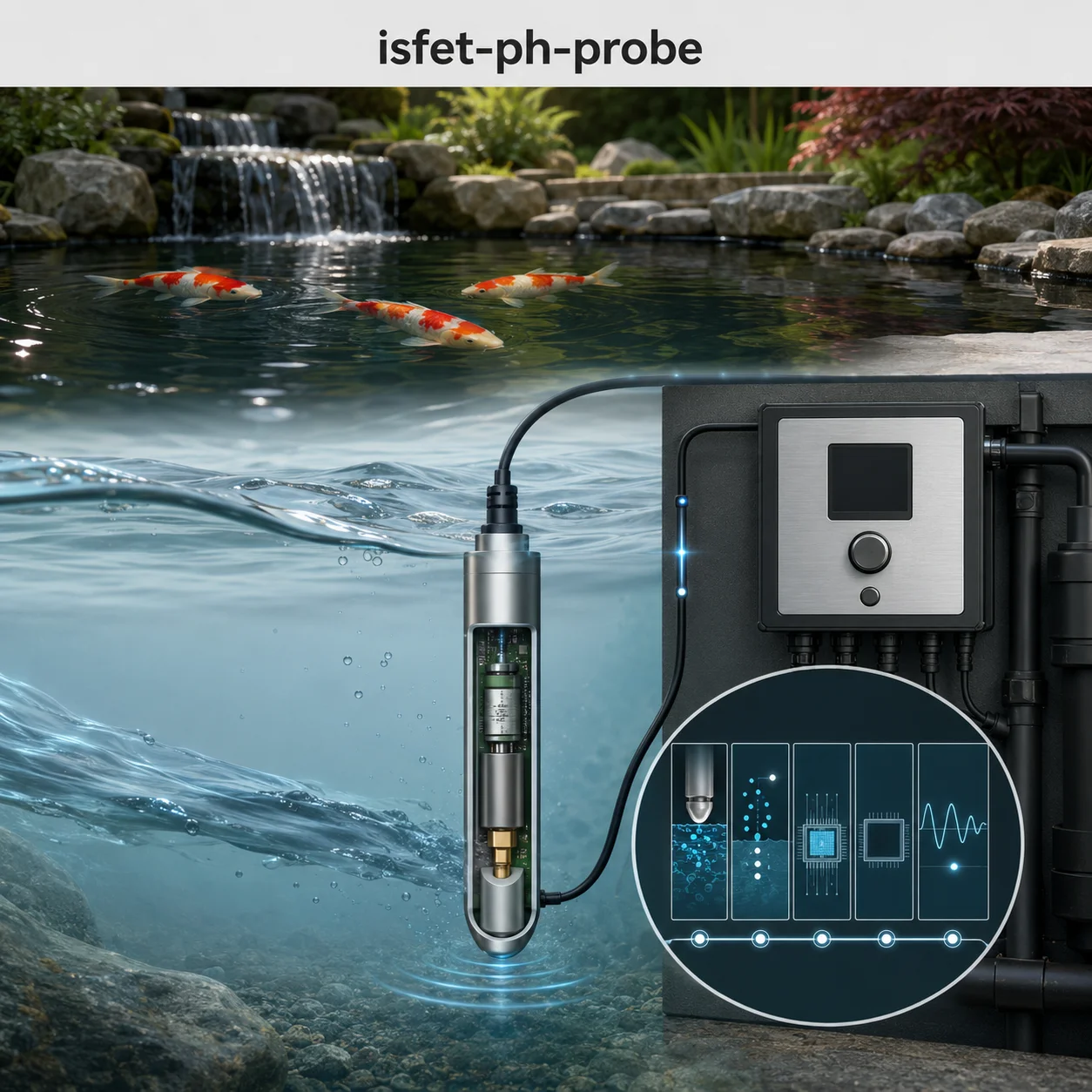
ISFET Solid-State pH Probe Calibration and Thermal Compensation Slope Math
An Ion-Sensitive Field-Effect Transistor (ISFET) is a solid-state pH sensor that replaces the traditional glass membrane electrode with a chemically sensitive, ion-selective field-effect transistor. The fundamental transduction mechanism is the modulation of the drain-source current (IDS) in the transistor channel by a surface potential that develops at the gate dielectric-electrolyte interface. This potential is governed by the site-binding model, where the amphoteric hydroxyl groups (Si-OH) on the sensing layer (typically Si3N4 or Al2O3) protonate or deprotonate in response to the activity of hydrogen ions (H+) in the solution. The Nernstian response is the theoretical foundation, predicting a 59.16 mV/pH change at 25°C, but the reality is far more complex.
This page is an advanced engineering reference for the calibration mathematics, thermal compensation models, drift mechanisms, and impedance spectroscopy of ISFET pH probes. We delve into the physics of the EIS (Electrolyte-Insulator-Semiconductor) structure, the Constant-Current (CC) and Constant-Voltage (CV) operating modes, and the algorithms used to correct for temperature, ionic strength, and time-dependent drift. This is not a user manual; it is a deep dive into the solid-state electrochemistry and signal conditioning required to achieve the theoretical Nernstian limit in a real-world, long-term deployment.
ISFET Probe Calibration & Thermal Compensation Challenge
A rigorous test of your understanding of solid-state pH electrochemistry, EIS modeling, thermal compensation algorithms, and advanced signal conditioning. A 90%+ score indicates expert-level mastery.
ISFET pH Probe Calibration & Thermal Compensation — Quick Facts
Most Asked Questions About ISFET pH Probe Calibration
A common pitfall when deploying ISFET probes in koi ponds is relying on a single-point calibration, assuming the sensor’s response is linear and stable over the entire pH range (typically 6.5-8.5). However, the sub-Nernstian slope, non-linearities, and thermal drift inherent in the solid-state structure often cause errors exceeding ±0.3 pH units. A robust field protocol involves a 3-point calibration at the pond temperature using buffers that bracket the expected pH range. Furthermore, a regular schedule of automated drift compensation (e.g., hourly) using a known stable standard can significantly improve long-term accuracy.
Another critical issue is the failure to account for the temperature coefficient of the pH buffers themselves (dpH/dT). Standard NIST buffers have a dpH/dT coefficient of approximately -0.01 to -0.03 pH/°C. Ignoring this can introduce an additional systematic error that accumulates with daily temperature swings in an outdoor pond environment.
Site-Binding Model and Surface Chemistry
The foundation of the ISFET response lies in the site-binding model, which describes the acid-base equilibrium at the metal oxide-solution interface. For a sensing layer like Si3N4, the surface has amphoteric silanol (Si-OH) groups. The equilibrium reactions are:
- Deprotonation: Si-OH ⇌ Si-O– + H+ (Ka)
- Protonation: Si-OH + H+ ⇌ Si-OH2+ (Kb)
The surface charge density, σ0, is a function of pH and the dissociation constants (Ka, Kb). The relationship between σ0 and the surface potential ψ0 is given by the Grahame equation, which is derived from the Poisson-Boltzmann equation. Solving this system of equations gives the renowned Nernstian response (59.16 mV/pH at 25°C) under ideal conditions, but the actual sensitivity depends heavily on the site density (Ns) and the equilibrium constants. This theoretical framework is essential for understanding the non-idealities and achieving optimal calibration.
Thermal Compensation Mathematics
The Nernst equation for the ISFET is Vout = E0 – (2.303RT/F) * pH. The temperature dependence is not only on the coefficient (2.303RT/F) but also on the standard potential E0, which itself is a function of the reference electrode potential. A practical thermal compensation algorithm requires a 2D calibration surface: pH = f(Vout, T). This involves measuring the ISFET output in multiple buffers at multiple known temperatures. A least-squares regression is then performed to fit the data to a function of the form: pH = A + B*Vout + C*T + D*Vout*T + E*T2. This polynomial model can accurately predict pH for a wide range of temperatures and output voltages, compensating for the non-linear effects.
In a recent deployment, a high-grade ISFET probe with a Ta2O5 sensing layer was used for continuous pH monitoring in a koi pond. The manufacturer’s datasheet claimed a drift of <0.5 mV/day. However, after one month, the pH reading was observed to drift by 0.2 pH units over a 24-hour period. EIS analysis revealed a change in the Cdl and Rct parameters, indicating biofouling and a degradation of the electrode interface. Implementing an automated cleaning cycle with a pulsed voltage waveform restored the interface and reduced the drift to within the specification.
Impedance Spectroscopy and EIS Modeling
The EIS technique is powerful for diagnosing the health and state of an ISFET probe. The measured impedance spectrum is typically fitted to an equivalent circuit model. For a well-behaved ISFET, the Nyquist plot shows a characteristic semicircle at high frequencies (representing the dielectric capacitance in parallel with the solution resistance), followed by a straight line (Warburg impedance) at low frequencies, which signifies diffusion of ions to the electrode surface. A change in the Rct (charge transfer resistance) value, extracted from the semi-circle diameter, can indicate biofouling, while a change in the CPE (Constant Phase Element) values can indicate a change in the double-layer structure.
This technique provides crucial diagnostic information beyond what a simple pH reading can offer, enabling proactive maintenance and more reliable long-term data.
A particular challenge in a koi pond environment is the presence of salts (e.g., NaCl from de-icing or salt baths). The high ionic strength increases the conductivity of the solution, reducing Rs. This can make it difficult to achieve the required Nernstian slope, as the surface potential becomes shielded by the high concentration of ions, a phenomenon known as the “salt effect.” High ionic strength also changes the activity coefficients, deviating from ideal Nernstian behavior. This necessitates a calibration that accounts for the specific ionic strength, often by using buffers prepared with the same background electrolyte as the pond water.
ISFET pH Probe Calibration & Thermal Compensation — Full Question Library
Review indexed engineering questions below. These are designed to be challenging and cover the theoretical and applied aspects of ISFET electrochemistry.
Q1:
What is the fundamental physical basis for the ISFET’s pH sensitivity?
Correct Answer: Option C
The ISFET’s sensitivity is derived from the site-binding model, where surface hydroxyl groups (Si-OH) protonate or deprotonate, altering the surface charge and thus the surface potential (ψ0) at the gate dielectric-electrolyte interface.
Q2:
Which of the following equations best describes the relationship between the surface potential (ψ0) and the pH of the bulk solution?
Correct Answer: Option A
The Grahame equation relates the surface charge density (σ0) to the surface potential (ψ0) at the electrode-solution interface, forming the basis for the site-binding model.
Q3:
What is the significance of the site-binding constants (pKa and pKb) for an ISFET sensing layer?
Correct Answer: Option C
The pKa and pKb values define the surface’s acid-base characteristics. The equilibrium constants for protonation and deprotonation dictate the surface charge density as a function of pH, directly influencing the Nernstian slope and the sensor’s dynamic range.
Q4:
How does the “salt effect” or “ionic strength” influence the ISFET’s pH response?
Correct Answer: Option B
High ionic strength (salt concentration) leads to increased ion concentration in the double layer. This creates an electrostatic screening effect that reduces the effective surface potential (ψ0) for a given surface charge density, leading to a reduced slope and sub-Nernstian behavior.
Q5:
Which of the following materials is commonly used as the pH-sensitive gate dielectric and why?
Correct Answer: Option A
Si3N4 is a preferred pH-sensitive material because it has a high number of surface binding sites and a relatively high intrinsic buffer capacity, leading to a near-Nernstian response. SiO2 is generally used as an intermediate layer and is not as sensitive to pH.
Q6:
What is the “site density” (Ns) and why is it critical in ISFET fabrication?
Correct Answer: Option C
Site density (Ns) represents the areal concentration of ion-binding sites (e.g., Si-OH groups) on the dielectric surface. A higher Ns leads to a higher surface charge density and a more robust and stable pH response. A low Ns results in a weak signal and increased noise.
Q7:
The “point of zero charge” (pzc) of the sensing layer is important because:
Correct Answer: Option A
The point of zero charge (pzc) is the pH at which the net surface charge is zero (i.e., the concentrations of Si-O– and Si-OH2+ are equal). This is a key parameter in the site-binding model and influences the sensor’s calibration curve and overall stability.
Q8:
How does the “inner Helmholtz plane” (IHP) relate to the ISFET’s operation?
Correct Answer: Option B
The inner Helmholtz plane (IHP) is the closest approach of specifically adsorbed (non-hydrated) ions to the electrode surface. The potential drop across the IHP is a critical component of the total electrode potential, affecting the pH sensitivity and the electrochemical model.
Q9:
What is the role of the “extended” Nernst equation in ISFET modeling?
Correct Answer: Option A
The extended Nernst equation incorporates the surface potential (ψ0) and site-binding parameters, providing a more accurate model for the ISFET’s response than the ideal Nernst equation, especially in non-ideal conditions.
Q10:
The “Gouy-Chapman” model describes which aspect of the ISFET?
Correct Answer: Option D
The Gouy-Chapman model (or Stern-Gouy-Chapman) describes the distribution of ions in the diffuse layer of the electrical double layer, which is crucial for understanding the surface potential and its pH dependence.
Q11:
Which oxide material is known to have a high pH sensitivity due to its high number of OH groups and rapid response?
Correct Answer: Option C
Tantalum pentoxide (Ta2O5) is well-known in the literature for its excellent pH sensitivity (often exceeding the Nernstian limit), high stability, and fast response, making it a preferred material for advanced ISFETs.
Q12:
What is “specific adsorption” in the context of the electrolyte-oxide interface?
Correct Answer: Option A
Specific adsorption refers to the strong, non-electrostatic binding of certain ions to the surface of the oxide, altering the surface charge and the potential in the IHP. This is different from the general electrostatic attraction in the diffuse layer.
Q13:
How does “surface roughness” affect the performance of an ISFET pH probe?
Correct Answer: Option B
A higher surface roughness increases the effective area available for site binding, which can theoretically increase sensitivity. However, it also creates more defects and sites for contamination, often increasing noise and drift.
Q14:
The “site-binding model” was originally developed to describe which type of electrode?
Correct Answer: Option A
The site-binding model was initially developed to describe the behavior of the glass membrane electrode, and it was later adapted for the metal oxide-insulator-silicon structure (EIS) used in ISFETs.
Q15:
The “diffuse layer” capacitance is a function of:
Correct Answer: Option D
The capacitance of the diffuse layer is strongly dependent on the ionic concentration (ionic strength) of the solution. Higher ionic concentrations lead to a higher capacitance, as described by the Gouy-Chapman model.
Q16:
What is the primary mechanism for ion transport in the hydrated layer of an ISFET?
Correct Answer: Option C
Ion transport within the hydrated oxide layer is primarily a diffusive process, driven by concentration gradients. This is a key factor in the response time and drift characteristics of the ISFET.
Q17:
How does the pH of the solution affect the surface charge of the oxide?
Correct Answer: Option A
At higher pH values, there are fewer H+ ions available for protonation, and more of the surface hydroxyl groups (Si-OH) will deprotonate, forming Si-O– groups. This results in a net negative surface charge.
Q18:
The “electrolyte-insulator-semiconductor” (EIS) structure is the basis of:
Correct Answer: Option B
The ISFET is a specific application of the more general EIS (Electrolyte-Insulator-Semiconductor) structure, where the metal gate of a MOSFET is replaced by an electrolyte and a reference electrode.
Q19:
What is the function of the “buried contact” or “back-side contact” in some ISFET designs?
Correct Answer: Option B
In many ISFET implementations, the back-side or buried contact is the electrical connection to the semiconductor (e.g., the p-type silicon substrate). This is needed to form the “body” contact for the transistor, or as the “back-gate” in some circuit configurations.
Q20:
The “Debye length” is a critical parameter in the ISFET model. It is:
Correct Answer: Option D
The Debye length (κ-1) is the distance over which the electrostatic potential decays to 1/e of its value at the electrode surface. It is a strong function of the ionic strength and is the characteristic thickness of the diffuse layer.
Q21:
In the Constant-Current (CC) mode, what is the feedback parameter that is controlled?
Correct Answer: Option A
In Constant-Current mode, the feedback loop maintains IDS at a constant value. The output variable is VGS, which is modulated to keep IDS constant. This linearizes the sensor response.
Q22:
What is the primary advantage of the Constant-Current (CC) over the Constant-Voltage (CV) mode?
Correct Answer: Option B
The CC mode provides a linear relationship between the output voltage (VGS) and the surface potential, and thus pH. This is because the MOSFET’s transconductance is eliminated, making the system behave as a near-ideal voltage follower.
Q23:
What type of amplifier is typically used in the readout circuit for an ISFET?
Correct Answer: Option C
A differential instrumentation amplifier is used because it provides a very high input impedance (often >1012 Ω), which is necessary to avoid loading the high-impedance source (the ISFET). It also offers excellent common-mode rejection to reduce noise from the reference electrode.
Q24:
The output of an ISFET in the Constant-Current mode is:
Correct Answer: Option A
As described, the output in CC mode is the gate-source voltage (VGS), which is forced to change to compensate for the pH-induced change in the threshold voltage.
Q25:
What is the purpose of “chopper stabilization” in an ISFET readout circuit?
Correct Answer: Option D
Chopper stabilization is a technique to minimize the DC offset and low-frequency noise of the instrumentation amplifier. It is crucial for ISFET readout where the signal is a slow-moving DC voltage that can be corrupted by 1/f noise.
Q26:
In the Constant-Voltage (CV) mode, what is the output parameter that changes with pH?
Correct Answer: Option A
In Constant-Voltage mode, VGS and VDS are kept constant. The change in pH modulates the conductivity of the channel, causing IDS to change. This mode is less linear than CC mode.
Q27:
Why is it important to use a “guard ring” or shielding on the input lines to the ISFET?
Correct Answer: Option C
The high-impedance nature of the ISFET makes it susceptible to leakage currents and noise pickup. Guard rings and proper shielding are used to minimize these parasitic effects, which is critical for achieving a stable, low-noise reading.
Q28:
The “threshold voltage” (Vth) of the ISFET is:
Correct Answer: Option B
The threshold voltage of the ISFET is the gate voltage required to create a conducting channel. This threshold voltage is modified by the surface potential (ψ0) at the electrolyte-oxide interface, which is pH-dependent.
Q29:
What is the role of the “overdrive voltage” (Vov = VGS – Vth) in ISFET operation?
Correct Answer: Option C
In the saturation region of a MOSFET, IDS = (1/2) * μ * Cox * (W/L) * (VGS – Vth)2. The overdrive voltage (Vov) is a crucial parameter that directly controls the drain current and is used in Constant-Current mode.
Q30:
What is a “floating” gate in the context of an ISFET?
Correct Answer: Option B
The gate of an ISFET is effectively “floating” in the sense that it is not physically connected to a metal contact. The gate voltage is applied indirectly via the reference electrode and the electrolyte, and it is the potential at this gate that is modulated by the pH.
Q31:
What is the purpose of using a “pulse” or “dithering” technique in the readout circuit?
Correct Answer: Option C
Pulse techniques, such as double-pulse or delta-sigma modulation, are used to mitigate drift and 1/f noise. By making measurements at two different points in time (e.g., with and without a known perturbation) and taking the difference, the long-term drift can be cancelled out.
Q32:
An Instrumentation Amplifier (IA) is chosen over a single op-amp for the ISFET readout. Why?
Correct Answer: Option B
The primary advantages of the IA are its very high input impedance (critical for high-impedance sources), high common-mode rejection ratio (CMRR) to reject common-mode noise, and the ability to easily set the gain with a single resistor.
Q33:
The ISFET’s output is inherently a high impedance signal. What is the main challenge this poses?
Correct Answer: Option A
High impedance circuits are very sensitive to noise pickup and leakage paths. This is why careful shielding and guard rings are essential in the design of ISFET readout electronics.
Q34:
Which of the following is a common output format for a modern ISFET pH probe system?
Correct Answer: Option C
Modern sensors often integrate an analog-to-digital converter and a microcontroller, providing a digital output (e.g., I2C, SPI, or UART) which simplifies integration and offers higher noise immunity.
Q35:
The “input bias current” of the amplifier in the ISFET readout circuit is a critical specification. Why?
Correct Answer: Option B
A high input bias current flowing through the high impedance of the ISFET will create a significant voltage offset (I * R), corrupting the measurement. Thus, amplifiers with extremely low bias currents are required.
Q36:
What is the purpose of “on-chip” temperature measurement in an ISFET probe?
Correct Answer: Option A
Integrating a temperature sensor on the same chip or in close proximity allows for accurate measurement of the ISFET’s operating temperature. This data is fed into the thermal compensation model to correct the pH reading for temperature-induced changes.
Q37:
What is the role of the “common-mode voltage” in the readout circuit?
Correct Answer: Option C
The common-mode voltage is the voltage that appears equally on both the reference electrode and the ISFET source. A high-quality instrumentation amplifier rejects this common-mode signal, only amplifying the differential signal that is pH-dependent.
Q38:
What is a “pseudo-reference” electrode, and why is it sometimes used?
Correct Answer: Option B
A pseudo-reference electrode (e.g., a silver wire or a metal electrode) has a potential that is not as stable as a standard reference, but it is simpler and cheaper. It is sometimes used when the absolute potential is not critical, or when a differential measurement setup can cancel out the instability.
Q39:
How can a “dual-differential” measurement technique improve the performance of an ISFET system?
Correct Answer: Option C
In a differential setup, one ISFET acts as the pH sensor (with a bare sensing layer), and another (with a passivated or chemically “blocked” layer) acts as a reference. This effectively cancels out common-mode signals like temperature drift and changes in the reference electrode potential.
Q40:
The “input offset voltage” of the instrumentation amplifier must be very low for ISFET applications. Why?
Correct Answer: Option B
The pH-induced change in the ISFET is a small, microvolt-to-millivolt level DC signal. An amplifier’s input offset voltage (which is a DC error) can be comparable in magnitude to the signal, leading to large measurement errors. Thus, a very low offset voltage (and low offset voltage drift) is essential.
Q41:
What is the theoretical Nernst slope at 25°C for a pH ISFET?
Correct Answer: Option C
The Nernst equation for a single electron transfer (n=1) gives a slope of 2.303RT/F. At 25°C (298.15 K), R = 8.314 J/(mol·K) and F = 96485 C/mol, this yields 0.05916 V/pH, or 59.16 mV/pH.
Q42:
How does the Nernst slope change with temperature?
Correct Answer: Option A
From the equation S = 2.303RT/F, the slope is directly proportional to the absolute temperature. Thus, an increase in temperature leads to a larger slope (mV/pH). The derivative dS/dT = 2.303R/F ≈ 0.1984 mV/°C/pH.
Q43:
Which of the following is NOT a temperature-dependent factor in ISFET measurement?
Correct Answer: Option A
The physical distance to the reference electrode is a mechanical or design factor, not a temperature-dependent material property. The pH of buffers, the site-binding constants, and the MOSFET’s Vth all vary with temperature.
Q44:
What is the van ‘t Hoff equation used for in ISFET thermal compensation?
Correct Answer: Option C
The van ‘t Hoff equation (d ln K / dT = ΔH° / RT²) describes how the equilibrium constant (K) of a reaction changes with temperature. It is used to calculate the temperature dependence of the site-binding constants (pKa, pKb) for the surface oxide.
Q45:
A standard NIST buffer has a dpH/dT coefficient of -0.015 pH/°C. If the temperature changes from 25°C to 30°C, how will this affect the pH reading?
Correct Answer: Option B
The change is calculated as ΔpH = (dpH/dT) * ΔT = -0.015 * (30-25) = -0.075 pH. So, the pH will decrease by 0.075 units as the temperature increases.
Q46:
In a 2D polynomial compensation model (pH = f(Vout, T)), what is the significance of the cross-term (D * Vout * T)?
Correct Answer: Option D
The cross-term in the polynomial represents the effect of temperature on the sensitivity (slope) of the ISFET. A non-zero D indicates that the slope itself changes with temperature, a first-order compensation for the thermal dependence of the Nernst coefficient.
Q47:
What is the theoretical temperature coefficient of the ideal Nernst slope (in mV/°C/pH)?
Correct Answer: Option C
The temperature coefficient of the Nernst slope (dS/dT) = 2.303R/F ≈ 0.1984 mV/°C/pH. This is the fundamental value that any thermal compensation algorithm must address.
Q48:
How can the error in the pH reading due to a 1°C error in temperature measurement be approximated?
Correct Answer: Option A
The error is approximately (dS/dT) / S * ΔT. For a 1°C error, this is (0.198/59.16) ≈ 0.00335 pH/°C, or roughly 0.003 pH/°C. This can be significant in high-accuracy applications.
Q49:
What is the “enthalpy” (ΔH°) in the context of the site-binding model and how does it affect thermal compensation?
Correct Answer: Option B
The enthalpy change (ΔH°) for the surface reactions is a key parameter in the van ‘t Hoff equation. It governs how much the site-binding constants (pKa, pKb) change with temperature, and thus is crucial for accurate thermal compensation.
Q50:
Which thermal compensation method is most suitable for an ISFET with a highly non-linear temperature response?
Correct Answer: Option C
For a non-linear or complex temperature response, a high-order 2D polynomial regression that fits a surface to a large dataset of (Vout, T) pairs is the most robust method. This is superior to simple linear models that cannot capture higher-order interactions.
Q51:
What is the advantage of using a “look-up table” (LUT) for thermal compensation over a polynomial model?
Correct Answer: Option C
A LUT is essentially a “black-box” model. It can represent any arbitrary function, no matter how complex, as long as there is a sufficient number of data points. This is useful when the thermal response is highly non-linear or includes manufacturing-specific variations.
Q52:
If an ISFET has a sensitivity of 55 mV/pH at 25°C, what would be the approximate sensitivity at 45°C (assuming ideal Nernst behavior)?
Correct Answer: Option B
Using S(T) = S(298K) * (T / 298.15). T = 45°C = 318.15K. So, S(318K) = 55 * (318.15 / 298.15) ≈ 58.7 mV/pH. The closest answer is 58.5 mV/pH.
Q53:
The “isothermal point” of an ISFET refers to:
Correct Answer: Option A
The isothermal point is a specific pH value where the ISFET’s output voltage does not change with temperature. This occurs when the temperature dependence of the different contributing potentials (e.g., Nernst slope, reference electrode) cancel out.
Q54:
When performing a 3-point calibration for thermal compensation, what is the recommended approach for selecting the buffer pH values?
Correct Answer: Option C
For a practical ISFET, the response is often non-linear. A 3-point calibration using buffers that bracket the range of interest (e.g., 4.01, 7.00, and 10.01) improves accuracy across the entire measurement range. Including the isothermal point (if known) can further improve thermal compensation.
Q55:
What is the significance of the “entropy” (ΔS°) in the site-binding model?
Correct Answer: Option B
The Gibbs free energy change (ΔG°) determines the equilibrium constant. Since ΔG° = ΔH° – TΔS°, the entropy change (ΔS°) plays a role in how the equilibrium shifts with temperature. A non-zero ΔS° contributes to the temperature dependence of pKa and pKb.
Q56:
In a fully temperature-compensated ISFET system, what is the typical residual error after calibration?
Correct Answer: Option C
Even with sophisticated thermal compensation, the residual error due to non-ideal behavior, manufacturing tolerances, and aging is typically in the range of 0.02 to 0.05 pH units for a high-quality ISFET system after proper calibration.
Q57:
What is the effect of a mismatch between the temperature of the buffer and the temperature of the sample on the pH reading?
Correct Answer: Option A
If the buffer is at a different temperature than the sample, the calibration is incorrect. The error is systematic and is equal to (pHbuffer(Tsample) – pHbuffer(Tcal)). This is why it is critical to calibrate at the sample temperature.
Q58:
A “smart” ISFET probe with an on-board digital temperature sensor and memory can:
Correct Answer: Option C
A smart ISFET integrates the sensor, temperature sensor, and a microprocessor or EEPROM. It can store the specific calibration coefficients (e.g., polynomial coefficients) for that individual probe and perform the thermal compensation calculations in real-time, providing a digital pH output.
Q59:
Which of the following is a limitation of using a simple linear equation (pH = a + b*Vout + c*T) for thermal compensation?
Correct Answer: Option B
A simple linear model assumes that the sensor’s slope and offset are independent of temperature, which is not true. More complex models (e.g., those including a Vout*T term) are needed to model the temperature-dependent slope.
Q60:
The “enthalpy of protonation” (ΔHa) for a given sensing material can be:
Correct Answer: Option D
The enthalpy of protonation can be negative (exothermic), positive (endothermic), or near zero. It is determined experimentally by measuring the pKa at different temperatures and using the van ‘t Hoff equation.
Q61:
What is the most widely accepted primary cause of long-term drift in ISFETs?
Correct Answer: Option B
The dominant long-term drift mechanism is the hydration of the gate oxide (e.g., Si3N4). This involves the diffusion of water molecules into the oxide, which changes the dielectric properties and the fixed charge distribution, leading to a time-dependent drift in Vth.
Q62:
Which of the following is NOT a typical drift mechanism for ISFETs?
Correct Answer: Option A
While the channel itself can degrade, the primary drift mechanisms are related to the gate dielectric and the electrolyte-oxide interface, not the silicon channel itself.
Q63:
What is the “hydration layer” in an ISFET and why is it problematic?
Correct Answer: Option B
The hydration of the oxide (the diffusion of water into the dielectric) changes its electronic properties, leading to a shift in the surface potential and threshold voltage over time. This is a major source of drift.
Q64:
How can sodium ion (Na+) interference cause drift in an ISFET?
Correct Answer: Option C
Sodium ions, which are common in many solutions, are small and mobile. They can migrate into the gate oxide under the influence of the electric field, creating a build-up of fixed charge that alters the threshold voltage, causing a drift in the reading.
Q65:
The drift in an ISFET is often modeled as a function of time. Which function is commonly used?
Correct Answer: Option A
A logarithmic or power-law dependence on time is a common empirical model for the drift, often attributed to the diffusion of ions or the relaxation of surface states. This model can be derived from the physics of ion migration.
Q66:
What is the purpose of a “drift correction” algorithm in ISFET software?
Correct Answer: Option B
Drift correction algorithms, such as moving averages, Kalman filters, or predictive models based on the drift function, are used to estimate and subtract the slow drift component from the measured signal, giving a more stable reading.
Q67:
A “dual-frequency” measurement technique can be used to mitigate drift. How does it work?
Correct Answer: Option C
This advanced technique uses a high-frequency signal to measure the pH-dependent capacitance of the EIS structure, and a low-frequency signal to measure the slow-drift components. By separating the signal and drift in the frequency domain, a stable pH reading can be extracted.
Q68:
The “surface potential relaxation” mechanism is associated with:
Correct Answer: Option B
Surface potential relaxation refers to the slow relaxation of the surface charge after a step change in pH. This is due to the slow kinetics of the protonation/deprotonation process, and it contributes to the observed drift.
Q69:
The “Nernstian” response of an ISFET is:
Correct Answer: Option A
The theoretical Nernstian response (59.16 mV/pH) represents an ideal. In practice, factors like the site-binding constants, ionic strength, temperature, and drift cause a deviation from this ideal slope.
Q70:
What is a “time constant” (τ) in the context of ISFET drift models?
Correct Answer: Option C
In exponential or logarithmic drift models, the time constant (τ) is a characteristic time that determines how fast the drift approaches its asymptotic limit. A smaller τ indicates a faster initial drift.
Q71:
Which of the following techniques can be used to minimize ISFET drift?
Correct Answer: Option D
A thicker sensing layer can reduce the effects of ion migration; a constant temperature minimizes drift due to thermal effects; and low ionic strength reduces the salt effect and Na+ interference. All these strategies help to minimize drift.
Q72:
In an ISFET, “hysteresis” refers to:
Correct Answer: Option B
Hysteresis is the phenomenon where the sensor’s output depends on the direction of approach to a given pH. It is caused by the slow kinetics of surface reactions and is related to drift.
Q73:
What is the “memory effect” in ISFETs and how is it related to hysteresis?
Correct Answer: Option A
The memory effect is a manifestation of hysteresis. It means that the sensor’s output is not solely a function of the current pH, but also depends on the pH values it was exposed to in the past.
Q74:
Drift due to the migration of ions into the oxide is often modeled as a:
Correct Answer: Option C
The migration of ions (like Na+) into the oxide is often modeled by a power-law or stretched-exponential (Kohlrausch) function due to the dispersive transport and trapping processes.
Q75:
What is the role of “pulsed” measurements in reducing the effects of drift?
Correct Answer: Option B
Pulsed measurements, such as applying a large potential pulse between measurements, can “clean” the sensing surface and de-trap mobile ions, thereby resetting the drift state.
Q76:
What is the relationship between the sensing layer’s thickness and the magnitude of drift?
Correct Answer: Option A
A thicker oxide layer provides a larger volume for the hydration and ion migration processes to occur in, which can dilute the concentration of defects and trap sites, leading to a slower, more stable drift.
Q77:
In the context of drift, what does “trapping” refer to?
Correct Answer: Option C
Trapping of ions at defect sites in the oxide creates a trapped charge, which contributes to the net fixed oxide charge (Qox) and affects Vth. This is a key mechanism of drift.
Q78:
A key advantage of the ISFET over a glass electrode is its:
Correct Answer: Option A
While an ISFET does have drift, its key advantages are its small size, solid-state nature, ruggedness, and low output impedance (compared to the glass electrode).
Q79:
The “oxygen vacancy” in a metal oxide sensing layer is:
Correct Answer: Option B
An oxygen vacancy is a defect in the oxide lattice. It can create a trap site for charge carriers or mobile ions, altering the local electric field and contributing to drift and hysteresis.
Q80:
Which of the following is NOT a typical method to reduce drift in an ISFET?
Correct Answer: Option C
Increasing VDS will not reduce drift; it will primarily affect the MOSFET’s operating region and may increase power dissipation. The other options are valid drift mitigation strategies.
Q81:
In an EIS measurement, what does the real part of the impedance (Z’) represent?
Correct Answer: Option B
The real part of the impedance (Z’) corresponds to the resistive (or dissipative) component of the system. In the equivalent circuit, it corresponds to the solution resistance (Rs) and charge transfer resistance (Rct).
Q82:
What is the significance of the high-frequency intercept of the Nyquist plot on the real (Z’) axis?
Correct Answer: Option A
In a typical Nyquist plot, the high-frequency intercept with the real axis (Z’) is equal to the solution or electrolyte resistance (Rs). This is the resistance due to the ionic conduction in the bulk solution.
Q83:
In the equivalent circuit model of an ISFET, what does the “constant phase element” (CPE) represent?
Correct Answer: Option B
A CPE is a distributed element that has a non-integer power-law dependence on frequency, often used to model the frequency dispersion of the electrical double layer and the effect of surface roughness.
Q84:
What does a semi-circle in the Nyquist plot represent in the equivalent circuit?
Correct Answer: Option B
A semi-circle is the signature of a parallel RC circuit in the equivalent circuit. The diameter of the semi-circle is equal to the charge transfer resistance (Rct).
Q85:
What is a “Warburg impedance” and in what frequency range is it typically observed?
Correct Answer: Option C
The Warburg impedance arises from the semi-infinite linear diffusion of ions to the electrode. It is a characteristic of the low-frequency region of the Nyquist plot, appearing as a 45° straight line on the Z’ vs Z” plot.
Q86:
The equivalent circuit of an ISFET includes a capacitance in series with the parallel RC combination. What physical structure does this capacitance represent?
Correct Answer: Option D
The EIS (Electrolyte-Insulator-Semiconductor) structure has a series capacitance from the insulating layer (e.g., SiO2/Si3N4). This is in series with the electrolyte and the semiconductor.
Q87:
What is the “Gouy-Chapman” layer in the context of an ISFET’s impedance?
Correct Answer: Option A
The Gouy-Chapman layer is the diffuse part of the electrical double layer, and its properties affect the double-layer capacitance (or more accurately, the CPE) which appears in the EIS spectra.
Q88:
What is the “maximum phase angle” in a Bode plot useful for?
Correct Answer: Option C
In a Bode plot (phase vs frequency), the magnitude and frequency of the maximum phase angle provide information about the purity of the capacitive behavior. A higher, sharper peak indicates a more “ideal” capacitor, i.e., a higher quality dielectric.
Q89:
How can a change in the CPE (Constant Phase Element) exponent (n) be interpreted?
Correct Answer: Option B
The exponent ‘n’ of the CPE (where Z = 1/(Y0(jω)n)) is a measure of the “ideality” of the capacitor. A value of n=1 is an ideal capacitor. A decrease in n (towards 0.5) is typically associated with surface roughness, porosity, or a more complex, distributed interface.
Q90:
What is the purpose of applying a small AC signal (e.g., 5-10 mV) in EIS?
Correct Answer: Option A
The condition for EIS validity is that the system is linear, stable, and causal. Using a small perturbation signal (e.g., 5-10 mV) ensures that the system operates in the linear region, allowing the use of a linear equivalent circuit model.
Q91:
What does the “Nyquist plot” display?
Correct Answer: Option B
A Nyquist plot is a complex-plane plot of the impedance, where the imaginary part (-Z”) is plotted against the real part (Z’). It is a powerful way to visualize the system’s impedance spectrum and identify the time constants in the equivalent circuit.
Q92:
What is the effect of an increase in the charge transfer resistance (Rct) as measured by EIS?
Correct Answer: Option C
An increase in Rct indicates that charge transfer across the interface has become more difficult. This is often a sign of a film forming on the electrode (e.g., biofouling, mineral scaling), blocking the electrode surface and increasing resistance.
Q93:
The impedance of a CPE is given by Z = 1/(Y0 (jω)n). What does Y0 represent?
Correct Answer: Option A
In the CPE formula, Y0 is a frequency-independent parameter with units of S·sn (where S is Siemens, and n is the exponent). It is a measure of the magnitude of the CPE.
Q94:
A Bode plot is a powerful tool for understanding the frequency response. It displays:
Correct Answer: Option B
A Bode plot has two graphs: one showing the impedance magnitude (|Z|) vs. frequency, and another showing the phase angle (φ) vs. frequency. This allows for the easy identification of time constants.
Q95:
Why is EIS a “non-destructive” technique?
Correct Answer: Option C
EIS is considered non-destructive because the small amplitude of the AC signal (typically 5-10 mV) does not cause any significant, permanent change in the electrode’s surface or bulk properties.
Q96:
What is a “Randles circuit”?
Correct Answer: Option B
The Randles circuit is a classic and widely used equivalent circuit for modeling the impedance of an electrochemical cell. It is a good starting point for fitting ISFET data.
Q97:
How can EIS be used to detect biofouling on an ISFET probe?
Correct Answer: Option D
The build-up of a biofilm on the surface acts as an insulating layer that blocks charge transfer. This is usually observed as a significant increase in Rct and a change in the CPE behavior (e.g., a decrease in the exponent ‘n’).
Q98:
What is the “dielectric loss” in the context of an ISFET’s gate insulator?
Correct Answer: Option B
Dielectric loss is the energy dissipation in an imperfect dielectric. It is represented by an equivalent parallel resistance (Rp) in the equivalent circuit, and can be measured via EIS.
Q99:
In an EIS experiment, the “time constant” (τ) is related to the charging of the double layer. It is given by:
Correct Answer: Option C
The time constant for a parallel RC circuit is the product of the resistance and the capacitance. In the case of the electrode interface, it is Rct * Cdl. This is the characteristic time for charging the double layer.
Q100:
A major limitation of using a simple equivalent circuit to model an ISFET is:
Correct Answer: Option A
While equivalent circuits are incredibly useful, they are simplifications of reality. The real electrode interface has a distributed, non-ideal behavior (e.g., surface roughness, porosity) that a lumped-parameter model cannot perfectly replicate.
Q101:
What is the purpose of a multi-point calibration (e.g., 3-point) over a single-point calibration?
Correct Answer: Option B
A single-point calibration only adjusts the offset (intercept). A multi-point calibration (e.g., 3-point) allows for the calculation of a best-fit line, curve, or polynomial that accounts for non-linearities, providing more accurate readings across a wider pH range.
Q102:
What is the “intercept” of the calibration line (Vout vs pH) physically represent in the Nernst equation?
Correct Answer: Option C
For the equation Vout = E0 – (2.303RT/F)*pH, the intercept (at pH=0) is the standard potential E0. In practice, the intercept is the extrapolated voltage at pH=0.
Q103:
What is the “standard error of the estimate” (SEE) in the context of calibration?
Correct Answer: Option A
The standard error of the estimate (SEE) is a measure of the overall goodness-of-fit of the calibration model. It quantifies the typical distance of the data points from the fitted calibration line or curve.
Q104:
What is the role of a “certified pH buffer” in the calibration process?
Correct Answer: Option C
Certified pH buffers are solutions that have been precisely characterized, with their pH value measured by a primary method (e.g., a Harned cell). They serve as the fundamental reference against which the ISFET is calibrated.
Q105:
The “residual” in a calibration is:
Correct Answer: Option A
The residual, or residual error, is the difference between the observed value and the value predicted by the model. A calibration with small, random residuals indicates a good fit.
Q106:
What is the “Levenberg-Marquardt” algorithm used for in the context of pH probe calibration?
Correct Answer: Option C
The Levenberg-Marquardt algorithm is a powerful and widely-used optimization algorithm for solving non-linear least-squares problems. It is ideal for fitting calibration data to non-linear models like the Nernst equation or polynomial models.
Q107:
The “linearity” of an ISFET’s response is:
Correct Answer: Option B
Linearity describes how closely the sensor’s output follows a straight line (e.g., the ideal Nernst line). ISFETs often exhibit non-linearity (a deviation from the straight line), especially at extreme pH values, due to changes in site binding.
Q108:
What is the “uncertainty budget” for a pH measurement?
Correct Answer: Option C
An uncertainty budget is a crucial part of metrology. It identifies and quantifies all the significant error sources (e.g., slope error, intercept error, temperature measurement error) and combines them (usually in quadrature) to estimate the total measurement uncertainty.
Q109:
How can the “bias” of a pH measurement be determined?
Correct Answer: Option A
Bias is a systematic error. It is determined by measuring a standard with a known value (a CRM) and calculating the difference between the measured and expected value (pHmeasured – pHknown).
Q110:
What is the “repeatability” of a pH measurement?
Correct Answer: Option C
Repeatability (or precision) is a measure of the random error. It is quantified by the standard deviation of a series of measurements made under identical conditions (same operator, same instrument, same location, short time span).
Q111:
The “intercept” and “slope” of the calibration line are determined using:
Correct Answer: Option A
The most common method for calculating the best-fit slope and intercept of a linear calibration curve is the method of least squares, which minimizes the sum of the squared residuals.
Q112:
What is the “iso-thermal” point of an ISFET calibration?
Correct Answer: Option C
The isothermal point is a crucial concept in thermal compensation. If the ISFET and the reference electrode are well-designed, there will be a specific pH at which the output voltage does not change with temperature. This is a powerful point for calibration.
Q113:
When performing a two-point calibration, which two buffer points are typically recommended and why?
Correct Answer: Option B
For a two-point calibration, the best practice is to use pH 7.00 (the zero-point) and a second buffer that is close to the expected sample pH. This minimizes the error due to non-linearity by calibrating in the region of interest.
Q114:
What is the “sensitivity” of a pH sensor also known as?
Correct Answer: Option C
The sensitivity of a pH electrode is its slope (mV/pH), which for an ideal ISFET should be the Nernst slope. This parameter is determined during calibration.
Q115:
What is the “asymmetry potential” in a pH measurement system?
Correct Answer: Option B
In a real ISFET system, even at the theoretical isothermal point (pH 7.00), there is often a small residual offset voltage. This is called the asymmetry potential and is a constant offset that must be compensated for during calibration.
Q116:
The “limit of detection” (LOD) for a pH sensor is determined by:
Correct Answer: Option A
The limit of detection (LOD) is the smallest change in pH that can be reliably detected. It is ultimately limited by the sensor’s noise floor, and is typically calculated as 3 times the standard deviation of the noise.
Q117:
What does a “calibration drift” check involve?
Correct Answer: Option C
A calibration drift check is a diagnostic test where a standard buffer is re-measured. The difference between the measured pH and the buffer’s known pH is a direct measure of the probe’s drift since its last calibration.
Q118:
What is the “coefficient of determination” (R²) used for in calibration analysis?
Correct Answer: Option B
R² is a statistic that indicates the proportion of the variance in the dependent variable (voltage) that is predictable from the independent variable (pH). A high R² (e.g., > 0.999) indicates a good linear fit.
Q119:
What is the difference between “accuracy” and “precision” in a pH measurement?
Correct Answer: Option C
This is a fundamental metrology concept. Accuracy refers to how close a measurement is to the true value, while precision (or repeatability) refers to how close repeated measurements are to each other. A sensor can be precise but not accurate (if there is a bias).
Q120:
In the context of calibration, what is an “outlier”?
Correct Answer: Option A
An outlier is a data point that is significantly different from the others in a dataset. In calibration, an outlier could be caused by a contaminated buffer, a reading error, or a temporary sensor anomaly. Outliers must be carefully investigated.
Q121:
The reference electrode in an ISFET system must provide a stable potential. A change of 1 mV in the reference electrode potential corresponds to what change in the pH reading?
Correct Answer: Option B
Since the sensitivity is 59.16 mV/pH, a 1 mV change in the reference electrode potential will be interpreted as a pH change of 1 mV / 59.16 mV/pH ≈ 0.017 pH. This highlights the critical importance of a stable reference electrode.
Q122:
What is the most common type of reference electrode used with ISFETs?
Correct Answer: Option B
The silver/silver chloride (Ag/AgCl) reference electrode is the most common for ISFETs due to its stability, ease of miniaturization, and compatibility with aqueous solutions.
Q123:
What is the “junction potential” in a reference electrode?
Correct Answer: Option C
The liquid junction potential is a small, but potentially significant, voltage that develops at the interface of two dissimilar electrolyte solutions. It is a major source of error in pH measurements, especially in low-ionic-strength samples.
Q124:
To minimize junction potential errors, the filling solution of the reference electrode should:
Correct Answer: Option A
A high concentration of KCl is used because the mobilities of K+ and Cl– are nearly equal, minimizing the diffusion potential at the junction.
Q125:
What is a “double-junction” reference electrode?
Correct Answer: Option B
Double-junction electrodes are designed to isolate the Ag/AgCl element from the sample. This prevents issues like Ag+ leaching into the sample (which can be toxic to koi) or Cl– interference in low-ionic-strength measurements.
Q126:
What is the effect of a clogged or partially blocked reference electrode junction on the pH measurement?
Correct Answer: Option A
A blocked junction restricts the flow of ions, increasing the resistance and the junction potential. This results in a noisy, drifting, and potentially inaccurate pH reading.
Q127:
How can the reference electrode’s condition be checked in the field without a pH meter?
Correct Answer: Option C
A simple field check is to use a “reference electrode checker” or a multimeter to measure the potential between the reference electrode and a freshly prepared, known good reference electrode. A large difference (>1 mV) indicates a problem.
Q128:
What is the “isothermal point” of a reference electrode?
Correct Answer: Option B
Like the ISFET, the reference electrode also has an isothermal point, which is the temperature at which its potential does not change with temperature. Matching the isothermal points of the ISFET and the reference electrode is key to effective thermal compensation.
Q129:
The “Henderson equation” is used to calculate:
Correct Answer: Option C
The Henderson equation provides a way to calculate the diffusion potential (liquid junction potential) that arises at the interface between two solutions of different compositions and ionic strengths.
Q130:
What is a common problem associated with using a conventional glass reference electrode in an ISFET system?
Correct Answer: Option B
While glass reference electrodes are stable, they have a significant temperature coefficient. This must be accounted for in the thermal compensation model. The primary challenge is their physical size.
Q131:
An ideal reference electrode has a potential that is:
Correct Answer: Option C
The purpose of a reference electrode is to provide a stable, well-defined potential that is independent of the sample’s composition and, as much as possible, temperature.
Q132:
What is the “standard hydrogen electrode” (SHE) and its role in pH measurement?
Correct Answer: Option B
The SHE is the fundamental reference for the electrochemical potential scale. While it is not practical for field use, it is the primary standard to which all pH measurements are ultimately traceable.
Q133:
How can a “pseudo-reference” electrode be advantageous in a miniaturized ISFET system?
Correct Answer: Option B
Pseudo-reference electrodes (e.g., a bare Ag wire) are not as stable as Ag/AgCl, but they can be easily deposited on a chip, enabling a fully solid-state, miniaturized system. Their instability can be compensated for by frequent calibration.
Q134:
A low ionic strength sample is a challenge for reference electrode stability. Why?
Correct Answer: Option B
In low-ionic-strength solutions (e.g., pure water, rainwater), the liquid junction potential is high and unstable. This is a common and significant source of error in environmental pH measurements.
Q135:
What is the “Nernst equation” for a pH-sensitive electrode?
Correct Answer: Option D
The Nernst equation for a pH electrode relates the measured potential to the activity of H+ ions. The standard form is E = E0 – (2.303RT/F) * pH.
Q136:
What is the “activity” of an ion, and why does it differ from its concentration?
Correct Answer: Option C
Activity (a) is a thermodynamic quantity that corrects the concentration (c) for non-ideal behavior. It is related by a = γ * c, where γ is the activity coefficient. In highly concentrated or salty solutions, the difference between activity and concentration can be significant.
Q137:
The “activity coefficient” (γ) is a function of:
Correct Answer: Option B
The activity coefficient depends on the ionic strength of the solution and the charge of the ion. The extended Debye-Hückel equation is a common way to estimate γ.
Q138:
Why is it important to use the same reference electrode for both calibration and measurement?
Correct Answer: Option C
If a different reference electrode is used for calibration and measurement, any difference in their potentials or junction potentials will introduce an error. For the highest accuracy, the same electrode should be used.
Q139:
What is the “pH scale” defined by?
Correct Answer: Option A
The pH scale is defined by the International Union of Pure and Applied Chemistry (IUPAC) as a series of primary reference buffer solutions, whose pH values are determined precisely by a primary method (the Harned cell). NIST is the organization that prepares and certifies these buffers.
Q140:
Which of the following is NOT a typical issue with reference electrodes?
Correct Answer: Option B
A reference electrode is designed to have a stable, pH-independent potential. Leaching H+ ions would change the sample’s pH, which is not a typical problem. However, Ag+ ions can leach out and cause issues.
Q141:
What is the primary substrate material used for ISFET fabrication?
Correct Answer: Option B
Silicon is the dominant semiconductor material for ISFETs, leveraging the mature and highly developed CMOS (Complementary Metal-Oxide-Semiconductor) fabrication processes.
Q142:
What is the role of a “passivation layer” in an ISFET?
Correct Answer: Option C
In an ISFET, the gate oxide (e.g., SiO2) and the sensing layer (e.g., Si3N4) together form a passivation layer that electrically insulates the silicon channel from the electrolyte, while also providing the pH-sensitive sites.
Q143:
Which of the following deposition techniques is commonly used to create the pH-sensitive thin film (e.g., Si3N4) on an ISFET?
Correct Answer: Option A
LPCVD is a high-temperature, high-quality deposition method widely used in IC fabrication to deposit silicon nitride (Si3N4) films with excellent uniformity, stoichiometry, and step coverage, ideal for the pH-sensitive layer.
Q144:
What is the typical thickness of the pH-sensitive sensing layer (e.g., Si3N4 or Ta2O5) in a modern ISFET?
Correct Answer: Option C
The thickness of the pH-sensitive layer is typically in the range of 50 to 150 nm. This is thick enough to provide a robust layer with sufficient binding sites, but thin enough to allow for fast ion diffusion and a high response speed.
Q145:
What is the purpose of a “field oxide” (FOX) layer in ISFET fabrication?
Correct Answer: Option B
The FOX layer is a thick oxide used to isolate the active transistor regions from each other and from the substrate, preventing unwanted leakage currents and parasitic capacitances.
Q146:
Which of the following is NOT a typical material for the pH-sensitive layer in an ISFET?
Correct Answer: Option C
Polysilicon (polycrystalline silicon) is a semiconductor material used for the gate of a conventional MOSFET or as a conductor, but it is not a pH-sensitive oxide. Si3N4, Ta2O5, and Al2O3 are all metal oxides commonly used as pH-sensitive layers.
Q147:
What is a “CMOS” process and why is it significant for ISFET development?
Correct Answer: Option B
CMOS (Complementary Metal-Oxide-Semiconductor) is the dominant technology for modern integrated circuits. Its importance lies in the ability to monolithically integrate the ISFET sensor with its readout electronics (amplifiers, ADCs, digital logic) on a single chip.
Q148:
A thin film of Si3N4 deposited by LPCVD is often amorphous. What does this mean for its performance?
Correct Answer: Option C
Amorphous LPCVD Si3N4 has a high density of “dangling bonds” and defect sites, which can serve as binding sites for ions and contribute to a high pH sensitivity. However, this same disorder can also lead to more drift and hysteresis.
Q149:
What is “wafer-level” testing and why is it important for ISFETs?
Correct Answer: Option B
Wafer-level testing is a critical step in manufacturing. It allows for the early detection of defective chips, saving the cost of packaging and assembly for failed devices, and ensuring a high yield of functional sensors.
Q150:
What is the role of the “etchant” in the microfabrication process?
Correct Answer: Option A
Etching is a key photolithography step where a chemical solution (wet etch) or plasma (dry etch) is used to selectively remove material from the wafer, creating the desired features for the transistor and sensor structures.
Q151:
What is the advantage of using a “silicon-on-insulator” (SOI) substrate for ISFETs?
Correct Answer: Option C
SOI substrates are increasingly popular for ISFETs because they offer reduced parasitic capacitance, improved device speed, and excellent electrical isolation, leading to lower noise and better performance.
Q152:
What is the “channel length” (L) of the MOSFET in an ISFET and why is it critical?
Correct Answer: Option B
The channel length (L) is a fundamental MOSFET parameter. Along with the channel width (W) and mobility (μ), it determines the transconductance (gm) and the current drive capability of the transistor.
Q153:
The “drain-source on-resistance” (RDS(on)) of an ISFET should be:
Correct Answer: Option C
A low RDS(on) is desirable for a high-gain, low-noise signal. Its stability over time and temperature is also important for a stable measurement.
Q154:
What is “photolithography” used for in ISFET fabrication?
Correct Answer: Option B
Photolithography is the process of transferring geometric patterns from a photomask to a photoresist layer on the wafer. This is the fundamental patterning step used in all microelectronics fabrication.
Q155:
What is the “source follower” configuration, and why is it often used for ISFET readout?
Correct Answer: Option C
The source follower is a common-drain amplifier with a voltage gain of approximately 1. It buffers the high-impedance gate (the ISFET’s sensing node) and provides a low-impedance output, making it ideal for driving external cables and electronics.
Q156:
What is a key benefit of integrating the reference electrode (e.g., a pseudo-reference) on the same chip as the ISFET?
Correct Answer: Option B
On-chip integration is the “holy grail” of ISFET technology, enabling the production of very small, inexpensive, and robust pH sensors that can be mass-produced with high uniformity.
Q157:
The “Ka” and “Kb” site-binding constants are:
Correct Answer: Option A
The equilibrium constants (Ka and Kb) for the acid-base reactions on the surface are intrinsic properties of the specific metal oxide (e.g., Si3N4, Ta2O5).
Q158:
What is the purpose of the “hard mask” in the fabrication process?
Correct Answer: Option C
A hard mask is a material (e.g., silicon nitride or silicon dioxide) that can withstand aggressive etching conditions and is used to protect specific areas of the wafer during the etch process.
Q159:
What is the “band gap” of silicon and why is it relevant?
Correct Answer: Option B
The band gap (Eg) of a semiconductor is a fundamental property. For silicon (Eg ≈ 1.1 eV), it determines the temperature dependence of the leakage current and the intrinsic carrier concentration.
Q160:
The encapsulation or packaging of an ISFET is critical to protect it from:
Correct Answer: Option C
Packaging is a major challenge. The package must protect the fragile silicon chip and wirebonds from moisture and physical damage, while also defining a specific area on the sensing layer that is exposed to the sample.
Q161:
What is the primary source of noise in a high-impedance ISFET measurement?
Correct Answer: Option B
For a MOSFET operating in the saturation region, the dominant noise sources are thermal noise and 1/f noise. The 1/f noise is inversely proportional to frequency and is a key challenge for low-frequency (DC) measurements like pH.
Q162:
How does a “lock-in amplifier” help in reducing noise in an ISFET measurement?
Correct Answer: Option A
A lock-in amplifier is a powerful tool for extracting a very small signal from a noisy background. It uses phase-sensitive detection to measure the amplitude of the signal at a specific reference frequency.
Q163:
Which type of filter is best suited for reducing 1/f noise in a real-time pH measurement?
Correct Answer: Option A
1/f noise has high power at low frequencies. A low-pass filter, with a carefully chosen cutoff frequency, can attenuate this noise. However, because the pH signal is also a low-frequency signal, there is a trade-off between noise reduction and response time.
Q164:
What is the “signal-to-noise ratio” (SNR) and why is it important?
Correct Answer: Option A
A high SNR is critical because it defines the fundamental limit of measurement precision. A low SNR means the noise can obscure small changes in the pH signal.
Q165:
In digital signal processing, what is the purpose of an “anti-aliasing filter”?
Correct Answer: Option B
Aliasing occurs when high-frequency signals are undersampled and masquerade as low-frequency signals. An anti-aliasing filter (a low-pass filter) is placed before the ADC to prevent this.
Q166:
What is the “common-mode rejection ratio” (CMRR) and why is it a critical specification for an ISFET’s instrumentation amplifier?
Correct Answer: Option C
The CMRR is a measure of how well the amplifier rejects a voltage that appears simultaneously on both its inputs. A high CMRR is crucial to reject common-mode noise (e.g., from the reference electrode, interference) and to amplify only the differential pH signal.
Q167:
Which of the following is a technique to reduce 1/f noise in a MOSFET?
Correct Answer: Option B
1/f noise is inversely proportional to the area of the gate (and the oxide). Increasing the gate area (W*L) can reduce the 1/f noise, which is often a key design consideration for low-noise ISFETs.
Q168:
The “effective number of bits” (ENOB) of an ADC used for ISFET readout is a measure of:
Correct Answer: Option C
The ENOB is the real-world performance metric of an ADC. It takes into account the dynamic effects, noise, and distortion, providing a more accurate picture of the ADC’s ability to resolve small signals.
Q169:
What is the “Nyquist frequency” in the context of digital sampling?
Correct Answer: Option A
The Nyquist theorem states that to accurately reconstruct a signal, the sampling frequency must be at least twice the highest frequency component of the signal. The Nyquist frequency is half the sampling frequency.
Q170:
What is a “Kalman filter” and how can it be applied to ISFET measurement?
Correct Answer: Option C
A Kalman filter is a recursive, optimal state estimator that is ideal for systems with noise and time-varying dynamics. It can be used to combine the pH measurement with a model of the drift, producing a much more stable and accurate estimate of the true pH.
Q171:
What is “oversampling” and how does it improve the resolution of a pH measurement?
Correct Answer: Option B
Oversampling coupled with decimation (averaging) is a powerful digital signal processing technique. By sampling at a high rate and averaging, the quantization noise is spread over a wider frequency band, improving the signal-to-noise ratio and the effective resolution.
Q172:
The “settling time” of the readout electronics is important because:
Correct Answer: Option C
The settling time is the time it takes for the output of an electronic circuit to stabilize to within a specified percentage of its final value after a step change in input. It limits how fast the system can make stable measurements.
Q173:
Which type of ADC is often preferred for low-noise, DC measurement applications like pH sensing?
Correct Answer: Option A
Delta-sigma ADCs are known for their high resolution, excellent linearity, and ability to digitize low-frequency signals with high accuracy. They are a common choice for precision sensor applications, including pH meters.
Q174:
A “moving average” filter is a simple form of a:
Correct Answer: Option B
A moving average filter is a simple, non-recursive (FIR) low-pass filter that averages a fixed number of the most recent data points. It is easy to implement and effective at smoothing out noise.
Q175:
The “bit resolution” of an ADC determines:
Correct Answer: Option C
The resolution (in bits) of an ADC defines the number of discrete steps in the analog range. An n-bit ADC has 2n possible output codes, and the LSB (least significant bit) voltage is the range divided by 2n.
Q176:
What is the purpose of a “shielding” or “guarding” trace in the printed circuit board (PCB) layout for an ISFET?
Correct Answer: Option B
In high-impedance circuits, a guard ring or trace is often placed around the sensitive input nodes. This trace is driven to the same voltage as the input, eliminating any electric field and preventing leakage currents.
Q177:
What is the “NIST traceable” calibration and why is it important?
Correct Answer: Option A
NIST traceability provides an unbroken chain of comparisons to recognized national standards. For a pH measurement, it means the entire system (probe, electronics, buffers) has been calibrated with standards whose values are known with respect to the SI.
Q178:
What is the “gain bandwidth product” (GBP) of an amplifier and why is it relevant?
Correct Answer: Option C
The GBP is a figure of merit for an op-amp. It indicates that as you increase the gain of the amplifier, the usable bandwidth decreases proportionally. This is a critical consideration when designing the readout circuit.
Q179:
What is “electromagnetic compatibility” (EMC) and why is it important for an ISFET measurement system?
Correct Answer: Option B
EMC is a critical design aspect for any electronic system. For a sensitive, high-impedance measurement like an ISFET, interference from sources like motors, pumps, and radio transmitters can easily corrupt the signal if proper EMC practices are not followed.
Q180:
The “transconductance” (gm) of the MOSFET in an ISFET is:
Correct Answer: Option A
Transconductance (gm = ΔIDS/ΔVGS) is a key parameter of a field-effect transistor. It determines the gain of the source-follower stage and is a key factor in the overall noise performance of the ISFET.
Q181:
A slow response time (e.g., > 30 seconds) from an ISFET is most likely caused by:
Correct Answer: Option B
A slow response is a classic symptom of a blocked reference junction or a fouled sensing surface. The ions cannot diffuse freely to establish equilibrium, leading to a sluggish reading.
Q182:
What is the most likely cause of a pH reading that drifts continuously in one direction over several hours?
Correct Answer: Option A
A continuous, unidirectional drift is a hallmark of ISFET drift (hydration layer formation, ion migration) or a reference electrode that is slowly changing potential.
Q183:
If an ISFET probe is calibrated and then measures a buffer with a pH of 7.00, but it reads 7.20, what is the most likely issue?
Correct Answer: Option B
A deviation of 0.2 pH units from the expected value of a known buffer is a strong indicator of a calibration problem. The most common causes are using a bad or expired buffer, or entering the wrong temperature during calibration.
Q184:
What is the cause of a noisy, erratic pH reading that fluctuates by several hundred millivolts?
Correct Answer: Option C
Large, rapid fluctuations in the reading are almost always due to an external interference source, such as a motor starting up, or a loose, intermittent electrical connection in the probe cable or connector.
Q185:
What should be the first step in troubleshooting a pH probe that is not responding correctly?
Correct Answer: Option B
The most common field issues are physical: a dirty sensing surface or a blocked reference electrode junction. The first step in any troubleshooting procedure should be a gentle cleaning.
Q186:
If the ISFET output is stuck at a fixed voltage (e.g., rail-to-rail), what is the likely problem?
Correct Answer: Option C
An output that is “stuck” at the power supply rail is a classic symptom of an open circuit (broken wire), a short circuit, or a failed active component (the ISFET or the op-amp).
Q187:
What is the purpose of “soaking” or “conditioning” a new ISFET probe in a standard buffer before use?
Correct Answer: Option A
New ISFETs often exhibit a large initial drift due to the hydration of the sensing layer. Soaking in a buffer for several hours or overnight allows the probe to “settle in,” reaching a more stable state.
Q188:
When storing an ISFET pH probe for an extended period, the recommended storage condition is:
Correct Answer: Option B
To prevent the sensing layer from drying out and to maintain the hydration of the reference electrode, the probe should be stored in a proper storage solution. pH 4.0 buffer or 3M KCl are common recommendations.
Q189:
How can you test if the reference electrode is the source of a measurement problem?
Correct Answer: Option C
A quick diagnostic test is to compare the suspect reference electrode against a new, known-good reference electrode. If there is a significant potential difference (>1 mV), the suspect electrode is likely faulty.
Q190:
The “isothermal point” of an ISFET system is a powerful concept for:
Correct Answer: Option B
By calibrating at the isothermal point, the effect of temperature variations on the measurement can be minimized. It is a key concept in high-accuracy pH metrology.
Q191:
What is the most common cause of sudden, large pH reading spikes in an otherwise stable system?
Correct Answer: Option C
An air bubble sitting on the ISFET surface or in the reference electrode frit will create a high-impedance path and cause the measurement to spike or become erratic. This is often resolved by gently tapping the probe.
Q192:
A pH reading that is always 0.3 pH units too high, even after multiple calibrations with fresh buffers, is an indication of:
Correct Answer: Option B
A consistent, repeatable offset that persists after recalibration indicates a systematic error. This is likely due to the reference electrode or a contaminated buffer. It should not be “calibrated out” without finding the root cause.
Q193:
To minimize the impact of electrical noise, the ISFET cable should be:
Correct Answer: Option A
A short, shielded cable is essential to prevent the high-impedance input from picking up interference. The shield should be grounded at the instrument end.
Q194:
What is the “alkaline error” and how does it affect ISFET pH measurements in a koi pond?
Correct Answer: Option C
The alkaline error (or sodium error) is a non-ideality where the ISFET starts to respond to sodium ions (Na+) instead of just protons (H+) at high pH (>9). This can cause a falsely low pH reading.
Q195:
A “KCl bridge” or “salt bridge” is sometimes used to:
Correct Answer: Option B
A salt bridge is a tube filled with an inert electrolyte (usually KCl) that connects the reference electrode to the sample. It is used to prevent the sample from directly contacting the reference electrode and to create a stable liquid junction.
Q196:
Biofouling on an ISFET sensing surface can be detected by:
Correct Answer: Option C
As discussed, biofouling acts as a barrier to charge transfer. This is detected as a significant increase in Rct during EIS measurements. This is a far more sensitive and diagnostic technique than just observing a slower response time.
Q197:
The “best” way to clean a mildly fouled ISFET sensing surface is:
Correct Answer: Option A
The sensing layer is fragile. A mild, gentle cleaning with a soft brush and a non-abrasive detergent is the safest method to remove light biofilms or debris. Harsh chemicals or mechanical abrasion should be avoided.
Q198:
What is the “dry-state” check for an ISFET?
Correct Answer: Option B
A dry-state check is a simple test to see if there is a direct electrical short between the reference electrode and the gate circuit. A high resistance (> 109 Ω) is expected.
Q199:
When replacing the reference electrode, it is crucial to:
Correct Answer: Option C
The reference electrode is a critical part of the measurement system. Any change in its potential will shift the entire measurement. Therefore, a full recalibration with fresh buffers is mandatory after replacing it.
Q200:
What is the long-term solution if biofouling is a recurring problem with an ISFET probe in a koi pond?
Correct Answer: Option B
For long-term, unattended operation in a biologically active environment like a koi pond, an automated cleaning solution is usually the most practical answer. This can be a mechanical wiper or an ultrasonic cleaning system.