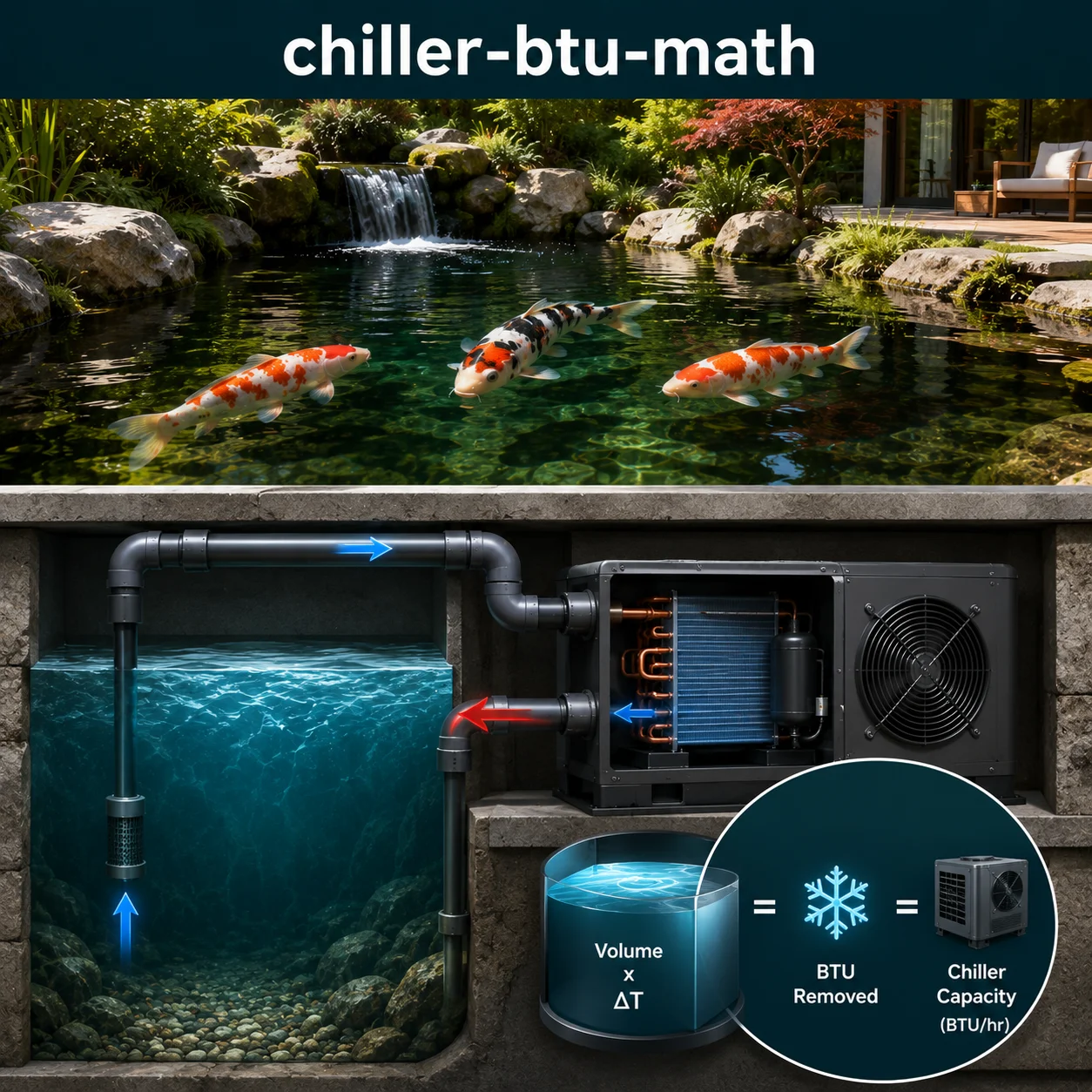
Chiller Titanium Exchanger BTU Sizing and Thermal Pull-Down Math
Proper chiller sizing for a koi pond is not a matter of matching tank volume to a manufacturer’s catalog rating — it requires calculating the actual heat load the pond will experience under worst-case conditions, then selecting a chiller with sufficient BTU capacity to maintain target temperature during peak ambient heat gain. The fundamental formula is straightforward: one BTU is the energy required to raise or lower one pound of water by one degree Fahrenheit. With a pond’s water weighing approximately 8.33 pounds per gallon, cooling a 1,000-gallon system by 1°F requires 8,330 BTUs of heat removal. But the chiller must also overcome ongoing heat gain from solar radiation, ambient air temperature, pump energy, and metabolic heat from fish — all of which must be accounted for in the sizing math.
This page works through the practical engineering behind chiller selection: calculating total dynamic heat load, understanding the relationship between BTU rating, flow rate, and delta-T, the thermal pull-down time formula, titanium heat exchanger performance characteristics, and the real-world compromises between chiller capacity, electrical service, noise, and cost. None of the guidance here is a universal rule — pond depth, surface area, shade, pump wattage, fish load, and local climate all shift the numbers, so every design decision needs to be checked against the specific system rather than a rule of thumb.
Chiller BTU Math Challenge
Work through ten advanced questions covering BTU calculations, thermal load analysis, pull-down time, titanium exchanger sizing, and chiller selection. Each answer includes the engineering reasoning behind it.
Chiller BTU Sizing — Quick Facts
Most Asked Questions About Chiller BTU Sizing
A 4,500-gallon koi pond in Arizona was installed with a chiller sized using the manufacturer’s “up to 5,000 gallons” rating. On the first hot day (112°F ambient), the chiller ran continuously but could not pull the water below 84°F — the target was 76°F. The heat load calculation revealed the error: the pond had 350 square feet of exposed surface receiving direct sun, adding ~100,000 BTU/hr of solar gain alone. The pump was a 350W unit adding ~1,200 BTU/hr. The 36,000 BTU/hr chiller was simply overwhelmed.
The solution was to install 70% shade cloth over the pond, reducing solar gain by ~65% (to ~35,000 BTU/hr) and upgrading to a 60,000 BTU/hr chiller with a titanium heat exchanger. The combined changes brought the system into balance, with the chiller cycling on hot days rather than running continuously.
Heat Load Components and Calculation Methodology
Accurate chiller sizing requires a systematic approach to heat load calculation. The five primary components are:
- Solar Radiation: The largest heat source for most ponds. Peak solar flux is approximately 1,000 W/m² (317 BTU/hr/ft²) at the Earth’s surface. Of this, roughly 60-70% is absorbed by the water, depending on water clarity, depth, and surface reflectivity. A typical peak absorption rate is 250-350 BTU/hr per square foot of exposed surface. Partial shade, water depth, and surface agitation (which increases reflectivity) all reduce this figure.
- Ambient Air Conduction: Heat transfer from the air to the pond surface is governed by Q = U × A × ΔT, where U is the overall heat transfer coefficient (typically 4-8 BTU/hr-ft²-°F for still water, higher with wind or surface agitation), A is the surface area, and ΔT is the temperature difference between the air and water. On a 100°F day with 80°F water, the conduction load is 4-8 × A × 20 = 80-160 BTU/hr per square foot of surface.
- Pump Heat: Every watt of pump power ultimately ends up as heat in the water. The conversion is 3.41 BTU/hr per watt. A 300W pump adds ~1,023 BTU/hr, which may not seem significant but becomes substantial with multiple pumps (filtration pump, skimmer pump, water feature pump).
- Metabolic Heat: Fish produce heat through metabolism. For koi, the heat production is approximately 1-2 BTU/hr per pound of fish, with larger fish producing more heat per pound than smaller fish. A pond with 500 pounds of koi produces 500-1,000 BTU/hr of metabolic heat.
- Evaporative Cooling: Water evaporating from the pond surface removes heat (approximately 1,000 BTU per pound of water evaporated). This is a cooling effect, not a heat source. It becomes negligible in high humidity and is often ignored in chiller sizing calculations to provide a conservative safety margin.
The total heat load is the sum of the four positive components minus evaporative cooling. For conservative sizing, evaporative cooling is ignored, and a 15-20% safety margin is added to the total to account for unmeasured heat sources, equipment derating, and future system expansion.
The Thermodynamics of Titanium Heat Exchanger Performance
Titanium’s thermal conductivity (approximately 14 W/m·K) is significantly lower than copper (401 W/m·K) or cupronickel (30-40 W/m·K). This might suggest titanium is a poor heat exchanger material, but the comparison is misleading: heat exchanger performance is determined primarily by the heat transfer coefficient on the water and refrigerant sides, not by the tube wall conductivity. The tube wall thermal resistance in a typical chiller evaporator is a small fraction (typically 1-5%) of the total thermal resistance. The dominant resistances are the convective heat transfer coefficients on the water side (which is enhanced by turbulent flow) and the refrigerant side (two-phase boiling heat transfer). Titanium’s corrosion resistance allows thinner walls than copper alloys in aggressive environments, potentially offsetting its lower conductivity. In practice, titanium exchangers achieve 95%+ of the heat transfer performance of a similarly designed cupronickel exchanger.
A chiller installation with a cupronickel heat exchanger was showing signs of corrosion after 18 months in a koi pond where salt (0.1%) was being used for parasite treatment. The corrosion was concentrated on the water-side surface, creating pitting that reduced heat transfer efficiency by approximately 30% and eventually led to a refrigerant leak.
The replacement chiller specified a titanium heat exchanger, which showed no signs of corrosion after 3 years of operation under the same salt treatment protocol. The additional cost was approximately $800 for the titanium upgrade, which was justified by the extended service life and eliminated the risk of refrigerant leakage into the pond.
Chiller Selection and Installation Considerations
Selecting the correct chiller involves more than matching BTU ratings. Key considerations include: (1) Ambient temperature range — chiller capacity decreases as ambient temperature increases; (2) Electrical service requirements — high-BTU chillers often require 220-240V circuits and significant amperage; (3) Noise level — water-cooled chillers are quieter than air-cooled units but require a cooling tower or well water; (4) Installation location — air-cooled chillers require adequate airflow for the condenser, typically 2-3 feet of clearance on all sides; (5) Plumbing connections — minimum pipe size, proper bypass arrangements, and flow rate optimization; (6) Controller integration — compatibility with the pond’s existing automation system.
A common installation error is undersizing the pump that feeds the chiller. The chiller’s heat exchanger requires a specific flow rate (typically 3-5 GPM per ton) to achieve rated performance. Too little flow causes the water to freeze in the evaporator; too much flow reduces the residence time and lowers the temperature drop, reducing efficiency. Matching the chiller pump to the chiller’s flow requirements, not just the pond’s circulation needs, is essential for proper operation.
During a chiller upgrade on a 3,500-gallon pond, the existing 1/2 HP pump was retained to feed the new 2-ton chiller. The chiller’s specification sheet required 7-10 GPM; the pump delivered 12 GPM at the chiller’s pressure drop. The high flow rate reduced the temperature drop across the evaporator to only 2°F, causing the chiller to short-cycle and never achieve stable temperature control.
Installing a flow regulator and bypass loop to reduce the flow through the chiller to 8 GPM (while maintaining the higher flow for the rest of the pond circuit) resolved the issue. The chiller now runs in 25-30 minute cycles and maintains target temperature within ±0.5°F.
Chiller BTU Math — Full Question Library
Review indexed engineering questions below.
Q1:
What is the weight of one gallon of water in pounds, used in BTU calculations?
Correct Answer: Option A
One US gallon of water weighs approximately 8.33 pounds at 60°F. This is the standard weight used in BTU calculations: BTU = Gallons × 8.33 × ΔT.
Q2:
What is a BTU (British Thermal Unit) defined as?
Correct Answer: Option B
A BTU (British Thermal Unit) is defined as the amount of heat required to raise the temperature of one pound of water by one degree Fahrenheit at a constant pressure.
Q3:
How many BTUs are required to cool a 1,000-gallon pond by 10°F?
Correct Answer: Option A
Using the formula: BTUs = Gallons × 8.33 × ΔT = 1,000 × 8.33 × 10 = 83,300 BTUs. This is the total energy removed, not the rate (BTU/hr).
Q4:
If a chiller is rated at 36,000 BTU/hr, how many tons of cooling is this?
Correct Answer: Option C
One ton of cooling equals 12,000 BTU/hr. Therefore, 36,000 BTU/hr ÷ 12,000 = 3.0 tons. This is the standard measure used in the HVAC and chiller industry.
Q5:
What is the formula for calculating BTUs required for a pond temperature change?
Correct Answer: Option B
The standard formula for calculating the BTUs required to change the temperature of a given volume of water is: BTU = Gallons × 8.33 × ΔT, where ΔT is the temperature change in °F.
Q6:
How many BTUs are equivalent to 1 kilowatt-hour (kWh) of electrical energy?
Correct Answer: Option A
1 kWh = 3,412 BTUs. This conversion is used to calculate the heat added to the pond from pump energy: Pump BTU/hr = Pump Watts × 3.412.
Q7:
What is the approximate specific heat of water in BTU/lb-°F?
Correct Answer: Option C
Water has a specific heat of approximately 1.0 BTU/lb-°F. This means it takes 1 BTU to raise 1 pound of water by 1°F, which is the basis of the BTU formula.
Q8:
A 5,000-gallon pond needs to be cooled from 82°F to 76°F. How many total BTUs must be removed?
Correct Answer: Option A
BTU = 5,000 × 8.33 × (82 − 76) = 5,000 × 8.33 × 6 = 5,000 × 49.98 = 249,900 BTUs.
Q9:
If a 3-ton chiller operates for 8 hours, how many BTUs of cooling does it deliver?
Correct Answer: Option B
3 tons = 36,000 BTU/hr. Total BTUs = 36,000 × 8 = 288,000 BTUs.
Q10:
What is the COP (Coefficient of Performance) of a chiller that moves 36,000 BTU/hr while consuming 3.5 kW of power?
Correct Answer: Option C
COP = Cooling Output (BTU/hr) ÷ Power Input (BTU/hr). Power Input = 3.5 kW × 3,412 = 11,942 BTU/hr. COP = 36,000 ÷ 11,942 = 3.01. Typical pond chillers have COP of 2.5-4.0.
Q11:
What is the typical peak solar radiation heat gain per square foot of exposed pond surface?
Correct Answer: Option B
Peak solar radiation on a clear summer day provides approximately 250-350 BTU/hr per square foot of exposed pond surface. This is the largest single heat source for most ponds.
Q12:
How much heat does a 300W pond pump add to the water per hour?
Correct Answer: Option A
Pump heat = Watts × 3.412 BTU/hr per watt = 300 × 3.412 = 1,023.6 BTU/hr. All pump energy ultimately ends up as heat in the water.
Q13:
What is the typical metabolic heat production rate for koi?
Correct Answer: Option C
Koi produce approximately 1-2 BTU/hr per pound of body weight, with higher rates for larger, more active fish. A 500-pound population adds 500-1,000 BTU/hr.
Q14:
What is the ambient air conduction heat transfer rate for a pond with 200 ft² surface, air at 95°F, water at 78°F, and U = 5 BTU/hr-ft²-°F?
Correct Answer: Option B
Q = U × A × ΔT = 5 × 200 × (95 − 78) = 5 × 200 × 17 = 17,000 BTU/hr.
Q15:
Which heat source is typically the largest contributor to pond heat load?
Correct Answer: Option A
Solar radiation is typically the largest heat source for outdoor ponds, contributing 60-80% of the total heat load on a sunny day.
Q16:
A pond has 500W of pumps, 200W of UV sterilizer, and 50W of aerator. What is the total equipment heat addition?
Correct Answer: Option C
Total power = 500 + 200 + 50 = 750W. Heat = 750 × 3.412 = 2,559 BTU/hr.
Q17:
How does evaporative cooling affect the net heat load of a pond?
Correct Answer: Option B
Evaporative cooling removes heat from the water. Each pound of evaporated water removes approximately 1,000 BTUs. However, this effect is often ignored in conservative chiller sizing.
Q18:
A pond has 400 ft² of surface area exposed to sun. What is the approximate peak solar heat gain?
Correct Answer: Option A
Solar heat gain = Surface Area × 250-350 BTU/hr/ft² = 400 × (250-350) = 100,000-140,000 BTU/hr.
Q19:
How much heat does a 1,000-pound koi population add to a pond?
Correct Answer: Option A
At 1-2 BTU/hr per pound, 1,000 pounds of koi produces 1,000-2,000 BTU/hr of metabolic heat.
Q20:
What effect does wind have on pond heat gain?
Correct Answer: Option B
Wind increases evaporative cooling by removing the boundary layer of humid air above the water surface. This increases cooling and reduces net heat gain.
Q21:
A 2,500-gallon pond needs a chiller. What is the minimum recommended BTU size for a moderate climate?
Correct Answer: Option B
Rule of thumb: 2,500-4,000 BTU per 1,000 gallons. For 2,500 gallons: 2.5 × (2,500-4,000) = 6,250-10,000 BTUs.
Q22:
What is the rule of thumb for chiller sizing in hot climates (100°F+ ambient)?
Correct Answer: Option A
Hot climates with sustained high ambient temperatures require 5,000-8,000 BTU per 1,000 gallons to overcome peak heat loads.
Q23:
A 4,000-gallon pond with 250 ft² surface, 300W pump, 200W UV, and a 200-lb koi population needs cooling in a moderate climate. Calculate the approximate peak load.
Correct Answer: Option C
Solar = 250 × 300 (avg) = 75,000. Pump + UV = (300+200) × 3.412 = 1,706. Metabolic = 200 × 1.5 = 300. Ambient = ~5-10,000. Total = 77,000-87,000+ BTU/hr. Round to 87,500-100,000 for margin.
Q24:
What is the recommended safety margin for chiller sizing?
Correct Answer: Option B
A 15-20% safety margin is recommended to account for derating, fouling, unmeasured heat sources, and future system expansion.
Q25:
A 3,000-gallon pond with 180 ft² surface, 500W total pumps, and 300 lbs of koi needs a chiller. What is the minimum recommended size?
Correct Answer: Option A
Solar = 180 × 300 = 54,000. Pump = 500 × 3.412 = 1,706. Metabolic = 300 × 1.5 = 450. Ambient = ~5,000-10,000. Total = ~61,000-66,000. Minimum recommended: 55,000-65,000 BTU/hr.
Q26:
Why should a chiller be sized for peak load rather than average load?
Correct Answer: Option C
Sizing for average load results in insufficient cooling during peak conditions, causing the pond temperature to rise above the setpoint on the hottest days.
Q27:
What is the EER (Energy Efficiency Ratio) of a chiller with COP of 3.5?
Correct Answer: Option A
EER = COP × 3.412 = 3.5 × 3.412 = 11.94. EER is the ratio of cooling output in BTU/hr to power input in watts.
Q28:
A chiller is rated at 24,000 BTU/hr at 80°F ambient. What is the approximate derated capacity at 100°F ambient?
Correct Answer: Option B
Chiller capacity drops 2-4% per °F above the rating point (typically 80°F). At 100°F, derate by 20°F × 2-3% = 40-60% loss, or 19,200-21,600 BTU/hr.
Q29:
What electrical service is typically required for a 3-ton (36,000 BTU) chiller?
Correct Answer: Option C
A 3-ton air-cooled chiller typically draws 15-25A at 230V, requiring a 20-30A circuit breaker. Actual amperage varies by efficiency and compressor type.
Q30:
What is the typical flow rate requirement for a 2-ton chiller?
Correct Answer: Option A
Typical flow rate is 3-5 GPM per ton. For a 2-ton chiller: 2 × (3-5) = 6-10 GPM.
Q31:
What is the primary advantage of a titanium heat exchanger in koi pond applications?
Correct Answer: Option B
Titanium is virtually immune to corrosion in pond water, saltwater, and chemical environments. This is its primary advantage over copper and cupronickel alloys.
Q32:
What is the typical cost premium for a titanium heat exchanger over cupronickel?
Correct Answer: Option A
Titanium heat exchangers typically cost 2-4 times more than cupronickel due to the higher material cost and more complex manufacturing process.
Q33:
What is the difference between a drop-in chiller and an inline chiller?
Correct Answer: Option C
Drop-in chillers have the evaporator coil placed directly in the pond water. Inline chillers are connected to the pond’s circulation system through plumbing, allowing the chiller to be located remotely.
Q34:
What is the typical lifespan of a titanium heat exchanger in a koi pond application?
Correct Answer: Option B
Titanium heat exchangers can last 15-20+ years in koi pond applications due to their excellent corrosion resistance.
Q35:
Which chiller type is generally quieter: air-cooled or water-cooled?
Correct Answer: Option A
Water-cooled chillers are generally quieter than air-cooled units because they don’t have a large, noisy condenser fan. They do, however, require a cooling tower or well water.
Q36:
What is the primary reason for using a heat pump chiller instead of a standard chiller?
Correct Answer: Option C
Heat pump chillers can reverse the refrigeration cycle to provide both heating and cooling, making them ideal for year-round temperature control.
Q37:
What is the typical clearance requirement for an air-cooled chiller installation?
Correct Answer: Option B
Air-cooled chillers typically require 2-3 feet of clearance on all sides for adequate airflow and maintenance access. Restricted airflow significantly reduces capacity.
Q38:
Why is titanium preferred over cupronickel for ponds treated with salt?
Correct Answer: Option A
Cupronickel can suffer from localized corrosion in chloride-rich environments, especially at elevated temperatures. Titanium is virtually immune to chloride attack.
Q39:
What is the typical EER (Energy Efficiency Ratio) range for modern pond chillers?
Correct Answer: Option C
Modern pond chillers typically have EER ratings of 9-14, with the most efficient units reaching 14+ EER. Higher EER = lower operating cost.
Q40:
What is the primary disadvantage of a drop-in chiller design?
Correct Answer: Option A
The exposed evaporator coil in a drop-in chiller can present a hazard to fish if not properly protected, and can be damaged by fish or debris.
Q41:
What is the minimum pipe size recommended for a 2-ton chiller?
Correct Answer: Option B
A 2-ton chiller typically requires a 1″ minimum pipe size to achieve the required 6-10 GPM flow rate with acceptable friction loss.
Q42:
What is the purpose of a bypass loop in a chiller installation?
Correct Answer: Option A
A bypass loop allows the user to adjust the flow rate through the chiller to the manufacturer’s recommended range while maintaining adequate circulation through the rest of the pond system.
Q43:
What is the typical pressure drop through a 2-ton titanium heat exchanger at rated flow?
Correct Answer: Option C
Titanium heat exchangers typically have a pressure drop of 4-8 psi at rated flow. This must be accounted for when selecting the pump for the chiller circuit.
Q44:
Why should a chiller be protected from direct sunlight?
Correct Answer: Option D
Direct sunlight can reduce chiller capacity by 10-20% by heating the condenser, can degrade electrical components over time, and can cause the chiller to overheat. Shade or shelter is recommended.
Q45:
What is the recommended approach for winterizing a chiller?
Correct Answer: Option A
To prevent freeze damage, the water should be drained from the heat exchanger and the exchanger should be blown out with air to remove all water.
Q46:
What type of valve is recommended for adjusting flow to a chiller?
Correct Answer: Option C
Globe valves provide the best flow control for chiller circuits. Ball valves are better for on/off control, while gate valves are not recommended for throttling.
Q47:
What is the typical distance limitation between a chiller and the pond?
Correct Answer: Option B
Most chiller installations can be 20-50 feet from the pond with proper pipe sizing. Longer distances require larger pipe to maintain flow rate and minimize heat gain/loss.
Q48:
Why should the chiller be installed on a firm, level surface?
Correct Answer: Option A
A firm, level surface ensures proper compressor oil return (critical for compressor longevity) and reduces vibration that can cause damage to the refrigerant lines and connections.
Q49:
What is the purpose of a flow switch in a chiller installation?
Correct Answer: Option C
A flow switch prevents the chiller from operating if the water flow is too low, which can cause the water in the evaporator to freeze and damage the heat exchanger.
Q50:
What is the recommended insulation for chiller plumbing exposed to ambient temperatures?
Correct Answer: Option B
Closed-cell foam pipe insulation provides the best protection against condensation and heat gain/loss in chiller plumbing. It should have a minimum thickness of 1/2″ for 1″ pipe.
Q51:
What is the primary difference between a scroll compressor and a reciprocating compressor?
Correct Answer: Option B
Scroll compressors have fewer moving parts and operate more quietly than reciprocating compressors. They are also more reliable and efficient in the typical operating range of pond chillers.
Q52:
What type of chiller uses a cooling tower or well water for heat rejection?
Correct Answer: Option A
Water-cooled chillers reject heat to a cooling tower, well water, or municipal water. They are generally more efficient than air-cooled chillers but require a separate water source.
Q53:
What is an inverter-driven chiller?
Correct Answer: Option C
Inverter-driven chillers use variable-speed compressors to match cooling output to the actual load, improving efficiency and temperature control.
Q54:
What is the typical refrigerant used in modern pond chillers?
Correct Answer: Option B
R-410A is the most common refrigerant in modern pond chillers, offering higher efficiency and zero ozone depletion potential compared to R-22.
Q55:
What is the advantage of a heat pump chiller over a standard chiller?
Correct Answer: Option A
Heat pump chillers can reverse the refrigeration cycle to provide both heating and cooling, making them versatile for year-round temperature control.
Q56:
What is the typical efficiency loss when using a water-cooled chiller with a cooling tower?
Correct Answer: Option C
Water-cooled chillers are typically 15-25% more efficient than air-cooled chillers because the cooling water temperature is lower than the ambient air temperature, improving condenser efficiency.
Q57:
What is the primary advantage of a brazed plate heat exchanger over a tube-in-tube design?
Correct Answer: Option B
Brazed plate heat exchangers provide high heat transfer efficiency in a compact footprint due to the large surface area-to-volume ratio and turbulent flow patterns.
Q58:
What is the typical noise level of a residential pond chiller?
Correct Answer: Option A
Typical residential pond chillers produce 50-60 dB of noise at normal operating conditions, comparable to a refrigerator or dishwasher.
Q59:
What is the primary maintenance requirement for a titanium heat exchanger?
Correct Answer: Option C
Titanium heat exchangers require minimal maintenance beyond regular inspection for biofouling and cleaning if necessary. They do not require sacrificial anodes.
Q60:
What is the purpose of a chiller’s expansion valve?
Correct Answer: Option A
The expansion valve (or thermal expansion valve – TXV) regulates the flow of liquid refrigerant into the evaporator, controlling the superheat and ensuring optimal evaporator performance.
Q61:
What is the relationship between chiller COP and operating cost?
Correct Answer: Option B
COP (Coefficient of Performance) is the ratio of cooling output to power input. Higher COP means more cooling per watt of electricity, resulting in lower operating costs.
Q62:
How much does it cost to operate a 2-ton chiller (COP = 3.0) for 8 hours at $0.15/kWh?
Correct Answer: Option A
2 tons = 24,000 BTU/hr. Power input = 24,000 ÷ (3.0 × 3.412) = 24,000 ÷ 10.236 = 2,345W = 2.345 kW. Energy = 2.345 × 8 = 18.76 kWh. Cost = 18.76 × $0.15 = $2.81 (using COP 3.0).
Q63:
What is the typical annual operating cost difference between a COP 2.5 and COP 3.5 chiller for the same cooling load?
Correct Answer: Option C
Power input is inversely proportional to COP. The COP 3.5 chiller uses 3.5/2.5 = 1.4 times less power for the same cooling, representing a 28.6% reduction in operating cost.
Q64:
What is the effect of a dirty condenser coil on chiller efficiency?
Correct Answer: Option B
A dirty condenser coil reduces heat rejection, causing higher condensing temperatures and pressures. This increases compressor power consumption and reduces cooling capacity.
Q65:
What is the energy savings from using an inverter-driven chiller vs a fixed-speed unit?
Correct Answer: Option A
Inverter-driven chillers can save 30-50% on energy costs by matching cooling output to the actual load, reducing cycling losses and operating at higher efficiency at partial load.
Q66:
What is the payback period typically for upgrading from a standard chiller to a high-efficiency titanium unit?
Correct Answer: Option C
The payback period for a high-efficiency titanium chiller upgrade is typically 3-5 years, depending on local electricity rates and usage hours.
Q67:
What is the typical SEER rating of a modern high-efficiency pond chiller?
Correct Answer: Option B
Modern high-efficiency pond chillers typically have SEER ratings of 13-16, with the most efficient units reaching 17+ SEER.
Q68:
How does increasing the water flow rate through a chiller affect its efficiency?
Correct Answer: Option A
Higher flow rates improve the water-side heat transfer coefficient, increasing evaporator efficiency. However, above the optimal flow rate, pump power increases without further improving chiller efficiency.
Q69:
What is the typical power consumption of a 1.5-ton air-cooled chiller?
Correct Answer: Option C
A 1.5-ton air-cooled chiller (18,000 BTU/hr) typically consumes 1.3-1.8 kW, depending on efficiency and ambient conditions.
Q70:
What is the benefit of installing the chiller’s condenser in a shaded, well-ventilated area?
Correct Answer: Option A
A shaded, well-ventilated location reduces the condenser air temperature, lowering condensing pressure and improving chiller efficiency and capacity by 5-15%.
Q71:
How does a heat pump chiller provide both heating and cooling?
Correct Answer: Option B
A reversing valve changes the direction of refrigerant flow, allowing the unit to function as either a chiller (cooling) or a heat pump (heating).
Q72:
What is the typical COP of a heat pump in heating mode compared to cooling mode?
Correct Answer: Option A
Heat pumps typically have slightly higher COP in heating mode than cooling mode because the temperature lift (the difference between source and sink temperatures) is often smaller in heating.
Q73:
At what minimum water temperature can a typical heat pump chiller operate effectively?
Correct Answer: Option C
Most heat pump chillers can operate effectively with water temperatures as low as 40°F, but capacity and COP decrease as the water temperature drops.
Q74:
What is the primary advantage of a heat pump chiller over a standard chiller for koi ponds?
Correct Answer: Option B
Heat pump chillers provide both heating and cooling from a single unit, making them ideal for year-round temperature control in koi ponds.
Q75:
What is the typical temperature range for a heat pump chiller’s heating operation?
Correct Answer: Option A
Heat pump chillers typically heat water to 70-85°F, which is ideal for koi ponds. They are not designed for high-temperature heating like pool heaters.
Q76:
What is the typical seasonal efficiency of a heat pump chiller compared to a standard chiller?
Correct Answer: Option C
Heat pump chillers can be more efficient year-round because they use the same refrigeration cycle for both heating and cooling, reducing the need for separate equipment.
Q77:
What is the primary limitation of heat pump chillers in cold climates?
Correct Answer: Option B
Heat pump heating capacity and efficiency decrease as the ambient temperature drops because there is less heat available to extract from the outdoor air.
Q78:
What is the function of a defrost cycle in a heat pump chiller?
Correct Answer: Option A
In heating mode, frost can form on the outdoor coil (evaporator) in cold, humid conditions. The defrost cycle temporarily reverses the refrigerant flow to melt the frost.
Q79:
How does the size of a heat pump chiller compare to a standard chiller of the same capacity?
Correct Answer: Option C
Heat pump chillers are typically 10-20% larger than standard chillers of the same capacity due to the additional components required for reversing and defrost operation.
Q80:
What is the typical cost premium for a heat pump chiller compared to a standard chiller?
Correct Answer: Option A
Heat pump chillers typically cost 20-40% more than standard chillers due to the additional components (reversing valve, defrost controls, etc.) required for heating operation.
Q81:
What is the formula for calculating chiller pull-down time?
Correct Answer: Option B
The net cooling available is the chiller capacity minus the ongoing heat gain rate. This formula provides a more accurate estimate of pull-down time than using gross chiller capacity.
Q82:
A 3,000-gallon pond at 84°F needs to reach 76°F. A 36,000 BTU/hr chiller is installed with a heat gain rate of 8,000 BTU/hr. How long will the pull-down take?
Correct Answer: Option A
Net cooling = 36,000 − 8,000 = 28,000 BTU/hr. BTUs required = 3,000 × 8.33 × 8 = 199,920. Hours = 199,920 ÷ 28,000 = 7.14 hours.
Q83:
How does the heat gain rate affect the pull-down time as the pond approaches the target temperature?
Correct Answer: Option C
As the pond temperature drops, the temperature difference between the water and ambient air decreases, reducing the heat gain rate. This makes the pull-down slightly faster than the linear estimate.
Q84:
A 4,000-gallon pond requires cooling from 86°F to 75°F. The chiller provides 48,000 BTU/hr and the heat gain rate is 12,000 BTU/hr. What is the pull-down time?
Correct Answer: Option B
BTUs required = 4,000 × 8.33 × 11 = 366,520. Net cooling = 48,000 − 12,000 = 36,000. Hours = 366,520 ÷ 36,000 = 10.18 hours.
Q85:
What is the effect of increasing chiller size on pull-down time?
Correct Answer: Option A
Pull-down time is inversely proportional to the net cooling capacity (chiller capacity minus heat gain). Doubling the chiller size approximately halves the pull-down time.
Q86:
Why is a longer pull-down time sometimes acceptable in practice?
Correct Answer: Option C
Gradual cooling (over 8-24 hours) is less stressful for koi and reduces the risk of thermal shock. It also allows the chiller to operate more efficiently at partial load.
Q87:
What is the maximum recommended pull-down rate for koi ponds?
Correct Answer: Option B
A maximum pull-down rate of 2-3°F per hour is recommended to avoid thermal shock to koi. Faster rates can stress fish and compromise their immune systems.
Q88:
A 1,500-gallon pond is 82°F and needs to be 76°F. A 24,000 BTU/hr chiller with 5,000 BTU/hr heat gain is used. What is the pull-down time?
Correct Answer: Option A
BTUs required = 1,500 × 8.33 × 6 = 74,970. Net cooling = 24,000 − 5,000 = 19,000. Hours = 74,970 ÷ 19,000 = 3.95 hours.
Q89:
How does the pond’s thermal mass affect pull-down time?
Correct Answer: Option D
The formula already accounts for thermal mass through the gallons × 8.33 × ΔT term. Higher thermal mass means more water volume or higher heat capacity, requiring more energy removal and longer pull-down time.
Q90:
What is the typical pull-down time target for a well-designed chiller system?
Correct Answer: Option A
A well-designed chiller system typically achieves pull-down in 8-24 hours, balancing equipment cost, operating efficiency, and fish welfare.
Q91:
What is the most common cause of chiller short-cycling?
Correct Answer: Option B
Short-cycling occurs when the chiller is oversized for the load, causing it to reach the setpoint quickly and shut off, then turn on again soon after. This reduces efficiency and increases wear.
Q92:
What is a symptom of low refrigerant charge in a chiller?
Correct Answer: Option A
Low refrigerant charge causes reduced cooling capacity, evaporator icing, and high superheat (the temperature difference between the evaporator outlet and the refrigerant boiling point).
Q93:
What causes high discharge pressure in a chiller?
Correct Answer: Option C
High discharge pressure is typically caused by a dirty or restricted condenser coil, insufficient condenser airflow, or non-condensable gases in the system.
Q94:
What does a frozen evaporator in a chiller typically indicate?
Correct Answer: Option B
A frozen evaporator typically indicates low water flow (water-side heat transfer insufficient) or low refrigerant charge (evaporating temperature too low). A flow switch or water flow check should be the first step.
Q95:
What is the most common electrical failure in a pond chiller?
Correct Answer: Option B
Capacitor failure is the most common electrical failure in pond chillers, affecting both compressor and fan motors. Regular replacement (every 3-5 years) is recommended.
Q96:
How can you test the water flow through a chiller without a flow meter?
Correct Answer: Option C
Using the heat balance equation: Q = Flow × 8.33 × ΔT. If the chiller capacity (Q) and the temperature drop (ΔT) are known, the approximate flow can be calculated.
Q97:
What is the typical sign of a failing compressor in a chiller?
Correct Answer: Option B
A failing compressor typically produces loud noise and vibration and provides reduced cooling capacity. The compressor may also draw higher-than-normal current.
Q98:
What is the first step when troubleshooting a chiller that is not cooling?
Correct Answer: Option A
The first step in troubleshooting should always be the simplest: verify power is supplied to the unit and the thermostat/controller is set correctly and calling for cooling.
Q99:
What is the recommended inspection frequency for a titanium heat exchanger?
Correct Answer: Option C
An annual inspection of the titanium heat exchanger is recommended to check for biofouling, scale buildup, and signs of corrosion. Cleaning should be performed as needed.
Q100:
What is the typical cost of a refrigerant recharge for a pond chiller?
Correct Answer: Option A
A typical refrigerant recharge for a residential pond chiller costs $200-400, including diagnostic time, refrigerant, and labor. R-410A refrigerant costs approximately $50-100 per pound.