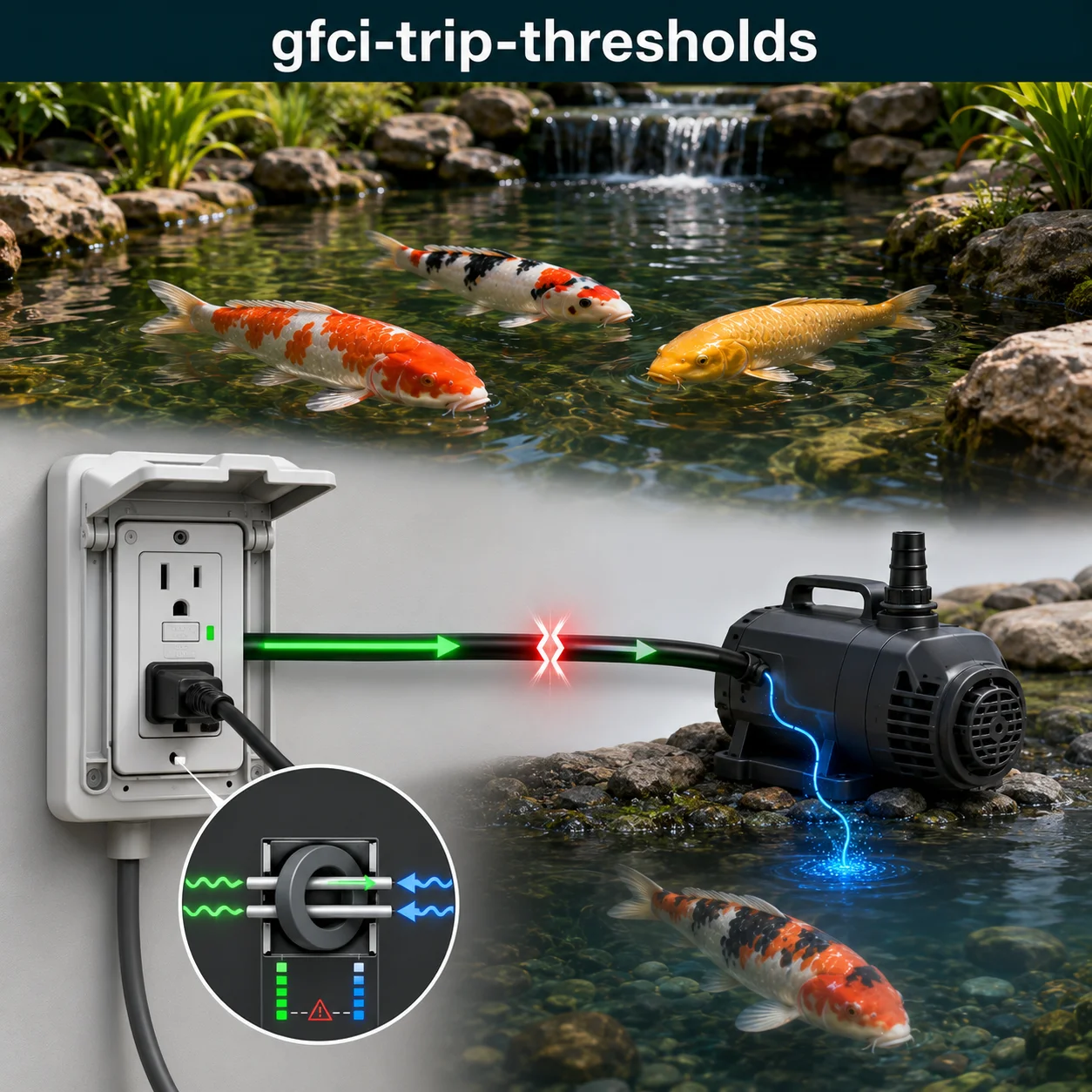
GFCI Circuit Interrupter Trip Thresholds and Leakage Current Isolation
A Ground Fault Circuit Interrupter (GFCI) — also known as a Residual Current Device (RCD) — is a critical safety device that protects people from electrical shock by monitoring the current balance between the hot and neutral conductors. When the differential current exceeds a threshold of typically 4-6 mA (5 mA nominal), the GFCI trips in 25-40 milliseconds, disconnecting the circuit before a lethal shock can occur. In a koi pond environment — where pumps, UV sterilizers, heaters, and other equipment operate in wet conditions — GFCIs are essential for both human safety and equipment protection. However, nuisance tripping from normal leakage currents (capacitive coupling, motor leakage, dampness) can be a persistent problem that frustrates pond owners and undermines confidence in the protection system.
This page works through the practical engineering behind GFCI protection for koi ponds: the operating principles of GFCIs, trip thresholds and response times, sources of leakage current, nuisance tripping causes and mitigation, isolation techniques, proper installation practices, code compliance requirements, and troubleshooting strategies. None of the guidance here is a universal rule — equipment age, environmental conditions, wiring configurations, and specific devices all shift the leakage current profile, so every design decision needs to be checked against the specific system rather than a rule of thumb.
GFCI Circuit Interrupter Challenge
Work through ten advanced questions covering GFCI operation, trip thresholds, leakage current sources, nuisance tripping mitigation, and code compliance. Each answer includes the engineering reasoning behind it.
GFCI Circuit Interrupter — Quick Facts
Most Asked Questions About GFCI Circuit Interrupters
An 8,000-gallon koi pond with three pumps, two UV sterilizers, and a heater was experiencing frequent GFCI tripping — sometimes multiple times per day, often during the night when no one was near the pond. The owner was frustrated and was considering removing the GFCI protection entirely.
Investigation revealed that the cumulative leakage current from all devices was 4.8 mA, just below the GFCI’s 5 mA threshold under normal conditions. However, during periods of high humidity (nighttime dew), the leakage increased to 5.5-6.0 mA, causing the GFCI to trip. The solution was to separate the equipment onto three individual GFCI breakers (pumps on one, UVs on another, heater on the third) and install GFCI receptacles for each device. The individual leakage currents were now 1.8 mA, 1.2 mA, and 1.5 mA — each well below the threshold. The nuisance tripping stopped completely.
GFCI Operating Principles and Trip Characteristics
A GFCI continuously monitors the current balance between the hot (ungrounded) and neutral (grounded) conductors. It consists of three main components:
- Differential Current Transformer: A toroidal transformer with both the hot and neutral conductors passing through the core. Under normal conditions, the currents are equal and opposite, producing zero net flux. When leakage current flows to ground (through a person or faulty equipment), the currents are no longer balanced, and the net flux is non-zero.
- Signal Processing Circuit: Amplifies the transformer output and compares it to the trip threshold (4-6 mA for Class A). The circuit includes filtering to reject noise and prevent nuisance tripping from transient currents.
- Interrupting Mechanism: When the differential current exceeds the threshold, the circuit energizes a solenoid that mechanically trips the contacts, disconnecting the circuit.
The trip time is inversely proportional to the differential current: at 6 mA, the trip time is typically 25-40 ms; at 10 mA, it is 15-25 ms; at 100 mA, it is 10-15 ms. The fast trip time ensures that the total current exposure before disconnection is well below the level that can cause ventricular fibrillation.
Leakage Current Sources and Accumulation
Leakage current in pond equipment comes from several sources that accumulate on a circuit, often causing nuisance tripping when the total exceeds the GFCI threshold:
- Motor Leakage: All AC motors have some leakage current due to capacitive coupling between the windings and the motor frame. New motors typically have 0.5-1.5 mA leakage at 120V; older motors with deteriorating insulation can have 2-5 mA or more. Submersible pumps are particularly prone to leakage because the windings are in direct contact with water.
- Capacitive Coupling: The capacitance between conductors in cables and between conductors and ground causes leakage current. For standard 14/2 NM cable, the capacitance is approximately 1-2 pF/ft. At 120V, 60 Hz, this translates to approximately 0.1-0.2 mA per 100 feet. Long cable runs can add significant leakage.
- VFD Leakage: Variable Frequency Drives generate high-frequency PWM signals that couple to ground through the motor cable capacitance. VFD leakage can be 1-10 mA or more, making them a common cause of nuisance tripping.
- UV Sterilizer Leakage: UV sterilizers with water-cooled ballasts can have 0.5-2 mA leakage. The leakage often increases with age as moisture enters the ballast housing.
- Heater Leakage: Electric heaters (immersion or inline) can have 1-5 mA leakage, especially if the heating element is in contact with water.
The total leakage current on a circuit is the sum of the individual leakage currents. If this sum exceeds 4-6 mA, the GFCI will trip. For example, a circuit with a pump (1.5 mA), a UV (1.0 mA), a heater (1.5 mA), and 150 feet of cable (0.3 mA) has a total leakage of 4.3 mA — below the threshold. Adding a second pump (1.5 mA) would bring the total to 5.8 mA, causing nuisance tripping.
A pond with a 3HP submersible pump and 200 feet of cable was experiencing intermittent GFCI tripping. The tripping occurred most frequently during the night when the ambient temperature dropped and humidity increased. The owner had replaced the GFCI twice without improvement.
Leakage current measurements with a clamp meter revealed that the pump had a leakage current of 2.8 mA at 120V, and the 200-foot cable added 0.8 mA of capacitive leakage. The total of 3.6 mA was below the threshold of most GFCIs, but when the ambient temperature dropped to 50°F, the pump’s leakage increased to 4.2 mA, and the total exceeded 5.0 mA. The solution was to replace the pump with a newer model (leakage 1.2 mA) and reduce the cable length to 50 feet by moving the GFCI closer to the pond. The total leakage was reduced to 1.5 mA, and the tripping stopped.
GFCI Isolation and Installation Best Practices
Proper installation is critical for reliable GFCI operation in pond applications. Key best practices include:
- Separate Circuits: Use individual GFCI breakers or receptacles for each major piece of equipment (pumps, UVs, heaters). This keeps leakage currents on each circuit below the 5 mA threshold.
- Short Cable Runs: Keep cable runs as short as possible. If cable lengths exceed 100 feet, use a GFCI at the equipment end rather than the panel to reduce capacitive leakage.
- Isolation Transformers: For equipment with high leakage current (VFDs, old pumps), use an isolation transformer to create a separately derived system that is not referenced to ground. The transformer isolates the leakage current from the upstream GFCI.
- Proper Grounding: Ensure all equipment is properly grounded. The GFCI’s neutral and ground conductors must be separated (not bonded together) downstream of the GFCI. Do not daisy-chain GFCIs.
- Weatherproof Enclosures: Use weatherproof enclosures for all outdoor GFCI receptacles (UL 943 compliant). Keep moisture out of junction boxes to prevent leakage.
- Regular Testing: Test GFCIs monthly using the test button. Use a GFCI tester to verify trip threshold and trip time annually.
For critical equipment (life support, filtration), consider using two separate GFCI circuits with independent equipment, so that the failure of one circuit does not compromise the entire system.
A 5HP VFD-controlled pump on a 4,500-gallon pond was tripping the GFCI breaker every time it started up. The VFD’s leakage current was measured at 8 mA during startup, well above the 5 mA threshold. The pump was critical for filtration, and the owner could not operate without it.
The solution was to install a 1:1 isolation transformer (5 KVA) between the VFD and the GFCI. The transformer created a separately derived system for the VFD, isolating the leakage current from the upstream GFCI. The GFCI now protected the transformer’s primary circuit (which had negligible leakage), while the VFD operated on the secondary with no GFCI protection. The system has been operating reliably for over three years with no nuisance tripping.
GFCI Circuit Interrupter — Full Question Library
Review indexed engineering questions below.
Q1:
What does GFCI stand for?
Correct Answer: Option A
GFCI stands for Ground Fault Circuit Interrupter — a device that protects people from electrical shock by detecting leakage current to ground and disconnecting the circuit.
Q2:
What is the trip threshold of a Class A GFCI in North America?
Correct Answer: Option C
A Class A GFCI trips when the differential current exceeds 4-6 mA, with a nominal trip threshold of 5 mA. This is the standard for residential and commercial GFCI protection.
Q3:
What is the typical trip time of a GFCI at 6 mA?
Correct Answer: Option B
At 6 mA, the GFCI typically trips in 25-40 ms. The trip time is faster at higher currents (15-25 ms at 10 mA, 10-15 ms at 100 mA).
Q4:
What is the operating principle of a GFCI?
Correct Answer: Option A
A GFCI continuously compares the current in the hot and neutral conductors. If the currents are not equal (a difference of 4-6 mA or more), the GFCI trips.
Q5:
What is the purpose of the test button on a GFCI?
Correct Answer: Option C
The test button creates a small leakage current (typically 6-8 mA) to simulate a ground fault and verify that the GFCI trips properly. It should be tested monthly.
Q6:
What is the difference between a GFCI receptacle and a GFCI breaker?
Correct Answer: Option B
A GFCI breaker provides protection for the entire circuit, including all wiring. A GFCI receptacle provides protection at the outlet location and downstream outlets.
Q7:
What is the nominal trip current for a Class A GFCI?
Correct Answer: Option A
The nominal trip current for a Class A GFCI is 5 mA. The actual trip point is 4-6 mA to account for manufacturing tolerances.
Q8:
What is the trip threshold for a Class B GFCI?
Correct Answer: Option C
Class B GFCIs (typically used for swimming pool equipment) trip at 20-30 mA. Class A GFCIs (4-6 mA) are the standard for most residential and commercial applications.
Q9:
What happens to the GFCI if the neutral and ground are bonded downstream of the GFCI?
Correct Answer: Option B
If neutral and ground are bonded downstream of the GFCI, some of the neutral current can flow through the ground path, causing an imbalance that trips the GFCI.
Q10:
What is the maximum response time allowed for a GFCI at the trip threshold?
Correct Answer: Option A
UL 943 requires that a GFCI trip within 200 ms at the trip threshold (4-6 mA). At higher currents, the trip time must be faster.
Q11:
What is the typical leakage current from a new submersible pump at 120V?
Correct Answer: Option B
A new submersible pump typically has 0.5-1.5 mA leakage current. Older pumps with deteriorating insulation can have 2-5 mA or more.
Q12:
What is the primary source of leakage current in a motor?
Correct Answer: Option A
The primary source of leakage current in a motor is capacitive coupling between the motor windings and the motor frame. This is inherent to the motor design and increases with motor size.
Q13:
What is the typical leakage current from a VFD (Variable Frequency Drive)?
Correct Answer: Option C
VFDs generate significant leakage current (1-10 mA) due to the high-frequency PWM switching and capacitive coupling through the motor cable. This often causes nuisance tripping of GFCIs.
Q14:
What is the typical leakage current from a UV sterilizer?
Correct Answer: Option B
UV sterilizers typically have 0.3-2 mA leakage current, depending on the ballast design and whether the ballast is water-cooled.
Q15:
How much leakage current is generated by capacitive coupling in 100 feet of standard NM cable at 120V, 60Hz?
Correct Answer: Option A
Standard NM cable has capacitance of approximately 1-2 pF/ft. At 120V, 60 Hz, this yields approximately 0.1-0.2 mA leakage per 100 feet.
Q16:
What causes leakage current to increase in older pond equipment?
Correct Answer: Option C
As equipment ages, the insulation can degrade, allowing moisture to enter and increasing leakage current. This is especially common in submersible pumps and outdoor equipment.
Q17:
What is the typical leakage current from an electric heater in a pond?
Correct Answer: Option B
Electric heaters can have 0.5-5 mA leakage current, especially if the heating element is in contact with water or if the insulation is degraded.
Q18:
How does moisture in a junction box affect GFCI operation?
Correct Answer: Option A
Moisture in a junction box can create a conductive path between conductors and ground, creating leakage current that can trip the GFCI.
Q19:
What is the cumulative leakage current from three pumps (1.2 mA each) on a single GFCI circuit?
Correct Answer: Option C
The total leakage is the sum of the individual leakages: 1.2 × 3 = 3.6 mA. This is below the 5 mA threshold, but adding a UV or heater could exceed it.
Q20:
What is the effect of increased frequency on capacitive leakage current?
Correct Answer: Option A
Capacitive leakage current is proportional to frequency (I = 2πfCV). VFDs with high switching frequencies (2-20 kHz) generate significantly more leakage current than 60 Hz.
Q21:
What is the most common cause of GFCI nuisance tripping in pond applications?
Correct Answer: Option B
The most common cause of nuisance tripping is cumulative leakage current from multiple devices (pumps, UVs, heaters, VFDs) exceeding the 4-6 mA trip threshold.
Q22:
How can nuisance tripping caused by VFD leakage be resolved?
Correct Answer: Option A
An isolation transformer creates a separately derived system, isolating the VFD’s leakage current from the upstream GFCI, preventing nuisance tripping.
Q23:
What is the recommended solution for multiple devices on a single GFCI circuit that exceed the trip threshold?
Correct Answer: Option C
Separating devices onto individual GFCI circuits reduces the cumulative leakage current on each circuit to below the trip threshold.
Q24:
What is the effect of long cable runs on GFCI nuisance tripping?
Correct Answer: Option B
Long cable runs increase capacitive leakage current (approximately 0.1-0.2 mA per 100 feet), which can contribute to nuisance tripping.
Q25:
How does humidity affect GFCI nuisance tripping?
Correct Answer: Option A
High humidity increases leakage current by creating conductive paths through moisture on surfaces, which can cause nuisance tripping.
Q26:
What is the effect of daisy-chaining GFCI outlets?
Correct Answer: Option C
Daisy-chaining GFCIs can cause nuisance tripping (the upstream GFCI may trip due to leakage from downstream devices) and makes troubleshooting difficult.
Q27:
What is the typical leakage current threshold for a GFPE (Ground Fault Protection for Equipment)?
Correct Answer: Option B
GFPE is designed to protect equipment, not people, and trips at 30-100 mA. This is used on equipment where the normal leakage exceeds the 5 mA GFCI threshold.
Q28:
How can a faulty piece of equipment be identified as the cause of nuisance tripping?
Correct Answer: Option A
Isolating each piece of equipment and measuring leakage current with a clamp meter identifies which device is contributing the most leakage.
Q29:
What is the effect of lightning on GFCI operation?
Correct Answer: Option C
Lightning can induce surges in the power lines that can cause GFCIs to trip. Surge protectors can help reduce this.
Q30:
What is the recommended approach for troubleshooting intermittent GFCI tripping?
Correct Answer: Option B
Systematic measurement of leakage currents and isolation of equipment is the recommended approach to identify and resolve intermittent GFCI tripping.
Q31:
What is the primary purpose of an isolation transformer in a GFCI circuit?
Correct Answer: Option A
An isolation transformer creates a separately derived system, isolating the equipment’s leakage current from the upstream GFCI, preventing nuisance tripping.
Q32:
What is a separately derived system in the context of GFCI protection?
Correct Answer: Option C
A separately derived system has a transformer with no direct connection to the utility’s grounded neutral, isolating the secondary from the primary and preventing leakage current from flowing back through the GFCI.
Q33:
How does a ground rod help with GFCI nuisance tripping?
Correct Answer: Option B
A ground rod provides a low-impedance path for fault current, which is essential for safety, but it does not prevent nuisance tripping caused by leakage currents.
Q34:
What is the advantage of using individual GFCI receptacles for each piece of equipment?
Correct Answer: Option A
Individual GFCI receptacles for each device isolate the leakage currents so that the cumulative leakage does not exceed the 5 mA threshold.
Q35:
What is the purpose of a GFCI tester?
Correct Answer: Option C
A GFCI tester creates a controlled ground fault to verify that the GFCI trips at the correct current and within the required time.
Q36:
What is the typical KVA rating required for an isolation transformer for a 2HP pond pump?
Correct Answer: Option B
A 2HP pump draws approximately 1.5-2 KVA. A 3 KVA isolation transformer provides adequate capacity with a reasonable safety margin.
Q37:
What is the effect of a neutral-ground bond downstream of a GFCI?
Correct Answer: Option A
A neutral-ground bond downstream of a GFCI creates an alternate path for neutral current, causing an imbalance that can trip the GFCI.
Q38:
What is the recommended practice for GFCI protection of VFD-controlled pumps?
Correct Answer: Option C
VFDs generate significant leakage current. An isolation transformer on the VFD input (between the GFCI and the VFD) is the recommended approach to prevent nuisance tripping.
Q39:
What is the purpose of a ground fault relay in a panel?
Correct Answer: Option B
A ground fault relay provides adjustable trip thresholds (typically 30-100 mA) for equipment protection (GFPE) and is used where the normal leakage exceeds the GFCI threshold.
Q40:
What is the recommended practice for wiring multiple GFCIs on the same circuit?
Correct Answer: Option A
GFCIs should not be daisy-chained. Each GFCI should be on its own circuit or wired in parallel (not through the load side of another GFCI).
Q41:
What is the recommended location for a GFCI breaker protecting pond equipment?
Correct Answer: Option B
GFCI breakers are typically installed in the main electrical panel. This protects the entire circuit, including all wiring to the pond equipment.
Q42:
What is the NEC requirement for GFCI protection of outdoor receptacles?
Correct Answer: Option A
NEC 210.8 requires GFCI protection for all outdoor receptacles, regardless of the location. This includes receptacles serving pond equipment.
Q43:
What is the NEC requirement for GFCI protection of pond equipment (NEC 680)?
Correct Answer: Option C
NEC 680 requires GFCI protection for all electrical equipment within 20 feet of a pool, pond, or fountain. This includes pumps, UV sterilizers, heaters, and lighting.
Q44:
What type of weatherproof enclosure is required for outdoor GFCI receptacles?
Correct Answer: Option B
Outdoor GFCI receptacles must be installed in a UL 943 listed weatherproof enclosure to protect against moisture and debris.
Q45:
What is the recommended wire size for a GFCI protected circuit serving a 2HP pump at 120V?
Correct Answer: Option A
A 2HP pump at 120V draws approximately 15-20A. 12 AWG wire (rated for 20A) is the minimum recommended size.
Q46:
What is the recommended installation practice for GFCI receptacles in damp locations?
Correct Answer: Option C
In damp or wet locations, GFCI receptacles must be installed in a weatherproof enclosure with a while-in-use cover that protects the outlet even when a plug is inserted.
Q47:
What is the recommended distance between the GFCI and the pond equipment?
Correct Answer: Option B
Keeping the GFCI as close as possible to the pond equipment minimizes cable length and reduces capacitive leakage current that can cause nuisance tripping.
Q48:
What is the recommended practice for wiring GFCI receptacles in a pump house?
Correct Answer: Option A
Each piece of equipment should have its own GFCI receptacle or circuit to isolate leakage currents and prevent cumulative tripping.
Q49:
What is the recommended color of a GFCI receptacle?
Correct Answer: Option C
There is no specific color requirement for GFCI receptacles. White, ivory, or other colors are acceptable. The GFCI is identified by the test and reset buttons.
Q50:
What is the recommended practice for labeling GFCI protected circuits?
Correct Answer: Option B
GFCI protected circuits should be labeled at both the panel and the receptacles to indicate that they are GFCI protected. This is important for safety and troubleshooting.
Q51:
Which NEC article covers GFCI requirements for dwelling units?
Correct Answer: Option A
NEC 210.8 covers GFCI requirements for dwelling units, including outdoor receptacles, bathroom receptacles, and kitchen countertop receptacles.
Q52:
Which NEC article covers GFCI requirements for pools, fountains, and similar installations?
Correct Answer: Option C
NEC 680 covers swimming pools, fountains, and similar installations, including GFCI requirements for equipment within 20 feet of the water.
Q53:
What is the NEC requirement for GFCI protection of equipment within 20 feet of a pond?
Correct Answer: Option B
NEC 680 requires GFCI protection for all electrical equipment within 20 feet of a pond, fountain, or similar installation.
Q54:
What is the NEC requirement for GFCI protection of receptacles within 20 feet of a pond?
Correct Answer: Option A
NEC 680.22 requires GFCI protection for all receptacles within 20 feet of a pool, pond, or fountain.
Q55:
What is the NEC requirement for GFCI protection of equipment in a pond?
Correct Answer: Option C
NEC 680.26 requires GFCI protection for all electrical equipment installed in or on a pool, pond, or fountain.
Q56:
What is the NEC requirement for GFCI protection of outdoor lighting near a pond?
Correct Answer: Option B
NEC 680.22 requires GFCI protection for lighting within 20 feet of a pool, pond, or fountain.
Q57:
What is the NEC requirement for GFCI protection of heater equipment in a pond?
Correct Answer: Option A
NEC 680.26 requires GFCI protection for all electrical equipment in or on a pond, including heaters.
Q58:
What is the NEC requirement for GFCI protection of a pond pump with a VFD?
Correct Answer: Option C
VFDs must be GFCI protected, but the installation must include proper filtering or isolation to prevent nuisance tripping due to high-frequency leakage current.
Q59:
What is the recommended frequency for GFCI testing in a pond installation?
Correct Answer: Option B
GFCIs should be tested monthly using the test button to verify proper operation. A GFCI tester should be used annually to verify trip threshold and time.
Q60:
What is the AHJ (Authority Having Jurisdiction) and why is it important?
Correct Answer: Option A
The AHJ (Authority Having Jurisdiction) is the local building department or electrical inspector who interprets and enforces the NEC. Local amendments may differ from the standard code.
Q61:
What instrument is used to measure leakage current in a GFCI circuit?
Correct Answer: Option B
A clamp-on ground leakage current meter (leakage current clamp meter) is used to measure the differential current in a GFCI circuit without disconnecting the wiring.
Q62:
How is leakage current measured in a GFCI circuit using a clamp meter?
Correct Answer: Option A
To measure leakage current, clamp the meter around both the hot and neutral conductors together. The meter measures the difference in current (the leakage current).
Q63:
What is the effect of a GFCI that fails to trip during testing?
Correct Answer: Option C
If a GFCI fails to trip during testing, the protection mechanism has failed and the device must be replaced immediately.
Q64:
What is the typical cause of a GFCI that trips immediately when a load is connected?
Correct Answer: Option B
A GFCI that trips immediately when a load is connected typically indicates a ground fault in the equipment or wiring. The equipment should be inspected and repaired.
Q65:
What is the typical cause of a GFCI that trips intermittently?
Correct Answer: Option A
Intermittent GFCI tripping is typically caused by intermittent leakage current from moisture in equipment or cables, or from equipment with variable leakage (e.g., motors starting).
Q66:
What is the recommended procedure for testing a GFCI with a GFCI tester?
Correct Answer: Option C
A GFCI tester creates a controlled ground fault to verify the trip current and time. The test button on the GFCI only verifies mechanical operation, not the trip threshold.
Q67:
What is the effect of a GFCI that trips on the load side but not on the line side?
Correct Answer: Option B
If the GFCI trips on the load side but not on the line side, the line and load connections are reversed. The GFCI must be rewired correctly to provide protection.
Q68:
What is the recommended tool for measuring leakage current in a pond pump?
Correct Answer: Option A
A clamp-on leakage current meter (with 1 mA resolution) is the appropriate tool for measuring leakage current in a pond pump or circuit.
Q69:
What is the recommended procedure for troubleshooting a GFCI that trips randomly?
Correct Answer: Option C
For random GFCI trips, measure leakage current over time to identify patterns (e.g., trips when a particular pump starts, or during rain/humidity). This helps isolate the cause.
Q70:
What is the typical lifespan of a GFCI in a pond environment?
Correct Answer: Option B
GFCIs typically last 5-10 years in a pond environment, depending on the exposure to moisture, temperature, and the number of trips. They should be replaced if they fail to trip during testing.
Q71:
Why are submersible pumps more prone to GFCI tripping than other pumps?
Correct Answer: Option B
Submersible pumps are in direct contact with water, which increases capacitive coupling and leakage current, making them more prone to GFCI tripping.
Q72:
What is the recommended GFCI protection for a submersible pond pump?
Correct Answer: Option A
A GFCI breaker in the panel provides protection for the entire circuit, including the wiring to the submersible pump. This is preferred over a receptacle, which may be affected by long cable runs.
Q73:
What is the typical leakage current from a 3HP submersible pump?
Correct Answer: Option C
A 3HP submersible pump typically has 1.5-4 mA leakage current, depending on the motor design and insulation condition. This is close to the GFCI threshold and can cause nuisance tripping.
Q74:
What is the recommended GFCI protection for a UV sterilizer in a pond system?
Correct Answer: Option B
UV sterilizers should have individual GFCI protection. A GFCI receptacle near the UV unit is often sufficient, but a GFCI breaker is also acceptable.
Q75:
What is the recommended GFCI protection for a pond heater?
Correct Answer: Option A
Pond heaters should have individual GFCI protection due to the potential for high leakage current from the heating element in water.
Q76:
What is the typical leakage current from a pond heater?
Correct Answer: Option C
Pond heaters can have 1-5 mA leakage current, especially if the heating element is in direct contact with water or if the insulation is degraded.
Q77:
What is the recommended practice for GFCI protection of VFD-controlled pumps in ponds?
Correct Answer: Option B
VFDs generate high leakage current. An isolation transformer between the VFD and the GFCI prevents nuisance tripping while maintaining GFCI protection.
Q78:
What is the recommended GFCI protection for a pond’s automatic fill valve?
Correct Answer: Option A
Automatic fill valves (especially solenoid valves) should be GFCI protected if they are within 20 feet of the pond or installed in a wet location.
Q79:
What is the recommended practice for GFCI protection of multiple pumps in a pond system?
Correct Answer: Option C
Each pump should have its own GFCI protection to prevent cumulative leakage current from causing nuisance tripping. Separate circuits are preferred.
Q80:
What is the recommended practice for GFCI protection of pond lighting?
Correct Answer: Option B
NEC 680.22 requires GFCI protection for lighting within 20 feet of a pond. Low-voltage lighting may also require GFCI protection depending on the installation.
Q81:
What is the primary purpose of a GFCI?
Correct Answer: Option A
The primary purpose of a GFCI is to protect people from electrical shock by detecting leakage current to ground and disconnecting the circuit.
Q82:
What is the difference between a GFCI and a circuit breaker?
Correct Answer: Option C
A circuit breaker protects against overcurrent (overload and short circuit). A GFCI protects against ground faults (leakage current to ground). They are often combined into a single device (GFCI breaker).
Q83:
What is the level of current that can cause ventricular fibrillation in humans?
Correct Answer: Option B
Ventricular fibrillation (the most common cause of death from electric shock) typically occurs at 100-200 mA. The GFCI trips at 4-6 mA to prevent this.
Q84:
What is the “let-go” threshold for adults in terms of current?
Correct Answer: Option A
The “let-go” threshold (the current at which a person cannot release the conductor) is approximately 5-10 mA. The GFCI trips at 4-6 mA, below this threshold.
Q85:
What is the purpose of a ground rod in a GFCI system?
Correct Answer: Option C
A ground rod provides a low-impedance path for fault current to the earth, which is essential for safety. However, it does not prevent nuisance tripping of GFCIs.
Q86:
What is the purpose of a GFCI’s test button?
Correct Answer: Option B
The test button creates a simulated ground fault (typically 6-8 mA) to verify that the GFCI trips properly. It should be used monthly.
Q87:
What is the recommended action if a GFCI does not reset?
Correct Answer: Option A
If a GFCI does not reset (the reset button pops out immediately), it indicates a fault in the circuit or the GFCI has failed. The cause must be investigated and the GFCI replaced if necessary.
Q88:
What is the purpose of the reset button on a GFCI?
Correct Answer: Option C
The reset button restores power after the GFCI has tripped. It should only be pressed after the fault has been cleared.
Q89:
What is the effect of a GFCI that trips during startup of a pump?
Correct Answer: Option B
A GFCI that trips during startup of a pump may be caused by inrush current that creates a momentary imbalance, or by increased leakage current during startup. Check the pump’s leakage current.
Q90:
What is the recommended practice for GFCI protection of equipment in a pond with saltwater?
Correct Answer: Option A
Saltwater is more conductive than freshwater, increasing the risk of leakage current. GFCI protection is required and even more critical in saltwater applications.
Q91:
What is the difference between a Class A and Class B GFCI?
Correct Answer: Option B
Class A GFCIs trip at 4-6 mA (personnel protection). Class B GFCIs trip at 20-30 mA and are typically used for swimming pool equipment protection.
Q92:
What is the effect of a GFCI on a VFD’s operation?
Correct Answer: Option A
VFDs generate high-frequency leakage current that can cause GFCI nuisance tripping. Isolation transformers or output filters are typically required.
Q93:
What is the purpose of a GFCI’s self-test feature?
Correct Answer: Option C
Some GFCIs have a self-test feature that automatically tests the GFCI periodically and disconnects if it fails. This enhances safety by ensuring the GFCI is always functional.
Q94:
What is the effect of a GFCI on the starting current of a motor?
Correct Answer: Option B
GFCIs do not affect the starting or running current of a motor. They only monitor the balance between hot and neutral conductors.
Q95:
What is the typical cause of a GFCI that trips during a lightning storm?
Correct Answer: Option A
Lightning can induce surges in the power lines that can cause GFCIs to trip. Surge protectors on the main panel can help reduce this.
Q96:
What is the recommended GFCI protection for equipment that cannot tolerate nuisance tripping?
Correct Answer: Option C
For critical equipment that cannot tolerate nuisance tripping, use an isolation transformer on the secondary (equipment side) and a GFCI on the primary (utility side) to provide protection without nuisance tripping.
Q97:
What is the effect of a GFCI on the ground fault current path?
Correct Answer: Option B
GFCIs do not affect the fault current path — they simply detect the leakage current and disconnect the circuit. The fault current path is determined by the wiring and grounding.
Q98:
What is the typical failure mode of a GFCI?
Correct Answer: Option A
The most common failure mode of a GFCI is failure to trip due to welded contacts or failed electronic components. This is why monthly testing is required.
Q99:
What is the purpose of a GFCI’s line/load orientation?
Correct Answer: Option C
The line side connects to the power source (utility), and the load side connects to the protected equipment. Proper orientation ensures the GFCI protects the load side.
Q100:
What is the typical warranty period for a commercial GFCI?
Correct Answer: Option A
Commercial GFCIs typically have a 1-2 year warranty. GFCIs should be replaced if they fail to trip during testing or show signs of damage.