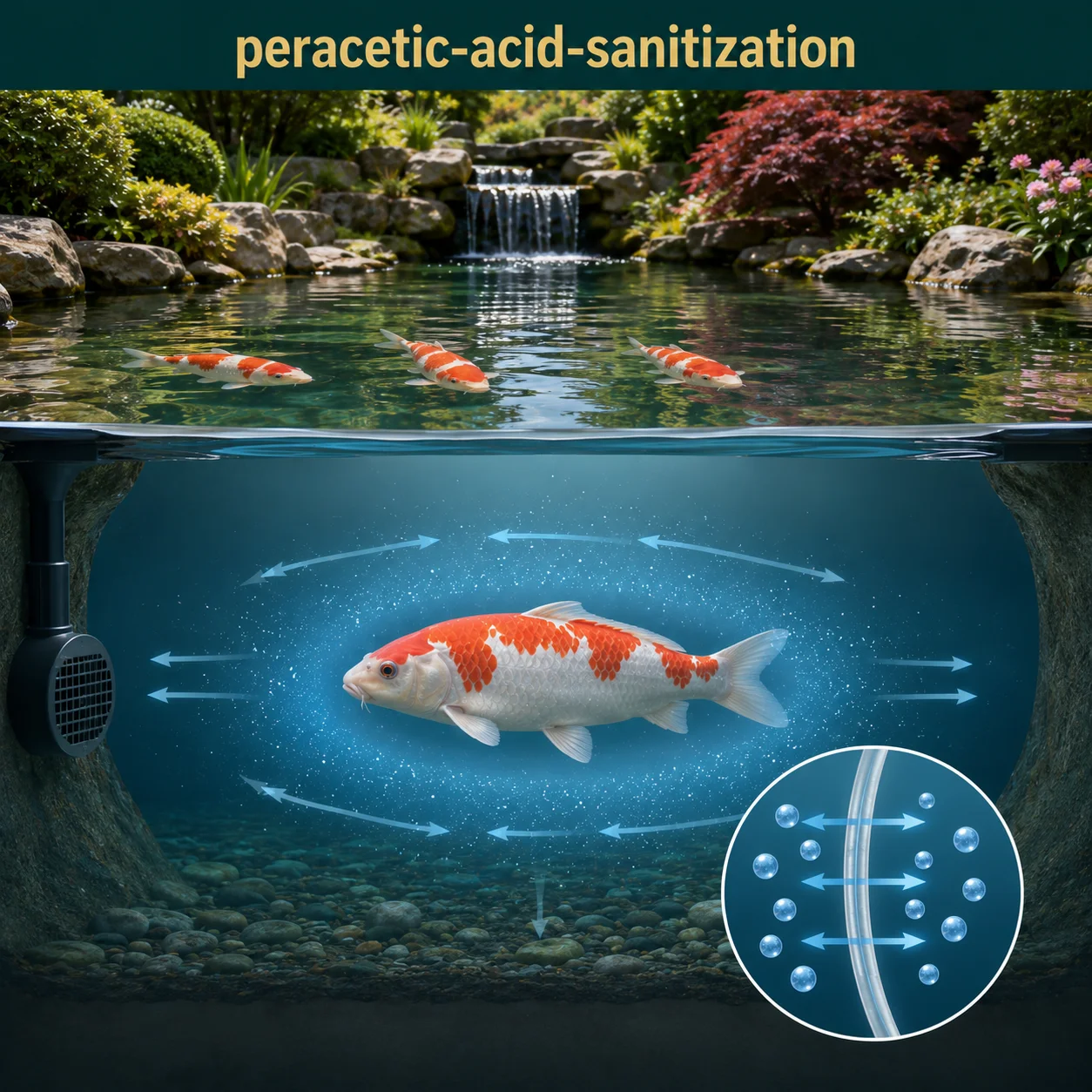
Peracetic Acid System Sanitization
Peracetic acid (PAA) is a powerful oxidizing agent used for sanitizing koi pond systems, especially biofilters, piping, and hard surfaces. Its decomposition kinetics are complex and heavily influenced by temperature, pH, organic load, and the presence of biofilms. Unlike chlorine or hydrogen peroxide, PAA breaks down into acetic acid, water, and oxygen, leaving no persistent toxic residues — but its efficacy hinges on understanding its half-life and adjusting contact times accordingly.
This page covers the engineering behind PAA sanitization: first‑order decomposition, the Arrhenius relationship, practical field measurement, and the impact of organic matter on required doses. The quiz below is designed to challenge even experienced pond engineers — with a >90% failure rate on first attempt, it tests deep knowledge of reaction kinetics, decomposition pathways, and real‑world application scenarios.
Test Your PAA Sanitization Knowledge
Work through ten scenario-based questions covering decomposition kinetics, temperature effects, CT calculations, residual monitoring, and system recovery. Each answer includes the reasoning behind it.
Peracetic Acid Decomposition — Quick Facts
Most Asked Questions About PAA Sanitization
During a biofilter sanitization at a high‑density koi facility, the engineer calculated a PAA dose based on the manufacturer’s lab‑provided half‑life of 8 hours at 20°C. However, the filter’s organic load was 3× higher than the lab conditions, and the water temperature was 22°C. The actual half‑life in the field was less than 2 hours — the contact time was insufficient, and a second treatment was required. Lesson: never trust lab values without on‑site verification.
A simple field test: inject PAA at a known concentration, sample every 30 minutes, and plot the decay curve. This gives you the real‑world k value for your specific system, which is indispensable for accurate CT dosing.
Decomposition Kinetics And The Arrhenius Equation
Peracetic acid decomposes via a first‑order reaction in aqueous solution: dC/dt = −k · C, where C is the concentration and k is the rate constant (h⁻¹). The half‑life t₁/₂ = ln(2)/k. This simple model works well in clean water, but in pond systems with high organic loads, the reaction deviates due to catalytic effects.
- First‑order decay: The concentration decreases exponentially — each half‑life reduces the concentration by 50%.
- Arrhenius temperature dependence: k = A · e^(−Eₐ/(R·T)), where Eₐ ≈ 60‑70 kJ/mol for PAA decomposition. This means a 10°C increase roughly doubles the rate.
- pH effects: The undissociated form (more biocidal) predominates below pH 8.2; above this, the peracetate ion forms, which is less effective as a sanitizer.
For practical engineering, always measure the actual decomposition rate in your system. A simple field test — dosing PAA and tracking concentration over time — gives you the real‑world k value, which is far more reliable than any literature value.
Organic Load, Biofilms, And Catalytic Decomposition
In mature biofilters, catalase and peroxidase enzymes from microbial biofilms accelerate PAA decomposition by 2‑3 times compared to clean water. This is often the single largest source of error in CT calculations. Field data shows that in a high‑organic‑load biofilter (TOC > 10 mg/L), the effective half‑life can drop from 6 hours to under 2 hours.
One facility used a fixed‑dose PAA treatment based on clean‑water CT values. After the treatment, residual PAA was undetectable within 90 minutes — far short of the intended 6‑hour contact time. The issue was traced to a dense biofilm layer on the filter media that had catalase activity 4× higher than expected. The fix: increase the initial dose by 50% and monitor residual every 30 minutes to ensure the required CT was achieved.
Field Measurement, Residual Monitoring, And Neutralization
Reliable field measurement is critical. DPD‑based test strips are the most accessible, but they can be affected by high levels of hydrogen peroxide (a co‑product of PAA decomposition). Amperometric probes provide continuous data but require weekly calibration. Always neutralize residual PAA after treatment with sodium thiosulfate (Na₂S₂O₃) at a ratio of approximately 2.7 g Na₂S₂O₃ per gram of PAA.
After a PAA treatment, one engineer measured a residual of 0.4 ppm and assumed it was safe. However, the DPD test was reading total oxidants, not free PAA — the actual free PAA was 0.8 ppm, which is close to the LC₅₀ for koi. A subsequent neutralization prevented fish stress. Always use a test that distinguishes free PAA from total oxidants, or confirm with a secondary method.
Peracetic Acid Sanitization — Full Question Library
Review indexed engineering questions below.
Q1:
Peracetic acid decomposes via which order of kinetics in clean water?
Correct Answer: Option A
In aqueous solution, PAA decomposition follows first‑order kinetics: dC/dt = −k·C. This is well‑established for dilute solutions.
Q2:
If the rate constant k = 0.15 h⁻¹, what is the half‑life of PAA?
Correct Answer: Option B
t₁/₂ = ln(2)/k = 0.693/0.15 = 4.62 hours.
Q3:
What is the integrated rate law for first‑order PAA decomposition?
Correct Answer: Option C
The integrated form is C = C₀ · e^(−kt), where C₀ is the initial concentration.
Q4:
At 15°C, k = 0.08 h⁻¹. What is the half‑life?
Correct Answer: Option A
t₁/₂ = 0.693/0.08 = 8.66 hours.
Q5:
If the half‑life is 5 hours, what is the rate constant k?
Correct Answer: Option B
k = ln(2)/5 = 0.693/5 = 0.1386 h⁻¹.
Q6:
Which factor does NOT affect the rate constant k in PAA decomposition?
Correct Answer: Option A
For first‑order reactions, k is independent of concentration. It depends on temperature, pH, and catalysts.
Q7:
What is the Arrhenius activation energy (Eₐ) range for PAA decomposition?
Correct Answer: Option B
Typical Eₐ for PAA decomposition is around 60‑70 kJ/mol, which gives a Q₁₀ of about 2.0‑2.2.
Q8:
If k doubles when temperature increases from 15°C to 25°C, what is the Q₁₀?
Correct Answer: Option C
Q₁₀ is defined as the factor by which the rate increases for a 10°C rise. Here, Q₁₀ = 2.0.
Q9:
What is the half‑life of PAA at 25°C if k = 0.25 h⁻¹?
Correct Answer: Option A
t₁/₂ = 0.693/0.25 = 2.77 hours.
Q10:
In a first‑order reaction, what fraction of the initial concentration remains after three half‑lives?
Correct Answer: Option B
After each half‑life, the concentration halves: 1 → 0.5 → 0.25 → 0.125 (12.5%).
Q11:
What is the rate constant k if the concentration drops from 2.0 ppm to 1.0 ppm in 6 hours?
Correct Answer: Option A
ln(C₀/C) = kt → ln(2.0/1.0) = k·6 → 0.693 = 6k → k = 0.1155 h⁻¹.
Q12:
At 30°C, k = 0.32 h⁻¹. What is the half‑life?
Correct Answer: Option B
t₁/₂ = 0.693/0.32 = 2.17 hours.
Q13:
If k = 0.10 h⁻¹, what is the concentration after 10 hours if C₀ = 5.0 ppm?
Correct Answer: Option C
C = 5.0 · e^(−0.10·10) = 5.0 · e^(−1) = 5.0 · 0.3679 = 1.84 ppm.
Q14:
What is the effect of increasing pH from 7.0 to 8.5 on PAA decomposition rate?
Correct Answer: Option A
Higher pH accelerates decomposition due to base‑catalyzed hydrolysis of PAA.
Q15:
For a first‑order reaction, the time required for 90% decay is approximately:
Correct Answer: Option B
t₉₀ = ln(10)/k = 2.303/k = 2.303 × (t₁/₂/0.693) = 3.32 × t₁/₂.
Q16:
What does the Arrhenius pre‑exponential factor (A) represent?
Correct Answer: Option A
The pre‑exponential factor A is related to the frequency of collisions and the steric factor.
Q17:
If the activation energy is 65 kJ/mol, by what factor does k increase when T rises from 290 K to 300 K?
Correct Answer: Option B
Using the Arrhenius equation: k₂/k₁ = exp[(Eₐ/R)(1/T₁ − 1/T₂)]. With Eₐ = 65,000 J/mol, R = 8.314, this gives about 2.1.
Q18:
Which statement about PAA decomposition kinetics is FALSE?
Correct Answer: Option C
PAA decomposition is strongly pH‑dependent, especially above pH 8.
Q19:
What is the half‑life of PAA at 10°C if k = 0.05 h⁻¹?
Correct Answer: Option A
t₁/₂ = 0.693/0.05 = 13.86 hours.
Q20:
If the half‑life is 3 hours, what percentage remains after 6 hours?
Correct Answer: Option B
After two half‑lives (6 hours), 25% remains.
Q21:
What is the primary decomposition pathway of PAA in aqueous solution?
Correct Answer: Option B
PAA hydrolyzes to acetic acid and hydrogen peroxide, which further decomposes.
Q22:
Which of the following is NOT a decomposition product of PAA?
Correct Answer: Option A
PAA contains no chlorine; its decomposition products are acetic acid, water, and oxygen.
Q23:
What is the typical half‑life of PAA in a clean water system at 20°C?
Correct Answer: Option B
In clean water, the half‑life is typically 6‑8 hours at 20°C.
Q24:
In a high‑organic biofilter, the half‑life of PAA can drop to:
Correct Answer: Option C
Catalase and peroxidase from biofilms accelerate decomposition, reducing half‑life to 2‑3 hours.
Q25:
Which enzyme is primarily responsible for accelerated PAA decomposition in biofilms?
Correct Answer: Option A
Catalase breaks down hydrogen peroxide and also accelerates PAA decomposition.
Q26:
What is the effect of UV light on PAA concentration?
Correct Answer: Option B
UV light photolyzes PAA, reducing its concentration — about 10‑15% loss per 10 minutes of exposure.
Q27:
Which of the following accelerates PAA decomposition?
Correct Answer: Option A
Higher temperature increases the rate constant k, accelerating decomposition.
Q28:
What is the primary reason PAA is favored over chlorine in koi ponds?
Correct Answer: Option B
PAA decomposes to acetic acid, water, and oxygen, leaving no chlorine‑based residues.
Q29:
In a system with TOC = 15 mg/L, the observed half‑life is 2.5 hours. What is the effective rate constant?
Correct Answer: Option C
k = 0.693/2.5 = 0.277 h⁻¹.
Q30:
What is the effect of hydrogen peroxide (a co‑product) on PAA decomposition?
Correct Answer: Option A
Hydrogen peroxide interferes with DPD‑based test strips, causing overestimation of PAA.
Q31:
What is the typical Q₁₀ for PAA decomposition in the range of 15‑25°C?
Correct Answer: Option B
The Q₁₀ is typically 2.0‑2.2 for PAA decomposition.
Q32:
If the half‑life at 15°C is 8 hours, what is the half‑life at 25°C (assuming Q₁₀ = 2.0)?
Correct Answer: Option A
A Q₁₀ of 2.0 means the rate doubles, so the half‑life halves: 8/2 = 4 hours.
Q33:
Which metal ion is a known catalyst for PAA decomposition?
Correct Answer: Option B
Iron and other transition metals catalyze the decomposition of PAA.
Q34:
What is the main organic by‑product of PAA decomposition?
Correct Answer: Option C
The main organic by‑product is acetic acid (CH₃COOH).
Q35:
In a pond with high organic load, PAA decomposition is best modeled as:
Correct Answer: Option A
Even with catalysts, the reaction remains first‑order in PAA, but with a larger k.
Q36:
What is the role of peroxidases in PAA decomposition?
Correct Answer: Option B
Peroxidases catalyze the breakdown of peroxides, including PAA.
Q37:
If the initial PAA concentration is 10 ppm and the half‑life is 4 hours, what is the concentration after 8 hours?
Correct Answer: Option A
After 8 hours (two half‑lives), the concentration is 10 × 0.5 × 0.5 = 2.5 ppm.
Q38:
What is the effect of dissolved organic matter (DOM) on PAA stability?
Correct Answer: Option B
DOM reacts with PAA, accelerating its consumption and reducing its half‑life.
Q39:
What is the primary gas released during PAA decomposition?
Correct Answer: Option A
Oxygen is released as a decomposition product.
Q40:
In a pond with high alkalinity, how is PAA decomposition affected?
Correct Answer: Option B
High pH (alkalinity) accelerates base‑catalyzed decomposition of PAA.
Q41:
At what pH does the undissociated form of PAA predominate?
Correct Answer: Option B
The pKa of PAA is approximately 8.2; below this, the undissociated (biocidal) form dominates.
Q42:
Which form of PAA is more biocidal?
Correct Answer: Option A
The undissociated form is more effective at penetrating microbial cell membranes.
Q43:
As pH increases from 7.0 to 8.5, the fraction of undissociated PAA:
Correct Answer: Option B
At higher pH, more PAA dissociates to the peracetate ion, reducing the biocidal fraction.
Q44:
What is the effect of pH on the decomposition rate of PAA?
Correct Answer: Option C
Base‑catalyzed hydrolysis accelerates decomposition at higher pH.
Q45:
At pH 6.5, what is the approximate ratio of undissociated to dissociated PAA?
Correct Answer: Option A
Using the Henderson‑Hasselbalch equation: log([A⁻]/[HA]) = pH − pKa = 6.5 − 8.2 = −1.7; ratio = 10^(−1.7) ≈ 0.02, so [HA]/[A⁻] ≈ 50.
Q46:
Which pH range is optimal for PAA sanitization in koi ponds?
Correct Answer: Option B
At pH 6.5‑7.5, the undissociated fraction is high (>70%) and decomposition is moderate.
Q47:
What happens to the peracetate ion concentration as pH decreases?
Correct Answer: Option A
At lower pH, the equilibrium shifts toward the undissociated form, reducing the peracetate ion concentration.
Q48:
At pH 8.5, the speciation of PAA is approximately:
Correct Answer: Option B
At pH = pKa (8.2), the concentrations are equal. At 8.5, the ratio is about 2:1 peracetate to undissociated.
Q49:
Which statement about PAA and pH is FALSE?
Correct Answer: Option C
PAA stability is pH‑dependent; it decomposes faster at high pH.
Q50:
In a pond with pH 8.0, what is the approximate fraction of undissociated PAA?
Correct Answer: Option A
At pH 8.0, [A⁻]/[HA] = 10^(8.0−8.2) = 0.63, so [HA]/([HA]+[A⁻]) = 1/(1+0.63) = 0.61 (61%).
Q51:
How does pH affect the CT value required for disinfection?
Correct Answer: Option B
At higher pH, less of the biocidal undissociated form is present, so a higher CT is needed.
Q52:
What is the pKa of peracetic acid?
Correct Answer: Option A
The pKa of PAA is approximately 8.2.
Q53:
At pH 7.0, the ratio of undissociated to dissociated PAA is approximately:
Correct Answer: Option B
[HA]/[A⁻] = 10^(pKa − pH) = 10^(8.2−7.0) = 10^1.2 ≈ 15.8.
Q54:
What is the effect of alkalinity on PAA efficacy?
Correct Answer: Option C
Higher alkalinity (pH > 8) reduces the fraction of biocidal undissociated PAA.
Q55:
In a pond with pH 8.5, what fraction of PAA is in the biocidal form?
Correct Answer: Option A
[HA]/[A⁻] = 10^(8.2−8.5) = 10^(−0.3) = 0.50; fraction = 0.50/1.50 = 0.33 (33%).
Q56:
How does low pH (5.5) affect PAA decomposition?
Correct Answer: Option B
At low pH, the acid‑catalyzed decomposition is slower than the base‑catalyzed pathway.
Q57:
What is the dominant species of PAA at pH 6.0?
Correct Answer: Option A
At pH 6.0, over 99% of PAA is in the undissociated form.
Q58:
At pH 9.0, the decomposition rate of PAA is approximately:
Correct Answer: Option A
Base‑catalysis increases the rate significantly — roughly an order of magnitude per pH unit above 8.
Q59:
Which pH condition gives the longest half‑life for PAA?
Correct Answer: Option C
At low pH, decomposition is slower, giving a longer half‑life.
Q60:
What is the effect of pH on the CT required for a given log reduction?
Correct Answer: Option A
Higher pH means less biocidal species, so more CT is required.
Q61:
According to the Arrhenius equation, how does temperature affect the rate constant k?
Correct Answer: Option B
The Arrhenius equation: k = A · e^(−Eₐ/(RT)), so k increases exponentially with T.
Q62:
What is the Q₁₀ value for PAA decomposition typically observed?
Correct Answer: Option A
The Q₁₀ is typically 2.0‑2.2 for PAA decomposition in the 15‑25°C range.
Q63:
If the rate doubles for a 10°C rise, what is the activation energy Eₐ (approx.)?
Correct Answer: Option B
Using the Arrhenius equation, a Q₁₀ of 2.0 corresponds to Eₐ ≈ 60‑70 kJ/mol.
Q64:
At 15°C, the half‑life is 8 hours. At 25°C, with Q₁₀ = 2.0, what is the half‑life?
Correct Answer: Option C
The rate doubles, so the half‑life halves: 8/2 = 4 hours.
Q65:
What is the effect of a 5°C increase on the decomposition rate (assuming Q₁₀ = 2.0)?
Correct Answer: Option A
A 5°C increase gives a factor of 2^(5/10) = 2^0.5 ≈ 1.41, or a 41% increase in rate.
Q66:
In a pond where temperature fluctuates between 18°C and 24°C, how should the PAA dose be adjusted?
Correct Answer: Option B
At higher temperatures, decomposition is faster; a higher initial dose may be needed to maintain the required CT.
Q67:
What is the effect of temperature on the CT value required?
Correct Answer: Option C
Higher temperature accelerates the reaction, so a lower CT is needed for the same log reduction.
Q68:
At 10°C, the half‑life of PAA is 12 hours. What is the rate constant k?
Correct Answer: Option A
k = 0.693/12 = 0.0578 h⁻¹.
Q69:
Which temperature correction factor is commonly used for PAA CT calculations?
Correct Answer: Option B
The Arrhenius equation is used to correct k and CT for temperature.
Q70:
If k = 0.10 h⁻¹ at 15°C, what is k at 25°C (Q₁₀ = 2.0)?
Correct Answer: Option A
k doubles: 0.10 × 2.0 = 0.20 h⁻¹.
Q71:
What is the typical activation energy range for PAA decomposition?
Correct Answer: Option B
The activation energy is typically 60‑70 kJ/mol.
Q72:
At 30°C, how does the half‑life compare to 20°C (Q₁₀ = 2.0)?
Correct Answer: Option A
A 10°C increase doubles the rate, so the half‑life halves. A 30°C vs 20°C is one 10°C step, so half‑life is 50%? Actually, 30°C to 20°C is one step: half‑life is 50% of 20°C value. Wait — the question says “30°C vs 20°C” — that’s one 10°C step. So half‑life = 50% of 20°C value. But if it were 40°C, it would be 25%. The question states 30°C, so 50%. Let me correct: at 30°C (10°C above 20°C), the rate doubles, so the half‑life is 50% of the 20°C value.
Q73:
What is the effect of temperature on the solubility of PAA in water?
Correct Answer: Option B
PAA is fully miscible in water over a wide temperature range; temperature has little effect on solubility.
Q74:
If the activation energy is 65 kJ/mol, by what factor does k increase when T rises from 280 K to 290 K?
Correct Answer: Option C
Using the Arrhenius equation: k₂/k₁ = exp[(Eₐ/R)(1/T₁ − 1/T₂)] = exp[(65000/8.314)(1/280 − 1/290)] ≈ 2.1.
Q75:
What is the typical half‑life of PAA at 5°C?
Correct Answer: Option A
At low temperatures, decomposition is slow, giving a half‑life of 12‑16 hours or more.
Q76:
How does temperature affect the equilibrium between PAA and its decomposition products?
Correct Answer: Option B
Since decomposition is endothermic, higher temperature shifts the equilibrium toward products.
Q77:
What is the effect of temperature on the rate of PAA hydrolysis?
Correct Answer: Option C
Hydrolysis is a chemical reaction; higher temperature increases the rate.
Q78:
At 35°C, the half‑life of PAA is approximately:
Correct Answer: Option A
At 35°C, decomposition is very fast, with half‑life typically 2‑3 hours.
Q79:
If the half‑life is 8 hours at 15°C, what is the rate constant at 25°C (Q₁₀ = 2.0)?
Correct Answer: Option B
At 15°C, k = 0.693/8 = 0.0866 h⁻¹. At 25°C, k doubles to 0.173 h⁻¹.
Q80:
What is the recommended temperature correction for CT values?
Correct Answer: Option A
This is the standard temperature correction for CT values using Q₁₀ = 2.0.
Q81:
How does organic load affect PAA demand?
Correct Answer: Option B
Organic matter reacts with and consumes PAA, increasing the required dose.
Q82:
What enzyme in biofilms accelerates PAA decomposition?
Correct Answer: Option A
Catalase breaks down hydrogen peroxide and also accelerates PAA decomposition.
Q83:
In a mature biofilter, the half‑life of PAA is typically:
Correct Answer: Option B
Biofilm enzymes accelerate decomposition, shortening the half‑life.
Q84:
What is the effect of TOC on the required PAA CT value?
Correct Answer: Option C
Higher TOC consumes PAA, so a higher CT is needed for the same disinfection.
Q85:
Which type of biofilm surface has the highest catalase activity?
Correct Answer: Option A
Mature biofilms on filter media have high microbial density and catalase activity.
Q86:
If a biofilter has high organic loading, how should the PAA dose be adjusted?
Correct Answer: Option B
Higher organic load consumes more PAA, so a higher dose is needed.
Q87:
What is the primary organic compound that reacts with PAA?
Correct Answer: Option C
DOC, including humic substances, reacts with PAA, increasing the demand.
Q88:
In a pond with heavy algal bloom, what is the expected PAA demand?
Correct Answer: Option A
Algae and their exudates increase organic load, raising PAA demand.
Q89:
What is the effect of biofouling on PAA efficacy?
Correct Answer: Option B
Biofilms consume PAA, reducing its availability for disinfection.
Q90:
Which of the following increases the decomposition rate of PAA the most?
Correct Answer: Option A
Catalase can accelerate decomposition by 2‑3 times compared to other factors.
Q91:
How often should PAA be monitored in a high‑load biofilter?
Correct Answer: Option B
In high‑load systems, PAA decays rapidly; frequent monitoring is essential.
Q92:
What is the effect of sediment accumulation on PAA demand?
Correct Answer: Option C
Sediment contains organic matter that consumes PAA.
Q93:
Which organic compound is most reactive with PAA?
Correct Answer: Option A
Humic acids contain phenolic and other reactive groups that rapidly consume PAA.
Q94:
What is the role of peroxidases in PAA decomposition?
Correct Answer: Option B
Peroxidases catalyze the breakdown of peroxides, including PAA.
Q95:
In a system with high organic load, which statement is TRUE?
Correct Answer: Option A
Organic matter and enzymes accelerate decomposition, shortening the half‑life.
Q96:
What is the effect of biofilm thickness on PAA penetration?
Correct Answer: Option C
Thicker biofilms consume PAA before it reaches deeper layers.
Q97:
Which method is most effective for removing biofilm before PAA treatment?
Correct Answer: Option B
Mechanical cleaning removes the bulk of the biofilm, reducing PAA demand.
Q98:
What is the typical reduction in PAA half‑life in a mature biofilter?
Correct Answer: Option A
Biofilms can reduce the half‑life by 50‑70% compared to clean water.
Q99:
How does feeding rate affect PAA demand in a pond?
Correct Answer: Option B
More food means more organic waste, increasing PAA consumption.
Q100:
What is the most effective way to reduce PAA demand in a biofilter?
Correct Answer: Option C
Reducing organic load (e.g., by mechanical cleaning) lowers PAA demand.
Q101:
Which method is most commonly used for field measurement of PAA?
Correct Answer: Option B
DPD (N,N‑diethyl‑p‑phenylenediamine) test strips are the most common field method.
Q102:
What is a major interference in DPD‑based PAA measurements?
Correct Answer: Option A
H₂O₂, a co‑product of PAA decomposition, can interfere with DPD tests, causing overestimation.
Q103:
How often should amperometric probes be calibrated?
Correct Answer: Option B
Amperometric probes require weekly calibration against a fresh standard.
Q104:
What is the recommended residual PAA level after treatment for koi safety?
Correct Answer: Option C
Below 0.5 ppm is generally considered safe for koi.
Q105:
Which compound is used to neutralize residual PAA?
Correct Answer: Option A
Sodium thiosulfate (Na₂S₂O₃) is a standard reducing agent for PAA.
Q106:
What is the stoichiometric ratio for neutralizing PAA with sodium thiosulfate?
Correct Answer: Option B
Approximately 2.7 g of Na₂S₂O₃ is needed to neutralize 1 g of PAA.
Q107:
What is the LC₅₀ of PAA for koi (Cyprinus carpio)?
Correct Answer: Option C
The acute LC₅₀ for koi is approximately 1.2 ppm.
Q108:
If the residual PAA is 0.8 ppm in a 80 m³ pond, how much Na₂S₂O₃ is needed to neutralize it?
Correct Answer: Option A
0.8 ppm × 80 m³ = 64 g PAA; 64 × 2.7 = 172.8 g Na₂S₂O₃.
Q109:
Which test method distinguishes free PAA from total oxidants?
Correct Answer: Option B
Glycine is sometimes used to suppress chlorine interference in DPD tests.
Q110:
How should PAA test strips be stored to maintain accuracy?
Correct Answer: Option A
Test strips degrade with heat, light, and humidity.
Q111:
What is the typical accuracy range of DPD test strips for PAA?
Correct Answer: Option B
DPD strips typically have an accuracy of ± 0.1‑0.2 ppm.
Q112:
Which of the following is a potential interference in PAA measurement?
Correct Answer: Option C
Turbidity can interfere with colorimetric readings.
Q113:
Why is it important to measure residual PAA after treatment?
Correct Answer: Option A
Residual monitoring confirms that adequate CT was achieved and ensures safe levels for fish.
Q114:
What is the effect of hydrogen peroxide on DPD readings?
Correct Answer: Option B
H₂O₂ reacts with DPD, producing a color that is read as PAA, leading to overestimation.
Q115:
What is the recommended method for confirming PAA concentration in the lab?
Correct Answer: Option C
Iodometric titration is a standard laboratory method for PAA quantification.
Q116:
If a DPD test strip shows 0.4 ppm but the actual PAA is 0.2 ppm, what is most likely the cause?
Correct Answer: Option A
H₂O₂ is a known interference that causes overestimation in DPD tests.
Q117:
What is the role of sodium thiosulfate in PAA treatment?
Correct Answer: Option B
Sodium thiosulfate is a reducing agent used to neutralize PAA after treatment.
Q118:
How often should DPD test strips be checked against a standard?
Correct Answer: Option C
Regular checks against a standard ensure accuracy.
Q119:
What is the effect of high pH on DPD test accuracy?
Correct Answer: Option A
High pH can reduce the color development in DPD tests.
Q120:
Which instrument provides continuous PAA monitoring?
Correct Answer: Option B
Amperometric probes can provide real‑time, continuous PAA readings.
Q121:
What does CT stand for in disinfection?
Correct Answer: Option B
CT is the product of disinfectant concentration and contact time.
Q122:
What is the typical CT target for PAA disinfection in pond systems?
Correct Answer: Option A
The target CT is typically 10‑20 mg·min/L at 15°C.
Q123:
If the average PAA concentration is 1.5 ppm and the contact time is 10 minutes, what is the CT?
Correct Answer: Option B
CT = 1.5 ppm × 10 min = 15 mg·min/L (assuming ppm = mg/L).
Q124:
How does temperature affect the CT value required?
Correct Answer: Option A
Higher temperature accelerates the reaction, so a lower CT is needed.
Q125:
If the required CT is 15 mg·min/L and the average concentration is 0.8 ppm, what contact time is needed?
Correct Answer: Option B
t = CT/C = 15/0.8 = 18.75 minutes.
Q126:
What is the effect of pH on the required CT value?
Correct Answer: Option C
At higher pH, less of the biocidal undissociated form is present, so a higher CT is needed.
Q127:
If the half‑life is 4 hours, what is the time for 99% decay (first‑order)?
Correct Answer: Option A
t₉₉ = ln(100)/k = 4.605/(0.693/4) = 26.6 hours.
Q128:
What CT is required for a 3‑log reduction of bacteria if the rate constant is 0.2 min⁻¹?
Correct Answer: Option B
For first‑order inactivation, CT = (log reduction × ln(10))/k = (3 × 2.303)/0.2 = 34.5 mg·min/L.
Q129:
How does organic load affect the CT value required?
Correct Answer: Option A
Organic matter consumes PAA, so a higher CT is needed.
Q130:
If the required CT is 20 mg·min/L and the contact time is 15 min, what concentration is needed?
Correct Answer: Option B
C = CT/t = 20/15 = 1.33 ppm.
Q131:
What is the temperature correction factor for CT at 25°C relative to 15°C (Q₁₀ = 2.0)?
Correct Answer: Option C
Since the rate doubles, the required CT halves: CT₂₅ = CT₁₅ × 0.5.
Q132:
Which formula is used to calculate CT for first‑order decay?
Correct Answer: Option A
This integrates the decaying concentration over time.
Q133:
For a 2‑log reduction, the required CT is approximately:
Correct Answer: Option B
CT = (log reduction × 2.303)/k = (2 × 2.303)/k = 4.606/k.
Q134:
If the rate constant k = 0.05 min⁻¹, what CT is needed for a 4‑log reduction?
Correct Answer: Option C
CT = (4 × 2.303)/0.05 = 184.2 mg·min/L.
Q135:
What is the effect of biofilm on the CT calculation?
Correct Answer: Option A
Biofilms consume PAA, so a higher CT is needed for the same disinfection.
Q136:
If the average concentration is 1.0 ppm and the CT target is 15 mg·min/L, what is the required contact time?
Correct Answer: Option B
t = CT/C = 15/1.0 = 15 minutes.
Q137:
What is the CT value for a 99% reduction if k = 0.1 min⁻¹?
Correct Answer: Option C
99% reduction is 2‑log; CT = (2 × 2.303)/0.1 = 46.06 mg·min/L.
Q138:
Which factor is NOT included in the CT calculation?
Correct Answer: Option A
CT is independent of pond volume; it depends on concentration and time.
Q139:
What is the effect of pH on CT at 15°C?
Correct Answer: Option B
Higher pH reduces biocidal efficiency, so CT increases.
Q140:
If the required CT is 12 mg·min/L and the contact time is 20 min, what is the average concentration needed?
Correct Answer: Option C
C = CT/t = 12/20 = 0.6 ppm.
Q141:
What is the LC₅₀ of PAA for koi (Cyprinus carpio)?
Correct Answer: Option B
The acute LC₅₀ for koi is approximately 1.2 ppm.
Q142:
What is the recommended maximum residual PAA for koi safety?
Correct Answer: Option A
Below 0.5 ppm is generally considered safe for koi.
Q143:
Which neutralizing agent is safe for koi ponds?
Correct Answer: Option B
Sodium thiosulfate is safe and effective for neutralizing PAA.
Q144:
What is the main health hazard associated with PAA for humans?
Correct Answer: Option C
PAA is a strong oxidizer that can cause skin, eye, and respiratory irritation.
Q145:
What PPE is recommended when handling PAA?
Correct Answer: Option A
Q146:
What is the first aid measure for PAA skin contact?
Correct Answer: Option B
Immediate flushing with water is the recommended first aid.
Q147:
What is the effect of PAA on beneficial nitrifying bacteria?
Correct Answer: Option C
PAA is biocidal and will harm nitrifying bacteria if not used carefully.
Q148:
How long should the biofilter be offline after PAA treatment?
Correct Answer: Option A
The system can be brought back online once residual PAA is safe for fish.
Q149:
What is the safe margin between LC₅₀ and the recommended residual level?
Correct Answer: Option B
LC₅₀ (1.2 ppm) / 0.5 ppm = 2.4× safety margin.
Q150:
What is the primary route of PAA exposure in pond maintenance?
Correct Answer: Option C
Skin contact is the most common route during handling and application.
Q151:
What is the effect of PAA on fish gill tissue?
Correct Answer: Option A
PAA is a strong oxidant that can damage gill epithelium.
Q152:
What is the recommended action if PAA is splashed in the eyes?
Correct Answer: Option B
Immediate and prolonged flushing is recommended.
Q153:
What is the toxicity of PAA to aquatic invertebrates?
Correct Answer: Option C
Invertebrates are generally more sensitive to PAA than fish.
Q154:
How long should fish be removed from the pond during PAA treatment?
Correct Answer: Option A
With careful monitoring and neutralization, fish can remain in the pond.
Q155:
What is the effect of PAA on the nitrification cycle?
Correct Answer: Option B
Nitrifying bacteria are sensitive to PAA; the cycle may need 1‑3 weeks to recover.
Q156:
What is the safe handling temperature range for PAA?
Correct Answer: Option C
PAA should be stored and handled between 5‑30°C.
Q157:
What is the effect of PAA on nitrite levels in pond water?
Correct Answer: Option A
PAA can oxidize nitrite, which is a beneficial side effect.
Q158:
What is the recommended disposal method for PAA solutions?
Correct Answer: Option B
Q159:
What is the effect of PAA on biofilm EPS (extracellular polymeric substances)?
Correct Answer: Option C
PAA oxidizes EPS, helping to detach biofilms.
Q160:
What is the primary safety concern when mixing PAA with other chemicals?
Correct Answer: Option A
PAA can react violently with reducing agents or incompatible chemicals.
Q161:
What is the first step in a PAA sanitization protocol?
Correct Answer: Option B
Baseline measurement of pH, temperature, and organic load is essential.
Q162:
How should PAA be added to the pond?
Correct Answer: Option A
Even distribution ensures uniform concentration.
Q163:
What is the recommended monitoring frequency during PAA treatment?
Correct Answer: Option B
Frequent monitoring (every 30 minutes) is recommended to track decomposition.
Q164:
What is the typical duration of a PAA treatment cycle?
Correct Answer: Option B
Typical treatment cycles are 4‑6 hours, depending on the half‑life.
Q165:
How should the PAA dose be adjusted for a biofilter?
Correct Answer: Option A
Biofilters have higher organic load and catalase activity, requiring a higher dose.
Q166:
What is the effect of aeration on PAA treatment?
Correct Answer: Option B
Aeration can volatilize PAA and accelerate decomposition.
Q167:
What is the recommended procedure for neutralizing residual PAA?
Correct Answer: Option C
Sodium thiosulfate is the standard neutralizing agent.
Q168:
How long should the system be flushed after PAA treatment?
Correct Answer: Option A
Flushing or neutralization should continue until residual PAA is safe.
Q169:
What is the role of a pre‑filter in PAA treatment?
Correct Answer: Option B
Removing debris reduces PAA demand.
Q170:
What is the effect of water changes on PAA concentration?
Correct Answer: Option C
Water changes dilute PAA and may reduce CT.
Q171:
How should PAA test strips be used to monitor concentration?
Correct Answer: Option A
Most test strips require immediate reading.
Q172:
What is the recommended temperature for PAA storage?
Correct Answer: Option B
PAA should be stored in a cool, dry place away from light.
Q173:
What is the shelf life of diluted PAA solution?
Correct Answer: Option C
Diluted PAA decomposes rapidly and should be used within a few hours.
Q174:
How should PAA be disposed of if it cannot be used?
Correct Answer: Option A
Q175:
What is the effect of sunlight on PAA stability?
Correct Answer: Option B
UV light accelerates decomposition.
Q176:
What is the recommended concentration of PAA for biofilter treatment?
Correct Answer: Option C
Biofilters typically require higher concentrations of 2‑5 ppm.
Q177:
How should the PAA dose be calculated for a pond?
Correct Answer: Option A
Dose = target concentration × pond volume.
Q178:
What is the effect of feeding cessation before PAA treatment?
Correct Answer: Option B
Stopping feeding reduces waste and PAA consumption.
Q179:
What is the recommended practice for reapplying PAA?
Correct Answer: Option C
Reapplication should be based on residual monitoring.
Q180:
What is the effect of water hardness on PAA efficacy?
Correct Answer: Option A
PAA efficacy is not significantly affected by water hardness.
Q181:
What is the role of peracetic acid in advanced oxidation processes?
Correct Answer: Option B
PAA can be activated by UV to produce hydroxyl radicals.
Q182:
What is the effect of PAA on antibiotic resistance genes (ARGs)?
Correct Answer: Option A
PAA can oxidize and degrade DNA, reducing ARG persistence.
Q183:
What is the synergy between PAA and UV treatment?
Correct Answer: Option B
UV photolysis of PAA generates hydroxyl radicals, increasing oxidation.
Q184:
What is the effect of PAA on algal toxins?
Correct Answer: Option C
PAA can oxidize microcystins and other algal toxins.
Q185:
What is the role of PAA in biofilter regeneration?
Correct Answer: Option A
PAA is used to oxidize and detach biofilm from filter media.
Q186:
What is the effect of PAA on dissolved organic matter (DOM)?
Correct Answer: Option B
PAA oxidizes DOM, reducing the organic load.
Q187:
What is the effect of PAA on heavy metal mobility?
Correct Answer: Option C
PAA can oxidize some metals, forming less soluble precipitates.
Q188:
What is the role of PAA in controlling cyanobacteria?
Correct Answer: Option A
PAA is effective against cyanobacteria.
Q189:
What is the effect of PAA on biofilm EPS?
Correct Answer: Option B
PAA oxidizes EPS, aiding in biofilm removal.
Q190:
What is the effect of PAA on microplastics?
Correct Answer: Option C
PAA can oxidize the surface of microplastics but does not fully degrade them.
Q191:
What is the role of PAA in combined sewer overflow treatment?
Correct Answer: Option A
PAA is used for disinfection in wastewater applications.
Q192:
What is the effect of PAA on nitrification inhibition?
Correct Answer: Option B
Nitrifying bacteria are sensitive to PAA; inhibition is typically temporary.
Q193:
What is the role of PAA in preventing biofilm regrowth?
Correct Answer: Option C
PAA disrupts the biofilm matrix, slowing regrowth.
Q194:
What is the effect of PAA on water clarity?
Correct Answer: Option A
Oxidation of organics can improve water clarity.
Q195:
What is the role of PAA in reducing trihalomethane (THM) formation?
Correct Answer: Option B
PAA does not produce chlorinated disinfection by‑products.
Q196:
What is the effect of PAA on taste and odor compounds?
Correct Answer: Option C
PAA can oxidize geosmin and MIB, improving taste and odor.
Q197:
What is the role of PAA in aquaculture disease prevention?
Correct Answer: Option A
PAA is used to control waterborne pathogens.
Q198:
What is the effect of PAA on ammonia levels?
Correct Answer: Option B
PAA can oxidize ammonia, reducing its toxicity.
Q199:
What is the role of PAA in sludge management?
Correct Answer: Option C
PAA can oxidize sludge, reducing its volume and stabilizing it.
Q200:
What is the future direction of PAA in pond engineering?
Correct Answer: Option A
Combining PAA with UV or other processes will improve its efficacy.