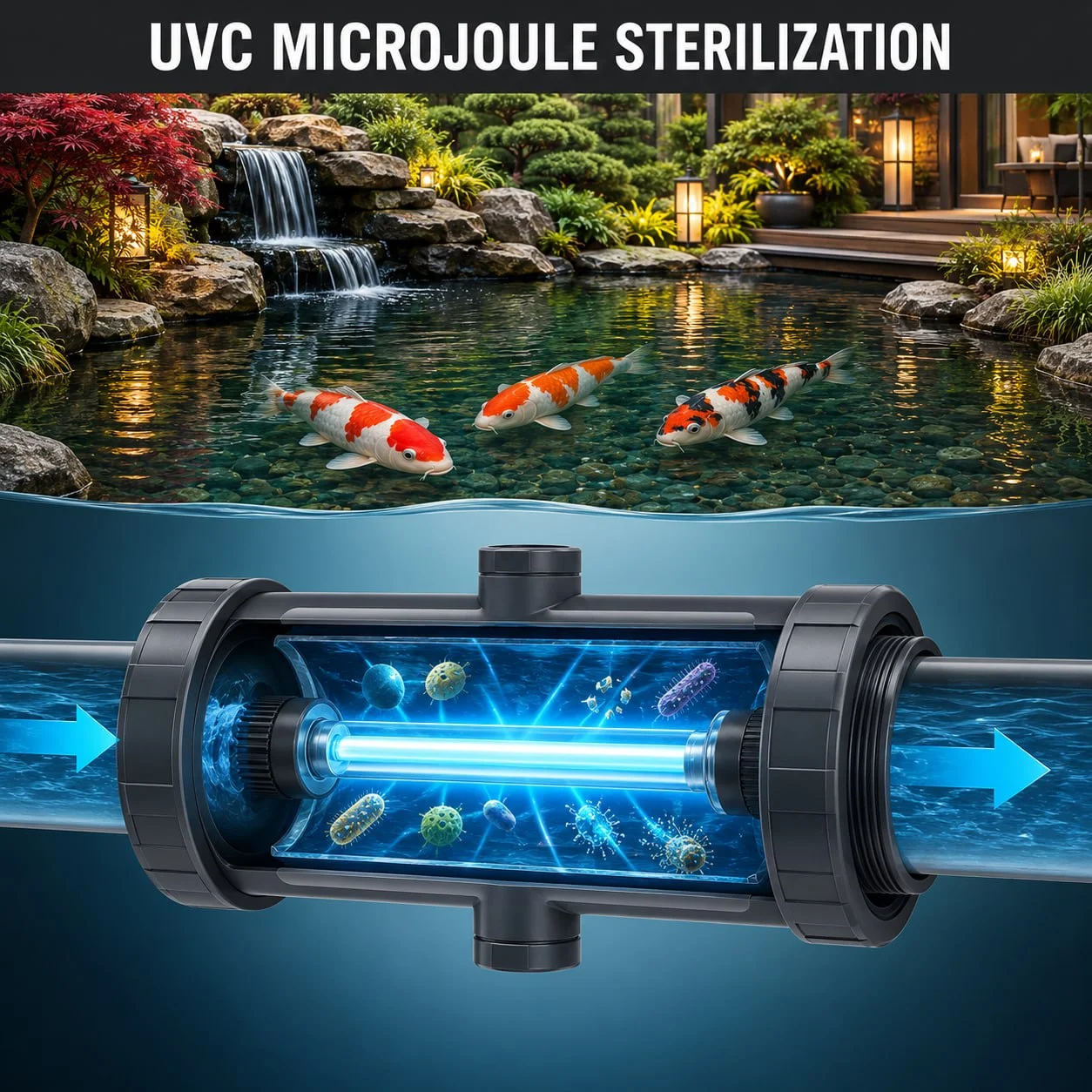
UV-C Amalgam Micro-Joule Radiation Dosage
UV-C radiation at 254 nm is the most effective broadband wavelength for inactivating single-celled algae, bacteria, and waterborne pathogens in koi ponds. The dosage — measured in microjoules per square centimeter (μJ/cm²) — determines the log-reduction of target organisms in a single pass through the sterilizer chamber. Amalgam lamps produce higher output and maintain stable emission over a wider temperature range than standard low-pressure mercury lamps, making them the preferred choice for high-flow, high-clarity pond systems where consistent micro-joule delivery matters.
This page works through the practical photobiology and hydraulics behind UV-C sterilization: how dosage is calculated from lamp output, flow rate, and chamber geometry; how water clarity and transmittance affect delivered energy; how amalgam technology differs from standard lamps; and how to size and troubleshoot a UV system for algae control. None of the guidance here is a universal rule — lamp age, water quality, and system flow all shift the numbers, so every design decision needs to be checked against the specific system rather than a rule of thumb.
Test Your UV-C Sterilization Knowledge
Work through ten scenario-based questions covering dosage calculation, lamp types, transmittance, flow rate, algae inactivation, and troubleshooting. Each answer includes the reasoning behind it.
UV-C Amalgam Micro-Joule Sterilization — Quick Facts
Most Asked Questions About UV-C Amalgam Micro-Joule Sterilization
A pond owner with persistent green water installed a 55-watt standard UV-C lamp rated for 10,000 gallons, matched to their 8,000-gallon pond. After six weeks, the green water remained. A radiometer reading showed the lamp’s actual 254 nm output was only 35% of its rated value, mainly due to the 60°F water temperature — well below the standard lamp’s optimum range.
Switching to a 55-watt amalgam lamp in the same chamber, without changing flow rate or plumbing, restored full output. The green water cleared within 10 days. The key difference was temperature stability: the amalgam maintained full output at 60°F, while the standard lamp had dropped to a fraction of its rated performance.
Micro-Joule Dosage Fundamentals
The fundamental equation for UV-C dosage is D = I × t, where D is dosage in μJ/cm², I is irradiance (μW/cm²) at the water surface, and t is exposure time in seconds. In a pond UV chamber, irradiance varies with distance from the lamp, water transmittance, and the quartz sleeve condition. The average irradiance across the chamber’s cross-section is the key variable for practical dosage calculation.
- Irradiance: Measured at the lamp’s quartz sleeve surface; decreases with distance from the lamp due to geometric spreading and water absorption.
- Exposure time: Determined by the chamber volume divided by the flow rate; longer chambers or lower flows increase exposure.
- Transmittance: The fraction of UV-C that passes through a unit thickness of water; measured at 254 nm.
In practice, most manufacturers provide validated dosage curves for their chambers, which account for the complex flow distribution and lamp geometry. These curves are far more reliable than trying to calculate dosage from first principles. The curves typically show dosage as a function of flow rate for a given lamp power and water clarity, allowing designers to match the chamber to the pond’s flow and target algae species.
Behind The Physics: Beer-Lambert Law and UV-C Transmission
The Beer-Lambert law describes how UV-C radiation is attenuated as it passes through water: I = I₀ × 10^(-α × L), where I₀ is the incident irradiance, α is the absorption coefficient at 254 nm (cm⁻¹), and L is the path length (cm). The absorption coefficient is primarily determined by dissolved organic carbon (DOC), turbidity, and other chromophores. In koi pond water, DOC from fish waste and feed breakdown is the main absorber, along with any tannins from leaves or wood. A transmittance of 90% over a 1 cm path corresponds to α ≈ 0.046 cm⁻¹.
A pond with a heavy fish load and visible yellow-brown color had a UV-C transmittance of just 62% at 254 nm. The pond owner had been running a 110-watt amalgam lamp but still had persistent algae. After adding a protein skimmer and activated carbon filtration to remove dissolved organics, transmittance increased to 89%, and the same lamp cleared the water within 10 days. The lesson: improving water clarity before the UV chamber can dramatically increase the effective dosage.
Amalgam Lamp Technology and Energy Efficiency
Amalgam lamps contain a small amount of mercury amalgam (a mercury-silver or mercury-zinc alloy) that regulates vapor pressure. The amalgam releases mercury vapor as temperature rises, maintaining a constant vapor pressure across a much wider range than pure mercury. This results in stable 254 nm output from about 10°C to 50°C, compared to standard lamps that peak at 40°C and lose output rapidly above or below that point. For pond applications, this means consistent sterilization performance across seasonal temperature swings.
The efficiency advantage is substantial: a 55-watt amalgam lamp delivers roughly the same UV-C output as a 100-watt standard lamp at optimal temperatures, and far more at cold or hot extremes. This translates to lower operating costs, less heat generation, and simpler system design.
A large koi pond with a 25,000-gallon capacity was equipped with a 220-watt amalgam UV system, designed for a flow rate of 10,000 GPH. After installation, the owner noticed that the pond water remained clear even with high stocking density and frequent feeding. The amalgam’s high efficiency at the pond’s 18°C winter temperature was the key factor; a standard lamp system would have required almost double the wattage to achieve the same result.
Measuring UV-C dosage in a working system is typically done with a 254 nm radiometer placed at the chamber outlet, or by using a transmittance meter to assess water clarity. For field estimation, many designers use the manufacturer’s dosage curves and verify with periodic radiometer checks. The most common mistake is assuming that a new lamp always delivers its rated output — quartz sleeve fouling, water transmittance, and lamp age all reduce delivered dosage.
When troubleshooting a UV system that fails to clear algae, it helps to separate three possibilities: insufficient lamp output (age, temperature, or fouling), inadequate exposure time (flow too high for the chamber), or low water transmittance (high DOC or turbidity). Each has a distinct remedy: lamp replacement, flow adjustment, or pre-treatment to improve clarity. Misdiagnosing one for another is a common reason UV systems underperform.
UV-C Amalgam Micro-Joule Sterilization — Full Question Library
Review indexed engineering questions below.
Q1:
What is the fundamental unit of UV-C dosage in water treatment?
Correct Answer: Option A
Dosage is defined as the product of irradiance (μW/cm²) and exposure time (seconds), resulting in μJ/cm². This is the standard unit for UV-C water treatment design.
Q2:
Which equation best describes the relationship between dosage, irradiance, and exposure time?
Correct Answer: Option B
Dosage is the product of irradiance (intensity) and exposure time. Doubling either doubles the dosage, assuming all other factors remain constant.
Q3:
What does the Beer-Lambert law describe in UV-C water treatment?
Correct Answer: Option C
The Beer-Lambert law describes how UV-C intensity decreases exponentially with path length due to absorption and scattering by water components.
Q4:
Why is 254 nm considered the optimal wavelength for UV-C sterilization?
Correct Answer: Option B
DNA absorbs UV-C most strongly at 254 nm, creating thymine dimers that disrupt replication. This makes 254 nm the most germicidal wavelength per unit energy.
Q5:
What is the typical dosage required for a 3-log reduction of green water algae (e.g., Chlorella) in a single pass?
Correct Answer: Option D
Chlorella and similar green water algae require 30,000–50,000 μJ/cm² for 3–4 log reduction. Bacteria are more sensitive, requiring 10,000–20,000 μJ/cm².
Q6:
How does UV-C dosage relate to the concept of ‘single-pass’ inactivation?
Correct Answer: Option C
Single-pass dosage is the UV-C energy delivered to the water as it flows through the chamber once. Multiple passes increase total inactivation but with diminishing returns.
Q7:
What is the primary reason UV-C is effective against algae but not against viruses in koi ponds?
Correct Answer: Option A
Algae have larger, more complex genomes (multiple chromosomes) that provide more UV-C absorption targets. Viruses, with much smaller genomes, require higher dosages for inactivation.
Q8:
Which parameter is most critical for calculating exposure time in a UV chamber?
Correct Answer: Option B
Exposure time is calculated as chamber volume divided by flow rate. The chamber’s internal geometry and flow distribution also affect the average exposure time.
Q9:
What is the term for the measure of UV-C transmittance through a 1 cm path of water at 254 nm?
Correct Answer: Option C
T254 is the standard measure of water clarity for UV-C applications. A T254 of 90% means 90% of UV-C passes through a 1 cm water path.
Q10:
How does UV-C dosage differ between laminar and turbulent flow in a UV chamber?
Correct Answer: Option A
Turbulent flow ensures that all water particles experience similar exposure time and irradiance, avoiding the low-dosage layers near the chamber wall in laminar flow.
Q11:
What is the approximate UV-C output of a 55-watt amalgam lamp compared to a standard 55-watt low-pressure lamp?
Correct Answer: Option B
Amalgam lamps typically deliver double the UV-C output per watt compared to standard lamps, due to more efficient mercury vapor pressure control.
Q12:
Which of the following is NOT a primary factor affecting UV-C dosage delivery in a koi pond system?
Correct Answer: Option A
pH has minimal effect on UV-C absorption in the typical pond range (7.0–8.5). Lamp age, transmittance, and flow rate are the primary dosage determinants.
Q13:
What is the recommended safety margin for UV-C lamp output degradation over its lifetime?
Correct Answer: Option D
UV-C lamps degrade by 30–50% over their rated life. A 40% safety margin ensures the system maintains adequate dosage even as the lamp ages.
Q14:
How does UV-C dose distribution vary across a chamber’s cross-section?
Correct Answer: Option B
Irradiance decreases with distance from the lamp due to geometric spreading and water absorption. The highest dosage is near the quartz sleeve, the lowest near the chamber wall.
Q15:
What is the effect of dissolved organic carbon (DOC) on UV-C performance?
Correct Answer: Option C
DOC (from fish waste and feed) strongly absorbs UV-C at 254 nm, reducing the transmittance and lowering the dosage delivered to target organisms.
Q16:
What is the relationship between UV-C dosage and the number of inactivation passes through the chamber?
Correct Answer: Option A
Each pass through the chamber adds the same dosage to the water. The total delivered dosage is the product of single-pass dosage and the number of passes.
Q17:
What is the typical UV-C transmittance (T254) of well-filtered koi pond water?
Correct Answer: Option B
Well-maintained koi ponds with good mechanical filtration typically have T254 of 80–90%. Heavily stocked ponds may drop to 70–80%.
Q18:
How does UV-C dosage affect the DNA of algae cells?
Correct Answer: Option B
UV-C at 254 nm causes adjacent thymine bases in DNA to form covalent dimers, which block DNA replication and transcription, leading to cell death or inactivation.
Q19:
What is the primary reason for using a radiometer to measure UV-C output in a pond system?
Correct Answer: Option A
Radiometers measure the actual UV-C irradiance at 254 nm, allowing verification that the lamp is delivering its rated output and that the system is performing as designed.
Q20:
What is the effect of high flow rate on UV-C dosage in a fixed chamber?
Correct Answer: Option C
Higher flow rate reduces the water’s residence time in the chamber, decreasing exposure time and resulting in lower dosage delivery.
Q21:
What is the key difference between amalgam and standard low-pressure mercury lamps?
Correct Answer: Option B
Amalgam lamps use a mercury-silver or mercury-zinc alloy that maintains a constant vapor pressure over a wide temperature range, resulting in stable 254 nm output.
Q22:
What is the typical operating temperature range for stable output from an amalgam UV-C lamp?
Correct Answer: Option C
Amalgam lamps maintain stable output from 10°C to 50°C, making them suitable for year-round operation in varying pond temperatures.
Q23:
How does the UV-C output of a standard low-pressure lamp change at 15°C water temperature compared to 40°C?
Correct Answer: Option A
Standard lamps rely on precise mercury vapor pressure that peaks at 40°C. Below 15°C, vapor pressure is too low, reducing UV-C output dramatically.
Q24:
What is the typical rated life of an amalgam UV-C lamp compared to a standard lamp?
Correct Answer: Option B
Amalgam lamps typically have a rated life of 12,000–16,000 hours, compared to 8,000–10,000 hours for standard low-pressure lamps.
Q25:
What is the primary disadvantage of amalgam UV-C lamps compared to standard lamps?
Correct Answer: Option C
Amalgam lamps are more expensive to manufacture than standard lamps, but their higher efficiency and longer life often justify the higher initial cost.
Q26:
How does an amalgam lamp maintain stable output across a wide temperature range?
Correct Answer: Option B
The amalgam alloy releases mercury vapor at a rate that compensates for temperature changes, maintaining a constant vapor pressure and thus constant UV-C output.
Q27:
What is the main reason amalgam lamps are preferred for high-flow pond applications?
Correct Answer: Option C
High-flow applications need high UV-C output to deliver adequate dosage despite short exposure times. Amalgam’s higher efficiency makes this possible.
Q28:
What effect does water temperature have on standard low-pressure UV-C lamp output?
Correct Answer: Option A
Standard lamps have a narrow optimal temperature range around 40°C; output drops significantly outside this range.
Q29:
How does amalgam lamp efficiency compare to standard lamps in terms of UV-C per watt?
Correct Answer: Option B
Amalgam lamps deliver about twice the UV-C output per watt compared to standard lamps, making them more energy-efficient.
Q30:
What type of ballast is typically required for amalgam UV-C lamps?
Correct Answer: Option A
Amalgam lamps require an electronic ballast with a preheat function to reach the proper operating temperature and ensure reliable starting.
Q31:
What is the typical UV-C output degradation rate for an amalgam lamp over its lifetime?
Correct Answer: Option C
Amalgam lamps degrade slowly at about 2–4% per 1,000 hours, reaching 60–70% of initial output at end of rated life.
Q32:
Why is the amalgam alloy used instead of pure mercury in UV-C lamps?
Correct Answer: Option B
The amalgam alloy regulates the release of mercury vapor, ensuring stable pressure and consistent 254 nm output across varying temperatures.
Q33:
What is the warm-up time for an amalgam UV-C lamp compared to a standard lamp?
Correct Answer: Option A
Amalgam lamps have a similar warm-up time to standard lamps, typically 2–3 minutes, with some models requiring slightly longer due to the amalgam’s thermal properties.
Q34:
How does the electrical efficiency of amalgam lamps compare to standard lamps?
Correct Answer: Option B
Amalgam lamps convert a higher percentage of input electrical power into UV-C radiation, resulting in better overall energy efficiency.
Q35:
What is the typical UV-C output of a 55-watt amalgam lamp at 254 nm?
Correct Answer: Option C
A 55-watt amalgam lamp typically produces 16–18 watts of UV-C at 254 nm, about twice the output of a standard 55-watt lamp (8–9 watts).
Q36:
What is the effect of repeated on/off cycling on amalgam lamp life?
Correct Answer: Option A
Frequent on/off cycling causes electrode wear and can reduce lamp life. Amalgam lamps should be left on for extended periods for maximum life.
Q37:
What is the recommended replacement schedule for an amalgam UV-C lamp in continuous operation?
Correct Answer: Option B
With a rated life of 12,000–16,000 hours, annual replacement (8,760 hours) is a common practice for continuous operation.
Q38:
How does ambient temperature affect amalgam lamp starting?
Correct Answer: Option C
Amalgam lamps are designed for reliable starting across the full operating temperature range, unlike standard lamps that may struggle at low temperatures.
Q39:
What is the typical UV-C output maintenance of an amalgam lamp at end of life?
Correct Answer: Option A
At end of rated life, amalgam lamps typically maintain 60–70% of their initial UV-C output, requiring replacement to ensure adequate dosage.
Q40:
Why are amalgam lamps preferred for cold-water koi ponds?
Correct Answer: Option B
Amalgam lamps maintain stable UV-C output even in cold water (10–15°C), where standard lamps would lose significant output.
Q41:
What is the primary cause of low UV-C transmittance in koi pond water?
Correct Answer: Option C
Dissolved organic carbon from fish waste and feed breakdown strongly absorbs UV-C at 254 nm, reducing transmittance.
Q42:
What does a T254 value of 90% indicate about water clarity?
Correct Answer: Option B
T254 is the percentage of UV-C transmittance over a 1 cm path length. T254 = 90% means 90% passes through, 10% is absorbed.
Q43:
How does suspended solids (turbidity) affect UV-C transmittance?
Correct Answer: Option A
Suspended solids scatter UV-C radiation, increasing the path length and reducing the effective dosage delivered to target organisms.
Q44:
What is the relationship between DOC concentration and UV-C absorption?
Correct Answer: Option C
Q45:
What is the standard path length for measuring UV-C transmittance (T254)?
Correct Answer: Option A
The standard path length for T254 measurement is 1 cm, allowing easy calculation of absorption coefficient and comparison between samples.
Q46:
How does water temperature affect UV-C transmittance?
Correct Answer: Option B
UV-C transmittance is largely independent of temperature in the typical pond range (10–30°C), unlike some other water quality parameters.
Q47:
What is the effect of tannins from leaves or wood on UV-C transmittance?
Correct Answer: Option C
Tannins are chromophores that absorb UV-C strongly, reducing transmittance and lowering delivered dosage.
Q48:
What instrument is used to measure UV-C transmittance in water?
Correct Answer: Option A
A UV-Vis spectrophotometer can measure transmittance at 254 nm, giving a direct reading of UV-C absorption by water.
Q49:
How does the absorption coefficient (α) relate to transmittance (T) at path length L?
Correct Answer: Option B
Transmittance is related to absorption coefficient by T = e^(-αL), where α is the absorption coefficient and L is the path length.
Q50:
What is the typical T254 value for a newly filled, clear pond with minimal organic load?
Correct Answer: Option C
Newly filled, clear water with minimal organics can have T254 of 95–98%, approaching distilled water quality.
Q51:
What is the primary method to improve UV-C transmittance in a pond?
Correct Answer: Option A
Removing suspended solids and dissolved organics through mechanical filtration and protein skimming improves UV-C transmittance.
Q52:
How does UV-C transmittance affect the required lamp wattage for a given pond size?
Correct Answer: Option B
Q53:
What is the relationship between UV-C transmittance and water clarity as perceived by the human eye?
Correct Answer: Option C
Dissolved organics can make water appear slightly colored while strongly absorbing UV-C, so visual clarity is not a reliable indicator of T254.
Q54:
How does a protein skimmer help improve UV-C sterilization?
Correct Answer: Option B
Protein skimmers remove hydrophobic dissolved organics (DOC) that absorb UV-C, increasing transmittance and delivered dosage.
Q55:
What is the typical UV-C absorption coefficient (α) for pond water with T254 = 85%?
Correct Answer: Option A
Using α = -ln(T)/L, with T = 0.85 and L = 1 cm, α ≈ 0.016 cm⁻¹. Higher absorption corresponds to lower T.
Q56:
How does the path length in a UV chamber affect the impact of transmittance?
Correct Answer: Option B
Since transmittance is exponential with path length, low transmittance causes even greater dosage reduction in long-path chambers.
Q57:
What is the effect of planktonic algae on UV-C transmittance?
Correct Answer: Option A
Q58:
What is the typical T254 value for a heavily stocked koi pond with moderate filtration?
Correct Answer: Option C
Heavily stocked ponds with moderate filtration typically have T254 of 70–80% due to elevated DOC from fish waste and feed.
Q59:
How can activated carbon filtration improve UV-C sterilization?
Correct Answer: Option B
Activated carbon adsorbs dissolved organic compounds (DOC), increasing UV-C transmittance and delivered dosage.
Q60:
What is the relationship between UV-C dosage and transmittance in a chamber with path length L?
Correct Answer: Option A
Higher transmittance (clearer water) allows more UV-C to reach the target, increasing delivered dosage proportionally.
Q61:
What is the exposure time in a UV chamber with volume 5 gallons and flow rate 500 GPH?
Correct Answer: Option B
Exposure time = (chamber volume / flow rate) × 3600 s/hour = (5/500) × 3600 = 36 seconds.
Q62:
How does increasing the flow rate affect UV-C exposure time?
Correct Answer: Option A
Exposure time is inversely proportional to flow rate; doubling the flow rate halves the exposure time.
Q63:
What is the recommended maximum flow rate for a UV chamber designed for algae control?
Correct Answer: Option C
Each UV chamber has a validated dosage curve showing the maximum flow rate that delivers the required dosage for the target organism.
Q64:
What is the relationship between flow rate and UV-C dosage in a fixed chamber?
Correct Answer: Option B
In a fixed chamber, dosage is inversely proportional to flow rate; higher flow means shorter exposure time and lower dosage.
Q65:
How is exposure time calculated for a UV chamber?
Correct Answer: Option A
Exposure time = chamber volume / flow rate, accounting for unit conversion to ensure consistent time units.
Q66:
What is the effect of a UV chamber’s internal baffles on exposure time?
Correct Answer: Option C
Baffles increase the effective path length through the chamber, increasing exposure time and therefore dosage.
Q67:
What is a typical exposure time range for pond UV sterilizers?
Correct Answer: Option B
Most pond UV systems provide 5–30 seconds of exposure, depending on chamber design and flow rate.
Q68:
How does the chamber diameter affect exposure time for a given flow rate?
Correct Answer: Option A
Larger diameter increases the chamber volume (and thus exposure time) for a given flow rate, all else being equal.
Q69:
What is the optimal flow rate for a UV system balancing pond turnover and dosage?
Correct Answer: Option B
The ideal flow rate balances the need for adequate dosage (lower flow) with pond turnover requirements (higher flow), typically using a chamber sized for the pond’s full flow.
Q70:
How does flow distribution within a UV chamber affect dosage?
Correct Answer: Option C
Q71:
What is the effect of short-circuiting on UV-C dosage?
Correct Answer: Option A
Short-circuiting occurs when a portion of the flow passes through the chamber too quickly, receiving insufficient exposure.
Q72:
What is the typical flow rate range for a residential koi pond UV sterilizer?
Correct Answer: Option B
Residential koi pond UV sterilizers are typically rated for 500–2,000 GPH, matching common pond circulation flow rates.
Q73:
How does the exposure time relate to the number of chamber turnovers per minute?
Correct Answer: Option A
If a chamber has N turnovers per minute, each turnover takes 60/N seconds of exposure time.
Q74:
What is the effect of increasing the chamber length on exposure time?
Correct Answer: Option B
Longer chamber length increases volume and exposure time for the same flow rate, increasing dosage.
Q75:
How does water viscosity affect exposure time in a UV chamber?
Correct Answer: Option A
While viscosity affects the velocity profile, the average exposure time is determined by chamber volume and flow rate, not viscosity.
Q76:
What is the recommended maximum flow rate to maintain laminar flow in a UV chamber?
Correct Answer: Option B
Turbulent flow is preferred in UV chambers to ensure uniform mixing and prevent low-dosage layers near the wall.
Q77:
How does a flow meter help optimize UV system performance?
Correct Answer: Option A
A flow meter confirms the actual flow rate, ensuring the UV chamber is receiving the flow it was designed for.
Q78:
What is the effect of a variable speed pump on UV-C dosage?
Correct Answer: Option B
Lower pump speeds reduce flow rate, increasing exposure time and dosage. This allows flexible operation based on pond conditions.
Q79:
What is the typical maximum flow rate for a 55-watt UV chamber rated for algae control?
Correct Answer: Option C
A 55-watt UV chamber is typically rated for 1,000–1,500 GPH at the required dosage for algae control.
Q80:
How does the chamber’s hydraulic residence time relate to exposure time?
Correct Answer: Option A
Hydraulic residence time (chamber volume / flow rate) is the average time water spends in the chamber, equal to the average exposure time.
Q81:
What is the mechanism by which UV-C inactivates algae cells?
Correct Answer: Option B
UV-C at 254 nm causes covalent thymine dimers in DNA, blocking replication and leading to cell inactivation.
Q82:
What dosage is typically required for a 4-log reduction of green water algae?
Correct Answer: Option C
Green water algae (Chlorella) typically require 40,000–50,000 μJ/cm² for 4-log (99.99%) reduction.
Q83:
Which algae species is most resistant to UV-C sterilization in koi ponds?
Correct Answer: Option A
Oocystis is known to be more resistant to UV-C, requiring dosages of 60,000–80,000 μJ/cm² for effective inactivation.
Q84:
What is the effect of UV-C dosage on algae cell morphology?
Correct Answer: Option B
UV-C primarily damages DNA, preventing cell division. The cells remain intact but cannot reproduce, effectively inactivating them.
Q85:
How does UV-C dosage affect the viability of algae cells over time?
Correct Answer: Option C
UV-C damaged cells may appear viable for 1–3 days but cannot divide, eventually dying as they cannot sustain themselves.
Q86:
What is the primary photobiological target of UV-C in algae?
Correct Answer: Option A
Nuclear DNA is the primary target, as it contains the genetic material needed for cell division and survival.
Q87:
How does water temperature affect algae susceptibility to UV-C?
Correct Answer: Option C
While temperature affects growth rate, the UV-C susceptibility of algae is relatively constant across the typical pond range.
Q88:
What is the effect of multiple UV-C passes on algae inactivation?
Correct Answer: Option B
Each pass adds the same single-pass dosage. The total dosage is the sum of dosages from each pass, accumulating linearly.
Q89:
What is the role of photoreactivation in UV-C treated algae?
Correct Answer: Option A
Some algae have photoreactivation enzymes that can repair UV-C damage when exposed to visible light, reducing the effectiveness of sterilization.
Q90:
Which organism is generally more sensitive to UV-C, algae or bacteria?
Correct Answer: Option C
Bacteria are more sensitive to UV-C, requiring lower dosages (10,000–20,000 μJ/cm²) compared to algae (30,000+ μJ/cm²).
Q91:
What is the typical log-reduction for algae at 30,000 μJ/cm²?
Correct Answer: Option B
30,000 μJ/cm² typically provides 2–3 log reduction (99–99.9%) for common green water algae.
Q92:
How does algae growth rate affect UV-C system sizing?
Correct Answer: Option C
Ponds with high nutrient loads and rapid algae growth require higher UV-C dosage or turnover to keep algae in check.
Q93:
What is the effect of UV-C on algae photosynthesis?
Correct Answer: Option A
UV-C can degrade chlorophyll and other photosynthetic pigments, impairing the algae’s ability to produce energy.
Q94:
What is the typical UV-C dosage for controlling filamentous algae in a koi pond?
Correct Answer: Option B
Q95:
How does UV-C compare to algaecides for algae control in koi ponds?
Correct Answer: Option C
UV-C is a physical treatment that doesn’t introduce chemicals into the pond, avoiding potential harm to fish or beneficial bacteria.
Q96:
What is the concept of ‘single-pass’ inactivation in UV-C sterilization?
Correct Answer: Option A
Single-pass inactivation means the target organism is inactivated during a single passage through the UV chamber.
Q97:
How does the UV-C sensitivity of algae vary with the cell cycle?
Correct Answer: Option B
Cells that are actively dividing (replicating DNA) are more sensitive to UV-C because DNA damage has a greater impact on reproduction.
Q98:
What is the effect of UV-C dosage on algae motility?
Correct Answer: Option A
UV-C can impair flagella function and motility in motile algae at lower dosages than required for complete inactivation.
Q99:
What is the typical UV-C dosage for controlling Chlamydomonas in a pond?
Correct Answer: Option B
Chlamydomonas is moderately sensitive to UV-C, typically requiring 25,000–35,000 μJ/cm² for effective inactivation.
Q100:
How does UV-C affect the nutrient uptake of algae cells?
Correct Answer: Option C
UV-C can damage cell membranes and transport proteins, impairing the algae’s ability to take up nutrients and contributing to death.
Q101:
What is the first step in sizing a UV sterilizer for a koi pond?
Correct Answer: Option B
The first step is to determine the system flow rate and the required dosage for the target organism, then select a chamber that delivers that dosage at that flow.
Q102:
What is the typical pond turnover rate for effective UV-C algae control?
Correct Answer: Option C
For effective algae control, the pond volume should be turned over 4–8 times per day through the UV system.
Q103:
What is the relationship between UV chamber size and flow rate capacity?
Correct Answer: Option A
Larger chambers provide more volume and exposure time for a given flow, allowing higher flow rates to achieve the same dosage.
Q104:
What is the safety factor typically applied to UV system sizing?
Correct Answer: Option B
A 20–30% safety factor accounts for lamp aging, quartz sleeve fouling, and variations in water quality.
Q105:
Where should the UV sterilizer be placed in the pond circulation system?
Correct Answer: Option C
The UV should be placed after mechanical filtration (to remove turbidity) and before biological filtration (to avoid damaging beneficial bacteria).
Q106:
What is the effect of quartz sleeve fouling on UV system performance?
Correct Answer: Option B
Quartz sleeve fouling by algae, minerals, or organics reduces UV-C transmittance from the lamp into the water, lowering delivered dosage.
Q107:
What is the recommended cleaning frequency for a quartz sleeve in a pond UV system?
Correct Answer: Option A
Quartz sleeves should be cleaned every 1–3 months, depending on the pond’s water quality and fouling rate.
Q108:
What is the typical lamp wattage range for residential koi pond UV sterilizers?
Correct Answer: Option C
Residential koi pond UV sterilizers typically range from 55 to 110 watts, with larger ponds using 150+ watts.
Q109:
What is the effect of bypass plumbing on UV system performance?
Correct Answer: Option B
Bypass plumbing allows a portion of the flow to bypass the UV chamber, reducing the effectiveness of the system unless flow is carefully managed.
Q110:
What is the minimum recommended UV-C dosage for algae control in a koi pond?
Correct Answer: Option A
30,000 μJ/cm² is the minimum recommended dosage for algae control, though 40,000–50,000 μJ/cm² is preferred for most ponds.
Q111:
How does the UV chamber’s construction material affect performance?
Correct Answer: Option B
Stainless steel chambers reflect UV-C, increasing the effective irradiance and dosage compared to plastic chambers that absorb UV-C.
Q112:
What is the effect of UV exposure on nitrifying bacteria in biofilters?
Correct Answer: Option C
UV-C can damage nitrifying bacteria, so the UV chamber should be placed after the biofilter to protect the beneficial bacteria.
Q113:
What is the typical pressure drop across a residential UV sterilizer?
Correct Answer: Option A
Residential UV sterilizers typically have a low pressure drop of 0.5–2 psi, making them compatible with most pond pump systems.
Q114:
What is the effect of UV-C on beneficial algae (e.g., attached algae in a biofilter)?
Correct Answer: Option B
Q115:
What is the recommended distance between the UV chamber and the return to the pond?
Correct Answer: Option A
Minimizing the distance between the UV chamber and the pond reduces pressure drop and heat loss, improving overall system performance.
Q116:
What is the effect of UV-C on ozone in a pond system?
Correct Answer: Option B
Ozone production requires 185 nm wavelength; 254 nm UV-C does not produce significant ozone, making it safe for use in pond systems.
Q117:
What is the typical electrical consumption of a residential UV sterilizer?
Correct Answer: Option A
Residential UV sterilizers typically consume 55–110 watts, making them relatively energy-efficient for continuous operation.
Q118:
What is the effect of UV-C on beneficial bacteria in a koi pond?
Correct Answer: Option C
UV-C can damage free-floating beneficial bacteria, so the UV chamber should be placed downstream of biofiltration to minimize impact.
Q119:
What is the recommended UV-C dosage for controlling bacteria in a pond?
Correct Answer: Option B
Bacteria are more sensitive to UV-C, typically requiring 10,000–20,000 μJ/cm² for 3–4 log reduction.
Q120:
What is the effect of UV-C on parasites (e.g., Ichthyophthirius) in a pond?
Correct Answer: Option A
UV-C can inactivate the free-swimming (theront) stage of parasites like Ich, helping to break the life cycle and reduce infection.
Q121:
What is the relationship between micro-joules (μJ) and joules (J) in UV-C dosage?
Correct Answer: Option A
A micro-joule is one millionth of a joule (10⁻⁶ J), making it the appropriate unit for UV-C dosage at 254 nm.
Q122:
What is the formula for UV-C dosage in terms of irradiance and time?
Correct Answer: Option B
Dosage (μJ/cm²) = Irradiance (μW/cm²) × Exposure time (seconds).
Q123:
How is irradiance at the chamber wall related to the lamp’s UV-C output?
Correct Answer: Option C
Irradiance at the chamber wall is approximately the lamp’s total UV-C output divided by the chamber’s cross-sectional area.
Q124:
What is the energy of a photon at 254 nm in electron-volts (eV)?
Correct Answer: Option A
Using E = hc/λ, with h = 4.1357 × 10⁻¹⁵ eV·s, c = 3 × 10⁸ m/s, and λ = 254 nm = 2.54 × 10⁻⁷ m, E ≈ 4.88 eV.
Q125:
What is the relationship between micro-joules (μJ) and millijoules (mJ)?
Correct Answer: Option B
1 micro-joule = 10⁻³ millijoules, or 1 mJ = 1,000 μJ.
Q126:
How does UV-C dosage (μJ/cm²) relate to total UV-C energy delivered to a pond?
Correct Answer: Option C
Dosage (μJ/cm²) is the energy delivered per unit area, not the total energy. Total energy = Dosage × Chamber surface area.
Q127:
What is the typical UV-C output of a 55-watt amalgam lamp in watts?
Correct Answer: Option A
A 55-watt amalgam lamp typically produces 16–18 watts of UV-C output, with the remaining power dissipated as heat and visible light.
Q128:
What is the formula for calculating UV-C dosage from lamp output and flow rate?
Correct Answer: Option B
Dosage = (Lamp power × Transmittance × Chamber area) / (Flow rate × Path length), with appropriate unit conversions.
Q129:
How does UV-C dosage change if the lamp output decreases by 20%?
Correct Answer: Option C
Dosage is directly proportional to lamp output, so a 20% decrease in output results in a 20% decrease in dosage.
Q130:
What is the typical UV-C dose required for 90% inactivation of E. coli in water?
Correct Answer: Option A
E. coli is sensitive to UV-C, requiring only 3,000–5,000 μJ/cm² for 90% inactivation (1-log reduction).
Q131:
How does the absorption coefficient affect the delivered dosage in a UV chamber?
Correct Answer: Option B
Higher absorption means less UV-C reaches the target, reducing the effective delivered dosage.
Q132:
What is the typical UV-C dose required for 4-log reduction of Pseudomonas aeruginosa?
Correct Answer: Option C
Pseudomonas aeruginosa requires 10,000–12,000 μJ/cm² for 4-log reduction, making it moderately sensitive to UV-C.
Q133:
What is the relationship between flow rate and exposure time in a UV chamber?
Correct Answer: Option A
Exposure time (t) is chamber volume (V) divided by flow rate (Q), with appropriate unit conversions.
Q134:
How does UV-C dosage change if the flow rate is halved?
Correct Answer: Option B
Dosage is inversely proportional to flow rate; halving the flow rate doubles the exposure time and dosage.
Q135:
What is the typical UV-C dose required for controlling Cryptosporidium in water?
Correct Answer: Option C
Cryptosporidium is highly resistant to UV-C, requiring 20,000–40,000 μJ/cm² for effective inactivation.
Q136:
What is the formula for calculating the power delivered to the water in a UV chamber?
Correct Answer: Option A
The power delivered to the water is the lamp’s UV-C output multiplied by the water’s transmittance.
Q137:
What is the typical UV-C dose required for 3-log reduction of Bacillus subtilis spores?
Correct Answer: Option B
Bacterial spores are more resistant than vegetative cells, requiring 15,000–20,000 μJ/cm² for 3-log reduction.
Q138:
How does the number of UV-C passes through the pond affect the total dosage?
Correct Answer: Option A
Each pass through the chamber adds the same single-pass dosage, so total dosage is the sum of doses from each pass.
Q139:
What is the typical UV-C energy conversion efficiency of an amalgam lamp?
Correct Answer: Option C
Amalgam lamps convert 30–35% of electrical input power into UV-C radiation, significantly higher than standard lamps.
Q140:
What is the relationship between UV-C dosage and inactivation rate for most organisms?
Correct Answer: Option B
Most organisms follow a log-linear inactivation curve, where the log reduction is proportional to the dosage.
Q141:
What is the most common cause of poor UV performance in a koi pond?
Correct Answer: Option A
A dirty quartz sleeve is the most common cause of poor UV performance, reducing UV-C transmittance into the water.
Q142:
What is a sign that a UV lamp needs to be replaced?
Correct Answer: Option B
Reduced UV-C output measured by a 254 nm radiometer is the most reliable indicator that a lamp needs replacement.
Q143:
What is the effect of a cloudy quartz sleeve on UV-C transmission?
Correct Answer: Option C
A cloudy or fouled quartz sleeve scatters and absorbs UV-C, significantly reducing the amount that reaches the water.
Q144:
What is the recommended cleaning solution for a quartz sleeve?
Correct Answer: Option A
A mild acid solution is recommended for removing mineral deposits and algae from quartz sleeves without damaging the glass.
Q145:
What is a symptom of a UV system operating at too high a flow rate?
Correct Answer: Option B
High flow rate reduces exposure time and dosage, leading to insufficient algae control and continued growth.
Q146:
What is the effect of low water transmittance on UV system performance?
Correct Answer: Option C
Low transmittance means less UV-C reaches the target, reducing the effective dosage and system performance.
Q147:
What is a sign that the UV lamp ballast is failing?
Correct Answer: Option A
A failing ballast may cause the lamp to flicker, fail to start, or run intermittently, indicating electrical issues.
Q148:
What is the effect of a UV system placed before mechanical filtration?
Correct Answer: Option B
Placing the UV before mechanical filtration exposes the quartz sleeve to more foulants, reducing UV-C transmittance and performance.
Q149:
What is a symptom of a UV lamp that is too old?
Correct Answer: Option A
An old lamp may still produce visible light but have reduced UV-C output, resulting in poor algae control.
Q150:
What is the effect of air bubbles in the UV chamber?
Correct Answer: Option B
Air bubbles scatter UV-C radiation and create shadows, reducing the effective dosage delivered to the water.
Q151:
What is the recommended check for a UV system that isn’t controlling algae?
Correct Answer: Option C
Flow rate, lamp age, and sleeve cleanliness are the most common issues; they should be checked first when troubleshooting.
Q152:
What is the effect of a cracked quartz sleeve on a UV system?
Correct Answer: Option A
A cracked quartz sleeve allows water to contact the lamp, potentially causing electrical shorts and posing a safety hazard.
Q153:
What is the effect of UV-C on beneficial algae in a pond?
Correct Answer: Option B
UV-C can affect any algae exposed to it, so the UV chamber should be placed to minimize direct exposure to beneficial attached algae.
Q154:
What is a sign of a UV system with too low a flow rate?
Correct Answer: Option C
Very low flow rate can result in excessive dosage and overly clear water, potentially stressing fish with sudden changes in light penetration.
Q155:
What is the effect of UV-C on the nitrogen cycle in a pond?
Correct Answer: Option A
UV-C can damage free-floating nitrifying bacteria, so placement before the biofilter can disrupt the nitrogen cycle.
Q156:
What is a symptom of a UV system with a failing ballast?
Correct Answer: Option B
A failing ballast can cause the lamp to flicker, fail to start, or operate erratically, requiring replacement.
Q157:
What is the effect of UV-C on copper-based algaecides?
Correct Answer: Option A
UV-C can photodegrade some organic copper compounds, reducing their effectiveness as algaecides.
Q158:
What is a sign that a UV system is oversized for the pond?
Correct Answer: Option B
An oversized UV can remove too much algae, leading to extremely clear water and potential fish stress from reduced cover.
Q159:
What is the effect of high pH on UV-C transmittance?
Correct Answer: Option C
pH has minimal effect on UV-C transmittance in the typical pond range (7.0–8.5), unlike some other water quality parameters.
Q160:
What is the first step in troubleshooting a UV system that isn’t clearing algae?
Correct Answer: Option A
Checking and cleaning the quartz sleeve is the quickest and most common first step, as fouling is the most frequent issue.
Q161:
What is the primary function of the quartz sleeve in a UV sterilizer?
Correct Answer: Option B
The quartz sleeve is a protective barrier that keeps water away from the electrical components while transmitting UV-C radiation.
Q162:
What material is used for UV-C lamp sleeves to maximize transmission?
Correct Answer: Option C
Quartz (fused silica) is used because it has high transmission of UV-C, unlike ordinary glass which absorbs it.
Q163:
What is the typical UV-C transmittance of a clean quartz sleeve?
Correct Answer: Option A
A clean quartz sleeve transmits 90–95% of UV-C, with the remaining 5–10% lost to reflection and absorption.
Q164:
What causes the quartz sleeve to become cloudy over time?
Correct Answer: Option B
Mineral deposits (calcium, silica) and biofilms form on the sleeve surface, scattering and absorbing UV-C.
Q165:
What is the recommended method to clean a quartz sleeve?
Correct Answer: Option C
A soft cloth with a mild acid solution (vinegar or citric acid) removes mineral deposits and biofilms without scratching the sleeve.
Q166:
What is the effect of a scratched quartz sleeve on UV-C transmission?
Correct Answer: Option A
Scratches on the quartz sleeve scatter UV-C, reducing the amount that reaches the water and decreasing dosage.
Q167:
How often should a quartz sleeve be replaced, independent of the lamp?
Correct Answer: Option B
Quartz sleeves should be replaced every 2–3 years or when they become scratched or permanently cloudy.
Q168:
What is the effect of a loose quartz sleeve O-ring?
Correct Answer: Option C
A loose O-ring can allow water to leak past the quartz sleeve, potentially damaging the lamp and ballast.
Q169:
What is the typical outside diameter of a quartz sleeve for residential UV systems?
Correct Answer: Option A
Residential UV systems typically use quartz sleeves with an OD of 0.75–1.0 inches, matching the lamp diameter.
Q170:
What is the effect of using a sleeve that is too thick for the lamp?
Correct Answer: Option B
A thicker sleeve absorbs more UV-C and increases the distance from the lamp, both reducing transmission.
Q171:
What is the recommended torque for tightening a quartz sleeve end cap?
Correct Answer: Option C
Over-tightening can crack the quartz sleeve; hand-tight only is recommended, with the O-ring providing the seal.
Q172:
What is the effect of UV-C on the O-ring material used in quartz sleeves?
Correct Answer: Option A
Q173:
What is the recommended material for quartz sleeve O-rings?
Correct Answer: Option B
EPDM and silicone are recommended for UV applications because they are more resistant to UV-C degradation.
Q174:
What is the effect of a dirty O-ring groove on sleeve sealing?
Correct Answer: Option A
Debris in the O-ring groove can prevent proper sealing, leading to water leaks that can damage the system.
Q175:
What is the effect of water temperature on quartz sleeve O-rings?
Correct Answer: Option B
Properly selected O-ring materials maintain their seal across the typical 10–50°C range found in pond systems.
Q176:
What is the effect of a mineral deposit on the quartz sleeve?
Correct Answer: Option C
Mineral deposits (calcium, silica) are opaque to UV-C and reduce the transmittance through the sleeve.
Q177:
What is the recommended way to check quartz sleeve integrity?
Correct Answer: Option A
Visual inspection is the most direct way to check for cracks, scratches, or clouding that could affect performance.
Q178:
What is the effect of a damaged quartz sleeve on lamp life?
Correct Answer: Option B
A damaged sleeve can lead to water contact, causing the lamp to overheat or short, reducing its life.
Q179:
What is the effect of a quartz sleeve that is too short for the chamber?
Correct Answer: Option C
A sleeve that is too short will not seal properly, allowing water to contact the lamp and cause electrical damage.
Q180:
What is the recommended cleaning frequency for a quartz sleeve in a heavily stocked pond?
Correct Answer: Option A
Heavily stocked ponds with high nutrient loads require more frequent cleaning, perhaps monthly, to maintain UV-C transmission.
Q181:
What is the primary advantage of amalgam UV-C lamps over standard lamps?
Correct Answer: Option A
Amalgam lamps maintain stable UV-C output across 10–50°C, while standard lamps peak at 40°C and lose output in cold water.
Q182:
What is the typical UV-C output difference between a 55-watt amalgam and a 55-watt standard lamp?
Correct Answer: Option B
Amalgam lamps typically produce 16–18 watts of UV-C compared to 8–9 watts for a standard 55-watt lamp, roughly double the output.
Q183:
How does the warm-up time compare between amalgam and standard lamps?
Correct Answer: Option C
Both amalgam and standard lamps have similar warm-up times of 2–3 minutes, though some amalgam designs may be slightly longer.
Q184:
What is the effect of water temperature on standard lamp output at 15°C?
Correct Answer: Option A
Standard lamps lose significant output below 15°C, often 50% or more, due to reduced mercury vapor pressure.
Q185:
What is the typical rated life of an amalgam lamp compared to a standard lamp?
Correct Answer: Option B
Amalgam lamps typically have a rated life of 12,000–16,000 hours, longer than standard lamps’ 8,000–10,000 hours.
Q186:
What is the typical operating temperature range for stable output of a standard low-pressure lamp?
Correct Answer: Option C
Standard lamps have a narrow optimum range of 35–45°C, with output dropping significantly outside this range.
Q187:
What is the effect of ambient temperature on amalgam lamp starting?
Correct Answer: Option A
Amalgam lamps are designed for reliable starting across the full 10–50°C range, unlike standard lamps.
Q188:
How does the energy efficiency (UV-C per watt) compare between amalgam and standard lamps?
Correct Answer: Option B
Amalgam lamps convert about 30–35% of electrical energy into UV-C, while standard lamps convert about 15–20%.
Q189:
What is the typical UV-C output maintenance of an amalgam lamp at end of life?
Correct Answer: Option C
At end of rated life, amalgam lamps typically maintain 60–70% of initial UV-C output, still effective for many applications.
Q190:
What is the primary reason amalgam lamps are preferred for cold-water ponds?
Correct Answer: Option A
Amalgam lamps’ stable output at low temperatures makes them ideal for cold-water ponds where standard lamps would fail.
Q191:
What is the typical UV-C output of a 110-watt amalgam lamp compared to a 110-watt standard lamp?
Correct Answer: Option B
A 110-watt amalgam lamp produces about 32–36 watts of UV-C, while a standard 110-watt lamp produces about 16–18 watts.
Q192:
What is the effect of UV-C degradation on the quartz sleeve of amalgam lamps?
Correct Answer: Option C
Q193:
What is the recommended ballast type for amalgam lamps?
Correct Answer: Option A
Amalgam lamps require an electronic ballast with preheat to ensure proper starting and stable operation.
Q194:
How does the mercury content compare between amalgam and standard lamps?
Correct Answer: Option B
Amalgam lamps typically contain less mercury than standard lamps, making them more environmentally friendly.
Q195:
What is the effect of frequent on/off cycling on amalgam lamps compared to standard lamps?
Correct Answer: Option C
Frequent cycling can reduce the life of both lamp types; amalgam lamps may be slightly more sensitive due to the amalgam’s thermal properties.
Q196:
What is the typical UV-C output of a 36-watt amalgam lamp?
Correct Answer: Option A
A 36-watt amalgam lamp typically produces 10–12 watts of UV-C, consistent with the 30–35% efficiency of amalgam technology.
Q197:
What is the typical UV-C output maintenance of a standard lamp at end of life?
Correct Answer: Option B
Standard lamps typically degrade faster, maintaining only 50–60% of initial UV-C output at end of rated life.
Q198:
What is the effect of ambient temperature on standard lamp output at 25°C?
Correct Answer: Option A
At 25°C, standard lamps operate below their optimum 40°C, resulting in 10–20% loss of UV-C output.
Q199:
What is the typical UV-C output of a 110-watt amalgam lamp?
Correct Answer: Option B
A 110-watt amalgam lamp produces 32–36 watts of UV-C, maintaining the 30–35% efficiency of amalgam technology.
Q200:
What is the recommended replacement cycle for an amalgam lamp in a year-round pond?
Correct Answer: Option A
Annual replacement is recommended for continuous operation, though a radiometer check can determine if longer intervals are acceptable.