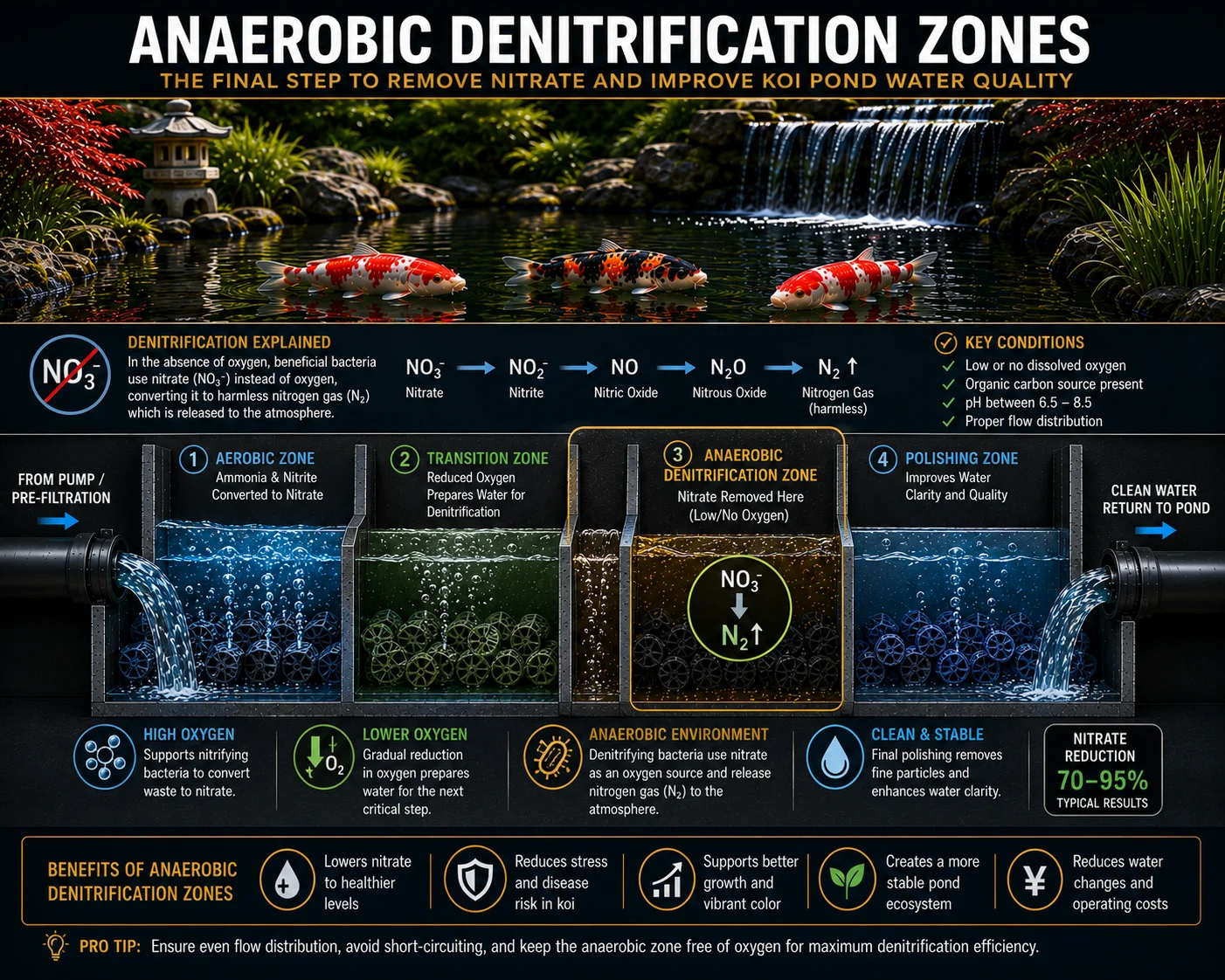
Deep-Bed Anaerobic Denitrification Zones
Anaerobic denitrification is the biological conversion of nitrate (NO₃⁻) to nitrogen gas (N₂) by facultative bacteria in oxygen-depleted environments. In a koi pond, these zones typically develop deep within sand or bead filters, in the lower layers of a moving-bed reactor, or within the boundary layer of a thick biofilm. While denitrification can be a powerful tool for managing nitrate accumulation—and thereby limiting algae growth—it also carries a serious hazard: hydrogen sulfide (H₂S) production by sulfate-reducing bacteria that compete for the same anoxic space.
This guide examines the conditions that promote or suppress denitrification in pond systems: the availability of organic carbon, the redox potential of the filter media, the hydraulic residence time, and the oxygen penetration depth into the biofilm or filter bed. We walk through the practical engineering choices that encourage nitrate removal while preventing the formation of toxic sulfide—a trade-off that sits at the heart of advanced pond water chemistry management. Every installation is unique, so the strategies presented here require verification against your own system’s parameters, rather than blanket application.
Test Your Anaerobic Zone Knowledge
Answer ten scenario-based questions covering denitrification biology, hydrogen sulfide prevention, filter design, and operational troubleshooting. Each answer includes the reasoning behind it.
Anaerobic Denitrification Zones — Quick Facts
Most Asked Questions About Anaerobic Denitrification Zones
A commercial koi facility noticed a gradual decline in fish appetite and occasional gasping at the surface, despite all water parameters appearing normal. The owner had been dosing ethanol to reduce nitrate, but had not been monitoring ORP. A quick sulfide test revealed 0.03 ppm free H₂S — well above the safe limit.
We traced the cause to over-dosing and a drop in nitrate concentration that allowed sulfate-reducing bacteria to take over. By cutting the ethanol dose in half, adding a small air stone to the filter sump to raise ORP above -50 mV, and performing a 20% water change, the sulfide was oxidized and fish behavior returned to normal within 48 hours. The lesson: carbon dosing requires active monitoring of nitrate, ORP, and sulfide, not a set-it-and-forget-it approach.
The Biology of Denitrification and Sulfate Reduction
Denitrification is a respiratory process carried out by facultative bacteria that preferentially use oxygen when available, but switch to nitrate (NO₃⁻) as an electron acceptor under anoxic conditions. The complete reduction of nitrate to nitrogen gas (N₂) proceeds through a series of intermediates (nitrite, nitric oxide, nitrous oxide), each step facilitated by specific enzymes. This process is essential for closing the nitrogen cycle in a pond, converting excess nitrate—which fuels algae growth—into harmless nitrogen gas that escapes into the atmosphere.
- Electron Acceptor Hierarchy: Bacteria will always use the most energetically favorable electron acceptor available. Oxygen is first, followed by nitrate, then sulfate. This means denitrification only begins after oxygen is depleted.
- Organic Carbon Requirement: Denitrification requires a source of organic carbon (electron donor) to fuel the reduction of nitrate. In many ponds, this carbon comes from fish waste, uneaten food, or added carbon sources. Without sufficient carbon, nitrate accumulates.
- Redox Potential as a Guide: ORP is a reliable indicator of which electron acceptor is dominant. Above +100 mV, oxygen respiration dominates; between +50 and +100 mV, denitrification begins; between -50 and +50 mV, denitrification is most active; below -50 mV, sulfate reduction becomes a risk.
Sulfate reduction, on the other hand, is carried out by obligate anaerobic bacteria that use sulfate (SO₄²⁻) as an electron acceptor. The byproduct of this process is hydrogen sulfide (H₂S), which is highly toxic, corrosive, and malodorous. Sulfate-reducing bacteria are present in most pond sediments and filters, but they only become active when the redox potential drops below about -150 mV and sulfate is available. This is the primary hazard of creating deep anaerobic zones: if nitrate is depleted, the system may shift from denitrification to sulfate reduction, turning a beneficial process into a dangerous one.
A hobbyist with a deep-bed sand filter (30 inches of #20 silica sand) had been running the system for two years with excellent water clarity but persistently high nitrate (60 ppm). A consultant recommended adding a carbon source to promote denitrification. The hobbyist started dosing acetic acid (vinegar) at a rate of 50 mL per 1000 gallons per day.
Within a week, nitrate dropped to 20 ppm—an impressive result. However, within two weeks, the pond developed a strong sulfur smell and the koi became lethargic. ORP readings showed -200 mV, and a sulfide test confirmed 0.02 ppm H₂S. The carbon dose was too high, and nitrate became the limiting factor, allowing sulfate reduction to dominate. By halving the dose and adding a small recirculation loop that introduced trace oxygen into the filter, ORP rose to -30 mV and sulfide disappeared. This case highlights that denitrification is a delicate balance between carbon supply, nitrate availability, and redox potential.
Filter Design and Operational Strategies
Not all filters are created equal when it comes to denitrification. Deep-bed sand filters, operated at slow flow rates, offer the most reliable environment for denitrification because they can maintain a stable redox gradient over a long residence time. Bead filters can also develop anaerobic zones if flow is throttled, but their shallow depth limits the volume of anoxic space. Moving-bed filters are generally poor for denitrification because their constant motion keeps oxygen levels high and disrupts biofilm stratification.
The most effective approach is often a hybrid design: a high-rate aerobic filter (bead or moving bed) for ammonia removal, followed by a dedicated low-rate denitrification filter (deep sand or a slow-flow chamber) that receives carbon dosing as needed. This separation allows the aerobic filter to operate at high efficiency without being compromised by low oxygen, while the denitrification filter can be managed independently to balance nitrate removal and sulfide prevention.
A pond owner constructed a separate ‘denitrification chamber’—a 55-gallon drum filled with sand, with a flow rate of 2 gallons per minute. The system was designed to treat 10% of the total flow, with the rest bypassing to the main filter. Initially, nitrate removal was negligible. By adding a small dose of ethanol to the influent of the chamber (1 mL per gallon per day), nitrate dropped from 50 ppm to 15 ppm over three weeks.
To prevent sulfide, the owner monitored ORP and adjusted the ethanol dose to keep ORP between -20 and +40 mV. After a year of operation, the chamber maintained nitrate at 10–15 ppm with no detectable sulfide. This case shows that a separate, controlled denitrification stage can be a reliable and safe solution when properly monitored and maintained.
Monitoring is the cornerstone of safe denitrification. ORP is the most practical tool for tracking redox conditions, with a target range of -20 mV to +80 mV for denitrification without sulfide. Nitrate and sulfide test kits provide confirmation, while a simple sulfur smell test is a useful early warning. Regular monitoring allows the operator to adjust carbon dosing or filter flow rates before a problem develops.
When troubleshooting sulfide problems, the first step is to stop carbon dosing and increase aeration to raise ORP. A water change can dilute sulfide and nitrate, while adding a small amount of an oxidizing agent (e.g., hydrogen peroxide, at 1 mL per 100 gallons) can rapidly oxidize sulfide if immediate action is required. However, chemical interventions should be used sparingly and carefully, as they can disrupt biological balances.
Anaerobic Denitrification — Full Question Library
Review indexed engineering questions below.
Q1:
In the nitrogen cycle, what is the primary source of nitrate in a koi pond?
Correct Answer: Option B
Nitrate is the end product of the nitrification pathway: ammonia (NH₃) → nitrite (NO₂⁻) → nitrate (NO₃⁻), carried out by aerobic bacteria in the filter.
Q2:
What is the final product of complete denitrification?
Correct Answer: Option A
Denitrification is the stepwise reduction of nitrate to nitrogen gas, which is inert and escapes into the atmosphere.
Q3:
Which environmental condition is necessary for denitrification to occur?
Correct Answer: Option C
Denitrification requires anoxic conditions; oxygen inhibits the enzymes responsible for nitrate reduction.
Q4:
What is the role of heterotrophic bacteria in denitrification?
Correct Answer: Option B
Heterotrophic denitrifiers require organic carbon for energy and use nitrate as a terminal electron acceptor in the absence of oxygen.
Q5:
In a healthy pond, what is the typical nitrate concentration range that prompts denitrification considerations?
Correct Answer: Option D
Nitrate concentrations above 50 ppm are common in heavily stocked ponds and are the primary driver for denitrification implementation.
Q6:
What is the first intermediate product of denitrification?
Correct Answer: Option C
The pathway is NO₃⁻ → NO₂⁻ → NO → N₂O → N₂; nitrite is the first intermediate.
Q7:
What is the effect of dissolved oxygen on denitrification rate?
Correct Answer: Option B
Oxygen is a more favorable electron acceptor; its presence represses the enzymes required for nitrate reduction.
Q8:
Autotrophic denitrification uses which electron donor?
Correct Answer: Option A
Autotrophic denitrifiers use inorganic electron donors, but this pathway is less common in pond filters than heterotrophic denitrification.
Q9:
Why does nitrate accumulate in many koi ponds despite active nitrification?
Correct Answer: Option B
In most pond filters, nitrification is efficient, but denitrification is limited because oxygen penetrates the biofilm or filter bed too deeply.
Q10:
What is the C:N ratio that typically supports efficient heterotrophic denitrification?
Correct Answer: Option B
A C:N ratio of 3–5:1 is often cited as optimal for denitrification, though it varies with the carbon source and bacterial population.
Q11:
Which of the following is NOT a known carbon source for denitrification?
Correct Answer: Option C
Ammonium chloride is a nitrogen source, not a carbon source. It would not support denitrification as a carbon donor.
Q12:
What happens to the nitrate removed by denitrification in a pond?
Correct Answer: Option A
Denitrification permanently removes nitrogen from the pond by converting it to inert nitrogen gas that escapes into the atmosphere.
Q13:
What is the main risk of using carbon dosing for denitrification?
Correct Answer: Option C
If carbon is overdosed and nitrate becomes limited, sulfate-reducing bacteria can take over, producing toxic hydrogen sulfide.
Q14:
What is the typical redox potential (ORP) range where denitrification is most active?
Correct Answer: Option A
Denitrification is most active in the low redox range, where oxygen is depleted but sulfate reduction has not yet become dominant.
Q15:
At what ORP value does sulfate reduction typically begin to dominate?
Correct Answer: Option C
Sulfate reduction becomes energetically favorable below approximately -150 mV, leading to hydrogen sulfide production.
Q16:
What is the biological purpose of denitrification for bacteria?
Correct Answer: Option B
Denitrification is a form of anaerobic respiration that allows bacteria to produce ATP in the absence of oxygen.
Q17:
What is the effect of temperature on denitrification rate?
Correct Answer: Option B
Bacterial activity generally increases with temperature, with denitrification following a Q10 of roughly 2.
Q18:
What is the role of pH in denitrification?
Correct Answer: Option A
Denitrifying bacteria function best in a neutral pH range; extreme pH values slow the process.
Q19:
What is the primary nitrogenous waste excreted by koi fish?
Correct Answer: Option B
Koi excrete ammonia directly across their gills as the primary nitrogenous waste product.
Q20:
What is the ultimate source of nitrogen in a pond ecosystem?
Correct Answer: Option A
The nitrogen input to a pond system is dominated by protein in fish food, which is metabolized and excreted as ammonia.
Q21:
What is the typical oxygen penetration depth into a biofilm?
Correct Answer: Option C
Oxygen penetration is limited by diffusion and consumption; typical biofilm anoxia begins within 100–200 µm of the surface.
Q22:
What is the role of extracellular polymeric substances (EPS) in biofilm formation?
Correct Answer: Option A
EPS creates a matrix that holds the biofilm together, protects bacteria, and retains water and nutrients.
Q23:
How does flow velocity affect biofilm redox profile?
Correct Answer: Option B
Increased turbulence and flow bring more oxygen into the biofilm, reducing the thickness of the anoxic zone.
Q24:
What is the effect of high organic loading on biofilm redox?
Correct Answer: Option A
High organic loading accelerates oxygen consumption, pushing the biofilm more deeply into anoxia and promoting denitrification.
Q25:
What is the significance of redox gradients in a denitrifying filter?
Correct Answer: Option B
In a healthy filter, a redox gradient allows nitrifying bacteria near the surface and denitrifiers deeper, achieving both ammonia and nitrate removal.
Q26:
What is the primary electron acceptor in the absence of oxygen and nitrate?
Correct Answer: Option A
Sulfate is the next most energetically favorable electron acceptor after nitrate, leading to hydrogen sulfide production.
Q27:
What is the role of sulfate-reducing bacteria in a filter?
Correct Answer: Option A
SRB are obligate anaerobes that use sulfate as an electron acceptor, producing hydrogen sulfide as a byproduct.
Q28:
What is the effect of backwashing on denitrification in a sand filter?
Correct Answer: Option C
Backwashing thoroughly mixes the media and reintroduces oxygen, destroying the redox gradient and halting denitrification until it re-establishes.
Q29:
How does media particle size affect denitrification potential?
Correct Answer: Option B
Smaller media particles create a denser bed with lower void volume, reducing oxygen diffusion and promoting anoxic zones.
Q30:
What is the typical redox potential of a well-aerated pond filter?
Correct Answer: Option B
In the presence of oxygen, ORP typically ranges between +200 and +400 mV, indicating an oxidizing environment.
Q31:
What is the effect of adding an oxidant like hydrogen peroxide to a denitrifying filter?
Correct Answer: Option A
Oxidants raise the redox potential, inhibiting the anoxic conditions required for denitrification.
Q32:
What is the primary factor that limits denitrification in a moving-bed biofilm reactor?
Correct Answer: Option C
Constant movement of the media in an MBBR ensures high oxygen transfer, which suppresses denitrification.
Q33:
What is the role of diffusion in biofilm redox?
Correct Answer: Option B
Diffusion is slow compared to convection; oxygen is consumed before it can penetrate far into the biofilm, creating anoxic conditions.
Q34:
What is the significance of the ‘active zone’ in a denitrifying biofilm?
Correct Answer: Option B
The active zone is where nitrate and carbon co-exist in the right proportions, maximizing denitrification.
Q35:
How does the redox potential change from the surface to the bottom of a deep-bed filter?
Correct Answer: Option A
Oxygen is consumed as water passes through the bed, so redox decreases, promoting denitrification at lower depths.
Q36:
What is the effect of high nitrate loading on biofilm redox?
Correct Answer: Option C
A steady supply of nitrate allows denitrifiers to outcompete sulfate-reducing bacteria, preventing sulfide formation.
Q37:
What is the role of facultative anaerobes in denitrification?
Correct Answer: Option B
Facultative anaerobes are the key denitrifiers; they use oxygen when available but switch to nitrate under anoxic conditions.
Q38:
What is the significance of ‘nitrate respiration’ in biofilm ecology?
Correct Answer: Option B
Nitrate respiration provides energy to bacteria in anoxic environments, driving denitrification and nitrogen removal.
Q39:
What is the effect of high organic carbon on sulfide production?
Correct Answer: Option A
Excess carbon, in the absence of nitrate, provides energy for sulfate-reducing bacteria, leading to H₂S production.
Q40:
What is the role of ORP monitoring in a denitrifying filter?
Correct Answer: Option B
ORP is a valuable indicator of redox conditions, helping operators adjust carbon dosing to avoid sulfide formation.
Q41:
What is the chemical formula for hydrogen sulfide?
Correct Answer: Option C
Hydrogen sulfide is H₂S, a weak acid that dissociates into HS⁻ and S²⁻ depending on pH.
Q42:
At what pH is hydrogen sulfide most toxic to fish?
Correct Answer: Option A
At lower pH, a greater proportion of sulfide is in the un-ionized H₂S form, which is highly toxic to fish.
Q43:
What is the primary toxic effect of hydrogen sulfide on fish?
Correct Answer: Option B
H₂S binds to the cytochrome c oxidase enzyme, blocking the electron transport chain and halting ATP production.
Q44:
What is the safe free H₂S concentration for koi?
Correct Answer: Option A
Koi are extremely sensitive; concentrations as low as 0.002–0.01 ppm can cause stress and mortality.
Q45:
What is the characteristic odor of hydrogen sulfide?
Correct Answer: Option C
The distinct ‘rotten egg’ smell is a classic warning sign of H₂S, though olfactory fatigue can occur at higher concentrations.
Q46:
How does hydrogen sulfide affect the pH of pond water?
Correct Answer: Option B
H₂S dissociates in water, releasing H⁺ ions and slightly acidifying the water.
Q47:
What happens to hydrogen sulfide when it is oxidized?
Correct Answer: Option B
Complete oxidation of H₂S yields sulfate, which is harmless and can be used by plants or bacteria.
Q48:
Which of the following is a common source of sulfate in pond water?
Correct Answer: Option A
Groundwater often contains sulfate from mineral dissolution, which can be a problem in ponds using well water.
Q49:
How does temperature affect hydrogen sulfide toxicity?
Correct Answer: Option B
Higher temperatures increase metabolic rates and the diffusion of H₂S into fish gills, exacerbating toxicity.
Q50:
What is the primary route of hydrogen sulfide entry into a pond system?
Correct Answer: Option C
Sulfate-reducing bacteria produce H₂S in anoxic zones like deep filter beds or pond sediments.
Q51:
How can hydrogen sulfide be removed from water?
Correct Answer: Option B
Oxidation converts H₂S to sulfate, which is non-toxic. Aeration and chemical oxidants are effective methods.
Q52:
What is the effect of hydrogen sulfide on copper and brass fittings?
Correct Answer: Option A
Hydrogen sulfide reacts with copper and brass to form dark tarnish and pits, a major concern for plumbing systems.
Q53:
What is the role of iron in sulfide management?
Correct Answer: Option B
Adding iron salts can precipitate sulfide as FeS, reducing the free H₂S concentration.
Q54:
Why is sulfide more toxic at lower pH?
Correct Answer: Option B
At low pH, the equilibrium shifts to H₂S, which is lipophilic and can cross biological membranes easily, increasing toxicity.
Q55:
What is the effect of hydrogen sulfide on pond oxygen levels?
Correct Answer: Option A
Oxidation of H₂S is an oxygen-consuming process, potentially contributing to oxygen depletion in an already stressed system.
Q56:
What is the first sign of hydrogen sulfide poisoning in koi?
Correct Answer: Option C
Koi will gasp for air at the surface as sulfide inhibits oxygen transport and respiration.
Q57:
How can you confirm hydrogen sulfide presence in a pond?
Correct Answer: Option B
Sulfide test kits, ORP probes, and sometimes the ‘rotten egg’ smell are the primary field detection methods.
Q58:
What is the maximum acceptable total sulfide concentration in koi pond water?
Correct Answer: Option A
Total sulfide, including H₂S and HS⁻, should be kept below 0.01 ppm to protect koi health.
Q59:
What is the role of aeration in sulfide management?
Correct Answer: Option B
Oxygen introduced through aeration reacts with H₂S, oxidizing it to harmless sulfate.
Q60:
What is the relationship between nitrate and sulfide production?
Correct Answer: Option C
When nitrate is available, denitrifiers outcompete sulfate-reducing bacteria for electron acceptors, preventing H₂S formation.
Q61:
What is the minimum recommended depth for a denitrifying sand filter?
Correct Answer: Option B
A depth of at least 24 inches is required to create a stable anoxic zone; shallower beds may be fully oxygenated.
Q62:
Which media is most effective for promoting denitrification in a pond filter?
Correct Answer: Option C
Fine sand creates a dense bed that restricts oxygen diffusion, promoting anoxic zones necessary for denitrification.
Q63:
What is the effect of increasing the depth of a sand filter on denitrification?
Correct Answer: Option A
Deeper beds allow more time for oxygen consumption and create a thicker anoxic zone for denitrifiers.
Q64:
What is the ideal flow rate (gpm/ft²) for a denitrifying sand filter?
Correct Answer: Option B
Slow flow rates are essential to allow sufficient contact time and oxygen depletion for denitrification.
Q65:
What is the role of media surface area in denitrification?
Correct Answer: Option A
Biofilm grows on media surfaces; more surface area allows for a thicker biofilm with deeper anoxic zones.
Q66:
Why is a bead filter less effective for denitrification than a sand filter?
Correct Answer: Option B
Bead filters typically have a bed depth of 12–18 inches and operate at higher flow rates, limiting anoxic zone development.
Q67:
What is the effect of backwashing on the denitrification capacity of a sand filter?
Correct Answer: Option C
Backwashing mixes the bed and introduces oxygen, destroying the redox gradient; denitrification resumes as the bed re-settles.
Q68:
What is the significance of ‘media stratification’ in deep-bed filters?
Correct Answer: Option B
Stratified media (e.g., coarse at top, fine at bottom) can naturally create gradients in flow and oxygen concentration.
Q69:
How does media density affect denitrification?
Correct Answer: Option A
Dense packing reduces pore space and limits oxygen diffusion, enhancing denitrification.
Q70:
What is the role of a distribution plate in a deep-bed filter?
Correct Answer: Option B
Even flow distribution is critical for maintaining a uniform redox profile and maximizing denitrification.
Q71:
What is the effect of adding a coarse gravel layer at the bottom of a sand filter?
Correct Answer: Option B
A gravel underdrain ensures collected water can exit without accumulating debris, preventing back-pressure and channeling.
Q72:
How does the uniformity coefficient of sand affect denitrification?
Correct Answer: Option A
A well-graded sand pack (with a range of particle sizes) creates a denser, less porous bed, limiting oxygen penetration.
Q73:
What is the typical bed expansion during backwash for a denitrifying sand filter?
Correct Answer: Option C
A 10–30% bed expansion is typically sufficient to clean the sand without excessive media loss or disrupting stratification.
Q74:
Which material is NOT suitable as a denitrification media?
Correct Answer: Option A
Large stones have too much void space and low surface area, preventing the development of anoxic zones.
Q75:
What is the effect of media age on denitrification?
Correct Answer: Option C
A mature biofilm has a stable redox gradient and high bacterial density, maximizing denitrification.
Q76:
How does the addition of a carbon source affect media selection?
Correct Answer: Option A
Soluble carbon sources pass through coarse media quickly; fine media increases contact time and prevents washout.
Q77:
What is the role of a support gravel layer in a denitrification filter?
Correct Answer: Option B
The support layer keeps the fine sand media out of the underdrain system, ensuring good hydraulic performance.
Q78:
What is the effect of fines (small particles) in sand media on denitrification?
Correct Answer: Option A
Small particles fill voids, creating a denser bed with less oxygen penetration, promoting anoxia.
Q79:
What is the typical lifespan of a denitrifying sand bed before it needs replacement?
Correct Answer: Option C
Sand media is durable and can last many years; it is typically replaced only when it becomes excessively fouled or loses stratification.
Q80:
How does a dual-media filter (sand and anthracite) compare to sand alone for denitrification?
Correct Answer: Option A
Sand’s high density and fine grain size make it more effective for creating anoxic zones than lighter, coarser anthracite.
Q81:
What is the most common carbon source used for denitrification in ponds?
Correct Answer: Option A
Ethanol is cheap, readily available, and easily utilized by denitrifying bacteria.
Q82:
What is the recommended starting dose of ethanol for denitrification?
Correct Answer: Option B
A conservative starting dose allows observation of nitrate reduction and ORP changes without overshooting into sulfide production.
Q83:
What is the chemical equation for denitrification with ethanol?
Correct Answer: Option C
This balanced equation shows the stoichiometric relationship; 5 moles of ethanol reduce 12 moles of nitrate.
Q84:
What is the effect of overdosing carbon on ORP?
Correct Answer: Option A
Excess carbon fuel drives ORP down quickly, often below -150 mV, where sulfate reduction becomes dominant.
Q85:
Which carbon source is NOT recommended for pond denitrification?
Correct Answer: Option C
Methanol is highly toxic to humans and animals; it is not suitable for hobbyist pond systems due to handling risks.
Q86:
What is the role of a ‘slow-release’ carbon source?
Correct Answer: Option B
Solid carbon sources like wood chips or biodegradable polymers provide a steady carbon supply, reducing the risk of sulfide spikes.
Q87:
What is the carbon requirement for denitrification in terms of COD:NO₃-N?
Correct Answer: Option A
This ratio accounts for the theoretical demand and the inefficiencies of biological utilization.
Q88:
What is the effect of temperature on carbon dosing rates?
Correct Answer: Option B
Bacterial metabolism increases with temperature, consuming more carbon; dosing may need to be adjusted seasonally.
Q89:
What is the primary risk of using a solid carbon source like wood chips?
Correct Answer: Option B
Wood chips release organic compounds (tannins) that can discolor pond water, an aesthetic concern for some hobbyists.
Q90:
How does carbon dosing affect dissolved oxygen?
Correct Answer: Option C
Increased bacterial activity consumes oxygen, which can lead to hypoxic conditions if dosing is too aggressive.
Q91:
What is the typical COD to nitrate ratio for denitrification with ethanol?
Correct Answer: Option B
The stoichiometric ratio is about 2.86 g COD per g NO₃-N, but practical ratios are slightly higher due to system inefficiencies.
Q92:
What is the effect of adding a carbon source to a pond with high nitrate?
Correct Answer: Option A
Carbon provides the energy needed for denitrifiers to reduce nitrate to nitrogen gas.
Q93:
What is the risk of using sucrose (sugar) as a carbon source?
Correct Answer: Option B
Sugar is rapidly metabolized, leading to a quick spike in bacterial activity and a sharp drop in dissolved oxygen.
Q94:
How should a carbon source be dosed to minimize sulfide risk?
Correct Answer: Option C
Frequent, small doses keep ORP stable and prevent the sudden drops that lead to sulfide production.
Q95:
What is the effect of pH on carbon source effectiveness?
Correct Answer: Option B
Bacterial enzymes function optimally in a neutral pH range, ensuring efficient carbon utilization.
Q96:
What is the advantage of using a mixture of carbon sources?
Correct Answer: Option A
Different carbon sources may select for different bacterial populations, potentially improving system resilience.
Q97:
What is the carbon requirement for denitrification of 10 ppm nitrate in 1000 gallons?
Correct Answer: Option B
10 ppm NO₃-N in 1000 gallons is about 38 g of nitrate-nitrogen; the carbon demand is about 2.5 times that, or roughly 95 g of COD.
Q98:
How does a high C:N ratio affect denitrification?
Correct Answer: Option B
When carbon exceeds nitrate, sulfate-reducing bacteria can use the excess carbon, leading to H₂S production.
Q99:
What is the role of acclimation when starting carbon dosing?
Correct Answer: Option A
Starting with a low dose and gradually increasing it allows denitrifiers to grow without overloading the system or causing sulfide spikes.
Q100:
What is the most important parameter to monitor when carbon dosing?
Correct Answer: Option A
Monitoring ORP (for sulfide risk) and nitrate (for denitrification effectiveness) are essential for safe carbon dosing.
Q101:
What is the typical denitrification rate in a sand filter?
Correct Answer: Option C
Rates vary widely with temperature, carbon, and nitrate availability; 0.5–5 g N/m³/day is a common range.
Q102:
What is the effect of temperature on denitrification rate?
Correct Answer: Option B
Denitrification is a biological process; rates increase with temperature until reaching an optimum, then decline at higher temperatures.
Q103:
What is the effect of nitrate concentration on denitrification kinetics?
Correct Answer: Option A
Like most enzyme-mediated reactions, denitrification rate increases with substrate concentration up to a maximum rate.
Q104:
What is the role of biofilm thickness in denitrification rate?
Correct Answer: Option B
There is an optimal biofilm thickness where denitrification is maximized; too thick, and diffusion becomes limiting.
Q105:
What is the typical half-velocity constant (Ks) for denitrification?
Correct Answer: Option A
The half-velocity constant is the nitrate concentration at which the rate is half the maximum; it is relatively low.
Q106:
How does the availability of organic carbon affect denitrification rate?
Correct Answer: Option B
Carbon is the electron donor; its availability limits the rate of denitrification.
Q107:
What is the Arrhenius temperature coefficient for denitrification?
Correct Answer: Option B
A Q10 of about 2 is common for biological processes, meaning the rate doubles for every 10°C increase.
Q108:
What is the effect of pH on denitrification rate?
Correct Answer: Option A
Most denitrifying bacteria are neutrophilic; significant deviations from neutral pH reduce activity.
Q109:
How does the hydraulic retention time (HRT) affect denitrification?
Correct Answer: Option B
Denitrification is a time-dependent process; longer residence times allow for more complete nitrate removal.
Q110:
What is the effect of mixing on denitrification in a filter?
Correct Answer: Option B
Mixing can disrupt anoxic zones by reintroducing oxygen, which inhibits denitrification.
Q111:
What is the maximum denitrification rate achievable in a pond filter?
Correct Answer: Option A
Practical rates in pond systems are relatively low due to temperature, carbon, and hydraulic limitations.
Q112:
What is the effect of influent nitrate concentration on the effluent nitrate concentration?
Correct Answer: Option B
First-order kinetics mean that a fraction of nitrate is removed, leaving a residual that is proportional to the influent.
Q113:
What is the role of denitrification in the overall nitrogen balance of a pond?
Correct Answer: Option B
Denitrification is the only permanent nitrogen removal pathway; other mechanisms merely convert nitrogen between forms.
Q114:
What is the effect of a sudden increase in nitrate load on denitrification?
Correct Answer: Option A
The bacterial population has a finite capacity; a sudden load increase can exceed it, causing a spike in effluent nitrate.
Q115:
What is the role of competition between denitrifiers and sulfate-reducers in kinetics?
Correct Answer: Option C
Denitrifiers have a kinetic advantage for carbon when nitrate is present, outcompeting SRB.
Q116:
What is the effect of feed concentration on denitrification rate?
Correct Answer: Option B
This is typical Monod kinetics; the rate increases with substrate until the enzymes are saturated.
Q117:
What is the effect of starvation on denitrification rates?
Correct Answer: Option B
If carbon or nitrate is absent for extended periods, the denitrifying population will decline, reducing the rate when conditions improve.
Q118:
How does the biomass concentration affect denitrification rate?
Correct Answer: Option A
More bacteria mean more active sites for nitrate reduction, up to the point where diffusion becomes limiting.
Q119:
What is the role of nitrite accumulation in denitrification?
Correct Answer: Option B
Nitrite accumulation can be a sign of incomplete denitrification and is toxic to koi.
Q120:
What is the effect of aeration on denitrification rate?
Correct Answer: Option A
Oxygen is a competitive electron acceptor and will be used preferentially, halting denitrification.
Q121:
Where does the majority of denitrification occur in a natural pond system?
Correct Answer: Option B
Sediments are typically anoxic and rich in organic matter, making them hotbeds of denitrification.
Q122:
What is the primary risk of excessive sludge accumulation in a pond?
Correct Answer: Option A
Sludge is a dense organic deposit that rapidly depletes oxygen, leading to sulfide production.
Q123:
How often should sludge be removed from a koi pond to prevent sulfide issues?
Correct Answer: Option B
Regular sludge removal prevents the buildup of anoxic, sulfide-producing sediments.
Q124:
What is the role of bottom aeration in sludge management?
Correct Answer: Option B
Aeration adds oxygen, promoting aerobic bacteria that break down sludge and prevent anoxia.
Q125:
What is the effect of a pond vacuum on denitrification?
Correct Answer: Option A
Sludge is a source of both organic carbon and the bacteria themselves; removing it can reduce denitrification capacity.
Q126:
What is the relationship between sludge depth and sulfide risk?
Correct Answer: Option B
Thicker sludge deposits are more likely to have deep anoxic zones where sulfate reduction can occur.
Q127:
How can you determine if sludge is producing sulfide?
Correct Answer: Option B
The ‘rotten egg’ smell is a direct indicator of sulfide production in the sludge.
Q128:
What is the effect of adding nitrate to the pond water on sediment redox?
Correct Answer: Option C
Nitrate is a more favorable electron acceptor than sulfate; its presence can prevent sulfide formation.
Q129:
What is the role of beneficial bacteria products in sludge management?
Correct Answer: Option A
Some products contain bacteria that break down organic matter, potentially reducing sludge and its associated risks.
Q130:
What is the effect of turning over the pond sediment?
Correct Answer: Option B
Disturbing anoxic sediments can release accumulated sulfide, potentially causing a toxic event.
Q131:
What is the role of plants in sediment redox?
Correct Answer: Option A
Roots release oxygen into the rhizosphere, creating a more oxidizing environment and reducing sulfide risk.
Q132:
What is the effect of temperature on sludge decomposition and sulfide production?
Correct Answer: Option B
Higher temperatures speed up all biological processes, including sulfate reduction in sludge.
Q133:
What is the primary benefit of a well-maintained bottom drain?
Correct Answer: Option A
A bottom drain is the most effective way to remove waste from the pond, preventing sludge buildup.
Q134:
How does the use of a settling tank or vortex filter affect sludge?
Correct Answer: Option B
Pre-filtration removes waste before it can settle and form sludge, reducing sulfide risk.
Q135:
What is the effect of high feed rates on sludge accumulation?
Correct Answer: Option A
More feed means more waste, leading to faster sludge accumulation and higher sulfide risk.
Q136:
How can you safely remove sludge without releasing sulfide?
Correct Answer: Option B
A vacuum removes sludge directly without disturbing it excessively, minimizing sulfide release.
Q137:
What is the role of bottom drains in sulfide prevention?
Correct Answer: Option C
By removing solid waste, bottom drains eliminate the primary substrate for sulfate-reducing bacteria.
Q138:
What is the effect of a pond liner on sediment dynamics?
Correct Answer: Option B
Folds in a liner can trap sediment, creating localized anoxic zones and sulfide production.
Q139:
How does a regular water change affect sludge?
Correct Answer: Option A
Water changes reduce nitrate and other waste products, indirectly reducing the risk of sludge-driven anoxia.
Q140:
What is the ultimate goal of sludge management in relation to denitrification?
Correct Answer: Option A
The goal is to manage sludge so that sulfide is not produced, while still allowing denitrification to occur in controlled filter zones.
Q141:
What does ORP stand for in water quality monitoring?
Correct Answer: Option B
ORP is a measure of the tendency of a system to donate or accept electrons, indicating its oxidizing or reducing power.
Q142:
What is the typical ORP range for a healthy koi pond?
Correct Answer: Option A
A well-oxygenated pond will have a positive ORP, indicating an oxidizing environment.
Q143:
What ORP range is indicative of denitrification?
Correct Answer: Option B
Denitrification occurs in the low redox range where oxygen is depleted but sulfate reduction has not yet begun.
Q144:
At what ORP value is hydrogen sulfide typically produced?
Correct Answer: Option C
Sulfate reduction becomes active when ORP drops below about -150 mV.
Q145:
What is the effect of adding oxygen to the pond on ORP?
Correct Answer: Option A
Oxygen is a strong oxidant; adding it raises the redox potential, making the water more oxidizing.
Q146:
What is the effect of adding a carbon source on ORP?
Correct Answer: Option B
Carbon addition stimulates bacterial activity, consuming oxygen and lowering ORP.
Q147:
How does temperature affect ORP readings?
Correct Answer: Option B
The redox potential is affected by temperature; most probes automatically compensate.
Q148:
What is the role of a platinum electrode in an ORP probe?
Correct Answer: Option A
The platinum electrode is the sensing element that measures the electron activity in the water.
Q149:
How often should an ORP probe be cleaned and calibrated?
Correct Answer: Option B
Regular cleaning and calibration are necessary to maintain accurate ORP readings.
Q150:
What is the effect of pH on ORP measurement?
Correct Answer: Option B
The redox potential is influenced by pH; some probes compensate for this.
Q151:
What ORP reading would indicate a healthy filter with active denitrification?
Correct Answer: Option C
This range suggests that oxygen is depleted but sulfate reduction is not yet a problem.
Q152:
What is the effect of adding an oxidizer like potassium permanganate on ORP?
Correct Answer: Option B
Strong oxidizers raise the ORP sharply, which is sometimes used to treat sulfide spikes.
Q153:
What is the relationship between ORP and dissolved oxygen?
Correct Answer: Option B
While not a direct correlation, ORP is often used as a proxy for oxygen status in the water.
Q154:
What is the effect of organic waste on ORP?
Correct Answer: Option A
Decomposition consumes oxygen and releases reducing substances, lowering the ORP.
Q155:
How can you raise ORP in a pond with low redox?
Correct Answer: Option C
Aeration adds oxygen, raising ORP; oxidants like hydrogen peroxide can also be used.
Q156:
What is the effect of a UV sterilizer on ORP?
Correct Answer: Option A
UV light affects microorganisms but does not change the redox chemistry of the water directly.
Q157:
What is the role of a reference electrode in an ORP probe?
Correct Answer: Option B
The reference electrode is the stable half-cell that allows the probe to measure the potential of the solution.
Q158:
How does salinity affect ORP readings?
Correct Answer: Option B
Ionic strength can affect the performance of the reference electrode, requiring compensation or specialized probes.
Q159:
What is the significance of a ‘negative ORP’ reading?
Correct Answer: Option A
Negative ORP means the water is reducing; it’s necessary for denitrification but also a risk for sulfide.
Q160:
What is the best location to measure ORP in a denitrifying filter?
Correct Answer: Option B
Measuring the effluent ORP gives an indication of the redox state of the water after it has passed through the filter.
Q161:
What is the primary nutrient that fuels algae growth in a koi pond?
Correct Answer: Option A
Nitrate is often the limiting nutrient for algae growth; reducing it can control algae blooms.
Q162:
What is the effect of high nitrate on algae blooms?
Correct Answer: Option B
Algae require nitrogen; high nitrate levels often lead to visible algae growth.
Q163:
How does denitrification help control algae?
Correct Answer: Option B
By reducing nitrate, denitrification limits a key nutrient for algae, helping to keep water clear.
Q164:
What is the effect of light on the relationship between nitrate and algae?
Correct Answer: Option A
Light is the energy source for algae; nitrate is a nutrient. Both are required for growth.
Q165:
What is the role of phosphate in relation to nitrate and algae?
Correct Answer: Option B
Both nitrogen and phosphorus are essential nutrients for algae; limiting either can control blooms.
Q166:
How does temperature affect the nitrate-algae relationship?
Correct Answer: Option B
Algae growth rates increase with temperature, making nitrate control more important in summer.
Q167:
What is the effect of a UV sterilizer on algae in relation to nitrate?
Correct Answer: Option A
UV clarifiers destroy algae cells, but the nitrate that fueled them remains in the water.
Q168:
What is the effect of a high fish load on nitrate and algae?
Correct Answer: Option B
More fish produce more waste, leading to higher nitrate and more potential for algae.
Q169:
What is the role of macroalgae (plants) in nitrate control?
Correct Answer: Option B
Aquatic plants are effective at absorbing nitrate, which can help prevent algae blooms.
Q170:
What is the ideal nitrate level to prevent algae in a koi pond?
Correct Answer: Option A
Maintaining nitrate below 20 ppm is a common goal to minimize algae issues, though it depends on other factors.
Q171:
How does alkalinity affect nitrate and algae?
Correct Answer: Option B
Algae need carbon as well as nitrogen; alkalinity provides a carbon source.
Q172:
What is the effect of a water change on nitrate and algae?
Correct Answer: Option B
Regular water changes are an effective way to keep nitrate levels in check.
Q173:
What is the role of denitrification in an integrated pond management strategy?
Correct Answer: Option A
Denitrification offers a long-term, natural solution to nitrate accumulation.
Q174:
What is the effect of shading on algae growth in relation to nitrate?
Correct Answer: Option B
Light is a limiting factor; shading can prevent algae blooms regardless of nitrate concentration.
Q175:
What is the effect of a biofilter on the nitrate-algae relationship?
Correct Answer: Option B
Biofilters are essential for breaking down ammonia, but they produce nitrate as a byproduct.
Q176:
What is the role of a protein skimmer in nitrate and algae control?
Correct Answer: Option B
Protein skimmers remove organic waste, reducing the load on the biofilter and subsequent nitrate production.
Q177:
How does nitrate affect the color of pond water?
Correct Answer: Option A
Nitrate is colorless; the green tint is from algae that use the nitrate.
Q178:
What is the effect of a deep-bed denitrification filter on pond clarity?
Correct Answer: Option B
By controlling nitrate, a denitrification filter helps maintain clear water.
Q179:
What is the role of barley straw in algae and nitrate control?
Correct Answer: Option A
Barley straw is a traditional method that works through allelopathic effects, not nitrogen removal.
Q180:
What is the ultimate goal of nitrate management in a koi pond?
Correct Answer: Option B
Some nitrate is normal; the goal is to prevent it from becoming excessive and causing problems.
Q181:
What is a ‘post-denitrification’ filter?
Correct Answer: Option A
Post-denitrification is a common design where nitrate is removed after nitrification is complete.
Q182:
What is the advantage of a ‘pre-denitrification’ system?
Correct Answer: Option B
In pre-denitrification, the anoxic zone is placed before the aerobic zone, using the BOD in the incoming water as a carbon source.
Q183:
What is a ‘sequencing batch reactor’ (SBR) in the context of denitrification?
Correct Answer: Option A
SBRs are versatile systems that can achieve both nitrification and denitrification in one tank by time-phasing.
Q184:
What is the role of a ‘carrier media’ in a moving-bed denitrification reactor?
Correct Answer: Option A
Carrier media support biofilm growth, allowing for a high biomass density in a compact reactor.
Q185:
What is the advantage of a ‘membrane bioreactor’ (MBR) for denitrification?
Correct Answer: Option B
MBRs use membranes to separate biomass from water, allowing for very high biomass retention and efficient denitrification.
Q186:
What is the role of a ‘carbon source’ in an advanced denitrification system?
Correct Answer: Option B
The carbon source is essential for energy and biomass growth in the denitrification process.
Q187:
What is the primary difference between fixed-film and suspended-growth denitrification systems?
Correct Answer: Option B
Fixed-film (e.g., sand filters) and suspended-growth (e.g., activated sludge) are two different biological configurations.
Q188:
What is the role of a ‘denitrification filter’ in a large pond facility?
Correct Answer: Option B
A denitrification filter is a specific piece of equipment designed to manage nitrate levels.
Q189:
What is the advantage of a ‘two-stage’ denitrification system?
Correct Answer: Option B
Two-stage systems (e.g., anoxic followed by oxic) allow for polishing and can achieve very low effluent nitrate.
Q190:
What is the role of ‘recirculation’ in denitrification design?
Correct Answer: Option C
Internal recirculation is a key feature of many activated sludge systems, returning nitrate to the anoxic zone.
Q191:
What is the effect of adding a denitrification filter on the overall energy consumption of a pond system?
Correct Answer: Option B
There is an energy trade-off, but the long-term benefits often outweigh the costs.
Q192:
What is the role of instrumentation (ORP, DO, nitrate probes) in advanced denitrification?
Correct Answer: Option A
Advanced systems rely on sensors for real-time control, ensuring stable and efficient denitrification.
Q193:
What is the effect of a ‘polishing pond’ on nitrate?
Correct Answer: Option B
A well-designed polishing pond with plant life and sediment can offer passive denitrification.
Q194:
What is the role of ‘activated carbon’ in nitrate removal?
Correct Answer: Option A
Activated carbon is a poor adsorbent for nitrate; it is used for other water quality parameters.
Q195:
What is the advantage of a ‘biological aerated filter’ (BAF) for combined nitrification-denitrification?
Correct Answer: Option B
BAFs are compact and can be designed with alternating aerobic and anoxic zones.
Q196:
What is the role of a ‘settling tank’ in a denitrification system?
Correct Answer: Option A
Clarification is essential to prevent biomass from being discharged with the effluent.
Q197:
What is the effect of ‘hydraulic retention time’ (HRT) on denitrification efficiency in advanced systems?
Correct Answer: Option B
Longer residence times allow for more complete nitrate removal.
Q198:
What is the role of ‘sludge wasting’ in a suspended-growth denitrification system?
Correct Answer: Option B
Wasting sludge is a routine operational task to maintain a healthy biomass level.
Q199:
What is the primary challenge of implementing denitrification in a koi pond?
Correct Answer: Option B
The risk of sulfide is the main operational hurdle in pond denitrification.
Q200:
What is the ultimate goal of advanced denitrification in a koi pond?
Correct Answer: Option C
The aim is to integrate denitrification safely and effectively into the overall pond management strategy.