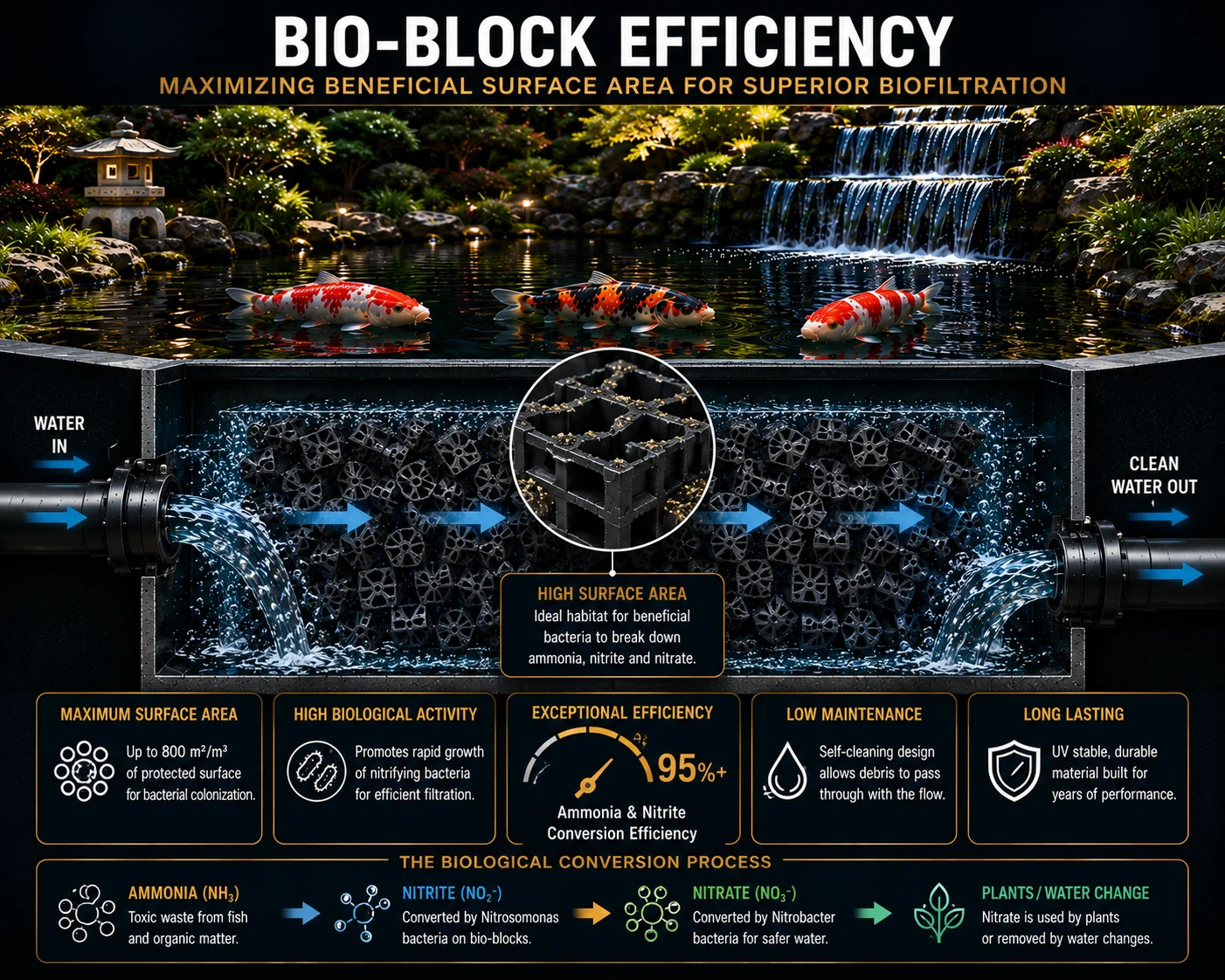
Static Ceramic Bio-Block Efficiency
Static ceramic bio-blocks represent a fundamental shift in biofiltration engineering: the use of a fixed, highly porous matrix to maximize the available surface area for nitrifying bacteria while requiring no fluidization energy. In a koi pond system, these blocks provide a stable, self-cleaning environment where bacterial colonies can establish robust biofilms, converting toxic ammonia and nitrite efficiently. The core engineering advantage lies in the material’s ability to offer up to 800 m² of protected surface area per cubic meter of media, far exceeding the effective surface area of most fluidized beds, which often suffer from abrasion and uneven colonization due to media collision.
The biological conversion process is a two-step aerobic pathway: Ammonia (NH₃), excreted by fish and produced from organic waste, is first oxidized to nitrite (NO₂⁻) by bacteria of the genus Nitrosomonas. This nitrite is then rapidly oxidized to the less toxic nitrate (NO₃⁻) by Nitrobacter bacteria. Both groups of bacteria thrive on the porous surface of ceramic bio-blocks, which protect them from being washed out of the system. Unlike fluidized beds, where the media’s constant motion can shear off biofilm, the static nature of these blocks allows for a thicker, more stable biofilm that can better handle fluctuations in ammonia load, making them a robust choice for high-density koi ponds.
This page provides a detailed engineering analysis of static ceramic bio-block efficiency, comparing it to fluidized and other media types, examining the factors that influence bacterial colonization and activity, and offering guidance on sizing and system integration. All calculations and recommendations are based on established principles of biological filtration and real-world pond engineering practice.
Test Your Bio-Block Knowledge
Work through ten scenario-based questions covering bio-block surface area, nitrification kinetics, comparison with fluidized systems, and troubleshooting. Each answer includes the reasoning behind it.
Static Ceramic Bio-Block — Quick Facts
Most Asked Questions About Static Bio-Block Efficiency
A 4,000-gallon koi pond with a heavy fish load and a high feeding rate was experiencing chronic low-level ammonia and nitrite spikes, especially during the warmer summer months. The existing biofilter was a fluidized bed, which, while functional, was energy-intensive and struggled to keep up during peak feeding periods. After a detailed system assessment, the solution was to add a downstream chamber filled with high-porosity ceramic bio-blocks.
Within four weeks of installation, water quality parameters stabilized. The static block provided the necessary additional surface area, and the stable biofilm allowed for more robust nitrification. The existing fluidized bed was repurposed for polishing, resulting in a more resilient filtration system with lower overall energy consumption.
Nitrification Kinetics and Biofilm Development
The biological conversion of ammonia to nitrate is a two-step aerobic process, and the efficiency of this process on a static bio-block is governed by the principles of biofilm kinetics. In the first step, Nitrosomonas bacteria oxidize ammonia (NH₃) to nitrite (NO₂⁻). This reaction consumes oxygen and alkalinity. The second step, carried out by Nitrobacter bacteria, oxidizes nitrite to nitrate (NO₃⁻). A healthy biofilm is a complex, stratified ecosystem: the outer layers are dominated by aerobic bacteria that consume oxygen rapidly, while deeper layers may become anoxic or anaerobic, hosting other types of bacteria that can participate in denitrification.
- Diffusion Limitation: The rate of nitrification within a thick biofilm is often limited by the diffusion of oxygen and ammonia from the bulk water into the depths of the film. This creates a concentration gradient, with the highest reaction rates occurring at the surface where oxygen is plentiful.
- Biomass Yield and Decay: Bacterial colonies grow and reproduce, increasing the thickness of the biofilm. However, as the film grows, the inner layers become starved of nutrients and oxygen, leading to cell lysis and detachment. This self-regulation maintains a dynamic equilibrium. A well-designed system provides the correct hydraulic shear to slough off older, less active biomass without stripping the active outer layers.
- Inhibition Factors: Nitrification is a sensitive process. It can be inhibited by low pH (< 7.0), low dissolved oxygen (< 2 mg/L), high ammonia concentrations (> 5 mg/L free NH₃), and the presence of certain chemicals (e.g., high chloramine levels in tap water). A robust bio-block filter design must account for these factors to ensure stable performance.
A large indoor koi facility with a multi-chamber filtration system noticed a sudden, sharp increase in nitrite levels that was not accompanied by a corresponding increase in ammonia. This is a classic sign of a “nitrite spike” or a “bottleneck” in the second stage of nitrification.
Analysis revealed that the static bio-block media, which had been operating for several years, was partially clogged with a heavy layer of inorganic precipitates (from hard water) and detritus. This clogging was creating anaerobic zones within the blocks, which inhibited the Nitrobacter population. A thorough cleaning of the media in a mild acid solution to dissolve the precipitates, followed by a gentle rinse, resolved the issue and restored the complete nitrification pathway.
Comparing Media Performance: Static vs. Fluidized vs. Moving Bed
Choosing the right biological media is a critical engineering decision. Each type has distinct advantages and disadvantages that must be weighed against the specific requirements of the pond system, including space constraints, energy costs, maintenance, and target water quality. Static ceramic bio-blocks offer a compelling value proposition, but they are not a universal solution. High-load systems or those with limited space might benefit from a moving bed or fluidized bed, while the simplicity and efficiency of static blocks are ideal for many large, gravity-fed ponds where energy consumption is a primary design driver.
- Static Ceramic Bio-Blocks: Highest surface area (up to 800 m²/m³), stable biofilm, self-cleaning, low maintenance, minimal head loss, no fluidization energy required. Disadvantages: Can be clogged by fine suspended solids if pre-filtration is inadequate; requires a larger footprint than some compact moving bed systems.
- Fluidized Sand Beds: Excellent for organic carbon removal and nitrification, very high solids retention due to its deep bed depth. Disadvantages: Very high head loss, requires high energy for fluidization, media is abrasive, expensive to install and operate.
- Moving Bed Biofilm Reactors (MBBR): Compact, excellent oxygen transfer, self-cleaning, good for high-load applications. Disadvantages: Media can be expensive, requires aeration to keep media in motion (energy cost), biofilm is continuously abraded, leading to lower effective surface area per volume.
For most large, outdoor, garden-style koi ponds where gentle water movement, low energy consumption, and longevity are priorities, static ceramic bio-blocks are often the most suitable primary biological filter. Their high internal surface area and stable biofilm make them exceptionally good at maintaining water quality.
A small pond builder was convinced to install a commercial moving bed filter in a 1,500-gallon system, believing it to be superior in all aspects. The filter required a large air pump to fluidize the media, adding significant noise and electrical cost to the installation. The client complained about the noise and the complexity of the system.
Switching to a simple, oversized static bio-block chamber, fed by gravity, solved all issues. The system was silent, required almost no maintenance, and maintained impeccable water quality. The initial cost of the bio-blocks was higher than the plastic media, but the elimination of the air pump and lower maintenance made it a more cost-effective and client-friendly solution over its operational life.
Bio-Block Efficiency — Full Question Library
Review indexed engineering questions below.
Q1:
What is the typical specific surface area of high-quality ceramic bio-blocks?
Correct Answer: Option B
High-quality ceramic bio-blocks are engineered to offer an extremely high specific surface area, typically in the range of 600 to 800 m² per cubic meter of media, providing ample space for bacterial colonization.
Q2:
Why is a bimodal pore structure beneficial in bio-block design?
Correct Answer: Option A
A bimodal pore structure is ideal because macropores (large pores) allow water and oxygen to flow through the block, while the extensive network of micropores provides the vast surface area necessary for a high-density bacterial biofilm.
Q3:
The “porosity” of a bio-block refers to which of the following?
Correct Answer: Option C
Porosity is a measure of the void spaces within the material, expressed as a ratio of void volume to total volume. For bio-blocks, high porosity allows more space for biofilm and improves the diffusion of nutrients and oxygen.
Q4:
What is the primary driver for bacterial colonization on a bio-block?
Correct Answer: Option A
The primary driver for colonization is the available surface area. More surface area provides more niches for bacteria to attach, grow, and form a stable biofilm.
Q5:
What does “specific surface area” (SSA) measure in the context of biofiltration?
Correct Answer: Option C
SSA is a key metric for biological media, defined as the surface area available for biofilm growth, divided by the bulk volume of the media.
Q6:
How can high specific surface area be detrimental in a bio-block?
Correct Answer: Option B
An extremely high surface area can be a double-edged sword. If the pre-filtration does not remove fine suspended solids, these particles can quickly clog the pores, reducing the effective surface area and hydraulic conductivity of the block.
Q7:
What is the typical shape of a static ceramic bio-block used in pond filtration?
Correct Answer: Option A
Static ceramic bio-blocks are most commonly manufactured in large, shaped forms such as rectangular bricks or discs. Their internal structure is an open-cell foam-like matrix that allows water to pass through.
Q8:
Why are macropores important for bio-block function?
Correct Answer: Option B
Macropores are large enough to allow water movement through the block via convection. This is critical because it brings dissolved oxygen and ammonia to the deeper areas of the biofilm, preventing the entire block from becoming anoxic.
Q9:
What is the “effective” surface area of a biofilter media?
Correct Answer: Option B
The “effective” surface area is the practical, usable area for biofilm. It is less than the theoretical total area because some pores may be too small for bacteria or may become clogged or anoxic, rendering them inactive.
Q10:
How does the geometry of a bio-block influence its hydraulic performance?
Correct Answer: Option B
Block geometry and placement significantly impact hydraulics. Shapes that create uniform flow distribution prevent channeling, ensuring that all media surfaces are exposed to the water and its nutrients.
Q11:
What is the main trade-off when designing a bio-block with extremely high porosity?
Correct Answer: Option A
The primary trade-off is structural integrity. Materials with very high porosity (many voids) have less solid material to bear load, making them more fragile and susceptible to physical damage during handling, installation, or cleaning.
Q12:
How does surface area per volume compare between ceramic blocks and plastic media like Kaldnes?
Correct Answer: Option B
Ceramic materials, due to their fine-pored internal structure, can offer surface areas that are an order of magnitude higher than that of smooth, solid plastic media, which rely almost exclusively on their external geometry.
Q13:
What does the “bulk density” of a bio-block refer to?
Correct Answer: Option B
Bulk density is an important practical measure that accounts for the entire volume of the block (solid material and pores). It determines the weight of the media required to fill a given filter chamber volume.
Q14:
Why might a beehive-shaped bio-block be advantageous?
Correct Answer: Option B
Structured media, such as beehive or honeycomb shapes, can guide the flow of water more effectively through the chamber, minimizing stagnant areas where biological activity would be low and potentially leading to the formation of anaerobic pockets.
Q15:
What happens to the effective surface area of a bio-block as biofilm accumulates?
Correct Answer: Option C
As biofilm develops, the surface area available for attachment is covered. A thin biofilm is beneficial, but if it becomes too thick, it can block the pores in the ceramic, reducing the effective area available for flow and further colonization.
Q16:
What is the main limitation of using a media with extremely high surface area but very small pores?
Correct Answer: Option B
Media with tiny pores (e.g., <1µm) may have a high SSA on paper, but these pores are often inaccessible to bacteria and can be easily blocked. More importantly, they severely restrict oxygen and nutrient diffusion, leading to dead zones.
Q17:
What is the recommended minimum hydraulic retention time (HRT) for a static bio-block filter?
Correct Answer: Option A
The required HRT is inversely proportional to the loading rate. A higher loading rate requires a longer HRT to give the bacteria enough time to convert the waste. Temperature also plays a role, as nitrification slows in cold water.
Q18:
What is the impact of “high temperature firing” on ceramic bio-blocks?
Correct Answer: Option B
High-temperature firing, typically above 1200°C, sinters the ceramic particles together. This creates a hard, glassy, and chemically inert structure that is highly durable, does not leach unwanted compounds into the water, and maintains its porosity over many years.
Q19:
How does the shape of a bio-block influence its packing density in a filter chamber?
Correct Answer: Option B
A high packing density is important for maximizing the amount of media surface area in a given filter chamber volume. Uniform shapes, like rectangular bricks, can be stacked to minimize dead space between them.
Q20:
What is the advantage of an open-cell foam structure over a closed-cell structure in a bio-block?
Correct Answer: Option A
The defining feature of a bio-block is that it is a porous, open-cell structure. This permeability is essential because it allows the entire internal volume of the block to become colonized, vastly increasing the effective surface area for biofiltration.
Q21:
Which genus of bacteria is primarily responsible for the oxidation of ammonia to nitrite?
Correct Answer: Option B
Nitrosomonas species are the primary ammonia-oxidizing bacteria (AOB) in freshwater systems. They carry out the first, and often rate-limiting, step of nitrification: NH₃ → NO₂⁻.
Q22:
What is the primary energy source for nitrifying bacteria?
Correct Answer: Option C
Nitrifying bacteria are chemoautotrophs. They derive the energy for growth and metabolism by oxidizing inorganic nitrogen compounds: Nitrosomonas oxidizes ammonia, and Nitrobacter oxidizes nitrite.
Q23:
What is the ideal pH range for optimal nitrification activity?
Correct Answer: Option A
Nitrifying bacteria are sensitive to pH. The optimal range for both ammonia and nitrite oxidation is slightly alkaline, typically between 7.5 and 8.5. Below pH 7.0, the rate of nitrification drops significantly.
Q24:
What is the final by-product of the two-step nitrification process?
Correct Answer: Option A
Q25:
What is the effect of Dissolved Oxygen (DO) levels below 2 mg/L on nitrification?
Correct Answer: Option B
Nitrification is an aerobic process. The bacteria require molecular oxygen as the final electron acceptor. Below about 2-3 mg/L DO, the process becomes oxygen-limited and the rate of nitrification is significantly reduced.
Q26:
What is the relationship between temperature and the nitrification rate?
Correct Answer: Option C
This is a classic “Q10” temperature coefficient relationship for biological processes. Nitrification is strongly temperature-dependent, with the rate roughly doubling with every 10°C rise in temperature, up to the optimum of around 30-35°C, after which it declines.
Q27:
What is the first step in establishing a new biofilm on a ceramic bio-block?
Correct Answer: Option B
Biofilm formation begins with the attachment of bacteria to a solid surface. This is facilitated by a conditioning film of organic molecules that adsorb to the surface, followed by bacterial adhesion, growth, and excretion of extracellular polymeric substances (EPS).
Q28:
What is the role of extracellular polymeric substances (EPS) in a biofilm?
Correct Answer: Option B
EPS is a complex mixture of polysaccharides, proteins, and nucleic acids that bacteria secrete. It forms a structural “scaffold” for the biofilm, provides protection from environmental stresses, and helps retain nutrients and enzymes.
Q29:
What is the limiting factor for nitrification in the deeper layers of a thick biofilm?
Correct Answer: Option A
In a thick biofilm, the distance from the bulk water is large. Oxygen and ammonia must diffuse across the film, and their consumption by bacteria in the outer layers creates a concentration gradient. Deep within the biofilm, these substrates become depleted, and nitrification slows or stops.
Q30:
What is “sloughing” in the context of biofilm management?
Correct Answer: Option A
Sloughing is a natural and important process in biofilm dynamics. It is the physical shedding of excess biomass, which prevents the biofilm from becoming so thick that it restricts flow and nutrient diffusion. This self-cleaning property is a key advantage of static bio-blocks.
Q31:
What is the impact of high ammonia concentration on the nitrification process?
Correct Answer: Option B
While ammonia is the substrate for Nitrosomonas, high concentrations of the un-ionized form (NH₃) are toxic and can inhibit both AOB and NOB, leading to a “stalled” filter and a toxic environment for fish.
Q32:
Which genus of bacteria is primarily responsible for oxidizing nitrite to nitrate?
Correct Answer: Option A
Nitrobacter species are the primary nitrite-oxidizing bacteria (NOB) in freshwater systems. They carry out the second step of nitrification: NO₂⁻ → NO₃⁻.
Q33:
What is the primary carbon source for chemoautotrophic nitrifying bacteria?
Correct Answer: Option B
Nitrifying bacteria are chemoautotrophs, meaning they use inorganic compounds (ammonia, nitrite) for energy and inorganic carbon (CO₂, HCO₃⁻) to build their cellular structures. They do not require organic carbon.
Q34:
What is alkalinity and why is it important for nitrification?
Correct Answer: Option B
Nitrification produces acid (H⁺). Alkalinity, primarily in the form of bicarbonate (HCO₃⁻), acts as a buffer and neutralizes this acid. Without adequate alkalinity, the pH can drop, inhibiting the bacteria.
Q35:
What is an indicator that a biofilter is “fully cycled” and mature?
Correct Answer: Option B
A mature biofilter has established a stable population of both AOB and NOB. The primary indication of this is that the system can process the entire ammonia load from the fish without any accumulation of toxic ammonia or nitrite in the water.
Q36:
What is the role of “pioneer” bacteria in biofilm development?
Correct Answer: Option B
The initial colonizers produce EPS and modify the surface chemistry, making it easier for subsequent species to adhere and grow. This successional process leads to a complex, mature biofilm community.
Q37:
What is the effect of light on nitrifying bacteria in a bio-filter?
Correct Answer: Option B
Nitrifying bacteria are sensitive to light, particularly the UV spectrum. Exposure to light can damage their DNA and inhibit their metabolic activity. This is why biological filters are typically opaque and housed in dark, enclosed chambers.
Q38:
What is a “nitrite spike” and what causes it?
Correct Answer: Option B
A nitrite spike occurs when the ammonia-oxidizing bacteria (Nitrosomonas) are more active than the nitrite-oxidizing bacteria (Nitrobacter). The AOB produce nitrite faster than the NOB can consume it, leading to a dangerous accumulation.
Q39:
What is the significance of the “active” biomass in a biofilm?
Correct Answer: Option B
Not all cells in a biofilm are active. The active biomass represents the fraction of cells that are actively growing and converting substrates. Maintaining a high proportion of active biomass is key to efficient biofiltration.
Q40:
What happens to the nitrification rate if the hydraulic loading rate is too high?
Correct Answer: Option A
A very high hydraulic loading rate can cause hydraulic shear, physically stripping biofilm from the media. It also reduces the contact time between the water and the bacteria, giving them less time to convert the ammonia, which can reduce overall nitrification efficiency.
Q41:
What is the primary energy requirement for a fluidized bed filter that a static bio-block filter does not have?
Correct Answer: Option B
The defining characteristic of a fluidized bed is that it requires energy to lift and suspend the media. This is usually achieved with a powerful pump (for sand filters) or a large air blower (for MBBR). Static blocks, being fixed in place, have no such requirement.
Q42:
What is a major disadvantage of fluidized media compared to static bio-blocks in terms of biofilm?
Correct Answer: Option B
The abrasion caused by media-on-media and media-on-wall collisions in a fluidized bed is a significant drawback. It continuously removes the outer layer of the biofilm, preventing the formation of a thick, stable film and reducing the overall effective biomass.
Q43:
Which type of system generally has a lower footprint requirement for the same biological capacity?
Correct Answer: Option B
MBBR systems are often more compact because the media is kept in constant motion, ensuring very high rates of mass transfer and biofilm activity per unit volume. Static systems rely on passive diffusion and may require a larger volume to achieve the same total nitrification rate.
Q44:
What is a common application where static bio-blocks are preferred over fluidized beds?
Correct Answer: Option A
For large, low-head, gravity-fed systems, the absence of energy consumption for fluidization and the simplicity of operation make static bio-blocks an ideal choice. This is why they are so popular in garden-style koi ponds.
Q45:
How does the ability to handle shock loads compare between static bio-blocks and MBBR systems?
Correct Answer: Option B
The continuous mixing in an MBBR provides excellent distribution of the substrate and oxygen, and the entire biofilm is active. This makes them more resilient to sudden changes in loading compared to static systems, where dead zones can form and the biofilm is less uniformly exposed.
Q46:
What is a significant operational cost advantage of static bio-block filters over sand fluidized beds?
Correct Answer: Option B
Sand fluidized beds require frequent and powerful backwashing to clean the captured solids and re-suspend the sand. This is energy-intensive and also results in water loss. Static blocks, being self-cleaning, avoid this costly and wasteful process.
Q47:
What happens to the media in a fluidized bed if the flow rate drops below the fluidization velocity?
Correct Answer: Option A
If the flow is too low, the media settles into a fixed, packed bed. This blocks the flow, creates dead zones, and often leads to the formation of anaerobic, sulfide-producing regions, rendering the filter useless and harmful.
Q48:
How does the long-term stability and durability of ceramic bio-blocks compare to plastic MBBR media?
Correct Answer: Option A
High-quality ceramic is extremely inert and physically robust. It does not degrade in the pond environment. Plastic media, while durable, can eventually become brittle, crack, and wear, and they are vulnerable to UV degradation if exposed.
Q49:
For a system with a very high ammonia loading, which media type is typically better suited?
Correct Answer: Option B
Moving bed reactors are specifically designed for high-rate, high-load applications due to their superior mass transfer characteristics. Static systems have a maximum loading rate determined by oxygen and substrate diffusion limits.
Q50:
What is the primary advantage of a static bio-block’s “self-cleaning” design?
Correct Answer: Option A
The term “self-cleaning” refers to the media’s ability to not act as a physical trap. The open structure and laminar flow allow suspended solids to be carried through the block and on to the next filtration stage, rather than accumulating and clogging the media, which requires manual or backwash cleaning.
Q51:
What is the primary limiting factor for the use of static bio-blocks in a high-head, pressurized system?
Correct Answer: Option B
In a pressurized system, the filter media adds to the total dynamic head. While the head loss across a well-designed bio-block chamber is low, it is a factor to be accounted for when sizing the pump. In a gravity-fed system, this is less of a concern.
Q52:
Which media type provides a more stable and protective environment for the biofilm?
Correct Answer: Option B
The static nature of bio-blocks provides a haven for biofilm. The bacteria are protected from shear and abrasion, allowing them to form thick, mature biofilms that are highly effective at processing waste. This is the central value proposition of static media.
Q53:
Why are static bio-block filters often used as a “polishing” step after a mechanical filter?
Correct Answer: Option B
Mechanical filters (sieve, drum, bead) remove suspended solids. A bio-block filter is designed to target dissolved waste—ammonia and nitrite. Placing it after mechanical filtration protects the bio-block from clogging and allows it to focus on biological conversion.
Q54:
What is the relative cost of operation for a static bio-block versus a fluidized bed?
Correct Answer: Option B
Operational costs for fluidized beds include the significant energy required to run powerful pumps or air blowers 24/7. Static bio-block filters have no such ongoing energy cost, making them much cheaper to run over the lifetime of the system.
Q55:
Which media type is more susceptible to performance loss due to power failure?
Correct Answer: Option B
If power fails, a static bio-block filter simply stops receiving water; the biofilm remains intact and can recover quickly once flow resumes. A fluidized bed collapses, which can cause clogging and create anaerobic pockets, making its recovery more difficult and slower.
Q56:
What is a “moving bed” and how does it primarily differ from a “fluidized bed”?
Correct Answer: Option C
In engineering terms, a “moving bed” (MBBR) is typically air-driven. The media is moved around the chamber but not suspended. A “fluidized bed” uses the flow of the water itself to suspend (fluidize) the media. Both are distinct from static systems.
Q57:
For a low-maintenance pond, which filtration approach is generally more suitable?
Correct Answer: Option B
For the average koi hobbyist who wants a reliable system with minimal day-to-day attention, a static bio-block filter is ideal. It has no moving parts, no high-pressure components, and requires only occasional visual checks.
Q58:
What is the impact of suspended solids on a static bio-block compared to a fluidized bed?
Correct Answer: Option A
The porous internal structure of a static block acts as a physical trap. High concentrations of fine solids can clog the pores, reducing the effective surface area and flow. Fluidized media is continuously abraded, which helps keep the surfaces clean, but it sacrifices biofilm thickness.
Q59:
What is the preferred media for a system designed to maximize energy efficiency?
Correct Answer: Option A
Energy efficiency is a hallmark of static bio-block systems. They have zero energy requirement for fluidization or aeration, making them the most energy-efficient biological filter option available.
Q60:
In terms of “effective” surface area for nitrification, which media type generally provides the most per unit volume?
Correct Answer: Option B
While sand has a very high theoretical surface area, its practical, effective area is limited because of diffusion and clogging. High-quality ceramic bio-blocks offer a balance of high theoretical surface area and good internal flow, resulting in a high effective surface area for active nitrification.
Q61:
At what water temperature do most freshwater nitrifying bacteria become severely inhibited?
Correct Answer: Option B
Nitrification activity drops dramatically at low temperatures. Below 10°C, the process is very slow, and below 4-5°C, it practically stops, which is why ammonia and nitrite can build up in pond systems during cold winters.
Q62:
What is the ideal range of Dissolved Oxygen (DO) for optimal nitrification?
Correct Answer: Option B
To sustain high nitrification rates, DO should be maintained above 4 mg/L. Levels between 6-8 mg/L are typical in well-oxygenated pond biofilters and provide a significant safety margin.
Q63:
What is the pH danger zone for nitrifying bacteria, where activity is severely reduced?
Correct Answer: Option B
Nitrification is sensitive to pH extremes. The bacteria are most active in a slightly alkaline environment. Below pH 7.0, the process slows, and below pH 6.0, it can be completely inhibited.
Q64:
What is the effect of salinity on nitrifying bacteria in a typical koi pond?
Correct Answer: Option B
While nitrifiers are primarily freshwater organisms, they are known to be resilient. The practice of adding salt to koi ponds (at low, therapeutic levels) can help the fish and, in some cases, can also benefit the biofilm by reducing competition.
Q65:
Which factor is most important for maintaining a healthy biofilm in a static bio-block?
Correct Answer: Option A
A stable, oxygen-rich environment with a suitable pH is the foundation for a healthy biofilm. Fluctuations in any of these parameters stress the bacteria and can lead to a “crash.”
Q66:
What is the limiting nutrient for nitrifying bacteria in a well-fed koi pond?
Correct Answer: Option B
Ammonia is the primary energy substrate and the limiting nutrient for Nitrosomonas. In a system where fish are being fed, ammonia is continuously produced, but if the bacteria are efficient, it is consumed as quickly as it is made, keeping its concentration low.
Q67:
What is the effect of UV light on the nitrifying bacteria within a bio-block?
Correct Answer: Option B
UV radiation is a powerful disinfectant. It can penetrate the biofilm and damage the bacterial DNA, inhibiting their ability to reproduce and function. Therefore, biofilters should not be exposed to UV light.
Q68:
What is the primary role of alkalinity in a bio-block filter?
Correct Answer: Option B
Alkalinity serves two key functions: it buffers the pH against the acid produced during nitrification, and the bicarbonate (HCO₃⁻) is the primary carbon source for the chemoautotrophic bacteria.
Q69:
What is the most common cause of a “crash” in a bio-block filter?
Correct Answer: Option A
Biofilter crashes are almost always caused by severe environmental stress. This can be a temperature drop, a pH shift (often from a lack of alkalinity), an oxygen deficit, or the introduction of a toxic compound like chlorine or chloramine from tap water.
Q70:
What is the effect of high organic loading from fish food on the nitrifying bacteria?
Correct Answer: Option A
Fish food is the primary source of ammonia in a pond. A higher feeding rate means a higher ammonia load, which the biofilter must process. However, the decomposition of uneaten food also consumes oxygen, potentially creating a DO deficit that limits nitrification.
Q71:
Why is aeration often used in conjunction with static bio-block filters?
Correct Answer: Option B
Nitrification is an oxygen-intensive process. Aeration of the filter chamber ensures that the water passing over the bio-blocks is saturated with oxygen, preventing the biofilm from becoming oxygen-limited and maximizing the nitrification rate.
Q72:
What is the primary source of carbon for nitrifying bacteria?
Correct Answer: Option B
As chemoautotrophs, nitrifiers fix inorganic carbon (CO₂, HCO₃⁻) to build their cellular structures, unlike heterotrophic bacteria that consume organic carbon.
Q73:
How does low pH affect the conversion of ammonia to nitrite?
Correct Answer: Option C
The activity of ammonia-oxidizing bacteria is highly pH-dependent. They function best in a slightly alkaline environment. In acidic conditions (low pH), their enzymatic processes are disrupted, and the conversion of ammonia to nitrite slows dramatically.
Q74:
What is the primary reason a new bio-filter must be “cycled”?
Correct Answer: Option A
Cycling, or establishing a biofilter, is the process of growing a large enough colony of nitrifying bacteria to process the ammonia produced by the fish. This takes time, as the bacteria are slow-growing, especially the Nitrobacter.
Q75:
What is the impact of barometric pressure on the operation of a static bio-block filter?
Correct Answer: Option B
While barometric pressure affects dissolved gas concentrations, the impact on the biological processes within a biofilter is minimal compared to the effects of temperature, pH, and dissolved oxygen.
Q76:
What is the effect of high concentrations of ammonia on Nitrobacter?
Correct Answer: Option A
High levels of free ammonia (NH₃) are toxic to both AOB and NOB. This is why during the cycling process, and after any disruption, it’s common to see a “nitrite spike”—the Nitrobacter are inhibited and cannot keep up with the nitrite being produced.
Q77:
What is the importance of a consistent water flow rate in a static bio-block filter?
Correct Answer: Option B
A stable flow rate is crucial for maintaining a healthy, active biofilm. Fluctuations can cause stress or physical sloughing, and a consistent flow ensures a constant delivery of the substrates (ammonia, oxygen) that the bacteria need.
Q78:
What is the effect of a sudden increase in water temperature on a mature biofilter?
Correct Answer: Option B
Bacterial metabolism is temperature-dependent. A sudden temperature increase can speed up the bacteria’s activity before the population has grown to match, leading to a short-term increase in ammonia or nitrite levels until the population can grow and catch up.
Q79:
What is the impact of high nitrate levels on the nitrifying bacteria in the bio-filter?
Correct Answer: Option B
Nitrate is the final, relatively non-toxic product of nitrification. Its accumulation is a sign of a healthy, functioning biofilter. It does not inhibit the nitrifiers at the concentrations normally seen in koi ponds.
Q80:
What is the role of oxygen in the nitrification process at the cellular level?
Correct Answer: Option B
Oxygen is the final electron acceptor in the aerobic respiration of nitrifying bacteria. It is essential for their metabolism and energy production (ATP). Without it, the entire process stops.
Q81:
What is the most common rule of thumb for sizing a static bio-block filter for a koi pond?
Correct Answer: Option B
Sizing by feed rate is the most reliable method, as it directly links to the ammonia loading. The 1.5-3.0 cu. ft./lb. of food guideline is a starting point, with the specific value chosen based on temperature, oxygen levels, and target water quality.
Q82:
What is the primary input for calculating the required bio-filter volume?
Correct Answer: Option B
The biofilter is designed to handle the biological load, which is the ammonia produced by the fish and organic waste. This is best estimated from the daily feeding rate.
Q83:
Why is the hydraulic loading rate (HLR) an important design parameter?
Correct Answer: Option A
HLR is the flow rate per unit surface area of the filter. An HLR that is too high can cause hydraulic shear and short-circuiting; too low can lead to dead zones. It must be matched to the media and system for optimal performance.
Q84:
What is the effect of over-sizing a bio-block filter?
Correct Answer: Option B
Over-sizing a biofilter generally does no harm to the biological process; the extra surface area simply remains uncolonized. The main disadvantages are the higher upfront cost and the larger footprint required.
Q85:
Under-sizing a bio-block filter is dangerous because it can lead to what?
Correct Answer: Option B
An under-sized filter cannot process the full ammonia load. This leads to the build-up of ammonia and nitrite, which are toxic to fish and can cause stress, illness, or death.
Q86:
How should a bio-block filter be integrated with a mechanical pre-filter?
Correct Answer: Option B
Mechanical filtration (removing solids) should always come before biological filtration. This protects the bio-media from clogging and ensures the biological filter receives clear water to efficiently process the dissolved waste.
Q87:
What is a “dead zone” in a bio-filter, and how is it avoided?
Correct Answer: Option B
Dead zones are regions within the filter where water does not flow. They become anaerobic and can harbor harmful bacteria. Proper chamber design, including the use of baffles or structured media, helps prevent them.
Q88:
What is the purpose of a “baffle” in a bio-filter chamber?
Correct Answer: Option A
Baffles are internal walls or guides that force the water to flow in a specific pattern (e.g., upward, downward, or horizontally) through the media, ensuring that all of it comes into contact with the water.
Q89:
When placing a bio-filter chamber in a gravity-fed system, what is the critical height consideration?
Correct Answer: Option B
In a gravity-fed system, the water level in the bio-filter must be below the water level in the pond to allow flow. The outlet from the chamber must also be at a sufficient height to return water to the pond, usually through the pump.
Q90:
What is the function of an air manifold or aeration grid in a bio-filter chamber?
Correct Answer: Option A
A well-designed aeration grid ensures that air bubbles are distributed across the entire footprint of the filter, preventing oxygen-depleted zones and maintaining a high DO concentration throughout the media.
Q91:
How should the inlet and outlet be designed to prevent short-circuiting?
Correct Answer: Option B
To force the water to travel through the entire media bed, the inlet and outlet should be placed as far apart as possible, ideally on opposite ends of the chamber. This maximizes the distance the water travels through the media.
Q92:
What is the purpose of a “sump” or low point in a bio-filter chamber?
Correct Answer: Option B
A sump is a depressed area at the bottom of the chamber where a drain can be placed. This makes it easy to completely empty the chamber for cleaning, servicing, or during winter shutdown.
Q93:
How do you determine the total volume of media needed for a given bio-filter?
Correct Answer: Option A
The most accurate method is to calculate the total ammonia produced (from feed rate) and then divide by the nitrification rate per unit volume of the specific media being used, which is a function of temperature and oxygen concentration.
Q94:
What is the purpose of media supports or grating in a bio-filter?
Correct Answer: Option A
Supports create an under-drain zone. This allows water to be introduced from the bottom and collected from the bottom, or it prevents the media from blocking the bottom outlet. It improves hydraulic flow and prevents dead zones.
Q95:
What is the design consideration for the water depth over the bio-media?
Correct Answer: Option B
To be effective, the entire volume of the bio-block must be submerged underwater. The water level must be maintained above the top of the highest block to ensure this.
Q96:
What is a common feature to include in the design to allow for easy media removal?
Correct Answer: Option B
While bio-blocks are long-lasting, it’s a good design practice to provide a large access point so that media can be inspected, removed for cleaning, or replaced if necessary.
Q97:
What is the benefit of a modular, multi-chamber bio-filter design?
Correct Answer: Option A
Modular designs are highly practical. They allow for staged filtration, and individual chambers can be taken offline for maintenance while the system continues to run on the others, making for a robust and serviceable system.
Q98:
Where in the pond system should a bio-block filter be placed relative to the pump?
Correct Answer: Option B
In a typical gravity-fed system, the bio-filter is placed after the mechanical filter and the pump, as the pump provides the flow. In other configurations, it could be placed directly after the mechanical filter if the system is designed to flow by gravity.
Q99:
What is the “turnover rate” in the context of pond design and how does it relate to bio-filter sizing?
Correct Answer: Option B
Turnover rate (often 1-2 hours for koi ponds) is about flow. Biofilter size, however, is a function of the biological load (ammonia), not flow alone. A proper design considers both.
Q100:
What is the purpose of a “bypass” line around the bio-filter chamber?
Correct Answer: Option A
A bypass is a crucial design feature for any major filter component. It allows the filter to be isolated and taken offline for servicing, while the pond circulation can continue through the bypass.
Q101:
What is the primary material used in the production of high-quality bio-blocks?
Correct Answer: Option B
High-quality bio-blocks are made from ceramic materials that are fired at very high temperatures. This process creates a highly porous, inert, and structurally stable media.
Q102:
Why is high-temperature firing important for ceramic bio-blocks?
Correct Answer: Option B
High firing temperatures cause the ceramic particles to sinter, forming a strong bond. This results in a material that is resistant to erosion, chemical attack, and physical breakdown, ensuring a very long lifespan in the pond environment.
Q103:
What is the advantage of an open-cell foam structure in a ceramic bio-block?
Correct Answer: Option A
An open-cell structure means the pores are connected. This is essential for a bio-block because it allows the water carrying oxygen and ammonia to permeate the entire piece, colonizing the vast internal surface area.
Q104:
How does pore size distribution impact the function of a bio-block?
Correct Answer: Option A
A good bio-block has a mix of pore sizes. The larger macropores allow for convective flow of water, while the smaller micropores provide a massive internal surface area for bacterial attachment.
Q105:
Why is ceramic bio-block preferable to some natural materials like lava rock?
Correct Answer: Option B
Natural rocks can contain metals or other compounds that leach into the water. Ceramic is engineered to be inert, meaning it will not affect water chemistry, making it a safe and predictable media.
Q106:
What does it mean for a bio-block to be “hydrophilic”?
Correct Answer: Option B
Hydrophilic surfaces are favored by bacteria for initial attachment and biofilm formation. Ceramics can be engineered to be hydrophilic, making them very effective for biofiltration.
Q107:
What is the significance of “compressive strength” in the context of bio-blocks?
Correct Answer: Option B
Compressive strength is a measure of the maximum pressure the material can withstand before failure. For a bio-block, good compressive strength means it won’t crumble or crack during installation, cleaning, or under the weight of other blocks.
Q108:
How does the “roughness” of the bio-block surface impact bacterial colonization?
Correct Answer: Option A
Microroughness is beneficial. It provides “footholds” for bacteria to attach to, which is the first step in biofilm formation. It also increases the available surface area for colonization.
Q109:
What is the impact of a bio-block leaching substances into the water?
Correct Answer: Option B
Any unwanted leaching from the media is a concern. High-quality ceramic bio-blocks are fired at temperatures that render them inert, so they do not leach any compounds into the water.
Q110:
What is the primary reason some bio-blocks are designed with a “honeycomb” or channeled geometry?
Correct Answer: Option B
A honeycomb structure provides a massive amount of geometric surface area on a macroscopic level, in addition to the microscopic pore surface area. The open channels allow water to flow freely, preventing clogging.
Q111:
What is the significance of the thermal conductivity of a ceramic bio-block?
Correct Answer: Option A
While a block’s thermal mass can help slightly buffer temperature changes, it is a minor factor compared to the importance of surface area, porosity, and chemical inertness.
Q112:
Why are some bio-blocks manufactured in black or dark colors?
Correct Answer: Option B
Nitrifying bacteria are photophobic and are inhibited by light, especially UV. Dark-colored blocks help to exclude light from the pore spaces, protecting the biofilm.
Q113:
What is the purpose of testing media for “particle release”?
Correct Answer: Option B
Media should be clean. If it sheds fine particles, it can cloud the water and potentially harm fish or clog downstream equipment. High-quality media should release minimal to no dust.
Q114:
What is the primary advantage of using a synthetic, engineered media over a natural one?
Correct Answer: Option B
Natural materials can have high variability. Engineered media is manufactured to precise specifications, ensuring its performance is consistent and reliable, which is crucial for process engineering.
Q115:
How does the material of a bio-block affect its long-term durability?
Correct Answer: Option A
The ceramic material, particularly when properly fired, is one of the most durable options available. It does not rot, degrade under UV light, or dissolve, giving it a lifespan that can span decades.
Q116:
What is a “wetting agent” and why is it sometimes used in bio-block manufacturing?
Correct Answer: Option B
Some manufacturers apply a wetting agent to ensure that water can easily penetrate the entire pore structure, especially in blocks that might otherwise trap air and resist wetting.
Q117:
How does the bulk density of a bio-block compare to water?
Correct Answer: Option C
Most ceramic bio-blocks are designed to be neutrally buoyant or to sink slightly. This ensures they stay in place in the filter chamber without floating or needing to be weighed down.
Q118:
What is the chemical resistance of fired ceramic bio-blocks like?
Correct Answer: Option B
The high-fired ceramic is extremely inert. It will not react with common pond chemicals, salt, or pH fluctuations, making it a very safe and stable media.
Q119:
Why is the media’s ability to “withstand abrasion” important in a filtration context?
Correct Answer: Option B
Even though static blocks don’t experience the same level of abrasion as fluidized media, good abrasion resistance is a mark of high quality. It means the material is solid and won’t crumble or produce dust that could cloud the water.
Q120:
What is a key difference between a “bio-block” and a “ceramic filter media” like bio-balls?
Correct Answer: Option B
This is a crucial distinction. “Bio-balls” are small plastic media with surface area only on their exterior. “Bio-blocks” are large, porous ceramic structures that have a vast internal surface area, making them far superior for nitrification.
Q121:
What is the primary maintenance task for a static ceramic bio-block filter?
Correct Answer: Option B
The beauty of a static bio-block filter is its low maintenance. The “self-cleaning” design means it rarely needs attention. The primary maintenance is visual inspection and maintaining good pre-filtration.
Q122:
What is an indication that a bio-block filter may need cleaning?
Correct Answer: Option B
A blocked filter will show signs of poor hydraulic performance. If the water level rises above normal or you see visible debris accumulation, it’s a sign the pre-filtration is failing, and the bio-block may be clogging.
Q123:
What is the recommended cleaning procedure for bio-blocks?
Correct Answer: Option C
Cleaning should be gentle to avoid damaging the biofilm. The best method is to use a gentle stream of pond water or a hose to wash off accumulated sediment, never exposing them to air or harsh chemicals.
Q124:
Why should you never allow a bio-block to dry out completely?
Correct Answer: Option B
Drying out is lethal to the biofilm. The bacteria will dehydrate and die. Once dry, the filter will need to go through a full cycling process again to re-establish the bacterial population.
Q125:
What is the lifespan of a good quality ceramic bio-block?
Correct Answer: Option B
Ceramic bio-blocks are exceptionally durable. Their physical and chemical stability means they can last for decades, significantly outliving other media types. They are considered a permanent investment.
Q126:
What can cause a ceramic bio-block to lose its effectiveness?
Correct Answer: Option B
The ceramic material itself is eternal. The only way a bio-block loses function is if its pores become blocked by fine solids or inorganic precipitates (like lime scale). Good pre-filtration is the key to its longevity.
Q127:
How can you clean bio-blocks that are clogged with mineral deposits?
Correct Answer: Option C
Mineral scale can be dissolved with mild acids. However, this must be done carefully to avoid a pH shock to the system when reinstalled, and the blocks must be thoroughly rinsed with pond water before being returned to the filter.
Q128:
What is the primary role of the mechanical pre-filter in the maintenance of a bio-block?
Correct Answer: Option B
The pre-filter (e.g., sieve, drum, settling chamber) is a protective device for the biofilter. Its job is to capture all the solid waste so that only clear water enters the bio-block chamber, preventing pore blockage.
Q129:
Should bio-block media ever be replaced?
Correct Answer: Option B
Media replacement is almost never necessary for ceramic bio-blocks. They are a permanent, long-term component of the filtration system. Replacement is only needed in cases of physical damage or terminal clogging.
Q130:
What is the best practice for shutting down a bio-block filter for winter?
Correct Answer: Option B
The goal is to protect the bacteria. If a filter must be shut down, it’s crucial to keep the media from freezing and drying out. The best practice is to keep it submerged or very moist to protect the biofilm.
Q131:
How does the flow rate through the bio-block affect its self-cleaning ability?
Correct Answer: Option B
The design relies on a balance. Sufficient laminar flow is required to transport any fine solids through the block, but excessive turbulent flow can physically damage the biofilm. This is managed by proper hydraulic design.
Q132:
What can cause a sudden release of fine particles from a bio-block?
Correct Answer: Option B
A sudden change in flow or hydraulic shock can cause a “sloughing” event where a significant portion of the older biofilm detaches. This is why smooth operation and gradual flow changes are recommended.
Q133:
What is the role of aeration in a static bio-block filter during periods of high fish load?
Correct Answer: Option B
High feeding rates increase the biological oxygen demand (BOD). The bacteria’s oxygen consumption rises in proportion. Aeration is often used to replenish the DO in the filter water to meet this demand and prevent the process from becoming oxygen-limited.
Q134:
What is the correct way to restart a bio-block filter after a prolonged shutdown?
Correct Answer: Option B
After a shutdown, the bacterial population will have been stressed. A gentle restart and close monitoring for a few days will allow the filter to recover. Adding a bacterial supplement can sometimes help.
Q135:
What is the primary sign of a healthy, mature bio-block filter?
Correct Answer: Option B
The ultimate sign of a mature filter is its performance. If it can completely process the ammonia produced by the fish, leaving no detectable ammonia or nitrite, it is functioning perfectly.
Q136:
What should you do if a bio-block filter is showing signs of low biological activity?
Correct Answer: Option B
Diagnosing the problem is the first step. Check for environmental stress factors or possible clogging. A gentle clean and correction of water parameters usually resolves the issue without drastic measures.
Q137:
How often should the bio-block media be visually inspected?
Correct Answer: Option B
Frequent inspections aren’t necessary. The media is robust and its performance is best monitored by water testing. A visual check during other maintenance tasks is sufficient.
Q138:
What is the best way to add new bio-blocks to an existing filter?
Correct Answer: Option B
Adding new media to an established filter is a safe way to expand capacity. The existing biofilm acts as an “inoculant,” and the new blocks will quickly become colonized.
Q139:
Why should you avoid using tap water to clean bio-blocks?
Correct Answer: Option B
Chlorine and chloramine are potent disinfectants used in municipal water. Rinsing media with tap water will kill the nitrifying bacteria, “crashing” the filter.
Q140:
What is the purpose of a “maturation” period for a new bio-block filter?
Correct Answer: Option A
Maturation, or cycling, is the critical period when the filter becomes biologically active. It is the process of growing a large enough population of nitrifiers to handle the pond’s biological load.
Q141:
A pond owner reports a persistent ammonia reading of 0.5 mg/L. What is the most likely cause?
Correct Answer: Option B
Any detectable ammonia indicates that the nitrification capacity of the filter is insufficient for the current load. The cause could be a filter that is too small, a new filter that hasn’t cycled, or a mature filter that has been compromised.
Q142:
What is a common cause of a “nitrite spike” in a mature bio-block filter?
Correct Answer: Option B
Nitrite spikes are a classic symptom of a bottleneck in the second stage of nitrification. Nitrobacter are often more sensitive to environmental stress than Nitrosomonas, leading to a build-up of the intermediate product, nitrite.
Q143:
What does a “rotten egg” smell from a bio-filter indicate?
Correct Answer: Option B
Hydrogen sulfide (H₂S) is a toxic and foul-smelling gas produced by sulfate-reducing bacteria in anoxic zones. Its presence indicates the filter has dead zones and is not functioning properly.
Q144:
What should you do first if you suspect a bio-block filter has crashed?
Correct Answer: Option B
A crash is a symptom. The first step is diagnosis. Test the critical environmental parameters. Once the source of stress is identified and corrected, the filter will often begin to recover.
Q145:
Low dissolved oxygen (DO) in the biofilter is most likely to cause what?
Correct Answer: Option B
Without adequate oxygen, the entire nitrification process stops. This is a common cause of high ammonia and nitrite levels, especially in heavily loaded systems or during warm weather when oxygen solubility is low.
Q146:
What is a potential sign that a bio-block is physically clogged?
Correct Answer: Option A
If the media becomes clogged, the hydraulic resistance increases. This often results in the water level in the chamber rising and water finding the path of least resistance over the top of the media, a clear sign of a problem.
Q147:
What is the most common water quality issue in a new pond with a new bio-block filter?
Correct Answer: Option B
New filters must cycle. This is the period when the nitrifying bacteria are growing, and ammonia and nitrite will accumulate until the population is large enough to process them.
Q148:
How can you tell if a biofilter is “over-cleaned”?
Correct Answer: Option C
Cleaning should be gentle. If you scrub the media too aggressively or wash it with tap water, you can remove too much biofilm, causing the filter to lose its nitrification capacity and leading to a mini-cycle.
Q149:
What is the effect of adding a large dose of medication to a pond with a bio-block filter?
Correct Answer: Option B
Many fish medications are also antibacterial or toxic to bacteria. They can severely inhibit nitrification. Always check the product label and consider using an alternative, or remove the filter from the system if possible, during treatment.
Q150:
What is the first step when troubleshooting a bio-block filter that is not performing?
Correct Answer: Option B
You can’t fix a problem you haven’t defined. The first step is always to gather data with a reliable test kit to understand the state of the water chemistry and identify the specific issue.
Q151:
What is the most likely cause of a persistent low pH in a bio-filter?
Correct Answer: Option B
Nitrification is acid-generating. If the incoming water has low alkalinity (buffering capacity), the pH will drop. This is a common problem in soft water areas.
Q152:
What is a sign of “channeling” in a bio-block filter?
Correct Answer: Option B
Channeling creates dead zones where the media is not receiving flow. This is usually a hydraulic design issue (e.g., poor baffling) or a sign of clogging that forces water through a narrow path.
Q153:
What should you do if the bio-block media starts to float?
Correct Answer: Option B
Most high-quality bio-blocks are designed to be heavier than water. If they float, it could be a sign that the block is new and has trapped air, which will purge over time, or it’s a low-quality material.
Q154:
What is the effect of high fish stocking density on a bio-block filter?
Correct Answer: Option A
The number of fish and the amount they are fed directly dictate the ammonia load. High stocking densities require a proportionally larger biofiltration capacity.
Q155:
How can you tell if a bio-block filter is “mature”?
Correct Answer: Option B
Maturity is defined by performance. A mature filter can process the entire biological load. The time this takes varies, but consistent test results are the only reliable indicator.
Q156:
What is the first sign of a biofilter crash after a chemical treatment?
Correct Answer: Option B
A crash is always revealed by a sharp rise in ammonia or nitrite. The bacteria are no longer able to metabolize the waste, so it accumulates in the water.
Q157:
Why is it important to understand the root cause of a problem instead of just treating the symptom in a bio-filter?
Correct Answer: Option B
This is a fundamental principle of engineering. Using a water conditioner to bind ammonia is a temporary fix. The real solution is to identify and solve the problem causing the ammonia to build up in the first place.
Q158:
What is a common cause of a biofilter “crash” in the spring?
Correct Answer: Option B
This is a classic seasonal event. Over winter, the bacterial population is small and inactive. As the water warms, they begin to grow, but if the keeper starts feeding heavily too quickly, the ammonia load can overwhelm the recovering filter.
Q159:
What is the likely cause of a sudden drop in pH in a bio-block filter?
Correct Answer: Option B
A sudden pH drop is a warning sign that the water’s buffering capacity is low. This is especially common in soft water areas. It needs to be addressed by adding a buffer to restore alkalinity.
Q160:
If the top of the bio-block media is covered in a thick, slimy layer, what does this indicate?
Correct Answer: Option B
A heavy slime layer on the surface suggests that solids are not being adequately removed upstream. This layer can block the flow of water into the media and should be addressed by improving mechanical filtration.
Q161:
What is the ideal location for a bio-block filter chamber in relation to the pond?
Correct Answer: Option B
Placing the filter at or below the pond water level allows for gravity-flow into the chamber. It is critical that the bio-filter is positioned *after* the mechanical filter to prevent it from being clogged.
Q162:
How does the head loss across a static bio-block filter compare to other filter types?
Correct Answer: Option B
Head loss is low because the media has high porosity and water flows through the large open pores or channels. This is a major advantage for low-head, gravity-fed systems.
Q163:
What is the recommended pipe sizing for the inlet and outlet of a bio-block filter chamber?
Correct Answer: Option B
Proper pipe sizing is essential for good hydraulics. Undersized pipes create excessive head loss, while oversized pipes are wasteful. The goal is to match the pipe diameter to the design flow rate.
Q164:
Why is a manifold or distribution header often used at the inlet of a large bio-filter chamber?
Correct Answer: Option B
A distribution manifold is a critical design element. Without it, the incoming water may enter as a single high-velocity jet, causing channeling and poor contact with much of the media.
Q165:
How do you determine the maximum flow rate through a static bio-block filter?
Correct Answer: Option B
The maximum flow is a function of the HLR, which is typically specified by the media manufacturer. Exceeding this rate can cause channeling or hydraulic shearing of the biofilm.
Q166:
What is the benefit of placing the bio-filter chamber at the same level as the pond?
Correct Answer: Option B
Placing the filter at or slightly below pond level is the standard for gravity-fed systems. It simplifies plumbing, and if a pump fails, the water will not siphon out of the pond.
Q167:
What is a “closed loop” system and how does it relate to a bio-filter?
Correct Answer: Option B
In pond engineering, a “closed loop” generally refers to the filter circuit that is hydraulically separate from other parts of the system, and a bio-block filter is a component within that loop.
Q168:
What is the role of a “return pipe” in a system with a bio-block filter?
Correct Answer: Option B
The return pipe is the final leg of the filtration circuit. After passing through the bio-filter, the now treated water is returned to the pond, usually via a waterfall or return jet.
Q169:
Should a UV sterilizer be placed before or after a bio-block filter?
Correct Answer: Option B
The bio-filter should be placed after the mechanical filter and before the UV. The UV needs clear water (free of suspended solids) to be effective, and placing it before the bio-filter could harm the bacteria.
Q170:
What is the purpose of a “vent” or “air bleed” in a bio-filter chamber?
Correct Answer: Option B
Air can become trapped in the top of a filter chamber or within the media. A vent allows this air to escape, preventing loss of water level and ensuring the media remains fully submerged.
Q171:
What is the effect of high water flow on the biofilm in a static bio-block filter?
Correct Answer: Option B
While a certain amount of flow is good for bringing nutrients, excessive turbulence is detrimental. The frictional forces from the water can peel away the biofilm, reducing the filter’s capacity and increasing particulate matter in the water.
Q172:
What is the primary consideration when using a submersible pump to feed a bio-block filter?
Correct Answer: Option B
Submersible pumps are commonly used. The key is correct sizing to deliver the design flow rate against the total system resistance, and ensuring good pre-filtration to protect both the pump and the bio-media.
Q173:
How should the flow rate through a bio-block filter be adjusted in a variable-flow system?
Correct Answer: Option B
Using a VFD is the most efficient method. A bypass line is a simpler, less expensive option. Throttling with a valve on the discharge side is inefficient and can stress the pump.
Q174:
What is the function of the “sump” or bottom drain in a bio-filter chamber?
Correct Answer: Option B
While self-cleaning, a very small amount of debris may settle. A bottom drain and sump make it easy to flush these particles out and completely drain the chamber for maintenance tasks.
Q175:
How do you calculate the volume of a bio-filter chamber needed for a specific system?
Correct Answer: Option B
The chamber volume is determined by the required media volume, plus an allowance for water above and below the media (usually 20-50% of the media volume for a gravity flow system).
Q176:
What is the purpose of supporting the bio-block media above the chamber floor?
Correct Answer: Option B
A support grid creates a plenum. In upflow filters, this allows for even distribution of incoming water. In downflow filters, it provides a clear space for the water to exit.
Q177:
What is the effect of a siphon in a filter return line?
Correct Answer: Option A
Siphons can be designed as a way to move water, but they are a potential hazard. If the return line is not properly designed, a siphon can continue to drain the filter chamber back to the pond when the pump is off.
Q178:
What is the advantage of an “up-flow” design for a bio-block filter chamber?
Correct Answer: Option A
In an up-flow design, water enters from the bottom and flows upward. This upward flow helps to lift and carry away fine particles, enhancing the self-cleaning properties and preventing settling within the media.
Q179:
What is the role of a “weir” or overflow pipe in a bio-filter chamber?
Correct Answer: Option B
An overflow is a critical safety feature. If the filter’s outlet is blocked (e.g., by a failed pump or clogged pipe), the water level will rise. The weir provides a path for the water to escape, preventing the chamber from overflowing.
Q180:
How do you size the pipe connecting a mechanical filter to a bio-block filter?
Correct Answer: Option B
Proper pipe sizing between components is essential. The goal is to minimize head loss and ensure the pump is operating at its optimal point on its curve.
Q181:
What is the maximum allowable ammonia level in a koi pond according to professional guidelines?
Correct Answer: Option B
The professional standard for high-end koi keeping and aquaculture is that total ammonia nitrogen (TAN) should be at or near zero, or below the detection limit of standard test kits. Any detectable ammonia is cause for concern and indicates a problem with the biofilter or overloading.
Q182:
What is the generally accepted maximum nitrite level for a healthy koi pond?
Correct Answer: Option B
Nitrite is highly toxic to fish, even at low levels. Professional standards dictate that nitrite should be kept as close to zero as possible (less than 0.1 mg/L) to ensure the health and well-being of the koi.
Q183:
What is the recommended minimum dissolved oxygen level for a static bio-block filter to function effectively?
Correct Answer: Option B
While the bacteria require oxygen, most professional designers aim for a minimum of 4 mg/L in the biofilter chamber itself. Higher levels, up to saturation (8-10 mg/L), are beneficial to provide a safety margin.
Q184:
According to best practices, how frequently should bio-block media be “actively” cleaned?
Correct Answer: Option B
The professional consensus is to clean only when needed (e.g., visible clogging, poor performance). Active, scheduled cleaning can be counterproductive and is not recommended.
Q185:
What is the industry-standard method for sizing a biofilter for a new koi pond?
Correct Answer: Option B
Feed-based sizing is the most accurate and professional method as it directly correlates to the biological waste load. It is the standard approach in aquaculture engineering.
Q186:
What is the best practice for introducing fish to a pond with a new bio-block filter?
Correct Answer: Option B
A “fishless” cycle is the safest method. If fish must be used, they should be added very gradually to allow the bacterial population to grow in proportion to the increasing ammonia load, preventing toxic spikes.
Q187:
What does the term “Nitrification Efficiency” mean in a professional context?
Correct Answer: Option B
This is a key performance metric. A highly efficient filter will convert nearly 100% of the ammonia to nitrate, leaving no toxic intermediates in the water.
Q188:
What is the “turnover rate” in the context of pond engineering, and how is it related to the biofilter?
Correct Answer: Option B
Turnover rate (e.g., once per hour) ensures the whole pond is mixed and water is sent to the filter. Biofilter size, however, is determined by the biological load (ammonia), not just the turnover rate.
Q189:
What is the general professional recommendation for the maximum fish stocking density in a koi pond?
Correct Answer: Option B
The 1 inch per 10 gallons guideline is a starting point for beginner ponds. The true limit is the capacity of the filtration system to handle the ammonia load. A larger, better-designed filter can support a higher stocking density.
Q190:
What is the best practice for decommissioning a bio-block filter?
Correct Answer: Option B
The ceramic itself is chemically inert and physically stable. It’s not considered hazardous waste. Drying it out kills the biofilm, after which it can be safely disposed of as solid waste.
Q191:
What is the purpose of a “water change” in relation to a bio-filter?
Correct Answer: Option A
A biofilter converts ammonia to nitrate. While less toxic, nitrate still accumulates and can become problematic over time. Regular water changes are the primary way to control and reduce nitrate levels.
Q192:
How does the feed rate of a koi pond directly relate to the required size of the bio-block filter?
Correct Answer: Option B
This is a foundational concept in biofiltration. The protein in fish food is the main source of ammonia. The more you feed, the more ammonia is produced, and the more biological capacity you need.
Q193:
What is the standard practice for managing a biofilter when treating the pond with medications?
Correct Answer: Option B
Many medications are biocides. The professional advice is to isolate the biofilter if possible to protect it. If it cannot be isolated, the filter will likely be compromised and need to recover after treatment.
Q194:
What is the purpose of “flow equalization” in a pond filtration system?
Correct Answer: Option B
Bacteria thrive on consistency. Flow equalization, achieved with a constant-speed pump or a buffer tank, ensures the biofilter receives a stable hydraulic and organic load, which is crucial for predictable performance.
Q195:
What is the recommended “turnover rate” for a professional koi pond to ensure water quality?
Correct Answer: Option B
A turnover rate of once per hour (the entire pond volume passing through the filter per hour) is a common standard for high-quality koi pond design, ensuring good water mixing and frequent filtration.
Q196:
What is the role of “dissolved oxygen” measurement in professional biofilter monitoring?
Correct Answer: Option B
Monitoring DO in the filter chamber is as important as measuring ammonia. Low DO is a primary cause of biofilter failure, so it is a key metric for professional system management.
Q197:
What is the professional approach to feeding fish when a new biofilter is cycling?
Correct Answer: Option B
During the cycling period, the bacteria population is small. To protect the fish, feeding must be minimal. The ammonia load must be kept below what the nascent biofilm can process.
Q198:
What is the best practice for storing new ceramic bio-blocks before use?
Correct Answer: Option B
Media should be kept clean and dry to prevent it from becoming contaminated with dust, chemicals, or other substances that could harm fish.
Q199:
What is the purpose of a “fail-safe” in a bio-filter system design?
Correct Answer: Option B
A fail-safe, such as an overflow line or a backup pump, is a hallmark of professional design. It anticipates potential failures and provides a means to prevent or mitigate damage.
Q200:
What is the ultimate goal of professional biofilter management?
Correct Answer: Option B
The goal is a “set and forget” or “low-touch” system. A well-designed biofilter is robust, self-regulating, and provides consistent water quality, allowing the keeper to focus on other aspects of pond enjoyment.