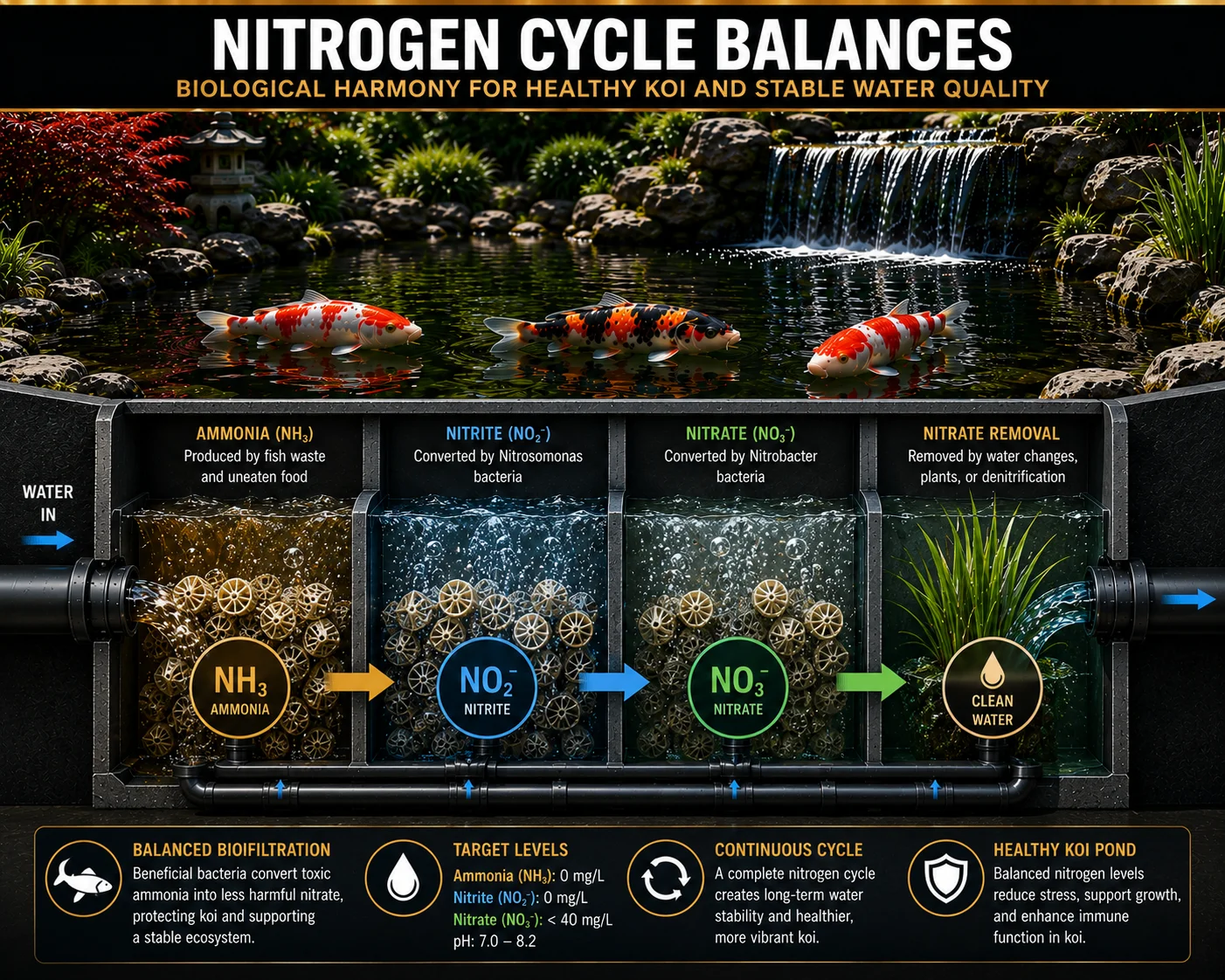
Nitrogen Cycle Volumetric Mass Balances
The nitrogen cycle in a koi pond is a series of biological and chemical transformations that convert toxic ammonia (NH₃) from fish metabolism and organic decomposition into less harmful nitrate (NO₃⁻) through the intermediate step of nitrite (NO₂⁻). While this pathway is well understood conceptually, the engineering challenge lies in quantifying the rates of these reactions and linking them to the physical volume of the pond, the filter media, and the flow rates through the system. Volumetric mass balancing provides the framework to calculate exactly how much biological filtration capacity is required, how quickly toxic compounds accumulate, and how water exchange or supplementation affects the overall concentration profiles.
This page works through the practical application of mass balance principles to the nitrogen cycle. It treats the pond and its filtration system as a series of interconnected control volumes, estimating the rates of ammonia production from fish and feeding, the conversion rates by nitrifying bacteria (primarily Nitrosomonas and Nitrobacter), and the influence of water changes on the net accumulation of nitrogenous wastes. None of the guidance here is a universal rule — stocking density, feeding rates, water temperature, pH, and filter efficiency all shift the numbers, so every design decision needs to be verified by sampling and adjusted to the specific conditions of the pond.
Test Your Nitrogen Cycle Knowledge
Work through ten scenario-based questions covering mass balance calculations, bacterial conversion rates, filter sizing, and troubleshooting high ammonia or nitrite levels. Each answer includes the reasoning behind it.
Nitrogen Cycle — Quick Facts
Most Asked Questions About Nitrogen Cycle Mass Balances
On a 4,500-gallon show pond with a high stocking density of 25 adult koi, the owner was experiencing chronic low-level ammonia readings (0.1–0.2 mg/L TAN) despite running a large bead filter. A mass balance was constructed for the system. The feeding rate was 250 g/day of a 45% protein food. The estimated ammonia production rate was approximately 12 g TAN/day. The bead filter, based on its volume and media surface area, was calculated to have a maximum nitrification capacity of around 8 g TAN/day at the prevailing water temperature (18°C). The mass balance showed that the filter was undersized for the current fish load, confirming that the ammonia was not being converted as fast as it was being produced.
The solution involved increasing the biofiltration volume by adding a second bead filter, which increased the total nitrification capacity to approximately 14 g TAN/day, bringing the system back into balance. The mass balance provided the quantitative evidence needed to justify the capital investment.
Nitrification Kinetics And Biofilter Sizing
The conversion of ammonia to nitrite and then to nitrate is not instantaneous; it follows Michaelis-Menten kinetics, where the rate of reaction depends on both the substrate concentration and the concentration of active bacteria. This leads to the concept of a ‘rate-limiting’ step. In a well-designed pond, the biofilter is sized so that the ammonia concentration remains low, and the bacterial population is operating at a rate below its maximum capacity. This is the ‘substrate-limited’ regime. The mass balance must account for the volumetric rate of nitrification, typically expressed as mg TAN/L/day or g TAN/m³/day, which can be measured using respirometry or estimated from known values for specific media.
- Michaelis-Menten Model: The nitrification rate (r) is given by r = r_max × [S] / (K_S + [S]), where [S] is the substrate concentration, r_max is the maximum rate at saturating substrate, and K_S is the half-saturation constant. For ammonia oxidation, K_S is typically very low, meaning the bacteria are efficient even at low ammonia concentrations.
- Temperature Dependence: The rate of nitrification roughly doubles with every 10°C increase in temperature (Q10 ≈ 2). This means a filter that is adequate at 25°C may be severely undersized at 15°C. Mass balance calculations must use the lowest expected operating temperature for sizing.
- Oxygen Limitation: Nitrifying bacteria are obligate aerobes. The mass balance must also consider the dissolved oxygen concentration. If the filter becomes oxygen-limited, the nitrification rate will drop, leading to ammonia accumulation.
For practical pond design, the specific nitrification rate (SNR) of the chosen media is the key parameter. This is the amount of TAN oxidized per unit of surface area per day. Manufacturers typically provide SNR values for their media under standard conditions. The required media volume is then calculated by dividing the peak ammonia production rate by the SNR and the media’s specific surface area (m²/m³). This volume must be housed within the filter system, and the hydraulic flow rate must be sufficient to expose the entire media volume to the pond water, preventing dead zones where bacteria starve.
In another case, a pond owner with a 3,000-gallon system was using a moving bed biofilter filled with K1 media. The ammonia was consistently zero, but nitrite was persistently elevated at 0.5 mg/L NO₂-N. The mass balance was expanded to include both ammonia and nitrite. The ammonia oxidation rate was found to be very high, essentially limiting the ammonia concentration to near zero. However, the nitrite oxidation rate (NO₂ → NO₃) was significantly lower. This is a classic case of a ‘nitrite spike’ — the two stages of nitrification are not equally balanced. The problem was traced to a low pH (6.8), which inhibits the Nitrobacter bacteria more than the Nitrosomonas. The solution involved raising the pH with sodium bicarbonate and supplementing the filter media with additional bacterial starter. The mass balance helped isolate the specific stage of nitrification that was failing.
After correcting the pH, the nitrite concentration dropped to near zero within a few weeks, restoring the full nitrogen cycle.
Denitrification And Nitrogen Removal Pathways
While nitrification converts ammonia to nitrate, it does not remove nitrogen from the system. The primary mechanism for nitrogen removal in most koi ponds is water exchange (dilution). However, a more sophisticated approach involves denitrification — the conversion of nitrate to nitrogen gas (N₂) by facultative anaerobic bacteria. Denitrification requires a source of organic carbon and anoxic conditions. In the context of a mass balance, denitrification represents a sink of nitrate that can be harnessed to reduce water change requirements. This is typically achieved through a separate denitrification reactor or a specialized media design that creates anoxic microzones.
The mass balance for nitrate must include denitrification as a removal term. The denitrification rate is often expressed as g N/m³/day and is dependent on the availability of organic carbon (often methanol or glucose) and the redox potential in the reactor. In a well-designed denitrification system, the nitrate concentration can be controlled by adjusting the carbon dosage and the hydraulic retention time. While less common in hobbyist ponds, denitrification is an important tool in high-density systems or those with limited water availability.
A facility with an extremely large, 20,000-gallon koi pond was facing nitrate levels exceeding 200 mg/L NO₃-N due to minimal water exchange and high stocking density. Conventional water changes were impractical due to water restrictions. A denitrification reactor was installed, consisting of a large tank filled with plastic media and a slow feed of a carbon source (glucose). The mass balance was used to design the reactor: the nitrate accumulation rate was calculated, and the reactor was sized to achieve a denitrification rate that matched the production rate, reducing the nitrate concentration to a target of 50 mg/L. The reactor brought the system into a new steady state, demonstrating the power of a comprehensive mass balance approach for advanced pond management.
Ammonia Toxicity And The Role Of pH And Temperature
Ammonia exists in two forms in water: the un-ionized, toxic form (NH₃) and the ionized, relatively non-toxic form (ammonium, NH₄⁺). The proportion of each is strongly dependent on pH and temperature. The mass balance must be expressed in terms of total ammonia nitrogen (TAN), but the biological impact is driven by the NH₃ fraction. The equilibrium constant for the reaction NH₄⁺ ⇌ NH₃ + H⁺ is pH- and temperature-dependent. At a higher pH (8.0), a much larger fraction of TAN is present as toxic NH₃ compared to at pH 7.0. The mass balance should include calculations to determine the concentration of NH₃, which is the biologically relevant parameter. This is often expressed using the equation: [NH₃] = [TAN] / (1 + 10^(pK_a – pH)), where pK_a is the acid dissociation constant of ammonium, which is temperature-dependent.
This is critical for design because two ponds with identical TAN readings can have vastly different toxic ammonia concentrations depending on pH. A mass balance that only tracks TAN is insufficient; it must also account for the speciation of ammonia to assess the true risk to fish health and to determine appropriate water quality targets.
The full nitrogen mass balance integrates all these elements: input from feed and fish, output via water changes and denitrification, and internal transformation via nitrification. It is a powerful tool for system design, troubleshooting, and optimization. By treating the pond as a well-mixed reactor, the engineer can develop a differential equation for each nitrogen species (TAN, NO₂, NO₃) and solve for concentration as a function of time. This allows for scenario analysis: what happens if I double the fish load? How much water must I change to maintain 50 mg/L nitrate? Such quantitative answers are the hallmark of professional engineering practice in koi pond design.
Nitrogen Cycle — Full Question Library
Review indexed engineering questions below.
Q1:
What is the primary source of ammonia in a koi pond?
Correct Answer: Option A
Ammonia is primarily produced by fish metabolism (excretion) and the breakdown of organic matter.
Q2:
How is ammonia produced from fish feed?
Correct Answer: Option B
Fish metabolize proteins and excrete nitrogenous waste, primarily as ammonia.
Q3:
Approximately how much TAN is produced per kg of fish feed?
Correct Answer: Option C
Typically, 0.04–0.07 kg of TAN are produced per kg of fish feed, depending on protein content.
Q4:
Ammonia excretion by fish occurs primarily through which organ?
Correct Answer: Option A
Fish excrete the majority of their nitrogenous waste as ammonia directly through their gills by diffusion.
Q5:
How does feeding rate affect ammonia production?
Correct Answer: Option B
Ammonia production increases linearly with feed input, as more nitrogen is introduced into the system.
Q6:
Does water temperature affect the ammonia production rate from fish?
Correct Answer: Option B
As temperature increases, the metabolic rate of fish increases, leading to a higher rate of ammonia excretion.
Q7:
What is the relationship between stocking density and ammonia production?
Correct Answer: Option A
Ammonia production scales with fish mass; more fish or larger fish produce more ammonia.
Q8:
How does dissolved oxygen (DO) affect ammonia production?
Correct Answer: Option B
Fish metabolism is relatively independent of DO, but low DO can be a stressor affecting overall health and waste output.
Q9:
What is the role of ammonification in the pond nitrogen cycle?
Correct Answer: Option C
Ammonification is the process where organic nitrogen from waste and dead matter is converted back to ammonia by bacteria.
Q10:
How does a high-protein diet influence ammonia excretion?
Correct Answer: Option B
High-protein diets lead to higher nitrogen intake, which is expelled as ammonia, increasing the load on the biofilter.
Q11:
What is the typical concentration of ammonia in a well-balanced pond?
Correct Answer: Option B
In a mature pond with an effective biofilter, TAN levels should be below 0.1 mg/L.
Q12:
What is the effect of pH on the toxicity of ammonia?
Correct Answer: Option C
At higher pH, more TAN is in the un-ionized, toxic form (NH₃), making the water more lethal to fish.
Q13:
What is the principal difference between ammonia (NH3) and ammonium (NH4+)?
Correct Answer: Option A
The equilibrium between NH₃ and NH₄⁺ determines the toxicity of total ammonia.
Q14:
What happens to ammonia production if fish are not fed for several days?
Correct Answer: Option B
When fish are starved, their nitrogenous waste output drops significantly as protein metabolism slows.
Q15:
How does water hardness affect ammonia toxicity?
Correct Answer: Option A
While hardness is important for fish osmoregulation, it does not affect the NH₃/NH₄⁺ equilibrium.
Q16:
What is the contribution of uneaten food to the ammonia load?
Correct Answer: Option C
Protein in uneaten food is broken down by heterotrophic bacteria, releasing ammonia into the water.
Q17:
How does the mass balance equation for ammonia differ in a steady-state pond compared to a transient pond?
Correct Answer: Option B
In steady-state, the concentration is constant over time, so the net accumulation is zero.
Q18:
What is the effect of temperature on the ammonia production rate from fish?
Correct Answer: Option A
Metabolic rates are higher at elevated temperatures, leading to increased ammonia excretion.
Q19:
How can ammonia production be estimated from oxygen consumption?
Correct Answer: Option B
The oxidation of proteins requires oxygen, and the nitrogen portion is excreted as ammonia, allowing for an estimate.
Q20:
What is the primary source of ammonia in a newly established pond?
Correct Answer: Option C
In a new pond, ammonia is produced by fish, but the biofilter is not yet established to convert it.
Q21:
What is the rate-limiting step in nitrification?
Correct Answer: Option B
The oxidation of ammonia to nitrite is typically the rate-limiting step due to the slower growth rate of ammonia-oxidizing bacteria.
Q22:
How does temperature affect the rate of nitrification?
Correct Answer: Option B
Nitrification rates follow a bell-shaped curve with temperature, with the optimum around 25–30°C and slowing significantly below 15°C.
Q23:
What is the optimum pH range for nitrifying bacteria?
Correct Answer: Option C
Nitrifying bacteria prefer a pH between 7.5 and 8.5; below 7.0, their activity is significantly inhibited.
Q24:
What is the effect of low dissolved oxygen on nitrification?
Correct Answer: Option A
Nitrification is an aerobic process; below 2 mg/L DO, the activity of Nitrosomonas and Nitrobacter drops significantly.
Q25:
Which bacteria are responsible for the oxidation of ammonia to nitrite?
Correct Answer: Option B
Nitrosomonas are the primary ammonia-oxidizing bacteria (AOB) in most biofilters.
Q26:
Which bacteria are responsible for the oxidation of nitrite to nitrate?
Correct Answer: Option A
Nitrobacter are the primary nitrite-oxidizing bacteria (NOB) in most biofilters.
Q27:
What is the yield coefficient (g biomass/g substrate) for ammonia-oxidizing bacteria?
Correct Answer: Option B
AOB have a low yield coefficient, meaning they convert a small fraction of the substrate into biomass, requiring a large surface area.
Q28:
What is the half-saturation constant (Ks) for ammonia oxidation?
Correct Answer: Option C
AOB have a very low Ks, indicating they are efficient at oxidizing ammonia even at low concentrations.
Q29:
What is the relationship between the concentration of ammonia and the nitrification rate?
Correct Answer: Option B
The rate increases with substrate concentration until it plateaus at the maximum rate (Vmax).
Q30:
How do nitrifying bacteria respond to a sudden increase in ammonia concentration?
Correct Answer: Option A
AOB have a slow growth rate, so they cannot instantly increase their population to match a sudden load; the rate may be substrate-limited for a time.
Q31:
What is the role of dissolved oxygen in the nitrification process?
Correct Answer: Option B
Oxygen is required for the oxidation of ammonia to nitrite and nitrite to nitrate.
Q32:
What is the effect of organic carbon (BOD) on the nitrification rate?
Correct Answer: Option A
High organic loads can favor heterotrophic bacteria, which outcompete nitrifiers for oxygen, slowing the conversion of ammonia and nitrite.
Q33:
Which of the following inhibits nitrification?
Correct Answer: Option C
Nitrification is severely inhibited at pH levels below 6.5, as the bacteria struggle to maintain pH homeostasis.
Q34:
What is the significance of the ‘alkalinity’ requirement in nitrification?
Correct Answer: Option B
Nitrifying bacteria consume about 7.1 mg of alkalinity (as CaCO₃) per mg of TAN oxidized, so monitoring alkalinity is crucial.
Q35:
What does the term ‘biological oxygen demand’ (BOD) indicate about the water quality?
Correct Answer: Option A
High BOD indicates a high organic load, which can deplete oxygen and inhibit nitrification.
Q36:
How does the biofilm thickness affect nitrification efficiency?
Correct Answer: Option C
If the biofilm is too thick, oxygen cannot penetrate to the deeper layers, creating dead zones and reducing efficiency.
Q37:
What is the relationship between nitrification and the pH of the water?
Correct Answer: Option A
The oxidation of ammonia releases hydrogen ions (H⁺), which consume alkalinity and can lower the pH over time.
Q38:
How long does it typically take for a biofilter to mature (establish nitrifying bacteria)?
Correct Answer: Option C
Nitrifying bacteria have a slow growth rate, and it typically takes 4–6 weeks for a new biofilter to fully establish.
Q39:
What is the ‘specific nitrification rate’ (SNR) of a filter media?
Correct Answer: Option B
SNR is the key design parameter for sizing biofilters.
Q40:
What happens to nitrification if the water temperature drops below 10°C?
Correct Answer: Option A
Nitrification is severely compromised at low temperatures, often requiring winterization strategies or reduced feeding.
Q41:
What is the most important parameter for sizing a biofilter?
Correct Answer: Option C
The biofilter must be sized to handle the maximum ammonia load, which is determined by the peak feeding rate and fish biomass.
Q42:
What is the typical specific surface area of plastic biofilter media (e.g., K1)?
Correct Answer: Option B
Plastic media typically have a specific surface area in the range of 300–500 m²/m³, depending on the design.
Q43:
How does the specific surface area of the media affect biofilter performance?
Correct Answer: Option C
A larger surface area allows for a higher bacterial population, increasing the nitrification capacity.
Q44:
What is the difference between a fixed-bed and a moving-bed biofilter?
Correct Answer: Option A
Moving-bed biofilters use fluidized media to prevent clogging and improve oxygen transfer, while fixed beds are static.
Q45:
What is the role of aeration in a biofilter?
Correct Answer: Option B
Aeration supplies the oxygen necessary for the aerobic nitrification process and helps keep the media clean.
Q46:
How is the hydraulic retention time (HRT) of a biofilter calculated?
Correct Answer: Option C
HRT = V_filter / Q, where V_filter is the volume of the filter and Q is the flow rate.
Q47:
What is a typical HRT range for a bead biofilter?
Correct Answer: Option A
Bead filters are designed for high flow rates and have very short HRTs, relying on high biomass concentration.
Q48:
How does the backwashing frequency affect a bead filter’s performance?
Correct Answer: Option B
While backwashing is necessary, it also removes biofilm; the frequency must be balanced to maintain filter efficiency.
Q49:
What is the purpose of a ‘biofilter starter culture’?
Correct Answer: Option C
Starter cultures introduce the necessary bacteria to accelerate the establishment of the biofilter.
Q50:
What is the primary difference between a fluidized bed and a trickling filter?
Correct Answer: Option B
Trickling filters are open to the air, relying on natural oxygen transfer, while fluidized beds are submerged and require aeration.
Q51:
How does media type affect the oxygen transfer rate in a biofilter?
Correct Answer: Option A
The geometric configuration of the media affects how water and air interact, impacting oxygen transfer efficiency.
Q52:
What is the impact of organic loading on a biofilter?
Correct Answer: Option B
High organic loads stimulate heterotrophic growth, which can lead to oxygen depletion and reduced nitrification capacity.
Q53:
What is the purpose of a ‘settling chamber’ before a biofilter?
Correct Answer: Option C
Pre-filtration is essential to prevent physical clogging of the biofilter media and reduce organic loading.
Q54:
How does the water flow distribution within a biofilter affect its performance?
Correct Answer: Option A
Poor flow distribution leads to dead zones where media is not used, reducing the overall effective capacity.
Q55:
What is the recommended maximum flow velocity through a biofilter to avoid media compaction?
Correct Answer: Option B
Excessive velocity can cause media compaction, reducing surface area and performance, or wash out the biofilm.
Q56:
How does the bacterial population in a biofilter respond to a period of low feeding?
Correct Answer: Option C
Q57:
What is the role of alkalinity in a biofilter?
Correct Answer: Option B
Alkalinity provides the inorganic carbon for bacterial growth and buffers the acids produced during nitrification.
Q58:
How is the required volume of a biofilter estimated from the ammonia production rate?
Correct Answer: Option A
The required volume is calculated using the SNR and the specific surface area of the media.
Q59:
What is the advantage of a submerged biofilter over a trickling filter?
Correct Answer: Option C
Submerged filters (e.g., bead filters) are pressurized, making them compact and suitable for circulation with centrifugal pumps.
Q60:
What is the effect of high salt levels (salinity) on nitrification?
Correct Answer: Option B
Freshwater bacteria are adapted to low salinity; exposure to high salt levels can cause osmotic shock.
Q61:
What is the most common cause of elevated nitrite in a koi pond?
Correct Answer: Option A
Nitrite accumulates when the Nitrobacter population is insufficient to convert the nitrite produced by the Nitrosomonas.
Q62:
What is the effect of low pH on nitrite oxidation?
Correct Answer: Option B
Nitrobacter are more sensitive to low pH than Nitrosomonas, often leading to nitrite spikes during pH drops.
Q63:
What is the toxic mechanism of nitrite to fish?
Correct Answer: Option C
Nitrite binds to hemoglobin, forming methemoglobin, which cannot transport oxygen, leading to ‘brown blood disease’.
Q64:
What is the effect of chloride ions (salt) on nitrite toxicity?
Correct Answer: Option A
Adding salt (NaCl) at a ratio of 10:1 (Cl⁻:NO₂⁻) is a common treatment to reduce nitrite toxicity.
Q65:
What is a ‘nitrite spike’ in the context of pond cycling?
Correct Answer: Option C
During the cycling process, the ammonia-oxidizing bacteria establish first, producing nitrite faster than the nitrite-oxidizing bacteria can consume it.
Q66:
How does temperature affect the duration of a nitrite spike during pond cycling?
Correct Answer: Option B
Bacterial growth rates increase with temperature, leading to a faster establishment of the entire nitrifying community.
Q67:
What is the recommended action if a nitrite spike occurs in a pond with fish?
Correct Answer: Option A
Reducing the ammonia load (less feeding) and supporting the bacteria (aeration) helps the system recover, while salt protects the fish.
Q68:
How does organic carbon (BOD) contribute to a nitrite problem?
Correct Answer: Option B
High BOD consumes oxygen, creating anoxic zones that can inhibit nitrifying bacteria, leading to nitrite accumulation.
Q69:
What is the relationship between nitrite and nitrate in the nitrogen cycle?
Correct Answer: Option C
Nitrite is an intermediate in the two-step nitrification process.
Q70:
What is the effect of low dissolved oxygen on nitrite oxidation?
Correct Answer: Option B
The oxidation of nitrite to nitrate is an aerobic process that requires oxygen.
Q71:
How does the pH affect the toxicity of nitrite?
Correct Answer: Option C
At low pH, more nitrite is in the form of nitrous acid, which is more toxic to fish.
Q72:
What is the maximum safe nitrite concentration for koi?
Correct Answer: Option A
Nitrite is highly toxic; concentrations should be kept below 0.1 mg/L NO₂-N to ensure fish health.
Q73:
How do you calculate the mass of nitrite in a pond given its concentration and volume?
Correct Answer: Option B
This is the fundamental mass balance calculation for any dissolved species.
Q74:
What is the effect of temperature on the rate of nitrite oxidation?
Correct Answer: Option A
Q75:
What is the relationship between nitrite concentration and the biofilter’s maturity?
Correct Answer: Option C
In a mature system, the nitrite-oxidizing bacteria are able to process the nitrite as quickly as it is produced.
Q76:
How does the addition of salt help mitigate nitrite toxicity in a pond?
Correct Answer: Option B
Chloride ions occupy the same uptake site as nitrite, effectively blocking the nitrite from entering the fish’s bloodstream.
Q77:
What is the relationship between nitrite concentration and dissolved oxygen in the pond?
Correct Answer: Option C
Low DO slows the activity of nitrifying bacteria, particularly the nitrite oxidizers, leading to nitrite accumulation.
Q78:
How does a ‘nitrite spike’ typically resolve in a pond system?
Correct Answer: Option A
The spike resolves when the Nitrobacter population catches up, oxidizing the accumulated nitrite to nitrate.
Q79:
What is the effect of a water change on a nitrite spike?
Correct Answer: Option B
Water changes are a short-term management tool to lower the nitrite concentration until the biofilter recovers.
Q80:
What is the primary source of nitrite in a pond?
Correct Answer: Option A
Nitrite is the intermediate product of ammonia oxidation.
Q81:
What is the primary method of nitrate removal in a typical koi pond?
Correct Answer: Option A
In most hobbyist ponds, nitrate is managed primarily through regular water exchange.
Q82:
What is the typical target nitrate concentration in a koi pond?
Correct Answer: Option B
Nitrate is less toxic, but high levels (above 50–80 mg/L NO₃-N) can stress fish and promote algae growth.
Q83:
How is the required daily water change volume calculated to control nitrate?
Correct Answer: Option C
The mass balance provides a direct calculation based on the nitrate concentration in the pond and the source water.
Q84:
What is the relationship between feeding rate and the required nitrate removal rate?
Correct Answer: Option A
The nitrogen load is directly proportional to the protein input from feed, so nitrate production scales with feeding.
Q85:
What is denitrification and how does it remove nitrate?
Correct Answer: Option B
Denitrification is a biological process that removes nitrogen from the system as a gas.
Q86:
What is required for denitrification to occur in a pond?
Correct Answer: Option C
Denitrifying bacteria require the absence of oxygen and an organic carbon source (e.g., methanol) to carry out the reduction.
Q87:
How does nitrate concentration affect the growth of algae?
Correct Answer: Option A
Nitrate is a primary nutrient for algae and aquatic plants; high levels contribute to green water and blanket weed.
Q88:
What is the role of a denitrification reactor in a koi pond system?
Correct Answer: Option B
A denitrification reactor is a specialized filter designed to promote denitrification, reducing nitrate without water changes.
Q89:
What is the effect of water changes on the overall nitrogen mass balance?
Correct Answer: Option C
Water changes are the primary sink for nitrogen in most closed-loop pond systems.
Q90:
How does the source water nitrate concentration influence the required water change rate?
Correct Answer: Option B
The mass balance must account for the nitrate concentration in the incoming water, as it contributes to the total load.
Q91:
What is the recommended frequency for measuring nitrate in a koi pond?
Correct Answer: Option A
Regular monitoring allows for adjustments to feeding and water changes to maintain a stable environment.
Q92:
How does the size of the water change affect the nitrate concentration?
Correct Answer: Option C
A 50% water change reduces the nitrate concentration by 50% (assuming no nitrate in the source water).
Q93:
What is a ‘mass balance’ approach to managing nitrate?
Correct Answer: Option B
This is the core principle of engineering-based water quality management.
Q94:
How does fish load affect the nitrate accumulation rate?
Correct Answer: Option A
More fish produce more ammonia, which is converted to nitrate, increasing the rate of nitrate buildup.
Q95:
What is the relationship between the feeding rate and the nitrate concentration in a steady-state pond?
Correct Answer: Option C
In steady-state, the nitrate concentration is determined by the balance between nitrogen input (feed) and removal (water changes).
Q96:
What is a common reason for nitrate levels to be persistently high despite regular water changes?
Correct Answer: Option B
If the water change rate is less than the nitrate production rate, the concentration will continue to rise.
Q97:
How do aquatic plants affect the nitrate mass balance?
Correct Answer: Option A
Plants and algae assimilate nitrate into biomass, providing a biological sink that complements water changes.
Q98:
What is the effect of high nitrate on fish health?
Correct Answer: Option B
While nitrate is less toxic than ammonia or nitrite, chronic exposure to high levels is harmful to fish health.
Q99:
How does a denitrification reactor fit into the overall mass balance?
Correct Answer: Option C
Denitrification is a sink term in the nitrate mass balance, allowing for control without water changes.
Q100:
What is the primary driver of nitrate accumulation in a pond?
Correct Answer: Option B
Nitrate is the end product of the nitrogen cycle, and it accumulates unless it is removed by water changes or denitrification.
Q101:
What is the most toxic form of ammonia in water?
Correct Answer: Option B
Un-ionized ammonia (NH₃) is highly toxic to fish, whereas ammonium (NH₄⁺) is relatively harmless.
Q102:
How does pH affect the proportion of NH3 in the water?
Correct Answer: Option C
At higher pH, the equilibrium shifts towards the toxic NH₃ form, making the water more dangerous.
Q103:
What is the effect of temperature on the NH3/NH4+ equilibrium?
Correct Answer: Option A
The pKa of ammonium decreases with increasing temperature, meaning more NH₃ is present at higher temperatures.
Q104:
At a pH of 8.0 and 25°C, approximately what fraction of TAN is in the toxic NH3 form?
Correct Answer: Option B
At this typical pond pH, a significant fraction of the total ammonia is present as toxic NH₃.
Q105:
What is the mechanism of ammonia toxicity to fish?
Correct Answer: Option A
Ammonia is neurotoxic and also interferes with the fish’s ability to regulate salt and water balance.
Q106:
What is the maximum safe concentration of un-ionized ammonia (NH3) for koi?
Correct Answer: Option C
The safe level of un-ionized ammonia is extremely low, typically below 0.01 mg/L NH₃-N.
Q107:
How do you calculate the concentration of NH3 from TAN and pH?
Correct Answer: Option B
The Henderson-Hasselbalch equation allows the calculation of the toxic fraction from the measured TAN, pH, and temperature.
Q108:
What is the effect of ammonia on the pH of pond water?
Correct Answer: Option A
Ammonia is a weak base and can raise the pH, particularly in poorly buffered water.
Q109:
How does alkalinity buffer against ammonia toxicity?
Correct Answer: Option B
By stabilizing pH, alkalinity prevents the formation of high NH₃ concentrations that would occur in a sudden pH rise.
Q110:
What is the recommended TAN level to maintain in a pond with a pH of 8.0?
Correct Answer: Option C
At a high pH, TAN must be kept very low to ensure the NH₃ fraction remains below the safe threshold.
Q111:
What are the symptoms of acute ammonia poisoning in koi?
Correct Answer: Option B
Acute ammonia poisoning typically presents with respiratory distress (gasping) and hyperemia of the gills.
Q112:
How does chronic exposure to low levels of ammonia affect koi?
Correct Answer: Option A
Even low, non-lethal levels of ammonia can cause long-term health problems and reduce the fish’s ability to fight off infections.
Q113:
How does a water change affect the ammonia concentration?
Correct Answer: Option C
Water changes are an effective way to lower ammonia concentration in an emergency.
Q114:
What is the relationship between ammonia and the biofilter’s bacterial population?
Correct Answer: Option B
The bacterial population is self-regulating and will increase to match the ammonia load.
Q115:
What is the effect of low pH on the toxicity of ammonia?
Correct Answer: Option A
At low pH, the majority of TAN is in the non-toxic ammonium form, reducing the risk to fish.
Q116:
What is a common source of ammonia in tap water used for pond filling?
Correct Answer: Option B
Chloramine is a compound of chlorine and ammonia; when neutralized, it releases ammonia into the water.
Q117:
How do you test for ammonia in a pond?
Correct Answer: Option C
Colorimetric test kits are the most common method for measuring ammonia in pond water.
Q118:
What is the effect of ammonia on the nitrification process?
Correct Answer: Option A
Ammonia is the energy source for the first step of nitrification.
Q119:
What is the ideal pH range for a koi pond to minimize ammonia toxicity?
Correct Answer: Option B
A slightly acidic to neutral pH keeps the NH₃ fraction low while still supporting nitrification.
Q120:
How do you reduce the toxic ammonia fraction in a pond with high pH?
Correct Answer: Option A
The safest approach is to lower the total ammonia concentration (TAN) through water changes or reduced feeding.
Q121:
What is the end product of the denitrification process?
Correct Answer: Option A
Denitrification is the reduction of nitrate to nitrogen gas, which is then released into the atmosphere.
Q122:
What are the environmental conditions required for denitrification?
Correct Answer: Option B
Denitrification is an anaerobic process carried out by facultative anaerobes that use nitrate as an electron acceptor.
Q123:
What is the role of a carbon source in denitrification?
Correct Answer: Option C
Denitrifying bacteria require an organic carbon source (like methanol or glucose) to fuel the reduction process.
Q124:
How does denitrification affect the alkalinity of the water?
Correct Answer: Option B
Denitrification produces alkalinity (approximately 3.6 g CaCO₃ per g NO₃-N reduced), helping to buffer pH.
Q125:
What is a ‘denitrification reactor’ typically filled with?
Correct Answer: Option A
Q126:
What is the carbon source often used in commercial denitrification reactors?
Correct Answer: Option C
Methanol is a common and inexpensive electron donor used in commercial and industrial denitrification systems.
Q127:
What is the primary challenge of operating a denitrification reactor in a pond system?
Correct Answer: Option B
Dosing too much carbon can lead to oxygen depletion and BOD issues, while too little reduces the denitrification rate.
Q128:
What is the role of sulphur-based media in denitrification?
Correct Answer: Option A
Q129:
How does the hydraulic retention time (HRT) affect the denitrification rate?
Correct Answer: Option B
Denitrification is a relatively slow process; a longer HRT (i.e., larger reactor) is required for significant nitrate removal.
Q130:
What is the effect of temperature on the rate of denitrification?
Correct Answer: Option C
Q131:
What is the significance of the redox potential (ORP) in denitrification?
Correct Answer: Option A
Denitrification occurs under anoxic conditions, which correspond to a low redox potential.
Q132:
What is the difference between denitrification and dissimilatory nitrate reduction to ammonia (DNRA)?
Correct Answer: Option B
DNRA is a different pathway that reduces nitrate to ammonium, which can then re-enter the nitrogen cycle.
Q133:
How does the presence of oxygen inhibit denitrification?
Correct Answer: Option C
The denitrification pathway is repressed in the presence of oxygen, as it is more energetically favorable.
Q134:
What is the role of plants in the nitrogen mass balance as a sink?
Correct Answer: Option A
Aquatic plants and algae uptake both ammonium and nitrate, providing a significant sink for nitrogen.
Q135:
What is the effect of organic carbon on the growth of denitrifying bacteria?
Correct Answer: Option B
Denitrifying bacteria are heterotrophic and require an organic carbon source for cell synthesis and energy.
Q136:
How do you calculate the denitrification potential of a system?
Correct Answer: Option A
The potential is limited by the nitrate concentration and the carbon supply; a mass balance can estimate the maximum rate.
Q137:
What is the primary purpose of a denitrification reactor in a closed-loop system?
Correct Answer: Option B
Denitrification provides a means of biological nitrogen removal, reducing the dependence on water exchange.
Q138:
What is the typical denitrification rate in a well-operated reactor?
Correct Answer: Option B
Denitrification rates are relatively slow compared to nitrification, requiring large reactor volumes or long retention times.
Q139:
How does the design of a denitrification reactor differ from a nitrification filter?
Correct Answer: Option A
The key difference is the redox environment; denitrification is an anoxic process, while nitrification is aerobic.
Q140:
What is a potential side effect of denitrification in a pond system?
Correct Answer: Option B
If the system becomes too reducing (too much carbon, too little nitrate), sulfate-reducing bacteria can produce toxic hydrogen sulfide.
Q141:
What is the ‘cycle’ in the context of a new pond?
Correct Answer: Option B
Cycling refers to the maturation of the biofilter, where the bacteria populations grow to handle the ammonia load.
Q142:
What is the first measurable event during the cycling of a new pond?
Correct Answer: Option A
As the first bacteria colonize and ammonia begins to accumulate, the ammonia concentration rises before the nitrifiers become active.
Q143:
What happens to the nitrite concentration during the middle of the cycling process?
Correct Answer: Option B
As the ammonia-oxidizing bacteria become active, they produce nitrite faster than the nitrite-oxidizing bacteria can consume it, leading to a spike.
Q144:
How long does the typical pond cycling process take?
Correct Answer: Option C
Due to the slow growth rate of nitrifying bacteria, it typically takes 4-6 weeks for a new biofilter to fully cycle.
Q145:
What is the effect of temperature on the cycling time?
Correct Answer: Option A
Bacterial growth is temperature-dependent; at warmer temperatures, the population establishes more quickly.
Q146:
What is the role of ‘seed bacteria’ or a ‘starter culture’ in cycling?
Correct Answer: Option B
Starter cultures can reduce the time required to establish a mature biofilter by several weeks.
Q147:
What is the recommended ammonia concentration to aim for during cycling?
Correct Answer: Option C
A moderate ammonia concentration is needed to provide food for the bacteria without being overly toxic to fish if they are present.
Q148:
How does the presence of fish affect the cycling process?
Correct Answer: Option A
Fish waste provides the ammonia required for the bacteria to grow, but fish must be added slowly to avoid ammonia toxicity.
Q149:
What is a ‘fishless cycle’?
Correct Answer: Option B
In a fishless cycle, a pure ammonia source is added to the pond to feed the bacteria, avoiding stress to fish.
Q150:
What is the indicator that a pond has successfully cycled?
Correct Answer: Option C
A fully cycled pond will have zero ammonia and nitrite, with measurable nitrate, indicating the complete cycle is functioning.
Q151:
How does the pH of the water change during the cycling process?
Correct Answer: Option A
The production of hydrogen ions during nitrification can lower the pH unless the water is well-buffered.
Q152:
What is the effect of a high fish load on the cycling process?
Correct Answer: Option B
Adding too many fish too quickly can overwhelm the immature biofilter, leading to dangerous ammonia spikes.
Q153:
What is the role of water changes during the cycling process?
Correct Answer: Option A
Water changes are used to manage high ammonia or nitrite levels during the cycling process to protect fish.
Q154:
How does the presence of plants affect pond cycling?
Correct Answer: Option C
Plants can consume ammonia and nitrite, which can make it appear that the pond is cycled before the biofilter is fully mature.
Q155:
What is the significance of alkalinity during the cycling process?
Correct Answer: Option B
Monitoring and maintaining alkalinity (e.g., >100 mg/L as CaCO₃) is essential to keep the pH stable and the cycle active.
Q156:
What is the effect of medication (e.g., antibiotics) on the cycling process?
Correct Answer: Option A
Many common pond medications are toxic to nitrifying bacteria, often causing the filter to crash.
Q157:
What is the difference between a ‘new pond’ and a ‘mature pond’ in terms of the nitrogen cycle?
Correct Answer: Option C
The key difference is the stability and capacity of the biofilter; a mature pond is resilient to fluctuations in fish load or feeding.
Q158:
How do you measure the progress of the cycling process?
Correct Answer: Option B
Tracking the three key nitrogen species is the only way to determine the stage of the cycle and when it is complete.
Q159:
What happens if the biofilter is cleaned too aggressively during cycling?
Correct Answer: Option A
Care must be taken when cleaning the filter during cycling to avoid washing out the newly established bacteria.
Q160:
What is the role of ‘ammonia-binding’ water conditioners during cycling?
Correct Answer: Option C
Conditioners like those containing chloramine-T or sodium hydroxymethanesulfonate can be a useful tool during cycling but must be used with caution.
Q161:
What is the first step in troubleshooting a high ammonia reading?
Correct Answer: Option A
The first step is to protect the fish by managing the toxic form of ammonia and reducing the load.
Q162:
What is a common cause of a ‘filter crash’?
Correct Answer: Option A
Chlorine in tap water is highly toxic to nitrifying bacteria and can easily destroy the biofilter.
Q163:
What is the effect of a high pH on ammonia toxicity and how is it managed?
Correct Answer: Option B
Managing pH or reducing TAN are the two strategies; the latter is safer and more reliable.
Q164:
What is a possible reason for a persistent nitrite reading in a mature pond?
Correct Answer: Option A
This indicates a specific failure of the second stage of nitrification, often due to low pH or lack of alkalinity.
Q165:
What is the effect of a sudden increase in feeding on the nitrogen levels in a pond?
Correct Answer: Option B
The bacteria population has a limited growth rate; a sudden increase in load can lead to a temporary spike in waste products.
Q166:
How do you troubleshoot high nitrate levels?
Correct Answer: Option A
High nitrate indicates the removal rate is insufficient; water changes or denitrification are the standard solutions.
Q167:
What is the first symptom of a biofilter that is failing due to low alkalinity?
Correct Answer: Option C
Alkalinity consumption lowers the pH, which then inhibits the nitrifying bacteria, causing waste accumulation.
Q168:
What is the effect of a power outage on the nitrogen cycle?
Correct Answer: Option B
A power outage stops aeration and circulation, causing oxygen levels to drop, which can kill the bacteria and release ammonia from the biofilm.
Q169:
What is the process for recovering a stalled biofilter?
Correct Answer: Option A
The first step is to address the root cause of the inhibition and then allow the bacteria to recover.
Q170:
How do you determine if the biofilter is undersized?
Correct Answer: Option B
If the ammonia production rate exceeds the filter’s capacity, it is undersized; this is determined by calculation.
Q171:
What is the effect of adding a new biofilter to an existing pond?
Correct Answer: Option A
Adding extra filtration capacity is a proactive measure to handle increased loads.
Q172:
What is the effect of a large water change on the biofilter?
Correct Answer: Option B
While the bacteria are attached to the media, sudden changes in water parameters can still cause stress and reduced activity.
Q173:
What is the role of a quarantine tank in preventing nitrogen cycle problems?
Correct Answer: Option C
A quarantine tank with its own biofilter prevents the main pond from being overloaded by a new fish’s waste.
Q174:
What is the effect of high BOD on the nitrification process?
Correct Answer: Option A
High BOD causes heterotrophic bacteria to consume oxygen, which is then unavailable for nitrifiers.
Q175:
How does the use of UV sterilization affect the nitrogen cycle?
Correct Answer: Option B
UV is only effective on waterborne bacteria; the biofilm inside the filter is protected.
Q176:
What is the first sign of a biofilter that is becoming clogged?
Correct Answer: Option A
Reduced flow is the primary mechanical indicator of a clogged filter, which can then lead to biological problems.
Q177:
How do you recover a pond after a medication that killed the biofilter?
Correct Answer: Option B
The filter must be re-established, which requires the same process as cycling a new pond.
Q178:
What is the effect of a protein skimmer on the nitrogen cycle?
Correct Answer: Option C
By removing dissolved organics, protein skimmers reduce the TAN load, making the filter’s job easier.
Q179:
What is the relationship between ammonia concentration and the oxygen level in the pond?
Correct Answer: Option A
The nitrification process itself consumes oxygen, so high ammonia production increases the biological oxygen demand.
Q180:
What is the effect of a high fish density on the stability of the nitrogen cycle?
Correct Answer: Option B
High stocking densities are more prone to failure if any part of the system (feeding, oxygen, filter) is disrupted.
Q181:
What is the fundamental equation for a mass balance of a nitrogen species in a pond?
Correct Answer: Option B
This is the standard conservation of mass equation, applied to a control volume (the pond).
Q182:
What is a control volume in the context of a mass balance for a pond?
Correct Answer: Option A
The control volume is the system boundary; in this case, it is the pond and all its connected components.
Q183:
In the steady-state mass balance, what is the value of the accumulation term?
Correct Answer: Option C
In steady state, the concentration is not changing over time, so dC/dt = 0.
Q184:
How can you model the effect of a water change on the nitrate concentration?
Correct Answer: Option B
This equation accounts for the dilution by new water and the addition of nitrate from the source water.
Q185:
What is the ‘sink’ term in the mass balance for ammonia?
Correct Answer: Option A
Ammonia is removed (a sink) by being converted to nitrite by bacteria.
Q186:
How does the ‘source’ term for nitrate differ from that for ammonia?
Correct Answer: Option C
Nitrate is not directly excreted; it is a product of the second stage of nitrification.
Q187:
What is the role of a sensitivity analysis in mass balance modeling?
Correct Answer: Option B
Sensitivity analysis shows how changes in input variables affect the model’s outputs.
Q188:
What is the difference between a ‘dynamic’ and a ‘steady-state’ mass balance?
Correct Answer: Option A
Dynamic models are used for understanding transients (e.g., after feeding), while steady-state models are used for long-term averages.
Q189:
How can you include denitrification in the mass balance for nitrate?
Correct Answer: Option B
Denitrification removes nitrate, so it is a sink term in the mass balance.
Q190:
What is the purpose of a ‘worst-case’ scenario in mass balance design?
Correct Answer: Option C
Designing for the worst case provides a safety margin and ensures the system remains functional under all normal operating conditions.
Q191:
How does the alkalinity concentration enter the mass balance for nitrification?
Correct Answer: Option B
Alkalinity is a key input; if it is depleted, the nitrification rate will become zero, so it must be monitored and maintained.
Q192:
What is the relationship between the ammonia production rate and the biofilter volume in the mass balance?
Correct Answer: Option A
This is the fundamental sizing equation: Filter Volume = (Production Rate) / (Specific Surface Area × SNR).
Q193:
How does the temperature coefficient (Q10) affect the nitrification rate in the model?
Correct Answer: Option B
The Q10 factor is a common way to model the temperature dependence of biological processes.
Q194:
What is the role of a ‘half-saturation constant’ (Ks) in the nitrification model?
Correct Answer: Option C
Ks is a key parameter in the Michaelis-Menten equation and reflects the affinity of the bacteria for the substrate.
Q195:
How do you model the effect of a sudden increase in fish load on a pond?
Correct Answer: Option A
A dynamic model can simulate the transient response of the system to a new load.
Q196:
What is the significance of the ‘mixing’ assumption in a simple pond mass balance?
Correct Answer: Option B
The ‘perfect mixing’ assumption simplifies the model but is often a good approximation for a well-designed pond with adequate circulation.
Q197:
What is the effect of ‘short-circuiting’ in a biofilter on the mass balance?
Correct Answer: Option C
Short-circuiting means the hydraulic retention time is less than calculated, reducing the filter’s performance.
Q198:
How do you calculate the total nitrogen accumulation in a pond over a week?
Correct Answer: Option A
The total accumulation is the integral of the rate equation, which is the foundation of dynamic mass balance.
Q199:
What is the role of ‘feedback loops’ in the nitrogen cycle mass balance?
Correct Answer: Option B
The nitrogen cycle is a classic example of a system with internal feedback; the bacteria population responds to the substrate concentration.
Q200:
What is the ultimate goal of using mass balance principles in koi pond engineering?
Correct Answer: Option A
The mass balance provides a quantitative framework for achieving water quality goals, which is the foundation of professional pond management.