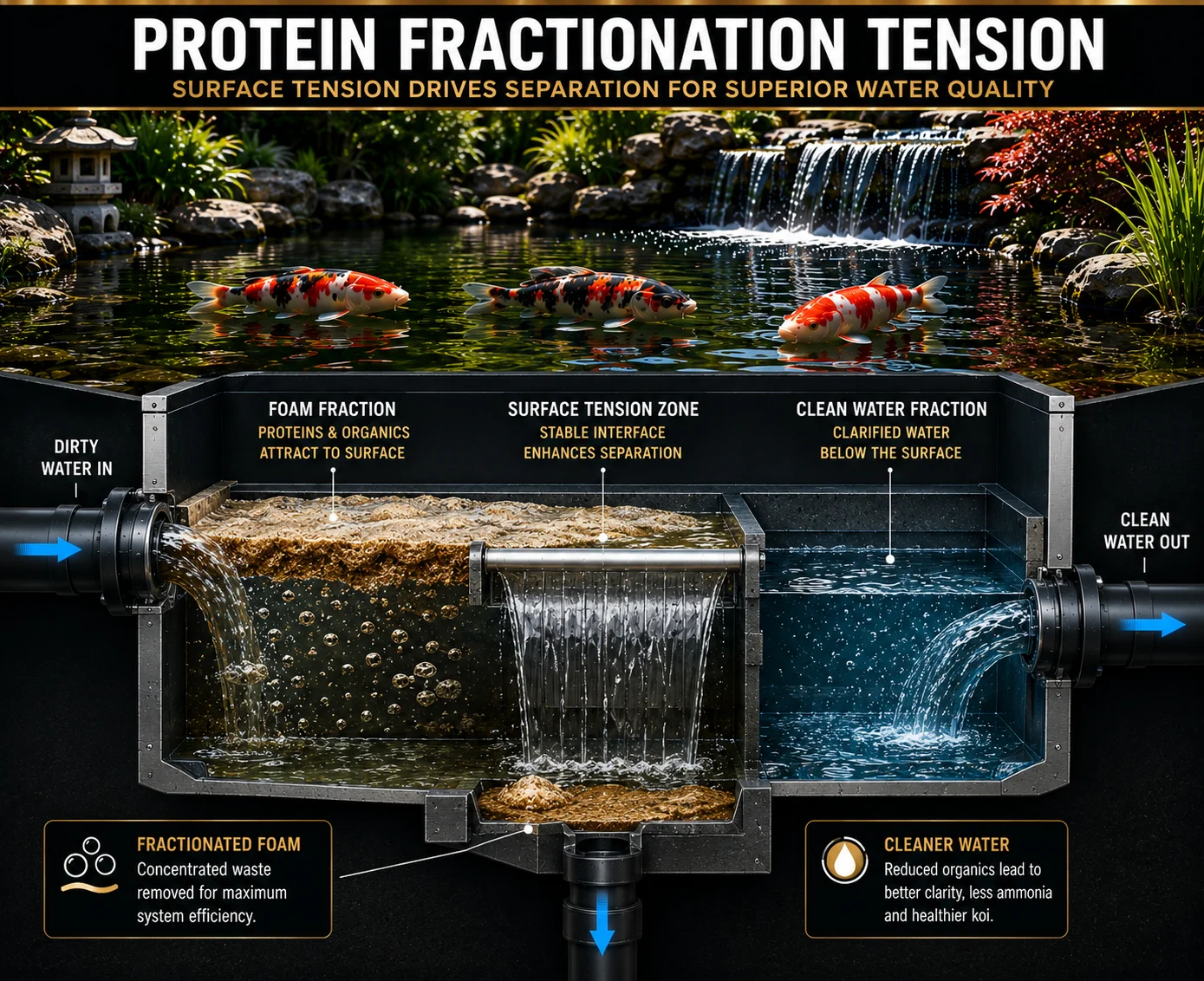
Protein Fractionation Hydrodynamics
Protein fractionation in a koi pond is the controlled removal of dissolved organic carbon (DOC) and fine colloidal particles by generating a stable, buoyant foam that can be skimmed off the water surface. The process relies on the surface-active behavior of amphiphilic molecules—such as proteins, lipids, and humic acids—which align at the air-water interface and reduce surface tension. When air is introduced as finely dispersed bubbles, these organics adsorb onto the bubble surfaces, forming stable aggregates that rise to the surface as a persistent foam layer.
The efficiency of fractionation is governed by a tight interplay of bubble hydrodynamics, water chemistry, and physical design parameters. Bubble size and rise velocity determine the surface area available for adsorption; hydraulic retention time dictates how long the bubbles interact with the bulk fluid; and foam density and shear strength influence how well the foam can be removed without collapsing back into the water. Understanding these variables is essential to engineering a fractionator that reliably reduces DOC load without stripping essential trace elements or destabilizing the pond’s biological balance.
Test Your Protein Fractionation Knowledge
Work through ten scenario-based questions covering bubble hydrodynamics, DOC adsorption, foam stability, and system design. Each answer includes the reasoning behind it.
Protein Fractionation Hydrodynamics — Quick Facts
Most Asked Questions About Protein Fractionation
On a large show pond, the owner noticed a persistent yellow-green tint to the water and heavy foaming at the waterfall, despite a low fish load. A TOC (Total Organic Carbon) measurement revealed DOC levels well above the recommended range for clear water—largely from decaying plant matter and uneaten food trapped in the filter.
The installation of a counter-current foam fractionator, using a 2-inch air diffuser at the bottom of a 4-foot reaction column, reduced DOC levels by 40% within one week. However, the operator had to adjust the water-to-foam ratio to prevent excessive stripping of trace elements, which was evident in the koi’s slightly reduced color intensity. The final solution was to run the fractionator for 6 hours per day, timed to coincide with the peak feeding period.
Bubble Hydrodynamics And Rise Velocity
The behavior of a bubble rising through a water column is governed by the balance of buoyancy, drag, and surface tension forces. For bubbles in the size range typical of koi pond fractionators—0.5 to 3 mm in diameter—the flow is often laminar, and the terminal rise velocity can be approximated by the Stokes equation for rigid spheres. However, surfactants at the bubble surface can immobilize the interface, increasing drag and slowing the rise velocity.
- Stokes regime: For small bubbles (Db < 1 mm), rise velocity is proportional to the square of the bubble diameter. These bubbles are spherical and rise slowly, offering high surface area per volume but limited throughput.
- Intermediate regime: Bubbles in the 1-2 mm range are slightly deformed into an oblate spheroid and rise at 15-25 cm/s. This is the preferred size range for many fractionators, balancing surface area and flow capacity.
- Large bubbles: Bubbles larger than 3 mm rise rapidly (over 30 cm/s) and have low specific surface area. They are less efficient for DOC removal but can handle higher gas flow rates.
The bubble size distribution entering the reaction column is a critical design parameter. A fine-bubble diffuser or a venturi injector is often used to generate a consistent bubble size. However, any surfactant present in the water will reduce the surface tension, affecting the bubble formation process and potentially leading to a finer bubble population. This is a self-reinforcing mechanism: as DOC is removed, the surface tension increases, which can cause the bubble size to increase, reducing subsequent removal efficiency.
Behind The Physics: Gibbs Adsorption And Foam Stability
The Gibbs adsorption isotherm describes the relationship between the surface excess concentration of a solute (Γ) and the change in surface tension (γ) with bulk concentration (C). It quantifies how much of the organic material accumulates at the air-water interface. The greater the surface excess, the more stable the foam will be. Foam stability is also a function of the film drainage rate and the viscoelasticity of the interface. A high surface excess of amphiphilic molecules creates a rigid, elastic film that slows drainage and prevents bubble coalescence.
A pond with a very high DOC concentration from overstocking produced a thick, stable foam. However, the foam fractionator was struggling to produce any foam at all. Investigation revealed that the pH had dropped below 6.0 due to a malfunctioning automatic acid dosing system. At low pH, the carboxylic acid groups on the humic acids were protonated, reducing the electrostatic repulsion between adsorbed molecules. This caused the foam film to become unstable and collapse, even though the DOC was high. Correcting the pH to 7.5 restored normal foam production.
Design Parameters For Efficient Fractionation
A well-designed foam fractionator balances three competing objectives: maximizing the interfacial surface area for adsorption, providing sufficient time for DOC to reach the surface, and ensuring that the foam can be effectively skimmed and removed. The air-to-water ratio is typically 1:10 to 1:30 (vol/vol) for freshwater applications, and the height-to-diameter ratio of the reaction column is often in the range of 4:1 to 8:1 to allow for adequate foam buildup and drainage.
The direction of flow (counter-current vs. co-current) also affects efficiency. In a counter-current fractionator, water flows downward while the bubbles rise, maximizing the contact time and the concentration gradient. This is the preferred configuration for high-removal applications. Co-current flow is simpler to design but typically results in lower removal efficiency for the same column height.
An operator attempted to retrofit a marine protein skimmer (designed for saltwater) onto a freshwater koi pond. The skimmer failed to produce any significant foam despite high DOC levels. In saltwater, the high ionic strength compresses the electrical double layer and enhances the hydrophobicity of organics, making them highly surface-active. In freshwater, the lower ionic strength reduces the activity of the surfactants, requiring a different hydrodynamic approach—specifically, a longer contact time and a more stable bubble population.
The rate of DOC removal is first-order with respect to the concentration, meaning that the fractionator removes a constant percentage of the incoming organic load, regardless of the influent concentration. This is why the effluent DOC concentration never reaches zero; the fractionation process becomes increasingly inefficient as the remaining DOC becomes more resistant to surface adsorption.
When troubleshooting a fractionator that is underperforming, it is helpful to measure the surface tension of the water and check the bubble size distribution. A high surface tension (above 72 mN/m) suggests a lack of surface-active agents; a low surface tension (below 55 mN/m) indicates high DOC but may also be associated with unstable foam if the correct chemical conditions are not met. Adjusting the air flow rate, the column water level, and the foam collection rate are the first steps in tuning the system for optimal performance.
Protein Fractionation — Full Question Library
Review indexed engineering questions below.
Q1:
What is the primary driving force for the rise of a bubble in water?
Correct Answer: Option A
The net force on a bubble is the difference between the buoyant force (density of water × volume × gravity) and the drag force. This causes the bubble to rise.
Q2:
For a small spherical bubble (< 1 mm) rising in water, which equation best approximates its rise velocity?
Correct Answer: Option B
Stokes’ law is applicable for low Reynolds number (Re < 1) flows, which is typical for very small bubbles. The rise velocity is proportional to the square of the bubble diameter.
Q3:
What is the effect of an adsorbed surfactant layer on a bubble’s rise velocity?
Correct Answer: Option C
Surfactants adsorbed at the interface create a rigid “stagnant cap” or a fully rigid surface, increasing the drag force and slowing the bubble.
Q4:
Which dimensionless parameter is used to predict the deformation of a rising bubble?
Correct Answer: Option B
The Weber number (We = ρ V² D / σ) represents the ratio of inertial forces to surface tension forces. High We indicates that a bubble will deform from its spherical shape.
Q5:
In the context of a foam fractionator, what does “bubble surface flux” measure?
Correct Answer: Option A
Bubble surface flux is a key metric for fractionator design, as it directly relates to the available adsorption capacity.
Q6:
What is the typical rise velocity for a 2 mm diameter air bubble in water at 20°C?
Correct Answer: Option B
A 2 mm bubble typically rises at about 25 cm/s in pure water, although surfactants can reduce this value.
Q7:
How does bubble coalescence affect the efficiency of a foam fractionator?
Correct Answer: Option A
Coalescence reduces the available surface area for adsorption, lowering the overall DOC removal efficiency.
Q8:
Which device is commonly used to generate fine bubbles in a foam fractionator?
Correct Answer: Option C
Fine-pore diffusers and venturi injectors are common methods for generating the small, uniform bubbles required for efficient fractionation.
Q9:
At a high air flow rate, what phenomenon can disrupt the efficiency of a bubble column?
Correct Answer: Option B
At high gas velocities, the flow regime transitions to churn-turbulent flow, characterized by large bubbles and high mixing, reducing the efficiency of mass transfer.
Q10:
What is the relationship between bubble size and terminal velocity in the Stokes regime?
Correct Answer: Option C
In Stokes flow, Vt = (g D² (ρl – ρg)) / (18 μ). The terminal velocity is proportional to the square of the bubble diameter.
Q11:
How does increasing the water temperature affect the rise velocity of a bubble?
Correct Answer: Option A
Water viscosity decreases with increasing temperature, reducing the drag force and allowing bubbles to rise faster.
Q12:
What is the shape of a bubble rising in water when the Weber number is very low?
Correct Answer: Option B
At low Weber numbers (We << 1), surface tension dominates, and the bubble maintains a perfectly spherical shape.
Q13:
What is the primary advantage of using a counter-current bubble column in a foam fractionator?
Correct Answer: Option C
In counter-current flow, water flows downward while bubbles rise, maximizing the average concentration gradient and improving mass transfer.
Q14:
What is the effect of a high concentration of dissolved salts on bubble coalescence?
Correct Answer: Option B
Dissolved salts can increase the ionic strength, which reduces the drainage rate of the liquid film between bubbles, thereby inhibiting coalescence.
Q15:
What is the terminal velocity of a 0.5 mm bubble in water at 20°C (assuming pure water)?
Correct Answer: Option A
Using Stokes’ law, a 0.5 mm bubble has a rise velocity of about 1.5 cm/s, assuming a rigid sphere.
Q16:
What is the role of the liquid film between bubbles in a foam column?
Correct Answer: Option B
The liquid film between bubbles is a thin layer of surfactant solution that provides structural integrity to the foam and allows for drainage.
Q17:
What happens to the rise velocity of a bubble if its surface becomes contaminated with suspended solids?
Correct Answer: Option D
A layer of suspended solids on the bubble surface increases the effective drag coefficient, slowing the bubble’s rise.
Q18:
Which flow regime is characterized by a high gas holdup and strong mixing in a bubble column?
Correct Answer: Option B
Churn-turbulent flow is characterized by large, fast-rising bubbles and strong recirculation currents, which is typical at high gas flow rates.
Q19:
What is a common method for measuring the bubble size distribution in a fractionator?
Correct Answer: Option A
High-speed photography combined with digital image processing is a standard technique for measuring bubble size and shape.
Q20:
How does the height of the bubble column affect the removal efficiency in a counter-current fractionator?
Correct Answer: Option B
A taller column increases the residence time of the bubbles in the water, providing more opportunities for DOC to adsorb.
Q21:
What is the definition of surface tension in fluid mechanics?
Correct Answer: Option B
Surface tension is a measure of the energy required to increase the surface area of a liquid. It is expressed as force per unit length (N/m).
Q22:
How does the presence of dissolved organic matter affect the surface tension of pond water?
Correct Answer: Option A
Amphiphilic organic molecules adsorb to the air-water interface, lowering the surface tension and facilitating foam formation.
Q23:
What is the Gibbs adsorption isotherm used for in the context of protein fractionation?
Correct Answer: Option C
The Gibbs adsorption isotherm relates the change in surface tension to the bulk concentration of the solute, providing a measure of surface activity.
Q24:
What is the primary factor that determines the stability of a foam?
Correct Answer: Option B
Foam stability is determined by the properties of the thin liquid film (lamella) between bubbles, including its elasticity, viscosity, and drainage rate.
Q25:
Which of the following organic compounds is most likely to act as a strong foaming agent in pond water?
Correct Answer: Option A
Proteins and fatty acids are highly amphiphilic and are among the most effective natural surfactants, promoting stable foam.
Q26:
What is the Marangoni effect in the context of foam stability?
Correct Answer: Option B
The Marangoni effect is the surface tension gradient-driven flow that transports surfactant molecules to areas of the film that are stretched, preventing rupture.
Q27:
How does the pH of pond water affect the foaming potential of a protein fractionator?
Correct Answer: Option C
The charge state of organic molecules is pH-dependent. For example, at low pH, carboxylic acid groups are protonated, reducing their solubility and increasing their surface activity.
Q28:
What is the effect of increasing the ionic strength of the water on foam stability?
Correct Answer: Option A
Higher ionic strength screens electrostatic repulsion between adsorbed molecules, allowing them to pack more densely at the interface, which enhances foam stability.
Q29:
What does it mean if a foam is described as “dry”?
Correct Answer: Option B
Dry foam is characterized by a high gas-to-liquid ratio, where the bubbles are polyhedral and separated by very thin liquid films. This type of foam is generally more stable.
Q30:
Which instrument is commonly used to measure the surface tension of a liquid?
Correct Answer: Option C
A tensiometer, such as the Du Noüy ring or Wilhelmy plate method, is used to measure the surface tension of a liquid.
Q31:
What is the relationship between foam stability and the surface viscosity of the adsorbed film?
Correct Answer: Option A
A high surface viscosity slows the drainage of liquid from the film and provides mechanical resistance to rupture, enhancing stability.
Q32:
What causes a foam to become “wet” or have a high liquid content?
Correct Answer: Option B
A wet foam is characterized by thick liquid films that have not had time to drain due to a short residence time in the fractionator.
Q33:
How does the presence of oil or grease affect the performance of a foam fractionator?
Correct Answer: Option A
Oils and greases are highly surface-active and often have high molecular weights, which can form rigid and stable films at the air-water interface.
Q34:
What is the critical micelle concentration (CMC) and how does it relate to foam fractionation?
Correct Answer: Option B
Above the CMC, the surfactant forms micelles in the bulk solution. The concentration of free monomers (which adsorb at the interface) remains constant, so increasing the total surfactant beyond the CMC does not improve foam stability.
Q35:
How does the “foam fractionation coefficient” relate to the removal efficiency?
Correct Answer: Option C
The enrichment factor (or fractionation coefficient) is a measure of how efficiently the fractionator can concentrate the target compound in the foam relative to the bulk water.
Q36:
What is the role of the Plateau borders in a foam structure?
Correct Answer: Option A
Plateau borders are the three-way channels between adjacent bubbles in a foam. They serve as the main pathways for liquid drainage, driven by gravity and capillary pressure.
Q37:
Why does an excessive amount of air sometimes cause a foam to collapse?
Correct Answer: Option B
Very high air velocities introduce high shear and turbulence, which can mechanically rupture the thin liquid films before a stable foam can be established.
Q38:
What is the difference between the surface tension of pure water and a 0.1M solution of sodium dodecyl sulfate (SDS), a common anionic surfactant?
Correct Answer: Option C
SDS is a very effective surfactant. At concentrations above its CMC, it can reduce the surface tension of water from about 72 mN/m to approximately 35-40 mN/m.
Q39:
In the context of foam fractionation, what is “drainage” and why is it important?
Correct Answer: Option B
Drainage is crucial because it determines the final liquid content of the foam. A dry foam is more concentrated and easier to remove.
Q40:
What is the significance of the “film elasticity” (Gibbs elasticity) in foam stability?
Correct Answer: Option A
Film elasticity provides the restoring force that allows a liquid film to heal after being stretched or perturbed, making the foam more stable.
Q41:
What does DOC stand for in the context of water quality?
Correct Answer: Option A
DOC is the fraction of total organic carbon that passes through a 0.45 µm filter and is a key parameter for assessing water quality and fractionator performance.
Q42:
What is the primary mechanism by which DOC is removed in a foam fractionator?
Correct Answer: Option B
The primary mechanism is adsorption of amphiphilic DOC molecules at the surface of bubbles, followed by their removal in the foam.
Q43:
Which type of organic compound is most effectively removed by foam fractionation?
Correct Answer: Option C
Amphiphilic molecules, with both hydrophilic and hydrophobic regions, are strongly surface-active and readily adsorb to bubble surfaces.
Q44:
What is the typical DOC removal efficiency range for a well-designed foam fractionator in a koi pond?
Correct Answer: Option B
Efficiencies vary widely depending on the design and water conditions, but 30-60% removal per pass is a reasonable expectation for a well-tuned system.
Q45:
What is the effect of a high concentration of DOC on the surface tension of water?
Correct Answer: Option A
High DOC levels, especially of surface-active compounds, result in a substantial reduction in surface tension, which promotes foaming.
Q46:
How does the adsorption of DOC on a bubble surface affect the bubble’s rise velocity?
Correct Answer: Option B
Adsorbed DOC molecules create a rigid layer at the interface, which increases drag and reduces the bubble’s terminal velocity.
Q47:
What is the significance of the “diffusion coefficient” in the adsorption of DOC onto a bubble?
Correct Answer: Option C
The diffusion coefficient controls how quickly molecules can diffuse to the bubble surface, which is a key step in the adsorption process.
Q48:
Which method is commonly used to measure DOC concentration in a pond?
Correct Answer: Option A
A TOC analyzer measures the total carbon content, both organic and inorganic. The DOC is the organic fraction that passes through a filter.
Q49:
Why is DOC removal important for koi pond water quality?
Correct Answer: Option B
DOC contributes to yellowing of the water and serves as a food source for heterotrophic bacteria and algae. Reducing it improves clarity and water quality.
Q50:
What is the relationship between the concentration of DOC and the stability of the foam?
Correct Answer: Option C
While higher DOC generally improves foam stability, if the DOC concentration becomes too high (e.g., due to excessive protein), the foam may become too wet and collapse.
Q51:
How does the molecular weight of a surfactant affect its adsorption rate?
Correct Answer: Option A
Smaller molecules have higher diffusion coefficients and can reach the interface more quickly than larger, bulky molecules.
Q52:
What is the effect of surfactants on the surface tension of water?
Correct Answer: Option B
This is the defining characteristic of a surfactant: it adsorbs to interfaces and reduces the surface or interfacial tension.
Q53:
In the context of koi ponds, what is a common source of DOC?
Correct Answer: Option B
Fish excreta, leftover food, and decomposing organic matter are the main sources of DOC in a koi pond, leading to foaming and water discoloration.
Q54:
What is the “Langmuir adsorption isotherm” and how is it used in foam fractionation?
Correct Answer: Option B
The Langmuir isotherm is a common model for adsorption at interfaces, relating the surface concentration (Γ) to the bulk concentration (C).
Q55:
How does the concentration of DOC in the water affect the wetness of the foam produced?
Correct Answer: Option C
High DOC levels create a rigid, elastic interfacial film that resists drainage, producing a dry foam that is easier to skim.
Q56:
What is the typical DOC concentration range in a moderately stocked koi pond?
Correct Answer: Option A
In a well-maintained koi pond, DOC levels are typically in the 5-20 ppm range, though they can be higher in heavily stocked or poorly filtered ponds.
Q57:
What is the relationship between the DOC removal efficiency and the air-to-water ratio in a foam fractionator?
Correct Answer: Option B
Increasing the air flow increases the surface area for adsorption, but too much air leads to excessive turbulence and bubble coalescence.
Q58:
What is the effect of suspended solids on the adsorption of DOC onto bubbles?
Correct Answer: Option C
High concentrations of suspended solids can interfere with the adsorption of DOC by physically blocking the bubble surface or by adsorbing the surfactant themselves.
Q59:
How does the hydrophobicity of a DOC molecule influence its removal by foam fractionation?
Correct Answer: Option B
Hydrophobic molecules have a greater tendency to partition to the air-water interface, making them more amenable to removal by foam fractionation.
Q60:
What is the primary reason for using a foam fractionator in a koi pond?
Correct Answer: Option A
The primary purpose is to remove dissolved and colloidal organic matter (DOC), which improves water clarity and reduces the load on the biological filter.
Q61:
What is the typical height-to-diameter ratio (H/D) for a counter-current foam fractionator column?
Correct Answer: Option B
A H/D ratio of 4:1 to 8:1 is typical to provide sufficient height for foam drainage and contact time without excessive pressure drop.
Q62:
What is the purpose of a foam collection cup or weir in a fractionator?
Correct Answer: Option A
The collection cup or weir is placed at the top of the column to capture the rising foam and remove it from the system.
Q63:
How does the water flow direction relative to the bubble flow affect the efficiency of a fractionator?
Correct Answer: Option C
In counter-current flow, bubbles are moving against the water flow, exposing them to progressively cleaner water, which drives adsorption.
Q64:
What is the primary function of an air diffuser in a foam fractionator?
Correct Answer: Option B
The diffuser is the critical component for bubble generation. Its pore size and design determine the bubble size distribution, which is key to performance.
Q65:
What is the effect of a larger column diameter on the performance of a foam fractionator?
Correct Answer: Option A
A larger diameter increases the cross-sectional area of the column, which allows a higher flow rate for the same bubble rise velocity and contact time.
Q66:
Why is it important to control the foam level in a fractionator?
Correct Answer: Option B
The foam level must be controlled so that the foam is removed at a steady rate. If the foam builds up too high, it can collapse back into the water.
Q67:
What is the typical air-to-water ratio used in a foam fractionator for freshwater applications?
Correct Answer: Option C
In freshwater, a lower air-to-water ratio is often sufficient due to the lower surface activity of the organics. 1:10 to 1:30 is a typical design range.
Q68:
What is the purpose of a “foam tower” or “reaction column” in a fractionator?
Correct Answer: Option A
The reaction column is where the primary mass transfer process occurs; its dimensions and internals are critical to overall performance.
Q69:
How does the temperature of the water affect the design of a foam fractionator?
Correct Answer: Option B
Water viscosity decreases with temperature. A good design should account for the temperature range of the pond water to ensure consistent performance.
Q70:
What is the purpose of a degassing section in a foam fractionator?
Correct Answer: Option C
The degassing section ensures that bubbles are not carried out with the treated water, which could introduce micro-bubbles into the pond.
Q71:
What is the effect of the water flow rate on the bubble residence time in a counter-current column?
Correct Answer: Option A
In a counter-current column, the water flow creates a downward force on the bubbles, reducing their net rise velocity. A high water flow can carry bubbles down.
Q72:
What is the role of a “liquid seal” in a foam fractionator’s air injection system?
Correct Answer: Option B
A liquid seal (such as a check valve or a loop of water) prevents backflow of water into the air delivery system, which could damage the pump.
Q73:
What is the typical material of construction for the reaction column in a koi pond fractionator?
Correct Answer: Option C
PVC and acrylic are preferred for koi pond applications because they are corrosion-resistant, non-toxic, and transparent (for acrylic) to allow visual inspection.
Q74:
How does the design of the foam collection cup affect the quality of the foam removed?
Correct Answer: Option A
The cup’s geometry affects the breakaway point of the foam; a good design minimizes water carryover and removes the driest possible foam.
Q75:
What is the effect of a high hydraulic loading rate on the performance of a foam fractionator?
Correct Answer: Option B
Q76:
What is the purpose of the baffles or internals inside a reaction column?
Correct Answer: Option C
Baffles or redistribution plates help to create a more uniform flow and prevent bubbles from coalescing or bypassing the main reaction zone.
Q77:
What is the typical way to control the foam overflow in a continuous fractionator?
Correct Answer: Option B
The water level or weir height is adjusted to ensure the foam overflows into the collection cup at a manageable rate.
Q78:
Why is the air supply to the fractionator typically filtered?
Correct Answer: Option A
Clean air is essential to avoid introducing pollutants. Oil from the air pump can be toxic to koi and can also destabilize the foam.
Q79:
What is the role of a flow meter in a foam fractionator system?
Correct Answer: Option B
Flow meters (e.g., rotameters) are essential for monitoring and adjusting the water and air flow to achieve the desired operating conditions.
Q80:
What is a common issue if the fractionator column is too tall?
Correct Answer: Option C
While a taller column is beneficial for efficiency, there is a diminishing return. The pressure drop increases with height, adding to the energy cost.
Q81:
Why is foam fractionation generally more effective in saltwater than in freshwater?
Correct Answer: Option B
Dissolved salts compress the electrical double layer around amphiphilic molecules, making them more hydrophobic and thus more surface-active.
Q82:
What is the primary difference in the design of a foam fractionator for a saltwater aquarium vs. a freshwater koi pond?
Correct Answer: Option A
Because saltwater fractionation is more efficient, the columns are often smaller and shorter for the same water flow rate.
Q83:
What is the typical air-to-water ratio for a saltwater protein skimmer?
Correct Answer: Option C
In saltwater, much higher air-to-water ratios are used to generate a very dry, stable foam that efficiently removes organics.
Q84:
In freshwater ponds, why is a longer hydraulic retention time often required for effective foam fractionation?
Correct Answer: Option A
The reduced surface activity in freshwater requires more contact time for adequate DOC removal, hence longer retention times.
Q85:
What is the effect of adding salt (sodium chloride) to a freshwater pond in relation to foam fractionation?
Correct Answer: Option B
Adding salt (e.g., therapeutic salt levels) increases the ionic strength, which can boost foam fractionation efficiency.
Q86:
Why do some freshwater fractionators use ozone injection?
Correct Answer: Option C
Ozone oxidation can “activate” refractory organics, making them more amenable to foam fractionation.
Q87:
In a marine aquarium, what is the primary purpose of a protein skimmer?
Correct Answer: Option A
This is the primary role, and it’s why they are often called “protein skimmers” in the marine context.
Q88:
Which of the following is a major challenge for foam fractionation in a freshwater pond compared to a marine tank?
Correct Answer: Option A
The higher surface tension in freshwater (due to lower ionic strength) makes it harder to generate and maintain a stable foam.
Q89:
What is a common way to adapt a marine protein skimmer for use in a freshwater pond?
Correct Answer: Option C
Marine skimmers are highly efficient in saltwater; in freshwater, they will typically produce very little foam due to the different surface chemistry.
Q90:
Why do saltwater protein skimmers typically produce a “dry” foam, while freshwater fractionators often produce a “wet” foam?
Correct Answer: Option A
The salt-enhanced rigidity of the interface promotes faster drainage, resulting in a drier, more concentrated foam.
Q91:
What is the effect of using a needle-wheel impeller in a saltwater skimmer vs. a venturi injector in a freshwater fractionator?
Correct Answer: Option B
Both are used, but needle-wheel impellers are particularly popular in saltwater due to their ability to produce very fine bubbles.
Q92:
In freshwater koi ponds, why might a foam fractionator be used only intermittently?
Correct Answer: Option B
In freshwater, the risk of removing trace elements is higher, and intermittent operation after heavy feeding can strike a balance.
Q93:
What is the effect of low pH on the performance of a freshwater foam fractionator?
Correct Answer: Option B
At low pH, the surface-active organics (like humic acids) become more protonated, which can reduce the electrostatic repulsion and thus the elasticity of the film, leading to less stable foam.
Q94:
In a saltwater aquarium, what is a common sign that the protein skimmer is working effectively?
Correct Answer: Option A
Effective skimming produces a dry, dark foam that is rich in organic waste.
Q95:
What is the “salting out” effect and how does it help in foam fractionation?
Correct Answer: Option B
Q96:
Which type of foam fractionator is typically more energy-efficient?
Correct Answer: Option C
While saltwater skimming is more hydraulically efficient, the energy consumption depends on the specific equipment.
Q97:
Why do marine aquarists often run their skimmers 24/7, while freshwater pond keepers might run theirs on a timer?
Correct Answer: Option B
The DOC levels in marine tanks can spike quickly, and the saltwater environment makes skimming highly efficient, so continuous operation is the norm.
Q98:
What is the effect of high alkalinity (carbonate hardness) on foam fractionation in freshwater?
Correct Answer: Option A
High alkalinity can stabilize the pH, which is beneficial. However, the presence of multivalent ions like calcium can bind to and precipitate some organics, altering their surface behavior.
Q99:
Which process is the primary mechanism for DOC removal in both marine and freshwater systems?
Correct Answer: Option B
The underlying physics is the same in both environments; the difference is the efficiency.
Q100:
What is the primary design consideration when building a DIY foam fractionator for a koi pond?
Correct Answer: Option B
For DIY freshwater fractionators, column height is often the most critical factor to compensate for the lower efficiency.
Q101:
What is the most common reason a foam fractionator fails to produce any foam?
Correct Answer: Option A
If the water is clean with a very low DOC concentration, there may not be enough surface-active material to form a stable foam.
Q102:
If a fractionator is producing a very watery foam with low organic content, what is the likely issue?
Correct Answer: Option B
If the foam is skimmed too aggressively, it will be wet and contain mostly water rather than a concentrated organic solution.
Q103:
What should you check if the foam in a fractionator suddenly collapses and stops rising?
Correct Answer: Option C
While pH is important, a sudden temperature change (e.g., after a heavy rain) can rapidly change the viscosity and surface activity, causing the foam to collapse.
Q104:
What causes a foam to be “brown” or “dark” in color?
Correct Answer: Option A
Darkly colored foam is a good indicator that the fractionator is removing a significant amount of organic waste.
Q105:
If a fractionator is producing excessive amounts of foam that is overflowing the collection cup, what is the first adjustment to make?
Correct Answer: Option B
Adjusting the water level controls the hydraulic pressure and the point at which the foam breaks over the weir.
Q106:
What does a “ringing” or “chugging” sound from the air pump usually indicate?
Correct Answer: Option A
A clogged filter or diffuser creates backpressure, causing the pump to strain and operate in an uneven manner.
Q107:
What is the effect of a dirty air diffuser on the performance of the foam fractionator?
Correct Answer: Option B
A clogged diffuser reduces air flow and changes the bubble size distribution, both of which negatively impact performance.
Q108:
When troubleshooting a foam fractionator, why is it important to check the water level in the column?
Correct Answer: Option C
The foam must travel from the water surface to the collection cup. If the water level is too high, the foam has less time to drain; if too low, it may not reach the cup.
Q109:
What is the primary cause of a “sweet” or “fishy” smell coming from the foam fractionator?
Correct Answer: Option B
The organic matter being removed (proteins, humic acids, etc.) is the source of the smell; this is a sign the system is working correctly.
Q110:
What should be cleaned regularly to maintain optimal foam fractionator performance?
Correct Answer: Option A
Biofilm and deposits can accumulate on all internal surfaces, especially the diffuser, reducing efficiency. A clean system is essential for reliable performance.
Q111:
What is the effect of using an oversized air pump on a foam fractionator?
Correct Answer: Option B
Excessive air flow creates high shear forces within the column, which can rupture bubble films and prevent the formation of a stable foam layer.
Q112:
If the foam produced by the fractionator is a bright white color, what does this usually mean?
Correct Answer: Option C
White, fluffy foam is often a sign of a “clean” system with little organic matter, or it can be an artifact of a very high air-to-water ratio.
Q113:
What is a sign that the bubble size in a fractionator is too large?
Correct Answer: Option A
Large bubbles have a low surface area and rise too quickly, providing insufficient contact time for adsorption.
Q114:
What should you do if the foam collection cup is filling up with water instead of foam?
Correct Answer: Option B
If the water level is above the overflow weir, water will flow directly into the collection cup, bypassing the foam.
Q115:
Why is it important to rinse the foam collection cup with pond water (not tap water) before reinstalling it?
Correct Answer: Option C
Rinsing with pond water preserves the biological “slime” coating that can help promote foam formation.
Q116:
If a fractionator has been turned off for a period, what is a common issue that can arise when restarting it?
Correct Answer: Option A
Biofilm can grow on the diffuser when the system is static, which can block the pores and require cleaning.
Q117:
What is a common cause of excessive noise in an air pump used for a foam fractionator?
Correct Answer: Option B
Air pumps vibrate; they should be placed on a soft surface or isolated with rubber mounts to reduce noise.
Q118:
How does the presence of medication in a koi pond affect a foam fractionator?
Correct Answer: Option C
Many medications are organic and can be removed by the fractionator, reducing their effectiveness. It is generally recommended to turn off the fractionator during treatment.
Q119:
What is a sign that the air flow is too low in a foam fractionator?
Correct Answer: Option B
Insufficient air flow means not enough bubbles are generated to create a stable foam head.
Q120:
If a chemical “cure” is added to the pond water to treat a disease, what should be done with the foam fractionator?
Correct Answer: Option A
Many treatments are surface-active and will be rapidly skimmed out. Turning off the fractionator ensures the treatment remains in the water for its intended duration.
Q121:
What are the two main parts of a surfactant molecule?
Correct Answer: Option A
This amphiphilic nature is what allows them to adsorb at interfaces like the air-water surface.
Q122:
How do organic surfactants stabilize a bubble film?
Correct Answer: Option B
The surfactant layer provides the film with strength and the ability to heal after being stretched, which is the basis of foam stability.
Q123:
What is the effect of adding a nonionic surfactant to pond water?
Correct Answer: Option C
Nonionic surfactants, like proteins, are often effective at stabilizing foams, and they can also help remove other organics.
Q124:
In the context of foam films, what is “disjoining pressure”?
Correct Answer: Option B
Disjoining pressure arises from the interaction of the two surfaces of a thin film (electrostatic, van der Waals) and acts to keep the film from collapsing.
Q125:
Which type of organic matter is the most effective at creating a stable foam in a koi pond?
Correct Answer: Option A
Proteins, particularly denatured ones, are excellent foaming agents due to their high molecular weight and ability to form strong, elastic films.
Q126:
What is the effect of high shear stress on a foam?
Correct Answer: Option B
Shear forces can mechanically break the bubbles, which is why flow rates and internals are designed to avoid excessive turbulence.
Q127:
How does the addition of a small amount of “anti-foaming agent” (e.g., vegetable oil) affect a foam fractionator?
Correct Answer: Option C
Anti-foaming agents work by displacing the surfactants or by promoting film drainage, thus destroying the foam.
Q128:
What is the role of the “electrical double layer” in foam film stability?
Correct Answer: Option A
The overlapping of electrical double layers from the two film surfaces generates a repulsive force (disjoining pressure) that is crucial for preventing film rupture.
Q129:
What is a “lamella” in the context of foam structure?
Correct Answer: Option B
The lamella is the critical structural element of a foam; its stability determines the overall foam stability.
Q130:
How does the drainage of liquid from the foam films affect the foam’s stability?
Correct Answer: Option C
Drainage is beneficial as it leads to a drier foam with a higher concentration of surfactants and a stronger film, which is more stable.
Q131:
What is the effect of increasing the surfactant concentration on the bubble size produced by a diffuser?
Correct Answer: Option A
Lower surface tension reduces the energy required to form a bubble, allowing smaller bubbles to be generated for the same amount of energy input.
Q132:
What is the “critical surface tension of wetting” and how does it relate to foam formation?
Correct Answer: Option B
This concept applies to solid surfaces, but it underscores that lower surface tension fluids interact differently with surfaces, which can affect the fractionation process.
Q133:
Why do proteins make such excellent foaming agents?
Correct Answer: Option C
Their ability to change conformation at the interface and form networks through intermolecular bonding makes their films exceptionally stable.
Q134:
What is the relationship between the foam “wetness” and the DOC concentration in the water?
Correct Answer: Option A
Higher DOC provides more surface-active material to create a rigid interface, which promotes drainage and yields a drier foam.
Q135:
What is the effect of temperature on the adsorption of organic surfactants?
Correct Answer: Option B
While lower viscosity helps, the adsorption process is typically exothermic; therefore, higher temperatures can reduce the amount of surfactant at the interface.
Q136:
How does the presence of multivalent cations (e.g., Ca²⁺, Mg²⁺) affect the foam stability?
Correct Answer: Option C
Multivalent cations can bridge or compress the electrical double layer, which can affect the disjoining pressure and thus the stability of the foam film.
Q137:
What is a “Gibbs-Marangoni” effect in the context of foam films?
Correct Answer: Option B
This is the key stabilizing mechanism in foam films, often referred to as the “Gibbs elasticity.”
Q138:
What is the impact of a high level of dissolved oxygen on the foam stability?
Correct Answer: Option A
Oxidation can break down the complex organic molecules responsible for foam stability, reducing their effectiveness as surfactants.
Q139:
Why do some ponds produce a very stable “head” of foam that persists for hours, while others produce a foam that collapses quickly?
Correct Answer: Option B
The chemical composition of the water (DOC, pH, ionic strength) is the primary determinant of foam stability.
Q140:
What is the best way to test the foaming potential of a pond water sample?
Correct Answer: Option A
A tensiometer directly measures the surface tension, which is the primary indicator of the presence of surface-active compounds.
Q141:
What is the primary driving force for mass transfer in a foam fractionator?
Correct Answer: Option A
Mass transfer is driven by the chemical potential gradient; in this case, the concentration difference drives the adsorption of DOC to the interface.
Q142:
How does the energy input (air pump power) relate to the DOC removal rate?
Correct Answer: Option B
There is a “sweet spot” for air flow, and the energy efficiency curve is not linear.
Q143:
What is the role of the Sherwood number in the context of mass transfer to a bubble?
Correct Answer: Option C
The Sherwood number (Sh = k L / D) is used to correlate mass transfer coefficients, with k being the mass transfer coefficient.
Q144:
How does the rate of bubble generation (gas holdup) affect the energy consumption of the fractionator?
Correct Answer: Option A
Q145:
What is the concept of “mass transfer coefficient” in a foam fractionator?
Correct Answer: Option B
The mass transfer coefficient (kL) is a key parameter in reactor design, dictating how fast the organic molecules can be removed.
Q146:
How does the specific surface area of the bubbles affect the required energy input for a given DOC removal?
Correct Answer: Option C
By maximizing the surface area per volume of air, the fractionator can remove more DOC, often allowing for a lower energy input to achieve the same result.
Q147:
What is the relationship between the liquid film thickness around a bubble and the mass transfer rate?
Correct Answer: Option B
For surfactants, the film thickness determines the distance molecules must diffuse to reach the interface, so thinner films are better.
Q148:
How does the presence of a surfactant affect the interfacial mass transfer coefficient?
Correct Answer: Option A
The surfactant itself is quickly transferred, but a dense layer can hinder the transfer of larger or less surface-active molecules.
Q149:
What is the energy efficiency of a typical foam fractionator (i.e., DOC removed per kWh of energy)?
Correct Answer: Option B
There is no standard efficiency rating, as it depends on all the variables discussed. A well-tuned system is more efficient than a poorly designed one.
Q150:
How does the “bubble residence time” relate to the energy input?
Correct Answer: Option C
This is a key trade-off in design. More energy creates more bubbles, but if the flow is too turbulent, the bubbles may pass through too quickly.
Q151:
What is the effect of the oxygen transfer rate in a foam fractionator on the overall mass transfer?
Correct Answer: Option A
While aeration happens, the core goal of a foam fractionator is the removal of organic matter.
Q152:
How does the “power number” of the foam fractionator’s air pump relate to its hydraulic performance?
Correct Answer: Option B
The power number is a key factor in pump selection and operation, but it is more relevant to the pump curve than the fractionator’s hydraulic design.
Q153:
What is the effect of increasing the concentration of the surfactant on the energy required to form a bubble?
Correct Answer: Option C
Lower surface tension reduces the interfacial energy, making it easier to create new surfaces and thus requiring less energy to generate a given bubble size distribution.
Q154:
How does the rate of foam removal (skimming) affect the mass transfer process?
Correct Answer: Option A
By continuously removing the surfactant-rich foam, the concentration gradient is maintained, which keeps the adsorption process going.
Q155:
What is the effect of a tall fractionator column on the energy consumption of the air pump?
Correct Answer: Option B
Q156:
How does the “specific energy consumption” of a foam fractionator (kWh per kg of DOC removed) compare to other filtration methods?
Correct Answer: Option C
Fractionation is often more energy-efficient for specific DOC removal compared to biological methods, but it doesn’t handle particulate matter.
Q157:
What is the role of the “gas-liquid volumetric mass transfer coefficient” (kLa) in the design of a foam fractionator?
Correct Answer: Option A
kLa is used in reactor design and modeling to predict the rate of mass transfer.
Q158:
What is the effect of the water’s viscosity on the energy required to generate bubbles?
Correct Answer: Option B
More viscous fluids are harder to aerate and create a higher pressure drop across the diffuser, thus requiring more energy.
Q159:
How does the “interfacial area” of the bubbles relate to the overall mass transfer rate?
Correct Answer: Option C
Mass transfer is directly proportional to the available surface area (J = kL * A * ΔC).
Q160:
What is the overall energy balance in a foam fractionator?
Correct Answer: Option A
This is a correct description of the energy conversion process in the system.
Q161:
What is the effect of pH on the adsorption of humic acids to a bubble surface?
Correct Answer: Option A
Lower pH reduces the charge on humic molecules, making them more hydrophobic and thus more prone to adsorb at the air-water interface.
Q162:
What is the role of multivalent cations (like Ca²⁺) in the removal of organic matter by foam fractionation?
Correct Answer: Option B
Calcium and magnesium ions can help neutralize the charge on organic molecules, making them more surface-active and improving foam stability.
Q163:
What is the “salting-in” effect and how does it relate to foam fractionation?
Correct Answer: Option C
Salting-out, which is common in saltwater, is what makes foam fractionation so effective in marine environments.
Q164:
How does the oxidation-reduction potential (ORP) of the pond water relate to foam fractionation?
Correct Answer: Option B
Oxidizing environments can break down the complex organic molecules responsible for foam, impacting the efficiency of the fractionator.
Q165:
What is the effect of adding a flocculant (like alum) to the water on foam fractionation?
Correct Answer: Option A
This is a separate water clarification process that can work in tandem with foam fractionation to improve water quality.
Q166:
How does the presence of carbohydrates (sugars) affect foam fractionation?
Correct Answer: Option B
Simple sugars are hydrophilic and do not adsorb strongly to the air-water interface.
Q167:
What is the role of the “Helmholtz double layer” in the context of bubble surface chemistry?
Correct Answer: Option C
The charged nature of the bubble interface (zeta potential) and the ionic environment are crucial for the adsorption of ionic organic molecules.
Q168:
What is the effect of high levels of phosphate in the pond water on foam fractionation?
Correct Answer: Option A
The effect is indirect; phosphate is a nutrient that can lead to algal growth, which produces the organics that the fractionator removes.
Q169:
What is the effect of high concentrations of dissolved gases (like CO₂) on the foam?
Correct Answer: Option B
CO₂ in solution forms carbonic acid, lowering the pH and thus altering the chemistry of the adsorption process.
Q170:
How does the “zeta potential” of the bubbles relate to the adsorption of organic matter?
Correct Answer: Option C
The surface charge of the bubble and the ionic strength of the solution play a key role in the adsorption of ionic species.
Q171:
What is the role of “hydrophobic interactions” in driving the adsorption of DOC to a bubble?
Correct Answer: Option A
This is the fundamental thermodynamic driver for the process.
Q172:
What is the effect of adding a chelating agent (like EDTA) to the pond water on foam fractionation?
Correct Answer: Option B
By removing calcium and magnesium ions, EDTA can make the organics more hydrophilic and reduce foam stability.
Q173:
What is the relationship between the “cloud point” of a nonionic surfactant and foam fractionation?
Correct Answer: Option C
This is a temperature-dependent phenomenon specific to nonionic surfactants and is part of their phase behavior.
Q174:
How does the presence of a strong oxidizer (like ozone) affect the chemistry of the foam?
Correct Answer: Option B
This is the basis for using ozone in conjunction with foam fractionation; it can “activate” some organics.
Q175:
What is the effect of high levels of nitrate on the foam fractionation process?
Correct Answer: Option A
The effect is indirect, similar to phosphates.
Q176:
What is the “hydrophilic-lipophilic balance” (HLB) and how does it relate to surfactants?
Correct Answer: Option B
Surfactants with a balanced HLB are often the most effective at stabilizing foams.
Q177:
What is the effect of the water’s alkalinity on the efficiency of a foam fractionator?
Correct Answer: Option C
Stable pH maintains the consistent surface charge of the organics, which is important for a consistent process.
Q178:
What is a common sign that the organic matter being removed is primarily protein-based?
Correct Answer: Option B
The decomposition products of proteins (amines, ammonia) are often malodorous, and the foam itself may have a distinct smell.
Q179:
How does the presence of a high concentration of suspended clay particles affect the foam fractionation?
Correct Answer: Option A
Q180:
Why is it important to avoid adding soap or detergents to a pond that uses a foam fractionator?
Correct Answer: Option B
Accidental introduction of soap is a known cause of massive foam-over incidents in ponds and aquariums.
Q181:
What is the most important factor when selecting an air pump for a foam fractionator?
Correct Answer: Option B
The pump must be able to overcome the hydrostatic pressure of the water in the column and provide the required airflow for the diffuser.
Q182:
What is the typical material used for the air diffuser in a DIY foam fractionator?
Correct Answer: Option A
Airstones are common and effective for generating fine bubbles, though wooden diffusers are also used in some saltwater applications.
Q183:
How often should the foam collection cup be emptied and cleaned?
Correct Answer: Option B
Q184:
What is the purpose of a “collection cup drain” in some fractionator designs?
Correct Answer: Option C
This is a convenience feature for continuous operation, especially in systems with a high organic load.
Q185:
What is the effect of placing the foam fractionator in a dark location?
Correct Answer: Option A
Algae can foul the column and the diffuser; a dark environment helps minimize this.
Q186:
What is a common mistake when setting up a DIY foam fractionator?
Correct Answer: Option B
Insufficient column height is a common oversight that leads to wet, watery foam.
Q187:
How can you tell if the water flow rate through the fractionator is too high?
Correct Answer: Option C
A high downward water velocity can entrain bubbles and prevent a stable foam head from forming.
Q188:
What is the purpose of a “standpipe” in some fractionator designs?
Correct Answer: Option A
A standpipe acts as an adjustable overflow, allowing the water level to be set precisely.
Q189:
How does the use of an ozone generator with a foam fractionator affect the operating requirements?
Correct Answer: Option B
Ozone is a powerful oxidizer and requires specific safety considerations, including proper materials (PVC is often ok) and off-gas treatment.
Q190:
What is the best location to install the foam fractionator in a pond system?
Correct Answer: Option C
A side-loop is the most practical and common installation method, allowing for control and isolation of the fractionator.
Q191:
How does the “dwell time” of the foam in the collection cup affect its concentration?
Correct Answer: Option B
The longer the foam sits in the cup, the more liquid drains out, leaving a more viscous, concentrated organic sludge.
Q192:
What is a sign that a fractionator is “over-skimming” the pond?
Correct Answer: Option C
Over-skimming can remove beneficial trace elements, leading to health issues in koi, so it’s important to monitor.
Q193:
What is the recommended way to clean the inside of a foam fractionator column?
Correct Answer: Option A
Gentle cleaning with pond water is recommended to preserve the “slime” layer that helps with foam formation and to avoid introducing toxins.
Q194:
What is the primary advantage of a transparent (acrylic) fractionator column?
Correct Answer: Option B
Being able to see the process is a significant advantage for troubleshooting and tuning the system.
Q195:
How does the use of a “recirculating” flow pattern affect the overall DOC removal in a pond?
Correct Answer: Option C
A single pass may remove 30-60% of the DOC, but by recirculating the pond water, the fractionator can have a cumulative effect.
Q196:
What is the relationship between the foam fractionator’s effectiveness and the pond’s turnover rate?
Correct Answer: Option B
The fractionator works on a side-stream; the total volume of water processed per day is a function of the flow rate, so a faster pond turnover moves more water through the fractionator.
Q197:
What is a common cause of the air pump overheating in a foam fractionator?
Correct Answer: Option A
Air pumps are often cooled by the airflow; if the flow is restricted, the pump can overheat and fail.
Q198:
What is the effect of a large fractionator on the overall system head loss?
Correct Answer: Option B
The column itself does not create much pressure drop, but the connecting pipes and any control valves will add to the total dynamic head.
Q199:
What is the first step in troubleshooting a foam fractionator that has stopped producing foam?
Correct Answer: Option C
Start with the basics: is air flowing? Are the bubbles being generated? Is the water level high enough?
Q200:
What is the best way to dispose of the concentrated organic waste collected from the foam fractionator?
Correct Answer: Option B
The waste is rich in nutrients and organic carbon; it should be disposed of thoughtfully to avoid reintroducing it into the pond system.