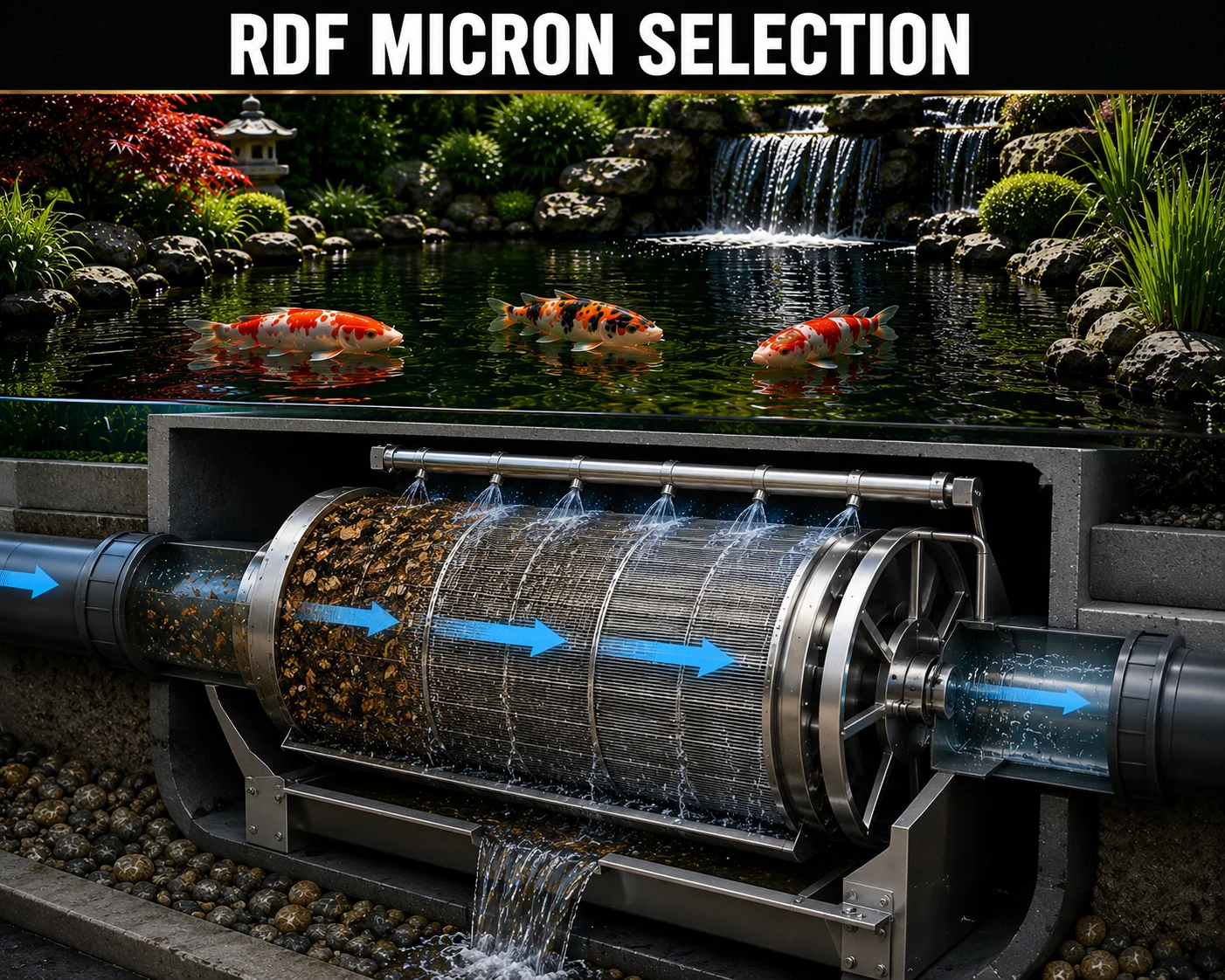
Rotary Drum Filter (RDF) Micron Screen Sizing & High-Pressure Flush Metrics
Rotary drum filters have become the gold standard for mechanical filtration in high‑end koi ponds, combining continuous self‑cleaning operation with exceptional solids removal efficiency. The core performance parameters—micron screen aperture, drum rotational speed, and high‑pressure flush nozzle selection—are tightly coupled and must be sized to the specific hydraulic loading and waste characteristics of the system. Selecting a screen that is too fine increases the frequency of backwash cycles and flush water consumption; a screen that is too coarse allows fine solids to pass, overwhelming biological filtration and reducing water clarity.
This technical hub covers the engineering principles behind RDF screen sizing: the relationship between mesh opening and particle capture efficiency, the effect of drum submergence on effective filtration area, and the hydraulic power required for nozzle flush systems. We also examine the real‑world tradeoffs between flush pressure, nozzle angle, and water recovery, and how to match these to a pond’s turnover rate and solids loading. All recommendations are presented as design considerations rather than universal rules, because every installation varies in flow, fish load, and feed rate. Use this resource to benchmark your current system or to specify a new RDF with confidence.
Test Your RDF Sizing & Flush Knowledge
Ten scenario‑based questions covering micron selection, flush pressure, drum speed, nozzle layout, and energy recovery. Each answer includes full engineering reasoning.
RDF Micron Sizing & Flush Metrics — Quick Facts
Most Asked Questions About RDF Micron Sizing & Flush Metrics
A commercial koi farm upgraded from a 80 µm to a 50 µm screen without upgrading the flush pump. Within two weeks, the drum was cycling every 90 seconds, consuming nearly 15% of the total water flow as flush water. The root cause was insufficient nozzle pressure (only 35 psi) to clear the finer mesh, leading to a buildup of a biofilm‑particle layer that reduced effective open area by 40%. Replacing the flush pump with a 1.5 HP unit delivering 60 psi at 18 GPM restored normal cycling to 4‑5 minutes and reduced flush water consumption to 4% of turnover.
Screen Aperture & Particle Capture Efficiency
The micron rating of an RDF screen directly determines the size of particles that are removed from the water column. A 60 µm screen will capture particles larger than 60 µm, but also removes a significant fraction of smaller particles through the buildup of a “filter cake” on the screen surface. This cake enhances fines removal but also increases the pressure drop across the drum, which must be managed by the flush system.
- Nominal vs. absolute rating: Nominal rating refers to the average pore size, while absolute rating indicates the largest particle that can pass. For koi ponds, nominal ratings are typically used, but absolute ratings are more reliable for critical applications.
- Open area percentage: The open area (ratio of pore area to total screen area) decreases as micron rating becomes finer. A 60 µm screen may have 25–30% open area, while a 40 µm screen drops to 15–20%, directly affecting hydraulic capacity.
- Mesh count: Screen mesh count (threads per inch) combined with wire diameter determines aperture. For a given micron rating, a higher mesh count with smaller wire offers better particle retention but lower open area.
When selecting a screen, the tradeoff between fines removal and hydraulic capacity must be weighed against the pond’s solids loading. A heavily stocked pond producing large amounts of fine waste may require a finer screen, but this must be accompanied by an appropriately sized flush system to maintain performance.
High‑Pressure Flush System Hydraulics
The flush system is responsible for removing captured solids from the screen and returning the drum to a clean state. The key hydraulic parameters are nozzle pressure, flow rate, and the angle of impingement. The impingement force on the screen is proportional to the square of the nozzle velocity, making pressure a primary design variable. However, the total cleaning effectiveness also depends on the total flow (GPM) and the dwell time of each nozzle over the screen.
A typical RDF flush system uses a positive displacement pump to maintain consistent pressure regardless of flow, with a pressure relief valve to protect the nozzles. The nozzle array is designed to cover the entire width of the drum, with overlap to ensure no streaks are left. The flush pump should be sized to deliver the required pressure and flow simultaneously, and the suction line should be fed from a clean water source—either the pond or a separate reservoir—to avoid re‑introducing solids.
During a retrofit of a 10,000‑gallon show pond, the RDF was installed with a 70 µm screen but the original flush pump was undersized at 0.5 HP. The system would cycle every 3 minutes, and the pond water remained hazy. After upgrading to a 1 HP flush pump with a 5‑nozzle manifold (each nozzle 1/8″ orifice), the pressure rose from 30 to 65 psi, the cycle time extended to 8 minutes, and the pond achieved crystal clarity within 48 hours. The lesson: flush pump sizing is as critical as the screen micron rating.
An installer placed the flush nozzles at a 90° angle to the screen, assuming that perpendicular impact would be most effective. In practice, the high‑pressure water simply penetrated the mesh without sweeping the solids off, leading to rapid blinding. Adjusting the nozzles to a 20° angle (relative to the screen surface) increased the tangential cleaning force, reducing the blinding rate by 60% without changing pressure or flow. This small geometry change had a dramatic impact on overall system reliability.
Energy Recovery & Water Conservation
The flush water used in an RDF represents a continuous loss of water from the pond, typically 2–5% of the total turnover flow. In regions with water restrictions or high water costs, this can be a significant operational expense. Some advanced systems recover flush water by routing it through a settling tank or a side‑stream filter, allowing the solids to be removed and the water returned to the pond.
Energy recovery is also possible by using a variable‑speed flush pump that adjusts pressure based on the drum’s pressure differential. At low solids loads, the pump can run at reduced speed, saving electrical energy. Modern controllers with pressure sensors and VFDs (Variable Frequency Drives) can cut flush pump energy consumption by 30–50% compared to fixed‑speed systems.
RDF Micron Sizing & Flush Metrics — Full Question Library
Review indexed engineering questions below.
Q1:
What does a 60 µm screen rating indicate?
Correct Answer: Option B
Nominal micron ratings indicate the approximate size of particles that will be retained, but the actual performance is enhanced by the filter cake that forms on the screen.
Q2:
What is the typical open area percentage for a 60 µm RDF screen?
Correct Answer: Option A
Open area decreases as micron rating becomes finer. 60 µm screens typically have 25–30% open area, which affects hydraulic capacity.
Q3:
Which screen rating is generally recommended for high‑clarity koi ponds?
Correct Answer: Option C
For high‑clarity show ponds, 40–50 µm screens are preferred to remove fine particles, but require robust flush systems.
Q4:
What is the relationship between mesh count and aperture size?
Correct Answer: Option B
For a given wire diameter, higher mesh count (threads per inch) results in smaller aperture openings.
Q5:
What is the primary tradeoff when selecting a finer micron screen?
Correct Answer: Option A
Finer screens remove more particles but require more frequent backwashing and a more powerful flush system.
Q6:
What is the effect of a filter cake on the effective micron rating?
Correct Answer: Option C
The accumulated solids on the screen form a cake that traps finer particles, improving overall clarity.
Q7:
How does screen blinding affect drum performance?
Correct Answer: Option B
Blinding occurs when particles become lodged in the mesh, reducing open area and increasing the pressure drop across the drum.
Q8:
What is the typical lifespan of an RDF screen in a koi pond application?
Correct Answer: Option A
With regular flushing and occasional chemical cleaning, screens typically last 3–5 years before needing replacement.
Q9:
Which material is most commonly used for RDF screens?
Correct Answer: Option C
Stainless steel offers excellent durability and resistance to abrasion and corrosion, making it the preferred material for RDF screens.
Q10:
What is the effect of submergence on effective screen area?
Correct Answer: Option B
Only the portion of the drum that is submerged is actively filtering; typical submergence is 50–70% of the drum diameter.
Q11:
How does the screen’s weave pattern affect performance?
Correct Answer: Option A
Plain weave is the most common, providing a good balance of mechanical strength and open area for pond filtration.
Q12:
What is the maximum recommended micron rating for a gravity‑fed RDF?
Correct Answer: Option C
For gravity‑fed systems, 60 µm is a practical limit; finer screens require pumped flow to maintain adequate hydraulic capacity.
Q13:
What is the relationship between screen open area and flow capacity?
Correct Answer: Option B
Higher open area allows more water to pass through the screen at a given pressure, increasing the drum’s hydraulic capacity.
Q14:
What is the typical thickness of an RDF screen mesh?
Correct Answer: Option C
Wire diameter affects both open area and mechanical strength; thinner wires provide higher open area but are less durable.
Q15:
How does the drum’s rotational speed interact with screen rating?
Correct Answer: Option B
Finer screens benefit from slower rotation to allow the filter cake to develop, enhancing fines capture.
Q16:
What is the recommended cleaning frequency for an RDF screen?
Correct Answer: Option C
The most efficient control strategy is to initiate flushing based on pressure differential, rather than fixed time intervals.
Q17:
What is the effect of water temperature on screen performance?
Correct Answer: Option B
Warmer water has lower viscosity, which improves flow, but also affects the hydraulic performance of the flush nozzles.
Q18:
What is the maximum particle size that a 60 µm screen will absolutely capture?
Correct Answer: Option A
The absolute rating of a screen indicates the largest particle that can pass through, so all larger particles are captured.
Q19:
What is the benefit of using a two‑layer (sandwich) screen construction?
Correct Answer: Option C
A two‑layer design with a fine mesh supported by a coarse backing offers better durability and reduces the risk of screen damage.
Q20:
How often should the screen be chemically cleaned?
Correct Answer: Option B
Chemical cleaning removes organic buildup and restores open area; frequency depends on the pond’s organic load.
Q21:
What is the recommended flush pressure for a 60 µm screen?
Correct Answer: Option B
40–60 psi provides sufficient impingement force to clean 60 µm screens without damaging the mesh.
Q22:
How does nozzle flow rate affect cleaning efficiency?
Correct Answer: Option A
Adequate flow rate ensures that the spray covers the entire screen width and removes dislodged solids.
Q23:
What is the typical flush water consumption as a percentage of pond turnover?
Correct Answer: Option B
Well‑designed systems consume 2–5% of the total flow for backwashing; higher percentages indicate inefficiency.
Q24:
What is the effect of increasing flush pressure on water consumption?
Correct Answer: Option B
Higher pressure typically requires a larger pump and more flow, increasing the total flush water volume.
Q25:
What type of pump is most commonly used for RDF flush systems?
Correct Answer: Option A
Positive displacement pumps maintain consistent pressure regardless of flow, making them ideal for nozzle cleaning applications.
Q26:
What is the recommended nozzle angle for effective screen cleaning?
Correct Answer: Option C
An angle of 15–25° provides a tangential cleaning force that sweeps solids off the screen without driving them through the mesh.
Q27:
How does flush water temperature affect cleaning?
Correct Answer: Option B
Warmer water has lower viscosity, which can improve nozzle atomization and coverage.
Q28:
What is the purpose of a pressure relief valve in the flush system?
Correct Answer: Option A
A pressure relief valve prevents damage to the pump and nozzles if the discharge line is blocked.
Q29:
What is the effect of nozzle orifice size on flush performance?
Correct Answer: Option C
A larger orifice allows more flow at the same pressure, but may reduce the exit velocity and impingement force.
Q30:
How can flush water consumption be minimized?
Correct Answer: Option B
Pressure‑based control initiates flushing only when needed, reducing overall water and energy consumption.
Q31:
What is the typical flush cycle duration for a koi pond RDF?
Correct Answer: Option C
A cycle of 15–30 seconds is typical, allowing the drum to make one or more complete rotations under the flush nozzles.
Q32:
What is the recommended pipe size for a flush supply line?
Correct Answer: Option A
A 1‑inch or larger pipe ensures that the flush pump can deliver the required flow at the desired pressure with minimal friction loss.
Q33:
How does the number of nozzles affect flush performance?
Correct Answer: Option B
The number of nozzles should be chosen to cover the entire drum width with overlapping spray patterns.
Q34:
What is the effect of a clogged nozzle on the flush system?
Correct Answer: Option B
A clogged nozzle leaves a streak of uncleaned screen, which can lead to progressive blinding of that area.
Q35:
What is the recommended flush pump duty cycle?
Correct Answer: Option B
Intermittent operation saves energy and reduces wear on the pump, while maintaining screen cleanliness.
Q36:
What is the typical pressure drop across a clean RDF screen?
Correct Answer: Option A
A clean screen has a very low pressure drop; a significant increase indicates blinding and the need for flushing.
Q37:
How does flush water quality affect screen longevity?
Correct Answer: Option C
Minerals in hard water can precipitate onto the screen, reducing open area and requiring chemical cleaning.
Q38:
What is the recommended flush pump motor size for a pond up to 10,000 gallons?
Correct Answer: Option B
A 0.5–1.0 HP pump is typically sufficient for small to medium ponds, but the actual size depends on the number of nozzles and required pressure.
Q39:
What is the effect of flush water on the pond’s water balance?
Correct Answer: Option C
Flush water is typically discharged to waste, so the pond requires make‑up water to maintain level.
Q40:
What is the benefit of using a VFD on the flush pump?
Correct Answer: Option B
A VFD allows the pump speed to be adjusted, matching pressure to the actual cleaning requirement and saving energy.
Q41:
What is the typical rotational speed range for an RDF drum?
Correct Answer: Option B
Most RDFs operate at 0.5–3 RPM to balance filtration dwell time with flush frequency.
Q42:
What is the recommended submergence level for an RDF drum?
Correct Answer: Option A
50–70% submergence provides a good balance between filtration area and the ability to flush the non‑submerged section.
Q43:
How does drum speed affect the filter cake thickness?
Correct Answer: Option C
Slower rotation gives each screen segment more time in the dirty water, allowing a thicker filter cake to build up.
Q44:
What is the effect of submergence on hydraulic capacity?
Correct Answer: Option B
A larger submerged area provides more surface for filtration, increasing the drum’s flow capacity.
Q45:
What controls the drum’s rotational speed in modern RDFs?
Correct Answer: Option C
Most RDFs use an electric motor with a gearbox; premium models offer VFDs for precise speed control.
Q46:
How does water level fluctuation affect RDF performance?
Correct Answer: Option B
Maintaining a consistent water level is critical for stable operation; sudden drops can expose dirty screen areas.
Q47:
What is the relationship between drum speed and flush frequency?
Correct Answer: Option A
Faster rotation means each screen segment has less dwell time, so the cake builds up faster, triggering more frequent flushes.
Q48:
What is the effect of drum diameter on submergence volume?
Correct Answer: Option B
The submerged volume is proportional to the cross‑sectional area, which scales with the square of the radius.
Q49:
How does drum speed affect the dwell time of each screen segment?
Correct Answer: Option C
Dwell time is inversely proportional to rotational speed; faster rotation reduces the time each segment is exposed to the water.
Q50:
What is the recommended submergence for a gravity‑fed RDF?
Correct Answer: Option B
Gravity‑fed RDFs typically operate at 50–60% submergence to balance hydraulic capacity with drain‑line flow.
Q51:
What is the effect of low submergence on a pump‑fed RDF?
Correct Answer: Option A
Low submergence can expose the pump intake, leading to air entrainment and loss of prime.
Q52:
How does the drum’s rotational direction affect cleaning?
Correct Answer: Option C
Proper nozzle layout ensures cleaning regardless of rotation direction, as long as the drum rotates past the nozzles.
Q53:
What is the maximum practical drum speed for solids removal?
Correct Answer: Option B
Above 5 RPM, the screen dwell time becomes too short for effective solids capture and cake formation.
Q54:
How does the drum’s bearing system affect speed stability?
Correct Answer: Option C
Worn or misaligned bearings can cause speed fluctuations, affecting filtration uniformity.
Q55:
What is the relationship between drum speed and the frequency of flush cycles?
Correct Answer: Option B
Higher speed means each segment is exposed to dirty water more frequently, requiring more frequent flushing.
Q56:
What is the recommended minimum submergence for a pump‑fed RDF?
Correct Answer: Option A
At least 50% submergence is recommended to ensure the pump intake remains covered and the drum operates efficiently.
Q57:
How does the drum’s structural integrity affect speed selection?
Correct Answer: Option C
Unbalanced or poorly designed drums can vibrate at high speeds, leading to premature wear and noise.
Q58:
What is the effect of submergence on the pressure differential across the drum?
Correct Answer: Option B
With more submerged area, the total resistance to flow increases, raising the pressure differential across the drum.
Q59:
What is the typical drive mechanism for an RDF drum?
Correct Answer: Option A
Direct gear motor drives are common, offering simplicity and reliable speed control.
Q60:
How does the pond’s flow rate affect the optimal drum speed?
Correct Answer: Option C
At high flow rates, a faster drum speed helps prevent the buildup of a thick, blinding layer by moving the screen through the water more quickly.
Q61:
What type of nozzle is commonly used for RDF flush systems?
Correct Answer: Option B
Flat fan nozzles provide a wide, uniform spray pattern ideal for covering the screen width.
Q62:
What is the purpose of overlapping nozzle spray patterns?
Correct Answer: Option A
Overlap ensures that every part of the screen is hit by at least one nozzle, preventing streaks.
Q63:
What is the recommended nozzle spacing for a flat fan nozzle?
Correct Answer: Option C
Spacing is a function of spray angle and the distance from the nozzle to the screen, typically set to achieve 20–30% overlap.
Q64:
How does the nozzle’s spray angle affect cleaning?
Correct Answer: Option B
A wider spray angle covers more area but at a lower impingement pressure; the optimal angle is a tradeoff.
Q65:
What is the typical material used for RDF flush nozzles?
Correct Answer: Option C
Stainless steel and brass are preferred for their corrosion resistance and durability under high pressure.
Q66:
What is the purpose of a nozzle filter or strainer?
Correct Answer: Option B
A strainer prevents particles from entering and blocking the small nozzle orifice, which would reduce cleaning effectiveness.
Q67:
How does nozzle wear affect the flush system?
Correct Answer: Option A
As nozzles wear, the orifice enlarges, pressure drops, and the spray pattern becomes less effective.
Q68:
What is the recommended distance between the nozzle and the screen?
Correct Answer: Option C
The distance is set to achieve the desired spray width at the screen surface; too close reduces coverage, too far reduces impact.
Q69:
What is the effect of multiple nozzles on the flush pump sizing?
Correct Answer: Option B
The total flow is the sum of the individual nozzle flows; more nozzles require a larger pump.
Q70:
How can nozzle clogging be prevented?
Correct Answer: Option C
Preventive maintenance, including strainers and periodic cleaning, is the most effective way to prevent clogging.
Q71:
What is the effect of nozzle elevation on the spray pattern?
Correct Answer: Option B
Adjusting the nozzle height changes the coverage and impingement; it must be optimized during installation.
Q72:
What is the typical flow rate per nozzle in a koi pond RDF?
Correct Answer: Option A
Small nozzle orifices (1/8″ to 1/4″) typically flow 1–4 GPM at 60 psi.
Q73:
What is the benefit of using a self‑cleaning nozzle?
Correct Answer: Option B
Self‑cleaning nozzles use a moving part to clear blockages, reducing manual maintenance.
Q74:
How does the nozzle’s spray pattern affect the cleaning of blind spots?
Correct Answer: Option C
Careful nozzle layout and pattern selection ensure that the entire screen surface is cleaned.
Q75:
What is the recommended operating pressure for flat fan nozzles?
Correct Answer: Option B
Most flat fan nozzles are designed to operate effectively in the 40–80 psi range.
Q76:
What is the effect of nozzle clogging on the drum’s pressure differential?
Correct Answer: Option A
If a nozzle is clogged, the corresponding screen section remains dirty, increasing the overall pressure drop.
Q77:
How can nozzle performance be verified?
Correct Answer: Option C
Visual inspection of the spray pattern is the most direct way to confirm that nozzles are working properly.
Q78:
What is the typical lifespan of a stainless steel nozzle?
Correct Answer: Option B
Stainless steel nozzles are durable and can last several years if protected from abrasion and scale buildup.
Q79:
What is the purpose of a nozzle manifold?
Correct Answer: Option C
A manifold ensures that each nozzle receives water at the same pressure and flow rate.
Q80:
How does the nozzle’s angle of attack affect cleaning efficiency?
Correct Answer: Option B
The optimal angle is 15–25° from the screen surface, creating a tangential force that removes solids without driving them through.
Q81:
What is the primary source of solids loading in a koi pond?
Correct Answer: Option A
Koi produce metabolic waste, and uneaten food decomposes, contributing the majority of solids load.
Q82:
How does fish feeding rate affect RDF performance?
Correct Answer: Option C
More food means more waste, which loads the RDF faster and requires more frequent cleaning.
Q83:
What is the typical solids concentration in a well‑stocked koi pond?
Correct Answer: Option B
Total suspended solids (TSS) in a koi pond typically range from 10 to 50 ppm, depending on stocking density.
Q84:
How does the type of fish feed affect waste characteristics?
Correct Answer: Option C
High‑quality feed with better digestibility produces firmer, more cohesive waste that is easier to filter.
Q85:
What is the effect of a bio‑film on the screen?
Correct Answer: Option B
A bio‑film layer can clog the mesh, increasing pressure drop and the frequency of backwash cycles.
Q86:
How does pond temperature affect solids loading?
Correct Answer: Option A
Warmer water accelerates fish metabolism, leading to more waste production and a higher load on the RDF.
Q87:
What is the typical solids removal efficiency of a 60 µm RDF?
Correct Answer: Option C
A well‑operated RDF with a 60 µm screen removes 85–95% of particles larger than the nominal rating.
Q88:
How does the presence of suspended algae affect screen performance?
Correct Answer: Option B
Algae and organic matter can combine to form a sticky biofilm that clings to the screen.
Q89:
What is the recommended approach to handling peak solids loads (e.g., after feeding)?
Correct Answer: Option C
Oversizing or using a buffer tank helps smooth out peak loads and prevents the drum from being overwhelmed.
Q90:
How does the age of the fish affect waste production?
Correct Answer: Option B
Waste production is proportional to fish mass; larger fish generate more solids.
Q91:
What is the effect of a high protein diet on waste particle size?
Correct Answer: Option A
High‑protein feed can result in softer, more fragmented waste that is harder to capture.
Q92:
How can the solids loading be estimated for a new pond?
Correct Answer: Option C
Solids loading can be estimated from the fish biomass and feed conversion rates.
Q93:
What is the effect of a sudden increase in feeding on the RDF?
Correct Answer: Option B
A surge in solids can overwhelm the drum, leading to a rapid backwash cycle and potential bypass.
Q94:
How does the use of a settling tank before the RDF affect solids loading?
Correct Answer: Option A
A settling tank removes larger, heavy solids, reducing the load on the RDF.
Q95:
What is the typical particle size distribution of koi waste?
Correct Answer: Option C
Koi waste includes a wide range of particle sizes, making screening an important part of the filtration train.
Q96:
How does water hardness affect solids removal?
Correct Answer: Option B
Calcium and magnesium deposits can build up on the screen, especially if the flush water is hard.
Q97:
What is the relationship between aeration and solids loading?
Correct Answer: Option C
Aeration creates water movement that keeps waste in suspension, allowing the RDF to capture it before it settles.
Q98:
How often should the waste discharge line be inspected?
Correct Answer: Option B
Regular inspection of the discharge line prevents blockages that could back up the RDF.
Q99:
What is the effect of high ammonia levels on screen performance?
Correct Answer: Option C
Ammonia is a nutrient for bacteria, which can form a bio‑film that clogs the screen.
Q100:
What is the best way to reduce solids loading on the RDF?
Correct Answer: Option B
Feeding less and using a digestible feed reduces the amount of waste entering the system.
Q101:
What type of pump is typically used for the main pond circulation through an RDF?
Correct Answer: Option B
Centrifugal pumps are most commonly used for pond circulation due to their efficiency and ability to handle varying head conditions.
Q102:
How does the RDF’s pressure drop affect the main pump selection?
Correct Answer: Option A
The RDF introduces a pressure drop; the main pump must be selected to deliver the required flow at the combined system head.
Q103:
What is the recommended approach to integrating a flush pump with the main circulation pump?
Correct Answer: Option C
A dedicated flush pump ensures consistent pressure and prevents interference with the main circulation flow.
Q104:
What is the effect of the RDF’s bypass valve on system flow?
Correct Answer: Option B
A bypass valve is used to divert flow during flushing or if the screen becomes blinded, preventing system shutdown.
Q105:
How does the pump curve affect RDF operation?
Correct Answer: Option C
The pump and RDF must be matched; if the pump provides too much flow, the drum may overflow; too little reduces filtration.
Q106:
What is the recommended pipe size for the RDF’s inlet and outlet?
Correct Answer: Option B
Larger pipe reduces friction loss and ensures the RDF operates at its rated capacity.
Q107:
How does the RDF’s location relative to the pump affect performance?
Correct Answer: Option A
Placement affects the pressure and flow; on the suction side, the RDF sees negative pressure, which can affect its seals.
Q108:
What is the purpose of a check valve in the RDF discharge line?
Correct Answer: Option C
A check valve prevents water from flowing back through the RDF when the pump stops, avoiding back‑contamination.
Q109:
How does the RDF’s flow capacity influence the pond’s turnover rate?
Correct Answer: Option B
The RDF must be large enough to pass the entire pond volume through the filter within the desired turnover time.
Q110:
What is the recommended approach to system automation?
Correct Answer: Option A
Automated pressure‑based control ensures optimal flushing and reduces water and energy waste.
Q111:
How does the RDF’s construction material affect system integration?
Correct Answer: Option C
The material must be durable and non‑reactive with pond water to ensure long‑term reliability.
Q112:
What is the role of a pressure gauge in the RDF system?
Correct Answer: Option B
Pressure gauges on the inlet and outlet allow the operator to monitor the drum’s condition.
Q113:
How does the RDF’s waste discharge system affect the overall pond design?
Correct Answer: Option A
The waste discharge must be planned to avoid flooding and ensure proper disposal of concentrated solids.
Q114:
What is the effect of the RDF’s head loss on the main pump’s operating point?
Correct Answer: Option C
The added resistance from the RDF increases the system head, moving the pump’s operating point.
Q115:
What is the recommended way to control the flush pump?
Correct Answer: Option B
Pressure‑based control is the most efficient, ensuring the pump runs only when needed.
Q116:
What is the purpose of a bypass line around the RDF?
Correct Answer: Option A
A bypass valve or line allows water to flow around the RDF when the drum is offline.
Q117:
How does the RDF’s footprint affect the equipment room layout?
Correct Answer: Option C
The RDF is a major piece of equipment; its size and access requirements must be planned.
Q118:
What is the relationship between the main pump and the flush pump in terms of power consumption?
Correct Answer: Option B
The main pump runs continuously, while the flush pump is intermittent, so its energy cost is lower.
Q119:
How does the RDF affect the overall water chemistry?
Correct Answer: Option A
By removing particulate organic matter, the RDF reduces the biological oxygen demand and improves water quality.
Q120:
What is the recommended frequency for checking the RDF’s drive motor?
Correct Answer: Option C
Routine checks prevent unexpected failures and extend the motor’s lifespan.
Q121:
What is the typical water loss from an RDF flush system?
Correct Answer: Option B
A well‑designed RDF loses 2–5% of the total flow as flush water; higher numbers indicate inefficiency.
Q122:
How can flush water be reused in a pond system?
Correct Answer: Option A
A settling tank allows solids to drop out, and the clarified water can be returned to the pond or used for other purposes.
Q123:
What is the effect of water recovery on the pond’s water balance?
Correct Answer: Option C
Recovering flush water reduces the continuous loss and the need for fresh water addition.
Q124:
What is the recommended approach to reducing flush water consumption?
Correct Answer: Option B
Optimizing the flush cycle to clean only when necessary saves water and energy.
Q125:
How does the use of a variable speed flush pump affect water conservation?
Correct Answer: Option C
A VFD adjusts the pump speed to the minimum required pressure, reducing both water and energy use.
Q126:
What is the purpose of a solids holding tank in a water recovery system?
Correct Answer: Option B
A holding tank acts as a primary clarifier, reducing the solids content of the recovered water.
Q127:
How can recovered water be used for garden irrigation?
Correct Answer: Option A
The solids‑laden water is rich in nutrients and can be a valuable fertilizer for non‑edible plants.
Q128:
What is the effect of flush water recovery on the pond’s salinity?
Correct Answer: Option C
If make‑up water is reduced, salts from feed and evaporation can build up, requiring periodic dilution.
Q129:
What is the typical payback period for a water recovery system?
Correct Answer: Option B
In areas with high water costs or restrictions, a recovery system can pay for itself within a few years.
Q130:
How does the RDF’s waste discharge affect the environment?
Correct Answer: Option A
The waste is rich in organics and should be directed to a sewer, septic, or irrigation system.
Q131:
What is the effect of water conservation on the pond’s ecosystem?
Correct Answer: Option C
Stable water conditions are beneficial for koi health, and conservation supports that stability.
Q132:
How can a water meter be used to monitor flush efficiency?
Correct Answer: Option B
Sudden increases in flush water consumption are a sign that the screen is not being cleaned effectively.
Q133:
What is the recommended way to store recovered water?
Correct Answer: Option A
Covered storage prevents light‑induced algae blooms and keeps the water clean.
Q134:
How does the frequency of flushing affect water conservation?
Correct Answer: Option C
Reducing the number of flush cycles directly lowers water loss.
Q135:
What is the effect of using a side‑stream filter on flush water recovery?
Correct Answer: Option B
A side‑stream filter can remove fine solids, allowing the water to be returned with minimal impact.
Q136:
What is the potential of using flush water for a constructed wetland?
Correct Answer: Option A
Constructed wetlands can treat the waste and provide a sustainable disposal method.
Q137:
How does the RDF’s flush cycle time affect water loss?
Correct Answer: Option C
The cycle should be just long enough to clean the screen; over‑running wastes water.
Q138:
What is the effect of flush water on the pond’s alkalinity?
Correct Answer: Option B
Frequent water changes to maintain level can dilute alkalinity, requiring buffering.
Q139:
What is the best way to measure flush water recovery efficiency?
Correct Answer: Option C
A mass balance approach provides a clear picture of the system’s water efficiency.
Q140:
What is the role of a solids dewatering unit in a water recovery system?
Correct Answer: Option B
Dewatering separates the solids, leaving a drier cake and cleaner water.
Q141:
How can the main circulation pump’s energy consumption be optimized with an RDF?
Correct Answer: Option B
Proper pump selection ensures it operates near its best efficiency point, minimizing energy use.
Q142:
What is the effect of the RDF’s pressure drop on pump energy consumption?
Correct Answer: Option A
Energy is proportional to flow × head; a higher head requirement means more power.
Q143:
How does the use of a VFD on the main pump affect the RDF’s performance?
Correct Answer: Option C
A VFD allows the pump to operate at the lowest speed needed to achieve the required flow, saving energy.
Q144:
What is the typical energy consumption of an RDF flush pump compared to the main pump?
Correct Answer: Option B
Although the flush pump may have a higher peak power, its low duty cycle means its total energy use is much lower.
Q145:
How does the RDF’s clean pressure drop affect the system’s operating point?
Correct Answer: Option A
A clean screen offers minimal resistance, so the main pump can run at a lower speed or with a smaller impeller.
Q146:
What is the effect of a dirty RDF screen on pump energy consumption?
Correct Answer: Option C
A dirty screen increases head loss, shifting the pump’s operating point and increasing energy use.
Q147:
How can the energy efficiency of the flush system be improved?
Correct Answer: Option B
Reducing the number and duration of flush cycles reduces both water and energy consumption.
Q148:
What is the relationship between drum speed and energy consumption?
Correct Answer: Option A
Faster rotation requires more torque and power, increasing the energy use of the drive motor.
Q149:
How does the RDF’s design affect its overall energy footprint?
Correct Answer: Option C
A well‑designed RDF minimizes head loss, lowering the total system energy consumption.
Q150:
What is the typical payback period for a high‑efficiency RDF system?
Correct Answer: Option B
Energy‑efficient components may have a higher initial cost but save money over time.
Q151:
How can the RDF’s energy performance be benchmarked?
Correct Answer: Option A
A specific energy consumption metric allows comparison and optimization.
Q152:
What is the effect of a worn screen on system energy consumption?
Correct Answer: Option C
A damaged or worn screen may have a different pressure drop characteristic, affecting pump energy.
Q153:
How does the flush pump’s efficiency affect the overall system energy?
Correct Answer: Option B
Choosing a high‑efficiency pump for the flush system saves energy over its lifetime.
Q154:
What is the effect of pipe friction on the RDF system’s energy use?
Correct Answer: Option A
Long or undersized pipes add to the system head, increasing the energy required to move the water.
Q155:
How can the RDF’s operating point be optimized for energy savings?
Correct Answer: Option C
Matching the pump to the system curve ensures it runs efficiently.
Q156:
What is the typical power draw of a flush pump for a small RDF?
Correct Answer: Option B
Small flush pumps typically draw 150–300 W, depending on the pressure and flow.
Q157:
What is the effect of a variable speed drive on the main pump’s energy consumption?
Correct Answer: Option A
VFDs allow the pump to match the system’s flow requirements, saving significant energy.
Q158:
How does the RDF’s automatic control system affect energy use?
Correct Answer: Option C
Smart controls ensure that pumps run only when needed and at the optimal speed.
Q159:
What is the relationship between the main pump’s flow and the RDF’s capacity in terms of energy?
Correct Answer: Option B
An oversized pump will operate at a higher head, consuming more energy than necessary.
Q160:
How can energy monitoring be used to diagnose RDF performance?
Correct Answer: Option A
Energy consumption is a valuable diagnostic tool for system health.
Q161:
How often should the RDF screen be inspected?
Correct Answer: Option B
Regular inspection prevents unexpected failures and maintains performance.
Q162:
What are the signs of a dirty RDF screen?
Correct Answer: Option A
A rising pressure differential is the primary indicator that the screen needs attention.
Q163:
How can a clogged nozzle be detected?
Correct Answer: Option C
Visual inspection is the most direct method to identify blocked nozzles.
Q164:
What is the recommended procedure for cleaning a clogged nozzle?
Correct Answer: Option B
Soaking and air purging effectively clears blockages without damaging the orifice.
Q165:
How often should the flush pump’s inlet strainer be cleaned?
Correct Answer: Option A
A clean strainer ensures the flush pump receives adequate flow and prevents nozzle clogging.
Q166:
What is the typical lifespan of an RDF’s mechanical seals?
Correct Answer: Option C
Mechanical seals wear over time and should be inspected and replaced as needed.
Q167:
What causes the RDF drum to rotate erratically?
Correct Answer: Option B
Mechanical issues in the drive system or bearings can cause uneven rotation.
Q168:
How can you tell if the RDF is operating at its design capacity?
Correct Answer: Option A
Flow and pressure readings are objective indicators of performance.
Q169:
What should be done if the RDF’s flush cycle duration becomes excessively long?
Correct Answer: Option C
Increased cycle time often indicates that the screen is not being cleaned effectively.
Q170:
How does the RDF’s bypass valve become blocked?
Correct Answer: Option B
Bypass valves should be exercised periodically to prevent fouling.
Q171:
What is the recommended way to store spare RDF parts?
Correct Answer: Option A
Proper storage extends the life of spare seals, belts, and nozzles.
Q172:
How can you verify that the flush pump is delivering the correct pressure?
Correct Answer: Option C
A pressure gauge is the most accurate way to monitor flush pressure.
Q173:
What is the effect of a worn drive motor on the RDF?
Correct Answer: Option B
Motor wear leads to unreliable operation and should be addressed promptly.
Q174:
How can the RDF’s performance be restored after a period of neglect?
Correct Answer: Option A
A comprehensive maintenance overhaul is the best way to recover performance.
Q175:
What is the most common cause of RDF overflow?
Correct Answer: Option C
Overflow occurs when the screen becomes blocked faster than it can be cleaned.
Q176:
How can the RDF’s discharge line be kept clear?
Correct Answer: Option B
Proper drainage design prevents blockages in the waste line.
Q177:
What is the recommended approach to winterizing an RDF?
Correct Answer: Option A
Freezing water can crack the drum and housing; proper winterization is essential.
Q178:
How often should the RDF’s drive chain or belt be inspected?
Correct Answer: Option C
Regular inspection prevents sudden drive failure.
Q179:
What is the effect of electrical power fluctuations on the RDF?
Correct Answer: Option B
Power surges can damage sensitive electronic components; protection is advised.
Q180:
How can the RDF’s status be monitored remotely?
Correct Answer: Option A
Remote monitoring provides peace of mind and early warning of issues.
Q181:
What is the next generation of RDF materials?
Correct Answer: Option B
New materials offer lighter weight, higher strength, and better corrosion resistance.
Q182:
How is AI being used in RDF control systems?
Correct Answer: Option A
Machine learning algorithms can improve efficiency by learning the pond’s loading patterns.
Q183:
What is the potential of using solar energy for RDF pumps?
Correct Answer: Option C
With falling solar costs, many pond systems are integrating renewable energy.
Q184:
How does the Internet of Things (IoT) apply to RDFs?
Correct Answer: Option B
IoT integration provides real‑time data and remote control capabilities.
Q185:
What is the future of micron screen technology?
Correct Answer: Option A
New coatings can reduce blinding and extend screen life.
Q186:
How can the RDF’s carbon footprint be reduced?
Correct Answer: Option C
Energy efficiency directly reduces the environmental impact of the system.
Q187:
What is the role of 3D printing in RDF component manufacturing?
Correct Answer: Option B
3D printing is a valuable tool for creating custom or hard‑to‑find parts.
Q188:
How can water quality sensors be integrated with the RDF?
Correct Answer: Option A
Quality‑based control can further optimize filter performance.
Q189:
What is the trend in RDF size for residential ponds?
Correct Answer: Option C
Manufacturers are focusing on user‑friendly, space‑saving designs.
Q190:
How will advancements in motor technology affect RDFs?
Correct Answer: Option B
Energy‑efficient motors are a key trend in pump and filter design.
Q191:
What is the potential of using hydrodynamic cavitation for screen cleaning?
Correct Answer: Option A
Cavitation‑based cleaning could be a future method for removing stubborn bio‑films.
Q192:
How can the RDF contribute to a circular economy in pond keeping?
Correct Answer: Option C
The waste from an RDF can be a valuable resource, closing the loop in sustainable aquaculture.
Q193:
What is the role of artificial intelligence in predictive maintenance?
Correct Answer: Option B
Predictive maintenance reduces downtime and repair costs.
Q194:
How will changes in water regulations affect RDF design?
Correct Answer: Option A
Stricter environmental regulations will drive innovation in water‑saving features.
Q195:
What is the future of RDF control interfaces?
Correct Answer: Option C
Modern interfaces make system management more accessible and intuitive.
Q196:
How can the RDF’s energy use be further reduced in the future?
Correct Answer: Option B
Energy recovery, such as using a turbine on the flush discharge, is a future possibility.
Q197:
What is the potential of using drones for RDF inspection?
Correct Answer: Option A
While interesting, drone inspection is not yet a common practice in residential ponds.
Q198:
How will the integration of biological and mechanical filtration evolve?
Correct Answer: Option C
Hybrid systems that optimize both mechanical and biological processes are the future.
Q199:
What is the role of smart water meters in an RDF system?
Correct Answer: Option B
Data from smart meters can be used to fine‑tune the system for maximum efficiency.
Q200:
How will climate change affect RDF design and operation?
Correct Answer: Option A
Climate resilience is becoming an important consideration in system design.