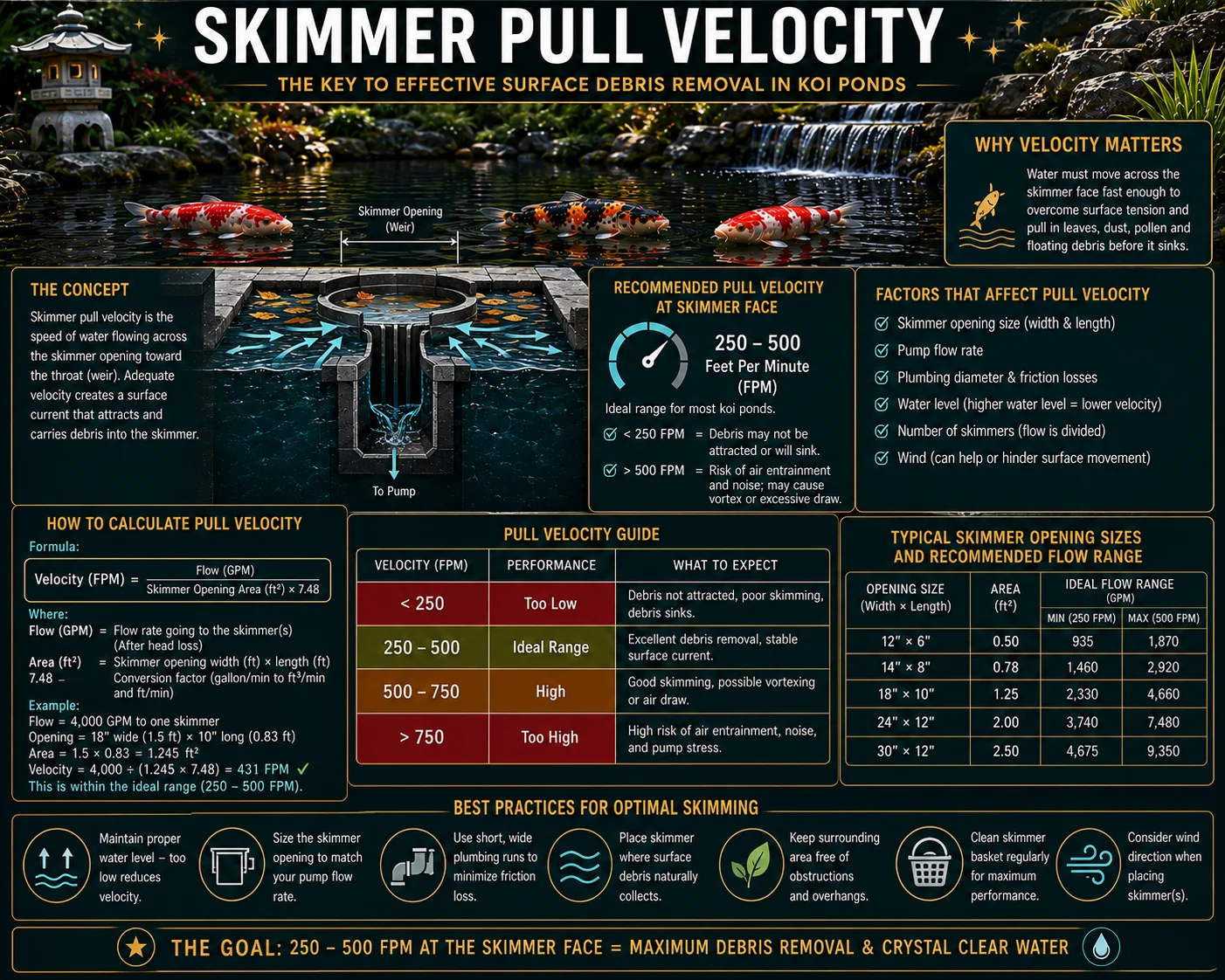
Perimeter Skimmer Weir Kinetic Pull Velocities and Surface Tension Optimization
Perimeter skimmer weirs rely on a thin, fast-moving surface layer to carry floating debris toward the intake mouth. The velocity driving that transport is local and highly concentrated, shaped by weir geometry, submergence, and pump flow rather than by any single pond-wide current. Understanding this distinction is central to skimmer placement and sizing.
This page separates skimmer-mouth kinetic pull from broader pond circulation, and ties each design variable—weir width, drawdown, flow rate, wind exposure, debris type—to measurable outcomes rather than fixed capture distances. Guidance here supports sizing decisions specific to a pond’s shape, operating water level, and pump curve, not generic rules of thumb.
Skimmer Weir Kinetic Pull
Advanced principles of surface tension and weir dynamics.
Quick Facts
Frequently Asked Questions
On one rectangular pond with a single perimeter skimmer, pull was strong within about eighteen inches of the weir, but debris still parked in far corners regardless of pump speed.
Adding a return jet aimed across that dead corner restored a surface path to the skimmer without raising total flow—pull at the mouth wasn’t enough without pond-wide routing.
Weir Hydraulics and Approach Velocity
Approach velocity at a skimmer weir depends on flow rate, weir width, and submergence at the current water level. Narrower weirs or shallower submergence concentrate the same flow into a faster, thinner stream, raising local pull but narrowing capture width.
- Weir width: narrower openings raise velocity for a given flow.
- Submergence: shallower depth over the lip increases approach velocity.
- Drawdown: head loss across the weir drives surface acceleration.
Velocity at the weir mouth doesn’t describe conditions a few feet out. Boundary-layer transport dissipates with distance, friction, and competing currents, making pull distance a site-specific outcome of geometry and flow rather than a fixed radius.
Surface Tension, Debris, and Wind Interaction
Surface tension and meniscus curvature influence how readily floating debris joins flow toward a skimmer; small, light, or hydrophobic particles can resist entrainment even where velocity suits larger debris. Wind shear can overwhelm weak currents a short distance from the weir, and return-jet placement can reinforce or fight that flow. Misaligned returns leave persistent dead zones in corners, collecting debris regardless of pump flow.
A pond with an undersized pipe run to the skimmer pump saw delivered flow drop nearly a third at the impeller despite a correctly sized weir—measuring actual flow, not nameplate GPM, resolved the weak-pull complaint.
Pump Matching, Measurement, and Commissioning
A pump’s true operating point is set by its curve intersecting total dynamic head—pipe friction, fittings, elevation, and valve losses between pump and skimmer return. Sizing to nameplate flow without these losses overstates achievable surface velocity.
Commissioning should confirm performance at the pond’s actual operating water level, since submergence shifts with seasonal fill changes. Floating test material released at multiple points, observed under calm and windy conditions, reveals where pull is adequate and where dead zones persist.
Skimmer openings and intake throats present entrapment risk for small pets, hands, and loose hair, especially at higher approach velocities. Grate spacing and accessible shutoffs are safety checks independent of hydraulic performance and belong in every commissioning visit.
Variable water level changes weir submergence directly: a low pond exposes more of the weir, raising local velocity but shrinking intake area, while a high level can drown the weir and slow surface draw. Seasonal swings warrant periodic rechecking, not a one-time setup.
Troubleshoot weak pull in order: verify delivered flow at the pump, check submergence against design water level, inspect for return-jet misalignment or wind exposure, and map dead zones with floating debris before assuming the skimmer is undersized.
Skimmer Engineering Mastery
Review indexed engineering questions below.
Q1:
What is the primary physical mechanism that resists the initial capture of surface debris by a skimmer weir?
Correct Answer: Option B
Surface tension is caused by the cohesive forces between water molecules, which must be overcome to draw debris into the skimmer.
Q2:
How does the boundary-layer transport affect the efficiency of a perimeter skimmer in a koi pond?
Correct Answer: Option D
The velocity gradient at the surface determines how effectively surface-bound particles are transported toward the skimmer intake.
Q3:
Which factor most significantly influences the thickness of the surface layer captured by a skimmer?
Correct Answer: Option D
The drawdown depth directly determines the volume and thickness of the surface layer that enters the skimmer.
Q4:
Why is laminar flow preferred over turbulent flow at the entrance of a skimmer weir?
Correct Answer: Option D
Laminar flow ensures efficient transport of surface debris without the energy dissipation associated with turbulent eddies.
Q5:
What role does wind-induced surface drift play in skimmer placement strategy?
Correct Answer: Option D
Wind pushes surface water and debris toward the leeward side, making it the optimal location for skimmer placement.
Q6:
How does surface tension affect the capture of hydrophobic particles like pollen or oils?
Correct Answer: Option B
Hydrophobic particles are held at the surface by tension, requiring sufficient kinetic pull to break the surface film.
Q7:
What is the relationship between surface velocity and skimmer capture efficiency?
Correct Answer: Option A
Increased velocity creates a stronger pull that overcomes surface tension and draws debris into the skimmer.
Q8:
Why is the surface-to-volume ratio important when designing skimmer systems?
Correct Answer: Option A
The surface-to-volume ratio helps engineers calculate the necessary skimming capacity to cover the entire pond surface.
Q9:
What happens to surface debris when the skimmer weir velocity is too low?
Correct Answer: Option C
Insufficient velocity fails to overcome the surface tension holding the debris, allowing it to drift elsewhere.
Q10:
How does the presence of a waterfall affect the skimmer’s surface transport?
Correct Answer: Option D
Waterfalls create currents that dictate the flow path of surface debris, which must be accounted for in skimmer placement.
Q11:
What is the primary purpose of a floating weir in a skimmer system?
Correct Answer: Option D
A floating weir adjusts to water level changes, ensuring the intake remains at the optimal depth for skimming.
Q12:
How does water viscosity impact the efficiency of surface skimming?
Correct Answer: Option B
Viscosity affects the fluid’s resistance to flow, impacting how easily surface particles move toward the skimmer.
Q13:
What is the effect of surface-active agents on skimmer performance?
Correct Answer: Option D
Surfactants lower surface tension, which can make it harder to ‘grab’ and pull debris into the skimmer.
Q14:
Why is the shape of the skimmer mouth critical for flow dynamics?
Correct Answer: Option C
The mouth geometry shapes the flow, ensuring a uniform pull that maximizes surface debris capture.
Q15:
What is the relationship between pond depth and surface skimming efficiency?
Correct Answer: Option D
Skimming is a surface-level process; as long as the intake is positioned correctly, total depth is largely irrelevant.
Q16:
How does the skimmer weir’s angle affect the kinetic pull of the surface?
Correct Answer: Option D
The angle of the weir dictates how smoothly water transitions from the pond into the skimmer, affecting flow efficiency.
Q17:
What is the primary cause of ‘dead zones’ in a pond’s surface flow?
Correct Answer: Option D
Dead zones occur when the skimmer is not positioned to capture the flow patterns created by the pond’s circulation.
Q18:
How does the skimmer’s internal baffle design influence surface pull?
Correct Answer: Option D
Baffles are used to smooth out flow, preventing turbulence that could disrupt the intake of surface water.
Q19:
What is the impact of water temperature on surface tension and skimming?
Correct Answer: Option B
Surface tension decreases as temperature increases, which theoretically makes it easier to break the surface film.
Q20:
Why is it important to maintain a consistent flow rate through the skimmer?
Correct Answer: Option D
A consistent flow rate maintains the necessary drawdown to keep the surface clear of debris at all times.
Q21:
What is the primary function of the weir gate in a perimeter skimmer?
Correct Answer: Option A
The weir gate controls the depth of the water entering the skimmer, which is critical for effective surface skimming.
Q22:
How does the width of the skimmer weir affect the approach velocity?
Correct Answer: Option C
Approach velocity is inversely proportional to the width of the weir for a constant flow rate.
Q23:
What is the consequence of an excessively high approach velocity at the weir?
Correct Answer: Option B
High velocity can create a vortex or draw air into the intake, which causes pump cavitation and performance loss.
Q24:
How does weir geometry influence the drawdown profile of the pond surface?
Correct Answer: Option A
The geometry of the weir affects how the water surface curves as it approaches the intake, defining the capture zone.
Q25:
What is the ideal approach velocity for a standard koi pond skimmer?
Correct Answer: Option C
The goal is to balance effective debris capture with the need to avoid creating unnecessary surface turbulence.
Q26:
How does the distance between the skimmer and the return affect drawdown?
Correct Answer: Option B
The placement of returns relative to the skimmer dictates the surface flow patterns and the resulting drawdown.
Q27:
What is the effect of a submerged weir on skimmer performance?
Correct Answer: Option C
A submerged weir pulls water from below the surface, failing to capture the floating debris that skimming is designed for.
Q28:
How does the weir’s vertical alignment affect the intake flow?
Correct Answer: Option C
Proper vertical alignment is essential to ensure that water enters the skimmer evenly across the entire weir.
Q29:
What is the relationship between weir drawdown and pump head pressure?
Correct Answer: Option C
Drawing water down creates a head loss that the pump must overcome to maintain the desired flow rate.
Q30:
How does the weir’s material affect the flow characteristics?
Correct Answer: Option D
The smoothness or texture of the weir material affects the friction and the boundary layer of the water flowing over it.
Q31:
What is the primary benefit of a wide-mouth skimmer weir?
Correct Answer: Option D
A wider mouth increases the area from which the skimmer can pull surface water, improving debris capture.
Q32:
How does the skimmer’s weir depth affect the intake velocity?
Correct Answer: Option A
For a fixed flow rate, increasing the cross-sectional area of the weir opening decreases the velocity of the water.
Q33:
What is the impact of a restricted weir on skimmer performance?
Correct Answer: Option A
A restricted weir limits the amount of water that can enter, which directly reduces the skimmer’s ability to clear the surface.
Q34:
How does the weir’s position relative to the water level affect skimming?
Correct Answer: Option D
The weir must be at the correct height to skim the surface film without drawing in excessive amounts of deeper water.
Q35:
What is the primary cause of weir chatter in a skimmer system?
Correct Answer: Option C
Weir chatter is caused by unstable flow conditions that make the floating weir move up and down rapidly.
Q36:
How does the weir’s design affect the capture of fine surface particles?
Correct Answer: Option C
The velocity gradient created by the weir design determines how effectively fine particles are pulled into the skimmer.
Q37:
What is the relationship between weir length and surface flow uniformity?
Correct Answer: Option A
A longer weir allows the water to spread out more evenly, leading to a more uniform flow profile.
Q38:
How does the weir’s buoyancy affect its performance in a skimmer?
Correct Answer: Option D
The buoyancy of the weir must be carefully balanced so that it sits at the correct depth to skim the surface effectively.
Q39:
What is the impact of a non-level weir on skimmer performance?
Correct Answer: Option D
A non-level weir results in uneven water intake, meaning some parts of the surface are not skimmed effectively.
Q40:
How does the weir’s hinge design affect its long-term reliability?
Correct Answer: Option A
The hinge is a critical component that must remain functional despite constant exposure to water and debris.
Q41:
How does the meniscus curvature at the weir edge influence the capture of hydrophobic floating debris?
Correct Answer: Option C
The meniscus at the weir edge creates a localized downward flow vector that overcomes the surface tension holding hydrophobic debris, effectively pulling it into the skimmer throat.
Q42:
What is the primary physical mechanism by which surface tension impedes debris entry into a skimmer?
Correct Answer: Option A
Surface tension acts as a cohesive membrane that resists the deformation required for debris to pass over the weir, effectively anchoring particles to the surface.
Q43:
Why is a sharp-edged weir profile superior to a rounded edge for maximizing debris capture?
Correct Answer: Option B
A sharp edge forces the water to break away cleanly, minimizing the boundary layer and maximizing the kinetic pull on surface debris.
Q44:
What effect does a surfactant-heavy environment have on the kinetic pull of a pond skimmer?
Correct Answer: Option D
Surfactants lower the surface tension of water, which weakens the cohesive film that typically traps debris, allowing the skimmer to capture it more efficiently.
Q45:
How does the angle of the weir gate affect the capture of surface-tension-bound particulates?
Correct Answer: Option B
Increasing the angle of the weir gate increases the vertical velocity component of the water entering the skimmer, which helps overcome the surface tension holding debris.
Q46:
What role does the ‘coanda effect’ play in the operation of a high-efficiency pond skimmer?
Correct Answer: Option C
The Coanda effect ensures that water adheres to the weir surface, creating a smooth, consistent flow that effectively carries debris into the skimmer basket.
Q47:
Why does high wind speed on a pond surface negatively impact skimmer capture efficiency?
Correct Answer: Option C
Wind creates surface currents that are often stronger than the localized pull of the skimmer, effectively pushing debris away from the intake regardless of weir design.
Q48:
What is the relationship between water temperature and the effectiveness of debris capture at the weir?
Correct Answer: Option D
Surface tension is inversely related to temperature; as water cools, surface tension increases, creating a stronger film that resists the skimmer’s pull.
Q49:
How does the presence of a biofilm on the weir lip alter the kinetic pull of the skimmer?
Correct Answer: Option A
Biofilm buildup increases the friction and turbulence at the weir lip, breaking the smooth laminar flow required to pull surface-tension-bound debris into the skimmer.
Q50:
Which factor is most critical for maintaining a consistent meniscus at the skimmer weir?
Correct Answer: Option A
A stable water level is required to ensure the weir remains at the optimal depth, maintaining the meniscus necessary for effective surface debris capture.
Q51:
What is the primary benefit of a floating weir over a fixed weir in a koi pond?
Correct Answer: Option B
Floating weirs maintain a constant relationship with the water surface, ensuring that the flow rate over the weir remains optimal despite changes in pond water level.
Q52:
How does the shape of the skimmer mouth influence the capture of debris near the edges?
Correct Answer: Option A
A wider skimmer mouth minimizes the ‘dead zones’ at the edges where velocity is too low to pull in debris, leading to more uniform capture across the entire width.
Q53:
What is the effect of excessive flow rate on the capture of small, light debris?
Correct Answer: Option D
Excessive flow creates turbulence at the weir, which can create a ‘bow wave’ that pushes light debris away from the intake rather than drawing it in.
Q54:
Why is it important to minimize the distance between the skimmer and the pond edge?
Correct Answer: Option B
Reducing the distance between the skimmer and the debris source ensures that the kinetic pull of the skimmer is more effective before the debris becomes waterlogged and sinks.
Q55:
How does the depth of the water flowing over the weir affect the capture of large debris?
Correct Answer: Option C
A deeper flow over the weir provides the necessary clearance for larger organic matter to pass into the skimmer basket without causing a blockage at the weir threshold.
Q56:
What is the purpose of a ‘weir flap’ in a professional-grade pond skimmer?
Correct Answer: Option B
The weir flap acts as a one-way valve, allowing water and debris to enter the skimmer while preventing captured debris from floating back out into the pond when the pump cycles off.
Q57:
How does the orientation of the skimmer relative to prevailing winds affect performance?
Correct Answer: Option B
Prevailing winds naturally concentrate floating debris on the leeward side of the pond; placing the skimmer there leverages these currents to increase capture efficiency.
Q58:
What is the primary cause of ‘skimmer bypass’ where debris floats past the intake?
Correct Answer: Option A
If the kinetic pull (velocity) at the weir is lower than the velocity of the surface current carrying the debris, the debris will simply bypass the skimmer intake.
Q59:
How does the use of a skimmer weir brush or comb improve debris capture?
Correct Answer: Option A
A brush or comb at the weir lip disrupts the cohesive surface film, effectively ‘tripping’ the debris into the downward flow of the skimmer.
Q60:
Why is it important to have a smooth transition from the pond surface to the skimmer?
Correct Answer: Option D
A smooth, laminar transition ensures that the kinetic energy of the water is directed into the skimmer rather than being dissipated by turbulence, which would otherwise repel debris.
Q61:
What is the optimal flow rate per inch of weir width for a standard koi pond?
Correct Answer: Option D
This flow range provides sufficient velocity to pull surface debris over the weir without creating excessive turbulence that would push debris away.
Q62:
How does the width of the skimmer mouth affect the total surface area covered?
Correct Answer: Option D
A wider weir mouth creates a broader intake profile, which increases the width of the surface current being pulled toward the skimmer, thereby covering more pond surface.
Q63:
What is the primary constraint when increasing the width of a skimmer mouth?
Correct Answer: Option B
If the mouth is widened without increasing the pump flow rate, the velocity per inch of weir drops, causing the skimmer to lose its ability to pull in debris.
Q64:
How does the distance from the skimmer to the pond center affect debris capture?
Correct Answer: Option B
The kinetic pull of a skimmer decreases with distance; therefore, to capture debris from the center of a large pond, the flow rate must be significantly higher.
Q65:
What is the effect of a ‘dead zone’ in front of the skimmer mouth?
Correct Answer: Option C
Dead zones are areas of low velocity where the skimmer’s pull is insufficient to move debris, causing it to stall and sink before it can be captured.
Q66:
How does the skimmer mouth height relative to the water level affect performance?
Correct Answer: Option D
A thin, consistent sheet of water maximizes the velocity at the surface, which is critical for pulling in floating debris without wasting pump capacity.
Q67:
What is the relationship between skimmer mouth width and flow velocity?
Correct Answer: Option C
Flow velocity is determined by the volume of water divided by the cross-sectional area; increasing the width while keeping the volume constant reduces the velocity.
Q68:
Why is it recommended to have multiple skimmers in a large, irregularly shaped pond?
Correct Answer: Option C
In large or complex ponds, a single skimmer cannot generate enough pull to cover the entire surface, leading to debris accumulation in distant or shielded areas.
Q69:
How does the skimmer mouth width affect the capture of large, floating leaves?
Correct Answer: Option A
Large leaves can easily bridge a narrow skimmer mouth, causing a blockage; a wider mouth provides more clearance, allowing the leaves to pass through into the basket.
Q70:
What is the primary advantage of a skimmer with an adjustable weir gate?
Correct Answer: Option D
An adjustable weir gate allows the operator to optimize the flow velocity for different conditions, such as high debris loads during autumn or lower loads in winter.
Q71:
How does the skimmer mouth shape affect the flow pattern in the pond?
Correct Answer: Option B
The geometry of the skimmer mouth can be used to shape the intake flow, creating a directional pull that effectively draws debris from the surrounding water surface.
Q72:
What is the impact of a high-flow pump on a narrow-mouth skimmer?
Correct Answer: Option C
Forcing too much water through a narrow opening creates high-velocity turbulence, which acts as a barrier to floating debris rather than a suction force.
Q73:
Why is the distance from the skimmer to the pump important for flow efficiency?
Correct Answer: Option B
Friction loss in the plumbing reduces the total flow rate available at the skimmer, which directly impacts the kinetic pull at the weir.
Q74:
How does the skimmer mouth width affect the capture of small, wind-blown debris?
Correct Answer: Option D
Small, wind-blown debris is often scattered; a wider skimmer mouth increases the ‘catchment’ width, making it more likely that the debris will be pulled into the intake.
Q75:
What is the primary function of a skimmer basket in a pond skimmer?
Correct Answer: Option C
The basket is the primary mechanical filter, trapping leaves, twigs, and other debris before they can reach the pump impeller or clog the biological filter media.
Q76:
How does the skimmer mouth height affect the capture of surface oils and proteins?
Correct Answer: Option B
Surface oils and proteins float on the very top layer of the water; a properly set weir ensures that this specific layer is drawn into the skimmer.
Q77:
What is the effect of a clogged skimmer basket on the kinetic pull of the weir?
Correct Answer: Option C
A clogged basket creates backpressure, which slows the water flow through the skimmer, causing the velocity at the weir to drop below the level needed for effective capture.
Q78:
Why is it important to match the skimmer capacity to the pond’s total volume?
Correct Answer: Option B
A skimmer must process the pond’s surface water at a rate that ensures debris is captured before it has a chance to sink, which is tied to the total pond volume.
Q79:
How does the skimmer mouth width affect the capture of debris in a circular pond?
Correct Answer: Option A
In circular ponds, rotational flow patterns are often better served by a narrower, more focused intake that aligns with the circular current rather than a wide, diffuse one.
Q80:
What is the primary benefit of a skimmer with a large-capacity basket?
Correct Answer: Option A
A larger basket can hold more debris before becoming clogged, which directly translates to less frequent maintenance for the pond owner.
Q81:
When matching a pump to a skimmer weir, what is the primary hydraulic objective regarding flow rate?
Correct Answer: Option C
The primary goal of a skimmer is to create a thin, high-velocity sheet of water over the weir to break surface tension and capture floating organics before they sink.
Q82:
How does excessive pipework friction loss impact the kinetic pull velocity of a skimmer weir?
Correct Answer: Option C
Friction losses decrease the pump’s output at the weir, directly reducing the kinetic energy required to pull surface debris into the skimmer basket.
Q83:
What is the consequence of using pipe diameters that are too small for the skimmer pump?
Correct Answer: Option A
Small diameter pipes increase friction, which increases total dynamic head and forces the pump to move less water, failing to maintain the required weir velocity.
Q84:
Why is it critical to calculate the total dynamic head when selecting a skimmer pump?
Correct Answer: Option B
Pump performance curves are dependent on head; calculating TDH ensures the pump actually delivers the flow needed to maintain the weir’s kinetic pull.
Q85:
How do 90-degree elbows in the skimmer plumbing affect the kinetic pull velocity?
Correct Answer: Option B
Each 90-degree elbow adds equivalent pipe length and friction, increasing head loss and reducing the flow rate available to create the weir pull.
Q86:
What is the effect of a partially clogged skimmer basket on the weir’s kinetic pull?
Correct Answer: Option C
A clogged basket acts as a flow restriction, increasing the system’s head and reducing the volume of water flowing over the weir, thus lowering velocity.
Q87:
Which pump characteristic is most important for maintaining consistent skimmer weir pull?
Correct Answer: Option C
A flat performance curve ensures that even if head changes slightly due to debris or water level, the flow rate remains sufficient for skimming.
Q88:
How does the elevation of the skimmer relative to the pond water level affect pull?
Correct Answer: Option C
The elevation determines the weir’s submergence; if too high, flow stops; if too low, the velocity is insufficient to pull surface debris effectively.
Q89:
What is the primary benefit of using larger diameter plumbing for skimmer installations?
Correct Answer: Option D
Larger pipes reduce friction, which is the primary enemy of flow rate; higher flow rates directly translate to better kinetic pull at the weir.
Q90:
How does a check valve in the skimmer line impact the system’s hydraulic performance?
Correct Answer: Option C
Check valves are necessary for some setups but inherently create resistance, which reduces the flow rate and the resulting kinetic pull at the weir.
Q91:
What happens to the skimmer weir pull if the pump is oversized for the plumbing?
Correct Answer: Option D
Oversized pumps can exceed the capacity of the plumbing, causing suction-side cavitation which disrupts the steady flow required for effective skimming.
Q92:
Why is it important to minimize the number of fittings in the skimmer suction line?
Correct Answer: Option A
Fittings are a primary source of head loss; minimizing them preserves the pump’s ability to maintain the necessary kinetic pull at the weir.
Q93:
How does the length of the suction pipe affect the skimmer’s kinetic pull?
Correct Answer: Option C
Pipe length is directly proportional to friction loss; longer runs require more pump power to maintain the same flow rate at the weir.
Q94:
What is the relationship between pump head and skimmer weir kinetic pull?
Correct Answer: Option D
Pump performance is defined by the head-flow curve; higher head always results in lower flow, which directly reduces the velocity of the water over the weir.
Q95:
How does a variable speed pump benefit the optimization of skimmer weir pull?
Correct Answer: Option D
Variable speed pumps allow the user to dial in the exact flow rate needed to create the perfect weir pull without wasting energy or causing turbulence.
Q96:
What is the impact of air leaks in the suction line on skimmer performance?
Correct Answer: Option B
Air leaks disrupt the hydraulic prime of the pump, causing cavitation that prevents the pump from maintaining the steady flow required for effective skimming.
Q97:
Why should the skimmer pump be located as close to the skimmer as possible?
Correct Answer: Option D
Suction-side friction is particularly detrimental to pump performance; keeping the run short maximizes the flow available for the weir.
Q98:
How does the diameter of the skimmer weir opening affect the kinetic pull?
Correct Answer: Option A
Flow velocity is a function of flow rate divided by the cross-sectional area; a wider weir requires more flow to achieve the same velocity.
Q99:
What is the effect of using flexible PVC pipe versus rigid PVC in skimmer lines?
Correct Answer: Option A
While convenient, flexible PVC often has a corrugated interior or smaller effective diameter, increasing friction and reducing the flow available for the weir.
Q100:
How does the pump’s impeller design influence the skimmer’s kinetic pull?
Correct Answer: Option B
The impeller design defines the pump’s performance curve; a well-designed impeller maintains flow against the head pressure inherent in the skimmer plumbing.
Q101:
How does wind direction influence the placement of a pond skimmer?
Correct Answer: Option A
Wind pushes floating debris across the surface; placing the skimmer downwind allows the natural current to deliver debris directly into the weir.
Q102:
What is the primary role of return jets in optimizing skimmer performance?
Correct Answer: Option A
Strategic placement of return jets creates a circular flow pattern that acts as a conveyor belt, pushing surface debris toward the skimmer.
Q103:
How does a dead zone in the pond affect the efficiency of the skimmer?
Correct Answer: Option A
Dead zones are areas of low circulation where debris accumulates and sinks; if debris sinks, the skimmer cannot capture it, leading to water quality issues.
Q104:
What is the ideal surface circulation pattern for a koi pond with a skimmer?
Correct Answer: Option D
A circular pattern ensures that no part of the surface is left stagnant, effectively moving all floating debris toward the skimmer’s intake.
Q105:
How do aquatic plants affect the surface circulation and skimmer efficiency?
Correct Answer: Option A
Dense plant growth can block the surface currents created by return jets, preventing debris from reaching the skimmer and causing it to sink.
Q106:
What is the impact of pond shape on the effectiveness of the skimmer?
Correct Answer: Option D
Complex shapes with corners and alcoves often have areas where water does not circulate, causing debris to settle before it can be skimmed.
Q107:
How can return jets be adjusted to improve skimmer performance?
Correct Answer: Option B
Angling return jets creates a cohesive surface current that pushes floating debris across the pond and into the skimmer’s intake zone.
Q108:
What is the effect of high wind on the surface tension of the pond?
Correct Answer: Option D
High winds create waves and turbulence that can interfere with the thin, laminar sheet of water required for effective skimming.
Q109:
Why is it important to have a consistent water level in the pond for skimming?
Correct Answer: Option D
If the water level drops too low, the weir stops flowing; if it rises too high, the weir is submerged and loses its ability to pull surface debris.
Q110:
How does the placement of the skimmer relative to the waterfall affect circulation?
Correct Answer: Option C
Placing the skimmer opposite the waterfall creates a long, continuous flow path that sweeps the entire pond surface, maximizing debris collection.
Q111:
What is the role of surface tension in the context of skimmer weir design?
Correct Answer: Option D
Surface tension holds floating particles on the water’s surface; the skimmer must create enough velocity to break this tension and pull the particles into the basket.
Q112:
How do floating plants like water lilies impact skimmer efficiency?
Correct Answer: Option C
Floating plants create physical barriers that trap debris and prevent it from being moved by the surface currents toward the skimmer.
Q113:
What is the effect of a large pond surface area on skimmer placement?
Correct Answer: Option B
A single skimmer has a limited reach; large ponds often have areas that are too far from the skimmer to be effectively cleared, necessitating multiple units.
Q114:
How can the shape of the pond be modified to improve skimmer efficiency?
Correct Answer: Option A
Sharp corners are notorious for creating dead zones where debris accumulates; rounding these corners allows the surface current to flow smoothly around the pond.
Q115:
What is the impact of return jet depth on surface circulation?
Correct Answer: Option A
Jets placed near the surface are much more effective at pushing floating debris toward the skimmer than deep-water jets, which primarily circulate the bottom.
Q116:
How does the presence of a waterfall affect the skimmer’s weir pull?
Correct Answer: Option B
Waterfalls introduce significant surface agitation; if the skimmer is too close, this turbulence disrupts the thin, steady flow needed for effective skimming.
Q117:
What is the primary goal of optimizing surface circulation in a koi pond?
Correct Answer: Option A
The ultimate goal of surface circulation is to act as a transport mechanism, moving floating debris to the skimmer before it can sink and decay.
Q118:
How do wind-driven currents interact with return jet currents?
Correct Answer: Option B
Wind and return jets both create surface currents; if they align, they can move debris very effectively, but if they oppose, they can create dead zones.
Q119:
What is the effect of pond depth on the effectiveness of surface skimming?
Correct Answer: Option C
Skimming is a surface-level process; as long as the surface currents are correctly directed toward the skimmer, the depth of the pond is largely irrelevant.
Q120:
How can the skimmer weir be adjusted to handle varying wind conditions?
Correct Answer: Option B
A floating weir maintains the correct submergence regardless of minor water level changes or surface fluctuations caused by wind, ensuring consistent skimming.
Q121:
What is the primary physical mechanism that allows a floating skimmer weir to capture hydrophobic debris?
Correct Answer: Option D
Surface tension creates a barrier for floating debris; the weir must break this tension through controlled laminar acceleration to pull particles into the skimmer.
Q122:
How does the density of floating leaf litter affect the required kinetic pull velocity at the weir?
Correct Answer: Option A
Inertia is proportional to mass; heavier debris requires a higher kinetic pull to move from a static state into the skimmer intake.
Q123:
What is the optimal surface velocity threshold to prevent debris from bypassing the skimmer weir?
Correct Answer: Option B
If the skimmer pull is slower than the wind-driven current, debris will be pushed past the skimmer mouth rather than into it.
Q124:
Which fluid property most significantly hinders the capture of small, hydrophobic pollen particles?
Correct Answer: Option A
Hydrophobic particles like pollen sit on the surface film; high surface tension acts as a structural barrier that must be breached.
Q125:
How does the shape of the weir gate influence the kinetic pull efficiency for large leaves?
Correct Answer: Option A
Flow separation causes dead zones; a curved profile ensures smooth, consistent velocity, which is critical for capturing large, flat debris.
Q126:
What effect does a high concentration of surfactants have on skimmer weir capture efficiency?
Correct Answer: Option D
Surfactants lower the surface tension of water, which causes floating debris to lose its buoyancy and sink, bypassing the skimmer.
Q127:
Why is the width of the weir opening critical for capturing wide-surface-area debris?
Correct Answer: Option C
Bridging occurs when debris is wider than the intake; a wider weir ensures that large leaves do not get stuck at the mouth.
Q128:
What is the relationship between weir gate buoyancy and kinetic pull consistency?
Correct Answer: Option C
The weir must float at a precise depth to maintain the thin sheet of water flow required for efficient surface debris capture.
Q129:
How does water temperature influence the kinetic pull efficiency of a skimmer weir?
Correct Answer: Option C
Viscosity changes with temperature; lower viscosity in warmer water reduces the drag force on debris, affecting capture dynamics.
Q130:
What is the primary purpose of a weir flap in a high-flow skimmer system?
Correct Answer: Option C
A weir flap acts as a one-way valve, ensuring that once debris is pulled into the skimmer, it cannot float back out.
Q131:
Which factor most limits the maximum debris capture rate of a floating weir?
Correct Answer: Option D
The kinetic pull is limited by the pump’s ability to move water; if the plumbing is restricted, the weir cannot pull effectively.
Q132:
How does wind direction relative to the skimmer affect debris capture efficiency?
Correct Answer: Option D
Wind-driven currents act as a force multiplier; when aligned with the skimmer, they naturally move debris toward the intake.
Q133:
What is the effect of excessive debris accumulation on the weir’s kinetic pull?
Correct Answer: Option B
As debris clogs the weir or basket, the head pressure increases, which reduces the flow rate and the resulting kinetic pull.
Q134:
Why is a laminar flow profile preferred over a turbulent one at the weir?
Correct Answer: Option D
Turbulence causes erratic surface movement, which can push debris away from the weir; laminar flow provides a steady, predictable pull.
Q135:
What is the impact of a skimmer weir that is set too high?
Correct Answer: Option B
If the weir is too high, it acts as a dam, preventing the thin layer of surface water from entering the skimmer.
Q136:
How does the pond’s surface area influence the required skimmer weir flow rate?
Correct Answer: Option C
To maintain the same kinetic pull across a larger area, the volume of water moved per hour must increase proportionally.
Q137:
What is the primary benefit of a self-adjusting floating weir design?
Correct Answer: Option A
Water levels fluctuate due to evaporation or rain; a floating weir automatically adjusts to keep the intake at the optimal depth.
Q138:
Which material property of the weir gate is most important for longevity?
Correct Answer: Option A
Pond skimmers are exposed to direct sunlight; UV-resistant materials are essential to prevent structural failure of the weir gate.
Q139:
How does the presence of aquatic plants near the skimmer affect weir performance?
Correct Answer: Option B
Plants disrupt the laminar flow required for the weir to pull debris, often creating stagnant areas where debris collects instead.
Q140:
What is the consequence of a skimmer weir that is set too low?
Correct Answer: Option A
If the weir is too low, it allows too much water to enter, which can exceed the pump’s capacity and lead to air intake or cavitation.
Q141:
What is the primary safety concern when installing a skimmer weir in a koi pond?
Correct Answer: Option D
Koi are curious and can swim into skimmers; the weir design must include features to exclude fish while allowing debris passage.
Q142:
How does a fluctuating water level impact the operational safety of a skimmer?
Correct Answer: Option D
If the water level drops below the skimmer intake, the pump will lose prime and potentially burn out due to lack of cooling.
Q143:
What is the recommended frequency for inspecting the skimmer weir for debris buildup?
Correct Answer: Option A
Weekly checks prevent the accumulation of debris that can restrict flow, strain the pump, and reduce overall pond water quality.
Q144:
What is the critical installation requirement for maintaining a consistent water-level seal between the skimmer faceplate and the pond liner?
Correct Answer: Option A
Proper mechanical sealing prevents water loss and maintains the structural integrity of the skimmer installation interface.
Q145:
What safety feature should be included in a skimmer to protect the pump?
Correct Answer: Option C
An overflow or bypass ensures that if the main intake is blocked, the pump still receives water, preventing motor burnout.
Q146:
How does the placement of the skimmer relative to the pond return affect safety?
Correct Answer: Option C
A circular flow pattern is essential for moving debris toward the skimmer; poor placement leads to dead zones and potential safety issues.
Q147:
What is the primary risk of using a skimmer weir without a basket?
Correct Answer: Option C
The basket acts as a primary filter; without it, debris enters the pump, which is not designed to handle solid organic matter.
Q148:
How should the skimmer weir be adjusted for seasonal changes in debris load?
Correct Answer: Option C
During heavy leaf fall, the weir may need to be adjusted to handle higher volumes of debris without becoming overwhelmed or clogged.
Q149:
What is the purpose of a check valve in a skimmer pump system?
Correct Answer: Option A
A check valve prevents backflow, which can disturb captured debris and potentially cause issues with the pump’s restart cycle.
Q150:
How does the skimmer’s lid design contribute to operational safety?
Correct Answer: Option B
The lid protects the skimmer from debris, animals, and tampering, ensuring the system remains safe and functional.
Q151:
What is the recommended material for a skimmer weir gate in a koi pond?
Correct Answer: Option C
HDPE is chemically inert, durable, and resistant to the harsh environment of a koi pond, making it ideal for weir gates.
Q152:
How does the skimmer’s intake depth affect the capture of surface oils?
Correct Answer: Option C
Surface oils float on the very top layer of the water; the weir must be set to skim only this thin layer for maximum efficiency.
Q153:
What is the impact of a skimmer weir that is not level?
Correct Answer: Option C
If the weir is not level, water will flow more heavily on one side, creating an uneven pull that misses debris on the other side.
Q154:
How does the skimmer’s flow rate affect the capture of floating algae?
Correct Answer: Option B
Floating algae is light and easily dispersed; a strong, consistent flow is needed to pull it into the skimmer before it sinks.
Q155:
What is the primary benefit of a skimmer with a large basket capacity?
Correct Answer: Option B
A larger basket holds more debris, meaning the owner does not have to clean it as often, which is a significant convenience.
Q156:
How does the skimmer’s location affect the capture of wind-blown debris?
Correct Answer: Option A
Wind pushes debris across the surface; placing the skimmer downwind ensures that the wind naturally delivers the debris to the intake.
Q157:
What is the risk of using a skimmer weir that is too narrow?
Correct Answer: Option A
A narrow weir is easily blocked by large leaves or debris, which then prevents any further water or debris from entering the skimmer.
Q158:
Which operational safety protocol is essential when adjusting the weir gate to accommodate fluctuating water levels in a high-flow koi pond?
Correct Answer: Option D
Preventing pump cavitation is a critical safety measure to protect the mechanical components of the pond filtration system.
Q159:
What is the importance of a skimmer’s weir being easily removable?
Correct Answer: Option C
Regular maintenance is key to skimmer performance; a removable weir makes it simple to clear blockages and clean the basket.
Q160:
What is the primary safety risk associated with improper installation of the skimmer weir gate relative to the pond’s water-level control system?
Correct Answer: Option D
A jammed weir gate can lead to catastrophic water loss and subsequent damage to the pond’s circulation pump equipment.
Q161:
What is the primary objective when measuring the kinetic pull velocity across a perimeter skimmer weir?
Correct Answer: Option A
The primary function of a skimmer weir is to create a thin, high-velocity sheet of water that breaks surface tension, pulling floating debris into the basket before it sinks.
Q162:
Which instrument is most accurate for verifying the velocity of water entering a perimeter skimmer?
Correct Answer: Option B
A digital flow meter provides precise velocity data at the point of entry, which is critical for verifying that the weir is pulling water at the designed kinetic rate.
Q163:
During commissioning, what indicates that the skimmer weir pull velocity is insufficient?
Correct Answer: Option A
If debris does not move toward the skimmer, the kinetic pull velocity is too low to overcome the surface tension and draw the material into the intake.
Q164:
How does the weir gate angle affect the kinetic pull velocity during commissioning?
Correct Answer: Option A
The angle of the weir gate controls the thickness of the water sheet; a thinner sheet increases velocity, which is more effective at pulling surface debris.
Q165:
What is the recommended velocity range for effective surface debris capture at the weir?
Correct Answer: Option C
A velocity of 0.5 to 1.0 feet per second provides enough kinetic energy to pull debris without creating excessive turbulence that might sink the material.
Q166:
Why is surface tension a critical factor in perimeter skimmer performance verification?
Correct Answer: Option B
Surface tension creates a ‘skin’ on the water that holds debris in place; the skimmer must generate enough velocity to break this skin to capture the debris.
Q167:
What is the primary risk of excessive kinetic pull velocity at the skimmer?
Correct Answer: Option B
Excessive velocity creates a strong suction force that can inadvertently pull fish or other aquatic life into the skimmer, which is a major design failure.
Q168:
How should the pond water level be maintained to ensure optimal weir performance?
Correct Answer: Option D
A floating weir requires a consistent water level to maintain the correct depth of the water sheet, ensuring the kinetic pull remains within the design parameters.
Q169:
What is the effect of debris accumulation on the weir’s kinetic pull velocity?
Correct Answer: Option C
As debris builds up in the basket or on the weir, it creates hydraulic resistance, which slows the water flow and reduces the effectiveness of the skimmer.
Q170:
Which parameter is most important when commissioning a skimmer for a large pond?
Correct Answer: Option B
The skimmer must be sized correctly for the surface area to ensure that the kinetic pull is sufficient to cover the entire pond surface effectively.
Q171:
What is the purpose of a weir gate’s buoyancy adjustment during commissioning?
Correct Answer: Option B
Buoyancy adjustment allows the weir to adapt to minor fluctuations in water level, keeping the intake depth consistent for optimal surface skimming performance.
Q172:
How does wind speed influence the verification of skimmer pull velocity?
Correct Answer: Option D
Wind-driven surface currents can push debris away from the skimmer, making it difficult to verify the effectiveness of the kinetic pull during commissioning.
Q173:
What is the primary indicator of a successful skimmer commissioning process?
Correct Answer: Option C
The ultimate goal of a skimmer is to automate debris removal; success is verified when debris is captured efficiently without needing manual assistance.
Q174:
Why is it necessary to measure velocity at different pump speeds?
Correct Answer: Option B
Testing at different speeds identifies the ‘sweet spot’ where the skimmer provides the best debris capture with the least amount of energy consumption.
Q175:
What role does the weir’s hinge mechanism play in performance verification?
Correct Answer: Option A
A properly functioning hinge allows the weir to float and pivot, ensuring the intake depth remains constant even if the pond water level fluctuates.
Q176:
How is the kinetic pull velocity affected by the pond’s perimeter shape?
Correct Answer: Option B
In complex pond shapes, water circulation patterns can create ‘dead zones’ where debris settles, requiring careful placement of the skimmer to ensure effective pull.
Q177:
What is the significance of the weir gate’s material density?
Correct Answer: Option B
The density of the weir material is critical for buoyancy; if the gate is too heavy or too light, it will not float at the correct depth for skimming.
Q178:
During commissioning, how do you verify the skimmer’s intake uniformity?
Correct Answer: Option D
Uniformity is verified by ensuring that debris is drawn in across the entire width of the weir, rather than just at one side or the center.
Q179:
What is the impact of a clogged skimmer basket on kinetic pull?
Correct Answer: Option B
A clogged basket restricts flow, creating backpressure that slows the water entering the weir, thereby reducing the kinetic pull necessary for surface skimming.
Q180:
Why is the weir’s edge profile important for kinetic pull?
Correct Answer: Option A
A sharp edge allows the water to fall away cleanly, which is more effective at breaking surface tension and pulling debris into the skimmer.
Q181:
What is the most effective way to troubleshoot a skimmer that fails to pull debris?
Correct Answer: Option B
If the weir is not floating at the correct level, it cannot create the necessary thin sheet of water to pull debris, making water level the first check.
Q182:
How can energy efficiency be optimized in a skimmer-based filtration system?
Correct Answer: Option C
Variable speed pumps allow the operator to reduce flow during low-debris periods, significantly saving energy while maintaining adequate skimming performance.
Q183:
What is a common cause of ‘surging’ at the skimmer weir?
Correct Answer: Option B
Surging occurs when the pump pulls water faster than the weir can supply it, causing the water level in the skimmer to drop and the weir to oscillate.
Q184:
How does plumbing diameter affect the energy efficiency of the skimmer?
Correct Answer: Option D
Reducing friction loss in the plumbing allows the pump to move the same volume of water at a lower RPM, which significantly reduces energy consumption.
Q185:
What is the benefit of using a weir gate with an integrated float?
Correct Answer: Option A
An integrated float ensures the weir gate stays at the optimal skimming depth, which is essential for consistent performance as the pond level changes.
Q186:
How can you minimize energy waste in a skimmer system?
Correct Answer: Option C
Short, direct plumbing runs minimize head pressure and friction, allowing the pump to operate more efficiently and consume less electricity.
Q187:
What is the effect of a dirty weir hinge on skimmer efficiency?
Correct Answer: Option A
A dirty hinge prevents the weir from moving freely, which means it cannot adjust to water level changes, leading to poor skimming performance.
Q188:
Which pump type is best for energy-efficient skimmer operation?
Correct Answer: Option B
Variable speed pumps are the most efficient choice because they allow the flow rate to be tuned to the specific needs of the pond and skimmer.
Q189:
How does the skimmer’s location affect energy efficiency?
Correct Answer: Option B
Positioning the skimmer to take advantage of natural wind-driven surface currents allows the pump to operate at a lower speed while still capturing debris.
Q190:
What is the primary goal of optimizing skimmer kinetic pull?
Correct Answer: Option D
Optimization is about balancing performance and energy use; the goal is to capture debris effectively without wasting electricity on excessive flow.
Q191:
Why should you avoid over-sizing the pump for a skimmer?
Correct Answer: Option A
An over-sized pump creates excessive suction, which can lead to cavitation, damage to the skimmer, or the accidental intake of pond inhabitants.
Q192:
What is the benefit of a wide-mouth skimmer design?
Correct Answer: Option B
A wide-mouth design allows the skimmer to cover more surface area, which is more efficient than using a narrow opening that requires higher velocity.
Q193:
How can you troubleshoot a skimmer that is pulling air?
Correct Answer: Option C
If the skimmer is pulling air, it usually means the water level is too low or the weir is stuck, preventing water from entering the skimmer box.
Q194:
What is the impact of water temperature on skimmer efficiency?
Correct Answer: Option B
While the effect is minor, water temperature influences density and surface tension, which can slightly alter how the skimmer interacts with the surface.
Q195:
Why is it important to keep the skimmer area free of plants?
Correct Answer: Option A
Aquatic plants growing near the skimmer can physically block the weir, preventing water and debris from entering and reducing the overall efficiency.
Q196:
What is the best way to maintain a skimmer for long-term efficiency?
Correct Answer: Option A
Routine maintenance, such as clearing the basket and checking the weir, is the most effective way to ensure the skimmer continues to operate efficiently.
Q197:
How does a skimmer’s weir gate prevent backflow?
Correct Answer: Option A
The weir gate is designed to swing freely in one direction, acting as a flap that prevents debris from floating back out of the skimmer when the pump is off.
Q198:
What is the role of the skimmer lid in system performance?
Correct Answer: Option B
The lid is a protective barrier that keeps large items out of the skimmer box, ensuring that only surface water and small debris enter the system.
Q199:
Why is it important to balance flow between multiple skimmers?
Correct Answer: Option C
When using multiple skimmers, balancing the flow ensures that each unit is pulling its share of the surface debris, preventing dead zones in the pond.
Q200:
What is the primary benefit of a skimmer with a large basket?
Correct Answer: Option C
A larger basket holds more debris, which means the pond owner does not have to clean it as frequently, improving the convenience of the system.