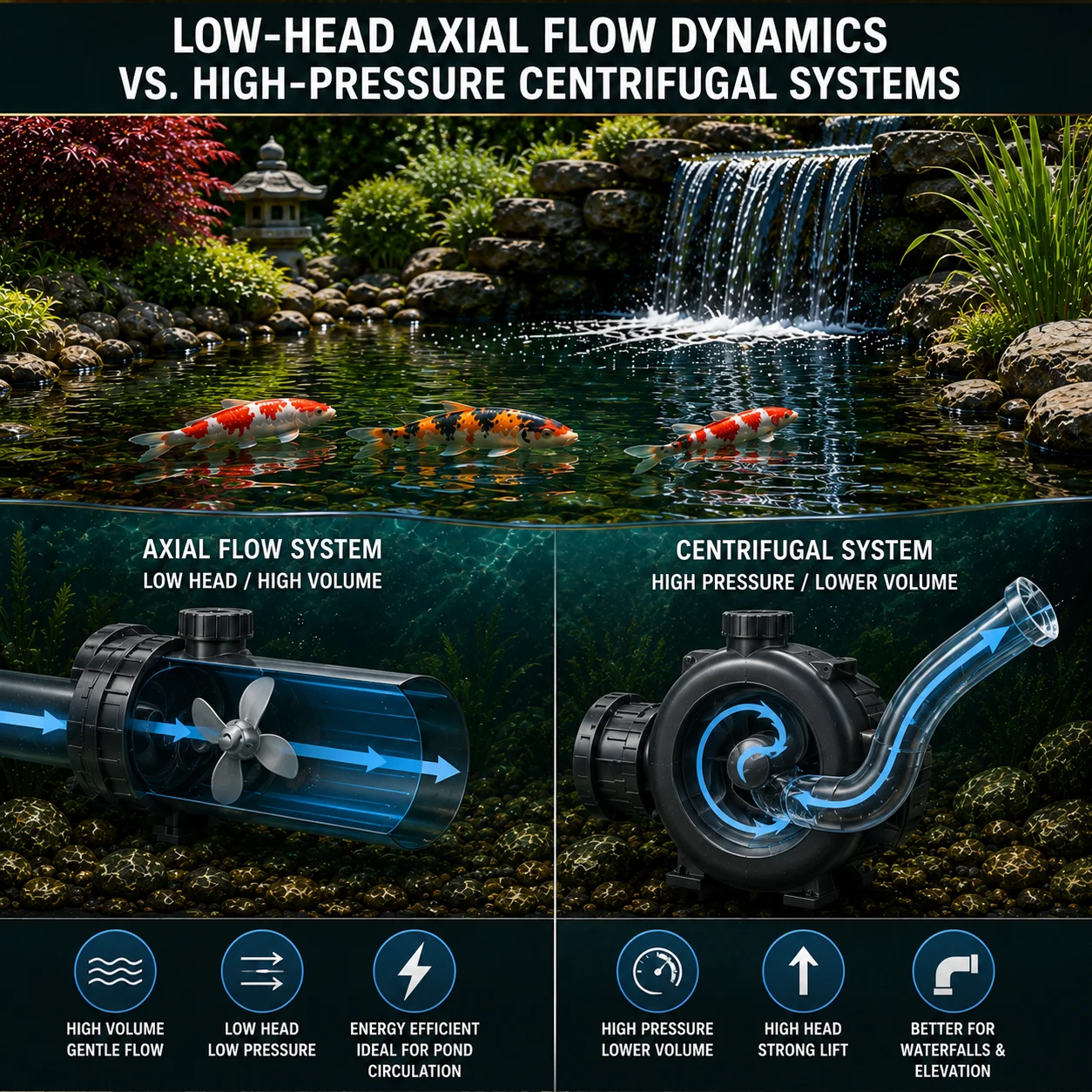
Axial Flow Dynamics
Axial flow describes water motion that runs parallel to the centerline of a pipe, fitting, or pump shaft — the straight-ahead component of movement that continuity calculations and velocity profiles actually describe. In a koi pond circulation system, axial flow is what carries water from the pump through the return line, out the eyeball fitting, and across the pond floor toward a bottom drain. It is easy to conflate axial velocity with the pump’s rated flow rate in gallons per minute, but the two are related only through pipe cross-sectional area, and they diverge the moment swirl, radial motion, or turbulence enters the picture.
This page works through the practical hydraulics behind axial motion: how velocity profiles develop and flatten along a straight run, how Reynolds number marks the shift between orderly laminar flow and mixed turbulent flow, how fittings and short pipe runs disturb that profile, and how axial-flow pump geometry differs from the centrifugal designs common in pond service. None of the guidance here is a universal rule — pipe diameter, run length, fitting count, and the pump’s actual operating point all shift the numbers, so every design decision needs to be checked against the specific system rather than a rule of thumb.
Test Your Axial Flow Knowledge
Work through ten scenario-based questions covering velocity profiles, Reynolds number, turbulence, pump behavior, and troubleshooting. Each answer includes the reasoning behind it.
Axial Flow Dynamics — Quick Facts
Most Asked Questions About Axial Flow Dynamics
On one build, the client reported that a bottom drain kept accumulating a crescent of fine debris on one side despite a pump rated well above the pond’s turnover requirement. The return line looked adequate on paper — correct diameter, reasonable length — but the return fitting sat immediately downstream of a close-coupled 90-degree elbow with almost no straight run before it exited into the pond.
A dye trace at the return showed the jet exiting with a visible corkscrew rather than a straight plume, confirming that swirl inherited from the elbow was steering axial momentum away from the drain side. Adding roughly six pipe diameters of straight run before the return fitting, and rotating the outlet slightly to counter the residual rotation, resolved the debris pattern without any change to pump size or flow rate.
Velocity Profiles And Flow Uniformity
Water moving through a pipe does not travel at a single uniform speed across the cross-section. Friction against the pipe wall slows water near the boundary, while water near the centerline moves fastest, producing a velocity profile rather than a flat number. The shape of that profile — parabolic in smooth laminar flow, flatter and blunter in turbulent flow — determines how evenly axial momentum is distributed and how representative a single-point velocity reading actually is of the whole flow.
- Laminar profile: smooth, layered flow with a pronounced parabolic velocity curve — centerline velocity can run roughly twice the cross-sectional average, though this shape is uncommon at typical pond return velocities and pipe diameters.
- Turbulent profile: chaotic mixing flattens the velocity curve, so the difference between centerline and near-wall velocity narrows, and the average velocity sits closer to the peak value — this is the more common condition in koi pond return and drain lines.
- Entrance effects: immediately after a pump outlet, valve, or fitting, the profile is disturbed and asymmetric; it takes a developing length of straight pipe for the profile to settle into its steadier downstream shape.
For practical pond design, the average axial velocity (flow rate divided by area) is usually the number that matters for sizing pipe and predicting whether solids stay suspended, but it’s worth remembering that this average masks real variation across the pipe. A pipe carrying an acceptable average velocity can still have slower near-wall regions where fine particulate settles over time, particularly on long horizontal runs — one reason some designers favor slightly higher design velocities on horizontal solids-carrying lines than on vertical or well-mixed sections.
Behind The Physics: Reynolds Number And Turbulence
Reynolds number (Re = V × D ÷ ν, where V is velocity, D is pipe diameter, and ν is the kinematic viscosity of water) is the dimensionless ratio that predicts whether flow behaves in an orderly, layered way or a chaotic, mixing way. Textbook water flow references commonly cite roughly Re below 2,300 as laminar and above about 4,000 as fully turbulent, with a transitional zone in between — but these boundaries are approximate and depend on pipe roughness, entrance conditions, and disturbances from upstream fittings. In most koi pond return and drain lines, typical velocities and pipe diameters put the flow well into the turbulent range, which is not inherently a problem: turbulent flow actually improves mixing and helps keep fine solids in suspension, but it also increases frictional losses and can amplify swirl introduced by fittings, so it’s a factor to design around rather than eliminate.
A recurring pattern on retrofit jobs is an oversized return pipe installed with good intentions — the assumption being that bigger pipe means less friction loss and better flow. On a system where the original 2-inch line was upsized to 3-inch without recalculating velocity, the resulting axial velocity dropped low enough that visible sediment began accumulating along the bottom of horizontal runs, something the original smaller pipe never showed. Pipe sizing has to balance friction loss against maintaining enough velocity to keep solids moving, and that balance point shifts with actual flow rate, not just pipe availability.
Pump Behavior, Fittings, And Design Tradeoffs
Axial-flow pumps move water primarily through propeller-style blades oriented along the shaft axis, pushing water in a direction parallel to that axis with comparatively little radial redirection. This makes them efficient at moving large volumes at low head — useful for lake circulation or bulk transfer — but less suited to the moderate-to-high head demands of a typical koi filtration loop with bead filters, UV clarifiers, and elevated waterfalls, where centrifugal pumps generally match the pump curve to system requirements more effectively. Where axial-flow devices do appear in pond service is often as submersible circulation or aeration units rather than as the primary filtration pump.
Every fitting in a return or drain line — elbows, tees, unions, valves — extracts energy from the flow and disturbs the velocity profile, converting some organized axial motion into turbulence, localized swirl, or head loss. These losses are typically expressed as an equivalent length of straight pipe or a loss coefficient (K-value) specific to the fitting type and size, and their impact scales with the square of local velocity. A system with several tightly packed fittings near the pump discharge can lose a meaningful share of available head before water even reaches the first straight run, which is part of why return line layout — not just pipe diameter — affects delivered axial velocity at the outlet.
A pond owner once specified an axial-flow circulation pump for a small filtration loop, drawn in by its high flow rating at low cost per gallon moved. Once installed against the actual system head — a bead filter, UV unit, and a four-foot elevation gain to the return — the pump’s performance curve collapsed well below its rated flow, delivering barely enough axial velocity to keep the return line’s solids moving. Matching pump type to the system’s head curve, not just its flow rating, made the difference between a marginal result and reliable performance.
Measuring axial flow in a working system is usually a matter of practical approximation rather than laboratory precision. Clamp-on ultrasonic flow sensors placed on a straight, full pipe section give a reasonably direct velocity reading; pitot-style probes inserted through an access fitting sample velocity at a point across the profile; and a timed dye or float trace over a known pipe length offers a low-tech estimate when instrumentation isn’t available. Whichever method is used, taking the reading well away from elbows, valves, and pump discharges — ideally after several pipe diameters of straight run — avoids the skew introduced by an unsettled velocity profile.
When troubleshooting weak axial flow at a return or drain, it helps to separate three distinct possibilities: insufficient total flow rate from the pump (a system-wide issue), adequate flow rate but excessive swirl or turbulence dissipating the axial component locally (a fitting or layout issue), or correct axial velocity that simply isn’t aimed where it needs to be (a placement issue). Each has a different fix — resizing or servicing the pump, adding straight run or adjusting fitting geometry, or repositioning the return — and misdiagnosing one for another is a common reason repeated adjustments fail to resolve persistent debris accumulation or dead zones.
Axial Flow Dynamics — Full Question Library
Review indexed engineering questions below.
Q1:
In an axial-flow pump, how does the fluid move relative to the impeller shaft?
Correct Answer: Option A
Axial-flow pumps are characterized by fluid flow being directed parallel to the impeller shaft, distinguishing them from centrifugal pumps.
Q2:
Which term describes the primary mechanism by which an axial-flow impeller generates head?
Correct Answer: Option B
Axial pumps function similarly to an airplane propeller; the shape of the blades creates lift, which moves the fluid axially.
Q3:
What is the typical relationship between flow rate and head in an axial-flow pump?
Correct Answer: Option C
Axial-flow pumps are designed to move large volumes of water (high flow) against relatively low vertical lift (low head).
Q4:
What is the primary function of the discharge guide vanes in an axial-flow pump?
Correct Answer: Option B
Guide vanes straighten the flow and convert the swirl (tangential velocity) imparted by the impeller into useful pressure head.
Q5:
When comparing specific speed (Ns), where do axial-flow pumps fall on the spectrum?
Correct Answer: Option D
Axial-flow pumps are classified as having a very high specific speed, correlating with their high-flow, low-head application.
Q6:
What occurs to the power consumption of an axial-flow pump as the flow rate decreases (shut-off head)?
Correct Answer: Option C
Axial-flow pumps have a ‘non-overloading’ power curve, but power demand actually peaks at shut-off, making it dangerous to operate against closed valves.
Q7:
The ‘pitch angle’ of an axial impeller blade primarily dictates which hydraulic characteristic?
Correct Answer: Option B
Adjusting the blade pitch changes the angle of attack, which directly affects the fluid volume moved and the resulting head generated.
Q8:
Which of the following describes the ‘bulb’ type axial pump configuration?
Correct Answer: Option A
Bulb pumps place the motor inside a bulb-shaped housing directly in the water flow for efficient cooling and minimal footprint.
Q9:
What is ‘pre-rotation’ in the context of axial-flow pump suction?
Correct Answer: Option B
Pre-rotation occurs when the fluid begins to swirl before entering the impeller, often reducing efficiency and hydraulic stability.
Q10:
Why is the NPSH (Net Positive Suction Head) requirement typically higher for axial-flow pumps?
Correct Answer: Option B
The high velocity of the impeller blades, particularly at the tips, creates significant pressure drops, necessitating higher suction head to prevent cavitation.
Q11:
Which fluid property has the most significant impact on axial-flow pump efficiency?
Correct Answer: Option B
High viscosity causes significant frictional losses on the impeller blade surfaces, severely degrading axial-flow efficiency.
Q12:
What design feature is often added to axial pumps to allow for variable flow at constant speed?
Correct Answer: Option B
Adjustable pitch blades (Kaplan-style) allow the pump to maintain efficiency across varying flow requirements without changing motor speed.
Q13:
The ‘hub-to-tip’ ratio in an axial impeller is a critical factor for:
Correct Answer: Option A
The hub-to-tip ratio influences the flow distribution; a higher ratio helps prevent blade stalls and cavitation near the hub.
Q14:
How does an axial-flow pump respond to a blockage in the downstream piping?
Correct Answer: Option C
As the flow decreases toward shut-off, the power requirement of an axial pump increases, risking motor thermal overload.
Q15:
What is the primary benefit of using a ‘draft tube’ in an axial-flow installation?
Correct Answer: Option A
A draft tube gradually increases in cross-section to recover energy from the fluid velocity, improving the pump’s net efficiency.
Q16:
Which of the following best describes the shape of the H-Q (Head vs Flow) curve of an axial pump?
Correct Answer: Option D
Axial pumps often have an ‘instability hump’ or dip in the H-Q curve at low flow, which must be accounted for during system design.
Q17:
When considering pond hydraulics, why might a propeller pump (axial) be preferred over a radial pump for water circulation?
Correct Answer: Option B
Propeller pumps are optimized for moving high volumes of water with minimal resistance, making them ideal for koi pond turnover.
Q18:
What is the consequence of ‘blade tip clearance’ being too large in an axial pump?
Correct Answer: Option B
Large clearances at the blade tips allow high-pressure discharge water to recirculate back to the low-pressure suction side, reducing overall efficiency.
Q19:
The term ‘specific speed’ in axial flow dynamics is calculated based on:
Correct Answer: Option A
Specific speed (Ns) is a dimensionless index relating the impeller’s rotational speed, the flow rate, and the total head.
Q20:
Which material characteristic is most vital for axial pump blades in koi ponds?
Correct Answer: Option B
Since koi ponds contain biological waste and often treatment chemicals, materials must resist oxidation, corrosion, and biological buildup.
Q21:
How does total dynamic head (TDH) affect an axial-flow pump in a closed-loop pond system?
Correct Answer: Option B
Axial pumps are sensitive to TDH; as resistance (head) increases, the axial flow drops sharply compared to centrifugal pumps.
Q22:
Why is the placement of a check valve significant in a high-flow axial system?
Correct Answer: Option A
Check valves prevent water from flowing backward through the impeller when the pump is off, protecting the pond from draining.
Q23:
What is the main advantage of using a ‘pond-friendly’ axial pump with a large-diameter intake?
Correct Answer: Option A
Larger intake diameters reduce fluid velocity, which decreases friction losses (head loss) and improves the system’s efficiency.
Q24:
How does fish waste (solid particles) impact axial-flow hydraulics in a gravity-fed pond?
Correct Answer: Option B
Solid waste buildup increases the roughness coefficient of piping, which increases the head loss that the axial pump must overcome.
Q25:
In a koi pond setting, what is the ‘turnover rate’ in relation to axial flow?
Correct Answer: Option B
Turnover rate is the fundamental hydraulic metric for pond health, determining how often the total water volume passes through the biological filtration.
Q26:
What is the potential hydraulic danger of a poorly designed inlet (suction) in an axial pump?
Correct Answer: Option A
A poor inlet configuration allows air-entraining vortices to form, which can cause hydraulic instability and pump air-locking.
Q27:
Which piping material is typically recommended to minimize friction head for axial flow in ponds?
Correct Answer: Option B
Smooth-bore piping minimizes hydraulic friction, which is vital for maintaining the high-flow, low-pressure characteristics of axial pumps.
Q28:
What does an ‘impeller shroud’ do in a residential-scale axial pump?
Correct Answer: Option B
A shroud (or housing close-clearance) minimizes recirculation around the tips, ensuring the axial flow is forced through the pipe consistently.
Q29:
If a pond pump is ‘over-spec’ed’ for the pipe diameter, what hydraulic issue is likely?
Correct Answer: Option C
Forcing high axial flows through narrow pipes causes high fluid velocities, leading to massive frictional losses and potential cavitation/pipe erosion.
Q30:
In a pond system with multiple gravity-fed bottom drains, why is the manifold design critical?
Correct Answer: Option A
Balanced manifold design ensures equal draw from all drains, preventing stagnant zones within the pond’s floor layout.
Q31:
Why are axial-flow pumps less effective when used with high-pressure UV sterilizers?
Correct Answer: Option C
Axial pumps are designed for low head; UV sterilizers usually introduce significant flow restriction, which pushes the axial pump outside its effective operating range.
Q32:
How does water temperature influence axial-flow dynamics in outdoor ponds?
Correct Answer: Option A
Fluid viscosity changes with temperature, affecting the Reynolds number and friction losses, which impacts the overall system efficiency.
Q33:
What is the primary function of a ‘pre-filter’ in an axial-flow pump circuit?
Correct Answer: Option B
Axial propellers are susceptible to damage from string algae, sticks, or stones; a pre-filter screen is vital to prevent mechanical interference.
Q34:
In pond design, why is ‘laminar flow’ preferred over ‘turbulent flow’ in return pipes?
Correct Answer: Option B
Laminar flow minimizes energy loss due to internal fluid friction, making the delivery of water to the pond more efficient.
Q35:
What is the main drawback of using an axial pump in a vertical ‘sump’ configuration?
Correct Answer: Option B
Vertical axial pumps rely on constant water levels for priming; if the sump level drops, the pump can lose prime and cause catastrophic heat buildup.
Q36:
Why is it important to match the axial pump curve to the specific pond system curve?
Correct Answer: Option A
Operating near the BEP ensures the pump works at its highest efficiency, prolonging motor life and minimizing energy usage.
Q37:
What effect does a large number of pipe bends have on an axial-flow system?
Correct Answer: Option A
Each bend in a pipe creates ‘minor losses’ due to turbulence, significantly increasing the total dynamic head an axial pump must overcome.
Q38:
Which of these is a common strategy to mitigate cavitation in axial-flow systems?
Correct Answer: Option D
Increasing submergence provides more static head at the suction (NPSHa), and lowering speed reduces the local pressure drop at the blade tips.
Q39:
What is ‘water hammer’ and is it a high risk in axial-flow systems?
Correct Answer: Option A
Water hammer is caused by sudden flow stoppage; because axial pumps move large volumes at very low pressure, the shock waves are less intense.
Q40:
What is the benefit of a variable frequency drive (VFD) for an axial pump in a koi pond?
Correct Answer: Option B
A VFD allows the pond manager to tune flow rate based on actual need, optimizing electricity usage and water turnover efficiency.
Q41:
In an axial-flow pump, how is the head primarily generated as the fluid passes through the impeller blades?
Correct Answer: Option C
Axial-flow pumps function similarly to an airplane propeller, where the fluid moves parallel to the shaft, and head is created by the lift generated on the rotating blades.
Q42:
Which characteristic best describes the head-capacity (H-Q) curve of a typical axial-flow pump?
Correct Answer: Option A
Axial-flow pumps exhibit a steep ‘power rise’ at low flow and a relatively flat H-Q curve, making them sensitive to small changes in system resistance.
Q43:
What happens to the power consumption of an axial-flow pump when the discharge valve is completely closed?
Correct Answer: Option B
Axial-flow pumps have a power characteristic where the power input increases as the flow rate decreases, posing a risk of overloading the motor at shut-off.
Q44:
Why is the ‘Specific Speed’ (Ns) significantly higher for axial-flow pumps compared to centrifugal pumps?
Correct Answer: Option B
Specific speed is a function of flow and head; axial-flow pumps operate at high flow and low head, which mathematically results in a very high specific speed.
Q45:
What is the primary function of the discharge vanes (or diffuser) in an axial-flow pump setup?
Correct Answer: Option B
The diffuser vanes redirect the swirling flow generated by the impeller into a straight, axial direction, recovering kinetic energy as pressure.
Q46:
Which dimensionless parameter defines the efficiency loss due to blade tip clearance in axial pumps?
Correct Answer: Option B
The gap between the impeller blade tip and the pump casing allows fluid to leak from the pressure side to the suction side, creating a vortex that reduces efficiency.
Q47:
In the context of koi pond hydraulics, why might a low-head axial pump be preferred over a centrifugal pump?
Correct Answer: Option B
Axial flow pumps are designed for high flow rates against low head loss, which is typical of gravity-fed koi pond filtration systems.
Q48:
What phenomenon occurs if an axial-flow pump is operated far to the left of its Best Efficiency Point (BEP)?
Correct Answer: Option B
Operating at low flow rates causes fluid to recirculate within the blade passages, creating turbulence, noise, and vibration.
Q49:
How does blade pitch adjustment affect the performance curve of an axial-flow pump?
Correct Answer: Option A
Adjusting the blade angle (pitch) changes the lift coefficient, allowing the pump to meet different flow/head requirements while maintaining optimal efficiency.
Q50:
Which of the following is a common issue related to axial-flow pump installation in shallow pond sumps?
Correct Answer: Option A
If the submergence is insufficient, a surface vortex can form, allowing air to be drawn into the pump, leading to priming loss and vibration.
Q51:
What is the relationship between impeller rotational speed and the head produced by an axial-flow pump?
Correct Answer: Option A
According to Affinity Laws, the head produced by a rotodynamic pump varies with the square of the rotational speed (H ∝ N²).
Q52:
Why does axial flow imply a high ‘axial velocity’ component?
Correct Answer: Option B
The defining characteristic of axial flow is that the flow direction remains parallel to the impeller shaft throughout the pumping process.
Q53:
What type of impeller design is most common for low-head, high-flow axial-flow pond pumps?
Correct Answer: Option C
For high-volume, low-head koi pond applications, propeller-style impellers are the standard because they efficiently move large volumes of water with minimal head.
Q54:
When considering pond plumbing, why is high friction loss detrimental to axial-flow pumps?
Correct Answer: Option A
Axial-flow pumps are sensitive to high system resistance; increased friction shifts the operating point to the left, significantly reducing flow output.
Q55:
What is the primary role of the pump casing in an axial-flow pump?
Correct Answer: Option B
The casing in an axial-flow pump functions as a flow conduit that directs the fluid smoothly along the shaft axis from inlet to outlet.
Q56:
Which of the following describes the blade profile for an efficient axial-flow impeller?
Correct Answer: Option B
Airfoil blade sections are used in axial pumps to maximize the hydrodynamic lift produced as the blades rotate, which is the mechanism of head creation.
Q57:
In pump system curves, the axial-flow pump’s curve is often described as ‘unstable’. What does this refer to?
Correct Answer: Option B
The instability in the H-Q curve (often called a ‘saddle’) can cause operational surges when the pump is operating at certain points near shut-off.
Q58:
How does increasing the number of blades on an axial-flow impeller affect performance?
Correct Answer: Option C
While more blades can increase pressure generation, they also increase the total wetted surface area, leading to higher frictional losses and reduced hydraulic efficiency.
Q59:
What is the primary indicator that an axial-flow pump is operating beyond its intended hydraulic design?
Correct Answer: Option A
When operated away from the design point, axial thrust loads on the pump bearings can change, leading to premature bearing failure.
Q60:
Which term describes the movement of fluid across the blade tips in an axial flow pump?
Correct Answer: Option A
Tip leakage occurs because fluid flows from the high-pressure side of the blade to the low-pressure side over the tip, reducing overall efficiency.
Q61:
In a koi pond bottom drain system, why is minimizing pipe head loss critical for axial-flow pumps?
Correct Answer: Option B
Axial pumps are high-flow, low-head devices. If the plumbing has high head loss, the pump moves significantly less water than its rated capacity, wasting electricity.
Q62:
What is the most effective way to throttle flow from an axial-flow pump without damaging the pump or motor?
Correct Answer: Option B
Throttling discharge on axial pumps can cause motor overload due to power characteristics. VFDs are the preferred method for flow control as they maintain efficiency and protect the motor.
Q63:
Which piping arrangement is recommended for the suction side of a large axial-flow pump in a pond filtration setup?
Correct Answer: Option B
To ensure uniform flow into the impeller and prevent pre-swirl/turbulence, a straight pipe approach is required to maximize pump efficiency.
Q64:
Why is ‘Net Positive Suction Head Available’ (NPSHa) more critical for axial-flow pumps compared to standard submersible pumps?
Correct Answer: Option A
Axial-flow pumps have high specific speeds and high suction velocity, making them highly susceptible to cavitation if NPSHa is lower than the required NPSHr.
Q65:
What is the consequence of placing a check valve directly at the discharge of an axial-flow pump?
Correct Answer: Option B
Because axial pumps move large volumes of water, a sudden closure of a check valve can create massive pressure surges (water hammer), damaging the plumbing.
Q66:
When designing a koi pond, how does a gravity-flow circuit impact the required head for an axial pump?
Correct Answer: Option B
In a properly designed gravity-fed system, the static head is zero; the pump only needs to overcome the friction head of the pipework, which is ideal for axial pumps.
Q67:
How do elbow-mounted axial pumps differ in installation from straight-line pumps?
Correct Answer: Option B
In elbow-propeller pumps, the elbow itself is designed to function as the discharge diffuser, helping to convert the rotational velocity of the flow into axial pressure.
Q68:
What role do ‘anti-vortex plates’ play in a pond filtration sump equipped with an axial pump?
Correct Answer: Option B
Anti-vortex plates are baffles placed near the suction intake to prevent the air-entraining vortices that often develop in high-volume axial pump sumps.
Q69:
Which material is generally preferred for large koi pond axial pump housings to resist corrosion?
Correct Answer: Option C
Pond water environment requires materials that are non-corrosive and non-toxic to koi; 316 stainless steel or marine-grade composites are industry standards.
Q70:
What is the primary hydraulic benefit of using larger diameter piping with an axial-flow pump?
Correct Answer: Option B
Since head loss is proportional to the square of velocity, larger pipe diameters reduce friction, which is vital for axial pumps to maintain high flow rates.
Q71:
Why is it inadvisable to use a standard gate valve as a flow-control device for axial pumps?
Correct Answer: Option C
Gate valves are intended for isolation. Using them for throttling creates turbulence and uneven flow distribution, negatively affecting pump performance and impeller longevity.
Q72:
How does submerged mounting benefit an axial-flow pump in a pond application?
Correct Answer: Option A
Submerged operation provides excellent motor cooling and eliminates the risk of suction-side leaks that could draw air into the system.
Q73:
In a pond cascade design, what happens if the return pipe is too small for the axial pump’s capacity?
Correct Answer: Option A
If the return pipe (discharge) is too small, the backpressure forces the pump to move up the head curve, potentially causing flow instability and cavitation.
Q74:
What is ‘pump hunting’ in the context of axial-flow pond systems?
Correct Answer: Option B
Pump hunting occurs when the system resistance intersects the pump curve at an unstable region, causing the operating point to wander and the flow to surge/drop.
Q75:
When balancing flow between two axial pumps, what is the best practice?
Correct Answer: Option B
Connecting two axial pumps to a single discharge line often creates turbulence or backpressure issues; separate lines are safer and more efficient.
Q76:
Which hydraulic feature is essential to ensure longevity in a pump-fed pond system using axial flow?
Correct Answer: Option B
Axial flow impellers are sensitive to debris; if foreign objects hit the blades, they can cause imbalance and catastrophic bearing failure.
Q77:
Why should axial pumps not be operated for extended periods with a dirty pre-filter?
Correct Answer: Option B
A dirty filter creates a high suction-side head loss, which drastically reduces NPSHa and leads to cavitation and premature impeller erosion.
Q78:
In terms of hydraulic energy, how do axial pumps compare to centrifugal pumps for pond turnover?
Correct Answer: Option A
Axial pumps are specifically designed for the high-volume, low-head requirements of pond turnover and are more efficient in this specific hydraulic regime than centrifugal pumps.
Q79:
What is a potential side effect of ‘oversizing’ an axial pump for a pond system?
Correct Answer: Option B
Oversizing leads to operation near the shut-off point, which is the unstable part of the axial-flow curve, leading to noise, vibration, and mechanical stress.
Q80:
What is the primary indicator that an axial pump installation has achieved ‘hydraulic equilibrium’?
Correct Answer: Option B
When the system curve intersects the pump curve at the Best Efficiency Point, the pump operates smoothly, quietly, and with optimal energy utilization.
Q81:
In an axial-flow pump, what is the primary direction of fluid velocity relative to the impeller shaft?
Correct Answer: Option B
By definition, axial-flow pumps move fluid along the axis of rotation, utilizing the lift generated by airfoil-shaped blades.
Q82:
Which coefficient is most commonly used to define the blade loading in axial-flow pond filtration systems?
Correct Answer: Option A
Solidity ratio (the ratio of chord length to blade pitch) is critical in determining the lift and pressure rise characteristics of axial rotors.
Q83:
Why are axial-flow pumps typically preferred for high-volume, low-head koi pond recirculation loops?
Correct Answer: Option C
Axial-flow designs excel at moving high volumes of water with minimal resistance (head), making them ideal for turnover systems.
Q84:
What phenomenon occurs when the axial flow blade angle of attack exceeds the stall limit?
Correct Answer: Option A
Exceeding the critical angle of attack leads to separation of the boundary layer, causing cavitation-like drops in performance and increased vibration.
Q85:
How does increasing the blade pitch angle typically affect an axial pump’s performance curve?
Correct Answer: Option C
Increasing pitch increases the angle of attack, resulting in higher flow capacity but also requiring significantly more motor torque.
Q86:
What is the primary function of the discharge guide vanes in an axial-flow pump assembly?
Correct Answer: Option B
Guide vanes are essential to recover tangential energy imparted by the impeller and redirect it axially to increase pressure recovery.
Q87:
Which hydraulic parameter represents the ratio of pressure energy to kinetic energy at the rotor exit?
Correct Answer: Option A
The degree of reaction characterizes how much of the energy transfer occurs as static pressure rise compared to kinetic energy increase.
Q88:
In axial-flow design, what is ‘tip clearance’ and why is it a critical concern?
Correct Answer: Option B
Tip clearance creates a pressure gradient that induces leakage flows from the pressure side to the suction side, significantly reducing efficiency.
Q89:
Which fluid property has the most significant impact on the Reynolds number calculation for axial flow blades?
Correct Answer: Option C
Kinematic viscosity is the denominator in the Reynolds number formula; lower viscosity leads to higher turbulence and potential flow issues.
Q90:
What is the result of ‘solidity’ being too low in an axial impeller design?
Correct Answer: Option A
Low solidity means the blades are spaced too far apart to effectively control the flow, leading to poor pressure development.
Q91:
How does the ‘Euler Head’ represent the energy transfer in axial-flow machinery?
Correct Answer: Option B
The Euler head equation relates the tangential velocity components at the rotor inlet and outlet to the ideal energy transfer.
Q92:
Why is the velocity triangle construction essential for designing axial pond pump blades?
Correct Answer: Option C
Velocity triangles determine the angle of the fluid relative to the moving blade, which is critical for preventing flow separation.
Q93:
Which type of pump is generally recommended if a koi pond system requires high head pressure?
Correct Answer: Option C
Centrifugal pumps are designed to develop higher head pressures compared to axial pumps, which are strictly low-head machines.
Q94:
In axial-flow dynamics, what does the ‘hub-to-tip ratio’ influence?
Correct Answer: Option B
The hub-to-tip ratio dictates how the flow is partitioned; as the ratio increases, the blade becomes less efficient at the hub due to high solidity.
Q95:
Which dimensionless parameter helps engineers predict the onset of cavitation in an axial pump?
Correct Answer: Option A
Thoma’s cavitation number relates the NPSH (Net Positive Suction Head) available to the total head developed, indicating cavitation risk.
Q96:
What is ‘Meridional Velocity’ in the context of axial-flow pond pumps?
Correct Answer: Option B
The meridional plane contains the axis of rotation; the velocity in this plane is essential for mass balance calculations.
Q97:
What happens to an axial-flow pump if it is operated at a flow rate significantly lower than its design capacity?
Correct Answer: Option B
Low flow leads to poor incidence angles at the blade leading edges, causing flow detachment and recirculating vortices at the inlet.
Q98:
Why is the material selection of the impeller critical in high-flow axial pond pumps?
Correct Answer: Option C
Axial blades are subject to significant fluctuating hydrodynamic loads; materials must have high fatigue strength to prevent deformation.
Q99:
Which design factor most directly impacts the ‘head’ output of an axial pump?
Correct Answer: Option B
The head developed by an axial pump is primarily a function of the peripheral velocity of the impeller, which depends on diameter and RPM.
Q100:
What is the purpose of a ‘diffuser’ or ‘straightener’ in an axial-flow discharge assembly?
Correct Answer: Option B
A diffuser performs the pressure recovery by expanding the cross-sectional area, reducing velocity and increasing static pressure.
Q101:
In advanced CFD analysis of axial-flow impellers, what does ‘slip’ represent?
Correct Answer: Option B
Slip occurs because the fluid does not perfectly follow the blade angle due to inertia, reducing the actual head relative to theoretical predictions.
Q102:
What is the primary advantage of using adjustable-pitch blades in axial pumps for variable-load koi systems?
Correct Answer: Option A
Adjustable blades allow the pump to maintain high hydraulic efficiency across varying system heads and flow requirements by optimizing the angle of attack.
Q103:
How does ‘blade sweep’ improve the hydrodynamic performance of high-speed axial impellers?
Correct Answer: Option B
Sweeping the blade trailing edge helps mitigate flow separation and cavitation onset by smoothing the pressure distribution across the span.
Q104:
What is the purpose of ‘blade lean’ in advanced axial turbine/pump design?
Correct Answer: Option B
Blade lean (tilting the blade relative to the radial line) is used to counter adverse pressure gradients and secondary flow vortices at the casing/hub walls.
Q105:
In the context of ‘NPSHr’ for axial-flow systems, what does the ‘r’ stand for?
Correct Answer: Option A
NPSHr (Net Positive Suction Head Required) is the minimum pressure required at the pump suction to prevent cavitation within the impeller.
Q106:
Why does axial flow pump performance deteriorate at very low rotational speeds?
Correct Answer: Option B
Below a critical rotational speed, the relative velocity of the fluid over the blades is insufficient to generate the circulation necessary for pumping.
Q107:
Which flow condition is identified by a ‘backflow’ in the inlet of an axial pump?
Correct Answer: Option A
Inlet pre-rotation occurs when the fluid is forced into a circular motion by the rotor before it even enters the blades, typically at off-design conditions.
Q108:
What is the relationship between the ‘stagger angle’ and the performance of an axial cascade?
Correct Answer: Option B
The stagger angle (the angle between the chord line and the rotation plane) is fundamental in defining the flow turning capacity of the cascade.
Q109:
How do ‘end-wall losses’ affect the overall efficiency of an axial pump?
Correct Answer: Option C
Frictional forces between the fluid and the casing/hub walls (end-walls) create boundary layers that degrade energy efficiency.
Q110:
What does a ‘performance map’ for an axial pump illustrate?
Correct Answer: Option B
A performance map (or pump curves) provides the necessary data for system integration by plotting the interdependencies of primary hydraulic variables.
Q111:
What is a ‘Vortex breakdown’ in an axial-flow system?
Correct Answer: Option B
Vortex breakdown is a flow instability where the organized swirling motion in the diffuser loses its structure, leading to turbulence and noise.
Q112:
Which phenomenon is most likely to cause blade erosion in axial pumps?
Correct Answer: Option B
The collapse of cavitation bubbles near the blade surface produces intense localized shock waves that erode even the hardest materials over time.
Q113:
How does ‘tip vortex’ formation impact the pump suction side?
Correct Answer: Option B
The tip vortex is a low-pressure core that forms at the blade tip; if the pressure drops below the fluid’s vapor pressure, cavitation occurs.
Q114:
What is the significance of the ‘lift coefficient’ in axial blade design?
Correct Answer: Option A
The lift coefficient determines how effectively the blade section deflects the flow to create the pressure rise required for the system.
Q115:
What does ‘surge’ mean in an axial-flow pump installation?
Correct Answer: Option B
Surge is an unstable phenomenon where the flow fluctuates back and forth, often resulting from operating at low-flow conditions where the pump cannot overcome the system head.
Q116:
How do you calculate the ‘Specific Speed’ (Ns) for a pump?
Correct Answer: Option A
Specific speed is a dimensionless grouping used to classify pump geometry; high Ns values (like those of axial pumps) indicate low-head, high-flow applications.
Q117:
What is the benefit of a ‘tapered hub’ design in an axial impeller?
Correct Answer: Option B
Tapering the hub allows for a controlled increase in flow area, which helps maintain a uniform velocity profile across the blade span.
Q118:
Why is ‘Blade Profile Curvature’ (Camber) essential for axial blades?
Correct Answer: Option B
Camber dictates the fluid turning angle provided by the blade; higher camber generally leads to higher circulation and pressure generation.
Q119:
What impact does ‘surface roughness’ have on axial-flow pump blades?
Correct Answer: Option B
Smooth blade surfaces are crucial; increased roughness creates parasitic drag in the boundary layer, reducing efficiency and flow capacity.
Q120:
What is the primary objective of ‘computational fluid dynamics’ (CFD) in axial pond pump engineering?
Correct Answer: Option B
CFD allows engineers to visualize flow patterns and pressure distributions, identifying and mitigating losses that physical testing alone cannot easily pinpoint.
Q121:
In an axial-flow pump, how does the fluid velocity vector primarily move relative to the impeller axis?
Correct Answer: Option A
Axial-flow pumps are defined by the fluid moving parallel to the shaft axis, differing significantly from radial centrifugal designs.
Q122:
What is the primary characteristic of the head-capacity curve for a typical axial-flow pump?
Correct Answer: Option B
Axial-flow pumps are known for their steep H-Q curves, meaning small changes in flow lead to large changes in head.
Q123:
Why does the power consumption of an axial-flow pump increase at shut-off (zero flow) conditions?
Correct Answer: Option B
Axial-flow pumps typically exhibit ‘non-overloading’ characteristics where power is highest at zero flow, the opposite of radial pumps.
Q124:
What defines the ‘Specific Speed’ ($N_s$) range associated with axial-flow (propeller) pumps?
Correct Answer: Option C
Axial-flow pumps are characterized by very high specific speeds, designed for high volume and low head applications.
Q125:
In koi pond systems, what is the main hydraulic advantage of using an axial-flow pump over a centrifugal one?
Correct Answer: Option B
Axial-flow pumps move large volumes of water with minimal energy consumption when the head (resistance) is very low.
Q126:
What role do diffuser vanes serve downstream of the impeller in an axial-flow pump?
Correct Answer: Option B
Diffuser vanes redirect the swirl imparted by the propeller, converting kinetic energy into pressure to increase efficiency.
Q127:
What happens to the efficiency of an axial-flow pump if the system head exceeds the design head significantly?
Correct Answer: Option C
Axial-flow pumps operate in a narrow efficiency band; excessive head leads to stall conditions on the blades.
Q128:
Which fluid property is most significantly impacted by the high blade-tip velocities in axial-flow designs?
Correct Answer: Option C
High blade-tip speeds lead to low pressure areas that can cause cavitation, damaging the impeller and the pump housing.
Q129:
What is the primary function of the intake bell or suction nozzle in an axial-flow pump setup?
Correct Answer: Option B
Uniform velocity distribution at the intake is critical for axial-flow performance; vortices cause vibrations and efficiency loss.
Q130:
How does blade pitch angle (variable vs. fixed) affect axial-flow pump performance?
Correct Answer: Option A
Adjustable pitch blades allow the operator to tune the pump’s performance curve to the specific hydraulic requirements of the system.
Q131:
What is the typical ratio of radial flow to axial flow component in a pure axial-flow pump?
Correct Answer: Option B
True axial-flow pumps operate with fluid moving along the axis with minimal radial displacement.
Q132:
What describes the relationship between NPSH (Net Positive Suction Head) and axial-flow pumps?
Correct Answer: Option B
Due to high flow rates, the low pressure on the back of the blades makes axial-flow pumps sensitive to cavitation.
Q133:
What is the effect of clearance between the propeller tip and the housing wall?
Correct Answer: Option A
Tip clearance allows water to leak from the high-pressure side back to the low-pressure side, causing loss of head and efficiency.
Q134:
Which parameter is often used to characterize the ‘steepness’ of an axial-flow pump’s curve?
Correct Answer: Option B
The ratio of shut-off head to the head at the best efficiency point (BEP) illustrates the slope of the curve.
Q135:
Why is axial-flow pump housing generally designed to be cylindrical and uniform?
Correct Answer: Option B
Maintaining constant velocity profiles within the housing is vital for stable and predictable axial-flow dynamics.
Q136:
What is the typical flow regime (in terms of Reynolds number) expected in a high-capacity axial-flow pond pump?
Correct Answer: Option C
Axial-flow pumps operate at high Reynolds numbers, placing them firmly in the turbulent flow regime.
Q137:
How does the ‘solidity’ (ratio of blade area to disc area) impact an axial-flow impeller?
Correct Answer: Option A
Increasing the blade surface area relative to the disk area helps in managing the flow direction and increasing pressure.
Q138:
What is the primary indicator of hydraulic imbalance in an axial-flow pump?
Correct Answer: Option B
Hydraulic imbalance, often caused by uneven flow entry, leads to premature wear, noise, and vibration.
Q139:
What describes ‘Best Efficiency Point’ (BEP) in the context of an axial-flow pump?
Correct Answer: Option B
The BEP is the design target where the fluid enters and leaves the blades with minimum turbulence and shock loss.
Q140:
Why are axial-flow pumps favored for high-turnover koi pond filtration?
Correct Answer: Option B
Koi pond health requires high turnover, and axial-flow pumps move vast volumes of water with very low power.
Q141:
How does the ‘swirl’ component of the flow exiting the impeller affect efficiency?
Correct Answer: Option B
Energy spent on creating swirl is non-productive; straightening the flow via vanes recovers this energy as pressure.
Q142:
In computational fluid dynamics (CFD) modeling of an axial pump, what is the ‘Stator’ component?
Correct Answer: Option B
Stators are stationary blades designed to guide flow; in axial pumps, they function as flow straighteners.
Q143:
What is the primary hydraulic challenge when using an axial-flow pump in a ‘deep’ pond configuration?
Correct Answer: Option B
If system resistance exceeds the pump’s capacity to build head, the pump may enter an unstable ‘surge’ region.
Q144:
What is ‘blade stall’ in the context of axial-flow hydraulics?
Correct Answer: Option A
Stall occurs when the angle of attack is too high, leading to flow separation and a massive drop in hydraulic performance.
Q145:
Why is the velocity distribution at the impeller exit critical for downstream components?
Correct Answer: Option B
Non-uniform velocity profiles cause mechanical stress and lower the efficiency of downstream hydraulic components.
Q146:
How does the ‘slip factor’ affect the theoretical head calculations in axial-flow pumps?
Correct Answer: Option B
Due to flow inertia, the fluid does not leave the blade perfectly parallel to the blade tip; this deviation is the slip factor.
Q147:
Which material characteristic is most important for axial-flow impellers to prevent cavitation erosion?
Correct Answer: Option B
Cavitation causes micro-jet impacts that can erode standard metals; hardened materials or specific alloys are needed.
Q148:
What is the relationship between impeller RPM and Head in an axial-flow pump?
Correct Answer: Option B
According to Affinity Laws, head is proportional to the square of the rotational speed ($N^2$).
Q149:
What is a ‘bellmouth intake’ and why is it used in large-scale axial systems?
Correct Answer: Option B
A properly designed bellmouth provides a streamline approach, essential for preventing pre-swirl and vortices.
Q150:
How do you calculate the power requirement of an axial-flow pump?
Correct Answer: Option A
Hydraulic power is $\rho gQH$. Shaft power is this divided by the hydraulic and mechanical efficiency.
Q151:
What is meant by the ‘run-out’ point of an axial-flow pump?
Correct Answer: Option B
Run-out is the far right of the performance curve where the pump may cavitate and power demand increases beyond motor capacity.
Q152:
Why are axial-flow pumps typically mounted in a vertical or inclined orientation in large ponds?
Correct Answer: Option C
Vertical mounting often allows for a more uniform approach flow, which is crucial for reducing cavitation risks.
Q153:
What happens if a VFD (Variable Frequency Drive) is used to slow down an axial-flow pump too much?
Correct Answer: Option A
If the RPM is too low, the blade lift coefficient is insufficient, and flow separation leads to performance breakdown.
Q154:
How does water temperature affect the performance of an axial-flow pump?
Correct Answer: Option B
As water warms, its vapor pressure rises, which directly reduces the available NPSH, increasing cavitation risk.
Q155:
What is the function of an ‘inlet cone’ in some axial-flow designs?
Correct Answer: Option B
The inlet cone provides a smooth transition, reducing flow separation at the center of the impeller where velocity is lowest.
Q156:
In axial-flow dynamics, what is ‘blade loading’?
Correct Answer: Option A
Blade loading relates to the pressure differential across the blade; too much loading causes flow detachment.
Q157:
Which hydraulic phenomenon is associated with the ‘vortexing’ of the free surface above an axial-flow intake?
Correct Answer: Option B
Surface vortices draw air into the pump, which drastically reduces capacity and causes severe mechanical damage.
Q158:
What is the primary benefit of a multi-vane impeller design in an axial-flow pump?
Correct Answer: Option B
More blades help distribute the pressure load more evenly, reducing turbulence and flow fluctuations.
Q159:
What is meant by ‘Specific Speed’ ($N_s$) in the context of pump selection?
Correct Answer: Option B
Specific speed is a tool that tells engineers whether a radial, mixed-flow, or axial-flow pump is best for the specific application.
Q160:
What represents the main hydraulic loss in an axial-flow stage?
Correct Answer: Option B
Tip leakage and secondary flows (vortices) around the blade ends are the largest sources of inefficiency in axial pumps.
Q161:
In an axial-flow pump, how does the flow direction relate to the shaft axis?
Correct Answer: Option A
Axial-flow pumps are characterized by the fluid moving parallel to the shaft, utilizing lift generated by aerofoil-shaped blades.
Q162:
Which principle of fluid mechanics is primarily responsible for the pressure head generation in an axial-flow pump?
Correct Answer: Option B
Axial pumps operate on the lift principle, where moving blades create a pressure differential similar to an aircraft wing.
Q163:
What is the characteristic ‘specific speed’ (Ns) range typical for axial-flow pumps compared to centrifugal pumps?
Correct Answer: Option C
Axial pumps are categorized by very high specific speeds, making them ideal for high-flow, low-head applications.
Q164:
Why is the NPSH requirement for axial-flow pumps typically higher than for other pump types?
Correct Answer: Option B
High velocity at the propeller blades results in significant local pressure drops, increasing the risk of cavitation and requiring higher NPSH.
Q165:
What is the typical relationship between the power consumption and the flow rate for an axial-flow pump?
Correct Answer: Option D
Axial pumps exhibit a non-overloading characteristic in reverse, but generally, power consumption peaks at the shut-off head and decreases as flow increases.
Q166:
What primary design feature distinguishes a ‘mixed-flow’ pump from a pure axial-flow pump?
Correct Answer: Option A
Mixed-flow pumps incorporate both radial and axial velocity components, acting as a bridge between centrifugal and pure axial designs.
Q167:
What is the function of the stationary guide vanes located downstream of the axial impeller?
Correct Answer: Option B
Guide vanes remove the swirl component of the fluid flow, effectively converting velocity head into pressure head.
Q168:
Which fluid property has the most significant impact on the efficiency of an axial-flow pump?
Correct Answer: Option C
High viscosity increases drag on the propeller blades, severely impacting the hydraulic efficiency of axial-flow designs.
Q169:
What happens to the axial pump head curve as the capacity approaches zero (shut-off)?
Correct Answer: Option A
Axial pumps typically exhibit a ‘steep’ head-capacity curve, where shut-off head can be significantly higher than the best efficiency point head.
Q170:
What is the primary role of the impeller hub-to-tip ratio in axial flow design?
Correct Answer: Option B
The hub-to-tip ratio influences the flow distribution; a larger hub ratio increases velocity at the tip, affecting pressure generation.
Q171:
How does cavitation manifest in axial-flow impeller blades?
Correct Answer: Option B
Cavitation in axial pumps typically occurs due to the low-pressure zones created on the suction side of the propeller blades.
Q172:
In koi pond hydraulics, why are axial-flow pumps preferred for high-volume circulation?
Correct Answer: Option C
Axial-flow pumps are efficient at moving large volumes of water at low head, making them ideal for high-turnover pond filtration.
Q173:
Which design modification allows an axial-flow pump to adjust performance for varying pond head requirements?
Correct Answer: Option A
Adjustable pitch blades allow the user to modify the angle of attack, altering the flow and head characteristics without changing speed.
Q174:
What is the effect of operating an axial-flow pump beyond its recommended maximum flow rate?
Correct Answer: Option C
Running beyond the Best Efficiency Point (BEP) increases power demand, potentially overloading the motor and inducing cavitation.
Q175:
How does the ‘solidity’ of an axial impeller relate to performance?
Correct Answer: Option B
Solidity (the ratio of blade area to total area) significantly impacts the pressure head generated and the potential for stall.
Q176:
What is the primary constraint when installing an axial pump in a pond filtration system?
Correct Answer: Option C
Most axial-flow pond pumps are not self-priming and require constant submergence to function correctly.
Q177:
Which flow condition can lead to ‘blade stall’ in an axial-flow pump?
Correct Answer: Option B
When flow rate is too low, the angle of attack becomes too steep, causing the fluid to separate from the blade, resulting in stall.
Q178:
What is a ‘bell mouth’ inlet in an axial-flow pump design used for?
Correct Answer: Option B
A bell-mouthed inlet minimizes flow separation and reduces turbulence as water enters the suction side of the pump.
Q179:
In the context of axial-flow dynamics, what is meant by ‘swirl’?
Correct Answer: Option A
Swirl is the residual tangential velocity component in the fluid exiting the impeller, which guide vanes are designed to rectify.
Q180:
What is the primary advantage of using a multi-stage axial-flow configuration?
Correct Answer: Option B
While axial pumps are inherently low-head, adding stages allows them to build up pressure progressively.
Q181:
How does the ‘Euler Pump Equation’ apply to the performance estimation of an axial-flow pump?
Correct Answer: Option B
The Euler equation provides the fundamental theoretical head produced by an impeller based on the tangential velocity changes at the inlet and outlet.
Q182:
What is the significance of the ‘slip factor’ in axial pump impeller design?
Correct Answer: Option B
The slip factor corrects the ideal Euler head for the fact that fluid does not perfectly follow the blade curvature due to inertia.
Q183:
What is the impact of Reynolds number on the efficiency of axial-flow blades?
Correct Answer: Option C
Higher Reynolds numbers correspond to turbulent flow regimes over the blades, reducing the boundary layer thickness and increasing efficiency.
Q184:
Which of the following describes the ‘shut-off power’ behavior of an axial-flow pump?
Correct Answer: Option B
Axial-flow pumps often consume more power at zero flow (shut-off) because the fluid is churned inside the casing, increasing internal drag.
Q185:
What is ‘blade angle optimization’ in high-performance pond circulation systems?
Correct Answer: Option B
Matching the pitch to the system’s resistance curve ensures the pump operates near its most efficient point for a given pond head.
Q186:
Why is the tip clearance (the gap between blade tip and housing) critical in axial pump performance?
Correct Answer: Option B
Excessive tip clearance creates a ‘tip leakage’ vortex, which dramatically reduces the hydraulic head developed by the pump.
Q187:
Which term describes the phenomenon of pressure pulsations in an axial pump caused by interaction between blades and stationary guide vanes?
Correct Answer: Option A
Blade pass frequency is a periodic pressure disturbance occurring when impeller blades pass by the guide vanes, often causing vibration.
Q188:
How does fluid rotation at the suction inlet (pre-swirl) affect axial pump performance?
Correct Answer: Option B
Pre-swirl in the direction of rotation reduces the work done by the impeller, thus reducing both the developed head and the power required.
Q189:
Which factor must be considered when using variable frequency drives (VFD) with axial pumps?
Correct Answer: Option A
Affinity laws state that flow is proportional to speed, head is proportional to speed squared, and power is proportional to speed cubed.
Q190:
What is the purpose of ‘casing liners’ in high-head axial pumps?
Correct Answer: Option B
Casing liners are often sacrificial or hardened surfaces used to maintain tight tip clearances, thereby preserving efficiency over time.
Q191:
What happens to the suction performance of an axial pump if the inlet piping has a sharp 90-degree elbow right at the flange?
Correct Answer: Option B
Non-uniform flow profiles caused by elbows near the inlet induce asymmetric loading on the impeller, increasing vibration and wear.
Q192:
What defines the ‘specific speed’ (Ns) in an axial pump formula?
Correct Answer: Option A
Ns = (N * sqrt(Q)) / (H^0.75). It is used to select the optimal pump geometry for a given application.
Q193:
What is ‘vortexing’ at the suction inlet, and why is it detrimental to axial flow?
Correct Answer: Option B
Surface or submerged vortices draw air into the pump, which creates pockets that block flow and cause intense vibration.
Q194:
In what scenario would an ‘axial-flow propeller’ be designed with ‘backward-curved’ exit angles?
Correct Answer: Option B
Curving the blade exit helps guide the fluid flow such that the residual swirl is reduced, improving efficiency.
Q195:
How does fluid compressibility affect axial flow analysis in standard koi pond systems?
Correct Answer: Option B
For most hydraulic applications, including pond engineering, water is treated as an incompressible fluid, simplifying the dynamic equations.
Q196:
What is the primary function of the ‘diffuser’ component in an axial-flow pump system?
Correct Answer: Option B
The diffuser is designed to decelerate the flow, which, by Bernoulli’s principle, converts the kinetic energy into pressure energy.
Q197:
Which analytical method is commonly used to model the 3D flow through axial pump blades?
Correct Answer: Option A
CFD is the gold standard for analyzing the complex, 3D turbulent flow patterns around rotating axial blades.
Q198:
How does ‘solidity’ impact the cavitation inception in axial-flow pumps?
Correct Answer: Option A
By increasing the number of blades or chord length (solidity), the load per unit area decreases, reducing the localized pressure drop.
Q199:
What is the ‘Head-Capacity’ (H-Q) slope characteristic of a classic axial-flow pump?
Correct Answer: Option B
Axial pumps are well-known for their steep H-Q curves, meaning a small change in head leads to a large change in flow.
Q200:
When designing an axial-flow system for a large koi pond, why is a high specific speed (Ns) preferred?
Correct Answer: Option B
High specific speed designs are physically optimized to move large volumes of water efficiently at the low heads typical of gravity-fed pond systems.